SUCLA2-USP10 interaction rather than SUCLA2 alone correlates with metastasis in breast cancer patients

Xinwei He
1

,
Yongzhao Shao
2,*
,
Xiaoqiang Sun
3,*
*Correspondence to:
Yongzhao Shao, Department of Population Health, NYU Grossman School of Medicine, New York University, New York, NY 10016, USA.
E-mail: Yongzhao.Shao@nyulangone.org
Xiaoqiang Sun, School of Mathematics, Sun Yat-sen University, Guangzhou 510275, Guangdong, China. E-mail: sunxq6@mail.sysu.edu.cn
Xiaoqiang Sun, School of Mathematics, Sun Yat-sen University, Guangzhou 510275, Guangdong, China. E-mail: sunxq6@mail.sysu.edu.cn
Comput Biomed. 2026;1:202617. 10.70401/cbm.2026.0022
Received: May 13, 2026Accepted: July 22, 2026Published: July 22, 2026
Abstract
Aims: Translating pre-clinical findings into clinical evidence is essential for cancer research. Although succinyl-CoA ligase ADP-forming subunit beta (SUCLA2) has been implicated in metastasis through stress granule assembly in pre-clinical models, direct clinical evidence linking SUCLA2, alone or in interaction with stress granule components such as ubiquitin-specific peptidase 10 (USP10), to distant metastasis-free survival (DMFS) remains limited. This study aimed to evaluate whether the SUCLA2-USP10 interaction correlates with breast cancer DMFS and whether treatment modifies this association.
Methods: We analyzed four independent breast cancer cohorts with DMFS data (GSE17705, GSE45255, GSE7390, and GSE11121). Patients were stratified into four subgroups based on median SUCLA2 and USP10 expression levels: low-SUCLA2/low-USP10 (LL), low-SUCLA2/high-USP10 (LH), high-SUCLA2/low-USP10 (HL), and high-SUCLA2/high-USP10 (HH). Stratified Cox regression was applied, with cohort as the stratification factor, to examine whether the prognostic impact of these subgroups differed between treated and untreated patients.
Results: A significant interaction was observed between treatment status and SUCLA2-USP10 subgroup membership, specifically for the LH subgroup (p = 0.00038). In untreated patients, the LH subgroup exhibited a significantly higher risk for DMFS (HR = 2.45), whereas in treated patients, this elevated risk was completely abrogated (HR = 0.71). Neither SUCLA2 nor USP10 alone showed a consistent association with DMFS across the four cohorts.
Conclusion: These findings provide clinical evidence that the SUCLA2-USP10 interaction, rather than either factor alone, correlates with breast cancer DMFS. The treatment-modulated risk reversal observed in the LH subgroup supports the development of anti-metastatic strategies targeting this interaction.
Keywords
Breast cancer, metastasis, mitochondrial metabolism, stress granule, SUCLA2, USP10
1. Introduction
Metastasis is the leading cause of cancer-related deaths, and the ability of cancer cells to resist anoikis, apoptosis induced by detachment from the extracellular matrix, is a critical step in the metastatic cascade[1,2]. Mitochondrial metabolism has emerged as a key regulator of this process, yet the mitochondrial factor that drives anoikis resistance and metastasis in patients remains poorly defined[3,4]. Recently, Boese et al. identified succinyl-CoA ligase ADP-forming subunit beta (SUCLA2) as a key driver of anoikis resistance and metastasis[5]. They demonstrated that upon cell detachment, SUCLA2 translocates from mitochondria to the cytosol, where it binds to and promotes the assembly of stress granules to enhance the translation of antioxidant enzymes, thereby reducing oxidative stress and conferring anoikis resistance[5-7]. In xenograft models, SUCLA2 knockdown dramatically reduced metastasis, and antioxidant treatment restored this effect[5].
Despite these mechanistic insights, direct clinical evidence linking SUCLA2 to cancer metastasis is still limited. Boese et al. reported that SUCLA2 protein levels are higher in metastatic lymph nodes than in primary tumors and that high SUCLA2 messenger RNA (mRNA) expression correlates with poor overall survival in several cancer types[5]. However, they did not assess the association of SUCLA2 with distant metastasis-free survival (DMFS), a more direct endpoint for metastatic progression. Moreover, while SUCLA2 physically interacts with stress granule proteins, the clinical relevance of these interactions has not been systematically investigated. In particular, ubiquitin-specific peptidase 10 (USP10), a stress granule component that also modulates p53 and other signaling pathways, has been implicated in cancer progression, but its functional cooperation with SUCLA2 in patient prognosis is unknown[8,9].
Importantly, the pro-metastatic mechanism of SUCLA2 is activated under cellular stress (e.g., anoikis)[5]. Notably, SUCLA2 is frequently co-deleted with RB transcriptional corepressor 1 (RB1) in aggressive breast cancers[10]. In untreated patients, such co-deletion may cause low SUCLA2 but poor baseline prognosis due to RB1 loss[10]. Conversely, under treatment-induced stress, high SUCLA2 promotes pro-metastatic stress granule pathways[5]. Thus, a linear relationship between SUCLA2 and DMFS cannot capture these opposing, context-dependent effects; an interaction-based framework is more appropriate. Examining SUCLA2 without considering treatment context is therefore insufficient, as its impact may be more pronounced under therapy-induced stress. Whether treatment modifies the SUCLA2-stress granule axis remains unexplored, and addressing this gap is essential.
In this study, we systematically analyzed four independent breast cancer cohorts with DMFS data, including both untreated and treated patients. Our objectives were: (i) to perform an exploratory screening of SUCLA2-interacting stress granule proteins as a stability check; (ii) to evaluate whether SUCLA2 alone or its product with USP10 is associated with DMFS; and (iii) to explore whether treatment status affects the prognostic value of the SUCLA2-USP10 axis. By focusing on the interaction rather than single-gene expression, we aim to provide clinical evidence that bridges pre-clinical mechanistic studies and patient outcomes, potentially identifying a novel prognostic marker and therapeutic target.
2. Methods
2.1 Data sources and study cohorts
We collected four breast cancer cohorts from the Gene Expression Omnibus (GEO) database: GSE17705[11], GSE45255[12], GSE7390[13], and GSE11121[14]. All cohorts included distant metastasis-free survival (DMFS) data, defined as the time from diagnosis to the first distant metastasis or last follow-up. GSE17705 and GSE45255 comprised patients who received systemic therapy (treated cohorts), whereas GSE7390 and GSE11121 consisted of untreated patients. Specifically, all patients in GSE17705 were uniformly treated with tamoxifen for 5 years, representing a homogeneous endocrine therapy cohort. In contrast, GSE45255 comprised patients who received heterogeneous systemic therapy, including both endocrine-only and chemo-containing regimens. For each dataset, we extracted gene expression profiles and corresponding clinical information. No additional exclusion criteria were applied beyond the original study designs.
2.2 Exploratory screening of candidate interacting proteins
To identify stress granule proteins with potential functional interaction with SUCLA2, we selected four candidate genes that are core components of stress granules and have been shown to interact with SUCLA2 in proteomic studies[5]: USP10, G3BP1, G3BP2, and ATXN2L. As an exploratory step, we computed Spearman rank correlations between SUCLA2 and each candidate across the four cohorts. We emphasize that bivariate correlation in the presence of potential interactions and confounding factors can be misleading; therefore, these analyses served primarily as a stability check rather than a definitive test of clinical association.
We then constructed a product term (SUCLA2 × candidate gene expression) to represent the biological interaction between SUCLA2 and each candidate, based on the law of mass action[15,16]. The product term, which assumes a linear, multiplicative relationship between SUCLA2 and the candidate gene, was used solely as an exploratory screening tool to identify the most promising interacting partner, since the product term may not capture the non-linear, context-dependent biological effects observed in patient data. For each product term, we performed univariate Cox proportional hazards regression with DMFS as the outcome in each cohort, and combined the resulting p-values across the four cohorts using Fisher’s method. The candidate with the smallest combined p-value was selected for further survival analyses.
2.3 Survival analysis for single genes and the product term
For each cohort, we stratified patients into high- and low-risk groups based on the expression level of SUCLA2, USP10, or the SUCLA2×USP10 product. The optimal cutoff was determined by the receiver operating characteristic (ROC) method[17]. Kaplan-Meier survival curves were generated to summarize patient survival in each risk group, and the log-rank test was used to compare DMFS distributions between the two groups. Statistical significance was defined as two-sided p < 0.05.
2.4 Combination group analysis of SUCLA2 and USP10
Because the biological effects of SUCLA2 and USP10 are bidirectional and treatment-modulated, where low SUCLA2 may reflect RB1 co-deletion and high SUCLA2 drives stress-granule-mediated resistance under therapeutic stress, a linear product term is insufficient to characterize the heterogeneous risk profiles across expression combinations. The median-based four-category approach was therefore adopted to evaluate the joint effect of SUCLA2 and USP10, which allows for direct comparison of distinct expression combinations and facilitates clinical interpretability. To dissect the joint effect of SUCLA2 and USP10 on DMFS and evaluate whether treatment status modifies this joint effect, we performed combination group analysis followed by stratified Cox regression. For the combination group analysis, patients in each cohort were classified into four subgroups based on the median expression levels of SUCLA2 and USP10: LL, LH, HL, and HH. Univariate Cox proportional hazards regression was performed with the LL group as the reference to estimate hazard ratios (HRs) and 95% confidence intervals (CIs) for the LH, HL, and HH groups relative to the LL group. Forest plots and bar plots were generated separately for untreated (GSE7390, GSE11121) and treated (GSE17705, GSE45255) cohorts to visualize the treatment-modified effect.
For the multivariable analysis, we performed stratified Cox proportional hazards regression using cohort as the stratification factor. Specifically, let K = 4 denote the four cohorts. For an individual in cohort k (k = 1, ..., 4) with covariates X, the hazard function is modeled as
where λ0k(t) is the unspecified baseline hazard for cohort k, and the regression coefficients β are assumed to be common across cohorts. This approach allows the baseline hazard function to vary across the four datasets while estimating common HRs for the predictors of interest. The full model included an indicator variable for LH subgroup membership (1 = LH, 0 = LL/HL/HH), treatment status (1 = treated, 0 = untreated), and their first-order interaction term (LH × treatment). The proportional hazards assumption within each stratum was assessed using Schoenfeld residual tests. To obtain stratum-specific HRs and 95% CIs, separate stratified Cox models were subsequently fitted within the untreated and treated subgroups, with cohort as the stratification factor in each subgroup model. All statistical tests were two-sided, and significance was defined as p < 0.05.
3. Results
3.1 Exploratory screening identifies USP10 as the strongest interacting partner with SUCLA2
As an exploratory stability analysis, we first examined the Spearman correlation between SUCLA2 and four candidate stress granule genes (USP10, G3BP1, G3BP2, ATXN2L) across the four breast cancer cohorts (Figure 1A). USP10 showed a weak negative correlation with SUCLA2 (mean r = -0.11), whereas G3BP2 showed the strongest positive correlation (mean r = 0.19). We caution that bivariate correlations ignore potential confounders and interaction effects, rendering them potentially misleading as standalone prognostic evidence. Therefore, we proceeded to construct product terms (SUCLA2 × candidate gene) to capture biological interactions based on the law of mass action[15,16], and performed univariate Cox regression for DMFS in each cohort, followed by Fisher's combined p-value across the four datasets. As shown in Figure 1B, the SUCLA2×USP10 product yielded the smallest combined p-value, despite USP10 having the weakest individual correlation with SUCLA2. In contrast, G3BP2, which correlated most strongly with SUCLA2, showed a much higher combined p-value. Notably, USP10 displayed the weakest individual correlation yet the strongest interaction effect, underscoring that interaction-driven associations may be more clinically informative than simple linear correlations when biological crosstalk is present. We therefore focused on the SUCLA2-USP10 interaction for all subsequent analyses.
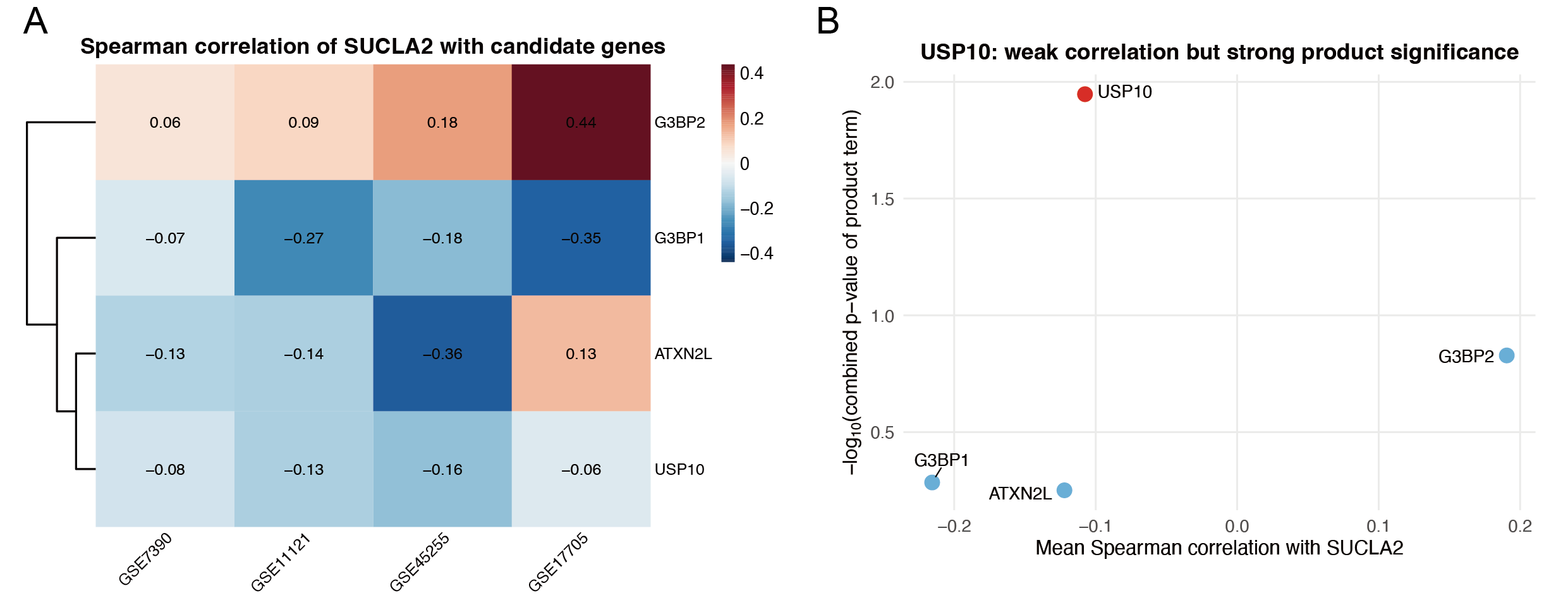
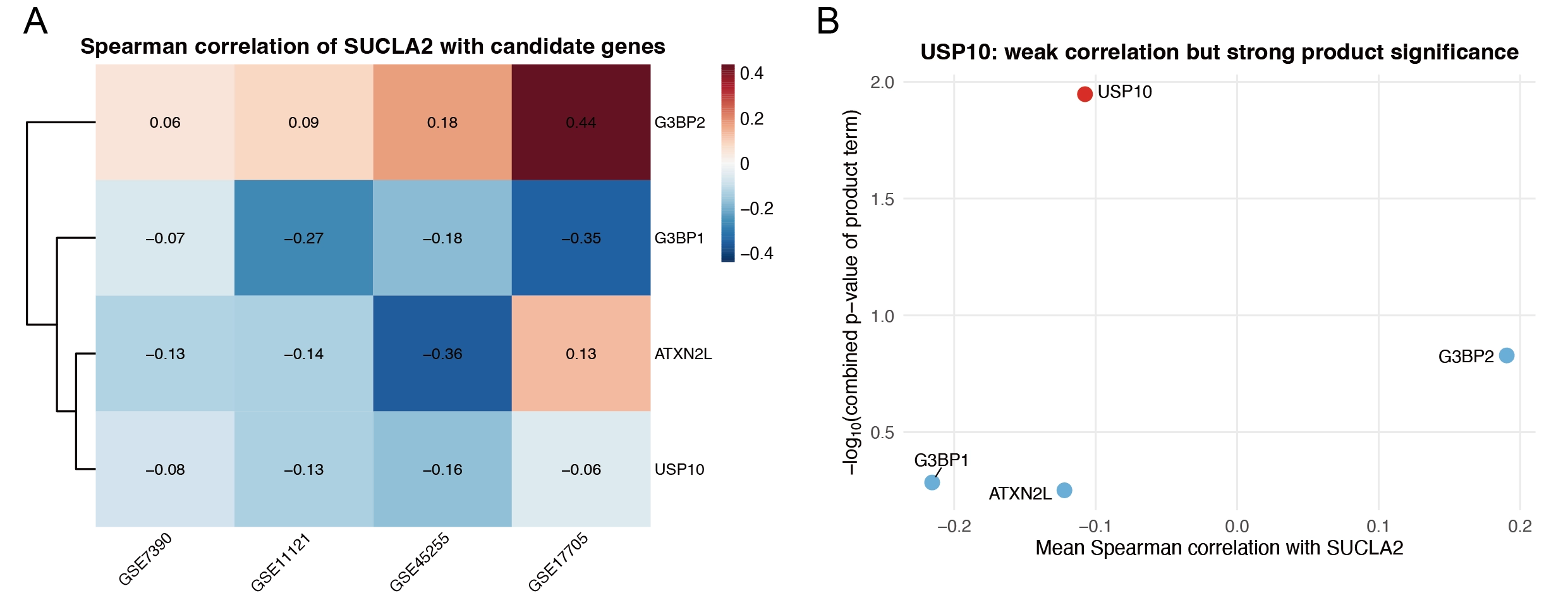
Figure 1. Exploratory screening of SUCLA2-interacting stress granule protein genes across breast cancer datasets. (A) Spearman correlation heatmap of SUCLA2 with USP10, G3BP1, G3BP2, and ATXN2L across four GEO datasets; (B) Scatter plot showing the relationship between mean Spearman correlation with SUCLA2 (x-axis) and -log10 (combined p-value of product term) (y-axis). USP10 (red) exhibits the weakest individual correlation but the strongest interaction significance, illustrating that bivariate correlations may not reflect clinically relevant biological crosstalk. SUCLA2: succinyl-CoA ligase ADP-forming subunit beta; USP10: ubiquitin-specific peptidase 10; GEO: Gene Expression Omnibus; G3BP1: GTPase-activating protein (SH3 domain)-binding protein 1; G3BP2: G3BP stress granule assembly factor 2; ATXN2L: ataxin-2-like.
3.2 SUCLA2-USP10 interaction rather than single genes correlates with DMFS
We then assessed the clinical association of SUCLA2 or USP10 alone with DMFS using Kaplan-Meier analysis with optimal cutoffs determined by the ROC method. As illustrated in Figure 2A, SUCLA2 expression alone was not significantly associated with DMFS in three of the four datasets (log-rank p > 0.05). Similarly, USP10 alone showed no significant association in most datasets, especially in the treated cohorts (GSE45255 and GSE17705; Figure 2B). In contrast, when we used the product term SUCLA2×USP10 to represent their biological interaction, the Kaplan-Meier curves separated significantly in all four datasets (log-rank p < 0.05), with the high-product group consistently showing worse DMFS (i.e., higher risk of distant metastasis) compared to the low-product group (Figure 2C). These results indicate that the combined effect of SUCLA2 and USP10, rather than their individual expression levels, is consistently associated with breast cancer metastasis.
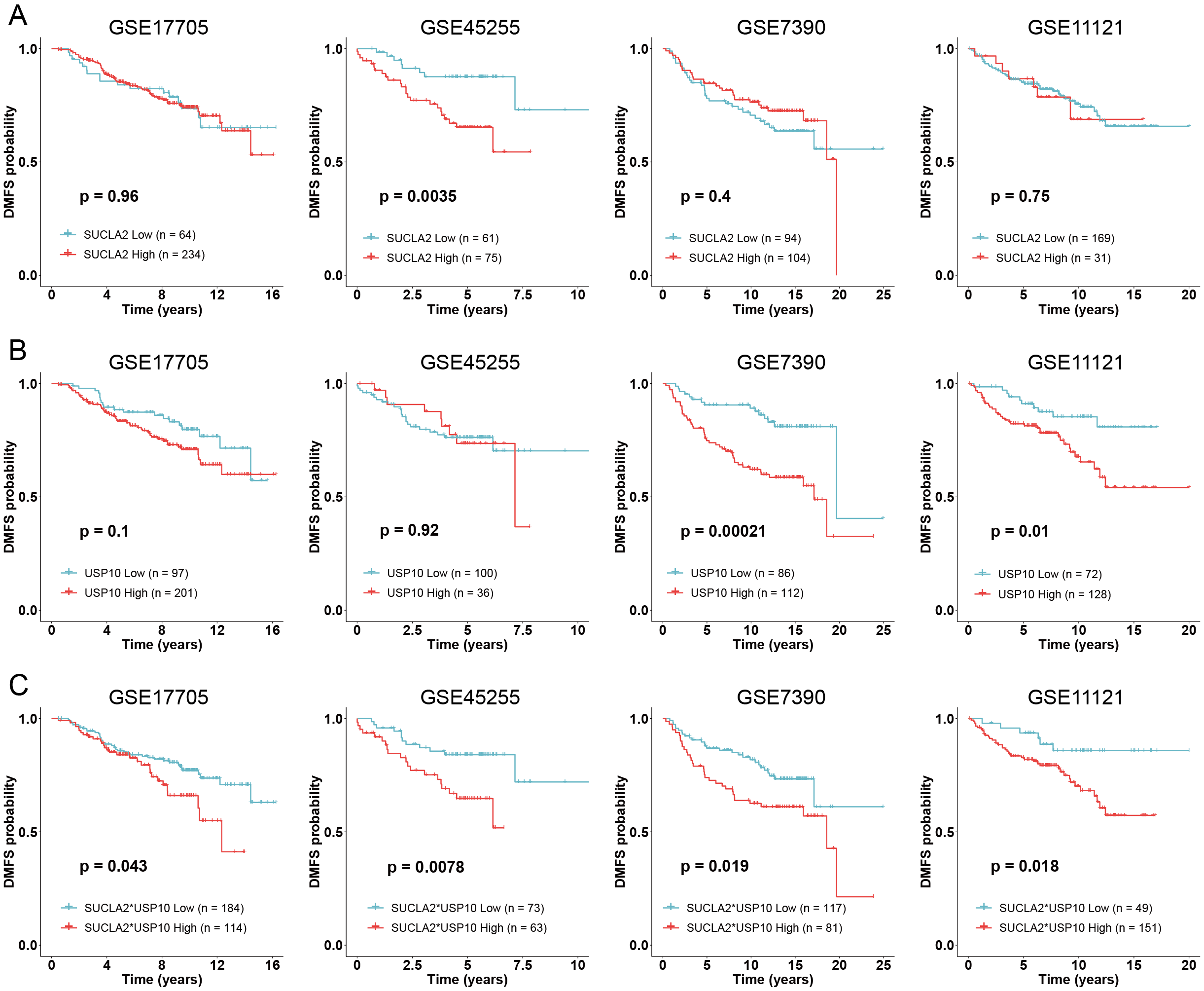
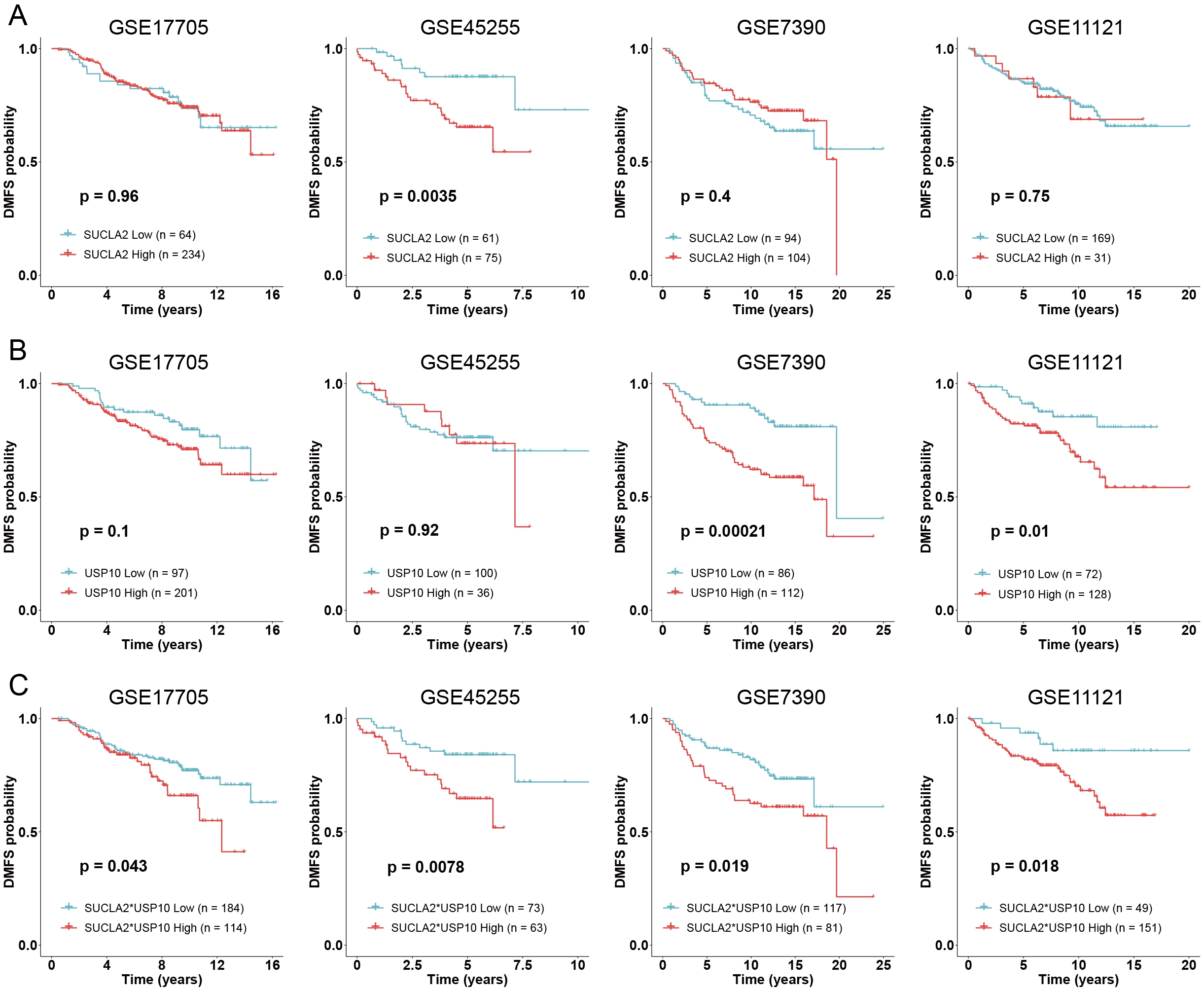
Figure 2. Kaplan-Meier survival analysis of DMFS in breast cancer patients. (A) Association between SUCLA2 expression and DMFS; (B) Association between USP10 expression and DMFS; (C) Association between SUCLA2×USP10 product and DMFS. Patients were stratified by optimal cutoff determined by the ROC method. p-values were calculated by log-rank test. SUCLA2: succinyl-CoA ligase ADP-forming subunit beta; USP10: ubiquitin-specific peptidase 10; DMFS: distant metastasis-free survival.
3.3 Risk reversal of low-SUCLA2/high-USP10 subgroup after treatment
To further characterize the joint prognostic value of SUCLA2 and USP10, we stratified patients into four groups based on median expression levels: LL, LH, HL, and HH. Using Cox regression with the LL group as reference, we calculated HRs for the LH, HL, and HH groups in each cohort (Figure 3A). In untreated patients (GSE7390 and GSE11121), both the LH and HH groups exhibited elevated HRs, with the LH group showing the highest risk. Strikingly, in treated patients (GSE45255 and GSE17705), the elevated risk associated with the LH group was no longer present; in fact, the HRs for the LH group were close to or below unity (Figure 3B). This pattern suggests that systemic therapy may abrogate the adverse prognostic effect of high USP10 expression in the context of low SUCLA2.
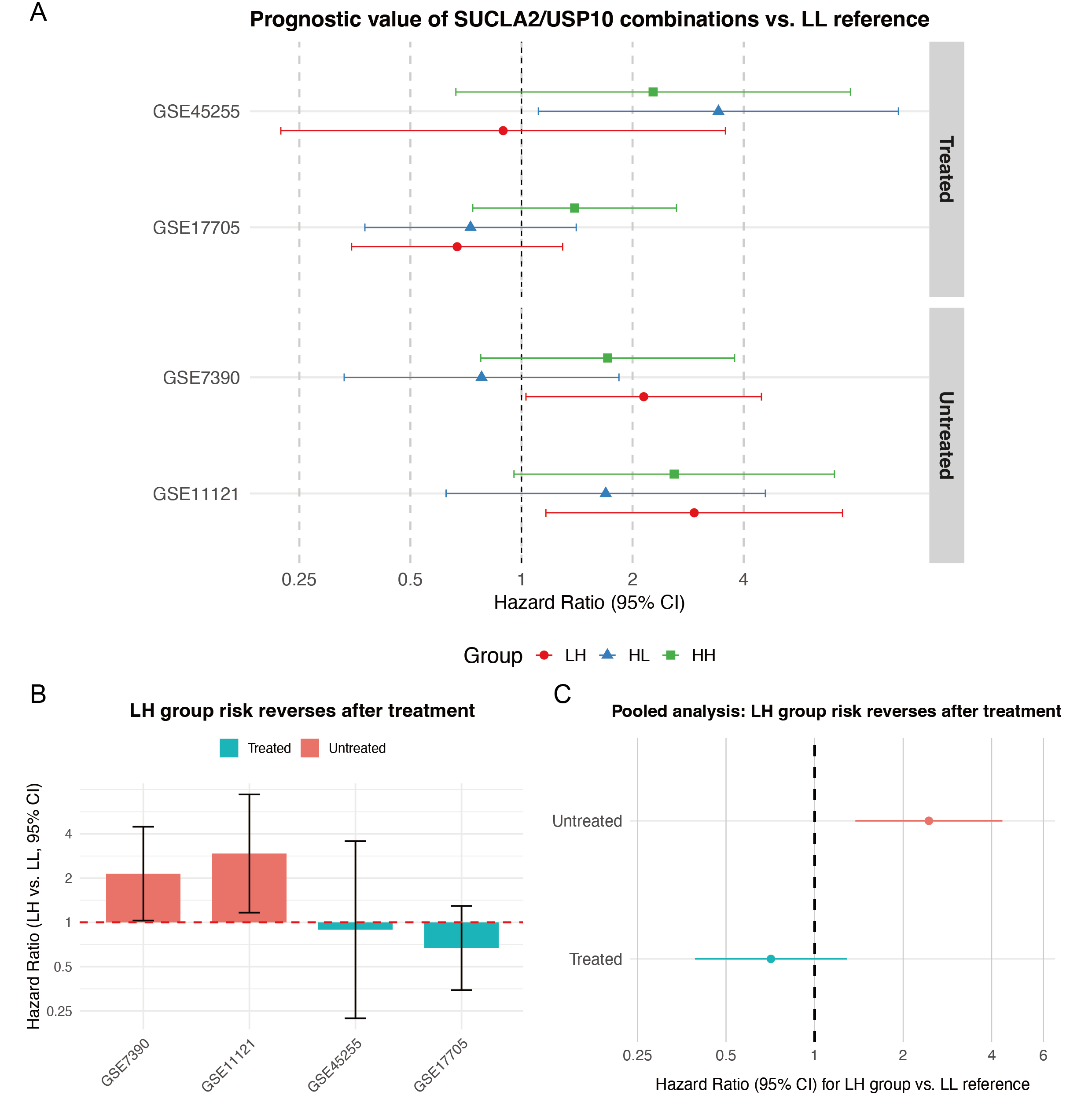
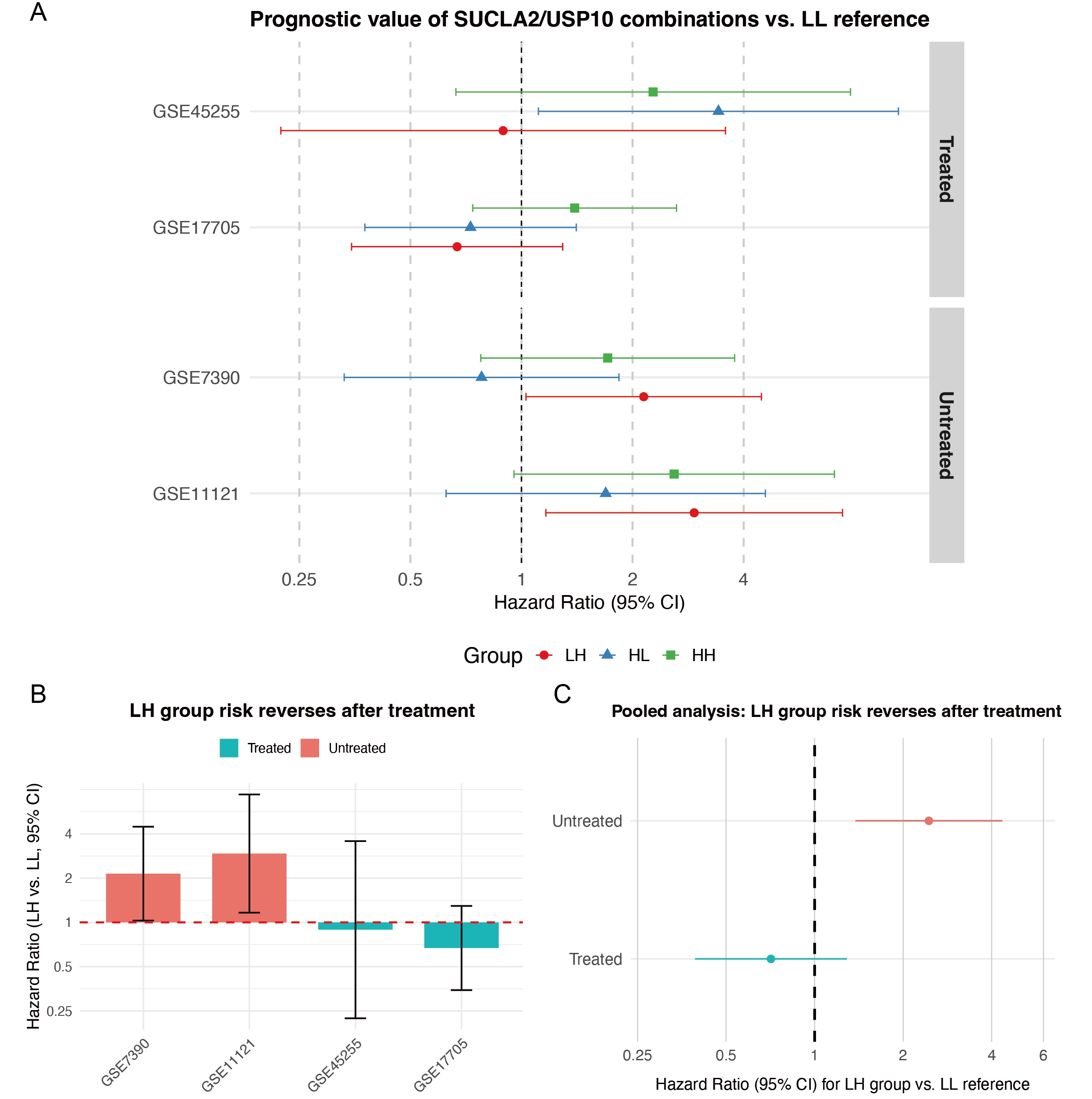
Figure 3. Prognostic value of SUCLA2-USP10 combination groups. (A) Forest plot showing hazard ratios of LH, HL, and HH groups versus LL reference across four datasets, stratified by treated and untreated cohorts; (B) Bar plot showing the hazard ratio of the LH group versus LL reference, demonstrating risk reversal after treatment. Error bars represent 95% confidence intervals; (C) Pooled stratified Cox analysis showing hazard ratios of the LH subgroup versus LL reference, separately for untreated and treated patients. Error bars represent 95% confidence intervals. SUCLA2: succinyl-CoA ligase ADP-forming subunit beta; USP10: ubiquitin-specific peptidase 10; LH: low-SUCLA2/high-USP10; HL: high-SUCLA2/low-USP10; HH: high-SUCLA2/high-USP10; LL: low-SUCLA2/low-USP10.
To evaluate the joint effect of SUCLA2 and USP10 across all four cohorts, we performed a stratified Cox regression analysis using cohort as the stratification factor, thereby allowing different baseline hazards across datasets while estimating common HRs for the predictors of interest. We tested the interaction between LH group status and treatment (untreated vs. treated) by including an interaction term in the model. The interaction was highly significant (p = 0.00038). Separate stratified Cox models were then fitted within the untreated and treated subgroups to obtain stratum-specific HRs. As shown in Figure 3C, with LL as reference, the LH subgroup was associated with a significantly higher risk of distant metastasis in untreated patients (HR = 2.45, 95% CI 1.38-4.35, p = 0.002), whereas in treated patients, this association was completely abrogated (HR = 0.71, 95% CI 0.39-1.29, p = 0.26). Taken together, these findings demonstrate that the adverse metastatic risk of the low-SUCLA2/high-USP10 subgroup is consistently reversed after treatment, both at the individual cohort level and in the pooled analysis.
4. Discussion
Our analysis shows that the SUCLA2-USP10 joint effect, rather than either factor alone, correlates with breast cancer metastasis. USP10 alone is non-significant due to its context-dependent duality[18]; its prognostic value requires SUCLA2 as a contextual partner. Similarly, SUCLA2 alone fails to predict DMFS because it is frequently co-deleted with RB1 in aggressive cancers[10], low SUCLA2 may mark RB1 loss and poor baseline prognosis, explaining the elevated risk in the LH subgroup. Conversely, under treatment stress, high SUCLA2 promotes pro-metastatic stress granule assembly[5]. This bidirectional influence (low SUCLA2 signals genomic aggressiveness; high SUCLA2 drives therapy resistance) makes linear prediction inadequate. The significant interaction term (p = 0.00038) captures this treatment-modulated reversal, justifying comparison of LH vs. LL/HL/HH: LH uniquely combines RB1-associated risk (low SUCLA2) and stress-granule potential (high USP10), a risk profile abrogated by therapy. These findings extend pre-clinical observations by Boese et al., who linked SUCLA2 protein levels to metastatic burden and overall survival but did not examine DMFS or gene-gene interactions[5]. We also clarified the dual prognostic role of USP10 reported by Fan et al.[18], by demonstrating that USP10's prognostic value is not intrinsic but depends on SUCLA2 as a contextual partner.
Mechanistically, we speculate that the SUCLA2-USP10 interaction promotes metastasis through the assembly and stabilization of stress granules in the cytosol. Boese et al. demonstrated that SUCLA2 translocates from mitochondria to the cytosol upon cell detachment, where it binds stress granule components including G3BP1, G3BP2, and NUFIP2 to promote granule assembly[5]. USP10 is a well-established constituent of stress granules, where it deubiquitinates and stabilizes key granule proteins including G3BP1 and G3BP2[6]. While the precise physical interaction between SUCLA2 and USP10 within stress granules remains to be experimentally characterized, the present clinical observation that their product predicts metastasis significantly better than either factor alone suggests that these two proteins cooperate functionally within the same pathway. This is why the product term served only as an initial screen under a log-linear assumption, while the subsequent median-based four-category stratification was used to characterize the non-linear, threshold-dependent joint effect that a continuous interaction term cannot adequately capture.
A particularly interesting observation from our analysis was that the LH subgroup (low SUCLA2, high USP10) exhibited elevated metastatic risk in untreated patients that was completely abrogated after treatment. This risk reversal aligns with the stress-dependent nature of SUCLA2 function. Specifically, SUCLA2’s pro-metastatic activity is triggered by cellular stress, such as anoikis or treatment pressure[5]. Therefore, patients with low SUCLA2 lack the molecular switch needed to activate stress granule-mediated survival pathways when exposed to therapy. In contrast, patients with high SUCLA2 retain this stress-responsive switch, which may continue to promote metastasis even under treatment, thereby limiting the benefit of therapy. From a computational perspective, the stratified Cox regression model with cohort as a stratification factor controlled inter-cohort heterogeneity in baseline hazard while estimating common hazard ratios, thereby strengthening the statistical rigor of our pooled analysis[19]. Clinically, these findings suggest that SUCLA2-USP10 may serve as a stratification biomarker, identifying LH patients who are particularly susceptible to treatment-induced disruption of stress granule signaling.
Several limitations should be acknowledged. First, the findings are based on transcriptomic data from public databases and require protein-level validation using techniques such as immunohistochemistry[20]. Second, causal relationships cannot be established from observational data alone; functional studies using CRISPR-mediated modulation of SUCLA2 and USP10 in patient-derived xenograft models are needed. Third, treatment regimens varied across cohorts, introducing potential heterogeneity. To address this, we performed exploratory subgroup analyses; however, these were substantially underpowered due to small sample sizes and wide confidence intervals. Treatment heterogeneity therefore remains an unadjusted confounding factor that limits the generalizability of the LH risk reversal. Fourth, the stratified Cox model assumes proportional hazards within each stratum, which should be verified in future analyses. Despite these limitations, convergent evidence from our survival, combination group, and stratified Cox analyses supports the reliability of our primary conclusions.
5. Conclusion
In conclusion, our multi-dataset analysis demonstrates that the SUCLA2-USP10 interaction significantly correlates with metastasis in breast cancer patients, while neither factor alone shows consistent association. These findings bridge the gap between pre-clinical mechanistic studies and clinical evidence, and imply new anti-metastatic strategies by targeting the SUCLA2-USP10 interaction. Future studies should validate these findings at the protein level and explore therapeutic approaches to disrupt this interaction in breast cancer patients.
Authors contribution
He X: Conceptualization, investigation, formal analysis, writing-original draft.
Shao Y: Formal analysis.
Sun X: Conceptualization, formal analysis.
All authors have read and approved the final version of the manuscript.
Conflicts of interest
The authors declare no conflicts of interest.
Ethical approval
Not applicable.
Consent to participate
Not applicable.
Consent for publication
Not applicable.
Availability of data and materials
The datasets (GSE17705, GSE45255, GSE7390, GSE11121) analyzed during the current study are available in the GEO repository: https://www.ncbi.nlm.nih.gov/geo/.
Funding
This work has been partially supported by the grants from the United States Center for Disease Control and Prevention (CDC) grant U01OH012778 and the National Natural Science Foundation of China (12526210, 92570102, 62273364).
Copyright
© The Author(s) 2026.
References
-
8. Li H, Liu Y, Cai Z, Li K, Gao S, Lan A, et al. ARL3 enhances ERα stability via USP10 deubiquitination to promote endocrine resistance and drive mitochondrial metabolic reprogramming in HR+ breast cancer. Adv Sci. 2025;12(47):e09769.[DOI]
-
11. Symmans WF, Hatzis C, Sotiriou C, Andre F, Peintinger F, Regitnig P, et al. Genomic index of sensitivity to endocrine therapy for breast cancer. J Clin Oncol. 2010;28(27):4111-4119.[DOI]
-
12. Nagalla S, Chou JW, Willingham MC, Ruiz J, Vaughn JP, Dubey P, et al. Interactions between immunity, proliferation and molecular subtype in breast cancer prognosis. Genome Biol. 2013;14(4):R34.[DOI]
-
14. Schmidt M, Böhm D, von Törne C, Steiner E, Puhl A, Pilch H, et al. The humoral immune system has a key prognostic impact in node-negative breast cancer. Cancer Res. 2008;68(13):5405-5413.[DOI]
-
17. Heagerty PJ, Lumley T, Pepe MS. Time-dependent ROC curves for censored survival data and a diagnostic marker. Biometrics. 2000;56(2):337-344.[DOI]
-
19. Wang Y, Chang F, Li Z, Duan C, Sun X, Wang S, et al. CircTP53/USP10/p53 signaling axis as a novel regulator of progression and prognosis of head and neck squamous cell carcinoma. Adv Sci. 2025;12(30):e14961.[DOI]
-
20. Xing FL, Li BR, Fang YJ, Liang C, Liu J, Wang W, et al. G3BP2 promotes tumor progression and gemcitabine resistance in PDAC via regulating PDIA3-DKC1-hENT in a stress granules-dependent manner. Acta Pharmacol Sin. 2025;46(2):474-488.[DOI]
Copyright
© The Author(s) 2026. This is an Open Access article licensed under a Creative Commons Attribution 4.0 International License (https://creativecommons.org/licenses/by/4.0/), which permits unrestricted use, sharing, adaptation, distribution and reproduction in any medium or format, for any purpose, even commercially, as long as you give appropriate credit to the original author(s) and the source, provide a link to the Creative Commons license, and indicate if changes were made.
Publisher’s Note
Science Exploration remains a neutral stance on jurisdictional claims in published
maps
and institutional affiliations. The views expressed in this article are solely those
of
the author(s) and do not reflect the opinions of the Editors or the publisher.
Share And Cite


Science Exploration Style
He X, Shao Y, Sun X. SUCLA2-USP10 interaction rather than SUCLA2 alone correlates with metastasis in breast cancer patients. Comput Biomed. 2026;1:202617. https://doi.org/10.70401/cbm.2026.0022
Tips
Copy completed.
Submit a Manuscript
Author Instructions
Cite this Article
Article Metrics
0
View
0
Download
Cited
Article Updates

 Get citation
Science Exploration Style

He X, Shao Y, Sun X. SUCLA2-USP10 interaction rather than SUCLA2 alone correlates with metastasis in breast cancer patients. Comput Biomed. 2026;1:202617. https://doi.org/10.70401/cbm.2026.0022
copy
Share Link
copy
Subscribe