Polarization-insensitive RGBN color router based on metasurface

Yunlai Fu
1,#

,
Xiujuan Zou
2,#
,
Jiawang Chen
1,#
,
Ruihan He
1
,
Quan Yuan
1
,
Haoxiang Yu
1
,
Shuming Wang
1,3,4,*
*Correspondence to:
Shuming Wang, National Laboratory of Solid State Microstructures, School of Physics, Nanjing University, Nanjing 210093, Jiangsu, China.
E-mail: wangshuming@nju.edu.cn
Light Manip Appl. 2026;1:202607. 10.70401/lma.2026.0016
Received: March 09, 2026Accepted: June 16, 2026Published: July 01, 2026
Abstract
Conventional complementary metal-oxide-semiconductor (CMOS) image sensors with Bayer color filter arrays face limitations in low-illumination color imaging. Color router (CR) aims to achieve absorption-loss-free spectral separation, providing an efficient way to sort and guide different color lights to the corresponding pixels. However, applying CR to imaging chips requires consideration of different incidence conditions and processing difficulties. In this study, we propose and fabricate a polarization-insensitive “red, green and blue + near-infrared (NIR)” CR based on a metasurface, operating within the wavelength range of 400-1,100 nm and exhibiting high light energy utilization efficiency. The structural parameters are optimized through an inverse design method. The device is fabricated by silicon-compatible processes, offering the advantage of high integration. Experimental results demonstrate that the measured energy utilization efficiency reaches over 90%, and the measured average correlation coefficient of spectral curves under different polarizations reaches 0.98. This device can efficiently route visible to NIR light, providing a novel approach for integrating metasurfaces into CMOS image sensors to enhance high-performance color imaging systems.
Keywords
Metasurface, color router, image sensor, polarization
1. Introduction
Color imaging technology plays a vital role in modern optoelectronic information systems. Complementary metal-oxide-semiconductor image sensors (CMOS ISs or CISs) have become the mainstream imaging architecture due to their high integration, low power consumption, and cost advantages[1]. However, the light-sensitive units of CIS only respond to light intensity information, lacking the ability to distinguish different spectral components directly. To achieve color restoration akin to human vision, the common approach involves the utilization of a Bayer color filter array (CFA) based on absorptive dyes[2]. By periodically arranging one red (R), two green (G) and one blue (B) filter units, white light is decomposed into three-channel signals, subsequently reconstructed into a color image using post-demosaicing algorithms[3-5]. However, the spectral response of silicon-based light-sensitive units in CIS spans 400-1,100 nm, with the range of 700-1,100 nm, encompassing near-infrared (NIR) wavelengths, causing crosstalk issues necessitating the addition of an extra IR-cut filter to suppress it[6]. Consequently, an unconventional “red, green and blue + near-infrared” (RGBN) CFA has been developed and deployed in fields such as portrait enhancement, shadow removal, vein enhancement, and multispectral imaging[7,8]. With the expansion of application scenarios, improving the performance of CISs under low light is an important development direction. The light energy utilization efficiency of the component (that is, the ratio of the remaining light energy after passing through the component to the total incident light) is the main indicator that affects this performance. As pixel dimensions continue to shrink, incident light flux and quantum efficiency (QE) decline. Concurrently, fluctuations in filter layer thickness and insufficient color purity lead to reduced signal-to-noise ratios, constraining imaging performance under low-light conditions[9,10].
Researchers have endeavored to replace chemical dye filter layers with nano-photon structures like photonic crystal structures to achieve color separation and enhance optical energy utilization efficiency[11-14]. These methods determine the spectral response through nanophotonic effects in artificially engineered nanostructures, such as plasmon resonance, Fano resonance, and guided-mode resonance[15-18]. However, these absorption-based methods remain constrained by the physical limits of energy utilization efficiency.
To overcome the inherent limitations in optical energy utilization efficiency posed by traditional CFA architectures, researchers have introduced the concept of the color router (CR)[19]. This technology achieves absorption-loss-free spectral separation by spectrally isolating and directing light of different wavelengths to designated detection regions. Theoretically, structures based on three-dimensional bulk metamaterials can achieve near-perfect spectral focusing; however, their nano-scale intricate structures exceed current processing capabilities and face process incompatibility issues with silicon-based CIS technology[20-23]. In recent years, the emergence of metasurface technology has provided a new avenue for implementing optical routing functionalities. As flat optical devices composed of subwavelength nanostructures, metasurface enable precise control of light phase, amplitude, and polarization within ultra-thin dimensions[24-28]. With high integration and design versatility, metasurface exhibit immense potential in wavefront shaping, beam control, holographic imaging, optical sensing, and computational imaging[29-33]. The metasurface-based color router (MBCR) has realized various spectral routing functions, with multi-focus metalenses designed based on phase modulation principles achieving color routing in red, green, and blue[34,35] and RGBN[36] forms. However, the fabrication challenge of requiring high aspect ratio meta-atoms to meet the continuous 0-2π phase coverage conditions limits the further development of CR in wide-band color imaging. Freeform metasurface based on inverse design have somewhat reduced the processing requirements and have achieved spectral routing in Bayer form[37-40], offering a promising new solution for color imaging technology. Products based on nano-prism[41,42] and nanopillars[43] are already available on the market, but their energy efficiency gains remain limited. Furthermore, as the light on the imaging plane does not constitute an accurate primary color triad, image processing algorithms are still required to correct for this[44,45].
In order to achieve red, green and blue (RGB)-NIR imaging, while reducing process difficulty and facilitating the integrated preparation of metasurface and CIS, we design and fabricate a polarization-insensitive RGBN color router based on a metasurface (RGBN-MBCR). Through an inverse design approach, we optimized the focal length, structural parameters and arrangement of the metasurface, achieving efficient wide-spectrum optical routing. The device is fabricated by Si-compatible CMOS technology, and features a metasurface period of 1 μm and a working distance of only 2.4 μm, enabling on-chip integration. Experimental results demonstrate that the device achieves a total optical energy utilization rate exceeding 90% in the 400-1,100 nm range and exhibits polarization-insensitive characteristics. We have realized efficient routing effects and color imaging, which experimentally validate the feasibility of combined detection and reconstruction of visible light and NIR light in wide-spectrum color imaging based on the CR architecture. This study provides a new design paradigm and technological foundation for developing high-sensitivity, wide-band, on-chip integrated next-generation imaging systems.
2. Methods
Details of the methods are provided in the Section S3,S5.
3. Results and Discussion
3.1 Design principles and optimization process of RGBN-MBCR
Figure 1a illustrates the operational principle of the traditional Bayer CFA. In color cameras, ambient light collected by the camera’s front lens first passes through an IR-cut filter to eliminate NIR light while retaining visible light. Subsequently, each sensor pixel receives only one channel (B, G, or R) through the color filters covering the pixels, outputting a grayscale value. The dual green (G) channels exist because human photoreceptor cells exhibit higher sensitivity to the green wavelength band. This Bayer color filter (BCF) array produces colors aligned with the human visual spectrum, achieving minimal inter-pixel crosstalk. Thus, demosaicing or interpolation algorithms can reconstruct single-channel grayscale patterns into three-channel color images. In an ideal scenario, post filtration through the Bayer CFA, white light retains only 25% of blue and red light, and 50% of green light, while completely blocking NIR energy.
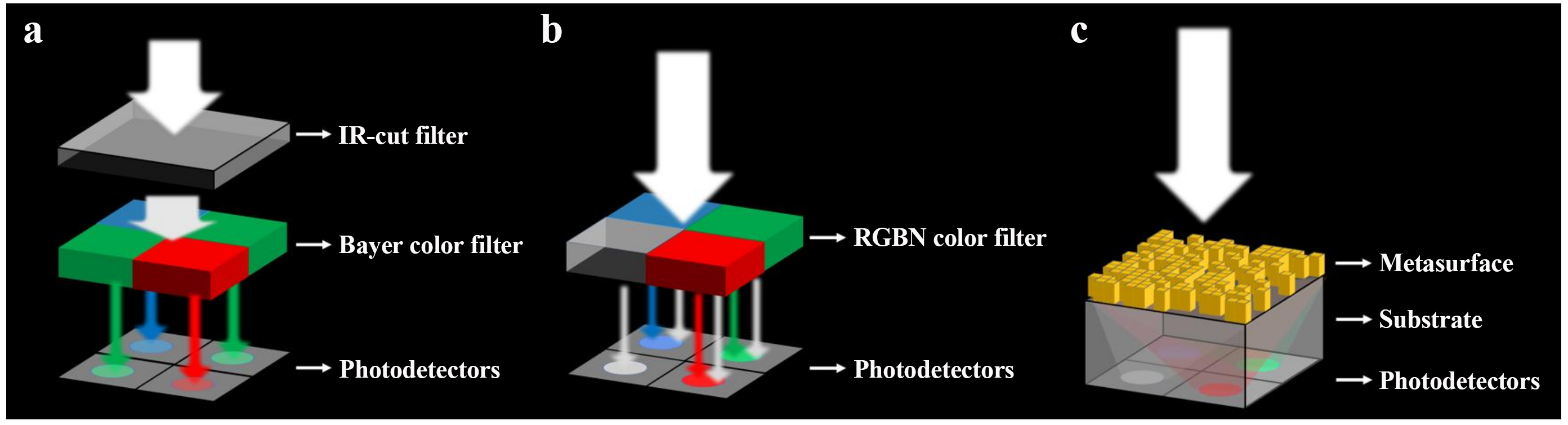
Figure 1. Working principles of color filters and color routers. (a) Schematic of the traditional Bayer color filter with an IR-cut filter for color imaging; (b) Schematic of the RGBN color filter, which replaces one green filter with an NIR filter; (c) Schematic of the proposed RGBN-MBCR. IR: infrared; RGBN: red, green and blue + near-infrared; NIR: near-infrared; MBCR: metasurface-based color router.
As shown in Figure 1b, modifying the Bayer CFA design by removing the IR-cut filter and replacing one G filter with an IR filter enables simultaneous four-channel capture. This approach enhances spatial responsivity at the cost of reduced spectral resolution in the G channel. The preserved IR channel significantly improves energy utilization efficiency. Spectral response curves shown in Figure S1 demonstrate that color pixels with RGBN filters inevitably detect NIR light, leading to color crosstalk and “washed-out” effects. These artifacts manifest as elevated brightness, reddish color bias, and reduced contrast, deviating from human visual perception. Color correction methods, such as color correction matrices (CCMs)[8,46] or deep learning-based approaches[6,7], are commonly employed to address these issues.
To overcome the limitations of filter-based imaging systems, including low energy utilization efficiency and color crosstalk, we propose a metasurface-based CR architecture depicted in Figure 1c, which routes distinct visible and NIR light to target pixels. A genetic algorithm (GA)[47,48] concurrently optimizes meta-atom dimensions and working distances through inverse design, achieving efficient wavelength separation and detection while minimizing polarization effects induced by asymmetric structures. As a classical heuristic method, the GA mimics biological evolution through crossover and mutation operations on a parameter matrix, enabling progressive convergence toward optimal solutions for discrete parameter optimization. With this RGBN CR, we can extract both visible images and NIR images from a single sensor, which has high spatial sampling and can be used in multispectral imaging.
3.2 Numerical simulation results of RGBN-MBCR
Considering CIS processing compatibility, Si₃N₄ is selected as the metasurface material instead of TiO2 due to the mask removal process for TiO2, which would damage the SiO2 layer covering CIS (see Section S2 for details). The proposed RGBN-MBCR structure is depicted in Figure 2a. The pixel pitch is set at P = 1 μm, with a single periodic unit measuring 2P × 2P. This configuration is compatible with commercially available backside-illuminated image sensor chips. Each period is divided into four channels corresponding to the B, G, R, and N wavelength bands (B: 400-500 nm, G: 500-600 nm, R: 600-700 nm, N: 700-1,100 nm).
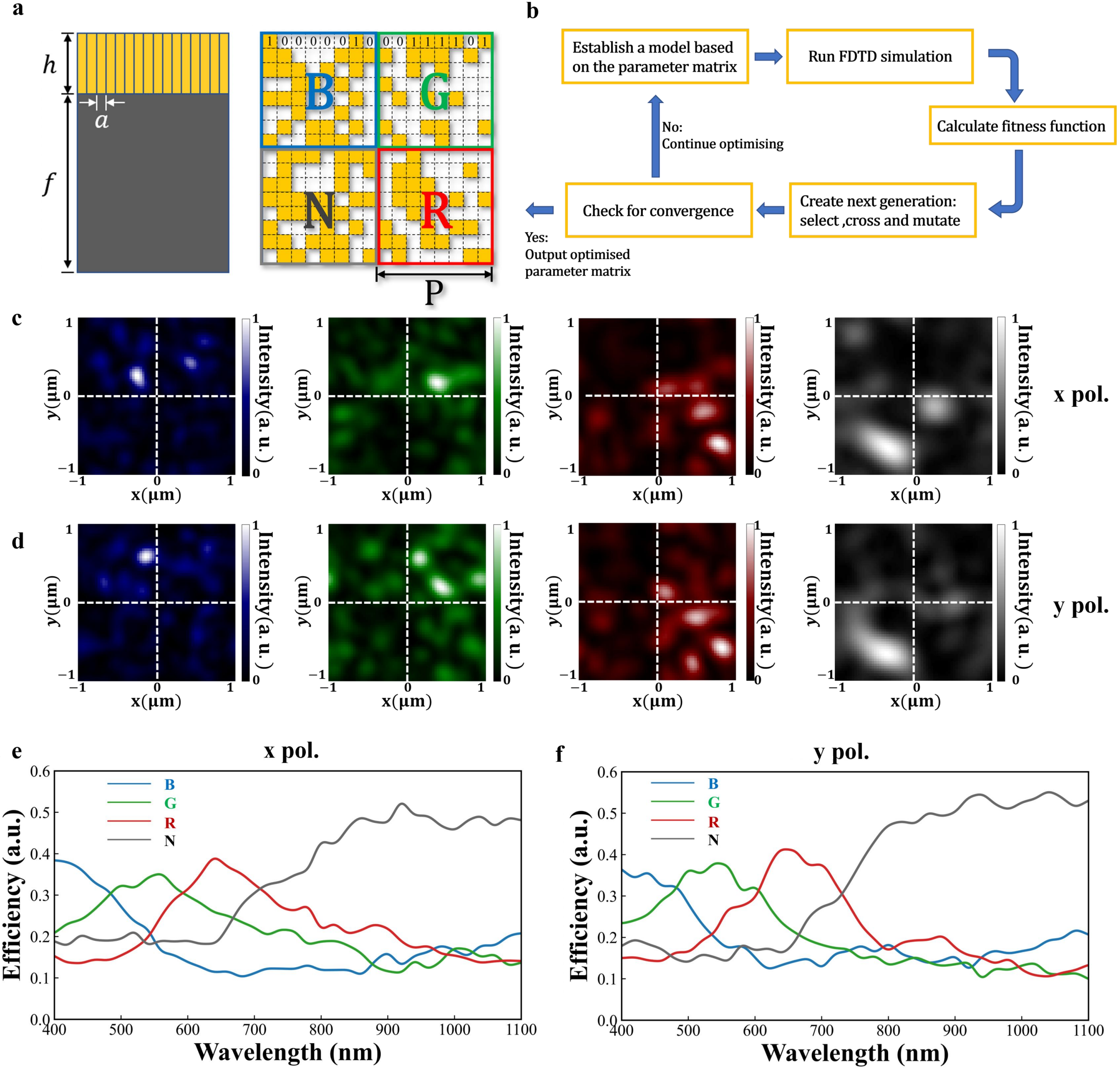
Figure 2. The design process and simulation results. (a) Schematic of the side and top views of the proposed metasurface. h, f, a and the binary pattern matrix are the fundamental structural parameters to be optimized; (b) Flowchart of the inverse design process based on the GA algorithm and FDTD simulation; (c-d) Intensity distribution of x-polarized and y-polarized incident light on the routing plane within a single period at B (450 nm), G (540 nm), R (630 nm), and N (900 nm). Each period is divided into four quadrants by the white dotted lines; (e-f) The simulated optical spectral curves of the four pixels in Figure 2a under x-polarized and y-polarized incident light. GA: genetic algorithm; FDTD: finite-difference time-domain.
Each period is partitioned into an n × n grid with cell side length a = 2P/n. Each meta-atom has a cross-sectional edge length a, maintaining a uniform height h (μm). A binary coding scheme is implemented where “1” indicates the presence of a meta-atom in a grid cell and “0” indicates the absence. The working distance f, equivalent to the SiO2 layer thickness, represents the distance from the metasurface to the spectral separation plane. It is also an optimizable parameter that determines the properties of the metasurface. Thus, the complete CR structure is defined by n × n + 2 parameters (including h and f). In this study, n = 16 is chosen to balance manufacturing constraints on metasurface linewidths while maximizing parameter space exploration.
Figure 2b outlines the optimization workflow. A GA is employed to optimize the n × n + 2 structural parameters. During GA execution, the objective translates to maximizing a fitness function, whose careful design ensures rapid convergence. The parameter matrix is input to Lumerical finite-difference time-domain (FDTD) for modeling and numerical simulation. Considering the subsequent integration application with CIS, the CR needs to have polarization insensitivity, which means that the total energy collected by each target pixel remains highly consistent under different incident polarizations. To represent this, the fitness function is evaluated using calculated transmission spectra tip, with iterations continuing until convergence to a maximum. To quantitatively assess routing performance, the fitness function is defined as follows.
Here, subscript i denotes the B/G/R/N channel, and λi represents the wavelength bands for each channel. The N channel is selected as 850-950 nm, which balances bandwidth and central wavelength considerations for 700-1,100 nm broadband NIR light. Subscript p accounts for varying polarization angles (PAs) of incident light. The quick response (QR)-code-like structure exhibits strong coupling resonance effects, preventing simplified superposition of individual meta-atom response[49]. This results in non-C4 symmetry and the absence of diagonal spatial symmetry, generating polarization-dependent responses. Thus, optimization must incorporate multiple PAs to ensure approximately polarization-insensitive performance.
Figure 2c,d illustrate the modulated light field distributions for incident light at PAs of 0° and 90°, respectively, with white dashed lines outlining four pixels within each periodic unit. Four typical reference wavelengths (450 nm, 540 nm, 630 nm, and 900 nm) are precisely directed to their respective pixels. It is noteworthy that while the focusing spots are not perfectly centered within the pixels, this slight offset does not impact the total energy collected by the CIS’s photosensitive surface. Spectral response curves for the four pixels under 0° and 90° PAs are depicted in Figure 2e,f, respectively. The spectral router efficiency, defined as the ratio of energy collected by a specific pixel at a given wavelength to the total incident energy of that wavelength over the entire period, shows an average peak router efficiency of 37.2% for blue light in the B pixel, 36.6% for green light in the G pixel, 40.3% for red light in the R pixel, and 52.5% for NIR light in the N pixel. The polarization-insensitive optimization approach yields nearly identical spectral profiles under varied PAs, confirming the structure’s insensitivity to polarization. Additional results for different PAs can be found in the Section S4. The calculated collective energy utilization efficiency (sum of router efficiencies across all pixels) surpasses 90% (Figure S7), which achieves more than two times the efficiency of the traditional BFA.
In order to evaluate the incidence angle dependence of the RGBN-MBCR, we calculated spectral curves at different incidence angles. As shown in the Figure S8, simulation results show that although the RGBN-MBCR is designed to route visible light at normal incidence, its routing performance is robust at an overall incidence angle of approximately 8°. In addition, moving from a binary pattern to a differentiable continuous topology or multi-height design would enlarge the parameter space and provide more freedom to optimize angular tolerance.
3.3 Experimental verification and performance analysis of the RGBN-MBCR
We fabricated the RGBN-MBCR sample on a 500 μm-thick SiO2 substrate. Figure 3a displays the scanning electron microscopy image of the processed metasurface, exhibiting intricate nanostructures consistent with the theoretical design. The specific fabrication process is detailed in Figure S9. This process can be extended to directly fabricate metasurface on silicon-based CIS chips without the need for additional support structures to assemble the metasurface with the chip. Subsequently, a custom-built microscopic imaging system (Figure 3b) was set up to measure the light intensity distribution on the routing plane, characterizing the routing performance of the RGBN-MBCR for light in the 400-1,000 nm wavelength range. Using a light source covering wavelengths from ultraviolet to infrared, the sample was adjusted to the working distance of the rear objective lens via a displacement stage to ensure accurate imaging of the routing plane by the monochrome camera. Detailed information on the measurement process is provided in Section S6.
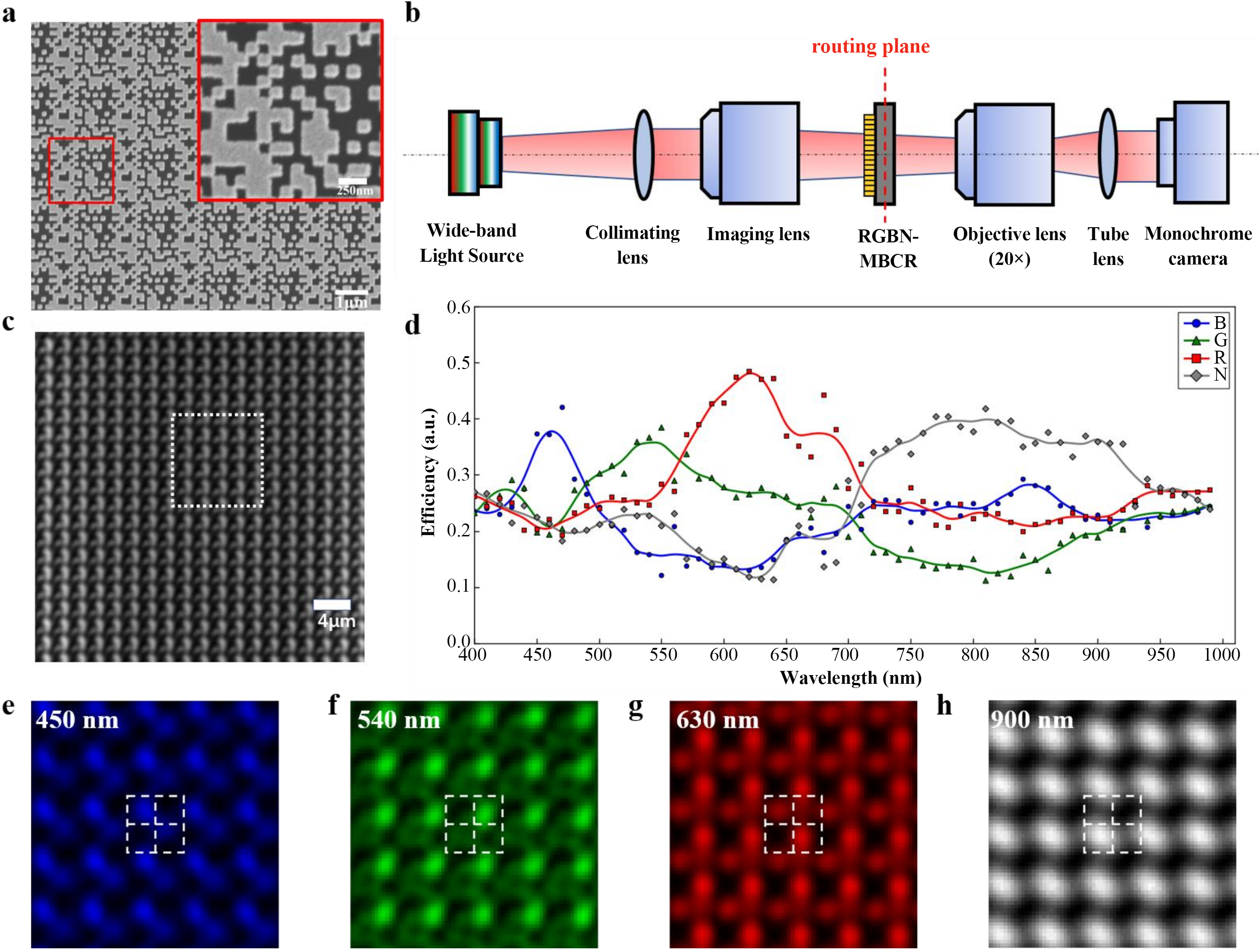
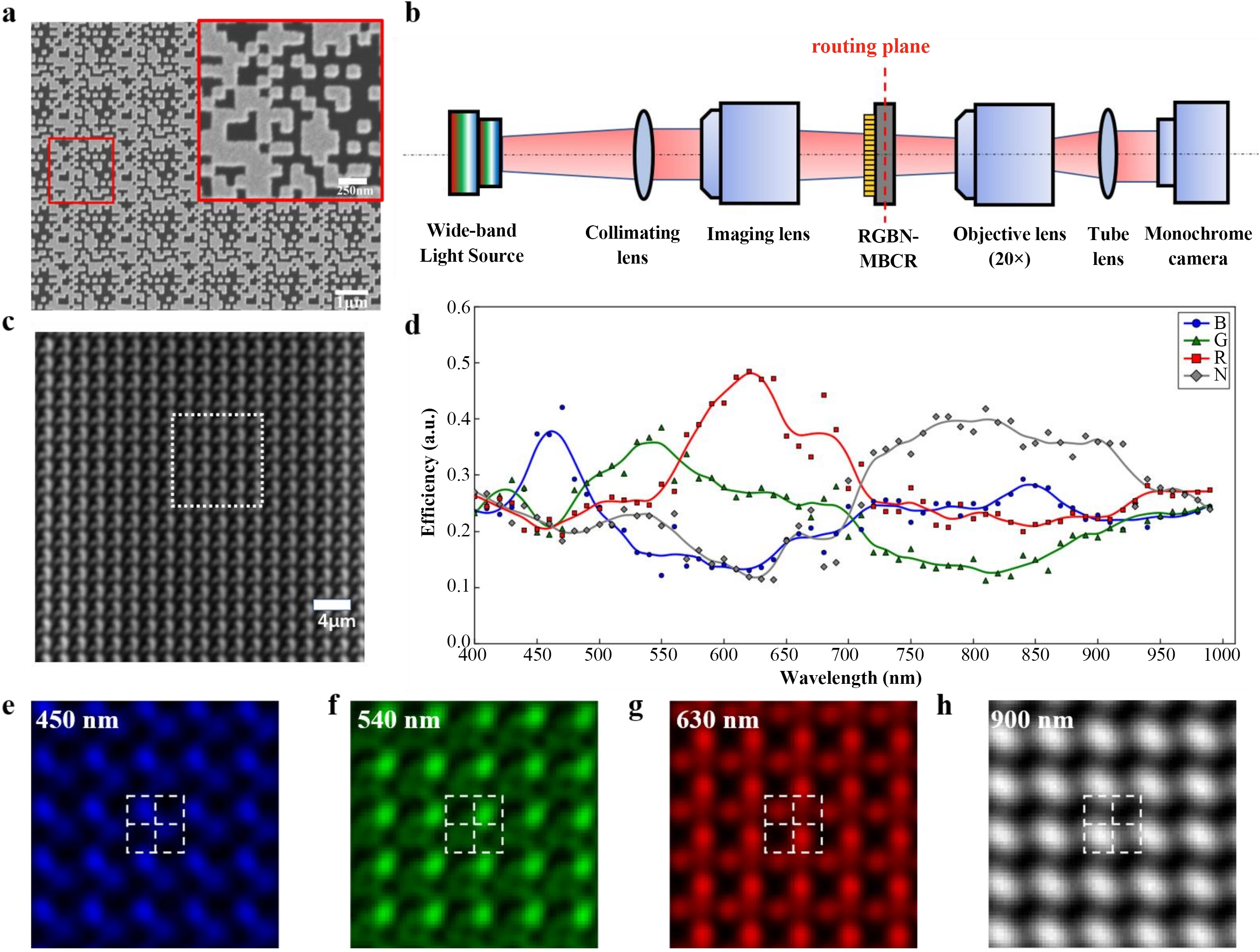
Figure 3. Experimental verification of color routing response. (a) SEM schematic of the fabricated sample. The red box represents a single period; (b) Experimental setup for characterizing the routing plane and light routing effect of the RGBN-MBCR; (c) Measured image at the imaging plane of the RGBN-MBCR array when illuminated by a collimated white beam; (d) The measured spectral routing efficiencies of each pixel in the 400-1,000 nm wavelength band. Each color curve corresponds to a pixel; (e-h) Light field distribution of the area within the dashed white line in (c) under monochromatic light incidence. The monochrome image was rendered in the corresponding color, respectively. SEM: scanning electron microscopy; RGBN: red, green and blue + near-infrared; MBCR: metasurface-based color router.
Figure 3c illustrates the collimated white light passing through the sample and generating the light intensity distribution image on the routing plane. Broad-spectrum white light is separated and effectively routed to the corresponding pixel areas, each area exhibiting a noticeable focusing effect, consistent with the simulation results. To quantitatively represent the spectral-routing capability, monochromatic light was used for illumination. The integrated monochromatic intensity distribution measured at each pixel was normalized by dividing it by the total intensity of a single period to obtain the measured spectral efficiency at that wavelength. Subsequently, the spectral curves of each pixel were fitted, and spectral routing efficiencies reach peak values of 37.3%, 38.5%, 48.5%, and 41.8% at wavelengths of 460 nm, 540 nm, 630 nm, and ~900 nm representing B, G, R, and NIR light, closely aligning with the theoretical calculations, as shown in Figure 3d. The light field distributions generated by monochromatic light at four typical wavelengths are depicted in Figure 3e,f,g,h, distinctly showing the colors corresponding to different pixels. At wavelengths above 950 nm, the decrease in sensitivity of the camera to infrared light and the enhancement of diffraction effects lead to a weakened signal-to-noise ratio, making it challenging to distinguish between pixels. Additional light-field distribution images are presented in the Figure S13. Compared with the RGBN filter, this sample has outstanding modulation performance in the near infrared, which can effectively separate the information of the infrared channel and suppress the crosstalk of infrared light with the visible light channel. It can be seen that channel crosstalk mainly originates from the limited structural design space of a single-layer binary QR code-like metasurface under practical manufacturing constraints, including minimum feature size, aspect ratio, and short working distance. Near-field coupling between adjacent subwavelength regions is inherent to this free-form structure and is included in the optimized response. Manufacturing errors and limited angular tolerances may also further widen the spot or alter the energy distribution.
Although the current structure has obvious color crosstalk among visible light pixels, the peak value of each channel is much higher than the limit benchmark value of 25%, which can be subsequently corrected through color calibration and restoration algorithms. Furthermore, we measured the energy utilization efficiency of the sample, averaging above 90% (Figure S14), surpassing commercial BCF by more than twice its efficiency. This is compared to the metasurface area and the bare silica substrate. Because the RGBN-MBCR has extremely high light energy utilization efficiency, it can improve the brightness of the output image while separating the color information of the image.
In CIS applications, the photosensitive element receives incident light from different angles collected by the imaging lens, so the incident angle tolerance of the metasurface is an important factor limiting its performance. To evaluate this, we investigated the routing performance under non-normal incidence and remeasured the light intensity distribution while changing the numerical aperture (NA) of the imaging lens (NA = 0.02-0.26), as shown in the Figure S15. The results show that as NA increases, the signal intensity on each pixel channel shifts, but obvious spectroscopic performance is still maintained when NA = 0.17. When NA continues to increase above 0.21, signals of different wavelengths cannot be effectively separated, and the focus point becomes blurred. These results are in good agreement with the simulation results. For practical camera lenses, the chief-ray-angle distribution can be introduced directly into the FDTD-GA objective as a multi-angle fitness term. Different RGBN-MBCR patterns can also be assigned to different field regions, similar to the lens-shift strategy used in CIS microlens arrays, so that each local router is optimized for its corresponding incident-angle range.
To further demonstrate the polarization-insensitive characteristics of the RGBN-MBCR, we added a polarizer in front of the collimating lens and measured the spectral routing effect at different PAs. Figure 4a,b,c,d,e,f,g,h illustrate the light field distributions at four wavelengths for PAs of 0° and 90°. It is evident that the spectral routing effect remains nearly unchanged with variations in polarization. Subsequently, we computed the spectral curves for each pixel under the two polarizations, depicted in Figure 4i,j,k,l. The blue curve represents the spectral curve at a PA of 0°, while the red curve represents the curve at 90°. The Pearson product-moment correlation coefficients among the spectral curves of the four pixels are r = 0.968, 0.988, 0.981, and 0.986 (see Table S1 for more), indicating that while maintaining RGBN spectral routing capabilities, the metasurface is insensitive to the polarization of incident light, presenting potential and advantages for direct integration into existing camera systems. In natural light imaging, the range of linear polarization changes is limited, and the current verification has covered the main polarization states.
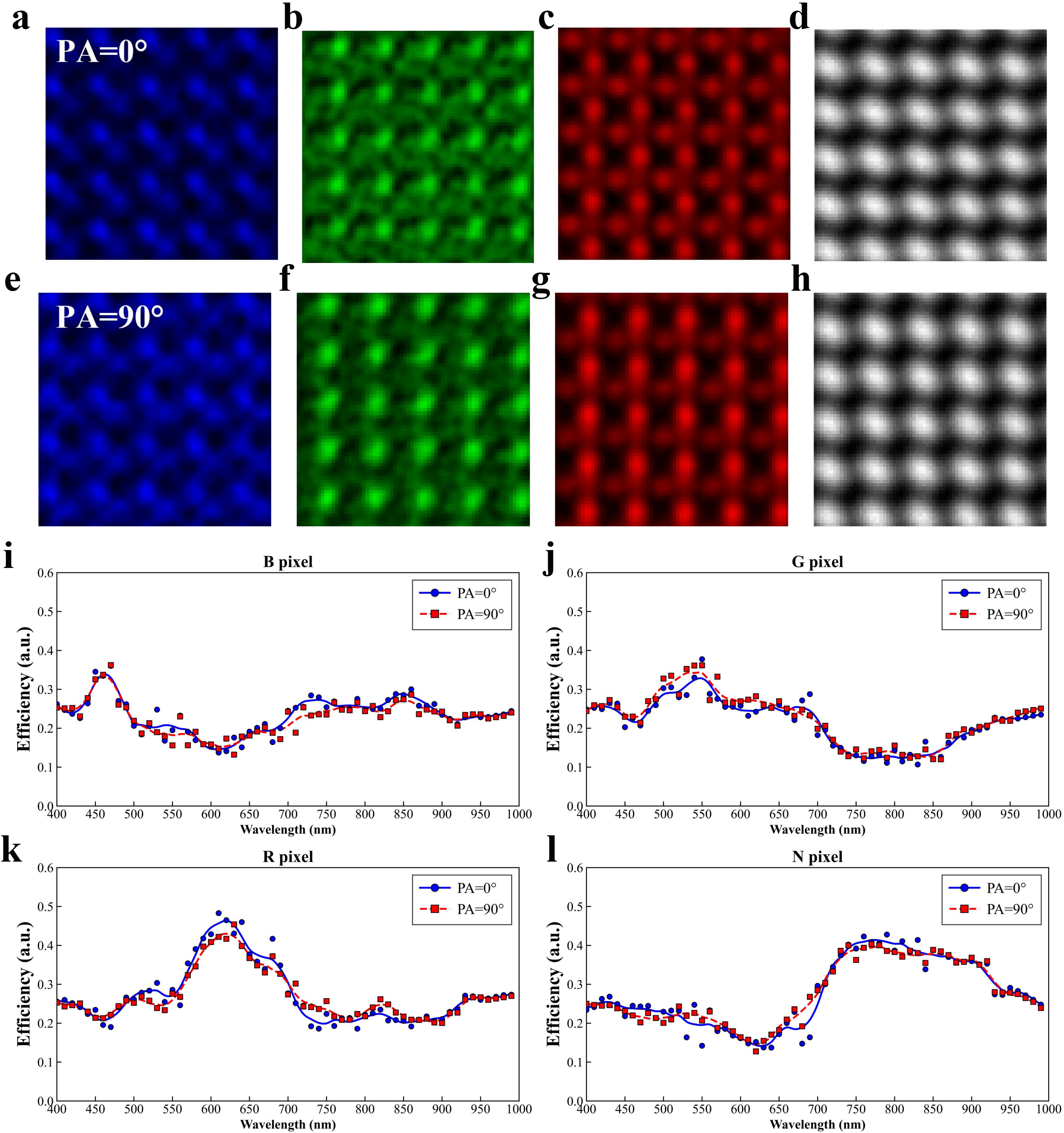
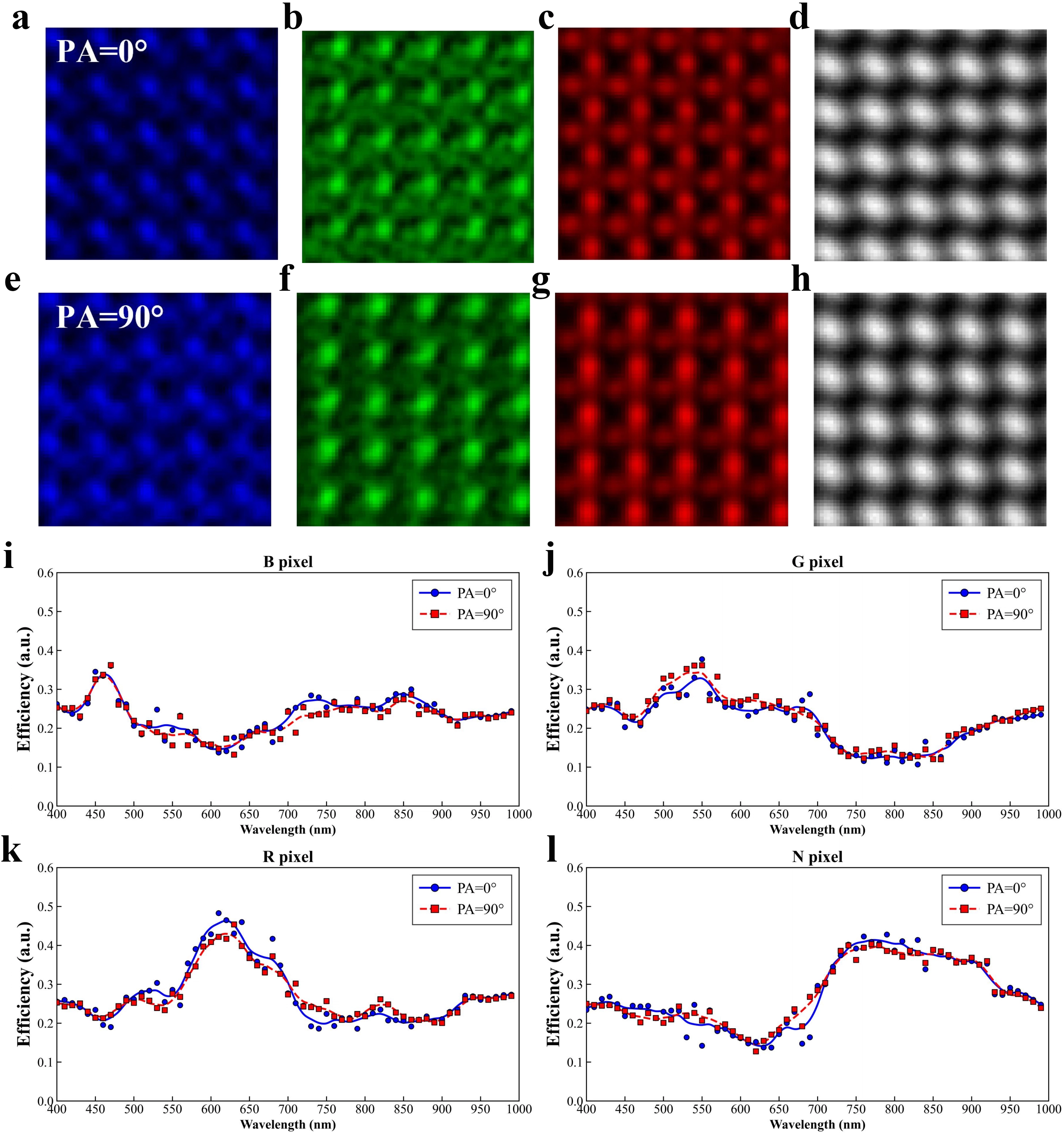
Figure 4. Polarization response analysis of RGBN-MBCR. (a-d) Light field distribution at a polarization angle of 0° with wavelengths 450 nm (B), 540 nm (G), 630 nm (R), and 900 nm (N); (e-h) Light field distribution at a polarization angle of 90° with wavelengths 450 nm (B), 540 nm (G), 630 nm (R), and 900 nm (N); (i-l) Measured spectral routing efficiencies of each pixel. The blue curves represent PA = 0° while the red curves represent PA = 90°. RGBN: red, green and blue + near-infrared; MBCR: metasurface-based color router; PA: polarization angle.
Here, we mainly demonstrate the possibility of using a metasurface to achieve RGBN spectral routing under normal incidence conditions. The experimental findings reveal that the majority of incident light energy is adeptly routed to the corresponding pixels; however, a minor fraction of energy leaks into adjacent pixels, giving rise to crosstalk effects that induce deviations in color perception discernible by the human eye. The fabricated RGBN-MBCR can still maintain a good routing effect when NA = 0.14, which is consistent with the theoretical simulation results. For hardware level solutions, one potential mitigation strategy involves overlaying an RGBN filter beneath the metasurface, thereby directly preventing color crosstalk. Nonetheless, this approach escalates costs and compromises the device’s portability, rendering it less amenable for seamless integration onto CIS chips. Therefore, we need to focus on how to eliminate crosstalk through lightweight multichannel information fusion algorithms to facilitate color image imaging.
3.4 Imaging and color restoration of RGBN-MBCR
To validate the practical applicability of the proposed RGBN-MBCR in RGB-NIR image sensors, we demonstrated imaging and image processing. The experiments utilized an optical microscopy system to simulate the image acquisition process of an RGBN-MBCR-based sensor by simultaneously imaging the routing plane and target objects (detailed measurement setups are provided in the Section S6). Figure 5a illustrates the color restoration workflow for simulated image sensor data, which references standard RGB-NIR image processing methods[7,8]. The acquired gray-scale raw data is first separated into four independent channels: B, G, R, and N, thus having the image’s spatial resolution is halved. Full resolution is then restored via demosaicing algorithms; finally, color is recovered using a CCM, combined with post-processing steps like white balance (WB), to output a color image generated by fusing the R-G-B channels. We captured images of a standard 24-ColorChecker. Figure 5b shows the raw image acquired using the RGBN-MBCR, where texture noise primarily originates from non-uniformities in sample preparation or substrate impurities. Each color patch covers 48 × 48 pixels. Figure 5c presents the result after channel separation and demosaicing. Due to the limited pixel count, bilinear interpolation was employed for demosaicing. The shadows observed in the image primarily stem from focusing deviations in the image system, sample tilt, and interpolation errors in edge pixels. Subsequently, we mapped the four-channel image to the RGB color space using a CCM and applied WB correction (see Figure S16 for the image without subsequent processing). The final output image is shown in Figure 5d.
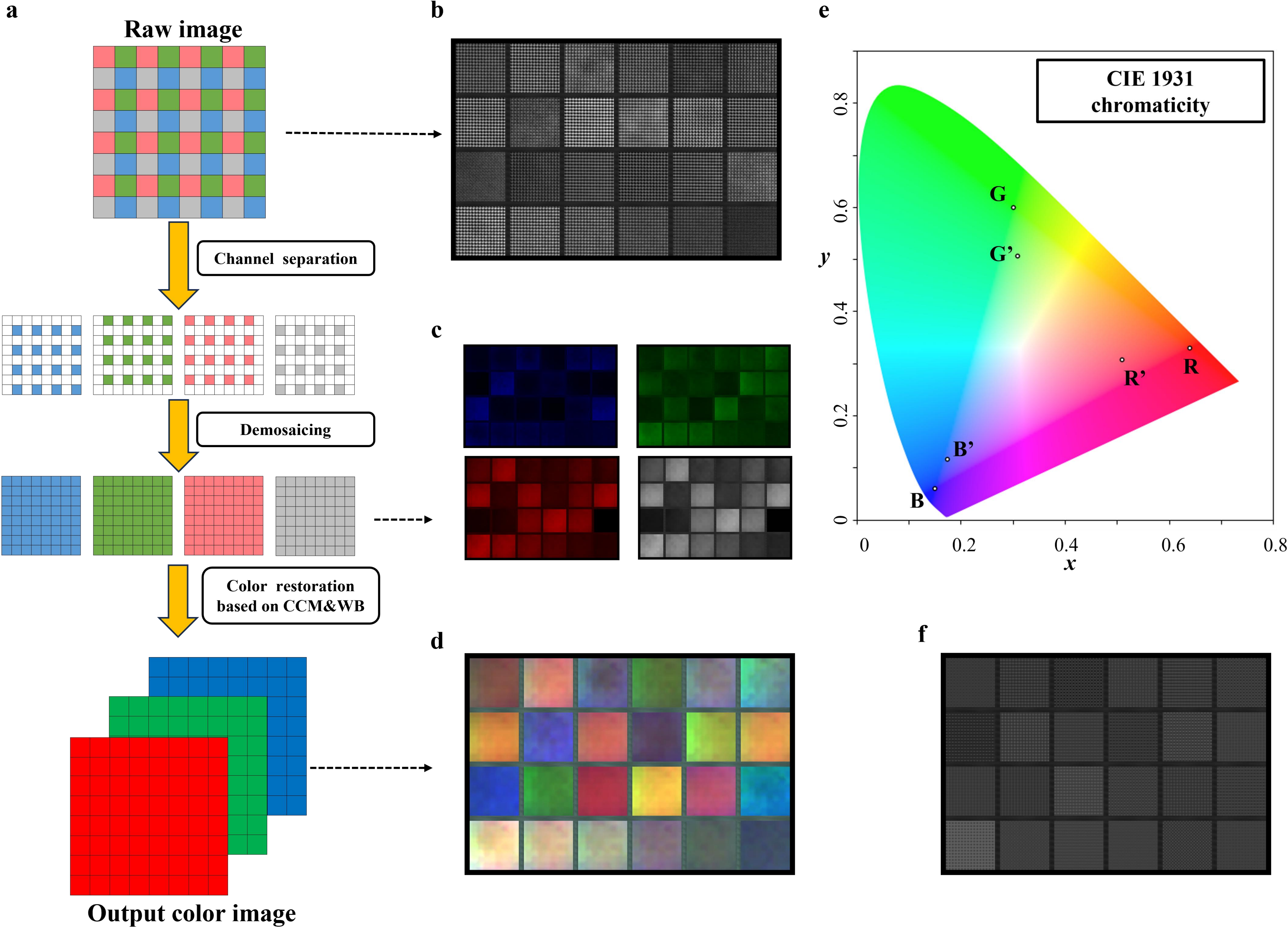
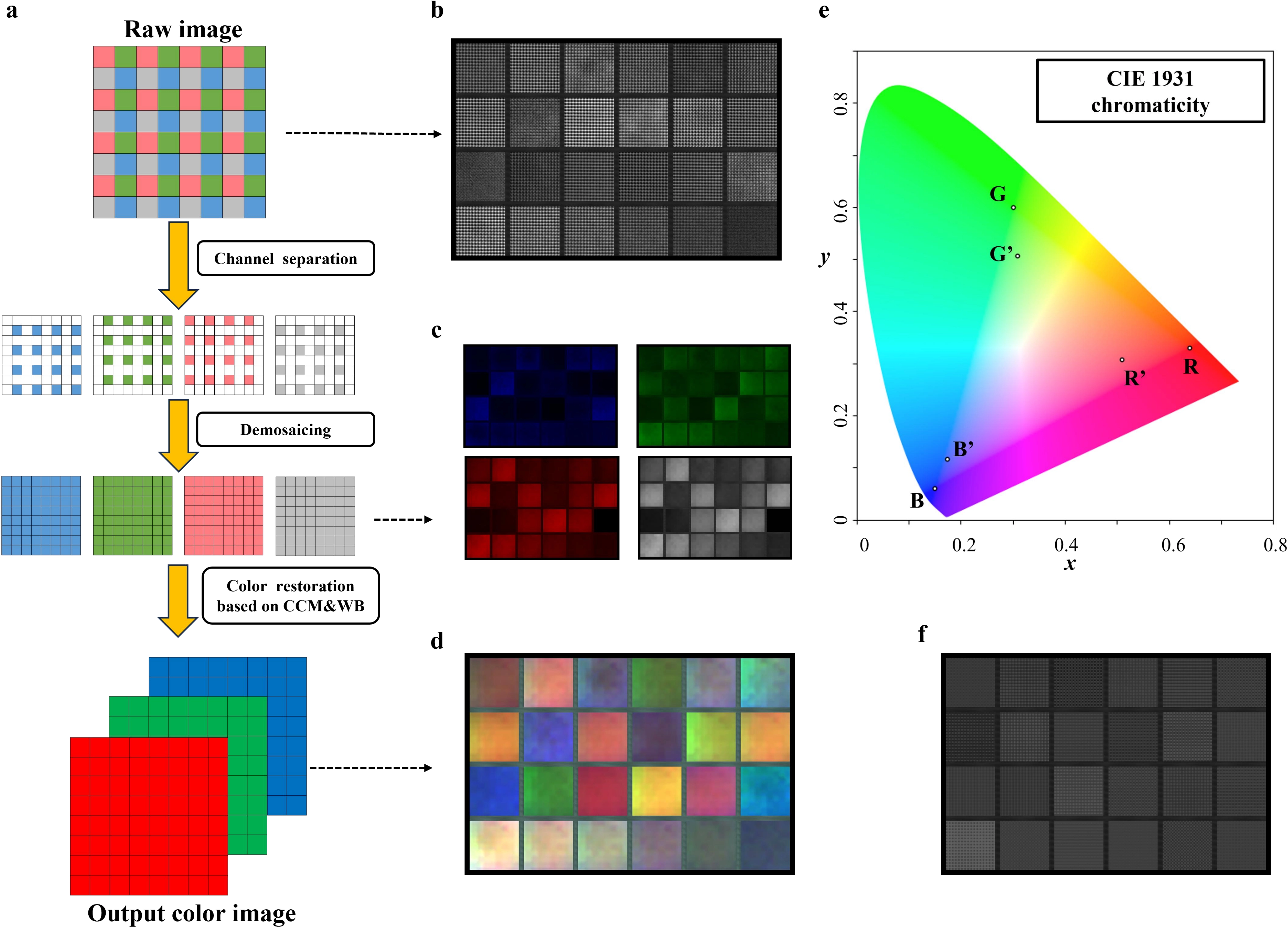
Figure 5. Image processing of RGBN-MBCR. (a) Color restoration process based on RGBN information; (b) Raw image captured from the RGBN-MBCR; (c) The discrete four-channel image extracted after color separation and demosaicing; (d) Color image after CCM restoration and WB; (e) Chromaticity diagram of the standard colors (R, G, B) and output colors (R’, G’, B’) in (d); (f) Raw image captured from the RGBN filter. RGBN: red, green and blue + near-infrared; MBCR: metasurface-based color router; CCM: color correction matrix; WB: white balance; CIE: International Commission on Illumination.
We compared the chromaticity coordinates of the output RGB patches in Figure 5d with the three primary colors in the International Commission on Illumination 1931 chromaticity diagram, as shown in Figure 5e. The color gamut width we output is slightly smaller than the standard color gamut, but still maintains a high contrast. Compared with the standard 24 colors, the average color difference value is only 7.5434 (see Figure S17 for ground truth). This result demonstrates that the proposed post-processing workflow effectively suppresses inter-channel crosstalk and achieves relatively accurate color reconstruction. We further compared the imaging system based on traditional RGBN filters under identical imaging conditions (including light intensity, imaging lens, exposure time, and gains) by inserting different color filters alternately. As shown in Figure 5f, the signal intensity between filter channels is extremely low, and due to readout noise, no effective channel separation can be achieved. For the white patch, the average brightness measured using a color filter (CF) was 44.94. In contrast, even though the relay imaging system cannot collect all the light energy, the average brightness measured using the CR reached 67.80, representing an approximately 1.5-fold increase in energy. Furthermore, the RGBN-MBCR system maintained clear channel separation, demonstrating its significant potential for color imaging in low-light conditions.
For future integrated applications, comprehensive consideration must be given to lens parameters (aperture, operating wavelength, focal length), the spectral response characteristics of the RGBN-MBCR, and factors such as the QE and readout noise of image sensor pixels. These challenges will be addressed through optimized fabrication processes, pixel-level calibration, and direct integration of the metasurface onto image sensors.
4. Conclusion
In summary, we have proposed and realized a polarization-insensitive RGBN-MBCR, and verified its feasibility for application in RGB-NIR image sensors. The metasurface can simultaneously modulate visible light and NIR light, showing a four-channel routing effect with high contrast and polarization insensitivity. The measured peak routing efficiencies of all channels reach the highest values we know of for experimental RGBN-type CRs. Through standard image processing procedures, color image reconstruction with a high degree of restoration can be achieved. At the same time, the light energy utilization efficiency exceeds 90%, which is almost three times the theoretical efficiency limit of existing color filters, making it beneficial for applications under low-light conditions.
In addition, although it is currently in the proof-of-principle stage, the design parameters of our proposed RGBN-MBCR significantly reduce the processing difficulty and adopt a silicon-compatible low-temperature process. It is expected that the MBCR can be directly prepared without damaging CMOS chips, which can support subsequent chip-level integrated preparation and testing. Although the spectral separation in the RGBN-MBCR makes it difficult to achieve ideal crosstalk-free conditions, resulting in a color gamut that is narrower than that of CF, this issue can be effectively resolved through more sophisticated color reproduction algorithms (such as higher-order CCM[8]) or by training the color reconstruction network after integration with CIS[7]. This breakthrough expands the hardware foundation of visible-near infrared simultaneous imaging technology. With further integration with image processing technology, it is expected to be used in fields that require multi-band imaging capabilities, such as night vision monitoring, autonomous driving cameras, and face recognition.
Supplementary materials
The supplementary material for this article is available at: Supplementary materials.
Authors contribution
Fu Y: Investigation, resources.
Zou X: Methodology, software.
Chen J: Investigation, methodology, formal analysis.
Wang S: Conceptualization, supervision.
He R, Yuan Q, Yu H: Formal analysis, investigation.
Conflicts of interest
Shuming Wang is an Editorial Board Member of Light Manipulation and Applications. The other authors declare no conflicts of interest.
Ethics approval
Not applicable.
Consent to participate
Not applicable.
Consent for publication
Not applicable.
Availability of data and materials
Data supporting the findings of this study are available from supplementary materials and the corresponding author upon reasonable request.
Funding
This work was supported by the National Key Research and Development Program of China (Grant No. 2024YFB3815900), National Program on Key Basic Research Project of China (Grant No. 2022YFA1404300), the National Natural Science Foundation of China (Grant Nos. 62405140 and 62505131), the Open Research Fund of the State Key Laboratory of Transient Optics and Photonics, Chinese Academy of Sciences (Grant No. SKLST202218), the Fundamental Research Funds for the Central Universities (Grant No. 020414380175), Natural Science Research Start Start-up Foundation of Recruiting Talents of Nanjing University of Posts and Telecommunications (Grant No. NY223152), and the Jiangsu Provincial Natural Science Foundation of China (Grant No. BK20240642).
Copyright
© The Author(s) 2026.
References
-
1. Lee SH, Lee C, Yoon SC, Noh YY. Toward color-selective printed organic photodetectors for high-resolution image sensors: From fundamentals to potential commercialization. Mater Sci Eng R Rep. 2022;147:100660.[DOI]
-
2. Bayer BE, inventor; Eastman Kodak Co, assignee. Color imaging array. United States patent US 3971065. 1976 Jul 20. Available from: https://patents.google.com/patent/US3971065A/en
-
3. Gunturk BK, Altunbasak Y, Mersereau RM. Color plane interpolation using alternating projections. IEEE Trans Image Process. 2002;11(9):997-1013.[DOI]
-
8. Chen Z, Wang X, Liang R. RGB-NIR multispectral camera. Opt Express. 2014;22(5):4985-4994.[DOI]
-
10. El Gamal A, Eltoukhy H. CMOS image sensors. IEEE Circuits Devices Mag. 2005;21(3):6-20.[DOI]
-
14. Hu Y, Wang X, Luo X, Ou X, Li L, Chen Y, et al. All-dielectric metasurfaces for polarization manipulation: Principles and emerging applications. Nanophotonics. 2018;9(12):3755-3780.[DOI]
-
16. Murray WA, Barnes WL. Plasmonic materials. Adv Mater. 2007;19(22):3771-3782.[DOI]
-
17. Franklin D, Frank R, Wu ST, Chanda D. Actively addressed single pixel full-colour plasmonic display. Nat Commun. 2017;8:15209.[DOI]
-
19. Chen Q, Nan X, Chen M, Pan D, Yang X, Wen L. Nanophotonic color routing. Adv Mater. 2021;33(49):2103815.[DOI]
-
20. Nishiwaki S, Nakamura T, Hiramoto M, Fujii T, Suzuki MA. Efficient colour splitters for high-pixel-density image sensors. Nat Photonics. 2013;7(3):240-246.[DOI]
-
22. Zhao N, Catrysse PB, Fan S. Perfect RGB-IR color routers for sub-wavelength size CMOS image sensor pixels. Adv Photonics Res. 2021;2(3):2000048.[DOI]
-
25. Zou X, Lin R, Fu Y, Gong G, Zhou X, Wang S, et al. Advanced optical imaging based on metasurfaces. Adv Opt Mater. 2024;12(6):2203149.[DOI]
-
27. Khorasaninejad M, Chen WT, Devlin RC, Oh J, Zhu AY, Capasso F. Metalenses at visible wavelengths: Diffraction-limited focusing and subwavelength resolution imaging. Science. 2016;352(6290):1190-1194.[DOI]
-
31. Liu W, Wan Y, Yu H, Yuan Q, Li T, Xue F, et al. Miniature snapshot mid-infrared spectrometer based on metal-insulator-metal metasurface. J Opt. 2024;26(8):085003.[DOI]
-
32. Zhou Y, Zhu X, Li T, Zhou Z, Bi Q, Liu J, et al. Metasurface-assisted multimodal quantum imaging. Proc Natl Acad Sci U S A. 2025;122(18):e2500760122.[DOI]
-
35. Miyata M, Nemoto N, Shikama K, Kobayashi F, Hashimoto T. Full-color-sorting metalenses for high-sensitivity image sensors. Optica. 2021;8(12):1596-1604.[DOI]
-
38. Zou X, Gong G, Lin Y, Fu B, Wang S, Zhu S, et al. Metasurface-based polarization color routers. Opt Lasers Eng. 2023;163:107472.[DOI]
-
40. Shao Y, Chen R, Wang Y, Guo S, Zhan J, Choudhury PK, et al. Pixelated Bayer spectral router based on a sparse meta-atom array. Chin Opt Lett. 2025;23(7):073601.[DOI]
-
41. Choi C, Park J, Lee Y, Kim B, Kim J, Kim S, et al. Optical design of dispersive metasurface nano-prism structure for high sensitivity CMOS image sensor. In: 2023 International Electron Devices Meeting (IEDM); 2023 Dec 9-13; San Francisco, USA. Piscataway: IEEE; 2023. p. 1-4.[DOI]
-
42. Yun S, Roh S, Lee S, Park H, Lim M, Ahn S, et al. Highly efficient color separation and focusing in the sub-micron CMOS image sensor. In: 2021 IEEE International Electron Devices Meeting (IEDM); 2021 Dec 11-16; San Francisco, USA. Piscataway: IEEE; 2021. p. 30.1.1-30.1.4.[DOI]
-
43. Wang CY, Huang GY, Yu CH, Liu HW, Lu YS, Tsai WL, et al. CMOS image sensor with nano light pillars for optical performance enhancement. In: 2023 International Electron Devices Meeting (IEDM); 2023 Dec 9-13; San Francisco, USA. Piscataway: IEEE; 2023. p. 1-4.[DOI]
-
44. Cha S, Cho S, Park Y, Heo J, Kim K, Kim SS, et al. Image quality performance of CMOS image sensor equipped with Nano Prism. Electron Imaging. 2023;35(8):1-5.[DOI]
-
45. Liu H, Lam EY. Joint optimization of splitter pattern and image reconstruction for metasurface-based color imaging systems. Opt Laser Technol. 2024;170:110265.[DOI]
-
46. Monno Y, Teranaka H, Yoshizaki K, Tanaka M, Okutomi M. Single-sensor RGB-NIR imaging: High-quality system design and prototype implementation. IEEE Sens J. 2019;19(2):497-507.[DOI]
-
47. Hu J, Ren X, Reed AN, Reese T, Rhee D, Howe B, et al. Evolutionary design and prototyping of single crystalline titanium nitride lattice optics. ACS Photonics. 2017;4(3):606-612.[DOI]
-
48. Jin Z, Mei S, Chen S, Li Y, Zhang C, He Y, et al. Complex inverse design of meta-optics by segmented hierarchical evolutionary algorithm. ACS Nano. 2019;13(1):821-829.[DOI]
Copyright
© The Author(s) 2026. This is an Open Access article licensed under a Creative Commons Attribution 4.0 International License (https://creativecommons.org/licenses/by/4.0/), which permits unrestricted use, sharing, adaptation, distribution and reproduction in any medium or format, for any purpose, even commercially, as long as you give appropriate credit to the original author(s) and the source, provide a link to the Creative Commons license, and indicate if changes were made.
Publisher’s Note
Science Exploration remains a neutral stance on jurisdictional claims in published
maps
and institutional affiliations. The views expressed in this article are solely those
of
the author(s) and do not reflect the opinions of the Editors or the publisher.
Share And Cite


Science Exploration Style
Fu Y, Zou X, Chen J, He R, Yuan Q, Yu H, et al. Polarization-insensitive RGBN color router based on metasurface. Light Manip Appl. 2026;1:202607. https://doi.org/10.70401/lma.2026.0016
Tips
Copy completed.
Submit a Manuscript
Author Instructions
Cite this Article
Article Metrics
0
View
0
Download
Cited
Article Updates

 Get citation
Science Exploration Style

Fu Y, Zou X, Chen J, He R, Yuan Q, Yu H, et al. Polarization-insensitive RGBN color router based on metasurface. Light Manip Appl. 2026;1:202607. https://doi.org/10.70401/lma.2026.0016
copy
Share Link
copy
Subscribe