Spin-selective Fourier transformation for parity-resolved optical vortex manipulation

Yanliang He
*

,
Feiguo Fang
Junchun Ye
Jun Luo
Juan Chen
Yuanfeng Zhu
Wen Yuan
Guiqiang Liu
Zhengqi Liu
Haimei Luo
*
,
Xianping Wang
*
*Correspondence to:
Yanliang He, Jiangxi Provincial Key Laboratory of Advanced Electronic Materials and Devices, Jiangxi Normal University, Nanchang 330022, Jiangxi, China.
E-mail: yanlianghe98@163.com
Haimei Luo, Jiangxi Provincial Key Laboratory of Advanced Electronic Materials and Devices, Jiangxi Normal University, Nanchang 330022, Jiangxi, China. E-mail: jxsdhm@jxnu.edu.cn
Xianping Wang, Jiangxi Provincial Key Laboratory of Advanced Electronic Materials and Devices, Jiangxi Normal University, Nanchang 330022, Jiangxi, China. E-mail: xpwang@jxnu.edu.cn
Haimei Luo, Jiangxi Provincial Key Laboratory of Advanced Electronic Materials and Devices, Jiangxi Normal University, Nanchang 330022, Jiangxi, China. E-mail: jxsdhm@jxnu.edu.cn
Xianping Wang, Jiangxi Provincial Key Laboratory of Advanced Electronic Materials and Devices, Jiangxi Normal University, Nanchang 330022, Jiangxi, China. E-mail: xpwang@jxnu.edu.cn
Light Manip Appl. 2026;1:202615. 10.70401/lma.2026.0019
Received: June 15, 2026Accepted: August 27, 2026Published: August 27, 2026
Abstract
We discover that a standard Fourier transformation intrinsically imparts a parity-dependent phase shift to optical vortices, yielding a phase difference of π between modes carrying odd and even topological charges. This phase shift, however, is not directly observable from the intensity profile of the transformed beam. To render it measurable, we develop a spin-selective Fourier transformer by co-designing propagation-induced dynamic phase and Pancharatnam-Berry geometric phase in a pair of hybrid-lenses. This device converts the parity-dependent phase shift into orthogonal polarization states via spin-orbit interaction, enabling non-destructive separation of both individual and superimposed orbital angular momentum (OAM) modes without the need for an interferometer. Our work establishes Fourier transformation as a new mechanism for parity-resolved vortex manipulation, offering an integrable platform for high-dimensional photonic applications.
Keywords
Orbital angular momentum, spin-orbit interaction, pancharatnam-berry phase, Fourier transformation
1. Introduction
The Fourier transform is a fundamental tool in modern optics, underpinning a broad range of applications including imaging[1-3], Fourier holography[4], and coherent information processing[5,6]. Its canonical physical implementation uses a simple lens to map a spatial field distribution into its angular spectrum, a property for which the Fourier transform is almost exclusively appreciated for its amplitude-transfer characteristics. The phase it imparts, in contrast, has received considerably less attention. For conventional optical fields such as plane waves or Gaussian beams, this phase is trivial and can be safely neglected. For structured fields such as optical vortices carrying orbital angular momentum (OAM), however, this neglect may obscure a nontrivial and deterministic phase modulation.
Optical vortices are beams characterized by a helical phase front of the form exp(ilθ), where θ is the azimuthal angle and the integer l is the topological charge[7-10]. Since the work of Allen et al. in 1992[11], such beams have been known to carry
Here we demonstrate that a standard 4f imaging system imparts a parity phase factor exp(ilπ) to an incident vortex field. Consequently, modes with even l acquire a phase shift of 0, whereas modes with odd l acquire a phase shift of π, establishing an intrinsic parity-dependent phase shift between opposite-parity OAM modes. This phase shift, however, is not directly accessible from the intensity distribution of the transformed beam. To render this hidden phase shift measurable, we introduce a spin-selective Fourier transformation that converts the parity-dependent phase shift into an observable polarization rotation. By co-designing propagation-induced dynamic phase and Pancharatnam-Berry geometric phase in hybrid-lenses, the Fourier transform is configured to act selectively on one circular polarization component while leaving the orthogonal component unaffected. Upon recombination, the parity-dependent phase shift is mapped onto orthogonal linear polarizations: even OAM modes retain their input polarization, whereas odd OAM modes undergo a 90° rotation. Experimentally, we demonstrate non-destructive separation of pure OAM modes spanning from l = ±1 to l = ±3, as well as sorting of randomly selected vortex pairs spanning from l = ±1 to l = ±10 under multimode excitation. This work establishes Fourier transformation as a new physical mechanism for parity-resolved vortex manipulation, serving as an intrinsic phase encoder rather than merely an amplitude filter, which may have potential in optical communications with both polarization and OAM multiplexing.
2. Methods
As shown in Figure 1a, a standard 4f imaging system performs a coordinate inversion operation (x, y)→(-x, -y). For an optical beam carrying OAM, the annular intensity profile is invariant under this rotation. The crucial transformation occurs in the phase. Theoretical analysis (detailed derivation provided in the Supplementary materials) shows that for an input OAM field, Uin(r, θ) = A(r) · exp(ilθ) (where A(r) is the radial amplitude distribution, l is the topological charge, and θ is the azimuthal angle), the output field after passing through an ideal 4f system becomes:
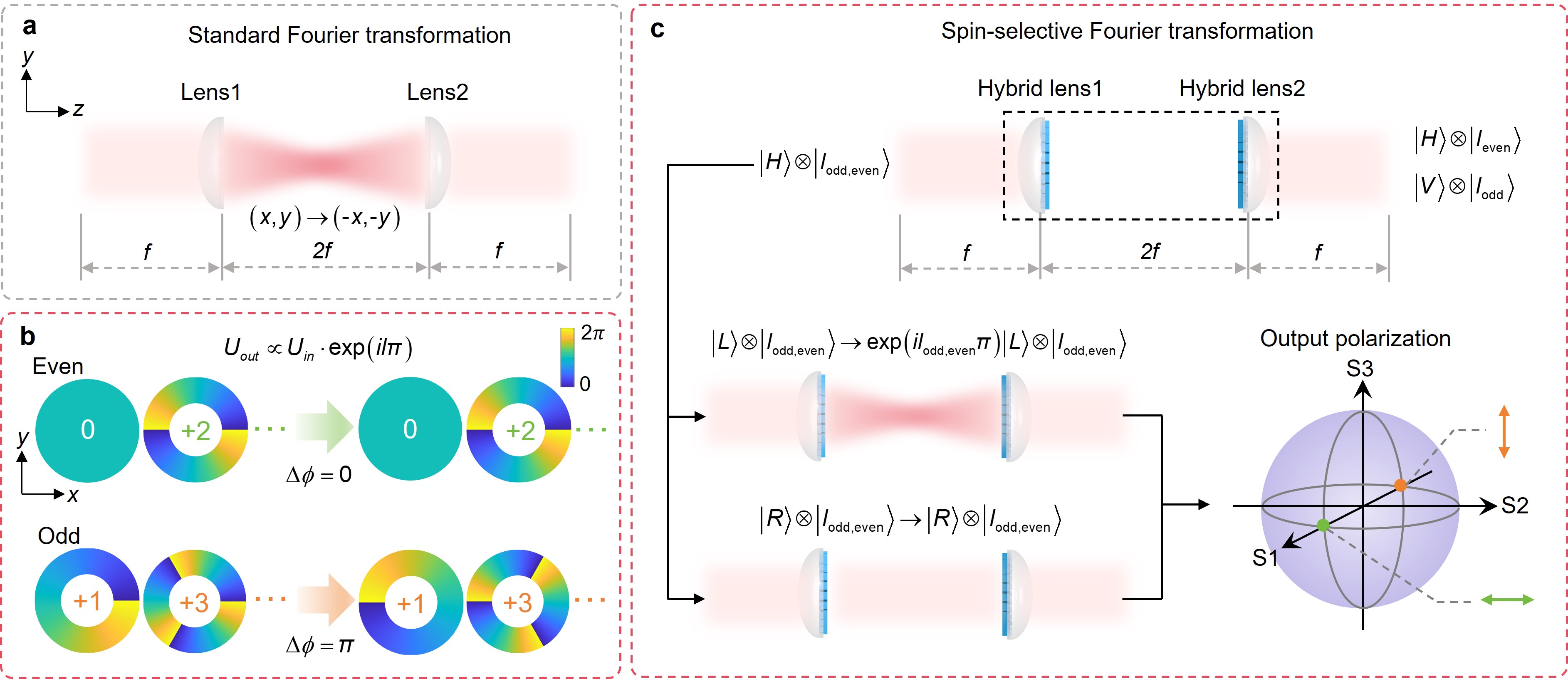
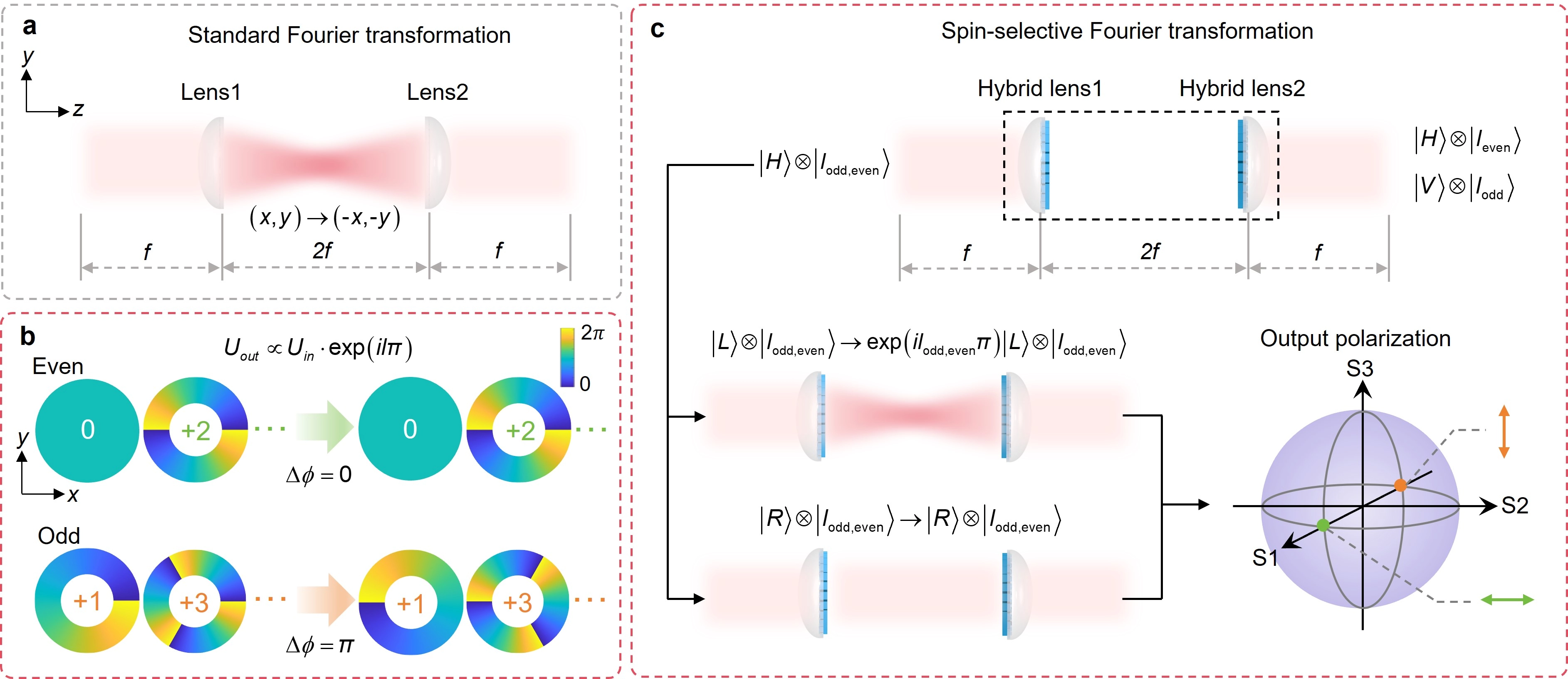
Figure 1. Principles of parity phase and spin-selective Fourier transformation. (a) A standard 4f system performs coordinate inversion (x, y)→(-x, -y) from input to output plane; (b) Schematic of the parity phase. Even OAM acquires a phase shift of 0, while odd OAM acquires a phase shift of π; (c) The spin-selective Fourier transformation converts the parity-dependent phase shift into an observable polarization rotation. The LCP component is Fourier-transformed while the RCP component remains unchanged. Upon recombination, the parity-dependent phase shift is converted into an engineered polarization rotation. The polarization states of the output OAM beams are mapped onto the Poincaré sphere. RCP: right-handed circularly polarized; LCP: left-handed circularly polarized; OAM: orbital angular momentum.
The spatial coordinate inversion introduces a global parity phase factor exp(ilπ) that depends on the topological charge l. As shown in Figure 1b, when l is an even number, the phase shift is zero; when l is an odd number, the phase shift is π. Thus, a standard 4f system inherently introduces a deterministic phase difference between OAM modes of opposite parity (odd and even topological charges). This phase shift, however, is not directly accessible from the intensity distribution of the transformed beam. To render this hidden phase shift measurable, we introduce a spin-selective Fourier transformation that converts the parity-dependent phase shift into an observable polarization rotation. As illustrated in Figure 1c, when an incident OAM beam passes through the designed spin-selective Fourier transformer, its left-handed circularly polarized (LCP) component undergoes a Fourier transformation, whereas its right-handed circularly polarized (RCP) component remains unaffected. After the two components recombine, the resulting output field exhibits distinct polarization behaviors depending on the topological charge:
Here,
3. Results
To achieve spin-selective Fourier transformation, a pair of hybrid-lenses is developed. As shown in Figure 2a, the hybrid-lens is designed by integrating a Pancharatnam-Berry (PB) phase liquid crystal lens with a dynamic phase lens. It is important to distinguish this PB phase from the parity phase: the former arises from adiabatic evolution of polarization states on the Poincaré sphere[25], while the latter originates from the topology of spatial coordinate inversion. The total phase profiles for the two circular polarization components can be expressed as the superposition of the PB phase and the dynamic phase, given by:
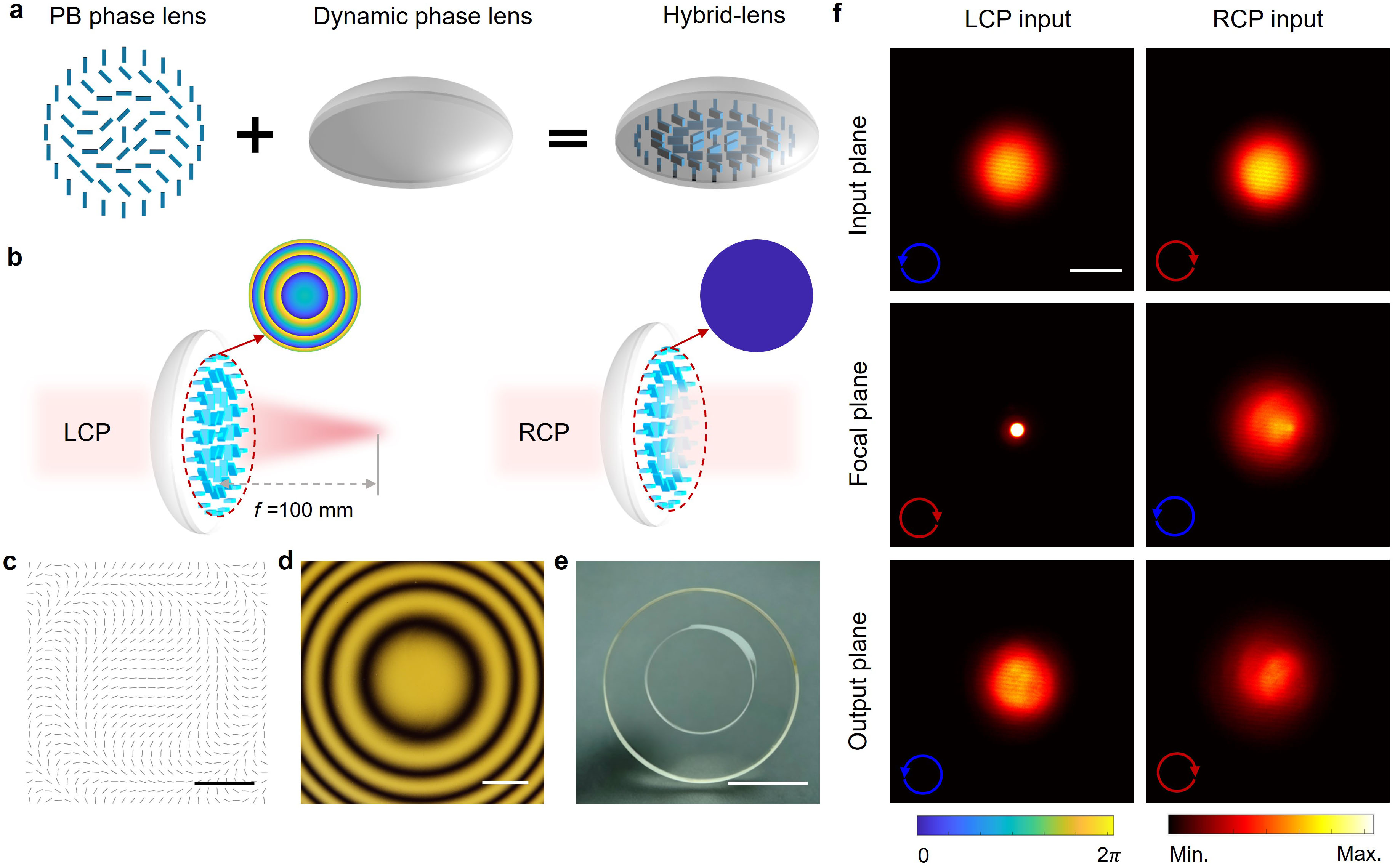
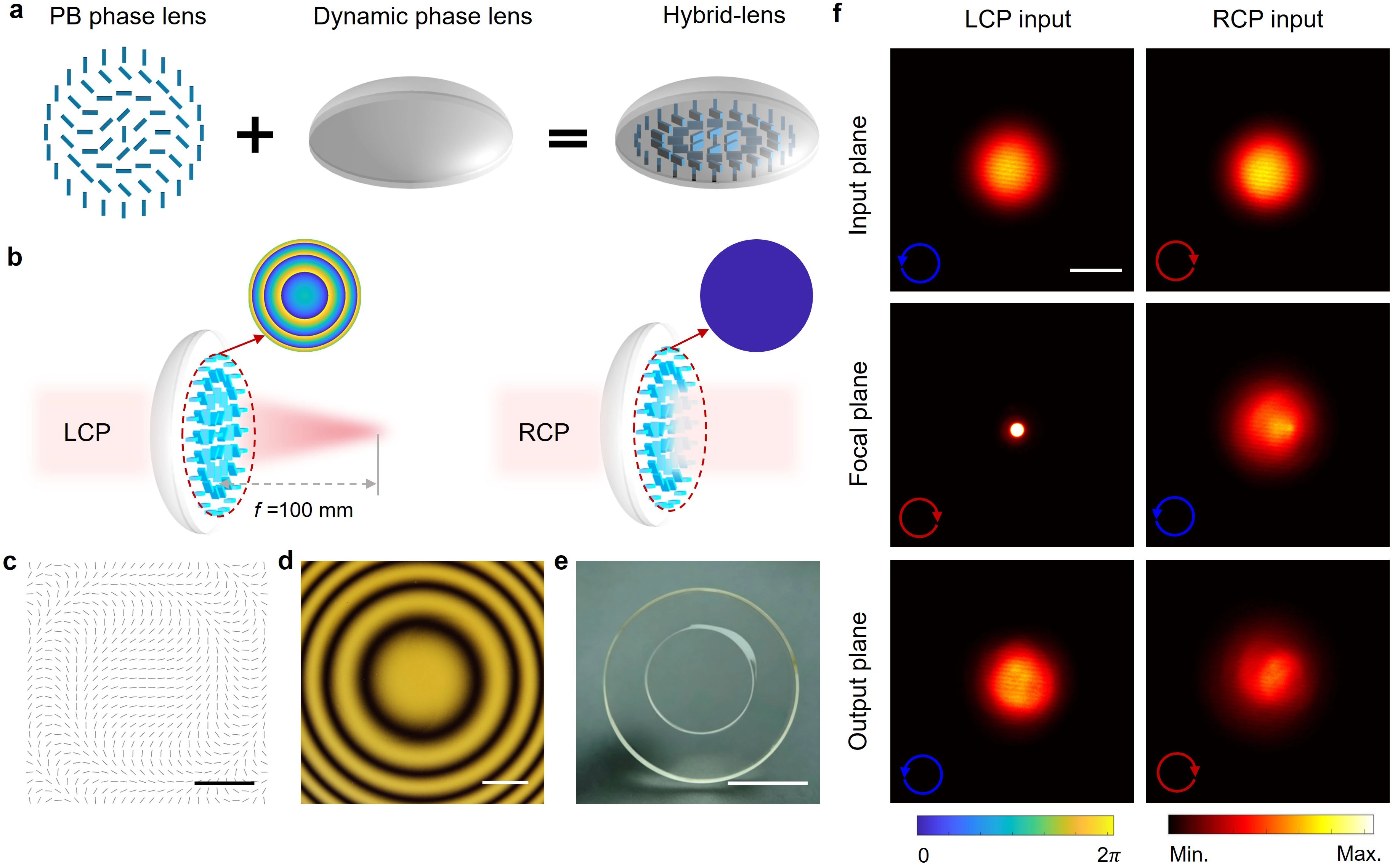
Figure 2. Design and characterization of the hybrid-lens. (a) Design of the hybrid-lens; (b) Schematic of the spin-dependent phase modulation of the hybrid-lens; (c) Two-dimensional slow-axis orientation map of the PB phase lens. Scale bar: 100 μm; (d) Cross-polarized microscopy image of the PB phase lens. Scale bar: 200 μm; (e) Photograph of the fabricated hybrid-lens. Scale bar: 1 cm; (f) Optical intensity distributions at the corresponding positions of the 4f hybrid-lens system for an LCP Gaussian beam input or an RCP Gaussian beam input, respectively. Scale bar: 0.5 mm. LCP: left-handed circularly polarized; RCP: right-handed circularly polarized.
where f1 and f2 are the focal lengths of the dynamic phase lens and PB phase lens, respectively. Here, both are set as 200 mm. The effective focal length of the hybrid-lens for each polarization can be calculated as:
where σ± = +1 and -1 denote LCP and RCP, respectively. Consequently, the LCP component focuses at 100 mm, while the RCP experiences an effective focal length of infinity (i.e., no focusing), as illustrated in Figure 2b.
The desired PB phase lens is realized by spatially tailoring the effective optical axes of the liquid crystal molecules, as illustrated in Figure 2c. To verify the OAM mode separation capability of the proposed non-interferometric scheme, a pair of hybrid-lenses was custom-fabricated by JCOPTIX, China. As shown in Figure 2e, the dynamic phase lens (diameter: 12.7 mm) is bonded to the PB phase liquid crystal lens (diameter: 25.4 mm). The size difference is designed to facilitate the alignment of their optical centers. The cross-polarized microscopy image of the PB phase liquid crystal lens is shown in Figure 2d. The concentric rings indicate that the orientation of the local optical axis changes continuously along the radial direction. In the experiment, the two identical hybrid-lenses were arranged in opposite orientations with a separation of 200 mm to implement spin-selective Fourier transformation. As shown in Figure 2f, the intensity distributions at the input, focal, and output planes indicate that the input LCP Gaussian beam is firstly focused into a small spot after passing through the hybrid-lens1, with its polarization converted into RCP due to the PB phase modulation. The beam is then recollimated to its original Gaussian profile after the hybrid-lens2, and its polarization is converted back to LCP. For the RCP case, the lens phases introduced by the PB phase and dynamic phase lenses cancel each other. Therefore, the RCP Gaussian beam undergoes normal diffraction without focusing. The experimental results confirm that spin-selective Fourier transformation is successfully realized, in good agreement with theoretical predictions.
The spin-selective Fourier transformer converts the parity-dependent phase shift into orthogonal polarization states via spin-orbit interaction, enabling non-destructive separation of OAM modes without the need for an interferometer. The experimental setup of the OAM mode separation system is illustrated in Figure S1. The OAM beams were generated using a computer-controlled phase-type spatial light modulator (spatial light modulator (SLM), CAS MICROSTAR) based on the principle of computer-generated holograms[26]. A linearly polarized Gaussian beam from a 632.8 nm He-Ne laser (Thorlabs) was incident on the SLM. The forked-phase hologram used to generate OAM beams was designed by combining a spiral phase profile with a blazed grating phase. The desired OAM beam, extracted from the first-order diffraction, was directed into the spin-selective Fourier transformer to perform OAM-to-polarization coupling. The use of liquid crystal-based hybrid lenses, however, imposes limitations on achieving short focal lengths. Consequently, the longer effective focal length results in a non-negligible mismatch between the beam spot sizes of the LCP and RCP components after propagation. To evaluate the beam-size mismatch quantitatively, we performed numerical simulations by propagating the LCP and RCP components through the 4f system for different focal lengths. As shown in Figure S2, the spot-size mismatch increases monotonically with the focal length. For longer focal lengths, however, the mismatch becomes significant and would degrade the recombination efficiency. With the 4× beam expansion used in our experiment, the mismatch is reduced to a negligible level, ensuring high-fidelity recombination of the two spin components. Notably, the liquid crystal-based hybrid lenses employed in this scheme can be replaced with spin-decoupled metasurfaces[27-30]. Since the characteristic size of meta-atoms is significantly smaller than that of liquid crystal molecules, metasurfaces enable the realization of much shorter focal lengths. When the focal length is sufficiently reduced, the propagation-induced spot-size mismatch is effectively minimized.
We first launched a vortex beam carrying a single OAM mode into the device. The polarization undergoes the following transformation: |H〉 ⨂ |leven〉→|H〉 ⨂ |leven〉 and |H〉 ⨂ |lodd〉→|V〉 ⨂ |lodd〉. Consequently, the even and odd OAM modes emerge from output ports A and B of a polarization-dependent beam splitter (PBS), respectively. The optical intensity distributions of the input and the separated OAM modes were captured with a complementary metal-oxide-semiconductor (CMOS) camera (Cinogy), as shown in Figure 3. The intensity distributions at ports A and B confirm that the separation function operates effectively. Due to slight deviations between the phase retardation of the PB phase lens and the ideal half-wave retardation, a small fraction of the unmodulated vortex light remains in the output field, resulting in faint concentric interference rings in the intensity profiles. These interference effects can be further suppressed by optimizing the fabrication processes. To quantify the influence of the PB lens imperfection on the separation performance, we performed numerical simulations based on Jones matrix analysis, as shown in Figure S3. For a quantitative characterization of the separation performance, we measured the input and output powers for each tested OAM mode using a calibrated power meter. The calculated performance metrics are summarized in Table S1.
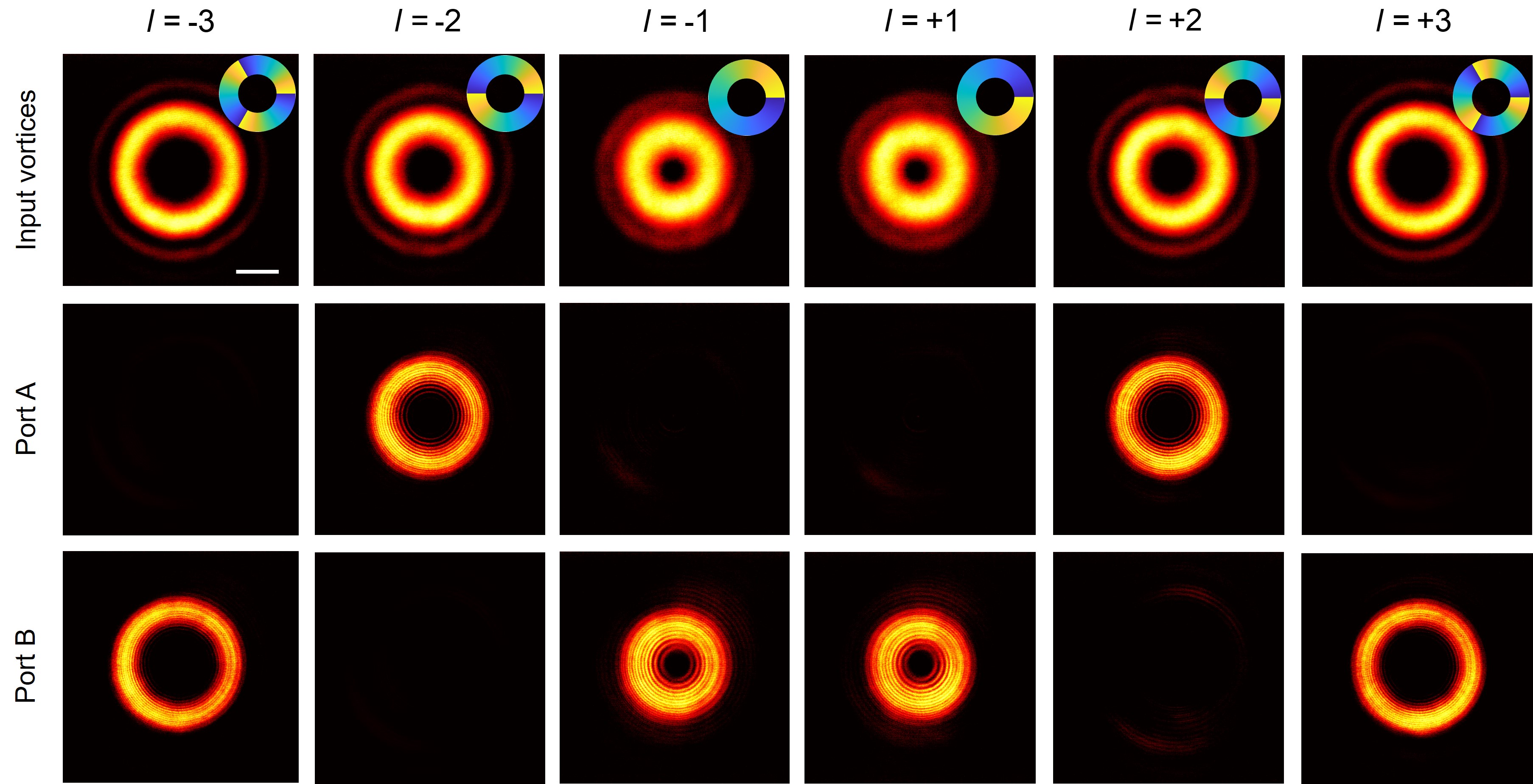
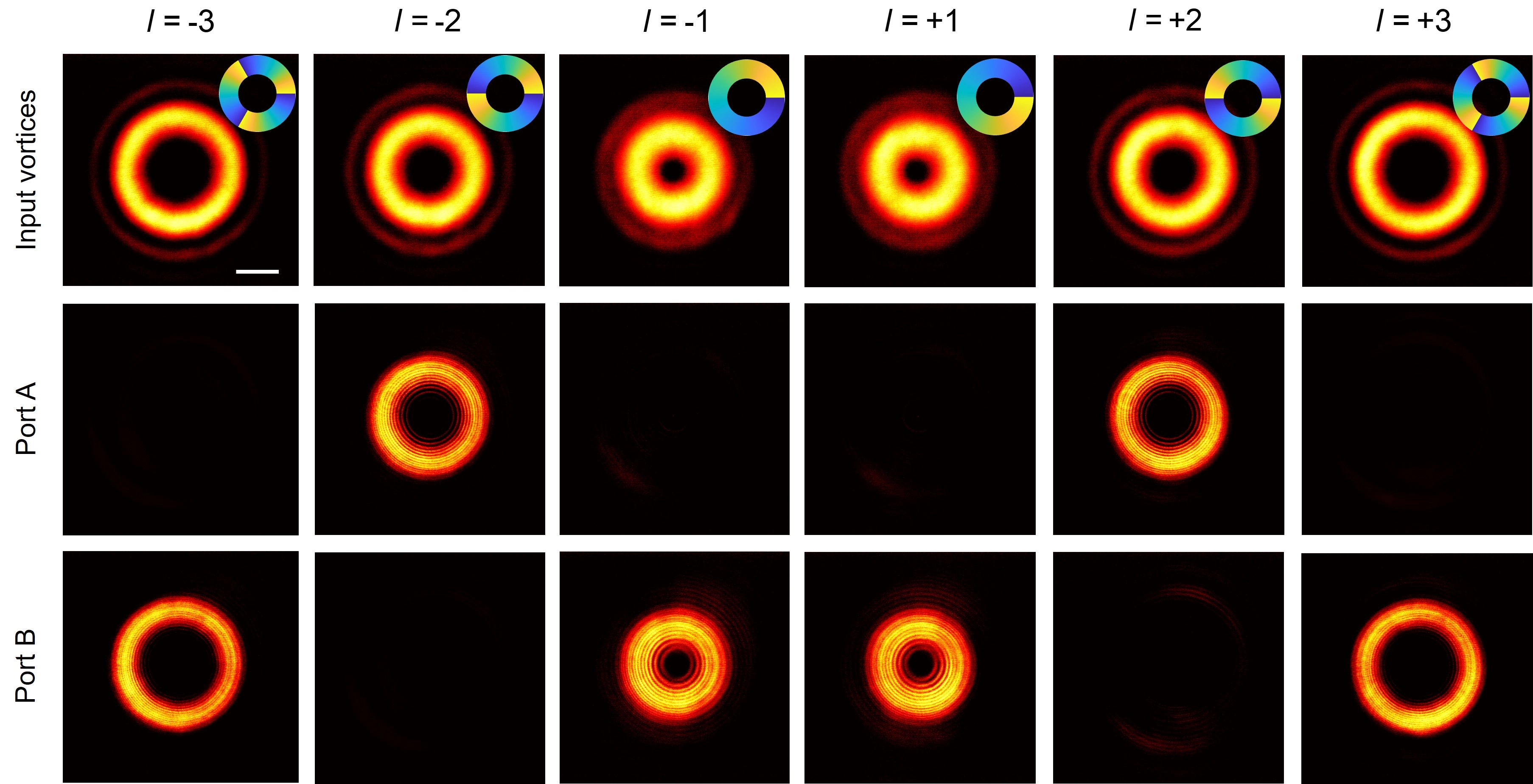
Figure 3. OAM mode separation under single-input-mode conditions. Experimentally captured intensity profiles of the input vortices, the output fields appear at ports A and B. The theoretical phase profiles of the input vortices are shown in the upper right corner. Scale bar: 1 mm. OAM: orbital angular momentum.
A more general case involving an input beam comprising a superposition of multiple OAM modes was also investigated. Specifically, we consider an input composed of two distinct vortex pairs with opposite l. The superposition of each ±l pair produces a petal-like interference pattern with 2|l| petals, which also provides a method for determining the l by counting the number of petals[31]. The intensity distributions of the input vortices with mixed OAM modes are presented in the second column of Figure 4. After passing through the transformer, the even and odd OAM modes are separated into ports A and B, as shown in the third and fourth columns. For example, when the input contains l = ±6 and l = ±7 OAM modes, a 12-petal pattern (corresponding to l = ±6) is observed at the even port (A), whereas a 14-petal pattern (corresponding to l = ±7) appears at the odd port (B). This result clearly demonstrates the effective, non-destructive separation of mixed OAM modes based on parity.
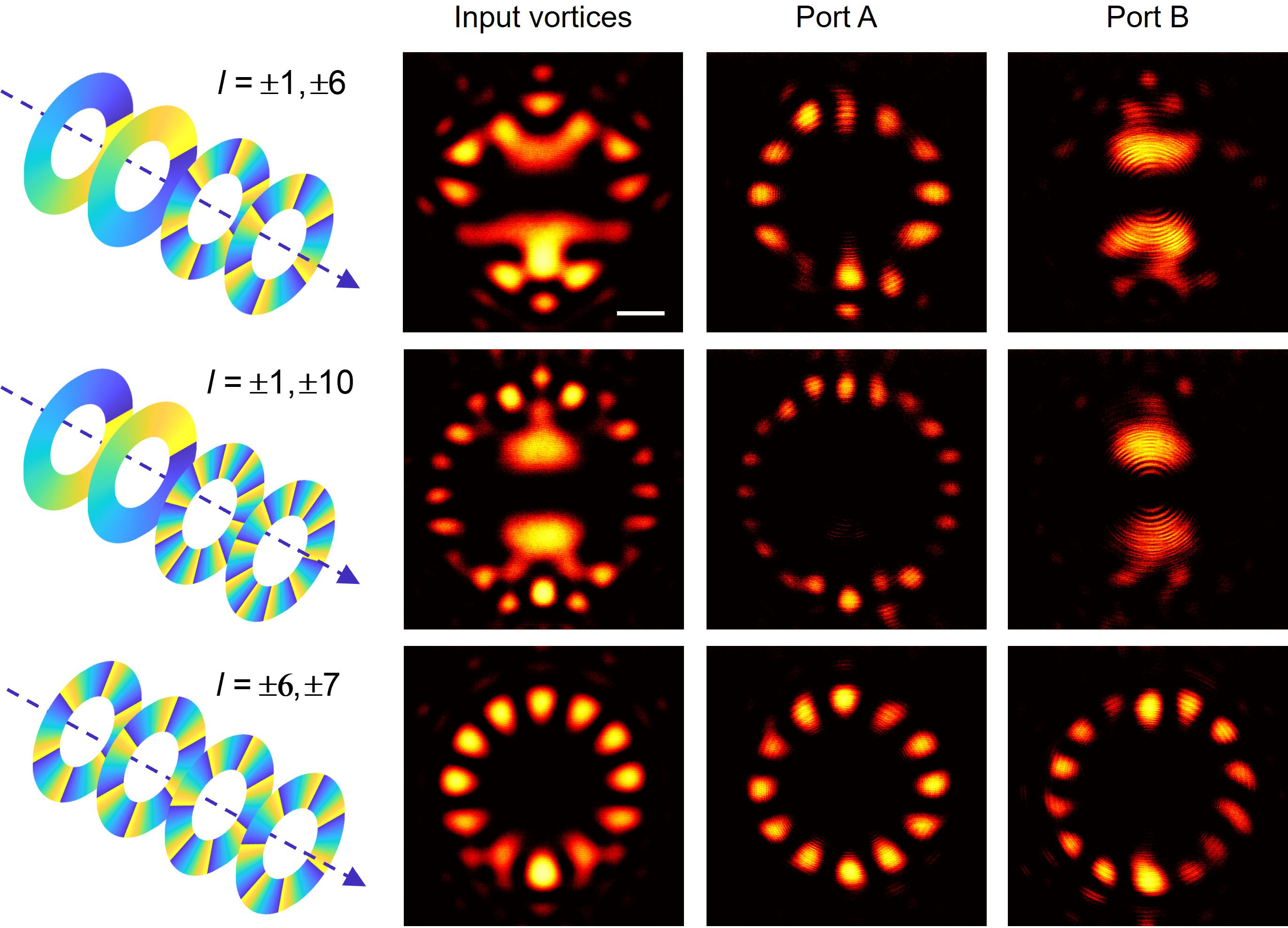
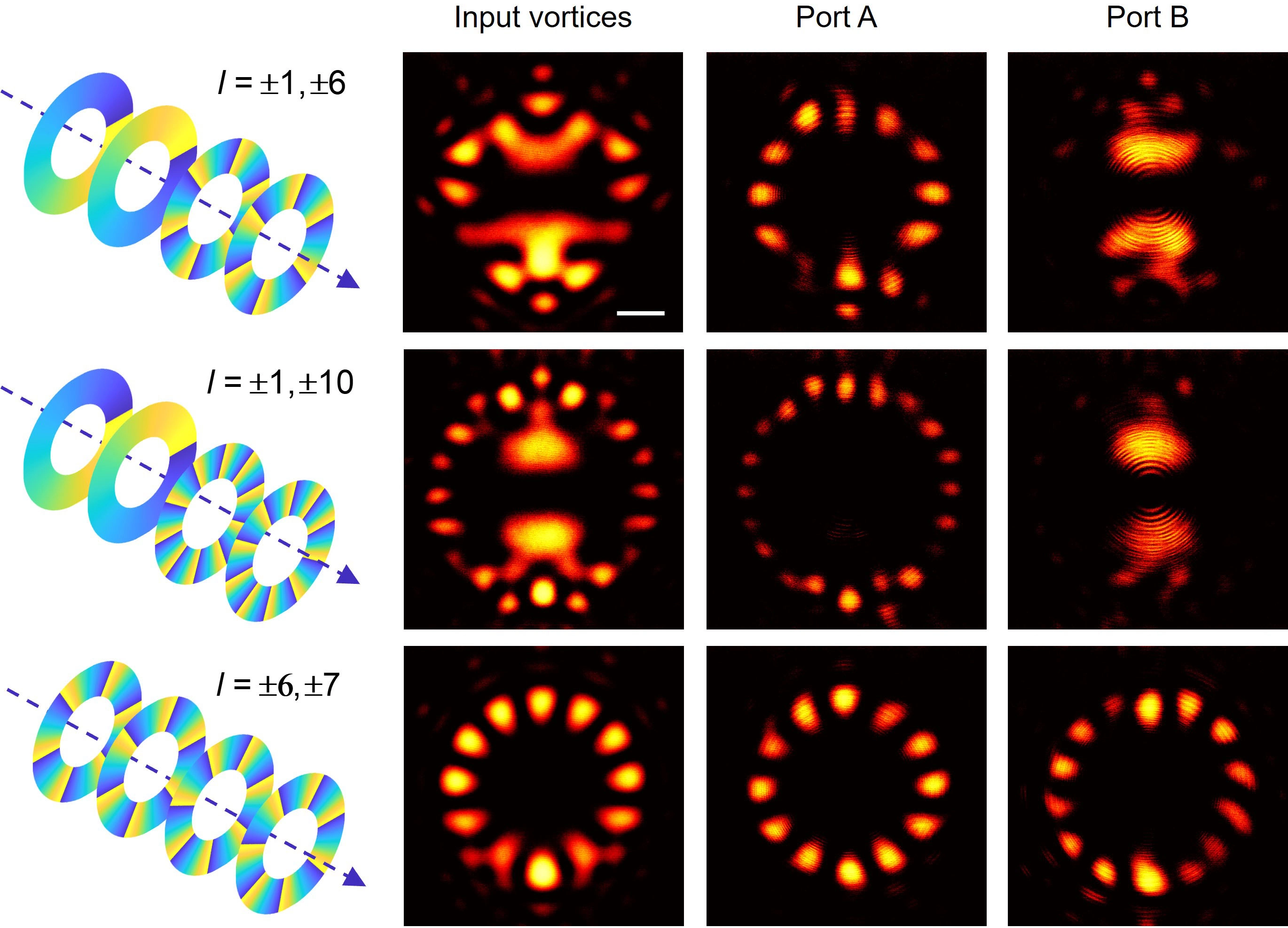
Figure 4. OAM mode separation under multiple-input-mode conditions. Even OAM modes (l = ±6, ±10) appear at port A, while odd OAM modes (l = ±1, ±7) appear at port B. Scale bar: 1 mm. OAM: orbital angular momentum.
4. Discussion
We have demonstrated that a standard Fourier transformation imparts an intrinsic parity-dependent phase shift to optical vortices. For a single OAM mode, the parity phase is a global phase and is therefore not observable by any measurement, not merely by intensity. It becomes physically meaningful only as a relative phase between modes of different parity, or, as implemented in our device, between the LCP and RCP components of the same beam. Our spin-selective Fourier transformer works by breaking the symmetry between the two spin components: the LCP component acquires the parity phase while the RCP component does not. The relative phase between the two circular polarization components is then mapped onto the output polarization state via coherent recombination.
This effect constitutes a new implementation scheme for non-destructive parity-dependent OAM sorting. The parity-dependent phase shift introduced by the Fourier transformation is distinct from the well-known topological phase shifts introduced by Dove prisms and Gouy phase accumulations. Based on these topological phase-shift mechanisms, various non-destructive OAM mode sorting schemes have been developed over the years. These include interferometric networks incorporating Dove prisms[32-34], a Faraday-effect-mimicking scheme that couples OAM to polarization[35], and methods exploiting Gouy-phase-based radial-mode sorting in focused systems[36,37] or OAM mode sorting in resonators[38]. However, a persistent challenge for these schemes is their reliance on numerous bulk optical components, active stabilization, or precise tuning, which increases system footprint, susceptibility to misalignment, and integration difficulty. In contrast, our approach exploits the intrinsic parity-dependent phase shift of the Fourier transform itself. This requires no interferometer and no active stabilization, offering a passive and compact solution for parity-resolved OAM sorting.
We acknowledge that the present device separates OAM modes only into odd- and even-parity groups, rather than resolving individual topological charges. This is an inherent limitation of parity-based sorting, shared with other parity sorters such as the Dove-prism-based Mach-Zehnder interferometer[35]. For applications requiring full topological charge resolution, our device can serve as a front-end pre-filter for cascaded sorting systems.
Regarding the operational bandwidth of the hybrid-lens system, the wavelength-dependent performance can be understood by analyzing the two constituent phase components. For the dynamic phase lens, the phase profile takes the form φd(x, y) = -π(x2 + y2)/λf1. When the operating wavelength deviates from the design value λ0 by ∆λ = λ - λ0, the resulting phase error is ∆φ = φd(λ) - φd(λ0) ≈ φd(λ0)· ∆λ/λ0, which manifests as an additional wavefront curvature that slightly alters the effective focal length. For the PB phase lens, the phase distribution φPB(x, y) = 2σ±a(x, y) (a(x, y) is the local orientation angle of the optical axis) is geometry-dependent and wavelength-independent. However, the conversion efficiency relies on the half-wave retardation condition δ = 2π∆nd/λ = π at the design wavelength. Wavelength detuning introduces a retardation error ∆ = δ - π, which leaves a fraction of the incident light unconverted with intensity proportional to sin2(∆/2). This unconverted component does not acquire the intended parity phase, thereby degrading the extinction ratio between the two output ports. These effects are negligible at the design wavelength but should be considered for broadband applications.
Despite this limitation, the spin-selective Fourier transformer holds promise for several practical scenarios. In optical communications, it can function as a compact in-line channel monitor, allowing the desired mode to be routed back into the communication link without loss while extracting spurious modes induced by link distortions, thus purifying the channel mode, and enabling channel diagnostics. In conventional OAM multiplexing systems, crosstalk between OAM modes with closely spaced topological charges typically necessitates a sufficiently large mode spacing to maintain channel isolation[39]. Introducing the OAM-to-polarization coupling effect provides an additional degree of orthogonality, as adjacent channels can be encoded with orthogonal polarization states, potentially enabling OAM multiplexing with reduced mode spacing and enhanced spectral efficiency. In high-dimensional quantum information processing, the device can be used to project OAM-entangled states onto parity subspaces, enabling simplified Bell-state analysis.
5. Conclusion
In summary, we have discovered that a standard Fourier transformation intrinsically imparts a parity-dependent phase shift to optical vortices, yielding a phase difference of π between modes carrying odd and even topological charges. Exploiting this mechanism, we have further developed a spin-selective Fourier transformation by co-designing dynamic and geometric phases in a pair of hybrid lenses, which converts this phase shift into orthogonal polarization states via spin-orbit coupling. Using this approach, we have demonstrated non-destructive separation of odd and even OAM modes without the need for an interferometer. The newly uncovered parity phase, rooted in the ubiquitous Fourier transform, establishes a new paradigm for vortex beam manipulation. This work offers an integrable platform for high-dimensional photonic applications, including optical communications and quantum information processing.
Supplementary materials
The supplementary material for this article is available at: Supplementary materials.
Acknowledgements
The authors thank Junxiao Zhou for assistance with this work.
Authors contribution
He Y: Conceptualization, formal analysis, funding acquisition, writing-review & editing.
Fang F, Ye J, Luo J: Validation, writing-review & editing.
Chen J, Zhu Y, Yuan W, Liu G, Liu Z: Formal analysis, writing-review & editing.
Luo H, Wang X: Supervision, resources, writing-review & editing.
Conflicts of interest
The authors declare no conflicts of interest.
Ethical approval
Not applicable.
Consent to participate
Not applicable.
Consent for publication
Not applicable.
Availability of data and materials
The data that support the findings of this study are available from the corresponding author upon reasonable request.
Funding
This work is supported by the National Natural Science Foundation of China (Grant No. 62465011); the Major Discipline Academic and Technical Leaders Training Program of Jiangxi Province (Grant No. 20243BCE51161).
Copyright
© The Author(s) 2026.
References
-
1. Goodman JW. Introduction to Fourier optics. 4th ed. New York: W. H. Freeman; 2017.
-
2. Zheng G, Horstmeyer R, Yang C. Wide-field, high-resolution Fourier ptychographic microscopy. Nat Photonics. 2013;7(9):739-745.[DOI]
-
5. Zeng K, Ke Y, Hong Z, Zeng L, Zhou X. In-situ and ex-situ twisted bilayer liquid crystal computing platform for reconfigurable image processing. Opto-Electron Adv. 2025;8(12):250226.[DOI]
-
7. Coullet P, Gil L, Rocca F. Optical vortices. Opt Commun. 1989;73(5):403-408.[DOI]
-
8. Yao AM, Padgett MJ. Orbital angular momentum: Origins, behavior and applications. Adv Opt Photonics. 2011;3(2):161-204.[DOI]
-
10. Molina-Terriza G, Recolons J, Torres JP, Torner L, Wright EM. Observation of the dynamical inversion of the topological charge of an optical vortex. Phys Rev Lett. 2001;87(2):023902.[DOI]
-
12. Forbes A, De Oliveira M, Dennis MR. Structured light. Nat Photonics. 2021;15(4):253-262.[DOI]
-
13. Willner AE, Huang H, Yan Y, Ren Y, Ahmed N, Xie G, et al. Optical communications using orbital angular momentum beams. Adv Opt Photonics. 2015;7(1):66-106.[DOI]
-
14. Wang J, Yang JY, Fazal IM, Ahmed N, Yan Y, Huang H, et al. Terabit free-space data transmission employing orbital angular momentum multiplexing. Nat Photonics. 2012;6(7):488-496.[DOI]
-
15. Mair A, Vaziri A, Weihs G, Zeilinger A. Entanglement of the orbital angular momentum states of photons. Nature. 2001;412(6844):313-316.[DOI]
-
18. Wang Y, Shou Y, Liu J, Yang Q, Chen S, Shu W, et al. Noncommutative metasurfaces enabled diverse quantum path entanglement of structured photons. Opto-Electron Sci. 2025;4(10):250006.[DOI]
-
19. Fang X, Ren H, Gu M. Orbital angular momentum holography for high-security encryption. Nat Photonics. 2020;14(2):102-108.[DOI]
-
20. Su H, Li B, Bai Y, Ye Y, Dong Y, Fang X. Achromatic 3D multi-color orbital angular momentum holography. Adv Sci. 2025;12(26):2503488.[DOI]
-
21. Pan W, Xu L, Li J, Liang X. Generation of high-purity Laguerre–Gaussian beams by spatial filtering. IEEE Photonics J. 2019;11(3):1-10.[DOI]
-
22. Ye J, Kang H, Cai Q, Hu Z, Solyanik-Gorgone M, Wang H, et al. Multiplexed orbital angular momentum beams demultiplexing using hybrid optical-electronic convolutional neural network. Commun Phys. 2024;7:105.[DOI]
-
23. Yang K, Luo H, Zhang Y, Li P, Wen F, Gu Y, et al. Modulating and identifying an arbitrary curvilinear phased optical vortex array of high-order orbital angular momentum. Opt Laser Technol. 2024;168:109984.[DOI]
-
24. Yang K, Luo H, Li P, Wen F, Gu Y, Wu Z. Controlling spacing of double-ring perfect optical vortex using the Fourier transform of Bessel beam with axicon phase. Opt Laser Technol. 2023;158:108881.[DOI]
-
25. Berry MV. The adiabatic phase and Pancharatnam’s phase for polarized light. J Mod Opt. 1987;34(11):1401-1407.[DOI]
-
26. Carpentier AV, Michinel H, Salgueiro JR, Olivieri D. Making optical vortices with computer-generated holograms. Am J Phys. 2008;76(10):916-921.[DOI]
-
28. Devlin RC, Ambrosio A, Rubin NA, Mueller JPB, Capasso F. Arbitrary spin-to–orbital angular momentum conversion of light. Science. 2017;358(6365):896-901.[DOI]
-
30. Jiang M, Zhang F, Chen Y, Kang T, Chen S, Pu M, et al. Spin-decoupled phase engineering with identical meta-atoms. Laser Photonics Rev. 2026.[DOI]
-
31. Padgett M, Arlt J, Simpson N, Allen L. An experiment to observe the intensity and phase structure of Laguerre-Gaussian laser modes. Am J Phys. 1996;64(1):77-82.[DOI]
-
34. Gao C, Qi X, Liu Y, Xin J, Wang L. Sorting and detecting orbital angular momentum states by using a Dove prism embedded Mach–Zehnder interferometer and amplitude gratings. Opt Commun. 2011;284(1):48-51.[DOI]
-
39. Lei T, Zhang M, Li Y, Jia P, Liu GN, Xu X, et al. Massive individual orbital angular momentum channels for multiplexing enabled by Dammann gratings. Light Sci Appl. 2015;4(3):e257.[DOI]
Copyright
© The Author(s) 2026. This is an Open Access article licensed under a Creative Commons Attribution 4.0 International License (https://creativecommons.org/licenses/by/4.0/), which permits unrestricted use, sharing, adaptation, distribution and reproduction in any medium or format, for any purpose, even commercially, as long as you give appropriate credit to the original author(s) and the source, provide a link to the Creative Commons license, and indicate if changes were made.
Publisher’s Note
Science Exploration remains a neutral stance on jurisdictional claims in published
maps
and institutional affiliations. The views expressed in this article are solely those
of
the author(s) and do not reflect the opinions of the Editors or the publisher.
Share And Cite


Science Exploration Style
He Y, Fang F, Ye J, Luo J, Chen J, Zhu Y, et al. Spin-selective Fourier transformation for parity-resolved optical vortex manipulation. Light Manip Appl. 2026;1:202615. https://doi.org/10.70401/lma.2026.0019
Tips
Copy completed.
Submit a Manuscript
Author Instructions
Cite this Article
Article Metrics
0
View
0
Download
Cited
Article Updates

 Get citation
Science Exploration Style

He Y, Fang F, Ye J, Luo J, Chen J, Zhu Y, et al. Spin-selective Fourier transformation for parity-resolved optical vortex manipulation. Light Manip Appl. 2026;1:202615. https://doi.org/10.70401/lma.2026.0019
copy
Share Link
copy