
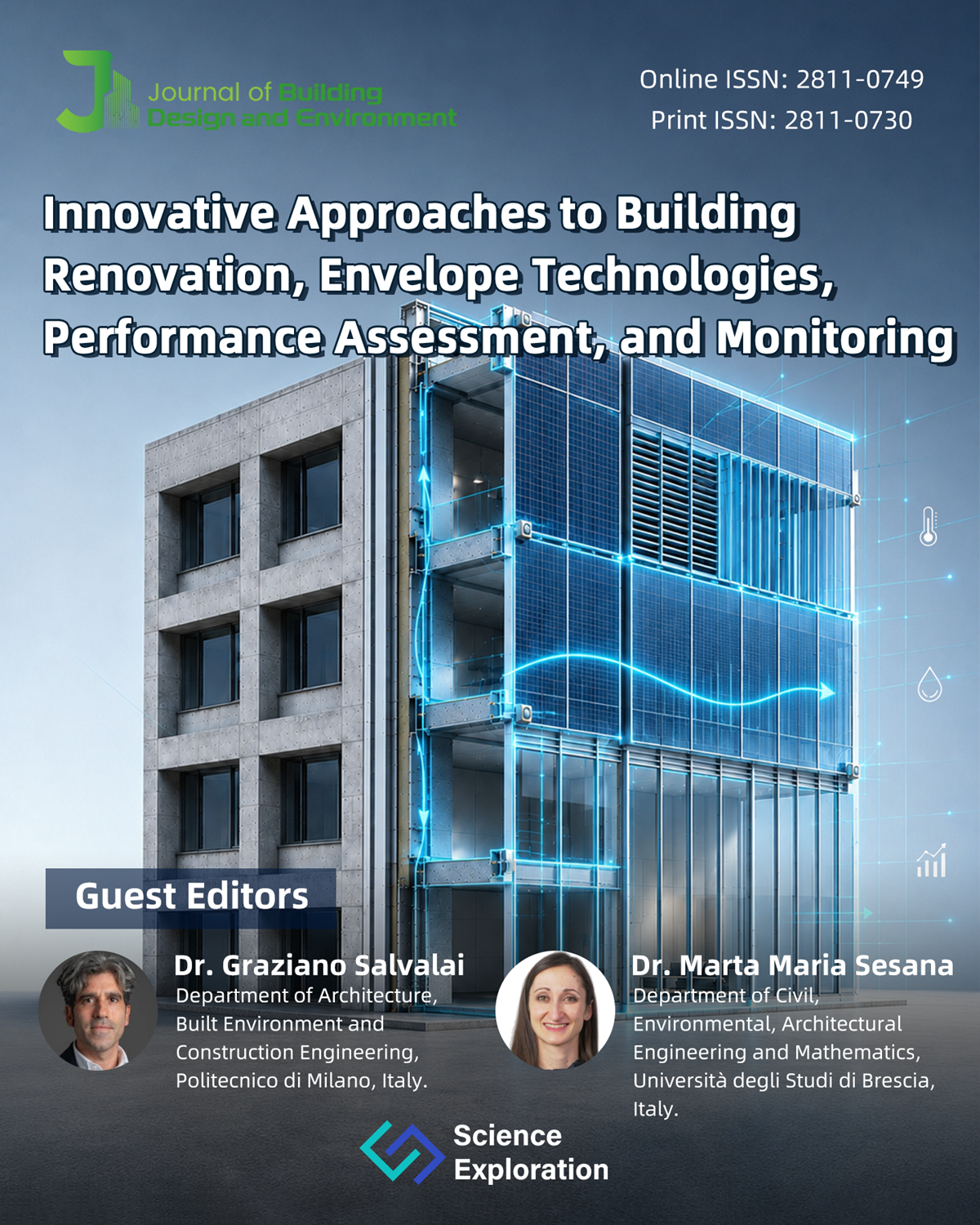
Guest Editor(s)
Department of Architecture, Built Environment and Construction Engineering, Politecnico di Milano, Milano, Italy.
Special Issue Information
The urgent need to decarbonize the building sector and improve the resilience and quality of the existing building stock is accelerating the transition toward innovative and integrated approaches to building renovation. As most of the buildings that will be in use in the coming decades have already been constructed, deep renovation represents a key strategy for reducing energy consumption and carbon emissions while improving indoor environmental quality, occupant comfort, and the overall performance and durability of buildings.
Building envelopes play a central role in this transition, acting as the interface between indoor and outdoor environments and increasingly integrating advanced materials, adaptive components, renewable energy technologies, and digital solutions. However, the effective implementation of innovative renovation strategies still faces several challenges, including the complexity of existing buildings, uncertainties in actual energy performance, gaps between predicted and measured performance, moisture and durability risks, and the need to assess interventions from a life-cycle and cost-effectiveness perspective.
At the same time, advances in monitoring technologies, sensors, data acquisition systems, building performance simulation, and data-driven approaches are creating new opportunities to better understand the behaviour of buildings before and after renovation. Continuous monitoring and performance assessment can support evidence-based design, commissioning, operation, predictive maintenance, and the long-term verification of renovation outcomes.
This Special Issue aims to bring together cutting-edge research and innovative case studies addressing new approaches, technologies, methods, and tools for building renovation and envelope design. Contributions combining experimental investigations, numerical modelling, monitoring campaigns, post-occupancy evaluation, and real-world demonstration projects are particularly encouraged. By fostering interdisciplinary perspectives, this Special Issue seeks to advance knowledge and support the development of high-performance, resilient, low-carbon, and reliable renovation solutions for the existing built environment.
We invite original research articles, review papers, case studies, and perspectives that contribute to advancing knowledge, practice, and implementation in this rapidly evolving field.
Keywords of the Special Issue:
• Innovative approaches to building renovation
• Deep and energy-efficient renovation
• Building envelope technologies and systems
• Advanced and multifunctional façade systems
• Adaptive and responsive building envelopes
• High-performance insulation and innovative materials
• Prefabricated and off-site renovation solutions
• Building-integrated renewable energy technologies
• Building performance assessment and verification
• Energy performance gap
• Experimental and in-field performance monitoring
• Building envelope monitoring and diagnostics
• Indoor environmental quality and occupant comfort
• Post-occupancy evaluation
• Building energy simulation and calibration
• Data-driven and AI-based performance assessment
• Digital twins and sensor-based building management
• Moisture, durability, and hygrothermal performance
• Life-cycle assessment and embodied carbon
• Cost-effectiveness and life-cycle performance of renovation strategies
Contact Us
Journal Editorial Office Email: jbdejournal@sciexplor.com
For Author Instructions, please refer to: www.sciexplor.com/jbde/author_instructions
For Online Submission, please login at: http://www.intellimanus.com/#/login?journalPath=jbde