
Table of Contents
Chemistry, manufacturing, and controls strategies for antibody-targeted lipid nanoparticles
Antibody-targeted lipid nanoparticles (Ab-LNPs) represent a highly promising delivery platform for precision therapy, enabling efficient in vivo targeted delivery of nucleic acid drugs such as mRNA, DNA and siRNA. Currently, the two primary strategies ...
More.Antibody-targeted lipid nanoparticles (Ab-LNPs) represent a highly promising delivery platform for precision therapy, enabling efficient in vivo targeted delivery of nucleic acid drugs such as mRNA, DNA and siRNA. Currently, the two primary strategies for antibody functionalization of LNPs are the post-insertion method and direct surface conjugation. This review outlines the key chemistry, manufacturing, and controls challenges associated with scaling up of Ab-LNP production, with a focus on antibody modification strategies, process scale-up challenges, and quality control considerations. It aims to provide practical guidance for translating Ab-LNP technology from laboratory research to scalable manufacturing.
Less.Ri Huang, ... Congcong Xu
DOI:https://doi.org/10.70401/bmeh.2026.0022 - April 01, 2026
The fusion of magnesium alloys and nanotechnology for bone repair: A review
Magnesium alloys are primarily composed of magnesium, with the additions of elements such as calcium, yttrium, and zinc. In the human physiological environment, they gradually degrade, and their degradation products can be absorbed, exhibiting excellent ...
More.Magnesium alloys are primarily composed of magnesium, with the additions of elements such as calcium, yttrium, and zinc. In the human physiological environment, they gradually degrade, and their degradation products can be absorbed, exhibiting excellent biocompatibility, mechanical properties comparable to bone tissue, and degradability; thus, they hold broad prospects in orthopedics. Nanotechnology involves the design and manufacture of materials, devices, and systems with unique physical, chemical, and biological properties by controlling the arrangement and interactions of atoms, molecules, or nanostructural units at the nanoscale (1-100 nm). The integration of these two technologies shows exceptional potential for orthopedic regenerative repair. Nanotechnology significantly enhances the mechanical performance, bioactivity, antibacterial properties, and controlled degradation of biodegradable magnesium alloys through various approaches, while biodegradable magnesium alloys provide an ideal biomaterial carrier for nanotechnology, enabling the better exertion of its advantages in bone tissue repair. This review summarizes the innovations arising from the fusion of magnesium alloys and nanotechnology in bone repair, aiming to advance the evolution of orthopedic medical devices, promote a shift in clinical treatment paradigms toward personalized and precise therapy, and ultimately deliver superior and more efficient therapeutic options for patients with orthopedic conditions, thereby improving human health and quality of life.
Less.Yuzhuo Tan, ... Yongping Wang
DOI:https://doi.org/10.70401/bmeh.2026.0021 - March 16, 2026
Coating modification techniques for medical catheters: From methods to applications
Medical catheters constitute indispensable components of contemporary healthcare, yet they are confronted with persistent limitations in biocompatibility and functionality, such as thrombosis, infection, and tissue injury, which adversely affect ...
More.Medical catheters constitute indispensable components of contemporary healthcare, yet they are confronted with persistent limitations in biocompatibility and functionality, such as thrombosis, infection, and tissue injury, which adversely affect patient safety and therapeutic outcomes. Surface coating technology has consequently arisen as a critical approach to reengineer the catheter-biological interface, thereby augmenting functional performance while preserving the intrinsic properties of the bulk materials. This review systematically outlines recent advances in coating technologies for medical catheters. It begins by analyzing mainstream coating methods, such as layer-by-layer self-assembly, surface grafting, and biomimetic adhesion, followed by the introduction of coatings with anticoagulant, antibacterial, lubricant, and multifunctional properties. The effectiveness and challenges of these coatings in clinical applications, such as cardiovascular intervention, long-term indwelling urinary catheters, and respiratory management are critically examined. Finally, the review discusses current translational bottlenecks and future trends toward intelligent, durable, and cost-effective coating solutions, providing a comprehensive reference for developing next-generation high-performance medical catheters.
Less.Haoxiang Chen, ... Changyou Gao
DOI:https://doi.org/10.70401/bmeh.2026.0020 - March 09, 2026
Adipose-derived stem cell exosomes for skin wound healing: Exploring opportunities and challenges
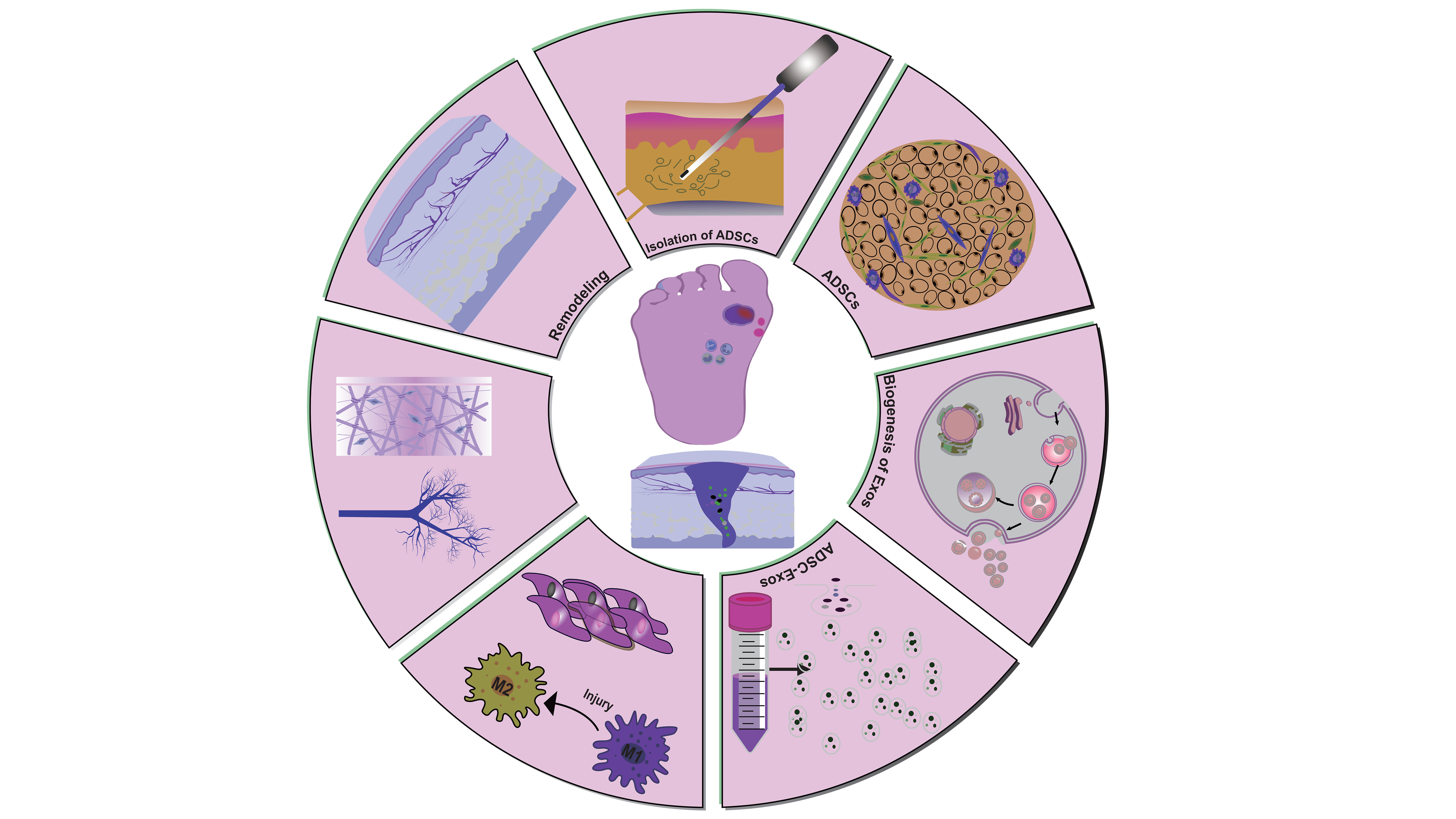
Adipose-derived mesenchymal stem cells (ADSCs) are increasingly recognized as a promising therapeutic tool in regenerative medicine, particularly for skin wound repair. However, achieving consistent and effective healing remains a clinical challenge, ...
More.Adipose-derived mesenchymal stem cells (ADSCs) are increasingly recognized as a promising therapeutic tool in regenerative medicine, particularly for skin wound repair. However, achieving consistent and effective healing remains a clinical challenge, especially in chronic or complex wounds. ADSC-derived exosomes (ADSC-Exos) have emerged as a key cell-free alternative, functioning as nanoscale messengers that transfer bioactive molecules to coordinate tissue regeneration. Unlike cell-based therapies, ADSC-Exos offer enhanced safety, stability, and logistical advantages while retaining potent regulatory capacity. They orchestrate multiple stages of wound healing by promoting angiogenesis, modulating inflammation, and accelerating re-epithelialization. This review first evaluates the relative benefits and limitations of various mesenchymal stem cells-derived cell populations for wound therapy. We then systematically examine the molecular mechanisms and functional roles of ADSC-Exos in skin repair, highlighting recent advances in their isolation, engineering, and delivery. Furthermore, we discuss current challenges and strategic insights for clinical translation. By integrating existing evidence with future perspectives, this review aims to guide the development of ADSC-Exos-based acellular therapies toward improved wound regeneration outcomes.
Less.Haoxuan Ji, ... Yujie Liang
DOI:https://doi.org/10.70401/bmeh.2026.0019 - March 05, 2026
Engineered T cell-derived extracellular vesicles for cancer immunotherapy
T cell-derived extracellular vesicles (TcEVs) are nanoscale lipid bilayer-bound particles, including exosomes, microvesicles, apoptotic bodies, and T cell microvilli particles. TcEVs possess advantages such as high yield, favorable biocompatibility, ...
More.T cell-derived extracellular vesicles (TcEVs) are nanoscale lipid bilayer-bound particles, including exosomes, microvesicles, apoptotic bodies, and T cell microvilli particles. TcEVs possess advantages such as high yield, favorable biocompatibility, low immunogenicity, and excellent solid tumor penetration, showing great potential in cancer immunotherapy. However, natural TcEVs exhibit weak targeting ability, limited immune activity, and low drug-loading capacity. To address these issues, several engineering strategies have been adopted to modify the vesicles through genetic engineering, surface modification, and drug-loading, thereby achieving effective treatment of both hematological and solid tumors. This review summarizes TcEVs’ classification, biological functions, engineering strategies, and applications in cancer immunotherapy, while discussing challenges and prospects to facilitate their clinical translation.
Less.Rui Diao, ... Xudong Zhang
DOI:https://doi.org/10.70401/bmeh.2026.0017 - March 01, 2026
Defect-engineered black titanium dioxide for near-infrared cancer phototherapy: A review
Traditional cancer treatment methodologies, including chemotherapy, surgery, radiotherapy, and immunotherapy, commonly lead to severe adverse reactions. In recent years, innovative treatment modalities, particularly photodynamic therapy (PDT) ...
More.Traditional cancer treatment methodologies, including chemotherapy, surgery, radiotherapy, and immunotherapy, commonly lead to severe adverse reactions. In recent years, innovative treatment modalities, particularly photodynamic therapy (PDT) and photothermal therapy (PTT), have garnered increasing attention due to their enhanced therapeutic levels. Against this background, black TiO2, a new kind of functional material, has become a research emphasis in the domain of cancer treatment. This material exhibits broad spectral absorption and strong near-infrared light penetration, enabling it to efficiently satisfy the optical requirements of both PDT and PTT. This article presents a mini review of PDT, PTT, and their synergistic combination strategies based on black TiO2.
Less.Yun-Fei Pei, ... Liang-Yu Chen
DOI:https://doi.org/10.70401/bmeh.2026.0018 - March 01, 2026