Precision geromedicine conference 2026 - Unlock Healthy Longevity nutraceuticals and repurposed drugs: Conference report

Duarte Barros
1,2,#

,
Wejdan M. Alenezi
1,2,#
,
Weilan Wang
1,2
,
Lihuan Guan
1,2
,
Nir Eynon
3
,
Morten Scheibye-Knudsen
4
,
Magali Moreau
5
,
Geng Zong
6
,
Vasso Apostolopoulos
7
,
Chen Huei Leo
8
,
Evandro Fei Fang
9,10
,
Shu-Qin Cao
10
,
Vincenzo Sorrentino
2,11
,
Barry Halliwell
11,12
,
Bob Beelman
13
,
Lin Yi
14
,
Wang Qingyun
2
,
Sandra Aleksic
15,16
,
Christian Sotelo
1
,
Grace Keh
2
,
Jordi Morwani-Mangnani
1,2
,
Christophe Lay
17,18
,
Denise Teo
19
,
Grace Shu Hui Chiang
20
,
Mazzarine Dotou
1,2
,
Guido Kroemer
21,22,23
,
Diana M. K. Tan
24,25
,
Tashiya Mirando
26,27,28
,
José María Valderas
29
,
Eu Leong Oh
19
,
Neil Forrest
26
,
Wanviput Sanphasitvong
30,31
,
Manjit Sareen
32
,
Dushani L. Palliyaguru
33
,
Michael Dunn
34
,
Henry Kwek
35
,
Paul Anantharajah Tambyah
36
,
Lars Hartenstein
37
,
Marek Piotrowski
38
,
Harpreet Bindra
39
,
Allen Law
40
,
Tim Shi
41
,
Shamandree Govender
19
,
Raymond Chua
42,43
,
Johannes Jacobus Meij
2,44
,
Andrea B. Maier
1,2,45,*
*Correspondence to:
Andrea B. Maier, NUS Academy for Healthy Longevity, Yong Loo Lin School of Medicine, National University of Singapore, Singapore 117456, Singapore; Healthy Longevity Translational Research Programme, Yong Loo Lin School of Medicine, National University of Singapore, Singapore 117597, Singapore; Department of Human Movement Sciences, @AgeAmsterdam, Faculty of Behavioural and Movement Sciences, Vrije Universiteit Amsterdam, Amsterdam Movement Sciences, Amsterdam 1081 BT, The Netherlands.
E-mail: a.b.maier@vu.nl
Geromedicine. 2027;3:202644. 10.70401/Geromedicine.2026.0040
Received: July 10, 2026Accepted: September 23, 2026Published: October 08, 2026
Abstract
There is a growing demand from society for gerotherapeutic interventions that can extend healthspan. Yet the increasing commercialization of insufficiently validated gerotherapeutics threatens to undermine the public confidence and the responsible translation of healthy longevity research into practice. The Unlock Healthy Longevity Conference 2026 convened international experts in Singapore to exchange scientific advances in precision geromedicine, with a particular focus on nutraceuticals and repurposed drugs. Precision geromedicine is increasingly being translated into clinical settings; however, standardized frameworks for clinical evaluation, implementation, quality assurance, and oversight remain insufficiently established. This emerging paradigm emphasises the need for collaboration across multiple stakeholders to support the development of a robust, safe, scalable, and equitable ecosystem. A central theme across the sessions was the need to advance clinical human validation, translation, and the development of standards and clinical guidelines. Panel discussions converged on the importance of developing robust clinical and data infrastructures to generate reproducible evidence capable of informing real-world clinical practice and enable equitable access to healthy longevity. Presentations addressed emerging clinical biomarkers of ageing and data-driven approaches to guide gerotherapeutics, including changes in DNA methylation and skin and gut as organ-level readouts of biological ageing. Several potential candidate gerotherapeutics were discussed, including the nutraceutical compounds urolithin A and ergothioneine, and repurposed drugs such as glucagon-like peptide-1 receptor agonists and sodium-glucose cotransporter 2 inhibitors. Additional sessions explored the clinical implementation of gerotherapeutics taking into account ethical, safety, and regulatory considerations. This report summarises the key messages and research priorities presented at the conference.
Keywords
Nutraceuticals, drugs, healthspan, longevity
1. Introduction
The field of healthy longevity is rapidly growing, driven by scientific advances, commercial innovation, and increasing consumer demand[1-3]. However, responsible clinical translation of healthy longevity research is still constrained by a lack of a global regulatory and standardised clinical framework. The proliferation of unvalidated efficacy overclaims associated with some gerotherapeutic interventions, including nutraceuticals, products derived from food sources that provide health benefits[4], has outpaced their rigorous clinical validation[1]. In addition, the high costs associated with healthy longevity medicine (HLM) clinics create inequity in access, where the field is currently benefiting a selected niche, while excluding the vast majority[1].
From 26 to 27 February 2026, the National University of Singapore (NUS) Academy for Healthy Longevity at the NUS hosted the Unlock Healthy Longevity Conference 2026: Nutraceuticals and Repurposed Drugs. The conference brought together experts and key stakeholders from across research, education, clinical practice, innovation, entrepreneurship, policy, and investment in the rapidly evolving field of precision geromedicine, a field that requires robust translational frameworks, defined evidence-based clinical standards, and coordinated implementation strategies. With over 500 in-person participants from 40 countries, alongside a global online audience, the conference provided an international platform for scientific exchange, cross-sector dialogue, and collaboration in geroscience and precision geromedicine (Figure 1).
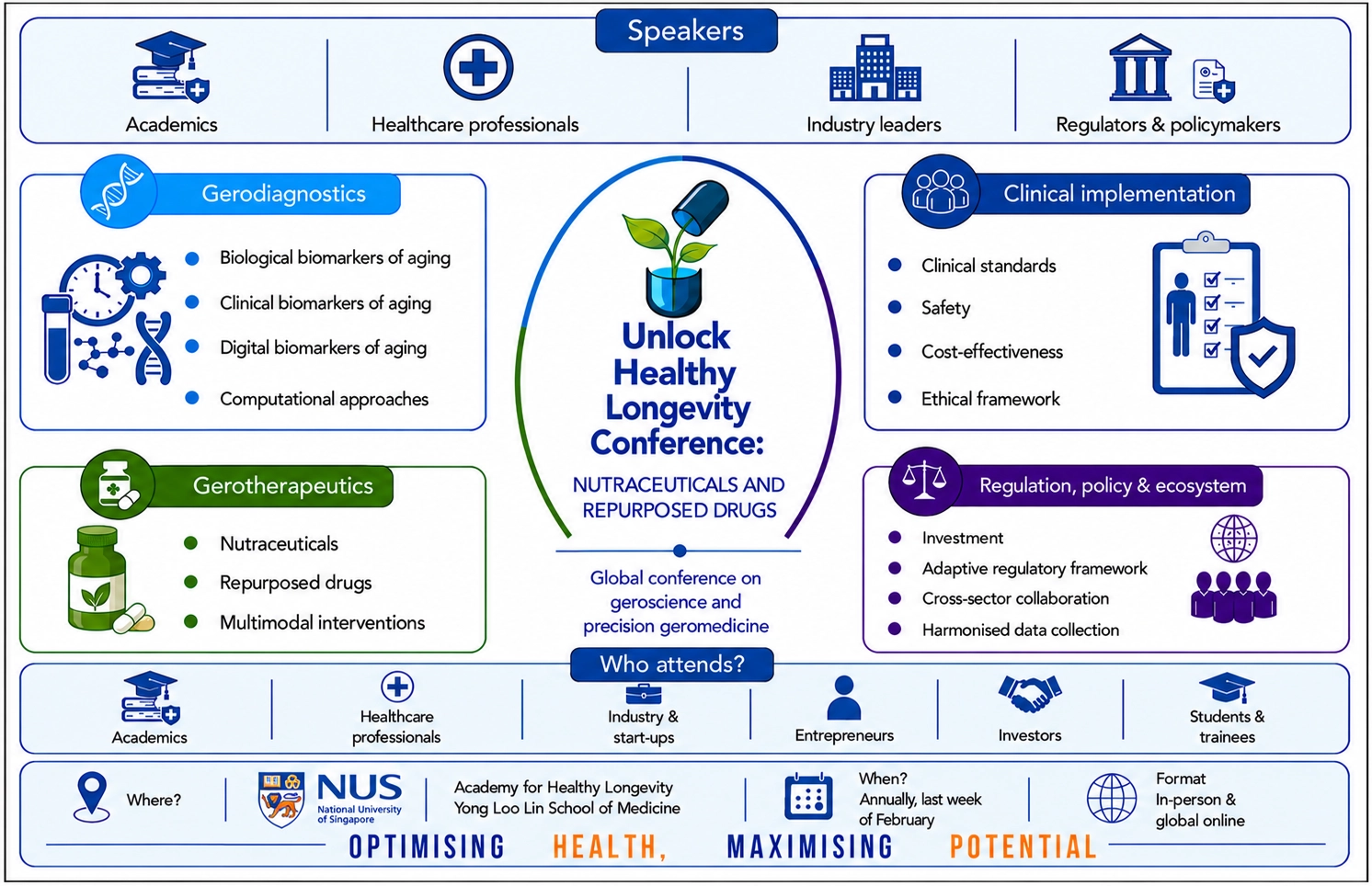
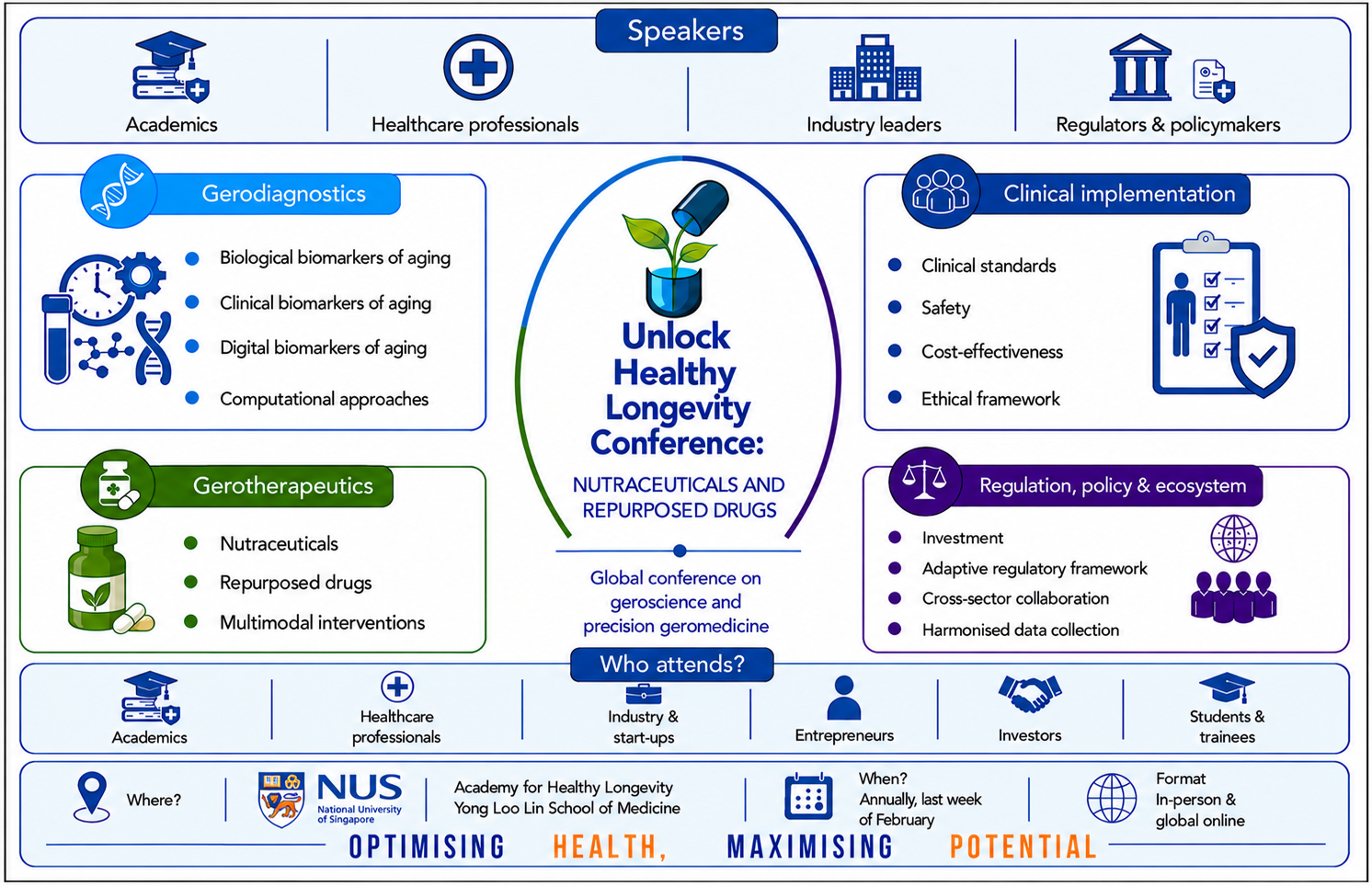
The conference programme featured 33 expert presentations and panel discussions that addressed key challenges and set the roadmap for new frontiers in the field. A start-up pitch competition and a poster lightning talk competition were also part of the programme to drive innovation, foster global collaboration, empower emerging talent, and accelerate the development of solutions with real-world impact. These broad initiatives were integrated as part of the conference to strengthen the pipeline of future leaders, technologies, and discoveries in geroscience and precision geromedicine.
A particular emphasis was placed on the gerotherapeutic potential of nutraceuticals and repurposed drugs, while also addressing the broader ecosystem challenges required for their responsible translation into clinical practice. Main topics covered emerging gerodiagnostics such as biological and clinical ageing biomarkers and data-driven approaches to guide gerointerventions, gerotherapeutic candidates such as nutraceutical compounds including urolithin A and ergothioneine; and the potential of repurposed drugs including glucagon-like peptide-1 (GLP-1) receptor agonists and sodium-glucose cotransporter 2 (SGLT2) inhibitors. From a clinical perspective, discussions focused on how gerodiagnostics and gerotherapeutics can be responsibly implemented in healthy longevity clinics, while managing consumer safety, and the evolution of regulatory and clinical standards (Figure 2).
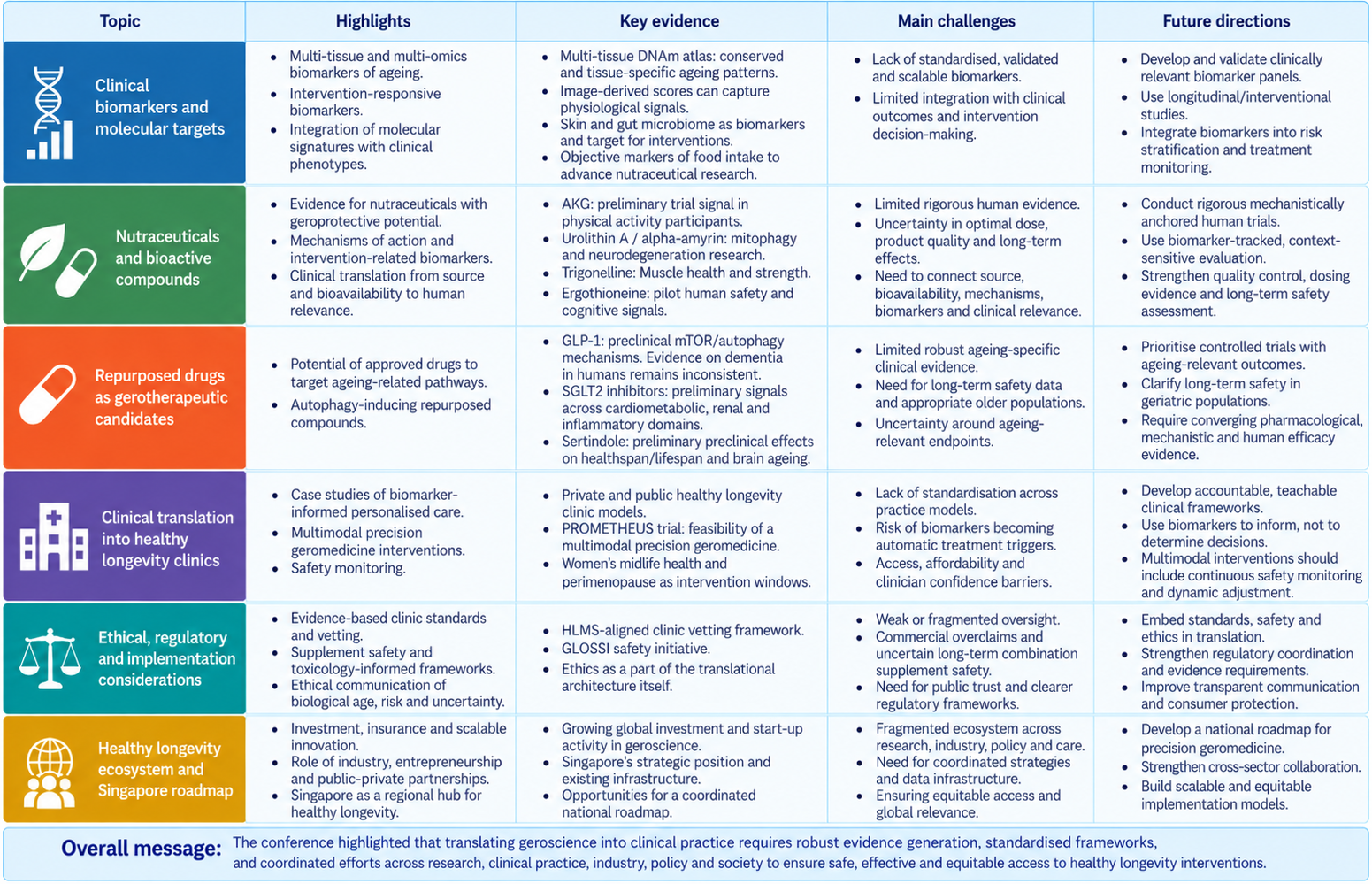
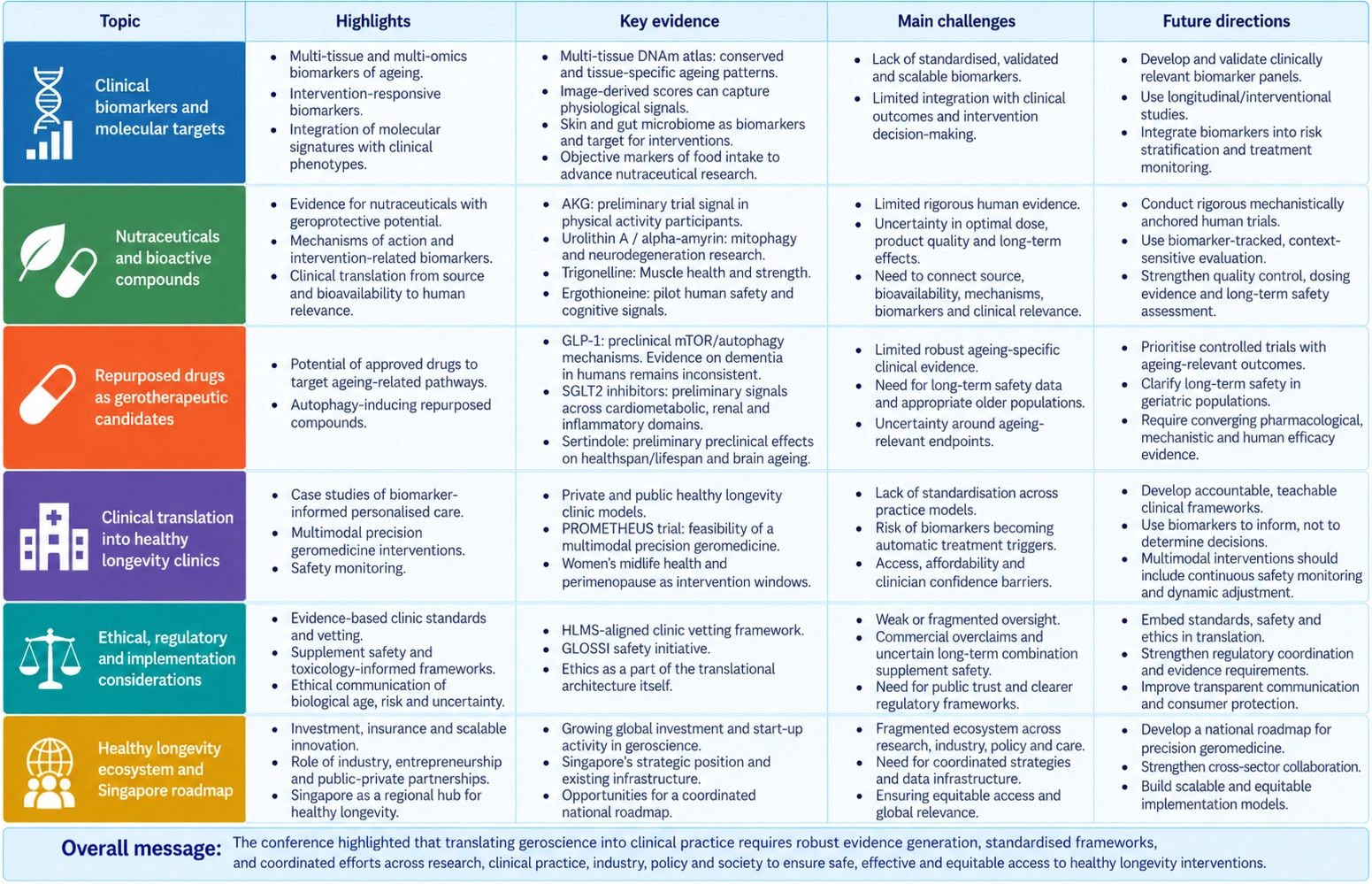
Figure 2. Summary of conference topics, highlights and future directions.
Together, these themes position geroscience as an increasingly mature scientific field and precision geromedicine as its clinical translation into a developing medical field, requiring rigorous evidence generation, evidence-based clinical standards, accountable practice, and coordinated translational, regulatory, and implementation pathways[1,5,6].
2. Clinical Biomarkers and Molecular Targets
A central gap between geroscience and its translation to precision geromedicine is connecting tissue-level biology, clinically relevant phenotypes, and intervention-relevant mechanisms in a way that can support precision clinical translation[7,8]. Within this context, Nir Eynon, Morten Scheibye-Knudsen, Magali Moreau, Christophe Lay, and Geng Zong presented examples of biomarkers of ageing and intervention-related biomarkers.
Nir Eynon (Monash University, Australia) emphasised that ageing cannot be fully understood through a single tissue, linear trajectory, or biomarker class. His group’s work on the development of a multi-tissue atlas of human epigenetic ageing provides a comprehensive mapping of age-associated epigenetic patterns, integrating more than 15,000 methylomes across 17 tissues[9]. The analysis of three layers of methylome dynamics demonstrated that ageing is associated with both tissue-specific and conserved cross-tissue patterns in the methylome[9,10]. Specifically, they found that protocadherins (PCDHs), a group of cell-cell adhesion molecules vital for neuronal development and involved in TF regulation, show coordinated age-related changes across multiple tissues[9]. While DNA methylation changes with ageing, his team demonstrated that exercise training can induce significant shifts toward a younger methylome and transcriptome profile in human skeletal muscle[11]. At the organ level, Magali Moreau (L’Oreal R&I, USA) provided compelling data supporting skin as an accessible organ-level readout of biological ageing processes. Her presentation showed how skin ageing reflects chronic inflammation[12], exposome-related damage[13], microbiome shifts[14], proteomic changes[15], and glycation biology[12,14,16], and how these data may be used to predict skin biological ageing and identify targets for intervention. Using computational approaches, Morten Scheibye-Knudsen (University of Copenhagen, Denmark) demonstrated that facial images, pathology records, and histological images can be translated into measures of biological ageing using computational approaches. These methods have the potential to stratify risk, predict future disease, and identify targets for intervention. His data established that image-derived risk scores can predict mortality and capture physiological signals not reflected in standard clinical assessments[17,18]. He presented an additional approach to quantifying ageing phenotypes through the assessment of cellular senescence[19], showcasing its potential to predict future breast cancer risk in women[20,21]. Both measures can diverge under different environmental exposures, capturing different features of ageing[22], and can be responsive to interventions[23].
From a precision nutrition perspective, Christophe Lay (Danone Research and Innovation, Singapore) positioned the gut microbiome as a key interface in the biology of ageing with systemic relevance for immune, metabolic, muscle, and brain health[24]. He further highlighted it as a promising biomarker and target for nutritional interventions. The development of objective markers of food intake was introduced by Geng Zong (Fudan University, Shanghai, China). His group’s framework includes pharmacokinetic characterisation of food-derived compounds, large-scale metabolomics platforms, and validation in large cohort studies[25]. Such biomarkers hold promise for advancing nutraceutical research beyond self-reported dietary assessments.
Together, these presentations underscore the importance of validated, integrative biomarker development approaches that can bridge tissue- and organ-level molecular biology with clinically relevant phenotypes, risk stratification, and the evaluation of targeted gerointerventions, thereby supporting the broader clinical translation of geroscience.
3. Nutraceuticals and Bioactive Compounds
Nutraceutical research still faces a translational challenge as many bioactive compounds are biologically intriguing, yet relatively few are studied through an integrated framework that connects source, bioavailability, target biology, biomarkers, and clinical relevance. The central challenge is therefore not whether bioactive compounds may contribute to healthy longevity, but how to identify those with genuine translational potential and distinguish them from compounds supported only by fragmented or preliminary evidence[26]. Addressing this challenge, Lihuan Guan, Vasso Apostolopoulos, Chen Huei Leo, Weilan Wang, Evandro Fei Fang, Shu-Qin Cao, Vincenzo Sorrentino, Barry Halliwell, Bob Beelman, and Lin Yi presented nutraceuticals and bioactive compounds with promising potential for human translation.
Lihuan Guan (NUS, Singapore) reported findings from a systematic review indicating that dietary ingredients such as resveratrol, vitamin E, and soy protein isolate show promise as senotherapeutics, therapies designed to target cellular senescence, in animal models, while also highlighting the limited evidence in humans. She also showed that high-fat diets consistently induce cellular senescence across multiple organ systems in animal models[27]. Vasso Apostolopoulos (RMIT, Australia) positioned bioactive compounds within a wider translational programme that spans disease mechanisms, biomarkers, clinical trials, lifestyle medicine, and AI-enabled monitoring. She presented evidence supporting the anti-inflammatory and anticancer properties of compounds such as carnosine and vitamin B6[28,29]. Chen Huei Leo (NUS, Singapore) further reported that food by-products such as okra seed extracts can yield flavonoid-rich fractions with antioxidant, anti-inflammatory, and anti-photoageing effects in skin models, linking sustainability with bioactive discovery[30,31].
The presentations then moved from broader nutraceuticals to specific compounds with emerging translational relevance such as alpha-ketoglutarate (AKG), urolithin A, α-amyrin, nicotinamide adenine dinucleotide (NAD+) precursors, and ergothioneine.
Weilan Wang (NUS, Singapore) presented preliminary unpublished results from a randomised controlled trial of AKG in middle aged biologically older adults[32], with supporting evidence of safety and efficacy of this nutraceutical in lowering the biological age only in participants who were physically active. Evandro Fei Fang (University of Oslo, Norway) provided both preclinical and clinical evidence that the decline in mitophagy observed in Alzheimer’s disease may be linked to impairment of Unc-51 Like autophagy activating kinase 1 (ULK1)[33,34]. This impairment may contribute to the accumulation of amyloid-β (Aβ) plaques alongside hyperphosphorylated tau and the formation of intracellular neurofibrillary tangles[33]. In experimental studies, urolithin A and NAD+ precursors restored mitophagy and improved memory in Alzheimer’s disease animal models and AD iPSC-derived neurons[35,36]. He is now leading a phase II clinical trial on urolithin A in early-stage Alzheimer’s disease patients. Shu-Qin Cao (University of Oslo, Norway) extended this neuroprotective focus by presenting α-amyrin isolated from passion fruit as a robust mitophagy inducer that can modulate the dual leucine zipper kinase (DLK)-sterile alpha and toll/interleukin-1 receptor motif-containing protein 1 (SARM1)-ULK1-autophagy/mitophagy axis. Intriguingly, α-amyrin can pass the blood-brain barrier and inhibit memory loss in preclinical models of Alzheimer’s disease[37,38]. Vincenzo Sorrentino (NUS, Singapore) focused on the modulation of NAD+ metabolism to influence ageing and related conditions[39]. His work demonstrated that trigonelline, a natural alkaloid, is associated with NAD+ levels and muscle health across multiple species and that its supplementation supported muscle strength in aged rodents[40]. From another perspective within the NAD+ cycle, Nicotinamide N-Methyltransferase (NNMT) is a key metabolic-epigenetic driver of renal tubular senescence and kidney fibrosis in early chronic kidney disease. His team demonstrated that NNMT inhibition in senescent kidney cells, organoids, and in vivo models exerts protective effects, highlighting its potential as a senotherapeutic strategy[41].
Barry Halliwell (NUS, Singapore) explored ergothioneine, a compound with a wide tissue distribution that includes the brain[42]. He reported that plasma concentrations of ergothioneine are reduced in neurodegenerative diseases, with lower levels associated with accelerated cognitive decline and potential prediction of dementia onset[43,44]. His team conducted a controlled pilot trial in older adults demonstrating that one year of ergothioneine supplementation was feasible and safe, with preliminary evidence of improved global cognitive performance and stabilisation of plasma neurofilament light chain levels[45]. Building on this, Robert Beelman (Pennsylvania State University, USA) explored ergothioneine across biology and food systems, showing that this compound is concentrated in mushrooms and fungal networks and is influenced by agricultural practices and soil health. These findings suggest a potential link between environmental quality and human ageing biology[46]. From an industry perspective, Lin Yi (Abinopharm Inc.) described the translational pathway from scientific discovery to manufacturing strategy, including manufacturing process development, quality control, regulatory compliance, clinical application, and commercialization of ergothioneine.
A panel of experts comprising Robert Beelman, Lin Yi, and Geng Zong, moderated by Barry Halliwell, discussed ergothioneine, focusing on its natural sources such as mushrooms, and key limitations in the supplement industry, including variability in product quality and labelling, and uncertainty around the optimal dose. They also highlighted promising research areas, including cognitive health, dementia, immune function, metabolism, and mitochondrial activity[43,47-49]. The panel concluded that ergothioneine is a safe and biologically interesting compound with potential health benefits, but its optimal use, full physiological role, and long-term effects are not yet fully established, and more rigorous human studies are still needed[47].
Collectively, these presentations shifted the discussion of nutraceuticals from biological promise to translational readiness, emphasising that clinical relevance depends on traceable source characterisation, demonstrable bioavailability, plausible mechanisms, validated biomarkers, and rigorous human evidence rather than isolated preclinical or compositional findings.
4. Repurposed Drugs as Gerotherapeutic Candidates
Ageing is not currently recognised as a disease by the Food and Drug Administration (FDA). Therefore, drug repurposing presents one of the most immediate translational opportunities in geromedicine. However, the challenge is to identify agents such as GLP-1 or SGLT2 whose pharmacology, ageing mechanisms, clinical signals, and safety profiles support their use as credible gerotherapeutic candidates[50]. Wang Qingyun, Sandra Aleksic, Christian Sotelo, and Grace Keh presented evidence on potential gerotherapeutic candidates.
Wang Qingyun (NUS, Singapore) provided mechanistic preclinical support for GLP-1 receptor agonists in extending lifespan in Caenorhabditis elegans through neuronal mammalian Target of Rapamycin (mTOR) inhibition and autophagy-related pathways, while carefully noting that this mechanism has not yet been shown to translate into mammalian lifespan extension. In human-based studies, Sandra Aleksic (Albert Einstein College of Medicine, USA) positioned GLP-1 receptor agonists and SGLT2 inhibitors as potential gerotherapeutic candidates, due to their role at the intersection between ageing, metabolic dysfunction, and dementia[50]. While observational data suggest associations with reduced dementia risk[51,52], clinical trial evidence remains inconsistent. She therefore emphasised the need for further long-term clinical studies in geriatric populations, particularly to clarify safety profiles and evaluate potential gerotherapeutic effects. Christian Sotelo (NUS, Singapore) further reported evidence supporting the potential candidacy of SGLT2 inhibitors as gerotherapeutics, based on preliminary unpublished findings from a systematic review of their off-label use. His results suggest beneficial effects beyond glucose lowering, particularly across cardiovascular, metabolic, renal, and inflammatory domains, with increased rates of metabolic syndrome remission and weight reduction without parallel loss of skeletal muscle mass, in both healthy and comorbid populations. Beyond cardiometabolic candidates, Grace Keh (NUS, Singapore) widened the repurposing landscape by identifying an autophagy-inducing anti-psychotic, Sertindole, which could extend healthspan and lifespan in worm and fly models. She noted that anti-psychotics offer the advantage of being brain-penetrant, and shared preliminary data that suggested Sertindole's ability to modulate brain ageing by protecting against astrosenescence and improving synaptic plasticity.
These presentations reinforced that, while drug repurposing offers an immediate route for translating geroscience into clinical practice, candidate gerotherapeutics require more than biological plausibility. Their clinical relevance will depend on converging evidence across pharmacology, mechanisms of ageing, human efficacy signals, and safety, particularly in older populations, before they can be responsibly advanced into precision geromedicine.
5. Clinical Translation of Precision Geromedicine into Healthy Longevity Clinics
Precision geromedicine is expanding, driven by a growing consumer demand[6]. However, the lack of standardisation across healthy longevity practice models, particularly those based on biomarker-driven decision-making and individualised interventions, may result in missed opportunities for geroprotection[6]. Within this context, Jordi Morwani-Mangnani, Christophe Lay, Denise Teo, Grace Shu Hui Chiang, Mazzarine Dotou, Guido Kroemer, Diana Tan, Tashiya Mirando, José María Valderas, Eu Leong Oh, Neil Forrest, and Wanviput Sanphasitvong presented findings on public and clinical perspectives.
Jordi Morwani-Mangnani (NUS, Singapore) explored data from the Healthy Longevity Consortium, a global survey evaluating public readiness, awareness, and demand for HLM[53]. He reported on the case of Singapore, where there is substantial consumer interest in HLM clinics. This interest appears to be shaped by knowledge, health behaviours, and motivation, suggesting a potential opportunity to design targeted strategies and expand reach to less involved populations[2].
Denise Teo (Chi Longevity, Singapore) detailed how biomarkers can be integrated into real-world decision-making without becoming automatic treatment triggers. In her case-based precision nutrition model, ageing signals such as GlycanAge, microbiome age, or Advanced Glycation End products-related risk were used as contextual inputs to design personalised lifestyle interventions targeting modifiable ageing drivers and predefined functional endpoints, with clear evaluation of intervention response and dynamic adjustments. In a complementary public ecosystem model, Grace Shu Hui Chiang (Alexandra Hospital, Singapore) further illustrated how a similar framework is being implemented at the Alexandra Hospital healthy longevity research clinic, where multimodal baseline assessment, biological ageing measures, and personalised care planning were embedded into a public-sector observational cohort[54]. Mazzarine Dotou (NUS, Singapore) reported preliminary unpublished data supporting the feasibility of the PRecision gerOMedicinE: Tailored Healthy agEing with lifestyle, sUpplements and drugS (PROMETHEUS) study[55], a multimodal precision geromedicine intervention tailored to participant profiles that targeted multisystem function. This tailored intervention showed feasibility, high participant engagement, and substantial inter-individual variability in responses across physiological systems, underscoring the need for personalised interventions. This study provided a blueprint for precision geromedicine practice that can be implemented into healthy longevity medicine clinics[54].
Extending the discussion, Guido Kroemer (Université de Paris Cité, France) stated that precision geromedicine should not only focus on adding interventions but also consider deprescribing when certain exposures may accelerate biological ageing. His talk argued that benzodiazepines and chronic glucocorticoid exposure may accelerate ageing through a shared ACBP/DBI-linked pathway involving autophagy inhibition, metabolic dysfunction, senescence, and immunosuppression[56,57].
Diana Tan (Menopause Care Alliance, Singapore) focused on women’s health, where she showed that one of the largest missed opportunities for geroprotection, menopause, remains constrained not only by science, but also by low awareness, low clinician confidence, structural barriers in access and affordability, limited workplace support, and weak integration of women’s midlife biology into routine care. Tashiya Mirando (Osler Health International, Singapore) highlighted a paradigm shift from reactive symptom management to proactive systemic protection in women’s health, presenting perimenopause as a critical window for intervention[58]. She argued that hormone replacement therapy, when used at the right time, in the right patient, and guided by a multidomain, biomarker-driven personalised approach, can be reframed not only as a treatment for symptoms but also as a geroprotective strategy grounded in ovarian ageing, endocrine decline, and a healthspan-oriented intervention window[58].
A panel of experts comprising José María Valderas (The National University Health System (NUHS) Department of Family Medicine, Singapore), Eu Leong Oh (Chi Longevity, Singapore), Neil Forrest (Osler Health, Singapore), and Wanviput Sanphasitvong (Bumrungrad Hospital, Thailand), moderated by Hans Meij (NUS, Singapore), outlined key clinical challenges of healthy longevity clinics. Drawing on perspectives from family medicine, private healthy longevity practice, and hospital-based care, the panellists converged on several points. At the core of healthy longevity clinic practice, the principle of “first, do no harm” remains essential when intervening in healthy adults. In this context, biomarkers of ageing should inform intervention decision-making while also enabling the monitoring of treatment response and safety. However, while the fields of nutraceuticals and repurposed drugs continue to evolve and novel biomarkers are being developed, lifestyle interventions remain the foundation of healthy longevity. The panel also emphasised that, while precision geromedicine may begin in highly specialized centres, its credibility will depend on whether it can eventually be standardized, taught, and responsibly extended into broader medical practice.
These topics demonstrated the move of precision geromedicine from a concept to care delivery: as demand is increasing, accountable healthy longevity clinic models require biomarker-informed rather than biomarker-determined decision-making, safety monitoring, lifestyle foundations, and standards that can be taught and extended beyond specialised centres.
6. Precision Geromedicine in Clinical Practice: Ethical, Regulatory, and Implementation Considerations
One of the main challenges is no longer whether ageing biology can be measured and modified, but how such biomarkers of ageing and gerointerventions should be introduced responsibly into practice[6]. Providing some insights into this challenge, Manjit Sareen, Dushani L. Palliyaguru, Michael Dunn, Henry Kwek, Paul Anantharajah Tambyah, Lars Hartenstein, and Marek Piotrowski shared perspectives spanning scientific, clinical, ethical, and translational dimensions.
Manjit Sareen (Longevity Clinics World, United Kingdom) outlined the need for the field to advance towards standardised and responsible practice, while responding to growing market enthusiasm and consumer demand. She described the work conducted by Longevity Clinics World in developing a vetting framework, in collaboration with the Healthy Longevity Medicine Society (HLMS)[59], to evaluate healthy longevity clinics against HLMS-defined evidence-based standards, thereby enhancing credibility for consumers. Dushani L. Palliyaguru (Healthsurveil, USA) provided a safety perspective by showing that the healthy longevity field increasingly relies on long-term and combination supplement use despite limited chronic-exposure data, weak pre-market oversight in many jurisdictions, contamination risks, and uncertain interaction effects across the life course. She then advocated for toxicology-informed safety frameworks for healthy longevity supplements, a Global Longevity Safe Supplements and Interventions Initiative (GLOSSI), which will provide a comprehensive roadmap for industries, physicians, consumers, and other stakeholders on how to formulate, manufacture, and incorporate safe and efficacious longevity supplements and interventions into their practice. Extending this responsibility to ethics, Michael Dunn (NUS, Singapore) addressed the ethical considerations of introducing precision geromedicine into clinical practice. He argued that ethics should not be an afterthought to innovation, but part of the translational architecture itself, particularly when shaping professional-patient relationships and communicating biological age, biomarker-based risk, uncertainty, and incidental findings[5].
At the policy and systems level, a panel of experts comprising Henry Kwek (Member of Parliament, Singapore), Paul Anantharajah Tambyah (NUHS, Singapore), Lars Hartenstein (McKinsey Health Institute, USA), and Marek Piotrowski (LiveBeyond.world), moderated by Hans Meij (NUS, Singapore), addressed implementation challenges. Drawing on perspectives from government, academic medicine and ethics, health policy, market strategy, and public communication, the panel identified key challenges, including the need for rigorous safety monitoring, a stronger evidence base, more integrated regulatory frameworks, clearer differentiation between evidence-based medicine and commercial overclaims, and sustainable models that determine what should be publicly supported, privately purchased, or insurer-funded. They concluded that implementation is not solely a technical challenge but a societal one, as the field of healthy longevity will remain fragile unless public understanding, regulation, and clinical credibility evolve in parallel.
In clinical practice of precision geromedicine, the central message was that precision geromedicine must be built not only around what can be measured or modified, but also around standards, safety, ethical communication, regulation, and public trust.
7. Building the Healthy Longevity Medicine Ecosystem: Investment and Future Directions
The field of precision geromedicine has expanded rapidly in recent years, particularly within the private sector, where access remains limited to selected populations. From this perspective, a panel presented different viewpoints on a shared challenge: how precision geromedicine can move from promising science to durable public, clinical, and commercial value, while also addressing the critical role of investment, scalability, and sustainable innovation in shaping the future of the HLM ecosystem. From Lars Hartenstein’s (McKinsey Health Institute, USA) perspective, HLM remains markedly underinvested relative to its economic potential. He underscored that progress and innovation in this field will require addressing challenges including a science-anchored field definition, biomarker consensus, translational and clinical development, regulatory dialogue, de-risked investment, and evidence-based practice infrastructure[60]. Furthermore, Harpreet Bindra (HSBC Life, Singapore) argued that healthy longevity must increasingly be understood as both a health trajectory and a financial one. From an insurance standpoint, this requires a shift from a reactive illness model towards early prevention, health literacy, workplace wellness, inclusive insurance, and community resilience. In doing so, his talk widened the ecosystem beyond clinics and products to include the financial structures that will determine whether healthy longevity remains a premium service or becomes part of a more sustainable societal model.
A panel of experts comprising Allen Law (Morrow Health, Singapore), Tim Shi (Asia-Pacific Longevity Medicine Society, Hong Kong, China), Shamandree Govender (Chi Longevity, Singapore), moderated by Andrea Maier (NUS, Singapore), discussed networking, validation, and investment in the healthy longevity field. Allen Law (Morrow Health, Singapore) emphasised that serious investment in this field requires patient capital because much of the evidence-based infrastructure is still being built. Tim Shi (Asia-Pacific Longevity Medicine Society, Hong Kong, China) highlighted validation as the missing bridge between scientific promise, investor confidence, and clinical adoption. Shamandree Govender (Chi Longevity, Singapore) made the clinical case that early specialized models may be expensive, but that standardisation, trust, and longitudinal outcomes are the pathways to broader democratisation. Across the discussion, the panellists agreed that healthy longevity medicine will scale only if research, validation, clinical governance, and capital formation are developed as one ecosystem rather than as isolated efforts.
Singapore ecosystem
Singapore is positioning healthy longevity as a national priority. Within this context, Raymond Chua and Andrea Maier presented the roadmap for precision geromedicine. Raymond Chua (Health Sciences Authority, Singapore) reinforced Singapore’s commitment to precision geromedicine, emphasising the need for collaboration across stakeholders to develop shared standards of evidence, validated biomarkers, appropriate clinical endpoints, and reproducible data. He also highlighted the importance of strong clinical governance and the co-creation of adaptive regulatory frameworks to support the development of longevity health products, ensuring robust consumer protection and clear regulatory pathways as the field matures. He noted that Singapore may not aim to be the loudest voice in healthy longevity innovation, but rather one of the most trusted, aligning innovation with evidence, progress with ethics, and advancing the field through a coordinated ecosystem[5]. Building on this national initiative, Andrea Maier (NUS, Singapore) outlined the agenda for the future of the field. She advocated the creation of a precision geromedicine registry, a human intervention testing programme modelled on the Intervention Testing Program (ITP) in ageing research, and the integration of randomised clinical trials within the precision geromedicine registry. She outlined that a national registry would enable the prospective and systematic collection of harmonised real-world data on efficacy and safety, supporting scalability and external validity. A human intervention testing programme with harmonised standard operating procedures and predefined outcomes would provide a structured platform to evaluate candidate gerotherapeutics and establish causality. Embedding clinical trials within the registry would further strengthen the generation of robust safety and efficacy data by combining internal and external validity, while accelerating evidence generation, regulatory acceptance, and cost efficiency.
Therefore, ecosystem building is a prerequisite for responsible scaling: investment, insurance frameworks, regulatory pathways, registries, and embedded trials must develop alongside clinical standards if precision geromedicine is to move beyond early adopters and become a credible, trusted, and scalable model of care.
8. Conclusion
The Unlock Healthy Longevity Conference 2026: Nutraceuticals and Repurposed Drugs conference highlighted both emerging evidence in precision geromedicine and the critical challenges that continue to shape the field. Novel gerodiagnostics are emerging and should be foundational to precision geromedicine, informing the prescription of gerotherapeutics while enabling continuous monitoring and dynamic tailoring to individual gerotypes. Nutraceuticals, including urolithin A, ergothioneine and NAD+ precursors, have shown promising results in preclinical models, yet a substantial translational gap remains in human clinical trials. It will require a geromedicine framework in which compounds are mechanistically anchored, measurably delivered, biomarker-tracked, context-sensitive, and tested with sufficient rigor to distinguish true intervention potential from early biological signal. Repurposed drugs such as GLP-1 receptor agonists, SGLT2 inhibitors and rapamycin represent potential gerotherapeutic candidates, although robust clinical evidence and long-term safety data are still lacking. The healthy longevity field now has growing biological insight, rising consumer demand, and expanding clinical activity, yet it still lacks the connected infrastructure needed to link validated science with trusted clinics, responsible industry, and scalable models of access. The challenge is to build an ecosystem that translates evidence-based precision geromedicine from the laboratory to clinical practice. In the context of the conference, this means that promising compounds or repurposed agents cannot be judged by mechanistic plausibility alone; they must also pass through rigorous standards of communication, monitoring, safety, governance, and equitable clinical use. The future direction of precision geromedicine requires standardisation and its transition towards a rigorous, data-driven medical discipline. Singapore offers a unique opportunity to support this transition through the development of a precision geromedicine registry and the integration of clinical trials within this framework. By bringing together stakeholders across academia, clinical practice, industry, and policy, the conference signals a shift in the field from fragmented and exploratory efforts to a more coordinated, evidence-based, and translational precision geromedicine framework.
Acknowledgements
The authors thank the organizing team and all sponsors and partners for their support, including Manulife; Danone; HSBC Life; AIA; L’Oréal; Novogene AI; Abinopharma Inc.; AstraZeneca; DSM Firmenich; Nightingale Health; Metapro Technologies; MDPI; Vavitas; The American Club Singapore; Shanghai EGT Synbio Group Co., Ltd.; Healthy Longevity Medicine Society; McKinsey Health Institute; Enterprise Singapore; Lifespan Research Institute; Science Exploration; and Longevity.Technology.
Authors contribution
Barros D, Alenezi WM, Maier AB: Conceptualization, writing-original draft, writing-review & editing.
Wang W, Guan L, Eynon N, Scheibye-Knudsen M, Moreau M, Zong G, Apostolopoulos V, Leo CH, Fang EF, Cao S-Q, Sorrentino V, Halliwell B, Beelman B, Yi L, Qingyun W, Aleksic S, Sotelo C, Keh G, Morwani-Mangnani J, Lay C, Teo D, Chiang GSH, Dotou M, Kroemer G, Tan DMK, Mirando T, Valderas JM, Oh EL, Forrest N, Sanphasitvong W, Sareen M, Palliyaguru DL, Dunn M, Kwek H, Tambyah PA, Hartenstein L, Piotrowski M, Bindra H, Law A, Shi T, Govender S, Chua R, Meij JJ: Validation, writing-review & editing.
Conflicts of interest
Evandro Fei Fang is a co-owner of Fang-S Consultation AS (Organization number 931 410 717) and NO-Age AS (Organization number 933 219 127); he has an MTA with LMITO Therapeutics Inc (South Korea), a CRADA arrangement with ChromaDex (USA), a commercialization agreement with Molecule AG/VITADAO, an MTAs with GeneHarbor (Hong Kong) Biotechnologies Limited, and a data license option agreement with Hong Kong Longevity Science Laboratory (Hong Kong); he is a consultant to NYO3 (Norway), AgeLab (Vitality Nordic AS, Norway), and Hong Kong Longevity Science Laboratory (Hong Kong). Guido Kroemer is the Editor-in-Chief of Geromedicine. Andrea Maier is Editorial Board member of Geromedicine. The other authors declare no conflicts of interest.
Ethical approval
Not applicable.
Consent to participate
Not applicable.
Consent for publication
Not applicable.
Availability of data and materials
Not applicable.
Funding
None.
Copyright
© The Author(s) 2026.
References
-
17. Heckenbach I, Iversen KK, Ezra MB, Andersen MP, Bundgaard H, Scheibye-Knudsen M, et al. Facial photographs reveal mortality risk beyond triage. medRxiv [Preprint]. 2026.[DOI]
-
20. Heckenbach I, Powell M, Fuller S, Henry J, Rysdyk S, Cui J, et al. Deep learning assessment of senescence-associated nuclear morphologies in mammary tissue from healthy female donors to predict future risk of breast cancer: A retrospective cohort study. Lancet Digit Health. 2024;6(10):e681-e690.
-
31. Tan CY, Lee MH, Lim Z, Setiawan M, Shanmugham M, Tan JC, et al. 383 Okra seed extracts mitigate skin photoaging. J Invest Dermatol. 2024;144(8):S66.[DOI]
-
46. Das S, Omondi EC, Hinson PO, Nguyen KD, Olson R, Beelman R, et al. Ergothioneine dynamics in a long-term farming systems trial: Effects of tillage, management, and oxidative stress on grain and soil ergothioneine. J Agric Food Res. 2026;26:102661.[DOI]
-
53. Wang B, Szücs A, Sandalova E, Horberg EJ, O’Keefe PA, Island L, et al. Awareness, knowledge, and motivations about lifespan, healthspan, and Healthy Longevity Medicine in the general population: The HEalthy LOngevity (HELO) conceptual framework. Geroscience. 2025;47(3):4567-4576.
-
57. Montégut L, Kroemer G. Benzodiazepine-induced iatrogenic aging: Increased risk and worsened outcomes of age-associated pathologies. Geromedicine. 2025;1(1):202511.[DOI]
-
59. Healthy Longevity Medicine Society [Internet]. 2026. Available from: https://hlms.co
-
60. Ahlawat H, Darcovich A, Feehan E, Maud M, Nagarajan N, Schabel P. Aging with purpose: Why meaningful engagement with society matters. New York: McKinsey Health Institute; 2023. Available from: https://www.mckinsey.com/mhi/our-insights/aging-with-purpose-why-meaningful-engagement-with-society-matters
Copyright
© The Author(s) 2027. This is an Open Access article licensed under a Creative Commons Attribution 4.0 International License (https://creativecommons.org/licenses/by/4.0/), which permits unrestricted use, sharing, adaptation, distribution and reproduction in any medium or format, for any purpose, even commercially, as long as you give appropriate credit to the original author(s) and the source, provide a link to the Creative Commons license, and indicate if changes were made.
Publisher’s Note
Science Exploration remains a neutral stance on jurisdictional claims in published
maps
and institutional affiliations. The views expressed in this article are solely those
of
the author(s) and do not reflect the opinions of the Editors or the publisher.
Share And Cite


Science Exploration Style
Barros D, Alenezi WM, Wang W, Guan L, Eynon N, Scheibye-Knudsen M, et al. Precision geromedicine conference 2026 - Unlock Healthy Longevity nutraceuticals and repurposed drugs: Conference report. Geromedicine. 2027;3:202644. https://doi.org/10.70401/Geromedicine.2026.0040
Tips
Copy completed.
Submit a Manuscript
Author Instructions
Cite this Article
Article Metrics
0
View
0
Download
Cited
Article Updates

- Abstract
- Keywords
- 1. Introduction
- 2. Clinical Biomarkers and Molecular Targets
- 3. Nutraceuticals and Bioactive Compounds
- 4. Repurposed Drugs as Gerotherapeutic Candidates
- 5. Clinical Translation of Precision Geromedicine into Healthy Longevity Clinics
- 6. Precision Geromedicine in Clinical Practice: Ethical, Regulatory, and Implementation Considerations
- 7. Building the Healthy Longevity Medicine Ecosystem: Investment and Future Directions
- 8. Conclusion
- Acknowledgements
- Authors contribution
- Conflicts of interest
- Ethical approval
- Consent to participate
- Consent for publication
- Availability of data and materials
- Funding
- References
- Copyright
 Get citation
Science Exploration Style

Barros D, Alenezi WM, Wang W, Guan L, Eynon N, Scheibye-Knudsen M, et al. Precision geromedicine conference 2026 - Unlock Healthy Longevity nutraceuticals and repurposed drugs: Conference report. Geromedicine. 2027;3:202644. https://doi.org/10.70401/Geromedicine.2026.0040
copy
Share Link
copy