Portable electrochemical systems for on-site detection of heavy metal ions: Principles, hardware architectures, and field applications

Yujie Zheng

Jin Chen
Liangzun Fu
Xiwei Huang
*
*Correspondence to:
Xiwei Huang. Innovation Center for Electronic Design Automation Technology, Hangzhou Dianzi University, Hangzhou 310018, Zhejiang, China.
E-mail: huangxiwei@hdu.edu.cn
Smart Mater Devices. 2026;2:202614. 10.70401/smd.2026.0035
Received: March 30, 2026Accepted: June 08, 2026Published: June 08, 2026
This article belongs to the Special lssue Micro-Nano Probes and Biosensors for Advanced Diagnostics and Therapeutics
Abstract
Heavy metal ions (HMIs) pose persistent risks to ecosystems and human health owing to their toxicity, environmental persistence, and bioaccumulation. Conventional laboratory techniques provide high sensitivity and accuracy, but their dependence on bulky instruments, skilled operators, and complex pretreatment restricts rapid on-site screening. Portable electrochemical systems offer a complementary strategy by integrating sensing electrodes, potentiostatic control, weak-current readout, and software-based signal processing to convert interfacial redox reactions into measurable electrical signals. This review examines portable electrochemical HMI detection from three perspectives: detection principles, hardware architectures, and field applications. It summarizes redox and stripping mechanisms, baseline correction, limit-of-detection (LOD) estimation, potentiostat evolution, and single- and multi-metal detection in complex matrices. Key bottlenecks include matrix-induced peak drift and fouling, coexisting-ion interference, limitations in weak-current readout, and insufficient field standardization. Future progress will require co-optimized sensing interfaces, low-noise electronics, multichannel and flow-cell formats, field calibration, and data-driven peak analysis.
Keywords
Heavy metal ions, portable electrochemical sensing, potentiostat, on-site detection
1. Introduction
Heavy metal and metalloid pollution remain a major concern in environmental analysis and public health because these contaminants combine persistence, mobility, bioaccumulation, and chronic toxicity. Elements such as Pb, Cd, As, Cu, Zn, and Hg enter water bodies, soils, and food chains through industrial emissions, mining and smelting, agricultural runoff, and improper waste disposal, where they can accumulate in environmental media and living organisms. After ingestion through daily exposure, even
As environmental exposure pathways diversify and demand for risk control increases, heavy metal detection and monitoring must move beyond highly accurate laboratory measurements to include rapid screening of complex samples and on-site analysis. In many cases, results must be obtained close to the sampling site to support timely risk identification and decision-making. Rapid on-site detection has therefore become an important direction in the development of heavy metal analytical technologies[6-8].
In the field of heavy metal analysis, conventional laboratory techniques such as inductively coupled plasma mass spectrometry
Electrochemical sensors directly convert chemical signals into electrical signals through redox reactions at the electrode interface, offering low cost, rapid response, and strong potential for miniaturized, real-time, on-site monitoring[15]. A complete portable electrochemical detection system for heavy metals typically consists of sensing electrodes[16], a potentiostatic control circuit, a current readout chain, and data processing and communication modules. Compared with large laboratory instruments[14], the key challenges for portable platforms are maintaining stable polarization under limited device volume and complex sample matrices, extracting weak faradaic signals from background currents and noise, and maintaining reproducible and interpretable quantitative performance in the presence of coexisting metal ions and complicated matrices[17-19].
Over the past decade, several representative reviews have advanced this field from different but largely separated perspectives. Existing articles have summarized portable heavy-metal electrochemical sensing platforms in general[20], nanomaterial-modified disposable electrodes and portable systems for wastewater analysis[21], screen-printed-electrode (SPE)-based sensing for water and environmental samples[22], and electrochemical sensors for heavy metal ions in aqueous media[23]. Other reviews have focused more specifically on voltammetric detection of individual target ions such as Pb, Cd, As, Cu, Zn, and Hg from environmental samples[24], or on the practical implementation of anodic stripping voltammetry as a method for heavy metal analysis[25]. In parallel, instrumentation-oriented reviews have summarized low-cost and open-source potentiostats, emphasizing accessibility, electronics fundamentals, and non-commercial portable electrochemical instrumentation[26,27]. Taken together, these studies have greatly enriched the field, but they have tended to emphasize sensing materials, voltammetric methodologies, target analytes, or portable devices as relatively separate topics. By contrast, the relationship between hardware architecture evolution and system-level analytical robustness in complex real samples remains less systematically articulated. In particular, relatively few reviews have explicitly linked the progression from discrete architectures to highly integrated analog front-end (AFE) and system-on-chip (SoC) platforms with the practical ability of portable systems to preserve selectivity, sensitivity, and interpretability under matrix interference, coexisting ions, and field-dependent variability. Recent reviews on flexible electronics and aqueous electrochemical heavy metal ion (HMI) sensors further indicate that portable sensing is moving toward decentralized, field-adapted, and
To address this gap, this review reframes portable electrochemical HMI detection around three coupled bottlenecks that determine field reliability rather than around a catalogue of electrodes and instruments. The first is the interface-chemistry bottleneck: real samples contain bound, colloidal, and competing metal species that can make a high-performance electrode in buffer fail in the field. The second is the hardware-noise bottleneck: pA to nA stripping currents must pass through a finite-bandwidth, leakage-prone,
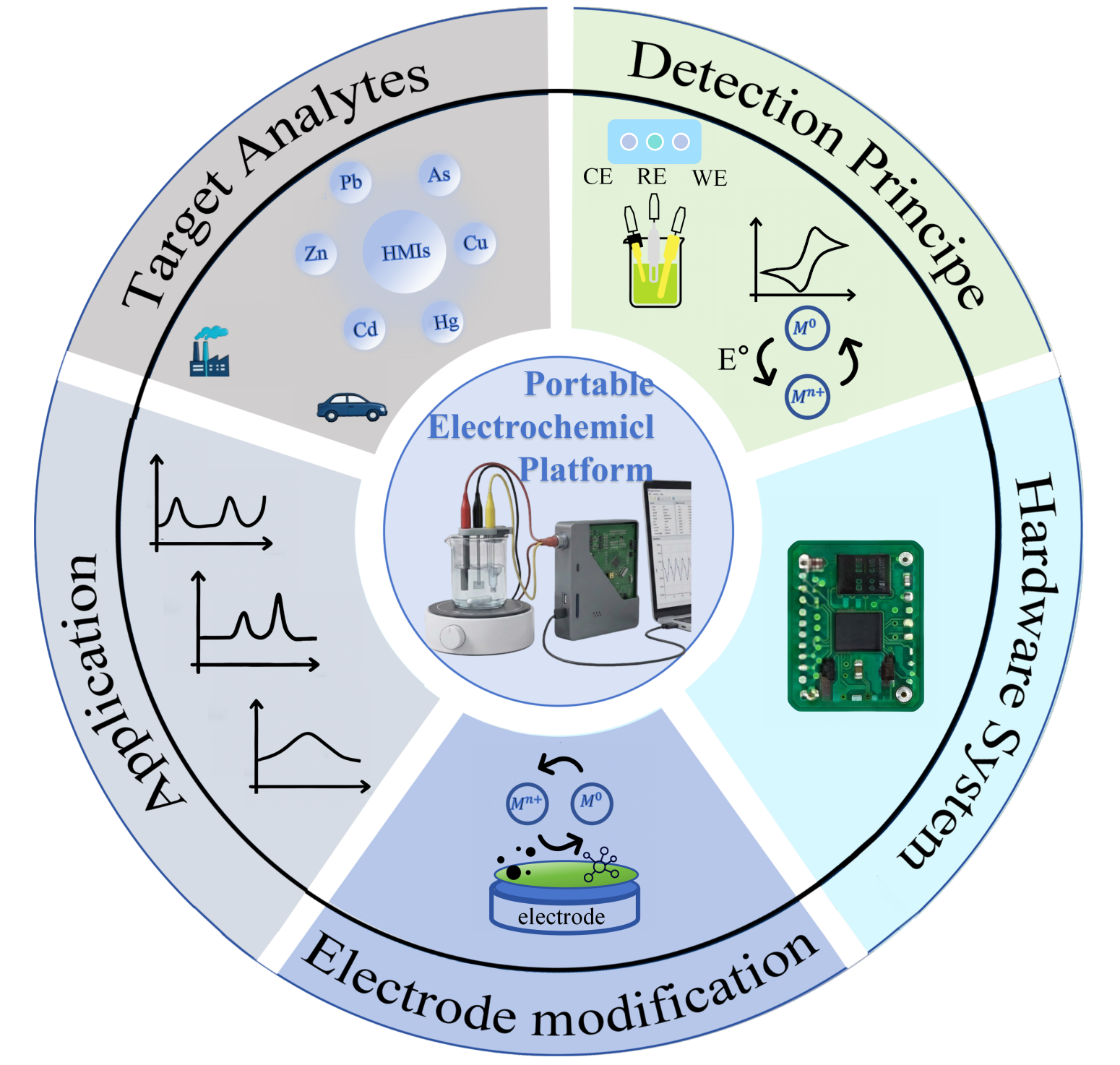
Figure 1. Schematic illustration of the research background and overall framework of this review. HMIs, including Pb, As, Cu, Zn, Cd, and Hg, originate from environmental pollution and pose risks to environmental and human health. Portable potentiostats serve as the core platform bridging laboratory electrochemical principles with on-site heavy metal analysis. Based on this framework, this review discusses portable electrochemical detection of HMIs in terms of fundamental detection principles, potentiostat hardware architecture, electrode modification, and practical applications. HMIs: heavy metal ions; WE: working electrode; RE: reference electrode; CE: counter electrode.
2. Overview of the Architecture of Portable Electrochemical Systems for Heavy Metal Detection
Portable electrochemical detection of heavy metals is not simply a straightforward combination of electrode sensing and detection circuitry[15], but an integrated measurement system organized around electrode interfacial reactions, potentiostatic control, and weak-current readout within strict volume and power constraints. A typical system includes an electrochemical cell, a
Accordingly, this section discusses not only the fundamentals of electrochemical kinetics, but also the full process of heavy metal ion electrodeposition and stripping. By clarifying the intrinsic relationships among interfacial reactions, current readout, and quantitative analytical models, this section provides a more coherent theoretical foundation for the subsequent discussion of hardware architecture evolution.
2.1 Electrochemical detection principles and ideal quantitative models
Under controlled laboratory conditions, the electrochemical quantification of heavy metal ions is traditionally governed by
However, translating this textbook workflow into a portable, field-ready platform forces a paradigm shift from controlled laboratory ideals to complex real-world matrix realities. Outside the shielded and buffered laboratory environment, the pristine
2.2 Interface-chemistry bottleneck: From labile ions to field speciation
In standard solutions, heavy metals are usually treated as electrochemically labile ions whose deposition and stripping can be described by familiar redox and Nernst relationships. In real field water, soil extracts, wastewater, and food leachates, this assumption often fails. A substantial fraction of Pb(II), Cd(II), Cu(II), Zn(II), Hg(II), or As(III) can be complexed by dissolved organic matter, adsorbed on particles, trapped in colloids, or converted into less labile species. The measured current then represents only the electrochemically accessible fraction, not necessarily the total metal burden.
This distinction converts sample pretreatment from a peripheral step into a defining part of the sensing mechanism. Liu et al.[28] and Feng et al.[29] show that vacuum ultraviolet (VUV)-H2O2 or photolysis-based oxidative pretreatment can release Cd(II) and Pb(II) from soil or water matrices before square wave anodic stripping voltammetry (SWASV) measurement. These studies are important not because they add another electrode material, but because they expose the first chemical bottleneck of field deployment: without a standardized strategy for converting bound or inert species into electrochemically active forms, a portable sensor may report a falsely low concentration even when its LOD in buffer is excellent.
2.3 Multi-metal deposition bottleneck: Peak overlap is not only a signal-processing problem
Multi-metal detection is often presented as a matter of resolving several stripping peaks, but the deeper problem occurs during
Therefore, multi-metal sensing should not be reduced to post hoc peak deconvolution. The deposition waveform, enrichment time, electrode film, and electrolyte composition must be designed to control interfacial phase behavior before the signal reaches the algorithm. This is the reason why multi-working-electrode layouts, flow control, and target-specific interfaces are not merely engineering conveniences; they are strategies for partitioning chemically incompatible deposition processes[31,32].
2.4 Weak-current quantification bottleneck: LOD as a coupled chemical-electronic quantity
For a review aimed at field reliability, the key quantitative relation is not any single textbook equation, but the coupled expression LOD = 3σ/S. The blank variation σ is raised by baseline drift, capacitive current, input bias current, printed circuit board (PCB) leakage, analog-to-digital converter (ADC) quantization, and environmental electromagnetic or humidity-induced noise. The slope S is shaped by deposition efficiency, active area, charge-transfer kinetics, peak width, sampling timing, and baseline correction. Thus, LOD is not an intrinsic property of an electrode material; it is a system-level outcome of interface chemistry, analog readout, and data processing.
This reframing also explains why high-area nanomaterials are not automatically beneficial. MXene-like and carbon-based interfaces can enhance electron transport and active-site density, but the same high area can increase double-layer capacitance and background current[33]. Similarly, protective films such as Nafion or polymers can improve antifouling behavior but may slow mass transport. The relevant question is therefore not whether a material increases peak height in buffer, but whether it improves S without increasing σ under the target matrix[33,34].
These constraints define the transition to Section 3: once the interface generates a weak and matrix-dependent faradaic current, the portable hardware determines whether that current is preserved, distorted, or buried beneath the physical noise floor.
A portable HMI measurement can therefore be understood as a complete workflow rather than as a single sensing event: sample conditioning defines the chemical form of the target ions; the modified electrode governs enrichment, selectivity, and fouling resistance; the potentiostat maintains the required interfacial potential; the transimpedance amplifier (TIA)/ADC chain converts pA to nA faradaic currents into digital signals; and the algorithmic layer performs baseline correction, peak identification, calibration, and validation. The three-electrode configuration, representative waveforms, cyclic voltammetry (CV) response, and ASV potential profile are summarized in Figure 2.
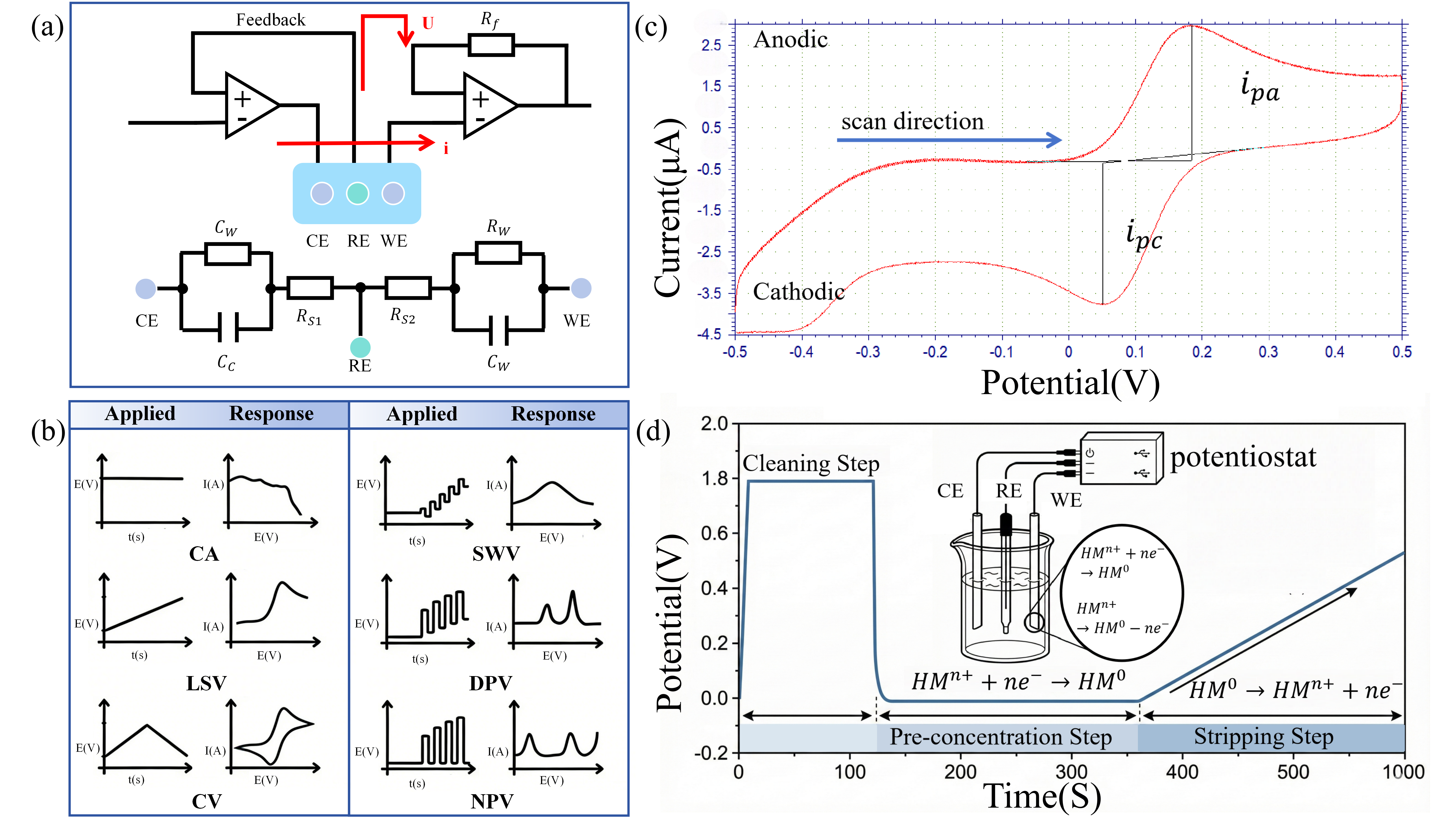
Figure 2. (a) Integration of the three-electrode system with a potentiostat and the equivalent circuit of an electrochemical cell; (b) Applied waveforms and corresponding responses of representative electrochemical techniques; (c) Typical cyclic voltammogram obtained by cyclic voltammetry; (d) Potential profile and metal-ion reaction process in ASV. ASV: anodic stripping voltammetry; CE: counter electrode; RE: reference electrode; WE: working electrode; SWV: square-wave voltammetry; DPV: differential pulse voltammetry; NPV: normal pulse voltammetry.
3. Evolution of Potentiostat Technologies
For portable heavy-metal-ion analysis, potentiostat evolution should not be interpreted merely as a progression toward smaller size or higher integration. Its analytical significance lies in whether the hardware can preserve weak, matrix-dependent faradaic currents generated at the electrode interface. In stripping voltammetry, the measured peak current must pass through a finite-bandwidth, leakage-prone, high-impedance analog signal chain before it becomes a digital concentration readout. Therefore, parameters such as input bias current, feedback resistance, analog bandwidth, ADC resolution, anti-aliasing filtering, and sampling synchronization directly affect blank fluctuation, peak shape, and calibration slope.
The development of portable potentiostats has not proceeded along a single linear path in which more components necessarily lead to better performance. Rather, several parallel technical routes have gradually emerged in response to different engineering objectives. Early designs emphasized low cost, open-source accessibility, and ease of self-construction, with the aim of making basic voltammetric techniques available for teaching and use in resource-limited settings. As the demand for trace analysis increased, platform design shifted toward lower noise, wider dynamic range, and stronger calibration robustness so as to enable stable readout of weak currents at the pA to nA level. Subsequently, with the maturation of dedicated analog front-end devices and system-on-chip technologies, highly integrated routes gradually gained advantages in size, power consumption, and deployability. This evolution is visually summarized in Figure 3, showcasing the structural transitions and performance milestones of key platforms. Additionally, a comprehensive cross-platform comparison of their potential windows, current specifications, and core architectures is systematically organized in Table 1. The later introduction of multichannel operation, wireless connectivity, dynamic compensation, and edge computing has further driven portable potentiostats to evolve from single-purpose measurement devices into analysis systems designed for field-oriented tasks[2,35,36,41,52,56-63].
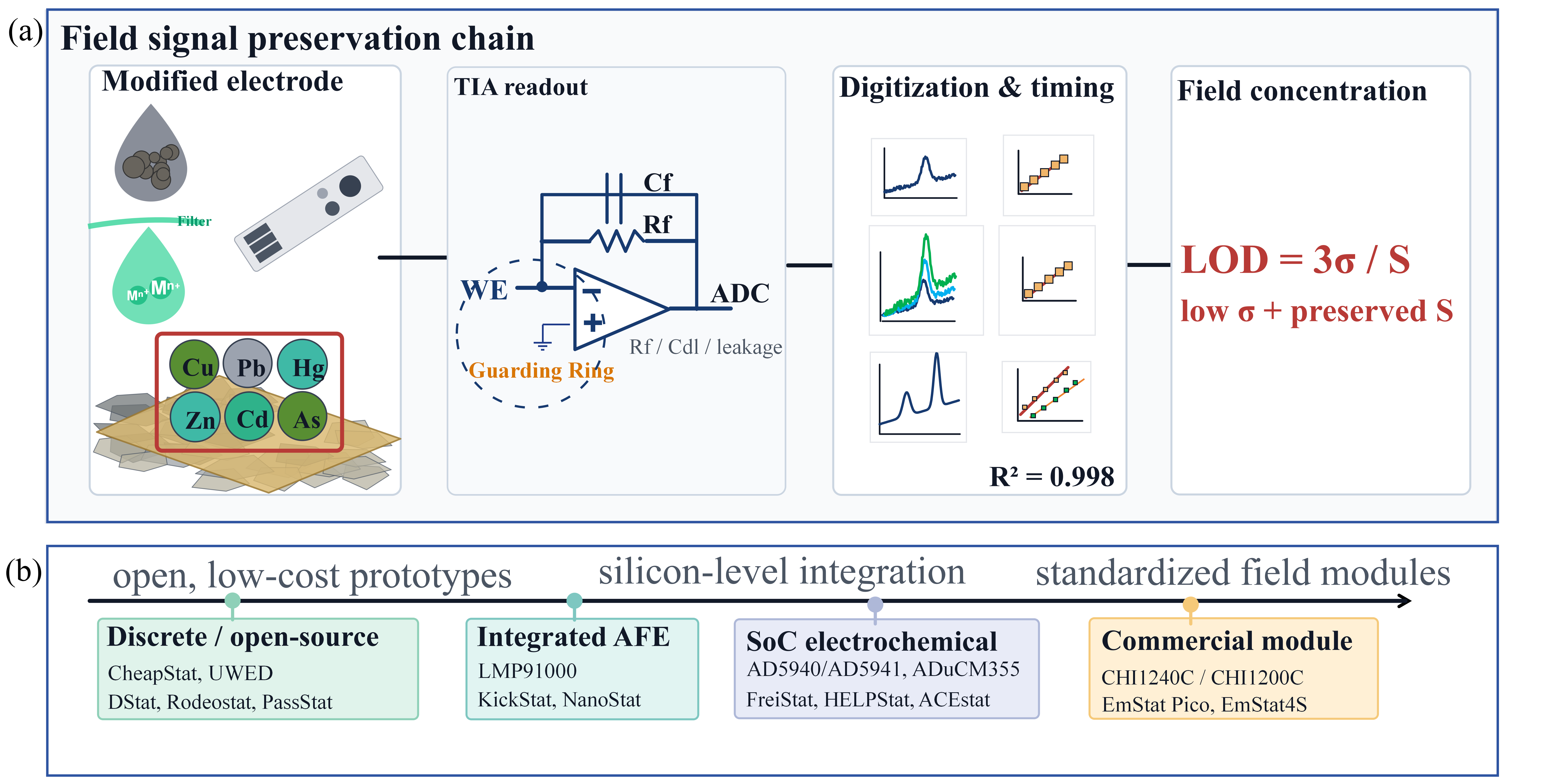
Figure 3. System-level field signal preservation chain and the evolutionary paradigm timeline of portable potentiostat hardware architectures. (a) Block diagram outlining the structural signal amplification, noise mitigation, and environmental shielding path from a modified screen-printed electrode interface to digital concentration readouts. The analog front-end highlights a TIA loop with high feedback resistance (Rf) dictating conversion gain, balanced by a compensation capacitance (Cf) against the dynamic
Table 1. Comparison of representative portable potentiostats.
| Potentiostat | Potential window/Supply | Current specification | Controller / core chip | Techniques |
| CheapStat[35] | ±0.99 V | 100 nA–50 μA | Atmel XMEGA | CV, LSV, SWV, ASV |
| JUAMI[26] | ±2.5 V | 10 mA | Arduino Uno | CV, LSV, CA |
| DStat[36] | ±1.5 V | ±1 pA–±1 mA | ATxmega256A3U | CV, DPV, SWV, CA, OCP |
| UWED[26] | ±1.5 V | ±180 μA | ESP32 | CV, IT, CA, SWV |
| PSoC-Stat[37] | ±1.5 V | ±100 μA | PSoC 5LP (ARM Cortex‑M3) | CV, SWV, ASV |
| ABE-Stat[38] | ±1.65 V | ±3 mA | ESP8266 + Bluetooth RN42 | CV, DPV, SWV, CA, OCP, EIS |
| SStat[39] | ±1.5 V | ±1 μA–±150 μA | ESP32 | CV, LSV, CA, SWV |
| SweepStat[40] | ±1.5 V | ±0.015 μA, 1.5 μA | Arduino Teensy | CV, LSV, CA, IT |
| KickStat[41] | ±0.792 V | 5 μA–750 μA | ARM Cortex‑M0 + SAMD21 | CV, SWV, CA, NPV, etc. |
| MYSTAT[42] | ±12 V | ±200 mA | Raspberry Pi | CV, LSV, DPV, SWV, CA, IT, OCP, etc. |
| HOME-Stat[43] | ±4 V | ±5 mA | Arduino Uno | N/A |
| Paqari Stat[44] | ±1.5 V | ±225 μA | Arduino Nano | CV, LSV, IT |
| ACEstat[45] | ±1.1 V | ±3 mA | ADuCM355 | LSV, CV, SWV, CA, EIS, etc. |
| TBISTAT[46] | Supply: 3.3 V | ±1 μA | Teensy LC | EIS, etc. |
| HunStat2[47] | ±2.1 V | 54 pA–3 mA | AD5941 + RP2040 | CV, OCP, EIS |
| NanoStat[48] | Supply: 3.3 V | 5 μA–50 μA | ESP32‑PICO‑D4 | CV, SWV, CA, NPV, etc. |
| PassStat[49] | Supply: 5 V | ±10 mA | Teensy 3.6 | CV, SWV, etc. |
| FreiStat[50] | ±2.0 V | ±900 μA | Adafruit Feather M0 Wi-Fi | CV, LSV, DPV, SWV, CA, IT, OCP |
| UnpadStat[51] | ±1 V | ±176 μA | STM32 | CV, etc. |
| Eprobe[52] | ±16 V | ±200 mA | STM32L4 + CH582 | CV, LSV, DPV, SWV, CA, IT, OCP, etc. |
| Rodeostat[53] | ±1, ±2, ±5, ±10 V | ±1–±1000 μA | Arduino Teensy 3.2 | CV, LSV, DPV, SWV, CA, IT, OCP, etc. |
| EmStat Pico[54] | -1.981-+2.166 V | ±3 mA | ADuCM355 (Arm Cortex‑M3) | CV, LSV, DPV, SWV, CA, IT, OCP, etc. |
| EmStat4S[55] | ±10 V | ±10 mA | N/A | CA, CV, DPV, SWV, LSV, CC, etc. |
Voltage values are reported as electrochemical potential windows where available; entries explicitly marked as “Supply” correspond to supply voltage rather than the working-electrode control range. Current values are reported as the current range or other current specification explicitly stated in the original source. N/A = not reported. ASV: anodic stripping voltammetry; CA/IT: chronoamperometry/amperometric i-t curve; CC: chronocoulometry; CV: cyclic voltammetry; DPV: differential pulse voltammetry; EIS: electrochemical impedance spectroscopy; LSP: linear sweep polarography; LSV: linear sweep voltammetry; NPV: normal pulse voltammetry; OCP: open circuit potential; SWV: square-wave voltammetry; ZRA: zero resistance ammeter.
Recent design reviews[15] have pointed out that potentiostat development has shifted from focusing on individual circuit functions to emphasizing the coordinated optimization of potential control, current detection, range management, synchronous sampling, and system-level noise immunity. The differences among platforms are therefore not simply matters of chip selection or circuit scale, but reflect system-level trade-offs among detection accuracy, degree of integration, cost, channel capability, and customizability.
3.1 Circuit-level polarization and waveform generation
Inside the portable hardware, the precise execution of the electrochemical reactions described in Section 2 relies entirely on the deep coordination among the microcontroller unit (MCU), high-precision data converters, and analog front-end circuitry.
First, the hardware feedback topology is integrated with the sensor interface, where the control amplifier forms a high-gain negative feedback loop together with the reference electrode (RE), counter electrode (CE), and working electrode (WE). As shown in the
To drive these controlled interfacial reactions, the MCU configures registers and DMA transfers to precisely adjust the step amplitude and pulse width of the output voltage on a microsecond scale. This pulse synthesis mechanism and the typical excitation voltage profiles applied for various representative electrochemical techniques (such as CV, square-wave voltammetry (SWV), and differential pulse voltammetry (DPV)) are illustrated in Figure 2b.
Together with the RE and CE, the amplifier forms a high-gain negative feedback control loop. This loop can dynamically track and compensate in real time for potential deviations caused by solution resistance, namely the iR drop. It forces the CE to output the corresponding faradaic current, thereby ensuring that, even under real-world field conditions where the conductivity of complex water samples fluctuates substantially, the polarization potential between the WE and the RE remains tightly locked to the ideal excitation waveform.
Under a designated scan direction, the analog front end sensitively captures the resulting faradaic responses, allowing the system to accurately extract key indicators that govern quantitative sensitivity and system kinetics: the anodic peak current (ipa) and the cathodic peak current (ipc), as visualized by the typical CV scan curve in Figure 2c. Finally, hardware timers, through strict clock scheduling, constitute the core timing state machine to execute the full life-cycle timing map of the stripping voltammetry workflow. As summarized in the potential-time profile curve in Figure 2d, the system controls sequential operations transitioning from the Cleaning Step (+0.6 V) to refresh the electrode surface, through the Pre-concentration Step (-1.2 V) for target ion enrichment, and ultimately into the high-speed Stripping Step for quantitative analytical output.
3.2 High-Precision discrete architectures and open-source prototype platforms
The early development of portable potentiostats was largely built upon open-source hardware and discrete analog circuits. CheapStat[35], reported in 2011, relied on on-chip MCU resources together with a simple analog front end to construct a potentiostatic control loop. It offered a potential control range of approximately -0.99 V to +0.99 V and a current range of about 100 nA to 50 μA, with the primary goal of implementing basic test modes such as CV, LSV, and SWV (Figure 4a). Its significance lay in demonstrating that on-chip digital-to-analog converter (DAC)/ADC resources and a general-purpose analog chain were already sufficient to support a low-cost, open, and education-oriented portable potentiostat prototype. JUAMI and UWED adopted a combination of Arduino Uno and a daughter board, using PWM-based approximation to generate scan waveforms while relying on a host computer for parameter input and real-time display[26] (Figure 4b). SweepStat further simplified the architecture to a two-electrode configuration, with emphasis on the usability of CV and CA at ultra-low cost. However, the quantization precision of on-chip DAC/ADC resources, the noise performance of general-purpose operational amplifiers, and the limited dynamic range of simple front-end structures were often insufficient for stable measurement of extremely weak currents[40].
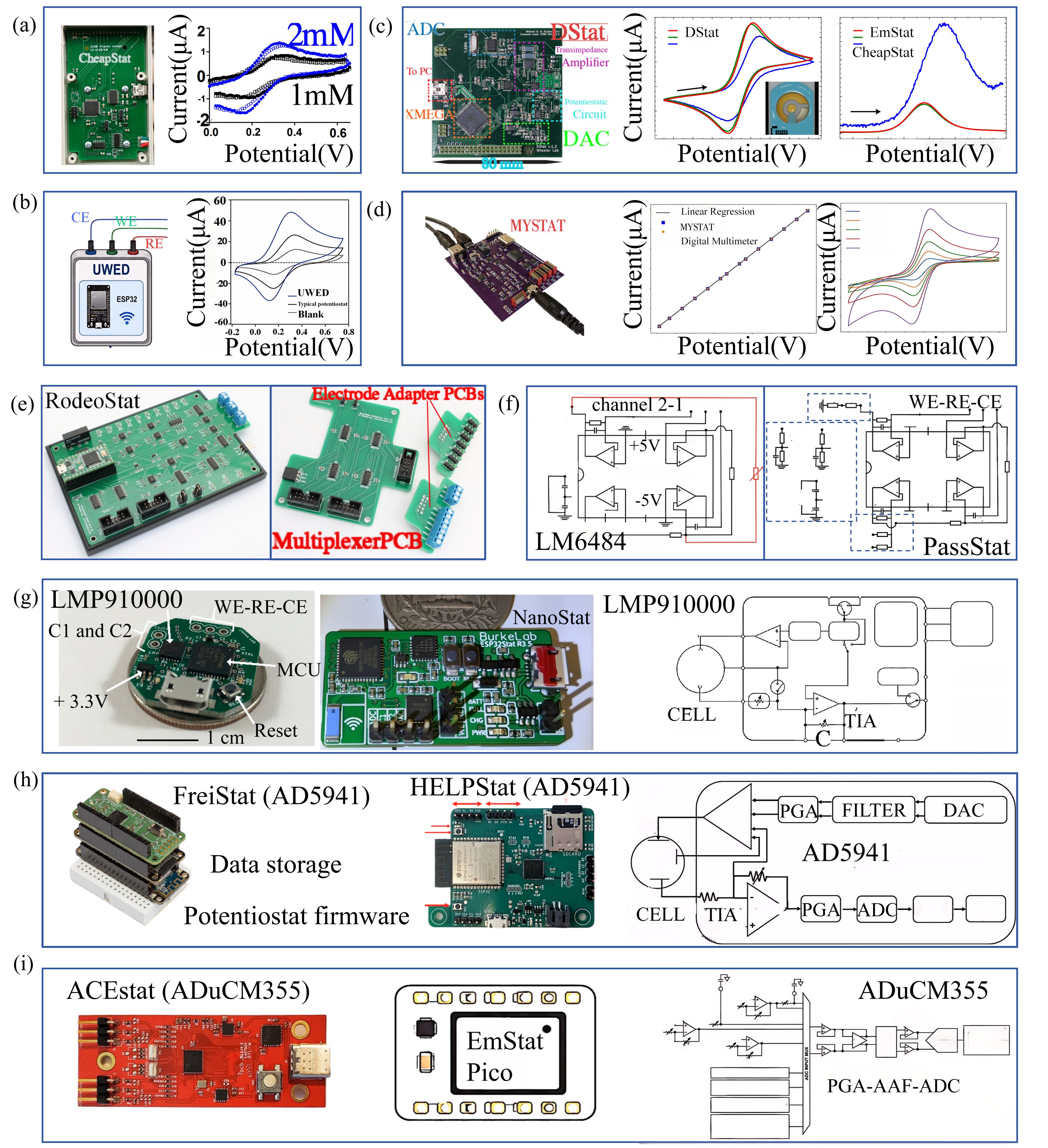
Figure 4. (a) Overall configurations of the potentiostats CheapStat and its CV result. Reprinted from reference[35]. CC BY 4.0; (b) Overall configuration of the potentiostat UWED and its CV result. Reproduced with permission from reference[60]. Copyright © 2011 American Chemical Society; (c) Overall configuration of the potentiostat DStat and its detection results obtained by CV and SWV. Reprinted from reference[36]. CC BY 4.0; (d) Overall configuration of MYSTAT, together with its calibration curve and CV result. Reprinted from reference[42]. CC BY 4.0; (e) Circuit architecture of Rodeostat and its multiplexing module. Reprinted from reference[53]. CC BY 4.0; (f) Evolution of the internal operational-amplifier design across the three generations of PassStat. Reprinted from reference[49]. CC BY 4.0; (g) Internal architecture of the LMP91000 analog front-end chip and the two potentiostat implementations based on it, namely KickStat and NanoStat. Reprinted from reference[41,48]. CC BY 4.0; (h) Internal architecture of the AD5940/AD5941 chip and its representative platforms, FreiStat and HELPStat. Reprinted from reference[50,64]. CC BY 4.0; (i) Internal architecture of the ADuCM355 chip and its representative platforms, ACEstat and EmStat Pico Reproduced with permission from reference[45]. Copyright © 2022 American Chemical Society. Reprinted from
To overcome these early noise-related limitations, later designs began to separate the digital controller physically from the analog signal chain and to employ dedicated high-precision, low-bias-current amplifiers together with more rigorously designed
At the same time, some discrete platforms did not devote their design resources to achieving the lowest possible current resolution, but instead pursued a wider operating window and greater generality. MYSTAT extended the platform capability to ±12 V and ±200 mA, making it more suitable for general electrochemistry, high-current-density operation, or electrodeposition experiments
After DStat, open-source potentiostats gradually entered a more platformized stage. Rodeostat[53] is a representative example. As shown on its official website and GitHub repository, the platform has undergone multiple design iterations and has developed a relatively complete functional system together with stable detection capability. Beyond the hardware itself, Rodeostat also exhibits strong continuity and maintainability at the engineering-ecosystem level, with a relatively complete secondary-development framework consisting of Arduino integrated development environment (IDE) firmware, a Python control library, open schematics, and extension interfaces (Figure 4e). This platform has further generated several variants, including a high-current version that extends current sampling to the mA range by reducing the transimpedance feedback resistance, and a multiplexed version that enables seamless switching among multiple additional working electrodes on a single working-electrode channel through a dedicated
PassStat has evolved through three generations and exemplifies how a four-op-amp structure can preserve a favorable balance between performance and space in a discrete design (Figure 4f). PassStat 1.0 adopted a classical potentiostat architecture with dual positive/negative supplies, support for iR drop compensation, and a design intended to maximize bandwidth. In version 2.0, the design was changed to Teensy-based single-USB supply operation, with a 1.65 V virtual ground created by dividing the 3.3 V rail. This simplified the circuit while retaining the highest available DAC/ADC precision, sacrificing only limited performance in exchange for greater integration and operability. Version 2.1 further expanded the potential window and scan rate by adding an inverting gain stage and an input-protection network. Although such platforms generally do not match systems specifically optimized for trace analysis in terms of ultimate noise performance, they have established stable open-hardware reference frameworks and significantly reduced the threshold for further development by researchers[49].
The analytical value of discrete architectures lies not merely in component-level flexibility, but in the strategic freedom to optimize the weak-current readout chain against the precise physical constraints of the electrochemical interface. In trace HMI analysis, this design freedom is essential for managing the intrinsic gain-bandwidth-noise trade-offs within the TIA. While a high feedback resistance scales up the voltage conversion of pA to nA stripping currents, it inherently introduces thermal noise and limits the analog bandwidth by coupling with electrode double-layer and PCB stray capacitances. This bandwidth degradation often manifests as incomplete signal settling during rapid DPV or SWV potential perturbations, distorting or broadening the targeted stripping peaks.
Discrete platforms empower designers to counteract these physics-imposed limits by selecting ultra-low-bias-current operational amplifiers, tuning customized feedback compensation networks, and applying meticulous guarding around high-impedance nodes. Consequently, the complex layout demands, independent power trees, and larger PCB footprints characteristic of discrete routes represent a deliberate architectural trade-off: they sacrifice the spatial and power efficiencies required for wearable formats to rigorously suppress leakage-induced blank fluctuations (σ) and preserve stripping-peak fidelity (S). This methodology remains uniquely suited for deployment scenarios that prioritize extreme sensitivity and custom interface adaptation over highly integrated, mass-deployed end-user platforms[27,66].
3.3 Highly integrated AFE/SoC platforms
With the development of dedicated analog front-end chips and system-on-chip technologies, highly integrated AFE/SoC platforms have gradually become the mainstream route for portable potentiostats. Compared with discrete architectures, their most notable feature is the integration of potentiostatic control, bias generation, transimpedance amplification, gain conditioning,
The LMP91000 analog front-end is one of the earliest miniaturized devices widely used in portable electrochemical front ends[67,68]. According to Texas Instruments, it is a programmable analog front-end interface for sensor-side applications, operating over
The AD5940/AD5941 and ADuCM355 represent devices with even higher levels of integration. According to Analog Devices, the AD5940/AD5941 is a complete on-chip electrochemical analog front-end that integrates two excitation paths and one shared measurement channel[69,70]. The first excitation path consists of an ultralow-power dual-output DAC and a low-power, low-noise potentiostat control amplifier; one DAC output controls the non-inverting input of the potentiostat, while the other controls the
FreiStat[50], built on the complete front-end chain and timing capabilities of the AD5940, supports a variety of electrochemical techniques and improves current resolution to 54 pA (Figure 4h). HELPStat[64], ABE-Stat[38], and TBISTAT[46] further demonstrate that the AD5941 is not limited to DC techniques, but can also support continuous electrochemical impedance spectroscopy over the range from 0.015 Hz to 200 kHz. HunStat2[47], using the AD5941 together with a Seeeduino XIAO RP2040, still supports CV, OCP, and EIS under low-cost conditions.
The ADuCM355 takes integration one step further by combining an MCU, memory, and on-chip peripherals with the AD5940-type electrochemical front end, while also adopting a dual-supply design and a lower ADC sampling rate, making it closer to a single-chip electrochemical measurement system[71,72]. The abstract of ACEstat[45] explicitly describes it as a low-SWaP-C platform based on the ADuCM355. By disclosing manufacturing and programming details, the work demonstrates CV, pulse voltammetry, and EIS using an application-specific integrated circuit (ASIC)/SoC-based potentiostat. Analog Devices and PalmSens have further packaged the ADuCM355 and its supporting devices into a 30.5 mm × 18 mm × 2.6 mm module intended directly for original equipment manufacturer (OEM) and embedded-system integration, resulting in the EmStat Pico[54]. Compared with the AD5941-plus-external-MCU route, the value of the ADuCM355 route lies in further reducing the bill of materials (BOM), shortening the development chain, and pushing chip-level implementation toward module-level delivery (Figure 4i).
Rather than representing a linear low-to-high product hierarchy, the implementation of the LMP91000, AD5941, and ADuCM355 chips corresponds to three distinct architectural paradigms tailored for targeted deployment scenarios: low-power fixed-function sensing, field-adapted execution of complex voltammetry, and single-chip modular system delivery. This monolithic consolidation abstracts the low-level analog signal chain, allowing developers to shift their focus toward application-level firmware scheduling, method timing, and cross-platform communication.
Crucially, silicon-level integration optimizes both signal timing preservation and noise immunity under rigorous field environments. By monolithically co-locating the potentiostatic control loop, programmable TIA, anti-aliasing filtering network, and high-resolution ADCs onto a single substrate, these AFE/SoC platforms substantially reduce the physical trace length and node area of the
Furthermore, their synchronized hardware clock networks are highly advantageous for pulse voltammetric techniques such as DPV and SWV. Because these transient methods rely on precisely timed current sampling at the absolute termination of each potential perturbation to decay the capacitive charging current, any timing jitter will induce severe baseline artifacts. In complex matrices where uncompensated solution resistance and double-layer capacitance vary dynamically with sample composition, this monolithic timing stability enforces strict peak-shape morphology and stabilizes the effective analytical slope.
However, this architectural consolidation imposes a rigid operational boundary by reducing low-level analog tunability, given that the internal TIA configurations, feedback elements, and dynamic range options are strictly predefined within the integrated circuit. When coupled with highly capacitive, nanomaterial-modified electrode interfaces (e.g., carbon nanotubes or MXenes) or subjected to high-amplitude, transient stripping currents, these inherently fixed configurations can precipitate severe signal-settling delays, amplifier saturation, or severe peak truncation. Consequently, to safeguard quantitative interpretability outside controlled laboratory environments, the selected internal hardware gain registers and pulse timing protocols must be meticulously matched to the dynamic impedance boundaries of the specific sensing interface.
3.4 Commercial electrochemical platforms
Unlike self-built discrete or integrated potentiostat designs, commercial modules and portable workstations are not concerned solely with implementing functions, but place greater emphasis on software-ecosystem compatibility and measurement standardization.
EmStat Pico, jointly developed by Analog Devices and PalmSens, is a standalone potentiostat module likewise based on the
Compared with independent modules such as EmStat Pico[54], CHI1240C/CHI1200C are positioned more as portable electrochemical workstations. Their official descriptions retain the core functional organization of traditional workstations, consisting of a digital function generator, a data-acquisition system, and a potentiostat/bipotentiostat. Their hardware specifications include a potential range of ±5 V, a compliance voltage of ±11 V, a current range of ±50 mA, current resolution below 1 pA, 16-bit data acquisition at
Commercial standalone instruments such as EmStat4S[55] reflect a design logic different from that of module-level products. PalmSens officially distinguishes between LR and HR versions and provides an S (sense) lead for high-current conditions. Through more carefully organized current ranges, lead compensation, and differentiated operating modes, such systems are designed to cover a broader range of practical tasks[55].
3.5 Hardware parameters and analytical reliability
To systematically conceptualize this electronic optimization, a field signal preservation chain is conceptually mapped in Figure 3a, illustrating how ultra-weak faradaic currents from target analytes (such as Cu, Pb, Hg, Zn, Cd, and As) are shielded and conditioned before digitization. A central difficulty lies in the gain-bandwidth-noise trade-off of the transimpedance amplifier (TIA). Trace stripping currents require high current-to-voltage gain, usually achieved with a large feedback resistor Rf (typically 10 kΩ to 10 MΩ). To counteract circuit oscillations and phase-margin degradation induced by the dynamic double-layer capacitance (Cdl) of high-area nanomaterial-modified sensing interfaces, a localized compensation capacitor (Cf) must be tuned in parallel to stabilize the
This trade-off explains why different portable potentiostat architectures offer different analytical advantages. Discrete platforms such as DStat[36] and PassStat[49] retain flexibility in the reference buffer, feedback network, filtering stage, and current-range design. This makes them attractive when ultra-low-noise weak-current acquisition is more important than minimum size. In contrast,
A second limitation becomes prominent only when the device leaves the laboratory: leakage at the high-impedance
4. Target Analytes, Complex Matrices, and Field Applications
The value of portable electrochemical detection of heavy metals ultimately does not lie in generating an ideal set of voltammetric curves in standard solutions, but in whether it can provide sufficiently reliable analytical results in real samples and real-world settings. Recent reviews have emphasized that stricter drinking-water requirements and the demand for decentralized monitoring have accelerated the development of portable, low-cost electrochemical platforms, especially those based on screen-printed electrodes and miniaturized potentiostats[20,22,30,78]. In the fields of environmental monitoring and food safety, heavy metals and metalloids such as Pb, Cd, As, Cu, Zn, and Hg remain the most important target analytes. Unlike standard solutions under laboratory conditions, samples encountered in field detection are typically characterized by complex composition, strong variability, and limited pretreatment options[22,24]. For example, environmental water samples usually contain not only target metals, but also large amounts of background ions, organic matter, suspended particles, and fluctuating conductivity. This means that the practical challenge of portable heavy metal detection is not simply to transfer laboratory calibration curves to the field, but to maintain sufficient selectivity, sensitivity, and reproducibility under complex matrices and dynamic environments[30]. Therefore, developing robust sensing interfaces that can effectively mitigate surface fouling and matrix effects has become a primary focus for enhancing the
4.1 Single-metal detection
In real samples, the analyte system is rarely an ideal solution containing only one metal ion; instead, it is often a coupled system in which multiple metal ions coexist, interact, and jointly shape the voltammetric response. Before simultaneous multi-metal detection can be addressed, it is first necessary to establish how a single heavy metal can be qualitatively and quantitatively identified in stripping voltammetry through its stripping peak potential and peak current. In a single-metal system, the target ion should produce a stable, reproducible, and interpretable stripping peak and stripping current on a given electrode under a specific method, and a detection limit should be established under blank-sample conditions.
Across the cases in Table 2, the main distinction is not simply the numerical LOD, but whether the reported performance can be transferred from standard solutions to complex water samples. Therefore, the following discussion distinguishes standard-solution performance from complex-water applicability, because the latter depends not only on the reported LOD but also on matrix tolerance, pretreatment, calibration strategy, and reference-method validation.
Table 2. Representative portable electrochemical HMI detection systems and analytical performance.
| Target ions | Electrode/interface | Method | Portable platform | Sample matrix | LOD | Linear range | Recovery/reference validation |
| As(III) | Modified SPCE (rGO/AuNPs/Mn/SPCE) | SWASV | Portable format | Groundwater, water | 3 ppb | 3-25 ppb | Recovery & stability check[79-81] |
| Cu(II), As(III) | Au nanostars/SPCE | SWV/ASV | Portable workstation | River water, tap water | As 2.9 ppb; Cu 42.5 ppb | As 0-100 ppb; Cu 0-250 ppb | 87.7% (As); vs. GF-AAS[82] |
| Cd(II) | GO-CNH/2WEs-SPCE | DPASV | Dual-channel potentiostat | Lake water, tap water | 4.56 ppb | 20-300 ppb | 97.3%-109.2%[25] |
| Cd(II), Pb(II) | Nafion/Sputtered Bi-SP-SPE | SWASV | Potentiostat with stirring | Natural waters | Cd 3.6 ppb; Pb 3.8 ppb | 30-90 ppb | Natural water test[83] |
| Pb(II), Cd(II) | In situ Bi/pre-anodized SPCE | ASV | Portable benchmark platform | Real water | Pb 0.8 ppb; Cd 0.4 ppb | 5-60 ppb | vs. ICP-MS[21] |
| Cu(II), Pb(II), Hg(II) | MWCNT/ZnO/SPCE | SWV | SPCE-based water sensor | Water, ternary mixtures | Cu 0.8 ppb; Pb 1.2 ppb; Hg 0.7 ppb | Cu 1-800 ppb; Pb 5-1000 ppb; Hg 1-900 ppb | 95%-102%; interference test[84] |
| Pb(II), Cu(II) | Nanoporous Au/SPCE | SWASV | Screen-printed sensor format | Drinking water | Pb 0.4 ppb; Cu 5.4 ppb | Pb 1-100 ppb; Cu 10-100 ppb | vs. ICP-MS[85] |
| Cd(II), Pb(II), As(III) | Dual-working-electrode SPCE | SWV/ASV | 3D-printed flow cell | Simulated river water | 0.5-2.0 ppb | Cd 5-150 ppb; Pb 5-150 ppb; As 5-150 ppb | 95%-101%[86] |
| Cd(II), Pb(II), Hg(II), As(III) | AuNPs-SPCE | DPV/ASV | Portable potentiostat | Tap water | Cd 9.4 ppb; Pb 4.4 ppb; Hg 1.5 ppb; As 7.6 ppb | Cd 10-500 ppb; Pb 10-500 ppb; Hg 10-500 ppb; As 10-500 ppb | Real-water validation[87] |
| Zn(II), Cd(II), Pb(II), Cu(II) | In situ BiFE/GCE | DPASV | Miniaturized automated system | Real river waters | Zn 2.95 ppb; Cd 1.84 ppb; Pb 1.29 ppb; Cu 1.11 ppb | 5-110 ppb | 91%-108%; vs. GF-AAS[88] |
| Hg(II), Cu(II) | Chitosan/PANI-BiNPs @GO-MWCNT | DPV | Smartphone-integrated cell | Tap water, complex sewage context | Hg 10 ppb; Cu 0.5 ppm | Hg 20-180 ppb; Cu 0.5-16.9 ppm | Interference evaluation[89] |
Gold-based modified electrodes are preferentially used for As(III) detection because arsenic exhibits a relatively stable electrochemical response during deposition and stripping on such interfaces. A representative example[79] is the AuNP-rLA-L-cysteine-modified screen-printed electrode platform reported in 2021. Using SWASV, the authors detected As(III) in groundwater and reported a formal peak potential of approximately -0.307 V, a detection limit of 3 μg/L and a linear range of 3-25 μg/L. More recent portable SPCE-based designs have leveraged multi-functional hybrid materials to boost electrocatalytic efficiency. As schematically illustrated in Figure 5a, the fabrication of the reduced graphene oxide (rGO)/gold nanoparticles (AuNPs)/MnO2/screen-printed carbon electrode (SPCE) interface involves a well-controlled sequential electrodeposition workflow. First, graphene oxide (GO) sheets are electrochemically reduced onto the bare carbon substrate to form a highly conductive 3D rGO network. Subsequently, AuNPs are precisely electrodeposited to provide highly stable and low-affinity active sites tailored for arsenic binding. Finally, MnO2 nanostructures are thoroughly integrated into the hybrid matrix to improve the overall surface-to-volume ratio and synergistic mass transport. This tailored nanocomposite configuration significantly optimizes the enrichment kinetics, yielding a sub-10 μg/L limit of detection and reliable field-oriented storage stability[80]. This platform yields clear, concentration-dependent SWASV responses, which translate into a highly linear calibration plot for precise quantification (Figure 5a).
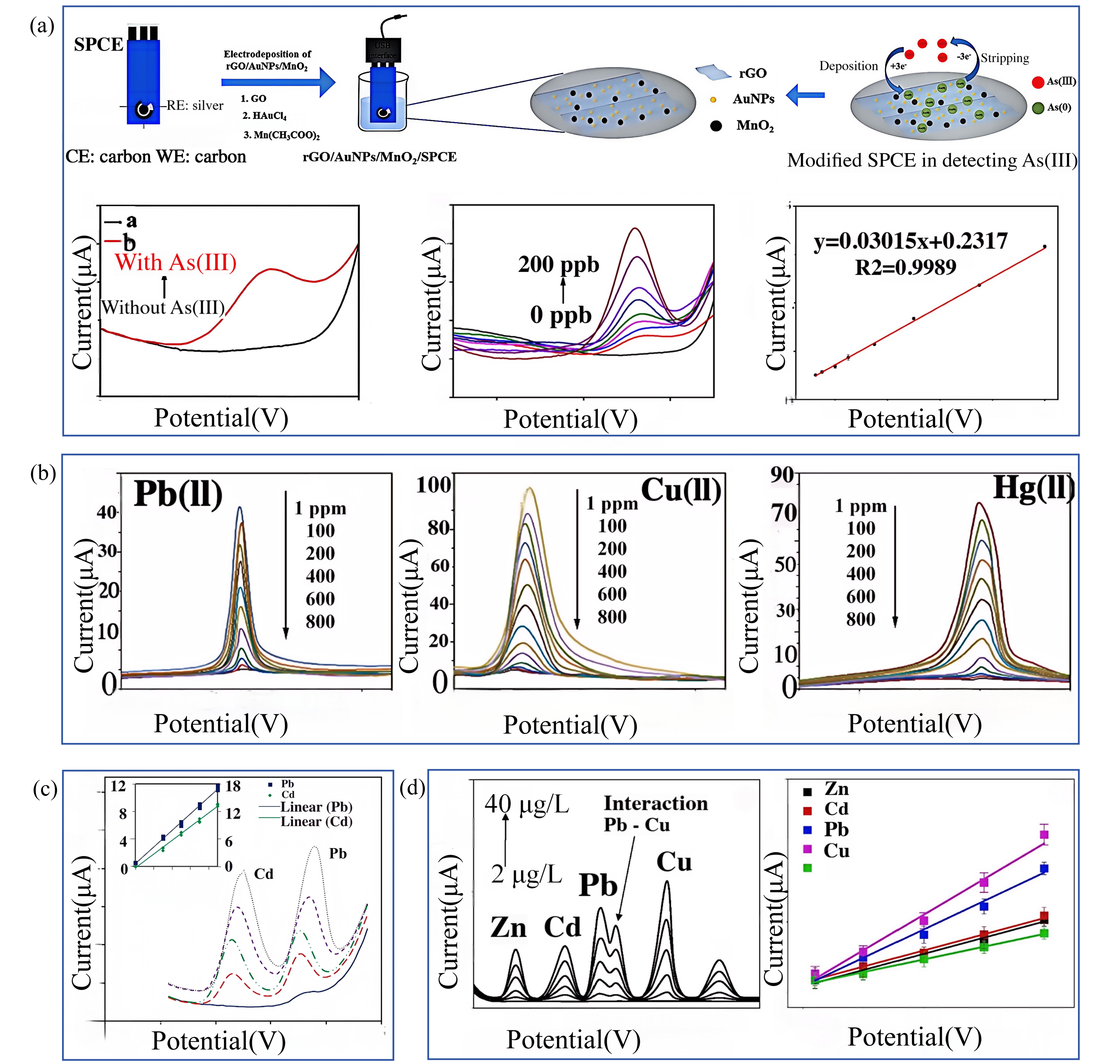
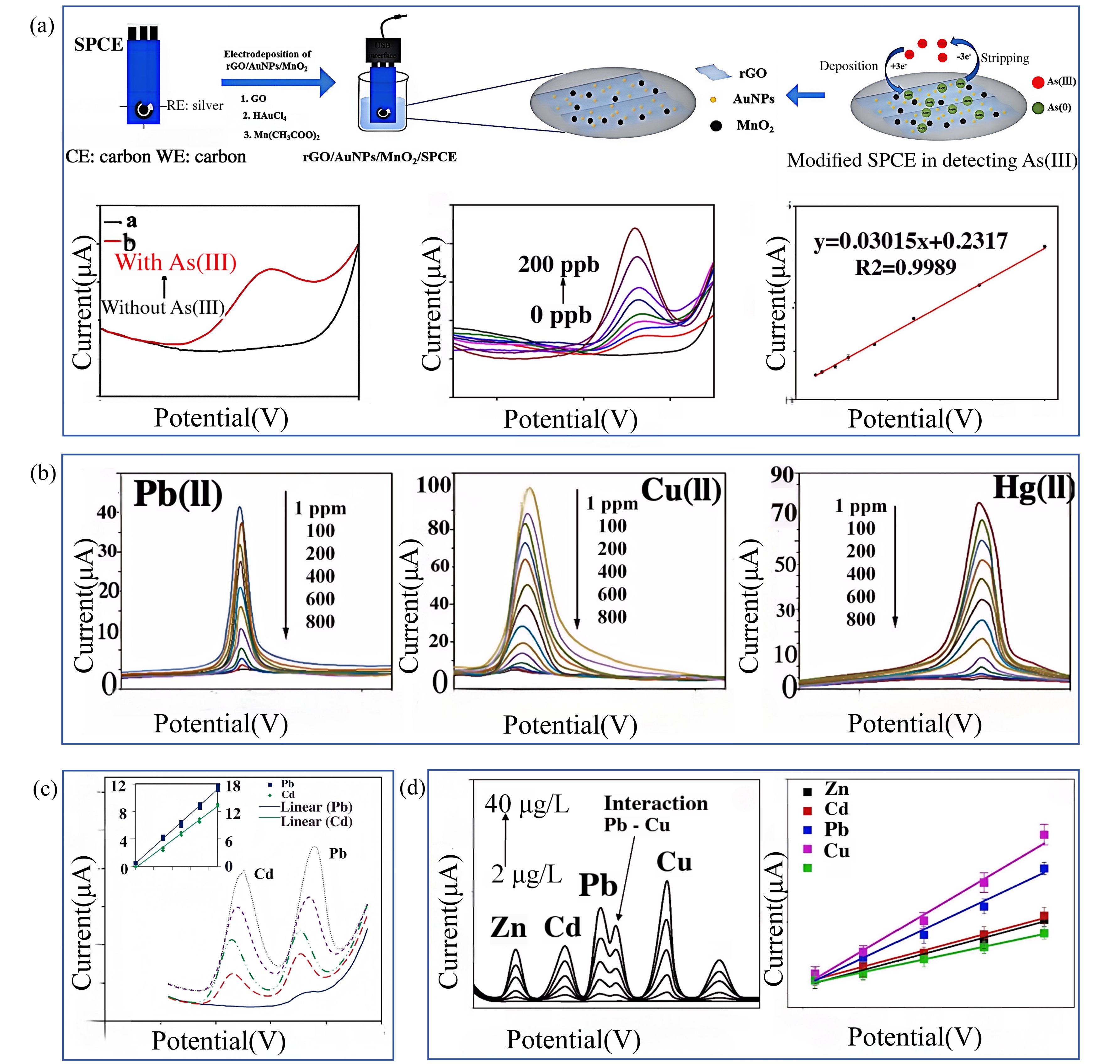
Figure 5. (a) Schematic illustration of the fabrication process of the rGO/AuNPs/Mn modified electrode (as a representative platform for As(III) analysis summarized in
The significance of these As(III) studies lies not only in their low LODs, but also in their demonstration that field-oriented arsenic sensing depends strongly on matching Au-based interfacial chemistry with disposable SPCE formats. Arsenic detection is particularly sensitive to surface state, dissolved oxygen, and pH-dependent speciation; therefore, storage stability, electrode-to-electrode reproducibility, and buffer control are as important as the reported calibration slope.
This interpretation should also consider two field constraints that are often understated in performance-driven summaries: pH and dissolved oxygen. Solution pH affects metal-ion speciation, complexation, and deposition efficiency; as pH increases, the fraction of electroactive, depositable species may decrease, and the stripping peak can weaken markedly or even disappear. At the same time, dissolved oxygen may interfere indirectly because oxygen reduction reactions may consume protons or generate hydroxide ions locally, thereby changing the interfacial pH and promoting metal hydroxide formation. The most direct engineering responses are deoxygenation and/or the use of buffered media to damp electrochemically induced pH changes[22].
For more common cationic metals such as Pb(II) and Cd(II), bismuth-based and carbon-based platforms remain representative choices (as compiled in Table 2). Nafion-protected sputtered-bismuth screen-printed electrodes coupled with a portable potentiostat and a battery-operated miniature stirring system enabled on-site SWASV measurements of Cd(II) and Pb(II) in natural waters[83]. This type of work is especially valuable because it represents a credible bridge from laboratory stripping analysis to genuinely portable operation. In a representative study of this route (Figure 5c), carried out in 0.05 M acetate buffer at pH 4.4, the limits of detection for Cd and Pb were approximately 3.62 and 3.83 μg/L, respectively, and the authors also reported sensitivity data that make the platform useful as a practical benchmark for field-portable Pb/Cd sensing.
The value of this configuration is that it combines a bismuth-based enrichment interface, an antifouling Nafion layer, controlled mass transport, and portable current readout. It therefore represents a more complete field-detection workflow rather than a single electrode material demonstration. Its remaining limitation is that performance still depends on acetate-buffer conditions and controlled stirring, so direct transfer to high-salinity or particle-rich waters requires additional matrix validation.
Recent portable Cd(II) work further demonstrates the importance of integrating electrode pretreatment with a low-cost field device. For example, an in situ Bi-modified pre-anodized SPCE coupled with a self-made PSoC Stat potentiostat and stirring module achieved Cd(II) detection from 5-100 μg/L with an LOD of 3.55 μg/L in water and rice samples[90].
The significance of single-metal detection lies in establishing a comparative reference framework for different heavy metal ions and in providing a rational basis for interpreting peak shifts and the relationship between stripping signals and concentration in
4.2 Simultaneous detection of multiple heavy metals
Simultaneous detection of multiple heavy metals is not achieved by simply adding several peaks to a single-metal voltammogram. Rather, it requires different metal ions to remain electrochemically distinguishable under the same deposition potential, deposition time, electrolyte composition, and readout protocol. In practice, pH-dependent speciation, intermetallic effects, competitive deposition, and matrix-dependent baseline changes can compress peak spacing or distort peak shape, making signal interpretation substantially more difficult than in single-metal systems[30].
A classical example is the NanoBiE platform, in which a bismuth-nanoparticle-modified glassy carbon electrode enabled simultaneous determination of Pb(II) and Cd(II) with well-defined peaks, linear responses from 5.0 to 60.0 μg/L, and detection limits of 0.8 and
A 2024 nanoporous gold SPCE study also illustrates how surface morphology and matrix validation should be reported together: Pb(II) and Cu(II) were simultaneously determined by SWASV with linear ranges of 1-100 μg/L and 10-100 μg/L and LODs of 0.4 μg/L and
When a single working electrode can no longer provide sufficiently separated or chemically appropriate responses for all target analytes, system architecture itself becomes part of the solution. A dual working electrode screen-printed platform integrated with a 3D-printed flow cell separated the sensing tasks for Cd(II)/Pb(II) and As(III), achieving low-μg/L detection limits and 95-101% recoveries in simulated river water[86]. Similarly, a 2021 disposable plastic-pipette instrument incorporating a six-electrode DEP chip, pump, and valve demonstrated on-site detection of Pb, Cu, and Zn in industrial wastewater and rainwater[92]. These studies suggest that the engineering route toward multi-metal analysis is not limited to peak resolution on a single electrode; in many cases, it also requires division of labor at the electrode and system levels.
These examples suggest that multi-metal detection should be viewed as a system-partitioning problem. Peak separation can be improved not only by electrode materials, but also by multi-working-electrode layouts, flow control, channel allocation, and algorithmic interpretation. The field implication is that portable systems may need to distribute the sensing task across hardware and software layers instead of forcing all analytes into one voltammetric response at one electrode.
Recent studies further suggest that once multi-metal interference and matrix variability become severe, interpretation of the full stripping response becomes a joint electrochemical and data-analysis problem. Peak-shape-based machine-learning models have been shown to classify multiple heavy metal ions using information beyond a single stripping peak[93], while feature-based learning has improved Cd(II)/Pb(II) quantification in the presence of Cu(II)/Zn(II) interference in complex extracts[94]. Although such data-driven strategies cannot replace sound electrochemical design, they offer a promising route for handling overlapping peaks and non-ideal matrices in portable multi-metal analysis.
4.3 Adaptation schemes for complex matrices
4.3.1 From standard-solution performance to complex-water applicability
Standard solutions are useful for establishing peak position, linear range, and instrumental detectability, but they remove many of the variables that determine field applicability. In real field water, pH, ionic strength, chloride/carbonate content, dissolved oxygen, humic substances, surfactants, suspended particles, and coexisting metal ions can change metal speciation, deposition efficiency, peak position, and baseline current. As a result, a calibration slope or LOD obtained in clean electrolyte may overestimate performance in river water, wastewater, seawater, or soil leachates unless matrix effects are explicitly tested.
4.3.2 Matrix tolerance beyond low LOD
The key question for complex-water applicability is therefore not whether an electrode can reach a low LOD in buffer, but whether it can maintain a stable response after exposure to real-matrix components. As demonstrated by the wide range of real-world matrices scrutinized in Table 2, organic matter and particles can foul the surface, coexisting ions can compete for deposition sites or overlap peaks, and variable conductivity can alter iR drop and background current. These effects reduce sensitivity, increase blank variation, and make the apparent LOD matrix-dependent. For this reason, recovery, repeatability, selectivity against coexisting ions, and comparison with reference methods are more informative than LOD alone.
4.3.3 Linking matrix tolerance to system design
A portable system becomes field-relevant only when matrix tolerance is built into both the sensing interface and the measurement protocol. Antifouling or ion-selective layers, disposable electrodes, electrochemical cleaning, controlled deposition/resting times, suitable supporting electrolytes, and baseline correction all help narrow the gap between standard-solution and real-water performance. However, these measures should be evaluated through matrix-matched calibration, standard addition, spike recovery, and reference-method validation rather than assumed from material properties.
4.3.4 Sample pretreatment and matrix-matched testing protocols
For complex water samples, the critical question is not simply whether pretreatment is used, but which chemical fraction is intended to be measured. ASV and SWASV preferentially quantify electrochemically depositable metal species, whereas real samples may contain free ions, inorganic complexes, organic complexes, colloid-associated metals, and particle-bound metals. Therefore, protocols designed for dissolved or labile HMIs may differ substantially from protocols intended to approximate total or recoverable metal content[30].
Pretreatment and testing should therefore be matched to the analytical objective. Settling, centrifugation, and filtration reduce turbidity and particle-induced fouling, but they may also remove particle-bound metals. To overcome the limitations of manual clogging-prone filtration in the field, advanced label-free microfluidic sorting technologies, such as inertial microfluidics developed for high-throughput cell and micro-particle separation[95], offer valuable architectural paradigms for the on-chip, continuous removal of suspended solids and biological matrix interferences from turbid environmental waters[95]. UV/H2O2 photolysis, acid digestion, or other oxidative pretreatments can release complexed or adsorbed metals and reduce organic interference, which is more suitable when total or recoverable metal content is required[28]. Buffer addition, supporting electrolytes, and pH adjustment stabilize metal speciation and peak position for ASV/SWASV, whereas dilution, standard addition, and matrix-matched calibration are more appropriate for high-salinity samples, industrial wastewater, or river water with strong ionic-background variability[30,96].
Field-oriented protocols should also control mass transport and validation. Stirring modules, vibration-assisted enrichment, flow cells, and automated cleaning steps can improve repeatability during deposition and reduce operator dependence[95,97]. Baseline correction, standard addition, spike recovery, and comparison with ICP-MS, AAS, or ICP-OES should be reported together with LOD and linear range. This reporting logic is essential because a low LOD measured in clean electrolyte does not by itself demonstrate reliable performance in complex field samples. Furthermore, borrowing concepts from bioparticle manipulation, active sample preparation platforms driven by acoustofluidics demonstrate that acoustic-streaming-induced mixing can substantially accelerate interfacial mass transport. Adapting such acoustofluidic manipulation to portable electrochemical cells could potentially bypass mechanical stirring, accelerating the enrichment kinetics of trace metal ions while mitigating non-specific fouling at the sensing interface[98].
4.4 Cross-case strategies for fouling, matrix interference, and coexisting ions
The literature reviewed above suggests that antifouling, anti-interference, and coexisting-ion tolerance should be treated as three related but distinct design targets. Antifouling strategies aim to preserve active surface area and stable interfacial capacitance in the presence of humic substances, proteins, surfactants, suspended particles, or biofilm-like residues. They usually rely on disposable SPCEs, Nafion or polymer films, electrochemical cleaning, surface renewal, filtration, or flow-cell washing. Their main limitation is that protective layers or pretreatment steps may reduce mass transport or remove particle-bound metals, so recovery tests in real matrices are required[99].
Anti-interference strategies address background current, peak drift, and matrix-derived chemical changes. Buffering, supporting electrolytes, pH control, deoxygenation, iR drop compensation, baseline correction, and standard addition are not merely procedural details; they define whether a calibration slope obtained in clean electrolyte remains meaningful in real field water. For this reason, a low LOD should be interpreted together with blank noise, baseline stability, spike recovery, and reference-method validation.
Coexisting-ion tolerance is a more specific problem of chemical selectivity and peak resolution. It can be improved by matching target ions with selective interfaces, using Bi/Sb or noble-metal enrichment layers, adjusting deposition potential and time, separating targets across multiple working electrodes, or applying peak-shape-based data interpretation when voltammetric peaks overlap. However, algorithmic separation cannot compensate for uncontrolled chemistry. Reliable multi-metal detection requires a combined strategy: selective interface design to preserve peak identity, hardware dynamic range to avoid saturation, and
Taken together, these strategies show the main contribution of a system-level review: field reliability emerges from the coordinated control of surface chemistry, matrix handling, circuit noise, sampling timing, and calibration protocol. This conclusion also explains why future figures should emphasize mechanism-oriented schematics, including the portable-system workflow, the complete ASV sequence, and the hardware-electrode coupling pathway, rather than only assembling photographs and voltammograms from individual studies.
4.5 Algorithmic-uncertainty bottleneck in overlapping-peak interpretation
Machine learning should be treated as a powerful but fragile layer in portable HMI sensing. Ye et al.[93] showed that full SWASV waveforms contain information beyond a single peak height, enabling classification of multi-metal responses from curve morphology. Liu et al.[94] further demonstrated that feature-based regression can improve Cd(II)/Pb(II) quantification in the presence of Cu(II)/Zn(II) interference. These studies establish the potential of data-driven peak interpretation, especially when intermetallic effects and overlapping peaks break simple linear calibration.
The limitation is that field deployment is a distribution-shift problem. A model trained on a limited set of standards or extracts may fail when pH, DOM, salinity, electrode aging, temperature, or hardware noise changes the waveform outside the training domain. In such cases, a black-box model can convert matrix drift into confident but wrong concentration estimates. Therefore, data-driven interpretation should be constrained by electrochemical priors, hardware-noise descriptors, uncertainty estimates, and
The future direction is not software replacing chemistry or hardware, but physics-informed edge interpretation: algorithms that ingest waveform morphology together with deposition conditions, baseline noise, impedance state, electrode history, and recovery/reference-method checks. Only this kind of constrained model can plausibly generalize from laboratory datasets to field samples.
5. Conclusion
This review has focused on portable electrochemical systems for on-site heavy-metal detection, with particular emphasis on how interfacial electrochemical mechanisms, potentiostatic control, weak-current readout, and application scenarios constrain one another. The field has already moved beyond proof-of-concept miniaturization: basic voltammetric methods can now be implemented on low-cost open hardware, pA-level current acquisition is feasible in carefully designed discrete or AFE/SoC platforms, and representative studies have demonstrated credible measurements for both single-metal and multi-metal analysis in practical matrices.
At the system level, no single hardware route is universally optimal. Open-source discrete architectures provide the greatest freedom in feedback-network design, range switching, and custom protocol development, but they demand more careful analog design, shielding, and calibration. Highly integrated AFE/SoC routes reduce size, power consumption, and development complexity, but usually limit low-level analog tunability. Commercial modules further improve workflow standardization and software maturity, yet they are less open to hardware-level customization. Platform selection should therefore be driven by the target deployment scenario rather than by integration level alone.
The central bottleneck is no longer the generation of an isolated voltammetric signal under ideal laboratory conditions, but the preservation of interpretability under real field constraints. Multi-ion coexistence, pH- and conductivity-dependent speciation, dissolved oxygen, baseline drift, competitive deposition, errors caused by low solution conductivity, and long-term electrode instability can all undermine peak assignment and quantitative reliability. In parallel, many studies still rely primarily on standard or simplified samples, so the evidence base for long-duration deployment, inter-device reproducibility, and standardized field calibration remains limited.
Future progress requires co-optimized sensing interfaces, low-noise electronics, multichannel/flow-cell formats, field calibration, and data-driven peak analysis. Crucially, next-generation heavy metal analyzers are expected to integrate fully automated workflows encompassing sample collection, fluidic injection, and sequential sampling procedures. By leveraging the unique structural and physical mechanisms inherent in microfluidic technologies, future platforms can achieve entirely automated on-chip matrix filtration alongside acoustic-streaming-enhanced faradaic current readouts. This holistic automation and hydrodynamic enhancement will substantially reduce operator-dependent errors, thereby accelerating the transition of portable systems from laboratory validation to dependable field deployment.
If these advances are realized in a coordinated manner, portable electrochemical platforms will be better positioned to evolve from promising prototypes into standardized tools for distributed environmental monitoring, food-safety screening, and rapid decision support.
Authors contributions
Zheng Y: Conceptualization, methodology, investigation, visualization, writing-original draft.
Chen J, Fu L: Validation, writing-review & editing.
Huang X: Supervision, funding acquisition, writing-review & editing.
Conflicts of interest
The authors declare no conflicts of interest.
Ethical approval
Not applicable.
Consent to participate
Not applicable.
Consent for publication
Not applicable.
Availability of data and materials
Not applicable.
Funding
This work was supported by the National Natural Science Foundation of China (Grant No. 62271184), National Key Research and Development Program of China (Grant No. 2022YFD2000100), and Fundamental Research Funds for the Provincial Universities of Zhejiang (Grant No. GK249909299001).
Copyright
© The Author(s) 2026.
References
-
1. Ferreira R, Chaar J, Baldan M, Braga N. Simultaneous voltammetric detection of Fe3+, Cu2+, Zn2+, Pb2+ e Cd2+ in fuel ethanol using anodic stripping voltammetry and boron-doped diamond electrodes. Fuel. 2021;291:120104.[DOI]
-
2. Covaci E, Darvasi E, Ponta M. Simultaneous determination of Zn, Cd, Pb and Cu in mushrooms by differential pulse anodic stripping voltammetry. Stud Univ Babes-Bolyai Chem. 2017;62:133-144.[DOI]
-
3. Melo JC, Carvalho WC, Boa Morte ES, Araujo RGO, Santos DCMB. Sequential determination of Cd, Co, Cu, Fe, Mg, Mn, Ni, Pb, and Zn in powdered refreshments by FS-F AAS after a simple sample treatment. Food Anal Methods. 2020;13(1):212-221.[DOI]
-
4. Ahamed M, Akhtar MJ, Khan MAM. Single-walled carbon nanotubes attenuate cytotoxic and oxidative stress response of Pb in human lung epithelial (A549) cells. Int J Environ Res Public Health. 2020;17(21):8221.[DOI]
-
5. Pansodtee P, Selberg J, Jia M, Jafari M, Dechiraju H, Thomsen T, et al. The multi-channel potentiostat: Development and evaluation of a scalable mini-potentiostat array for investigating electrochemical reaction mechanisms. PLoS One. 2021;16(9):e0257167.[DOI]
-
6. Gao Y, Nguyen DT, Yeo T, Lim SB, Tan WX, Madden LE, et al. A flexible multiplexed immunosensor for point-of-care in situ wound monitoring. Sci Adv. 2021;7(21):eabg9614.[DOI]
-
7. Ferreira C, Barry F, Todorović M, Sugrue P, Teixeira SR, Galvin P. PULSE: A fast portable unit for lab-on-site electrochemistry. Sensors. 2025;25(3):762.[DOI]
-
8. Xu Y, Ning H, Yu S, Liu S, Zhang Y, Niu C, et al. Portable multi-channel electrochemical device with good interaction and wireless connection for on-site testing. Micromachines. 2023;14(1):142.[DOI]
-
9. Tyler G, Yvon J. ICP-OES, ICP-MS and AAS techniques compared. In: ICP optical emission spectroscopy technical note. Longjumeau: Jobin Yvon S.A.S; 1995;5:1-11. Available from: https://www.semanticscholar.org/paper/ICP-OES-%2C-ICP-MS-and-AAS-Techniques-Compared-Tyler-Yvon/3a997ca1a20b00e68003ca04937b2035d0d76a5d
-
10. Thomas R. Practical guide to ICP-MS: A tutorial for beginners. Boca Raton: CRC Press; 2008.[DOI]
-
11. Khan SR, Sharma B, Chawla PA, Bhatia R. Inductively coupled plasma optical emission spectrometry (ICP-OES): A powerful analytical technique for elemental analysis. Food Anal Methods. 2022;15(3):666-688.[DOI]
-
12. Kumari P, Kachhwaha V, Mishra P. A comparative study of heavy metal toxicity in the vegetables using ICP-MS and AAS. Orient J Chem. 2024;40(2):446-453.[DOI]
-
13. Adesina KE, Burgos CJ, Grier TR, Sayam ASM, Specht AJ. Ways to measure metals: From ICP-MS to XRF. Curr Environ Health Rep. 2025;12:7.[DOI]
-
14. Vilasó-Cadre JE, Reyes-Domínguez IA, Cruz R, Rosales-Marín G, Rodríguez-Torres I, Castillo-Magallanes N, et al. Recent advances on impedimetric electroanalysis with non-commercial portable instruments: A mini review. Period Polytech Chem Eng. 2024;68(4):639-654.[DOI]
-
15. Kramarenko AS, Sharapa DI, Pidko EA, Studt F. Ab initio kinetics of electrochemical reactions using the computational Fc0/Fc+ electrode. J Phys Chem A. 2024;128(41):9063-9070.[DOI]
-
16. Xie A, Yin S, Jia Z, Chen H. A portable and open-source potentiostat for continuous electrochemical analysis. In: 2024 China Automation Congress (CAC); 2024 Nov 01-03; Qingdao, China. Piscataway: IEEE; 2024. p. 2138-2143.[DOI]
-
17. Brachfeld A, Mattana G, Laes-Huon A, Noël V, Challier L. Turning metals cations into catalytic nanoparticles on modified electrode: A general strategy for their electrochemical quantification. Electrochim Acta. 2026;560:148668.[DOI]
-
18. Wahyuni WT, Putra BR, Fauzi A, Ramadhanti D, Rohaeti E, Heryanto R. A brief review on fabrication of screen-printed carbon electrode: Materials and techniques. Indo J Chem Res. 2021;8(3):210-218.[DOI]
-
19. Zhu Y, Gao T, Fan X, Han F, Wang C. Electrochemical techniques for intercalation electrode materials in rechargeable batteries. Acc Chem Res. 2017;50(4):1022-1031.[DOI]
-
20. García-Miranda Ferrari A, Carrington P, Rowley-Neale SJ, Banks CE. Recent advances in portable heavy metal electrochemical sensing platforms. Environ Sci Water Res Technol. 2020;6(10):2676-2690.[DOI]
-
21. GadelHak Y, Hafez SHM, Mohamed HFM, Abdel-Hady EE, Mahmoud R. Nanomaterials-modified disposable electrodes and portable electrochemical systems for heavy metals detection in wastewater streams: A review. Microchem J. 2023;193:109043.[DOI]
-
22. Rubino A, Queirós R. Electrochemical determination of heavy metal ions applying screen-printed electrodes based sensors. A review on water and environmental samples analysis. Talanta Open. 2023;7:100203.[DOI]
-
23. Sulthana SF, Iqbal UM, Suseela SB, Anbazhagan R, Chinthaginjala R, Chitathuru D, et al. Electrochemical sensors for heavy metal ion detection in aqueous medium: A systematic review. ACS Omega. 2024;9(24):25493-25512.[DOI]
-
24. Ejigu A, Tefera M, Guadie A. A review article on: Voltammetric detection of lead, mercury, chromium, and arsenic metal ions from environmental samples. Electrochem Commun. 2025;178:107996.[DOI]
-
25. Permwong W, Jakmunee J, Pencharee S. Stripping voltammetric analysis of cadmium on a dual working screen-printed carbon electrode modified with graphene-oxide/carbon-nanohorn composite. Talanta Open. 2026;13:100608.[DOI]
-
26. von Zuben TW, Salles AG, Bonacin JA. Low-cost open-source potentiostats: A comprehensive review of DIY solutions and fundamental concepts of electronics and its integration with electrochemistry. Electrochim Acta. 2024;498:144619.[DOI]
-
27. Snizhko D, Zholudov Y, Kukoba A, Xu G. Potentiostat design keys for analytical applications. J Electroanal Chem. 2023;936:117380.[DOI]
-
28. Liu N, Zhao G, Ye WS, Wang JL, Liu G. VUV-H2O2 photolysis as a pretreatment method for improving the SWASV detection accuracies of Cd2+ and Pb2+ in soil extracts. J Environ Chem Eng. 2022;10(3):107813.[DOI]
-
29. Feng L, He R, Li H, Chen S, Lv C, Zhang S, et al. An ultra-efficient pretreatment method adopted LPUV/CoFe2O4/PMS-based photolysis for accurate detection of Cd(II) and Pb(II) in water via SWASV. Water Res. 2024;262:122066.[DOI]
-
30. Borrill AJ, Reily NE, MacPherson JV. Addressing the practicalities of anodic stripping voltammetry for heavy metal detection: A tutorial review. Analyst. 2019;144(23):6834-6849.[DOI]
-
31. Guo H, Chen B, Luo Y, Wang R, Tian Q, Chang Y. Effect of Bi (iii)-to-metal ion concentration ratios on stripping voltammetric response of bismuth-film glassy carbon electrodes. RSC Adv. 2024;14(53):39361-39371.[DOI]
-
32. Tian Y, Liu J, Qiao J, Ge F, Yang Y, Zhang Q. Advancements in electrochemical sensing technology for heavy metal ions detection. Food Chem X. 2025;25:102204.[DOI]
-
33. Afzal MH, Pervaiz W, Asif M, Huang Z, Dai J, Xu Y, et al. Engineering MXenes for electrochemical environmental pollutant sensing. Environ Sci Nano. 2025;12(1):121-149.[DOI]
-
34. Schalenbach M, Selmert V, Kretzschmar A, Raijmakers L, Durmus YE, Tempel H, et al. How microstructures, oxide layers, and charge transfer reactions influence double layer capacitances. Part 1: Impedance spectroscopy and cyclic voltammetry to estimate electrochemically active surface areas (ECSAs). Phys Chem Chem Phys. 2024;26(19):14288-14304.[DOI]
-
35. Rowe AA, Bonham AJ, White RJ, Zimmer MP, Yadgar RJ, Hobza TM, et al. CheapStat: An open-source, “do-it-yourself” potentiostat for analytical and educational applications. PLoS One. 2011;6(9):e23783.[DOI]
-
36. Dryden MDM, Wheeler AR. DStat: A versatile, open-source potentiostat for electroanalysis and integration. PLoS One. 2015;10(10):e0140349.[DOI]
-
37. Lopin P, Lopin KV. PSoC-Stat: A single chip open source potentiostat based on a Programmable System on a Chip. PLoS One. 2018;13(7):e0201353.[DOI]
-
38. Jenkins DM, Lee BE, Jun S, Reyes-De-Corcuera J, McLamore ES. ABE-stat, a fully open-source and versatile wireless potentiostat project including electrochemical impedance spectroscopy. J Electrochem Soc. 2019;166(9):B3056-B3065.[DOI]
-
39. Sarkar S, Bhattacharya M. SStat: Wi-Fi and bluetooth integrated multimodal “do-it-yourself” Electrochemical potentiostat. In: IECON 2020 The 46th Annual Conference of the IEEE Industrial Electronics Society; 2020 Oct 18-21; Singapore. Piscataway: IEEE; 2020. p. 5249-5254.[DOI]
-
40. Glasscott MW, Verber MD, Hall JR, Pendergast AD, McKinney CJ, Dick JE. SweepStat: A build-it-yourself, two-electrode potentiostat for macroelectrode and ultramicroelectrode studies. J Chem Educ. 2020;97(1):265-270.[DOI]
-
41. Hoilett OS, Walker JF, Balash BM, Jaras NJ, Boppana S, Linnes JC. KickStat: A coin-sized potentiostat for high-resolution electrochemical analysis. Sensors. 2020;20(8):2407.[DOI]
-
42. Irving P, Cecil R, Yates MZ. MYSTAT: A compact potentiostat/galvanostat for general electrochemistry measurements. HardwareX. 2021;9:e00163.[DOI]
-
43. Das A, Bose S, Mandal N, Pramanick B, RoyChaudhuri C. HOME-Stat: A handheld potentiostat with open-access mobile-interface and extended measurement ranges. Proc Indian Natl Sci Acad. 2021;87(1):84-93.[DOI]
-
44. Cordova-Huaman AV, Jauja-Ccana VR, La Rosa-Toro A. Low-cost smartphone-controlled potentiostat based on Arduino for teaching electrochemistry fundamentals and applications. Heliyon. 2021;7(2):e06259.[DOI]
-
45. Brown EW, Glasscott MW, Conley K, Barr J, Ray JD, Moores LC, et al. ACEstat: A DIY guide to unlocking the potential of integrated circuit potentiostats for open-source electrochemical analysis. Anal Chem. 2022;94(12):4906-4912.[DOI]
-
46. Burgos-Flórez F, Rodríguez A, Cervera E, Zucolotto V, Sanjuán M, Villalba PJ. TBISTAT: An open-source, wireless portable, electrochemical impedance spectroscopy capable potentiostat for the point-of-care detection of S100B in plasma samples. PLoS One. 2022;17(2):e0263738.[DOI]
-
47. Vamos I, Morrison R, Michaletzky S, Kertesz V. HunStat2–a simple and low-cost potentiostat with electrochemical impedance spectroscopy capability. Anal Methods. 2025;17(46):9494-9499.[DOI]
-
48. Lee SC, Burke PJ. NanoStat: An open source, fully wireless potentiostat. Electrochim Acta. 2022;422:140481.[DOI]
-
49. Caux M, Achit A, Var K, Boitel-Aullen G, Rose D, Aubouy A, et al. PassStat, a simple but fast, precise and versatile open source potentiostat. HardwareX. 2022;11:e00290.[DOI]
-
50. Bill D, Jasper M, Weltin A, Urban GA, Rupitsch SJ, Kieninger J. Electrochemical methods in the cloud: FreiStat, an IoT-enabled embedded potentiostat. Anal Chem. 2023;95(35):13003-13009.[DOI]
-
51. Setiyono R, Lestari TFH, Anggraeni A, Hartati YW, Bahti HH. UnpadStat design: Portable potentiostat for electrochemical sensing measurements using screen printed carbon electrode. Micromachines. 2023;14(2):268.[DOI]
-
52. Ma J, Yin S, Wang X, Zhang Q, Liang M. Eprobe: A multi-technique, multi-channel wearable potentiostat. Biosens Bioelectron X. 2025;27:100686.[DOI]
-
53. Rodeostat: Open source potentiostat [Internet]. Pasadena: IO Rodeo; 2026 [cited 2026 May 26]. Available from: https://iorodeo.com/products/rodeostat
-
54. Stratmann L, Heery B, Coffey B. EmStat Pico: Embedded electrochemistry with a miniaturized, software-enabled potentiostat system on module [Internet]. Analog Devices; 2019. Available from: https://www.palmsens.com/ko/app/uploads/2019/11/EmStat-Pico-Embedded-Electrochemistry-with-a-Miniaturized-Software-Enabled-Potentiostat-System-on-Module.pdf
-
55. PalmSens. EmStat4S: USB powered potentiostat/galvanostat with EIS [Internet]. Houten (Netherlands): PalmSens; [cited 2026 Jun 8]. Available from: https://www.palmsens.com/product/emstat4s/
-
56. Beach RD, Conlan RW, Godwin MC, Moussy F. Towards a miniature implantable in vivo telemetry monitoring system dynamically configurable as a potentiostat or galvanostat for two- and three-electrode biosensors. IEEE Trans Instrum Meas. 2005;54(1):61-72.[DOI]
-
57. Bentley CL, Bond AM, Hollenkamp AF, Mahon PJ, Zhang J. Advantages available in the application of the semi-integral electroanalysis technique for the determination of diffusion coefficients in the highly viscous ionic liquid 1-methyl-3-octylimidazolium hexafluorophosphate. Anal Chem. 2013;85(4):2239-2245.[DOI]
-
58. Koutilellis GD, Economou A, Efstathiou CE. A potentiostat featuring an integrator transimpedance amplifier for the measurement of very low currents—Proof-of-principle application in microfluidic separations and voltammetry. Rev Sci Instrum. 2016;87(3):034101.[DOI]
-
59. Abdul-Kadir N, Noi S, Harun FC. The evaluation of potentiostats: Electrochemical detection devices. J Telecommun Electron Comput Eng. 2017;9:7-14. Available from: https://jtec.utem.edu.my/jtec/article/view/3116
-
60. Ainla A, Mousavi MPS, Tsaloglou MN, Redston J, Bell JG, Fernández-Abedul MT, et al. Open-source potentiostat for wireless electrochemical detection with smartphones. Anal Chem. 2018;90(10):6240-6246.[DOI]
-
61. Umar SNH, Bakar EA, Kamaruddin NM, Uchiyama N. A low cost potentiostat device for monitoring aqueous solution. MATEC Web Conf. 2018;217:04001.[DOI]
-
62. Barragan JTC, Kubota LT. Minipotentiostat controlled by smartphone on a micropipette: A versatile, portable, agile and accurate tool for electroanalysis. Electrochim Acta. 2020;341:136048.[DOI]
-
63. Clark RB, Glasscott MW, Verber MD, DeMartino JC, Netchaev A, Ray JD, et al. A generalized potentiostat adaptor for multiplexed electroanalysis. Anal Chem. 2021;93(20):7381-7387.[DOI]
-
64. Bautista KA, Madsen E, Riegle SD, et al. HELPStat: A handheld, EIS-enabled, low-cost, and portable potentiostat. ACS Electrochem. 2025;1(3):386-394.[DOI]
-
65. Ali I, Dulal M, Karim N, Afroj S. 2D material-based wearable energy harvesting textiles: A review. Small Struct. 2024;5:2300282.[DOI]
-
66. Wachholz Junior D, Deroco PB, Hryniewicz BM, Kubota LT. Strategies for electrochemical point-of-care biosensors. Annu Rev Anal Chem. 2025;18:307-333.[DOI]
-
67. Nhu CT, Dang PN, Thanh TB, Duc TC. Development of a miniaturised potentiostat for urea detection using the LMP91000. Vietnam J Sci Technol Eng. 2023;65(1):19-24.[DOI]
-
68. Drift LBV. MP91000 low-power potentiostat for electrochemical sensing [Internet]. Dallas (TX): Texas Instruments; 2016. [cited 2026 Jun 8]. Available from: https://www.ti.com/lit/ds/symlink/lmp91000.pdf?ts=1780893607181
-
69. Farre Romera MD. Design, implementation and test of a low-cost electrical impedance spectroscopy system based on an AD5940[dissertation]. Barcelona (Spain): Universitat Politècnica de Catalunya; 2021. Available from: https://upcommons.upc.edu/entities/publication/2601e7ee-08a2-4a94-b9da-98a72e58c4cc
-
70. Jiang G, Chen Z, Dai M, Tao W, Yan Z, Lai N, et al. Design and implementation of an electrical impedance tomography system based on AD5940. In: Third International Conference on Electronic Information Engineering, Big Data, and Computer Technology (EIBDCT 2024); 2024 Jan 26-28; Beijing, China. Bellingham: SPIE; 2024. p. 1574-1552.[DOI]
-
71. Skaggs A. A portable analyzer for rapid and sensitive protein detection by AC electrokinetics capacitive sensing [Internet]. Morehead State University; 2021. Available from: https://scholarworks.moreheadstate.edu/celebration_videos_2021/22
-
72. Goldoni R, Goldoni F, Ria A, Tartaglia G, Strambini L. Design and development of a fully wireless board enabling multiple electrochemical sensors operation and readout for salivary diagnostics applications. In: 2024 9th International Conference on Smart and Sustainable Technologies (SpliTech); 2024 Jun 25-28; Bol and Split, Croatia. Piscataway: IEEE; 2024. p. 1-4.[DOI]
-
73. Al-Hamry A, Nasraoui S, Kallel AY, Kanoun O. High-precision portable microcontroller-based voltammetry potentiostat with noise reduction for electrochemical sensors. In: 2025 IEEE International Instrumentation and Measurement Technology Conference (I2MTC); 2025 May 19-22; Chemnitz, Germany. Piscataway: IEEE; 2025. p. 1-6.[DOI]
-
74. CH Instruments Inc. CHI1200C series handheld potentiostat/bipotentiostat [Internet]. Houston (TX): CH Instruments Inc.; [cited 2026 Jun 8]. Available from: https://www.chinstruments.com/chi1200.shtml
-
75. Shahdoost S, Medi A, Saniei N. Design of low-noise transimpedance amplifiers with capacitive feedback. Analog Integr Circ Sig Process. 2016;86(2):233-240.[DOI]
-
76. Colburn AW, Levey KJ, O’Hare D, MacPherson JV. Lifting the lid on the potentiostat: A beginner’s guide to understanding electrochemical circuitry and practical operation. Phys Chem Chem Phys. 2021;23(14):8100-8117.[DOI]
-
77. Grohe P. LMP7721 multi-function evaluation board users’ guide [Internet]. Santa Clara (CA): National Semiconductor; 2010. Available from: https://www.ti.com/lit/ug/snou004/snou004.pdf
-
78. Hu T, Lai Q, Fan W, Zhang Y, Liu Z. Advances in portable heavy metal ion sensors. Sensors. 2023;23(8):4125.[DOI]
-
79. Jijana AN, Mphuthi N, Shumbula P, Vilakazi S, Sikhwivhilu L. The ultra-sensitive electrochemical detection of As(III) in ground water using disposable L-cysteine/lipoic acid functionalised gold nanoparticle modified screen-printed electrodes. Electrocatalysis. 2021;12(3):310-325.[DOI]
-
80. Wang W, Yi Z, Liang Q, Zhen J, Wang R, Li M, et al. In situ deposition of gold nanoparticles and L-cysteine on screen-printed carbon electrode for rapid electrochemical determination of As(III) in water and tea. Biosensors. 2023;13(1):130.[DOI]
-
81. Wu Y, Zhang T, Su L, Wu X. Electrodeposited rGO/AuNP/MnO2 nanocomposite-modified screen-printed carbon electrode for sensitive electrochemical sensing of arsenic(III) in water. Biosensors. 2023;13(5):563.[DOI]
-
82. Sullivan C, Lu D, Brack E, Drew C, Kurup P. Voltammetric codetection of arsenic(III) and copper(II) in alkaline buffering system with gold nanostar modified electrodes. Anal Chim Acta. 2020;1107:63-73.[DOI]
-
83. Frutos-Puerto S, Miró C, Pinilla-Gil E. Nafion-protected sputtered-bismuth screen-printed electrode for on-site voltammetric measurements of Cd(II) and Pb(II) in natural water samples. Sensors. 2019;19(2):279.[DOI]
-
84. Zhou X. Electrochemical detection of heavy metal ions in water using MWCNT/ZnO nanocomposite. Int J Electrochem Sci. 2024;19(5):100559.[DOI]
-
85. Li Y, Chen X, Yuan Z, Yi Z, Wang Z, Wang R. Nanoporous gold-modified screen-printed electrodes for the simultaneous determination of Pb2+ and Cu2+ in water. Sensors. 2024;24(17):5745.[DOI]
-
86. Zhao G, Tran TT, Modha S, Sedki M, Myung NV, Jassby D, et al. Multiplexed anodic stripping voltammetry detection of heavy metals in water using nanocomposites modified screen-printed electrodes integrated with a 3D-printed flow cell. Front Chem. 2022;10:815805.[DOI]
-
87. Karn-orachai K, Niamlaoong R, Ngamaroonchote A, Wattanasin P. AuNPs-SPCE: A versatile sensor for multi-heavy metal detection in water. Microchem J. 2025;210:113028.[DOI]
-
88. Keramari V, Karastogianni S, Girousi S. New prospects in the electroanalysis of heavy metal ions (Cd, Pb, Zn, Cu): Development and application of novel electrode surfaces. MPs. 2023;6(4):60.[DOI]
-
89. Zhang L, Zhang Y, Chen WT, An X, Liu H, Chang F, et al. Recent advances and perspectives in functionalized nanocomposites for electrochemical sensing of toxic environmental heavy metal ions. Coord Chem Rev. 2025;542:216859.[DOI]
-
90. Li Y, Wang Z, Chen X, Yi Z, Wang R. In situ deposition of bismuth on pre-anodized screen-printed electrode for sensitive determination of Cd2+ in water and rice with a portable device. Sci Rep. 2024;14:18433.[DOI]
-
91. Thanh NM, Van Hop N, Luyen ND, Phong NH, Tam Toan TT. Simultaneous determination of Zn(II), Cd(II), Pb(II), and Cu(II) using differential pulse anodic stripping voltammetry at a bismuth film-modified electrode. Adv Mater Sci Eng. 2019;2019:1826148.[DOI]
-
92. Li Z, Xu D, Zhang D, Yamaguchi Y. A portable instrument for on-site detection of heavy metal ions in water. Anal Bioanal Chem. 2021;413(13):3471-3477.[DOI]
-
93. Ye JJ, Lin CH, Huang XJ. Analyzing the anodic stripping square wave voltammetry of heavy metal ions via machine learning: Information beyond a single voltammetric peak. J Electroanal Chem. 2020;872:113934.[DOI]
-
94. Liu N, Ye W, Liu G, Zhao G. Improving the accuracy of stripping voltammetry detection of Cd2+ and Pb2+ in the presence of Cu2+ and Zn2+ by machine learning: Understanding and inhibiting the interactive interference among multiple heavy metals. Anal Chim Acta. 2022;1213:339956.[DOI]
-
95. Xu X, Huang X, Sun J, Wang R, Yao J, Han W, et al. Recent progress of inertial microfluidic-based cell separation. Analyst. 2021;146(23):7070-7086.[DOI]
-
96. Ding Q, Li C, Wang H, Xu C, Kuang H. Electrochemical detection of heavy metal ions in water. Chem Commun. 2021;57(59):7215-7231.[DOI]
-
97. Baltima A, Panagopoulou H, Economou A, Kokkinos C. 3D-printed fluidic electrochemical microcell for sequential injection/stripping analysis of heavy metals. Anal Chim Acta. 2021;1159:338426.[DOI]
-
98. Liu JF, Xia J, Rich J, Zhao S, Yang K, Lu B, et al. An acoustofluidic device for sample preparation and detection of small extracellular vesicles. Cyborg Bionic Syst. 2025;6:319.[DOI]
-
99. Leppänen E, Peltonen A, Seitsonen J, Koskinen J, Laurila T. Effect of thickness and additional elements on the filtering properties of a thin Nafion layer. J Electroanal Chem. 2019;843:12-21.[DOI]
-
100. Deffo G, Tamo AK, Fotsop CG, Tchoumi HHB, Talla DEN, Wabo CG, et al. Metal-organic framework-based materials: From synthesis and characterization routes to electrochemical sensing applications. Coord Chem Rev. 2025;536:216680.[DOI]
Copyright
© The Author(s) 2026. This is an Open Access article licensed under a Creative Commons Attribution 4.0 International License (https://creativecommons.org/licenses/by/4.0/), which permits unrestricted use, sharing, adaptation, distribution and reproduction in any medium or format, for any purpose, even commercially, as long as you give appropriate credit to the original author(s) and the source, provide a link to the Creative Commons license, and indicate if changes were made.
Publisher’s Note
Science Exploration remains a neutral stance on jurisdictional claims in published
maps
and institutional affiliations. The views expressed in this article are solely those
of
the author(s) and do not reflect the opinions of the Editors or the publisher.
Share And Cite


Science Exploration Style
Zheng Y, Chen J, Fu L, Huang X. Portable electrochemical systems for on-site detection of heavy metal ions: Principles, hardware architectures, and field applications. Smart Mater Devices. 2026;2:202614. https://doi.org/10.70401/smd.2026.0035
Tips
Copy completed.
Submit a Manuscript
Author Instructions
Cite this Article
Article Metrics
0
View
0
Download
Cited
Article Updates

- Abstract
- Keywords
- 1. Introduction
- 2. Overview of the Architecture of Portable Electrochemical Systems for Heavy Metal Detection
- 3. Evolution of Potentiostat Technologies
- 4. Target Analytes, Complex Matrices, and Field Applications
- 5. Conclusion
- Authors contributions
- Conflicts of interest
- Ethical approval
- Consent to participate
- Consent for publication
- Availability of data and materials
- Funding
- References
- Copyright
 Get citation
Science Exploration Style

Zheng Y, Chen J, Fu L, Huang X. Portable electrochemical systems for on-site detection of heavy metal ions: Principles, hardware architectures, and field applications. Smart Mater Devices. 2026;2:202614. https://doi.org/10.70401/smd.2026.0035
copy
Share Link
copy
Subscribe