Skipping the middleman: Direct electroreduction of amine-captured CO2 via zwitterionic carbamate interfaces

Qin Pan
Ying Sun
*

*Correspondence to:
Ying Sun, College of Chemistry, Liaoning University, Shenyang 110036, Liaoning, China.
E-mail: yingsun@lnu.edu.cn
Smart Mater Devices. 2027;3:202634. 10.70401/smd.2026.0050
Received: July 02, 2026Accepted: September 17, 2026Published: September 20, 2026
Excessive CO2 emissions from fossil fuel combustion and industrial activities have intensified global warming and accelerated climate-related disruptions, making carbon capture and utilization an increasingly important strategy for achieving carbon
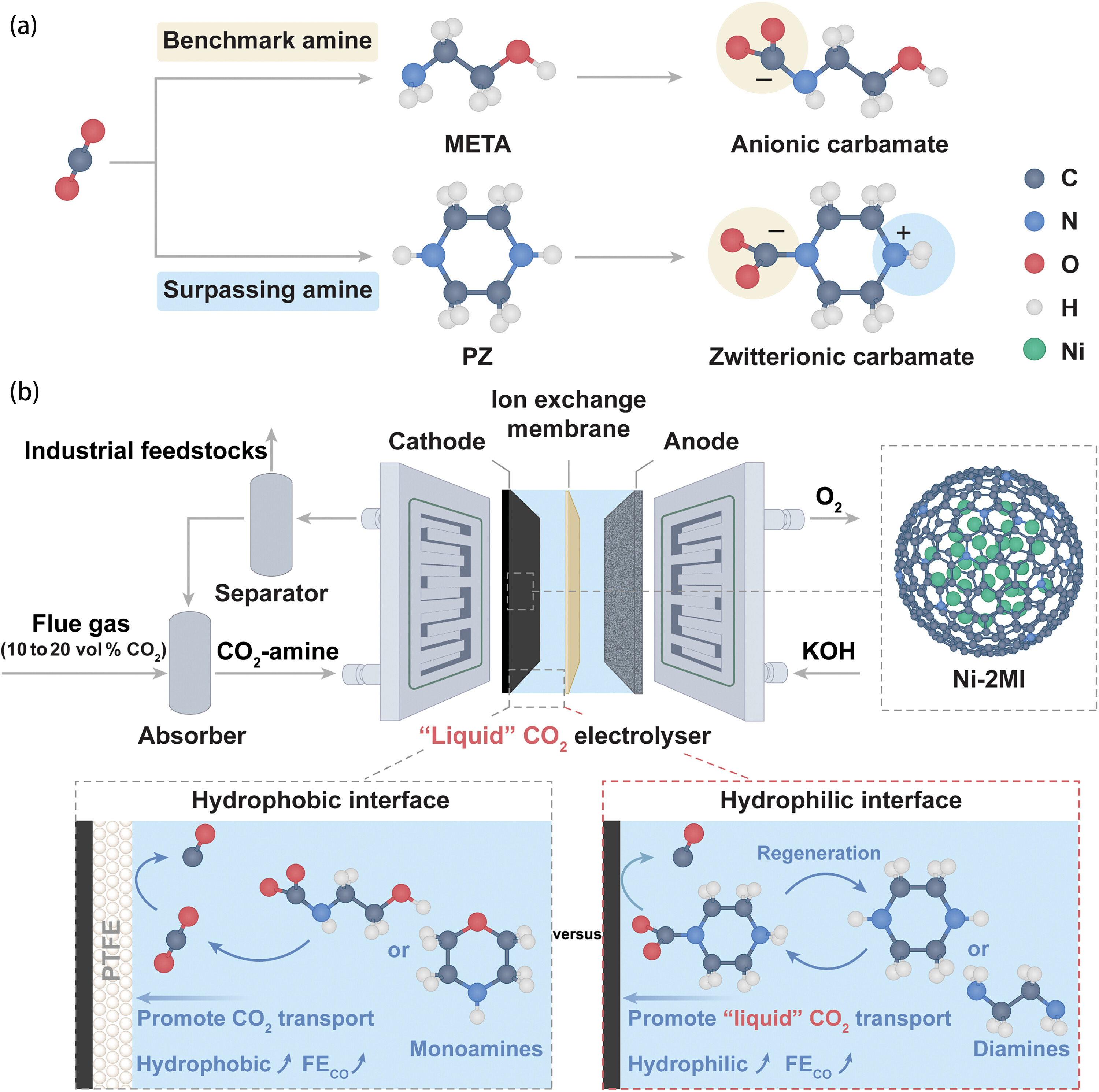
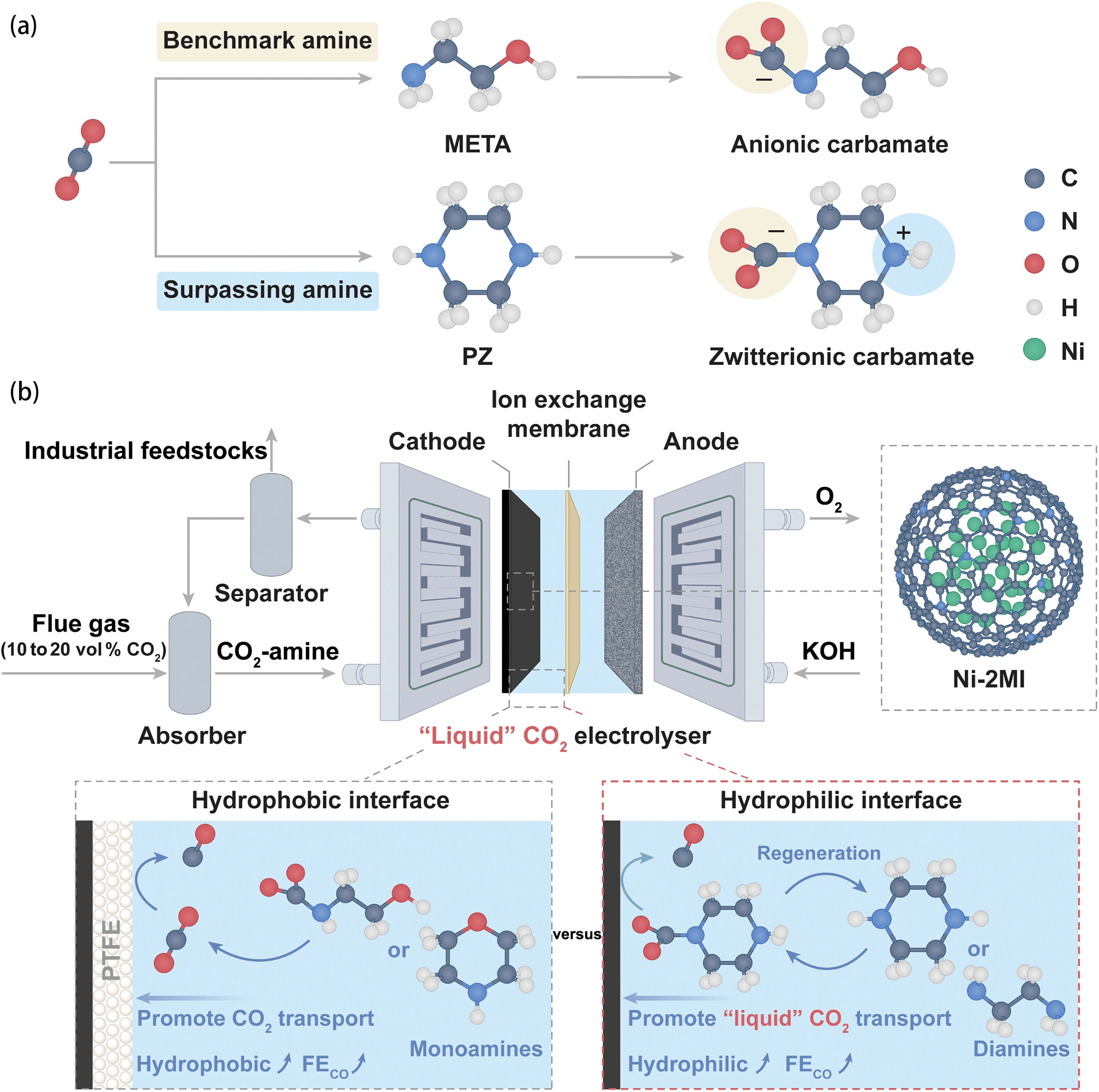
Figure 1. Capture chemistry and interfacial design for ICCE. (a) Comparison of carbamate formation pathways between benchmark (META) and surpassing (PZ) amines;
Prior to this work, research in this field had primarily focused on improving the electrochemical conversion step while treating the capture process as largely fixed[13-15]. Considerable efforts were devoted to enhancing the performance of conventional amine- or amino-acid-based reactive-capture systems through catalyst engineering[4], electrolyte optimization[14,16,17], and interfacial modifiers such as alkali metal cations, surfactants and advanced electrocatalysts. Although these approaches improved catalytic activity to varying degrees, they shared a common assumption that the capture solvent merely served as a passive CO2 reservoir. In 2025, Ma and co-workers proposed, for the first time, a tandem amine scrubbing and CO2 electrolysis process that directly converts captured CO2 into chemicals, thereby bypassing the energy-intensive desorption and compression stages. In their study, piperazine was employed as the absorbent, allowing for the direct electrochemical reduction of the resulting carbamate adducts over a nickel
In a recent study published in Science Advances, Ma and co-workers[4] challenge this conventional design philosophy by demonstrating that the molecular chemistry established during CO2 capture can be deliberately exploited to engineer the catalytic interface. Through a systematic comparison of six representative amines, they identify piperazine as uniquely capable of stabilizing the protonated carbamate species that spontaneously assembles into a zwitterionic interfacial environment[4,6]. Unlike conventional membrane electrode assembly (MEA) systems, where carbamates continuously undergo hydrolysis and exist in highly dynamic equilibria, the relatively stable protonated carbamates formed by piperazine provide a structurally organized interface that promotes efficient electrochemical conversion. Benefiting from this unique interfacial environment, the optimized piperazine-Ni nanoparticle system achieves a CO Faradaic efficiency of approximately 60%, while delivering stable CO Faradaic efficiencies of 30-45% and energy efficiencies of ca. 15-25% for over 150 hours in a 9 cm2 zero-gap membrane electrode assembly electrolyzer.
The deeper value of this work lies in how it resolves the long-standing ambiguity of “what is actually being reduced” in
Overall, the present work highlights the key role of molecular structures generated during CO2 capture in creating favorable interfacial environments for electrocatalysis. In this sense, capture chemistry is elevated from an upstream separation process to an active tool for electrochemical interface engineering. Such a perspective is likely to inspire future research that simultaneously considers capture solvent design, catalyst development and interfacial microenvironment regulation as a unified molecular system, rather than independent optimization targets. Beyond piperazine, this framework may also stimulate the exploration of new classes of capture molecules capable of simultaneously maximizing carbon capture efficiency and electrochemical reactivity, thereby accelerating the development of practical integrated carbon capture and conversion technologies. However, several challenges remain before this technology can be translated into practical applications. Current systems generally exhibit limited current densities insufficient product selectivity toward multi-carbon products. The complex interactions between capture solvents, catalysts, electrolytes, and membranes also hinder system optimisation. Future research should focus on developing integrated catalyst-capture media systems, advanced operando characterisation, and mechanistic modelling to guide materials innovation. Combining these advances with scalable reactor engineering, renewable electricity integration, and comprehensive
Authors contribution
Pan Q: Data analysis, investigation, validation, writing-original draft.
Sun Y: Conceptualization, project administration, data analysis, investigation, supervision, validation, writing-original draft, writing-review & editing.
Conflicts of interest
Ying Sun is an Editorial Board Member of Smart Materials and Devices. The other authors declare no conflicts of interest.
Ethical approval
Not applicable.
Consent to participate
Not applicable.
Consent for publication
Not applicable.
Availability of data and materials
Not applicable.
Funding
This work was supported by the National Natural Science Foundation of China (Grant No. 22308139).
Copyright
© The Author(s) 2026.
References
-
1. Zhong Y, Zheng Z, Hao D, Jin H, Zheng X, Li Y, et al. Electrochemically integrated carbon capture and utilization. ACS Mater Lett. 2025;7(12):3952-3973.[DOI]
-
5. Li Y, Zheng X, Zhao G, Li H, Zheng Z, Li P, et al. Electroactive species in reactive CO2 capture. Electrochem Commun. 2026;186:108146.[DOI]
-
6. Li P, Mao Y, Shin H, Yang Q, Cheng X, Li Y, et al. Tandem amine scrubbing and CO2 electrolysis via direct piperazine carbamate reduction. Nat Energy. 2025;10(10):1262-1273.[DOI]
-
7. Ding M, Sun J, Wang Y, Xu D. CO2 capture and utilization: Collaborative innovation under multi-disciplinary integration. Sustain Chem Energy Mater. 2025;2:100017.[DOI]
-
8. Verma PK, McCrory CCL. Electrochemical reactive capture of carbon dioxide using an amine sorbent and a homogeneous cobalt electrocatalyst. ACS Energy Lett. 2026;11(2):2045-2051.[DOI]
-
9. Sun SS, Xiao YC, Li F, Wu J, Che Y, Wang Y, et al. Industrial amine blends enable efficient CO electrosynthesis in reactive capture. EES Catal. 2026;4(2):387-396.[DOI]
-
11. Kim Y, Lees EW, Donde C, Jewlal AML, Waizenegger CEB, de Hepcée BMW, et al. Integrated CO2 capture and conversion to form syngas. Joule. 2024;8(11):3106-3125.[DOI]
-
12. Li Q, Zhang J, Ding Y, Xiong Z, Zhang J, Zhao Y. Unveiling direct and indirect pathways of electrochemical CO2 reduction in amine-based carbon capture electrolytes. Angew Chem Int Ed. 2026;65(16):e21624.[DOI]
-
13. Shen K, Cheng D, Reyes-Lopez E, Jang J, Sautet P, Morales-Guio CG. On the origin of carbon sources in the electrochemical upgrade of CO2 from carbon capture solutions. Joule. 2023;7(6):1260-1276.[DOI]
-
14. Lee G, Li YC, Kim JY, Peng T, Nam DH, Sedighian Rasouli A, et al. Electrochemical upgrade of CO2 from amine capture solution. Nat Energy. 2021;6(1):46-53.[DOI]
-
16. Xu T, Yin G, Wang F, Yang F, Xu J, Ye J, et al. Creating a microenvironment in an amine solution for integrated CO2 capture and electroreduction. ACS Catal. 2025;15(20):17133-17143.[DOI]
-
17. Gomes RJ, Li J, Xu J, Sarkar B, Mohebi M, Gabriel J, et al. Reactive CO2 capture via controlled amine speciation in non-aqueous electrolytes. Nat Energy. 2026;11(5):756-766.[DOI]
Copyright
© The Author(s) 2027. This is an Open Access article licensed under a Creative Commons Attribution 4.0 International License (https://creativecommons.org/licenses/by/4.0/), which permits unrestricted use, sharing, adaptation, distribution and reproduction in any medium or format, for any purpose, even commercially, as long as you give appropriate credit to the original author(s) and the source, provide a link to the Creative Commons license, and indicate if changes were made.
Publisher’s Note
Science Exploration remains a neutral stance on jurisdictional claims in published
maps
and institutional affiliations. The views expressed in this article are solely those
of
the author(s) and do not reflect the opinions of the Editors or the publisher.
Share And Cite


Science Exploration Style
Pan Q, Sun Y. Skipping the middleman: Direct electroreduction of amine-captured CO2 via zwitterionic carbamate interfaces. Smart Mater Devices. 2027;3:202634. https://doi.org/10.70401/smd.2026.0050
Tips
Copy completed.
Submit a Manuscript
Author Instructions
Cite this Article
Article Metrics
0
View
0
Download
Cited
Article Updates

 Get citation
Science Exploration Style

Pan Q, Sun Y. Skipping the middleman: Direct electroreduction of amine-captured CO2 via zwitterionic carbamate interfaces. Smart Mater Devices. 2027;3:202634. https://doi.org/10.70401/smd.2026.0050
copy
Share Link
copy