Structure-guided all-silk textiles for passive daytime cooling

Yating Ji
1

,
Weifeng Yang
2,*
*Correspondence to:
Weifeng Yang, Department of Health Sciences and Technology, ETH Zurich, Zurich 8008, Switzerland.
E-mail: weifeng.yang@hest.ethz.ch
Smart Mater Devices. 2027;3:202650. 10.70401/smd.2026.0051
Received: August 06, 2026Accepted: September 28, 2026Published: September 29, 2026
Daytime radiative-cooling textiles can alleviate personal heat stress, but many high-performing systems still rely on synthetic polymers, porous composites or inorganic scattering additives. These components improve spectral control but can complicate comfort, recycling and environmental safety. This Research Highlight discusses a study titled “Sustainable all-silk textiles for personal thermal management,” which instead uses the hierarchical organization of a natural fibre to achieve cooling. Silk fibroin contributes favourable intrinsic optical properties, whereas the yarn architecture retains the softness, breathability and processability required for wearable textiles. A Fermat-spiral twisting strategy continuously and relatively uniformly wraps silk nanofibres around conventional silk yarns, producing a hierarchical core-sheath structure with dense optical interfaces and no plastic or inorganic nanoparticle additives.
Personal thermal-management textiles face a dual challenge: they must mitigate heat stress without creating new environmental burdens[1-3]. Daytime radiative cooling offers a direct physical route, requiring high reflectance across the solar spectrum (0.28-2.5 micrometres) and high thermal emittance within the 8-13 micrometre atmospheric window[4-6]. Figure 1 summarizes these spectral pathways and the conductive transfer of body heat from the skin to the textile. A cooling textile must therefore function as both a photonic surface and a garment, combining optical regulation with breathability, mechanical durability, washability and practical end-of-life handling.
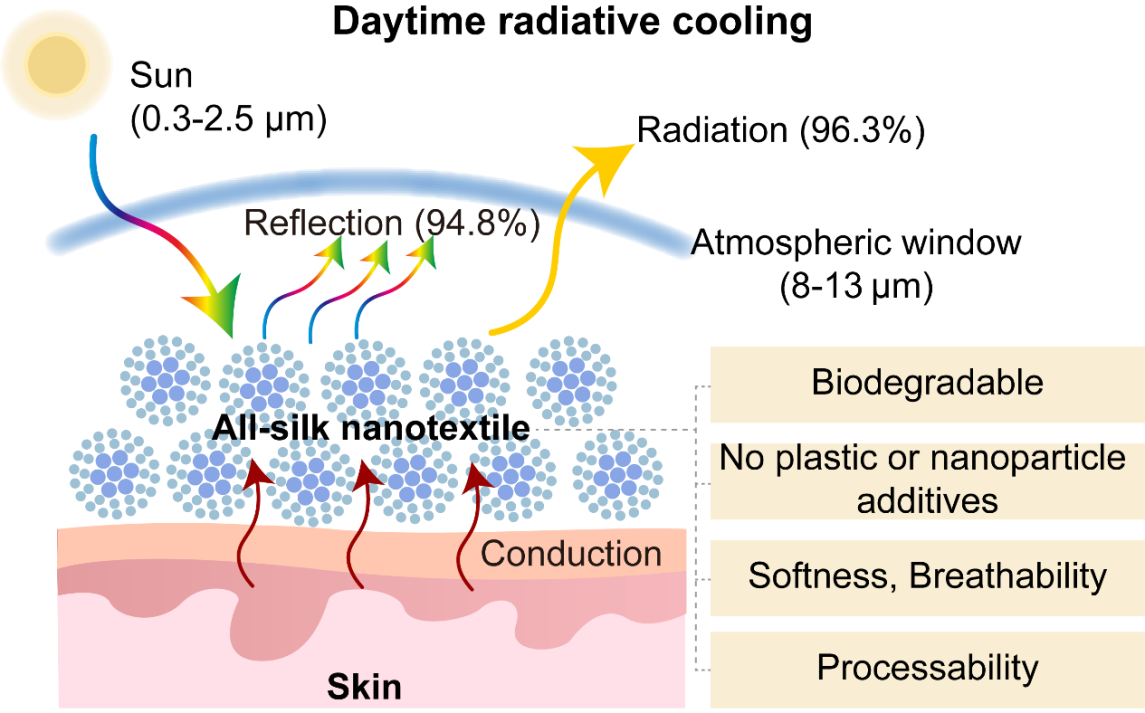
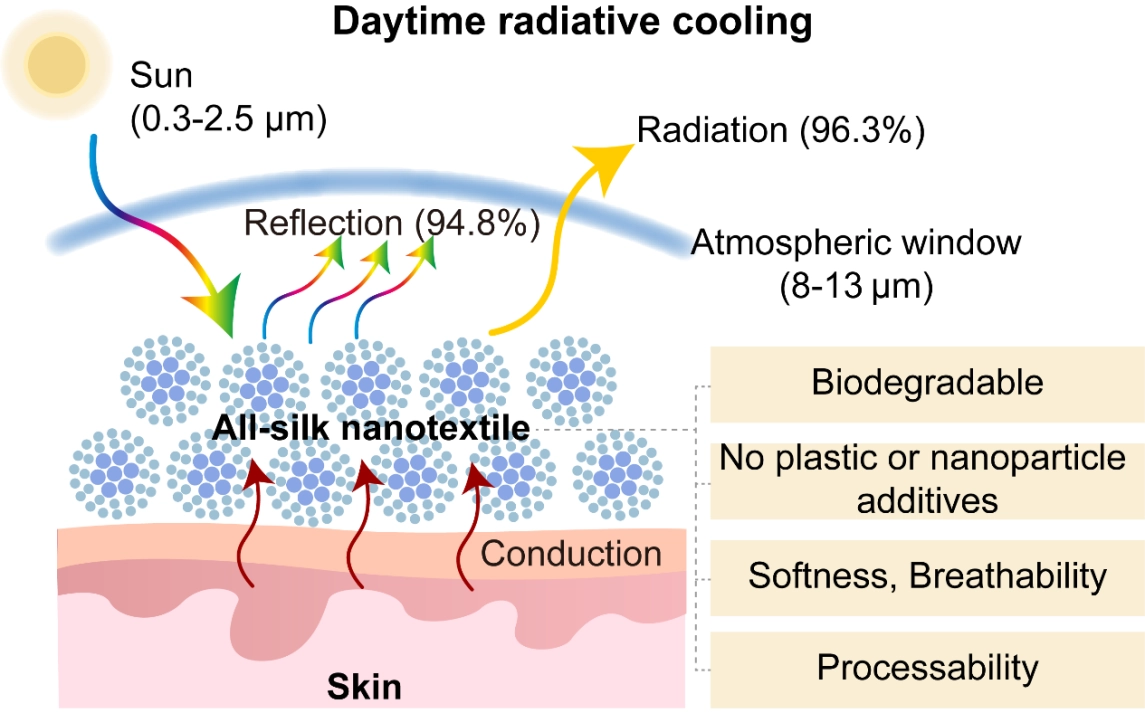
Figure 1. Passive daytime cooling mechanism of a hierarchical core-sheath all-silk textile. The structure couples solar reflection (Rsolar = 94.8%), thermal emission through the 8-13 μm atmospheric window (ε = 96.3%), and conductive heat transfer from the skin to the textile before radiative dissipation.
Silk therefore plays a more specific role in this study than simply replacing a synthetic fibre[7]. At the molecular level, silk fibroin exhibits low absorption across much of the solar spectrum, a refractive index suitable for interfacial scattering, and infrared-active vibrations that support thermal emission[8]. Silk can also convert part of the absorbed ultraviolet radiation into visible fluorescence, reducing heat accumulation associated with ultraviolet absorption. These intrinsic properties should be distinguished from the optical effects of the textile architecture: the hierarchical fibre arrangement mainly increases the number and size range of scattering interfaces. At the textile level, silk retains softness, breathability, moisture permeability, yarn processability, biocompatibility and biodegradability[9]. The all-silk route is compelling because it treats silk simultaneously as an optical medium and a wearable structural material, rather than merely as an environmentally preferable substitute in a conventional composite.
The Fermat-spiral twisting strategy addresses a specific structural limitation. Conventional silk yarns are mechanically robust and readily processed, but the characteristic dimensions of their constituent fibres alone do not provide the multiscale scattering required across the solar spectrum. The spiral winding primarily enables continuous and relatively uniform wrapping of silk nanofibres around the curved yarn surface. The inner yarn retains strength and processability, while the outer nanofibre sheath introduces micro- and nanoscale refractive-index discontinuities that enhance broadband solar scattering. Thus, the optical benefit arises from the hierarchical distribution of interfaces enabled by the winding strategy, rather than from the spiral geometry alone[10]. This structure-guided logic is consistent with other hierarchical thermal-management architectures, including crisscross channels formed by multidirectional freeze-casting[11]. Compared with particle-filled polymer or inorganic coatings, the all-silk architecture also preserves compositional purity and reduces dependence on detachable additives.
From a structural perspective, the significance of the reported performance extends beyond the headline optical values. The all-silk nanofibre textile achieves a solar reflectance of 94.8%, an infrared emittance of 96.3%, and ultraviolet absorption of only 8.19%, without plastic polymers or inorganic nanoparticles. Earlier scalable radiative-cooling textiles, including hierarchical metafabrics and wet-spun chitosan-silica systems, have shown how multiscale interfaces can improve solar scattering[12,13]. The distinction here is that hierarchically organizing a single natural material provides optical regulation, mechanical integrity and textile processability within an additive-free architecture. In addition to cooling tests on simulated and human skin and assessments of breathability, washability and mechanical durability, the original study reports approximately 95% material recyclability, biodegradation, the biosafety of degradation products, and a cradle-to-grave life-cycle assessment[7]. These results shift the emphasis from an isolated optical coating to the performance, comfort and end-of-life behaviour of the textile system.
For sustainable personal thermal management, the broader lesson is to simplify material composition through structural design rather than adding functional complexity. Controlled fibre-assembly strategies related to Fermat-spiral winding could be explored in cellulose, keratin, chitosan and other bio-derived fibres, especially when optical control must coexist with moisture transport, mechanical strength and skin comfort. Scalable routes such as wet-spinning, hierarchical weaving and directional freeze-casting provide useful benchmarks for processing throughput and structural control[11-14]. The original study already examined airflow, repeated washing and urban radiative surroundings[4,7]. The remaining practical questions therefore concern perspiration, body motion, garment geometry, coloration and long-term optical and mechanical stability at garment scale. Comparative studies should also consider processing inputs, solvent recovery, cost, silk supply, industrial finishing and end-of-life recovery alongside cooling performance. The lasting contribution of this work is its structure-first design principle: a single natural material can provide advanced thermal function when molecular optics, yarn architecture and life-cycle performance are treated as interconnected design variables.
Authors contribution
Ji Y: Conceptualization, investigation, visualization, writing-original draft.
Yang W: Conceptualization, resources, supervision, writing-review & editing.
Conflicts of interest
The authors declare no conflicts of interest.
Ethical approval
Not applicable.
Consent to participate
Not applicable.
Consent for publication
Not applicable.
Availability of data and materials
Not applicable.
Funding
None.
Copyright
© The Author(s) 2026.
References
-
3. Zhang Q, Qi C, Wang X, Zhu B, Li W, Xiao X, et al. Daytime radiative cooling dressings for accelerating wound healing under sunlight. Nat Chem Eng. 2024;1(4):301-310.[DOI]
-
7. Wu XE, Wang Y, Li S, Zhang Y, Lu H, Zhu L, et al. Sustainable all-silk textiles for personal thermal management. Nat Sustain. 2026.[DOI]
-
8. Reizabal A, Costa CM, Pérez-Álvarez L, Vilas-Vilela JL, Lanceros-Méndez S. Silk fibroin as sustainable advanced material: Material properties and characteristics, processing, and applications. Adv Funct Mater. 2023;33(3):2210764.[DOI]
-
11. Ou L, Li Z, Ding Y, Lu L, Wang X, Dai H, et al. Janus monolithic thermal management via directional radiative cooling and heat dissipation. Renew Energy. 2026;268:125825.[DOI]
-
12. Chen C, Jia X, Li X, Shi M, Hu J, Song M, et al. Scalable wet-spinning of wearable chitosan-silica textile for all-day radiative cooling. Chem Eng J. 2023;475:146307.[DOI]
-
14. Zhang S, Liu M, Wang J, Chen M, Wu J, Liang J, et al. Photoluminescent-assisted hierarchical metafabric sunshade for high-efficiency passive cooling. Innovation. 2026.[DOI]
Copyright
© The Author(s) 2027. This is an Open Access article licensed under a Creative Commons Attribution 4.0 International License (https://creativecommons.org/licenses/by/4.0/), which permits unrestricted use, sharing, adaptation, distribution and reproduction in any medium or format, for any purpose, even commercially, as long as you give appropriate credit to the original author(s) and the source, provide a link to the Creative Commons license, and indicate if changes were made.
Publisher’s Note
Science Exploration remains a neutral stance on jurisdictional claims in published
maps
and institutional affiliations. The views expressed in this article are solely those
of
the author(s) and do not reflect the opinions of the Editors or the publisher.
Share And Cite


Science Exploration Style
Ji Y, Yang W. Structure-guided all-silk textiles for passive daytime cooling. Smart Mater Devices. 2027;3:202650. https://doi.org/10.70401/smd.2026.0051
Tips
Copy completed.
Submit a Manuscript
Author Instructions
Cite this Article
Article Metrics
0
View
0
Download
Cited
Article Updates

 Get citation
Science Exploration Style

Ji Y, Yang W. Structure-guided all-silk textiles for passive daytime cooling. Smart Mater Devices. 2027;3:202650. https://doi.org/10.70401/smd.2026.0051
copy
Share Link
copy