Carbon black modified engineered cementitious composite-based triboelectric nanogenerator for mechanical energy harvesting and self-powered cathodic protection

*Correspondence to:
Menghuan Guo, Guangdong Provincial Key Laboratory of Durability for Marine Civil Engineering, Shenzhen University, Shenzhen 518060, Guangdong, China.
E-mail: menghuan.guo@szu.edu.cn
Qi Luo, School of Mechanics and Construction Engineering, Key Laboratory of Marine Civil Engineering Materials and Structures, Ministry of Education of China, Jinan University, Guangzhou 510632, Guangdong, China. E-mail: luoqi@jnu.edu.cn
Guoxu Liu, Beijing Key Laboratory of Micro-nano Energy and Sensor, Center for High-Entropy Energy and Systems, Beijing Institute of Nanoenergy and Nanosystems, Chinese Academy of Sciences, Beijing 101400, China. E-mail: liuguoxu@binn.cas.cn
Smart Mater Devices. 2027;3:202663. 10.70401/smd.2026.0056
Received: September 01, 2026Accepted: October 28, 2026Published: November 01, 2026
This article belongs to the Special lssue Advanced Triboelectric and Piezoelectric Nanogenerators for Self-Powered Systems
Abstract
Civil infrastructure is continuously exposed to low-frequency mechanical excitations from vehicles, pedestrians, wind vibration, and water flow during service, making in situ mechanical energy harvesting a promising route for self-powered structural health monitoring and cathodic protection. However, conventional cement-based triboelectric nanogenerators (TENGs) are limited by intrinsic brittleness, poor cycling stability, and inefficient charge transfer, which restrict their practical application in civil engineering environments. Herein, a carbon black (CB)-modified engineered cementitious composite (ECC) triboelectric nanogenerator, denoted as CBECC-TENGs, is developed by incorporating conductive CB into a highly ductile cement-based matrix. The optimized CB content synergistically regulates the surface roughness, pore structure, and electrical conductivity of ECC, thereby enhancing interfacial contact electrification, charge transport, and triboelectric output. COMSOL simulations reveal the potential evolution and charge transfer behavior during the contact-separation process. The CBECC-TENGs retain approximately 90% of their initial output after 5,000 cycles, indicating promising preliminary cycling stability. Moreover, the self-powered cathodic protection system shifts the open-circuit potential of carbon steel in chloride solution from -0.28 to -0.33 V (vs. Ag/AgCl) and effectively suppresses rust formation. This work provides a feasible strategy for developing ductile, durable, and energy-harvesting cement-based TENGs for smart civil infrastructure.
Keywords
TENG, engineered cementitious composites (ECC), cathodic protection
1. Introduction
With the rapid development of smart infrastructure and Internet of Things (IoT) technologies, civil engineering structures are evolving from conventional load-bearing components toward multifunctional systems with integrated structural and sensing capabilities[1]. However, most distributed sensors still rely on external batteries or wired power supplies, which face challenges such as battery replacement, high wiring cost, complex maintenance, and potential environmental pollution. These limitations make it difficult to meet the long-term, low-maintenance requirements of large-scale infrastructure[2]. Meanwhile, bridges, roads, buildings, and marine structures are continuously subjected to low-frequency mechanical excitations during service, including those induced by vehicles, pedestrians, wind vibration, and water flow, providing a widely available source of environmental mechanical energy[3,4]. Converting such mechanical energy into electricity in situ offers a promising route for self-powered structural monitoring[5], corrosion protection[6], and the sustainable operation of smart infrastructure[7].
Triboelectric nanogenerators (TENGs) operate on the coupling of triboelectrification and electrostatic induction and have been widely recognized for their simple structure, broad material compatibility, and high efficiency in harvesting low-frequency mechanical energy[8-10]. Studies on TENGs have demonstrated their versatility in self-powered sensing across diverse applications, such as intelligent path lighting[11], gamified hand rehabilitation[12], and human movement collection and monitoring[13,14]. The application of TENG is expanding from wearable devices to a wider range of infrastructure energy harvesting[15,16] and self-sensing[17]. However, TENGs have inherent limitations in terms of carrying capacity and long-term durability, making them difficult to directly apply to load-bearing structures such as roads and bridges. In contrast, cement-based TENGs naturally possess structural carrying capacity and are more suitable for achieving true structural-functional integration with civil infrastructure[18-20]. Previous studies have enhanced the output performance of cement-based TENGs by introducing various functional fillers, including nanoparticles[21], carbon fibers[22,23], carbon nanotubes[24,25], graphene[26,27], and carbon black (CB)[28,29]. These fillers can improve the dielectric polarization, charge transport, and charge storage capability of the cement matrix. Meanwhile, cement-based TENGs have been demonstrated for environmental mechanical energy harvesting, enabling self-powered structural systems[6,7,19,27,30], self-sensing[26,29,31-33], and autonomous crack detection[25]. However, conventional cement-based materials are highly brittle and have poor deformation capacity. Under repeated impact, friction, and cyclic loading, microcracks can easily develop in the matrix, resulting in weakened interfacial contact, disrupted conductive pathways, and reduced electrical output. These issues significantly limit the long-term service performance and practical application of cement-based TENGs in civil engineering environments[34].
To address these issues, engineered cementitious composite (ECC) offers low-carbon[35], strain-hardening, multi-crack propagation capability[36], and excellent damage tolerance[37], superior tensile deformation capacity[38], and fatigue resistance[39]. Compared to traditional cement-based materials, ECC provides a solid material foundation for enhancing the structural integrity and cyclic output stability of TENGs. The introduction of highly electronegative or conductive nanofillers has been proven to be an effective strategy for enhancing charge density and output performance[40]. CB has good electrical conductivity, a large specific surface area, and a low cost, making it suitable for tailoring the electrical properties of cementitious composites[41-44]. An appropriate CB content can refine the pore structure, improve matrix compactness, and construct effective conductive pathways[45,46], thereby promoting triboelectric charge transport and output performance[28]. In contrast, excessive CB may cause particle agglomeration or overly connected conductive networks, leading to local defects and charge leakage[47]. Unlike traditional CB cement-based materials, the strain hardening and multi-groove cracking characteristics of CB-ECC are expected to optimize its electrical output performance and cycling stability without affecting the ECC’s tensile properties[48]. Therefore, clarifying the synergistic effects of CB content on the microstructure, electrical properties, and triboelectric output of ECC is essential for developing high-performance ECC-based TENGs.
This study reports a CB-modified engineered cementitious composite triboelectric nanogenerator. The effects of CB content on the microstructure, mechanical properties, electrical conductivity, impedance characteristics, and triboelectric output of CBECC-TENGs were systematically investigated. COMSOL simulations were further conducted to reveal the charge transfer behavior during the contact-separation process. In addition, the load matching, energy storage capability, light-emitting diode (LED) driving performance, and cycling stability of the device were evaluated. Its potential application in self-powered cathodic protection under chloride environments was also explored. This study provides new insights into the design of cement-based TENGs with high ductility, durability, and energy-harvesting capability.
2. Experimental Section
The methods are provided in the Supplementary materials.
3. Results and Discussion
CBECC was prepared using ordinary Portland cement as the cementitious matrix. Slag powder, limestone powder, and silica fume were used as mineral admixtures. Quartz sand was used as fine aggregate. PE fibers were added to provide the toughening effect required for ECC. CB was introduced as the conductive phase and dielectric regulating phase (Figure 1a). The experimental section is presented in the Supplementary Material. After dry mixing, wet mixing, molding, and curing, CB particles were dispersed in the ECC matrix. This provides a microstructural basis for contact electrification and charge transport in the CBECC. Figure 1b compares the surface morphology and surface profiles of ECC and CBECC. The surface of plain ECC is relatively smooth. In contrast, the CBECC surface shows more micron-scale undulations, pits, and wrinkle-like structures. This indicates that CB changes the surface morphology of ECC and increases its surface roughness. A rougher surface can increase the effective contact area during triboelectrification. As a result, charge generation is promoted and the triboelectric output is improved[49]. Mercury Injection Porosimetry (MIP) was used to study the effect of CB content on the pore size distribution of ECC (Figure 1c). As the CB content increased from 0 to 2.5 wt%, the volume fraction of large pores above 100 nm decreased clearly. Meanwhile, the proportion of fine pores between 10 and 50 nm increased. This may be because CB particles act as physical fillers and nucleation sites during cement hydration. They help refine the pore structure and make the matrix denser[41]. A denser pore structure can improve mechanical strength. It may also reduce charge leakage and enhance charge retention. Figure 1d shows the compressive strength of CBECC with different CB contents after curing for 3, 7, and 28 days. When the CB content was 1.0 to 2.0 wt%, the compressive strength at each age was higher than that of plain ECC. The improvement was more obvious at 28 days. This is mainly attributed to the filling effect of CB. CB refines the pores and increases the compactness of the matrix. When the CB content increased to 2.5 wt%, the compressive strength decreased slightly. This phenomenon is consistent with the tensile properties of CBECC that we previously reported[48]. This may be related to particle agglomeration, local defects, or weak interfacial regions[48]. To further verify the mechanism responsible for the reduced compressive strength at 2.5 wt% CB, scanning electron microscopy (SEM) images of CBECC with different CB contents were obtained (Figure S1). At 0% CB, the microstructure appears dense with well-distributed hydration products. At 2.0 wt% CB, a well-connected conductive network is formed without obvious agglomeration. In contrast, at 2.5 wt% CB, local loose areas and micropores were observed at the interface between the fibers and the matrix. These microstructural defects are consistent with the increased large-pore volume fraction in the MIP results (Figure 1c). Therefore, the reinforcing effect of CB does not keep increasing with higher content. An appropriate content is needed to balance particle dispersion, pore refinement, and conductive network formation.
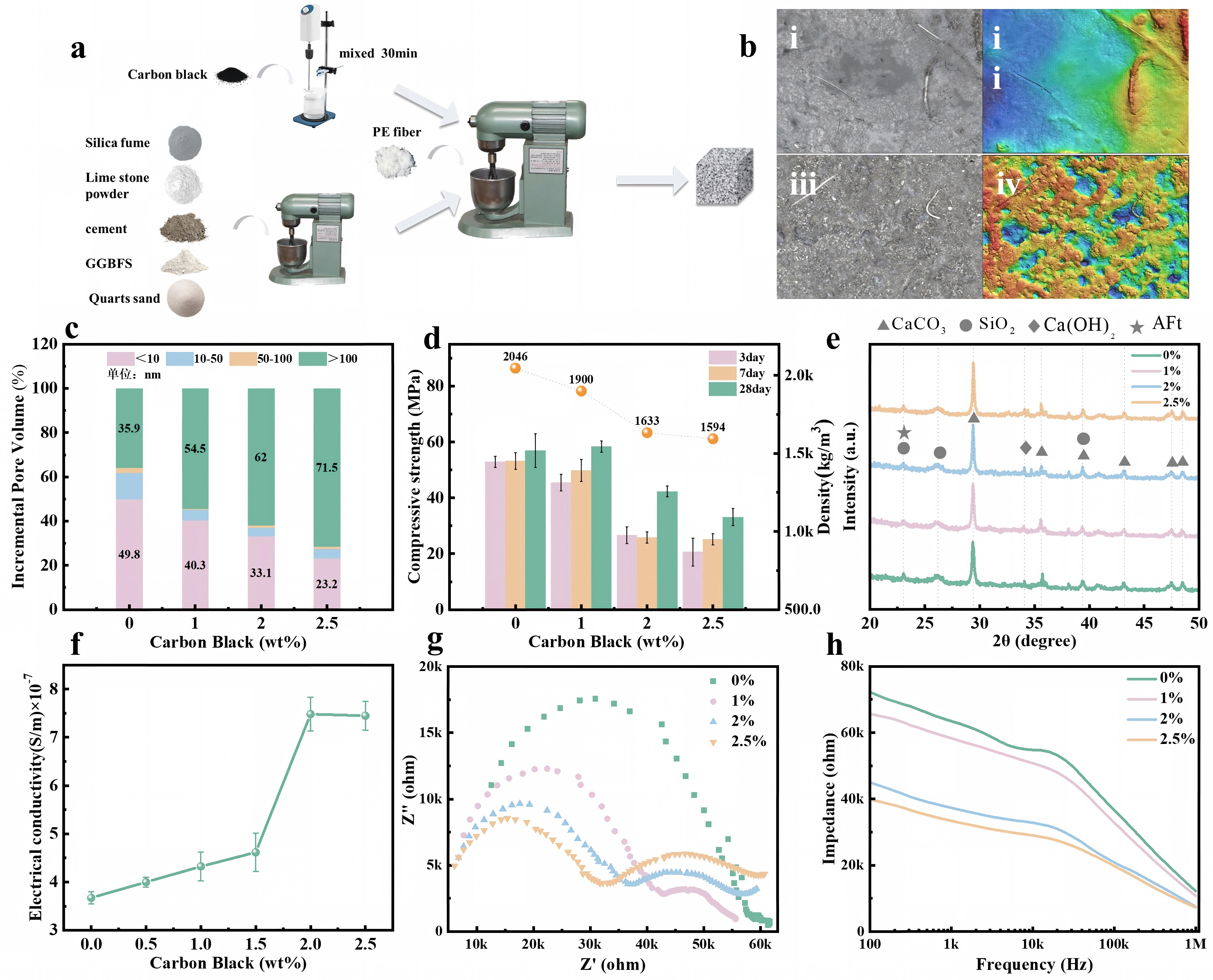
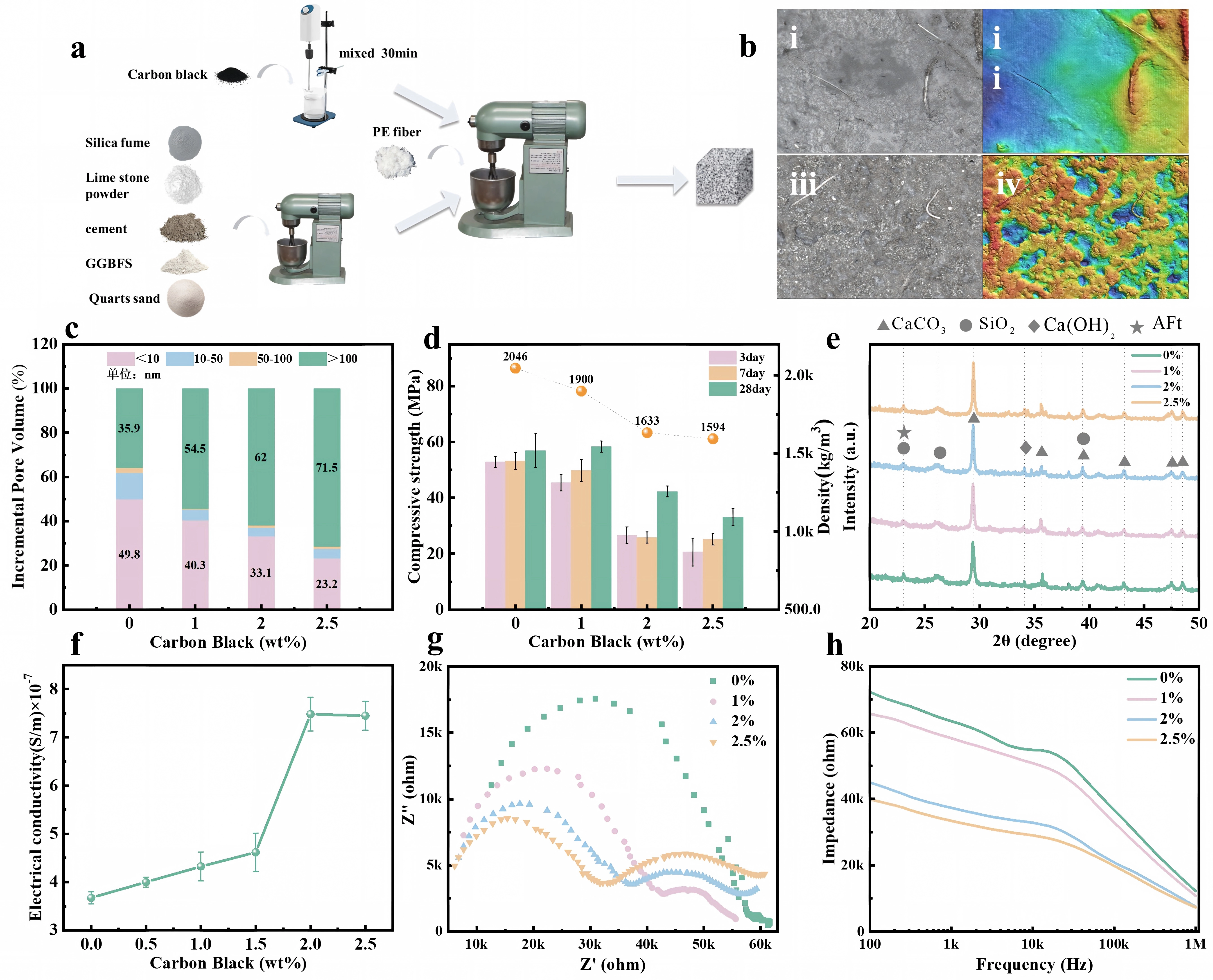
Figure 1. (a) Schematic diagram of the preparation process of CBECC cement-based composite materials; (b) Surface morphology and three-dimensional contour map: The top row shows (i) the surface of ECC and (ii) its three-dimensional roughness; the bottom row shows (iii) the surface of CBECC and (iv) the corresponding three-dimensional diagram; (c) Pore size distribution of CBECC at different CB contents (0, 1.0, 2.0, 2.5 wt%); (d) Compressive strength and corresponding volume density changes of CBECC at 3 d, 7 d, and 28 d of age; (e) XRD spectrum of CBECC; (f) Curve showing the relationship between the volume electrical conductivity of CBECC and the CB mass fraction; (g) Nyquist diagram of CBECC; (h) Impedance modulus of the Bode diagram. ECC: engineered cementitious composite; CB: carbon black; XRD: X-ray diffraction; PE: polyethylene; GGBFS: ground granulated blast-furnace slag.
The X-ray diffraction (XRD) results are shown in Figure 1e. Typical cement hydration products were detected in all CBECC specimens, including CaCO3, SiO2, Ca(OH)2, and aluminate (ettringite (AFt)). This indicates that the addition of CB does not generate new crystalline phases. However, the slight decrease in Ca(OH)2 peak intensity and the slight increase in AFt peak intensity suggest that CB influences the hydration process through physical effects. The large specific surface area of CB nanoparticles provides additional heterogeneous nucleation sites, which accelerate the hydration of C3S and C2S and promote the formation of C-S-H gel, thereby consuming Ca2+ and reducing the crystalline Ca(OH)2 content. Meanwhile, the accelerated aluminate reaction may slightly increase AFt formation. These effects are consistent with previous studies on carbon black-modified cementitious systems[41]. Therefore, the main role of CB is microstructural regulation and conductive network formation rather than chemical participation in hydration[42]. The volumetric electrical conductivity of CBECC with different CB contents is shown in Figure 1f. The conductivity shows a typical percolation behavior. When the CB content was lower than 1.5 wt%, the conductivity increased slowly. At this stage, most CB particles were dispersed as isolated particles in the ECC matrix. A continuous conductive network had not yet formed. Therefore, the electron transport ability of the matrix remained weak. When the CB content increased to about 2.0 wt%, the conductivity increased sharply. This indicates that CB particles gradually contacted each other and formed continuous conductive pathways. As a result, the electron transport ability of CBECC was greatly improved. Electrochemical impedance spectroscopy (EIS) results (Figure 1g,h) further indicate that the semicircular arc diameter in the Nyquist plot decreased significantly with increasing CB content. This indicates that both the internal charge transport impedance and the interfacial impedance of ECC gradually decreased. The decrease became more obvious when the CB content exceeded 2.0 wt%. This result is consistent with the percolation transition observed in the conductivity test. In the low frequency range of 10-2-101 Hz, the impedance modulus of CBECC with high CB content decreased markedly, indicating that the CB network effectively promotes rapid electron transport within the ECC matrix. It also provides continuous pathways for charge transfer, charge accumulation, and charge release at the triboelectric interface. Therefore, the triboelectric output performance of CBECC can be enhanced.
Figure 2 illustrates the evolution of charge generation and potential distribution in CBECC-TENGs operating in vertical contact-separation mode. The device primarily consists of an Al electrode, a CBECC triboelectric layer, and a polydimethylsiloxane (PDMS) triboelectric layer (the water contact angle is 103.1°, as shown in Figure S2). In the initial contact state, the PDMS and CBECC are in full contact (Figure 2a(i)). Due to their different electron affinities, contact electrification occurs at the interface. The PDMS surface becomes negatively charged. The CBECC surface becomes positively charged. When the external force is released, the upper PDMS and Al layer gradually separate from the CBECC (Figure 2a(ii)). The positive and negative triboelectric charges are then spatially separated. This charge separation creates a potential difference between the upper and lower electrodes. The potential difference drives electrons to flow through the external circuit. As the separation distance increases, the potential difference gradually increases. The device then reaches the fully separated state (Figure 2a(iii)). When an external force is applied again, the upper PDMS and Al layer move downward toward CBECC. The potential difference gradually decreases. The current direction in the external circuit reverses. In this way, a periodic alternating current output is generated (Figure 2a(iv))[8]. The COMSOL simulation results further show the evolution of the electric potential field during contact and separation (Figure 2b,c,d,e). In the contact state, the internal potential distribution is weak. No obvious potential difference is formed (Figure 2b). During separation, the distance between positive and negative triboelectric charges increases. A clear potential gradient is formed inside the device (Figure 2c). When the two layers are completely separated, the potential difference reaches a high level, and the potential field distribution is most pronounced (Figure 2d). Subsequently, as the layers approach each other again, the potential difference gradually weakens, and the potential field intensity decreases (Figure 2e). These results indicate that the contact separation process can induce charge separation and potential difference formation. This provides the driving force for current output in the external circuit. The simulation results are consistent with the proposed working mechanism based on contact electrification and electrostatic induction. They provide a qualitative visualization of the potential evolution during the contact-separation process. Under periodic mechanical excitation, the CBECC triboelectric layer can generate, separate, and transfer charges to the external circuit. This provides a mechanistic basis for the electrical output of the device.
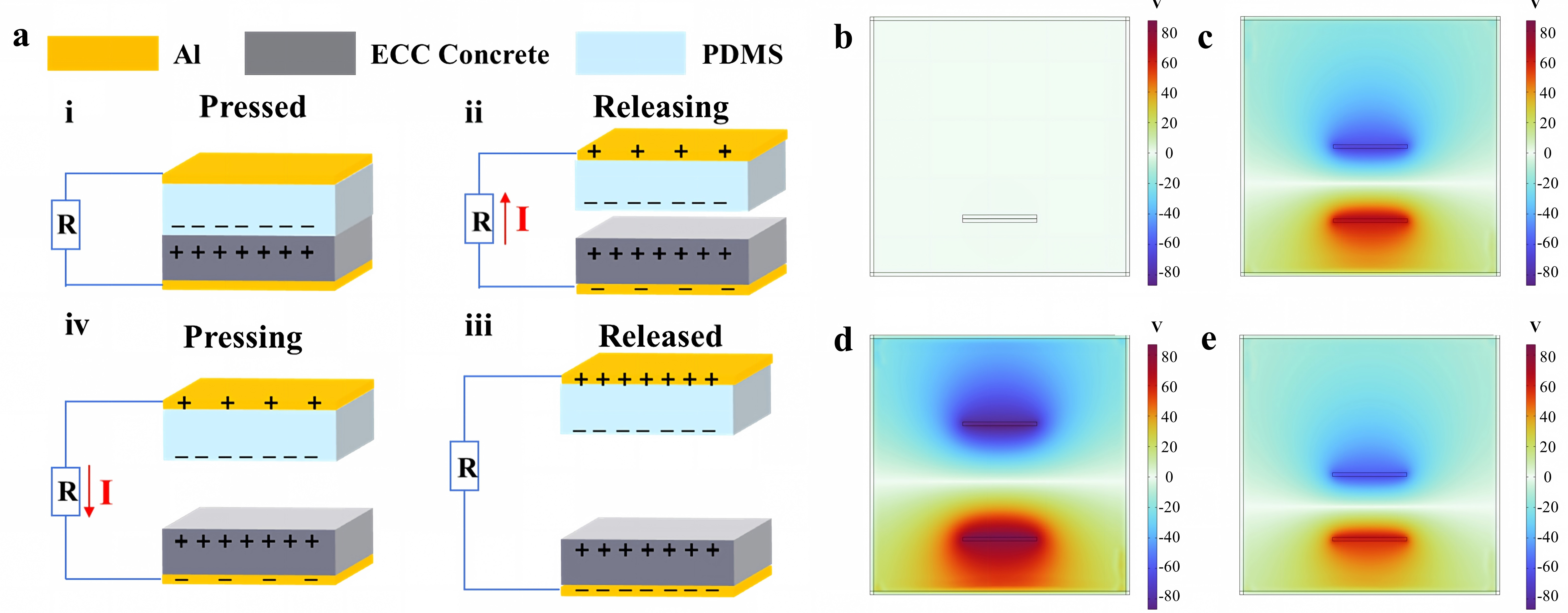
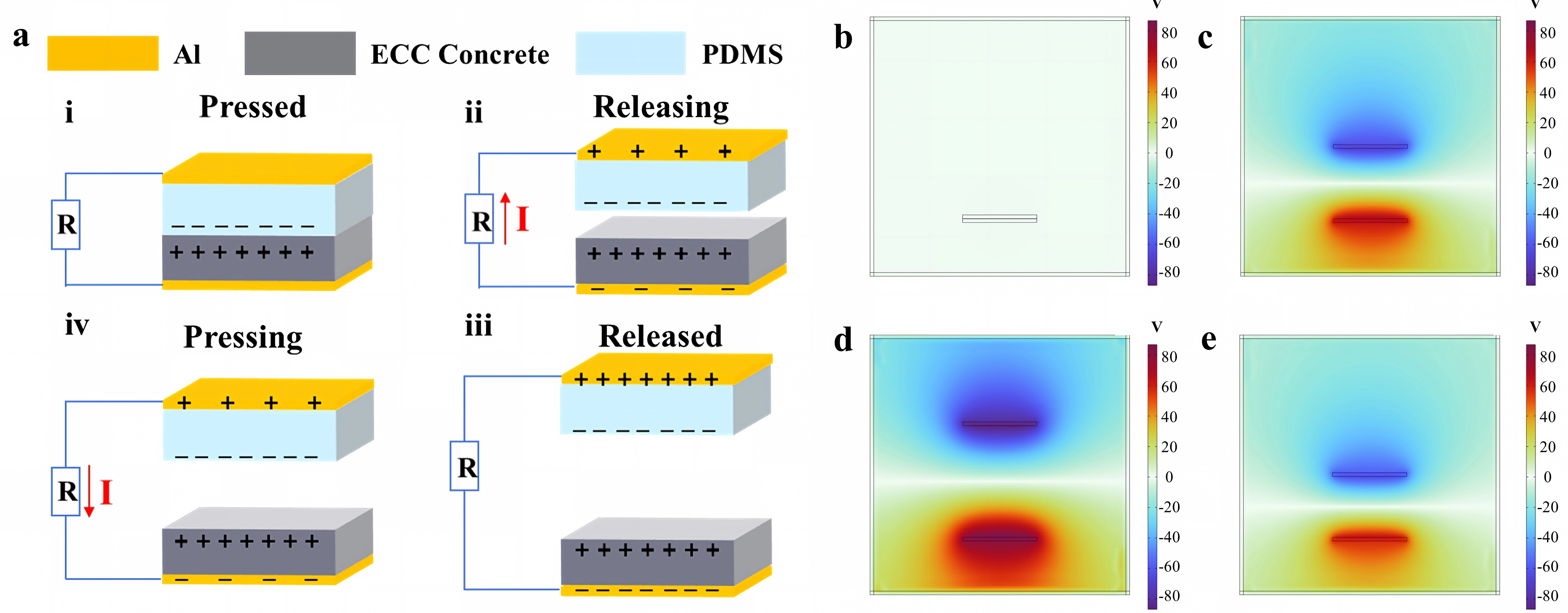
Figure 2. (a) Schematic diagram of the working principle of CBECC-TENGs. The upper electrode is a PDMS film covered with aluminum, and the lower electrode is a CBECC specimen covered with aluminum as a current collector. The two are connected in a loop through an external load R; (b-e) Two-dimensional potential distribution simulation results based on the COMSOL finite element software. CBECC-TENGs: carbon black-engineered cementitious composite triboelectric nanogenerators; PDMS: polydimethylsiloxane.
The electrical output performances of the CBECC-TENGs under different CB contents and excitation frequencies are shown in Figure 3. The device output was evaluated at 1 Hz under different CB contents, including open-circuit voltage (Voc), current, and transferred charge (Figure 3a,b,c). As the CB content increased from 0 to 2.0 wt%, the Voc, current, and transferred charge all increased clearly. This indicates that an appropriate amount of CB improves the electrical conductivity and charge transport ability of the CBECC matrix. It also helps the accumulation and output of triboelectric charges. At a CB content of 2.0 wt%, the CBECC-TENGs showed the best output performance. The Voc, current, and transferred charge all reached their highest values. Compared with the plain ECC-TENGs, the Voc of the CBECC-TENG increased from 28 V to approximately 70 V at 1.0 Hz (Figure 3a). The output current increased to about 8.5 μA and the transferred charge increased to about 22 nC (Figure 3b,c). These results show that a suitable amount of CB can greatly enhance the electrical output of the device. However, if the CB content is too high (2.5 wt%), the overly connected conductive network can also facilitate charge dissipation. The triboelectric charges may leak through the conductive pathways and recombine with opposite charges before being collected by the electrode, which weakens the output. Therefore, CB has an optimal content range for improving the output performance of the CBECC-TENGs. A CB content of 2.0 wt% provides a good balance among conductive network formation, charge transport, and charge retention. Figure S3 shows the surface electrostatic potential and the transferred charge quantity of CBECC-TENGs with 2% CB content and without CB content. The results indicate that the surface potential has decreased from an average of around 95 V of the 2% CB content to 78 V without CB content, and the surface charge density also decreased from 7.5 μC/m2 to 6 μC/m2. Figure 3d,e,f present the time-dependent curves of Voc, short circuit current, and transferred charge at different excitation frequencies. The tested frequencies were 0.5, 1.0, 1.5, and 2.0 Hz. The CB content was fixed at 2.0 wt%. With increasing excitation frequency from 0.5 to 2.0 Hz, the Voc, current, and transferred charge all increased gradually. At low frequencies, the triboelectric charges have more time to dissipate through the conductive network and environmental moisture, reducing the effective surface charge density. Higher contact separation frequency can accelerate charge generation at the triboelectric interface and promote charge transfer through the external circuit, thereby improving the transient output capability of the CBECC-TENG[50]. These results indicate that a higher contact separation frequency can accelerate charge generation at the triboelectric interface. It can also promote charge transfer through the external circuit. Therefore, the transient output capability of the CBECC-TENGs is improved.
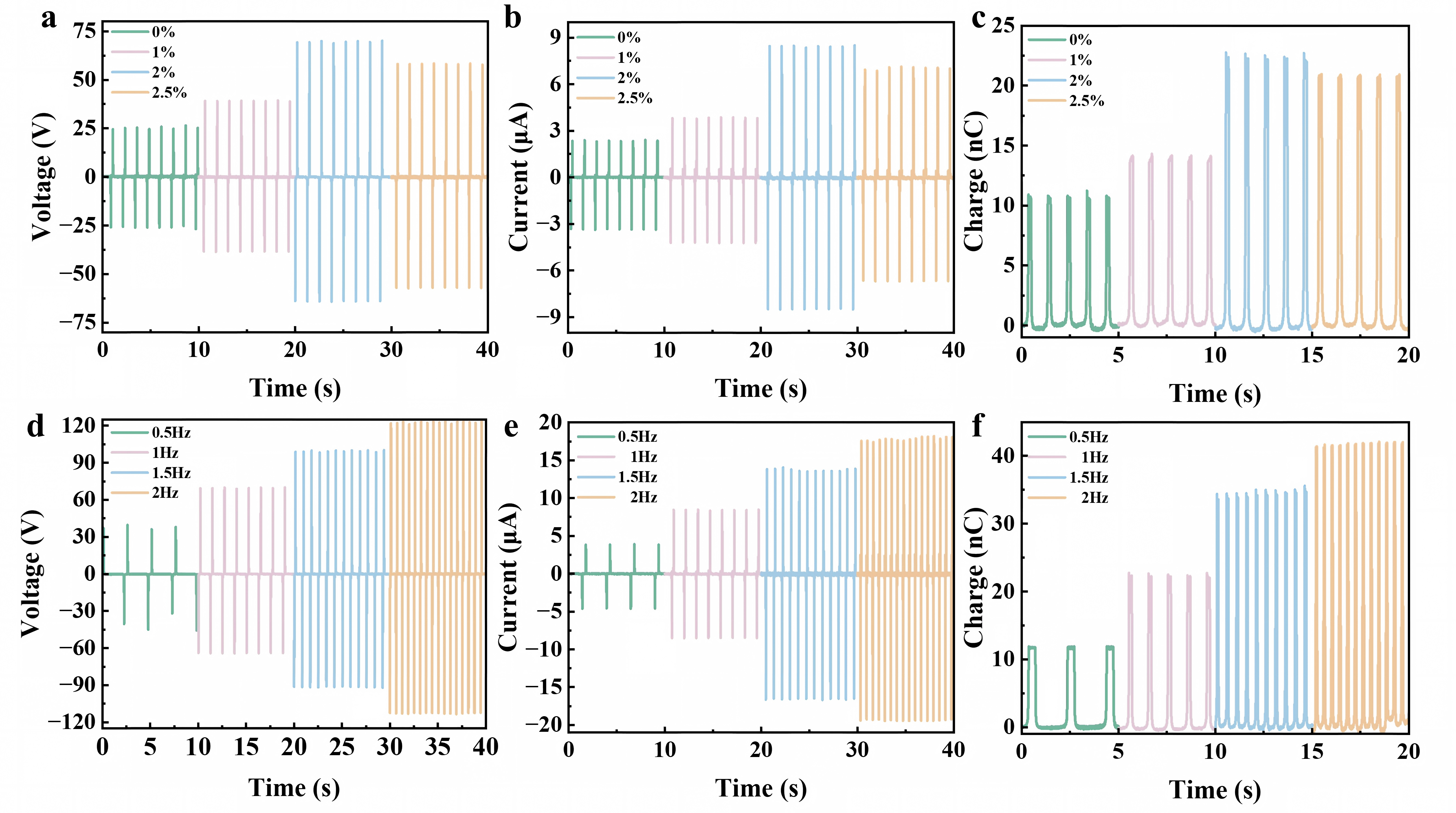
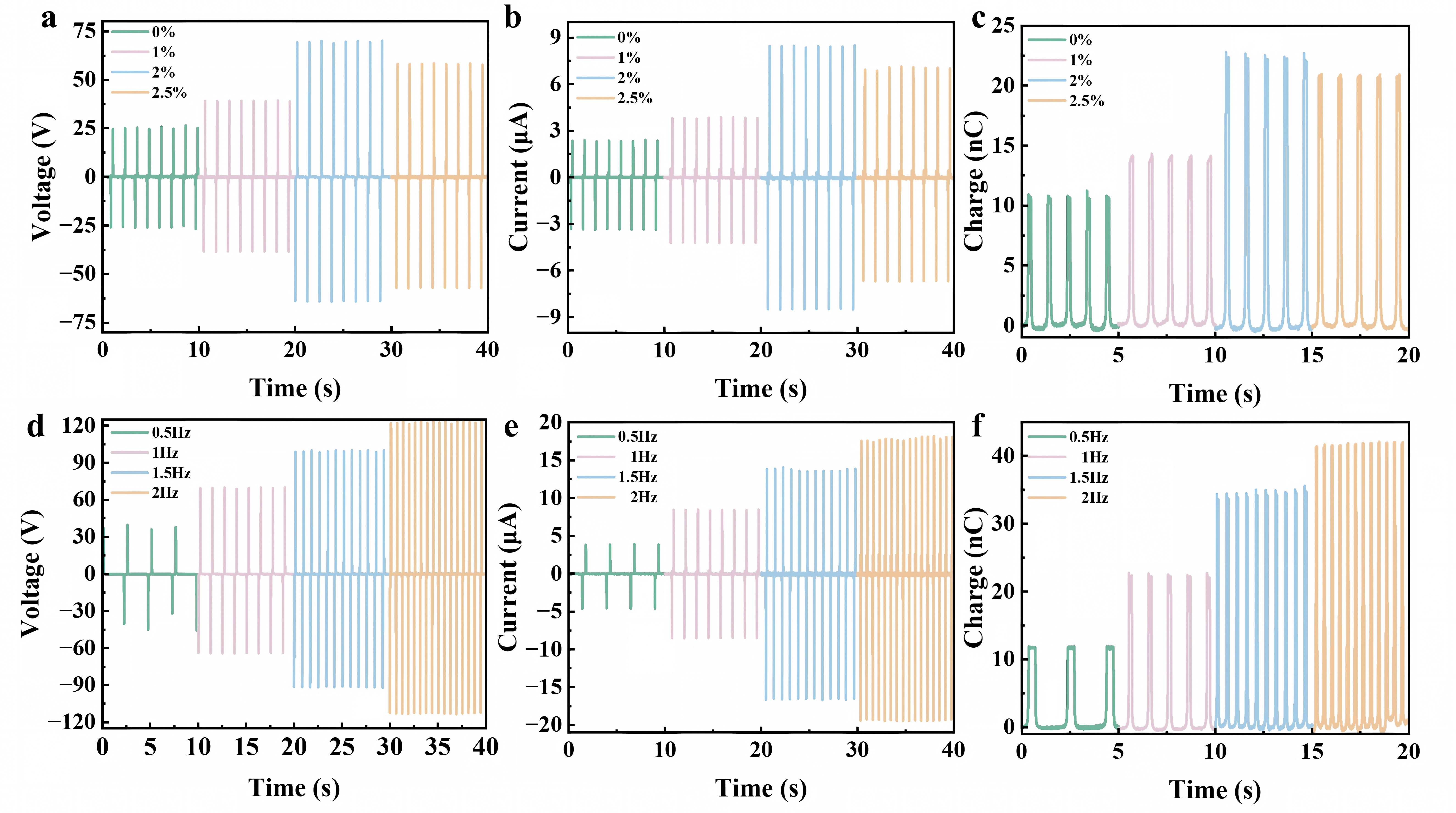
Figure 3. Output characteristics of the CBECC-TENGs. (a) Voc-time curve; (b) Short-circuit current; (c) Transfer charge of CBECC-TENGs with different CB contents of 0, 1.0, 2.0, and 2.5 wt%; (d) Voc; (e) short-circuit current; (f) Transfer charge quantity at excitation frequencies of 0.5-2.0 Hz with a fixed CB content of 2.0 wt%. CBECC-TENGs: carbon black-engineered cementitious composite triboelectric nanogenerators; Voc: open-circuit voltage.
Figure 4 illustrates the energy management, load matching, power output, and long-term cycling stability of the CBECC-TENGs. A schematic diagram shows the circuit connecting the energy storage capacitor to the test terminals via a rectifier bridge (Figure 4a). During the contact separation process, the CBECC-TENGs generate alternating pulse signals. Therefore, a full wave rectifier bridge is used to convert the alternating output into a unidirectional pulsed DC signal. This allows the capacitor to be charged and enables subsequent energy storage. The charging curves in Figure 4b show the charging behavior of the CBECC-TENGs for different capacitors. The capacitances are 2.2 μF, 22 μF, and 47 μF. The test was conducted under mechanical excitation at 2.0 Hz. As the capacitance increased, the charging rate decreased clearly. The small capacitor could be charged to about 4 V within a short time. In contrast, the larger capacitors showed a slower voltage increase during the same period. This indicates that the CBECC-TENGs have charge accumulation capability. Its charging efficiency is strongly affected by the external capacitance. To determine the optimal working load, the output voltage, current, and power density were tested under different external resistances. Figure 4c,d summarize the load-dependent output behavior. As the external resistance increased from the low resistance region, the output voltage gradually increased and then stabilized in the high resistance region. The output current showed the opposite trend and gradually decreased. The power density was calculated from the output voltage and current. It first increased and then decreased with increasing load resistance. The maximum power density reached about 975.6 mW m-2 at an external load of approximately 104 Ω. These results show that the CBECC-TENGs have clear impedance matching behavior. A suitable external load is necessary to achieve the maximum power output. To place the performance of our device in perspective, the power density of the CBECC-TENGs is compared in Table 1 with those of representative cementitious TENG systems reported in the literature. Although the testing frequency, contact force, and load conditions vary among these studies, several meaningful trends can still be discerned. The present CBECC-TENGs with 2.0 wt% CB achieve a power density of 975.6 mW·m-2 at 2 Hz, which is higher than that of the plain cement-based system (180 mW·m-2 at 5 Hz) and the graphene-cement system (95 mW·m-2 at 10 Hz), and comparable to the recycled carbon fiber-cement system (281 mW·m-2 at 2 Hz). In this study, the testing frequency was limited to 2 Hz because the linear motor employed could not maintain a stable and controllable contact force at higher frequencies such as 5 Hz, which would introduce significant fluctuations and compromise the reliability of output measurements. Nevertheless, the power density of 975.6 mW·m-2 achieved at 2 Hz demonstrates that the present CBECC-TENGs can deliver competitive output even under low-frequency excitation.
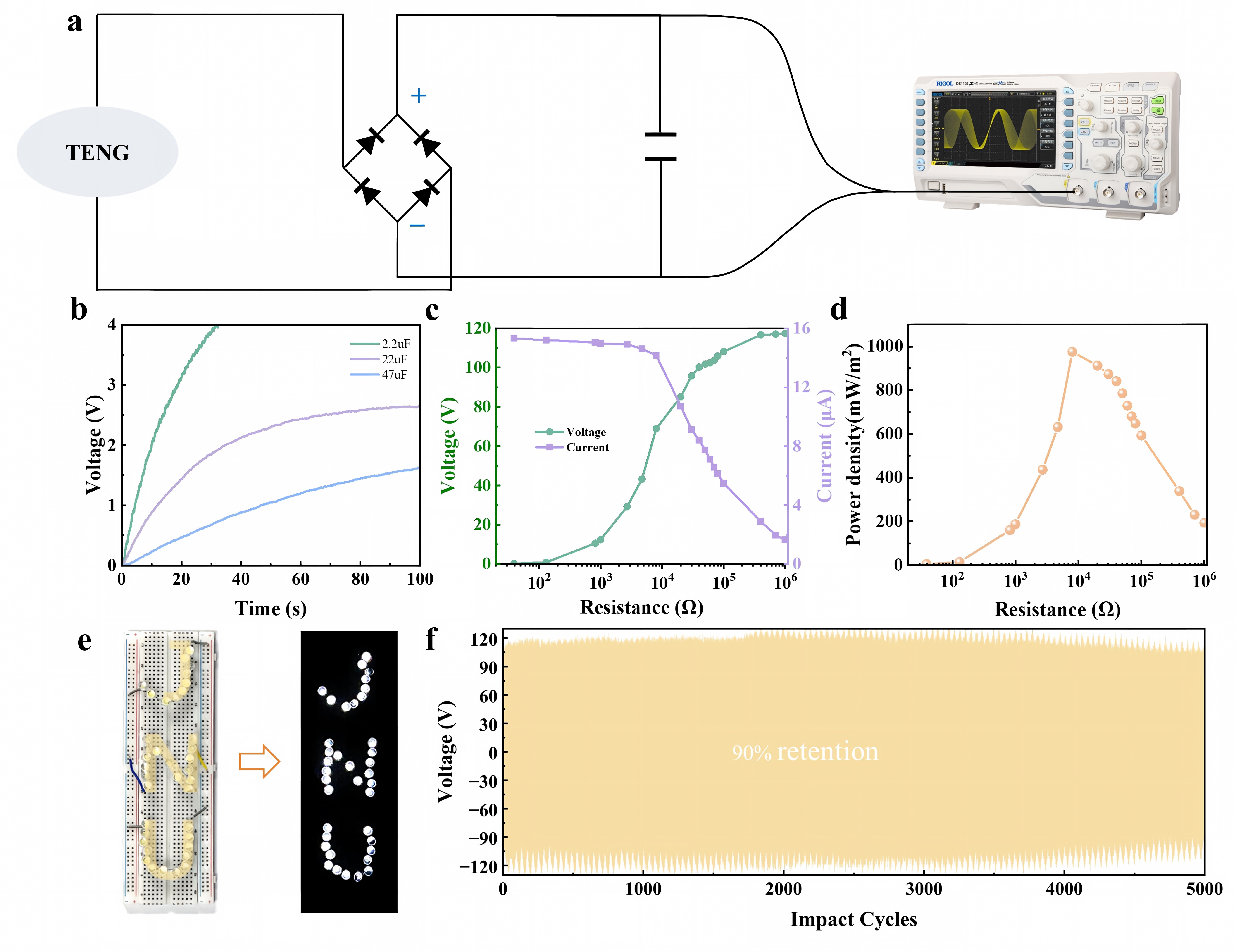
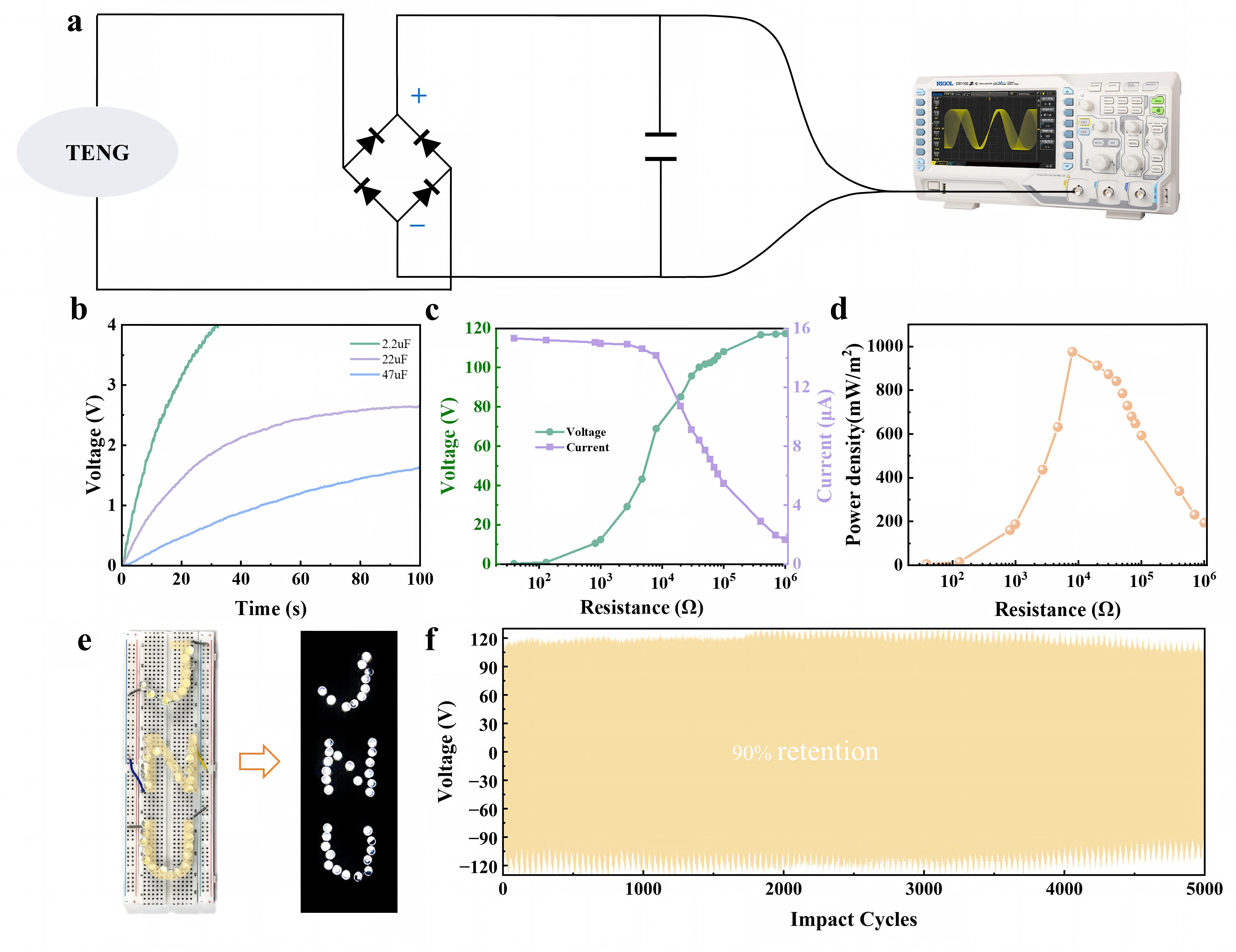
Figure 4. (a) Circuit diagram of CBECC-TENGs connected to the rectifier bridge, capacitor, and test load, monitored by an oscilloscope; (b) Voltage-time curves of 2.2 μF, 22 μF, and 47 μF capacitors under the charging effect of CBECC-TENGs at 2 Hz excitation condition; (c) Relationship between steady-state voltage and current output of CBECC-TENG and resistance under different external resistive loads; (d) Curve of power density varying with load resistance; (e) Demonstration photo of CBECC-TENGs driving an LED array through the rectifier-storage circuit; (f) Voltage output stability of CBECC-TENGs during 5,000 consecutive shock cycles under fixed mechanical excitation conditions. CBECC-TENGs: carbon black-engineered cementitious composite triboelectric nanogenerators; LED: light-emitting diode.
Table 1. Output performance comparison between CBECC-TENGs and representative cement-based TENGs.
| Materials | Optimal Filler Content | Operating Frequency | Power Density (mW·m-2) | Ref. |
| Pure cement | - | 5 Hz | 180 | [28] |
| Graphene-Cement | 1 wt% GP | 10 Hz | 95 | [27] |
| Carbon fiber-cement | 0.5 wt% rCF | 2 Hz | 281 | [23] |
| CNT-cement | 0.5 wt% CNT | 10 Hz | 3.364 | [51] |
| CB-ECC | 2.0 wt% CB | 2 Hz | 975.6 | This work |
CBECC-TENGs: carbon black-engineered cementitious composite triboelectric nanogenerators; CNT: carbon nanotube; GP: graphene; rCF: recycled carbon fiber.
The practical driving capability of the device is shown in Figure 4e. After being connected to a rectifier circuit, the CBECC-TENGs successfully lit a “JNU” LED array under continuous mechanical excitation. This demonstrates that the generated electrical energy can power low-power electronic devices. However, this demonstration should be regarded as a qualitative indication of the device’s output capability rather than a practical application in civil infrastructure. Figure 4f displays the long-term cycling stability of the CBECC-TENGs. After 5,000 contact separation cycles, the output voltage remained above 90% of its initial value. The 5,000-cycle test demonstrates the preliminary mechanical robustness and electrical stability of the CBECC-TENG. The PDMS surface was examined before and after 5,000 cycles. A small amount of particulate debris was observed, but no severe wear or delamination occurred. The surface roughness increased from 0.52 to 0.58 μm (Figure S4). Future work can explore surface-functionalized PDMS or anti-fouling coatings to combine high output with long-term stability. However, it should be noted that 5,000 cycles are still modest compared with the expected service life of civil infrastructure, where millions of loadings may occur.
To verify the application potential of the CBECC-TENGs in corrosion protection, a self-powered cathodic protection system was constructed, as shown in Figure 5. In this system, external mechanical excitation drives the CBECC-TENGs to generate electrical energy. The generated signal is then rectified and used to provide cathodic polarization for carbon steel in a chloride-rich environment. In this way, the corrosion tendency of carbon steel can be reduced.
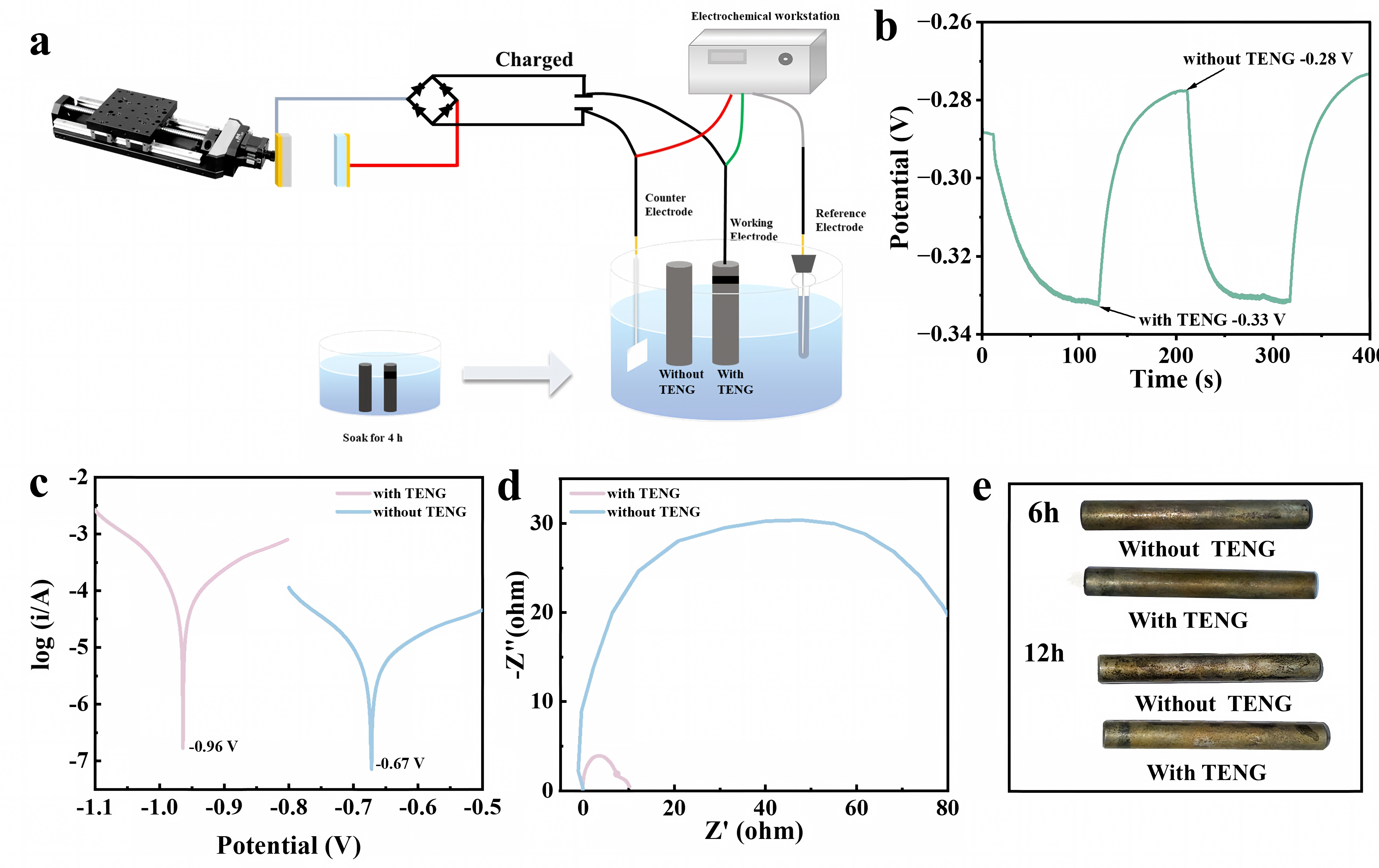
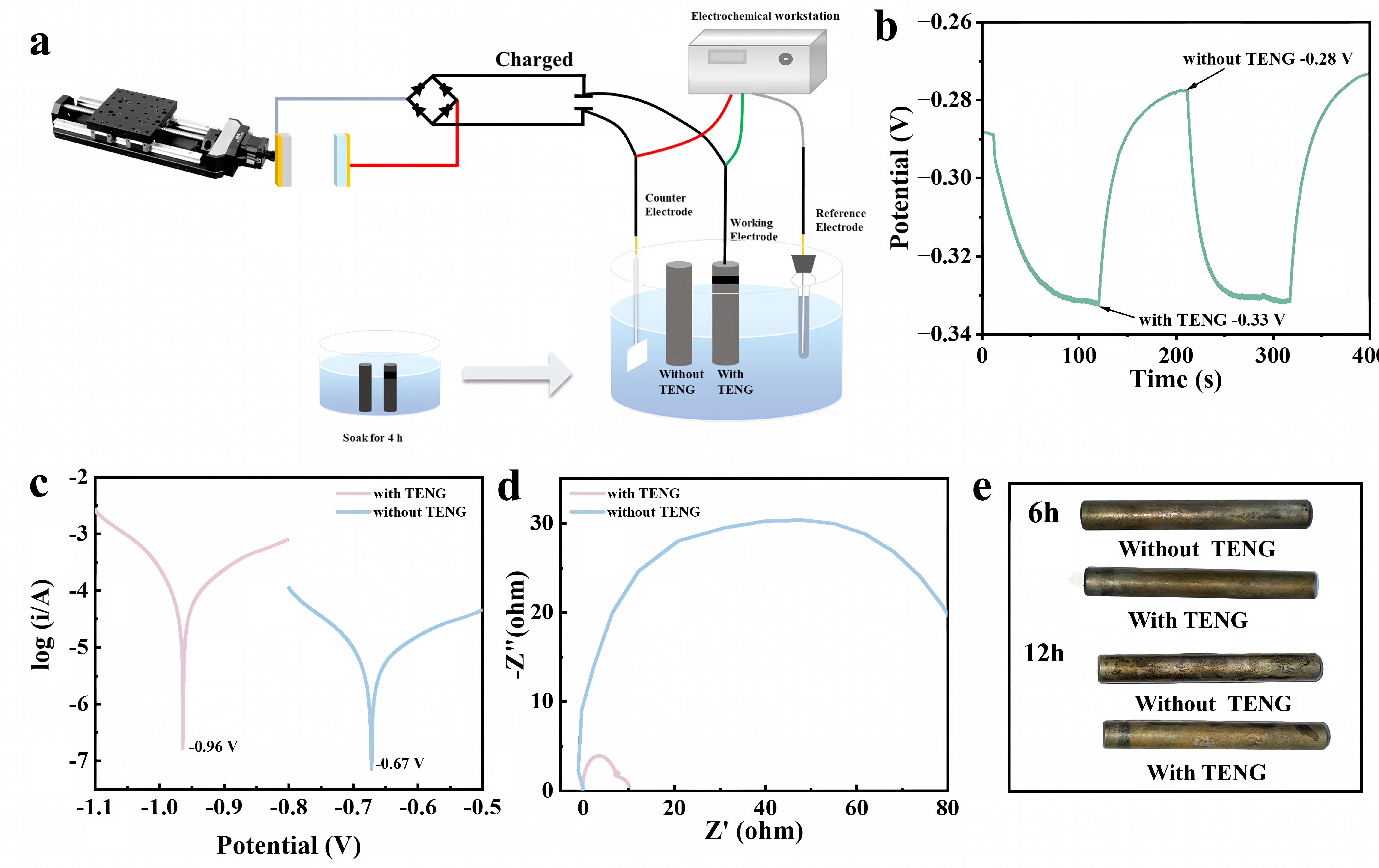
Figure 5. (a) Schematic diagram of the self-powered cathodic protection experimental setup; (b) Open-circuit potential curve of carbon steel in a 3.5 wt% NaCl solution; (c) Tafel polarization curves of carbon steel with and without CBECC-TENGs; (d) Nyquist plot of electrochemical impedance spectroscopy; (e) Surface corrosion morphology of carbon steel specimens with and without TENG after 6 and 12 hours of exposure. CBECC-TENGs: carbon black-engineered cementitious composite triboelectric nanogenerators.
A schematic diagram of the self-powered cathodic protection experimental setup was presented in Figure 5a. The actual protection current delivered to the carbon steel after rectification was measured to be approximately 15.1 μA (Figure S5), corresponding to a protection current density of approximately 4.8 μA/cm2. This current density is within the typical range required for cathodic protection of steel in chloride environments[52], confirming that the CBECC-TENG can provide sufficient protection current. During periodic contact separation, the CBECC-TENGs generate an alternating current signal. This signal is converted into a unidirectional pulsed electrical signal through a rectifier bridge. The rectified output is then connected to a carbon steel specimen immersed in a 3.5 wt% NaCl solution. This provides cathodic protection to the carbon steel surface. The open circuit potential (OCP) response of carbon steel in 3.5 wt% NaCl solution is shown in Figure 5b. When the CBECC-TENGs were connected, the OCP rapidly shifted in the negative direction, from about -0.28 V (vs. Ag/AgCl) to about -0.33 V (vs. Ag/AgCl). This behavior shows clear cathodic polarization characteristics. When the CBECC-TENGs were disconnected, the potential of carbon steel gradually shifted back to a more positive value. This indicates that the cathodic polarization effect became weaker. The system then gradually returned to its original corrosion state. This dynamic potential response further confirms that the CBECC-TENGs can regulate the potential of carbon steel in real time through mechanical energy conversion. The polarization curves of carbon steel are compared in Figure 5c. Without a CBECC-TENGs connection, the carbon steel shows a corrosion potential (Ecorr) of about -0.67 V (vs. Ag/AgCl). After the CBECC-TENGs are connected, the Ecorr shifts negatively to about -0.96 V (vs. Ag/AgCl). This negative shift indicates that the rectified output from the CBECC-TENGs can induce cathodic polarization on carbon steel. It also reduces the tendency of carbon steel to dissolve as an anode. The change in the polarization curve further confirms the protective effect of the CBECC-TENGs. The device can provide effective electrochemical protection for carbon steel in chloride solution[53,54].
The EIS results further reveal the influence of CBECC-TENGs-based cathodic protection on the carbon steel and solution interface. As displayed in Figure 5d, the Nyquist plot shows a larger capacitive arc radius after the CBECC-TENGs are connected. This indicates an increase in interfacial charge transfer resistance. It also suggests that the corrosion reaction is suppressed. These results show that the cathodic polarization supplied by the CBECC-TENGs can reduce the anodic dissolution rate of carbon steel. It can also improve the electrochemical stability of the interface. Therefore, the corrosion process of carbon steel in chloride solution is effectively slowed down, which is consistent with the mechanism reported in previous TENG-based cathodic protection studies[55].
The macroscopic corrosion morphology provides direct evidence of the cathodic protection effect of the CBECC-TENGs. As presented in Figure 5e, the surface rusting of carbon steel specimens was compared after different exposure times in a 3.5 wt% NaCl solution. For the specimen without CBECC-TENGs protection, obvious reddish-brown corrosion products appeared on the surface. The rusted area and corrosion degree increased with longer exposure time. In contrast, the carbon steel specimen protected by the CBECC-TENGs showed much less surface rusting. Only a few localized corrosion marks were observed. Most areas of the surface remained relatively intact. The present cathodic protection tests were conducted over a relatively short period of time, merely indicating that the CBECC-TENGs demonstrate promising potential for self-powered cathodic protection of carbon steel in chloride environments.
It should be noted that the cathodic protection tests in this study were conducted in a 3.5 wt% NaCl solution, which simulates a chloride-enriched environment but does not fully represent the actual reinforced concrete conditions. In real concrete structures, the pore solution is highly alkaline (pH > 13), and the steel surface is covered by a passive film that significantly influences its electrochemical behavior. Therefore, the results of this study should be considered as a proof-of-concept for the principle of self-powered cathodic protection. Future research will focus on integrating the CBECC-TENGs into concrete specimens and evaluating their protection performance under more realistic conditions, including alkaline pore solutions and long-term exposure environments[51]. In practical applications, the energy storage and supply strategy will also need to be optimized for continuous cathodic polarization. Currently, the current output of a single CBECC-TENG is insufficient for large-area protection, and an array of TENGs or a larger device area would be required. At the same time, capacitors with capacitances ranging from several hundred microfarads to several millifarads are also needed to buffer energy and provide continuous protection.
4. Conclusions
In this work, a CB-modified high-ductility cement-based composite was prepared, and a CBECC and PDMS contact-separation triboelectric nanogenerator was fabricated. The results show that carbon black can improve the surface roughness, pore structure, and electrical conductivity of ECC. Among the tested mixtures, the 2.0 wt% carbon black content provided the best balance among mechanical properties, charge transport, and triboelectric output. The COMSOL simulation results are consistent with the proposed working mechanism based on contact electrification and electrostatic induction. During the contact separation process, contact electrification occurs at the CBECC and PDMS interface. The separated charges then induce a potential difference through electrostatic induction. This process drives electron flow in the external circuit. Under optimized conditions, the CBECC-TENGs generate an output voltage of approximately 122 V, an output current of 18 μA, and a transferred charge of 41 nC. The device could also light an LED array, confirming its ability to power low-power electronic devices under laboratory conditions. The CBECC-TENGs retain approximately 90% of their initial output after 5,000 cycles, indicating preliminary cycling stability. Long-term durability under realistic civil infrastructure conditions requires further investigation. The CBECC-TENGs were further used for cathodic protection of carbon steel in a chloride environment. The corrosion potential shifted to a more negative value after the device was connected. The rusting degree of carbon steel was also reduced. These results demonstrate the potential of CBECC-TENGs for self-powered corrosion protection and smart infrastructure applications. Future work can also further integrate sensing and structural health monitoring functions with CBECC-TENGs.
Supplementary materials
The supplementary material for this article is available at: Supplementary materials.
Acknowledgements
The authors declare that ChatGPT 5.6 was used solely for language polishing during the manuscript preparation process. All research content, including study design, data analysis, interpretations, figures, and tables, is original and was not generated using AI tools. The authors reviewed, revised, and approved the final manuscript and take full responsibility for its content.
Authors contribution
Wu Y: Conceptualization, methodology, investigation, data curation, writing-review & editing.
Zhang C: Methodology, investigation, validation, writing-original draft.
Wu J: Investigation, formal analysis.
Guo M: Conceptualization, supervision, writing-review & editing.
Huang X: Investigation, validation.
Hu B: Investigation, resources.
Luo Q, Liu G: Conceptualization, supervision.
Conflicts of interest
Guoxu Liu serves as a Guest Editor for the Special Issue to which this manuscript was submitted and had no role in the peer-review or decision-making process for this manuscript. The other authors declare no conflicts of interest.
Ethical approval
Not applicable.
Consent to participate
Not applicable.
Consent for publication
Not applicable.
Availability of data and materials
Data will be made available on request.
Funding
This work was supported by the National Natural Science Foundation of China (NSFC) (Grants Nos. 52608410 and 52678346), the Fundamental Research Funds for the Central Universities (Grant No. 21625324) and Guangdong Basic and Applied Basic Research Foundation (Grant No. 2026A1515011454).
Copyright
© The Author(s) 2026.
References
-
1. Liu J, Huang Z, Fan M, Yang J, Xiao J, Wang Y. Future energy infrastructure, energy platform and energy storage. Nano Energy. 2022;104:107915.[DOI]
-
2. Zhang C, Zhou Y, Xing F, Guo M, Wu J, Wang J, et al. PEDOT: PSS-enabled CNT and Bi0.5Sb1.5Te3 interface microengineering for integrated thermoelectric energy harvesting and corrosion protection in cementitious composite. Adv Sci. 2025;12(42):e08424.[DOI]
-
3. Cui K, Lau D, Chang J. Advancements in energy harvesting through building materials: A critical review. J Build Eng. 2024;98:111412.[DOI]
-
4. Ji P, Wen J, Gao X, Li H, Cai H, Lv K, et al. Roadbed tribological energy harvester. Sci Adv. 2025;11(25):eadv9379.[DOI]
-
5. Fu H, Wang P, Li W, Dong W. Cement-based generators for smart infrastructure: Design principles and translation pathways toward multimodal energy harvesting. Nano Today. 2027;72:103198.[DOI]
-
6. Wu Y, Zhao L, Guo M, Zhou Y, Wu J, Zhang C, et al. Study on the mechanism and electrochemical performance of self-powered cathodic protection for reinforced concrete in marine environment. Carbon Neutraliz. 2026;5(2):e70143.[DOI]
-
7. Thongthapthai W, Sintusiri J, Prada T, Thongbai P, Amornkitbamrung V, Chindaprasirt P, et al. Lightweight cement-natural rubber nanocomposites for high-performance triboelectric nanogenerators in smart flooring applications. Constr Build Mater. 2025;501:144230.[DOI]
-
8. Wang ZL, Chen J, Lin L. Progress in triboelectric nanogenerators as a new energy technology and self-powered sensors. Energy Environ Sci. 2015;8(8):2250-2282.[DOI]
-
9. Wang ZL, Wu W. Nanotechnology-enabled energy harvesting for self-powered micro-/nanosystems. Angew Chem Int Ed. 2012;51(47):11700-11721.[DOI]
-
10. Barri K, Jiao P, Zhang Q, Chen J, Wang ZL, Alavi AH. Multifunctional meta-tribomaterial nanogenerators for energy harvesting and active sensing. Nano Energy. 2021;86:106074.[DOI]
-
11. Katta V, Mohana Rani G, Umapathi R, Huh YS, Sanasi PD. Chitosan-loaded lead-free sodium bismuth titanate composite flexible triboelectric nanogenerator for energy harvesting, biomechanical sensing, and smart-path touch-lighting for safe walking applications. Small. 2026;22(22):e12352.
-
12. Apu MMH, Rani GM, Akter A, Umapathi R, Doguwa A, Azeem MA, et al. VIPS-inspired surface roughening of ultrathin PDMS films for self-powered triboelectric sensors in gamified hand rehabilitation. Small Methods. 2025;9(12):e01592.[DOI]
-
13. Umapathi R, Rani GM, Patil SR, Haribabu J, Alhammadi M, Safarkhani M, et al. Human motion driven energy harvesting system enabled by a flexible PVA/g-C3N4 triboelectric nanogenerator. Ceram Int. 2026.[DOI]
-
14. Akter A, Rani GM, Apu MMH, Huh YS, Yamani A, Alsayoud AQ, et al. Toward intelligent wearables: Engineering self-powered triboelectric nanofiber sensors for the classification of risky ankle postures. Mater Horiz. 2026;13(15):7674-7689.[DOI]
-
15. Zhang Q, Barri K, Kari SR, Wang ZL, Alavi AH. Multifunctional triboelectric nanogenerator-enabled structural elements for next generation civil infrastructure monitoring systems. Adv Funct Mater. 2021;31(47):2105825.[DOI]
-
16. Jiang C, Li X, Ying Y, Ping J. A multifunctional TENG yarn integrated into agrotextile for building intelligent agriculture. Nano Energy. 2020;74:104863.[DOI]
-
17. Barri K, Zhang Q, Kline J, Lu W, Luo J, Sun Z, et al. Multifunctional nanogenerator-integrated metamaterial concrete systems for smart civil infrastructure. Adv Mater. 2023;35(14):2211027.[DOI]
-
18. Dong W, Li Z, Zhang Q, Guo H, Chen Y, Chu D, et al. Emerging cement-based energy harvesting and storage materials for future net-zero energy buildings and infrastructure. Sustain Mater Technol. 2026;47:e01817.[DOI]
-
19. Palaniappan V, Adineh A, Maddipatla D, Bazuin BJ, Atashbar MZ. Development of an energy harvesting tile using novel MXene-cement based triboelectric nanogenerator. In: 2023 IEEE Sensors; 2023 Oct 29-Nov 1; Vienna, Austria. Piscataway: IEEE; 2023. p. 1-4.[DOI]
-
20. Wu Y, Guo M, Zhou Y, Xing F. Self-powered cement-based triboelectric nanogenerators for smart infrastructure. Sci Bull. 2026;71(13):3244-3247.[DOI]
-
21. Sintusiri J, Harnchana V, Amornkitbamrung V, Wongsa A, Chindaprasirt P. Portland Cement-TiO2 triboelectric nanogenerator for robust large-scale mechanical energy harvesting and instantaneous motion sensor applications. Nano Energy. 2020;74:104802.[DOI]
-
22. Ra Y, You I, Kim M, Jang S, Cho S, Kam D, et al. Toward smart net zero energy structures: Development of cement-based structural energy material for contact electrification driven energy harvesting and storage. Nano Energy. 2021;89:106389.[DOI]
-
23. Dong W, Zhao C, Peng S, Wu C, Kim T, Wang K, et al. Recycled carbon fibre/cement-based triboelectric nanogenerators toward energy-efficient and smart civil infrastructure. Compos Part B Eng. 2025;303:112603.[DOI]
-
24. Ra Y, Kim JW, You I, Jang S, Cho S, Gwon G, et al. Direct electrospinning of reconstructable PVDF-TrFE nanofibrous mat onto conductive cement nanocomposite for triboelectricity-assisted net zero energy structure. Chem Eng J. 2024;485:149662.[DOI]
-
25. Chen H, Guo H, Guo Y, Jiang H, Guan W, Zhong J. Autonomous crack monitoring of cementitious structures driven by raindrop energy with a triboelectric nanogenerator. Cem Concr Compos. 2026;170:106569.[DOI]
-
26. Dong W, Duan Z, Peng S, Chen Y, Chu D, Tai H, et al. Triboelectric nanogenerator-powering piezoresistive cement-based sensors for energy harvesting and structural health monitoring. Nano Energy. 2025;137:110823.[DOI]
-
27. Dong W, Gao S, Peng S, Shi L, Shah SP, Li W. Graphene reinforced cement-based triboelectric nanogenerator for efficient energy harvesting in civil infrastructure. Nano Energy. 2024;131:110380.[DOI]
-
28. Kuntharin S, Harnchana V, Klamchuen A, Sinthiptharakoon K, Thongbai P, Amornkitbamrung V, et al. Boosting the power output of a cement-based triboelectric nanogenerator by enhancing dielectric polarization with highly dispersed carbon black nanoparticles toward large-scale energy harvesting from human footsteps. ACS Sustainable Chem Eng. 2022;10(14):4588-4598.[DOI]
-
29. Dong W, Peng S, Wang K, Huang Y, Shi L, Wu F, et al. Integrated triboelectric self-powering and piezoresistive self-sensing cementitious composites for intelligent civil infrastructure. Nano Energy. 2025;135:110656.[DOI]
-
30. Thongthapthai W, Harnchana V, Chanthad C, Amornkitbamrung V, Chindaprasirt P. The fabrication of calcium silicate-natural rubber composite for mechanical energy harvesting. Surf Interfaces. 2021;25:101180.[DOI]
-
31. Dong W, Gao Z, Duan Z, Zhang Q, Xi X, Peng S, et al. Sliding-mode cement-based triboelectric nanogenerators in intelligent infrastructure for a new energy harvesting paradigm. Mater Today Energy. 2025;52:101943.[DOI]
-
32. Lai B, Xu C, Hu Y, Chen Y, Li Z, Zheng J, et al. Multifunctional smart cement sensor based on triboelectric nanogenerators. ACS Appl Electron Mater. 2024;6(11):7923-7932.[DOI]
-
33. Kuntharin S, Harnchana V, Sintusiri J, Thongbai P, Klamchuen A, Sinthiptharakoon K, et al. Smart triboelectric floor based on calcium silicate-carbon composite for energy harvesting and motion sensing applications. Sens Actuators A Phys. 2023;358:114423.[DOI]
-
34. Dong W, Zhao C, Gao Z, Zhuo L, Liu G, Zhang J, et al. Assessment of environmental and mechanical factors affecting cement-based triboelectric nanogenerators: Stability and durability. Cem Concr Compos. 2026;168:106489.[DOI]
-
35. Xu LY, Yu J, Huang BT, Lao JC, Wu HL, Jiang X, et al. Green and low-carbon matrices for Engineered/Strain-Hardening Cementitious Composites (ECC/SHCC): Toward sustainable and resilient infrastructure. J Clean Prod. 2025;496:144968.[DOI]
-
36. Shoji D, He Z, Zhang D, Li VC. The greening of engineered cementitious composites (ECC): A review. Constr Build Mater. 2022;327:126701.[DOI]
-
37. Chen W, Liang L, Jiang F, Tang Z, Sun X, Yu J, et al. New opportunity: Materials genome strategy for engineered cementitious composites (ECC) design. Cem Concr Compos. 2025;159:106009.[DOI]
-
38. Shen H, Zhou Y, Guo M, Zhu Z, Hu B, Huang X. Unveiling the self-sensing mechanism and multifunctional performance of intelligent engineered cementitious composites. Constr Build Mater. 2026;509:145147.[DOI]
-
39. Qiu J, Yang EH. Micromechanics-based investigation of fatigue deterioration of engineered cementitious composite (ECC). Cem Concr Res. 2017;95:65-74.[DOI]
-
40. Jiang C, Wu C, Li X, Yao Y, Lan L, Zhao F, et al. All-electrospun flexible triboelectric nanogenerator based on metallic MXene nanosheets. Nano Energy. 2019;59:268-276.[DOI]
-
41. Zhang Q, Luan C, Yu C, Huang Y, Zhou Z. Mechanisms of carbon black in multifunctional cement matrix: Hydration and microstructure perspectives. Constr Build Mater. 2022;346:128455.[DOI]
-
42. Xiao Q, Cai Y, Long G, Ma K, Zeng X, Tang Z, et al. Effect of alternating current curing on properties of carbon black-cement conductive composite: Setting, hydration and microstructure. J Build Eng. 2023;72:106603.[DOI]
-
43. Li W, Dong W, Shen L, Castel A, Shah SP. Conductivity and piezoresistivity of nano-carbon black (NCB) enhanced functional cement-based sensors using polypropylene fibres. Mater Lett. 2020;270:127736.[DOI]
-
44. Monteiro AO, Loredo A, Costa PMFJ, Oeser M, Cachim PB. A pressure-sensitive carbon black cement composite for traffic monitoring. Constr Build Mater. 2017;154:1079-1086.[DOI]
-
45. Du M, Jing H, Gao Y, Su H, Fang H. Carbon nanomaterials enhanced cement-based composites: Advances and challenges. Nanotechnol Rev. 2020;9(1):115-135.[DOI]
-
46. Pârvan MG, Voicu G, Bădănoiu AI. Study of hydration and hardening processes of self-sensing cement-based materials with carbon black content. J Therm Anal Calorim. 2020;139(2):807-815.[DOI]
-
47. Zou Y, Xu J, Chen K, Chen J. Advances in nanostructures for high-performance triboelectric nanogenerators. Adv Mater Technol. 2021;6(3):2000916.[DOI]
-
48. Guo M, Shen H, Zhou Y, Wu Y, Zhu Z. Development of smart engineered cementitious composites with integrated self-sensing capability and enhanced tensile ductility. Constr Build Mater. 2026;519:145931.[DOI]
-
49. Dong W, Cheng AJ, Zhao C, Prabowo J, Peng S, Guo H, et al. High-performance and humidity-resilient cement-based triboelectric nanogenerators (CBTENGs) via surface functionalisation. Nano Energy. 2025;146:111503.[DOI]
-
50. Liu C, Zhang N, Li J, Dong L, Wang T, Wang Z, et al. Harvesting ultralow frequency (< 1 Hz) mechanical energy using triboelectric nanogenerator. Nano Energy. 2019;65:104011.[DOI]
-
51. Lee YE, Lee D, Sung J, You I, Choi D, Lee SJ. Study of energy harvesting from conductive cement nanocomposites using a triboelectric nanogenerator. Dev Built Environ. 2026;25:100854.[DOI]
-
52. Oleiwi HM, Wang Y, Curioni M, Chen X, Yao G, Augusthus-Nelson L, et al. An experimental study of cathodic protection for chloride contaminated reinforced concrete. Mater Struct. 2018;51(6):148.[DOI]
-
53. Gao Y, Zhang Y, Huang LB, Hua X, Dong B. Converting wave scouring damage into opportunities: Advancing marine structure protection through a wave-energy harvesting protective layer. Nano Energy. 2024;123:109367.[DOI]
-
54. Gao Y, Dong B, Wang Y, Hong S, Fang G, Zhang Y. Self-charging protective layer for marine reinforced concrete based on arch-shaped triboelectric nanogenerator. Mater Des. 2024;237:112536.[DOI]
-
55. Nan Y, Wang X, Xu H, Wu Y, Zhou H, Sun Y, et al. Synergistic effects of charge transport and trapping in tribomaterials for boosted triboelectric nanogenerators. Nano Energy. 2023;110:108345.[DOI]
Copyright
© The Author(s) 2026. This is an Open Access article licensed under a Creative Commons Attribution 4.0 International License (https://creativecommons.org/licenses/by/4.0/), which permits unrestricted use, sharing, adaptation, distribution and reproduction in any medium or format, for any purpose, even commercially, as long as you give appropriate credit to the original author(s) and the source, provide a link to the Creative Commons license, and indicate if changes were made.
Publisher’s Note
Science Exploration remains a neutral stance on jurisdictional claims in published
maps
and institutional affiliations. The views expressed in this article are solely those
of
the author(s) and do not reflect the opinions of the Editors or the publisher.
Share And Cite


Science Exploration Style
Wu Y, Zhang C, Wu J, Guo M, Huang X, Hu B, et al. Carbon black modified engineered cementitious composite-based triboelectric nanogenerator for mechanical energy harvesting and self-powered cathodic protection. Smart Mater Devices. 2027;3:202663. https://doi.org/10.70401/smd.2026.0056
Tips
Copy completed.
Submit a Manuscript
Author Instructions
Cite this Article
Article Metrics
0
View
0
Download
Cited
Article Updates

- Abstract
- Keywords
- 1. Introduction
- 2. Experimental Section
- 3. Results and Discussion
- 4. Conclusions
- Supplementary materials
- Acknowledgements
- Authors contribution
- Conflicts of interest
- Ethical approval
- Consent to participate
- Consent for publication
- Availability of data and materials
- Funding
- References
- Copyright
 Get citation
Science Exploration Style

Wu Y, Zhang C, Wu J, Guo M, Huang X, Hu B, et al. Carbon black modified engineered cementitious composite-based triboelectric nanogenerator for mechanical energy harvesting and self-powered cathodic protection. Smart Mater Devices. 2027;3:202663. https://doi.org/10.70401/smd.2026.0056
copy
Share Link
copy