Evolution of side-by-side electrospinning and Janus nanofibers

Deng-Guang Yu
*

,
Ying Wang
*Correspondence to:
Deng-Guang Yu, School of Materials and Chemistry, University of Shanghai for Science and Technology, Shanghai 200093, China.
E-mail: ydg017@usst.edu.cn
Smart Mater Devices. 2027;3:202659. 10.70401/smd.2026.0057
Received: August 18, 2026Accepted: October 14, 2026Published: October 20, 2026
Abstract
Janus and core-shell structures are among the most fundamental dual-chamber architectures for advanced functional materials. However, compared to electrospun core-shell nanofibers, electrospun Janus nanofibers have been extremely limited over the past three decades. This commentary examines the evolution of side-by-side electrospinning and Janus nanofibers. This limitation stems from the electrostatic repulsion between working fluids, posing a significant challenge to the formation of integrated Janus nanofibers. As increasing efforts have been devoted to this issue, new insights have emerged for resolving it through rational spinneret design and modifications to electrospinning processes. To bridge this gap in Janus-nanofiber-based devices and products, several key directions are proposed: (i) designing novel spinneret structures as templates for Janus nanofibers; (ii) scaled-up production via the newly developed "needle-in-hole" electrospinning technique; (iii) strategies for large-scale manufacturing of potential commercial products; and (iv) novel complex tri-chamber architectures.
Keywords
Janus nanofibers, side-by-side electrospinning, electrohydrodynamic mechanisms, evolution, capillary spinneret, integrated spinneret
1. There is a Big Gap for Developing Janus Nanofibers Based Functional Materials
Janus (or side-by-side) and core-sheath (or core-shell) represent the two most fundamental architectures to tailor components and compositions for developing advanced functional materials in almost all applied scientific fields[1,2]. Although both structures have been generally reported in comparable quantities, these two structures prepared using electrospinning have an extremely significant difference. As indicated in Figure 1a, there are 51,237 items when “Janus or side-by-side” is used as a topic to search in Web of Science (16-Aug-2026), whereas the number for “Janus or side-by-side” and “nanofibers” is only 491, a ratio of 0.96%. In contrast, the number for “core-shell or core-sheath” is 101,084, and that for “core-sheath or core-shell” and “nanofibers” is 4,197, a ratio of 4.2%. The comparisons suggest that there is a big gap for Janus-based nanostructures. What is more, as shown in Figure 1a about the year-by-year trends, the number of items for Janus has continuously increased, whereas those core-sheath items indicated a plateau period after 2020.
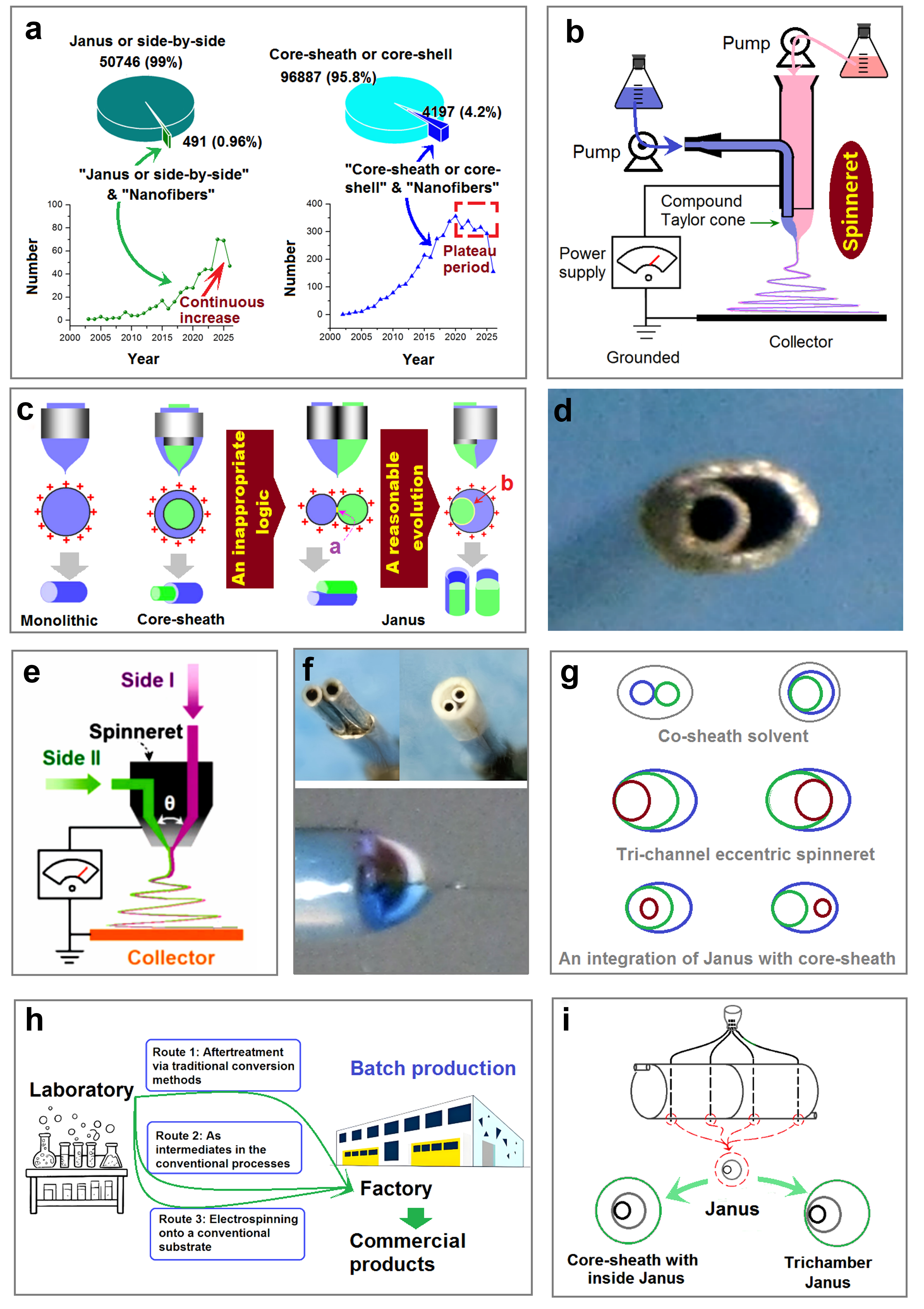
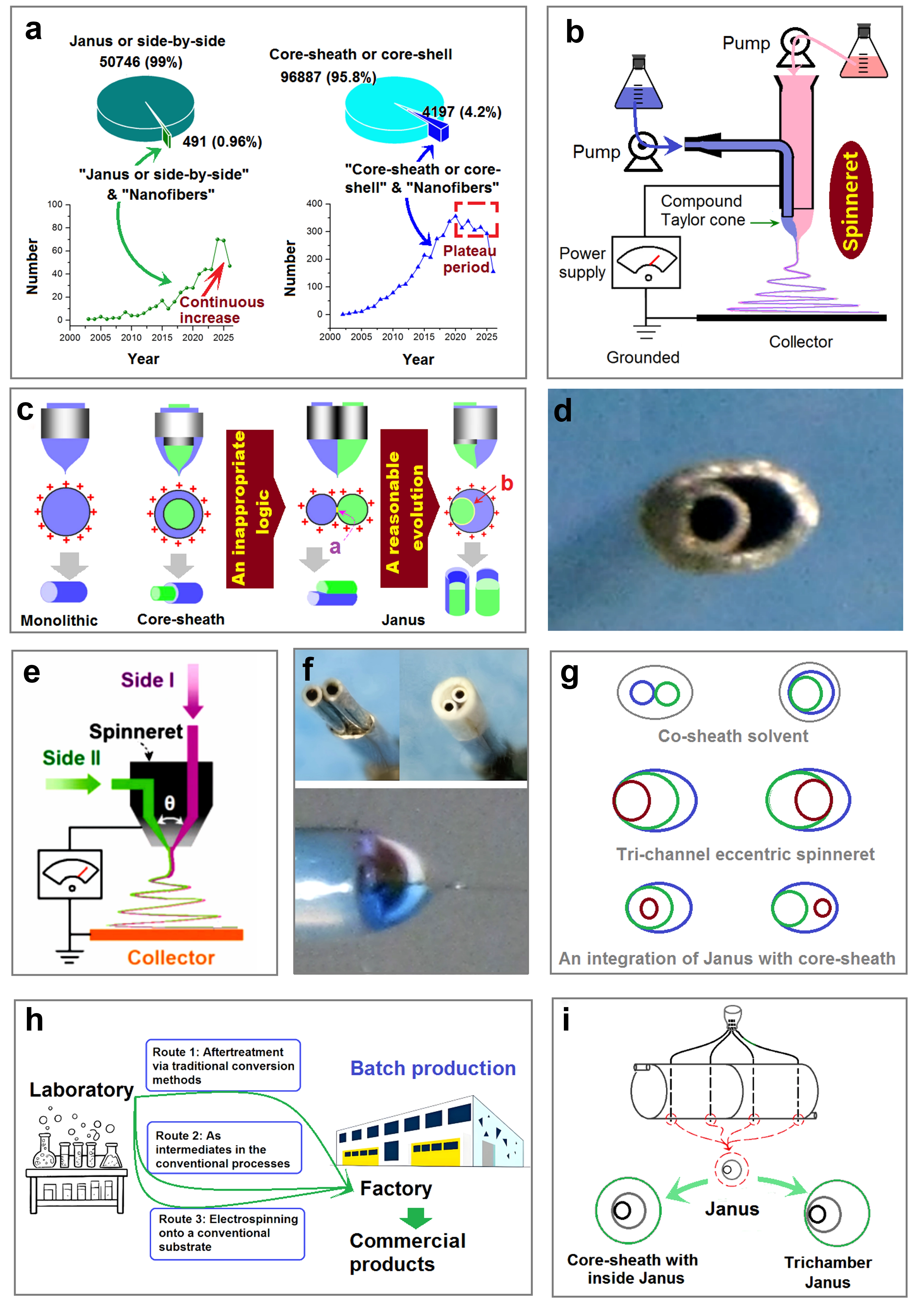
Figure 1. Janus nanofibers from side-by-side electrospinning: (a) The investigation trends of electrospun Janus nanofibers compared with the electrospun core-sheath nanofibers; (b) The fundamental elements within a side-by-side electrospinning apparatus; (c) The reasonable evolution of side-by-side electrospinning from the single-fluid blended process. Reproduced with permission from reference[3]. Copyright © 2024 Informa UK Limited; (d) A digital image of the eccentric spinneret[4]. Reproduced from reference[4]. CC BY 3.0; (e) An electrospinning process characterized by a double-channel spinneret. Reproduced with permission from reference[5]. Copyright © 2015 Royal Society of Chemistry; (f) A Teflon-coated spinneret. Reproduced with permission from reference[6]. Copyright © 2016 Elsevier; (g) A diagram about the further evolution of side-by-side electrospinning processes and the tri-channel spinnerets; (h) A diagram about the three industrialization routes of electrospun nanofibers; (i) A brand-new concept of needle-in-hole electrospinning for potential large-scale production of Janus nanofibers. Reproduced from reference[7]. CC BY 4.0.
It should be noted that the 491 items retrieved for “Janus or side-by-side” combined with “nanofibers” fall mainly into three categories: (i) review articles on electrospinning that contain only a brief section on Janus nanofibers; (ii) research articles on Janus nanofibrous films, macroscale bilayer films composed of different nanofibers in each layer; and (iii) individual Janus nanofibers with an internal side-by-side two-chamber structure. Although macroscale bilayer Janus nanofibrous films are currently very popular and have enabled many kinds of functional nanomaterials, such as wearable sweat sensors[8] and liquid-transport membranes[9], they are beyond the scope of the present commentary. Accordingly, only nanofibers with an internal two-chamber Janus structure are discussed here.
2. The Key for Creating Electrospun Janus Nanofibers Lies in the Spinneret
Electrospinning, along with electrospraying and e-jetting printing, is one of the three typical electrohydrodynamic atomization (EHDA) methods[3,10-14]. These methods take advantage of the effective interactions between the working fluids and high-voltage electrostatic energy for fast removing the solvents to result in solid nanoproducts. For implementing an EHDA process, there are four elements (Figure 1b), i.e., one or more pumps for driving the working fluids, a power supply for providing the applied high voltage, a collector for the deposition of nanofibers, and a spinneret for guiding the fluids into the electric field. Among the four elements, the spinneret is the most important part that is full of innovations[15,16]. To a certain extent, the evolution of electrospinning and electrospun nanofibers is the evolution of the spinneret, and the same holds true for side-by-side electrospinning and electrospun Janus nanofibers. This is because 1) the electrospun nanostructures are created with the nozzle’s structure of the spinneret as a macro template[17,18]; 2) the spinneret is the convergent point of the working fluids and the electrostatic energy; 3) the initiation of an electrospinning process depends on the formation of the Taylor cone hung on the spinneret, followed by the straight fluid jet and the unstable bending and whipping region[19,20]; 4) there are many hidden details about the spinneret that can be exploited for fulfilling the creation of integrated Janus nanostructures through an electrospinning process.
3. Slow Evolution of Side-by-Side Electrospinning and Janus Nanofibers
From 2003 to 2013, not only did side-by-side electrospinning have sporadic research reports, but there were also several historically contingent terms for side-by-side electrospinning and the corresponding Janus nanofibers in existing literature[21-27]. Wilkes and Gupta[12] were the first to report side-by-side electrospinning, in which two polymer solutions are simultaneously electrospun from adjacent spinnerets. They demonstrated this approach with two bicomponent systems: poly(vinyl chloride)/segmented polyurethane and poly(vinyl chloride)/poly(vinylidene fluoride), and termed the resulting products “electrospun bicomponent fibers.” Field emission scanning electron microscopy (FESEM) and energy dispersive spectroscopy (EDS) were used to characterize the fiber morphology and verify the local chemical composition, respectively.
Later, side-by-side electrospinning was named a dual spinning method[21], a side-by-side dual spinneret method[22], and the biocomponent electrospinning technique[23]. Meanwhile, Janus nanofibers were named two-component nanofibers[24], biphasic nanofibers[25], and Janus-type biphasic nanofibers[26,27]. Due to the fact that coaxial electrospinning and core-sheath nanofibers also involve “dual rings” and “bicomponents”, which are similar working processes with “two injectors” (i.e., dual fluids) and “dual components” (i.e., two parts of the internal and external relationship), those terms are not suitable for nominating either the bi-fluid electrospinning or the resultant bi-chamber nanofibers.
As the spinneret evolved and more details were disclosed, the moment of booming of Janus nanofibers was approaching. For side-by-side electrospinning, the key reason for the slow progress is associated with two facts. One is the exploitation of two parallel metal capillaries as the spinneret, which is facile to take for granted from the logic that the single-fluid blended electrospinning can create monolithic nanofibers, and coaxial electrospinning is able to fabricate core-sheath nanofibers using a concentric spinneret (Figure 1c). The other is the inevitable “mutual repulsion of the same electricity” when two fluids are pumped out from the nozzle in a parallel manner. When two side-by-side metal capillaries are exploited as the spinneret, the irregular charging surface (electrons are always concentrated on the liquid surfaces) and the small contact point (“a” in Figure 1c), and the inappropriate organization and guidance of two parallel working fluids into the electric fields can very easily lead to a fragile EHDA process, making the achievement of integrated Janus nanostructures a failure right from the beginning. Moreover, the separation of the two parallel fluids may occur throughout the entire electrospinning process, from the moment the fluids exit the nozzle, through the straight fluid jet, to the bending and whipping stages.
Over the past two decades, many efforts have been devoted to overcome the electrostatic repulsion in a reasonable manner. Among the reported methods, the eccentric spinneret holds the greatest promise for further evolution of side-by-side electrospinning and electrospun Janus nanofibers[4,28]. Meanwhile, other methods can provide some useful hints for further modifying the eccentric spinneret-based side-by-side electrospinning processes. Shown in Figure 1d is a digital image of the eccentric spinneret, which was composed of two metal capillaries with one nested into the other. Unlike the concentric spinneret, in which the two capillaries have a common axis, the two capillaries in the eccentric spinneret are organized with the inner capillary’s outer wall closely adhering to the inner wall of the outer capillary. This spinneret was successfully exploited to create electrospun Janus shellac-polyvinylpyrrolidone nanofibers[4] and to create Janus nanofibers loaded with both inorganic nanoparticles and little chemical molecular medicine for a joint antibacterial effect based on a combination of a contact antibacterial mechanism and a drug sustained release mechanism[28].
For preventing the separation of two working fluids at the nozzle of the spinneret, the two fluids were also managed to meet at a certain angle for preparing integrated Janus nanofibers (Figure 1e), which was demonstrated by Chen et al.[5]. The Dong group has reported several applications of Janus nanofibers fabricated through this method[29]. Breaking the concept of metal capillaries and spinnerets of electrospinning, Yu et al. reported a Teflon-coated spinneret, by which the two fluids were managed to meet first and later co-pumped into the electrical fields[6]. The digital images of the spinneret are shown in Figure 1f. Under the experimental conditions, a compound Taylor cone was clear with one side marked using methylene blue as a marker. In order to offset the electrostatic repulsion of the two jets, Cai et al. applied the same electric field to the outside of the parallel needle simply through an ancillary copper sheet around the needle nozzles[30]. The concept behind these methods is similar: to strengthen the contact of two working fluids before they enter the electrical fields or just under electric field electrodes.
The above-mentioned methods are focused on modifying the side-by-side spinneret for preventing the separation of two working fluids for forming an integrated compound Taylor cone to initiate the side-by-side electrospinning processes. However, modification methods can also be applied to the whole working process, from the formation of the Taylor cone through the straight fluid jet to the bending and whipping region. For further increasing the integrated effect of Janus nanofibers, Tian et al.[31] reported conjugated electrospinning, during which the two working fluid jets are charged with positive and negative electrons, separately. At the end of the straight fluid jets, they are conjugated together due to the electrostatic attraction. This conjugated electrospinning has also been demonstrated to be useful for preparing yarns through rotation collection. However, this method requires two power supplies, and the conjugated points need to be accurately controlled. Sun et al.[32] developed a tri-channel spinneret, by which a co-shell solvent was applied to the parallel side-by-side working fluids from the formation of the Taylor cone, through the straight fluid jet, to the former period of the unstable region. The shell solvent not only ensured the creation of integrated Janus nanofibers but also was favorable to the high quality of the Janus nanofibers for progressive controlled release of a transdermal enhancer and the insoluble drug icariin. A diagram of the spinneret is shown in Figure 1g (the left one on the top row). The right one on the top row is also a co-sheath solvent spinneret, which was based on the eccentric bi-chamber spinneret. The co-sheath method is anticipated not only to modify the spinneret but also the whole working processes and is thereafter expected to provide the most effective guarantee of electrospun integrated Janus nanofibers.
4. Future Evolution of Side-by-Side Electrospinning and Janus Nanofibers
Nanostructures represent one of the most important directions of nanoscience and nanotechnology[33]. Among all the above-mentioned methods aimed at modifying the spinneret and the whole processes, the eccentric spinneret is a promising one due to its simplicity, its facile revisions for further evolution, and its possible combinations with core-sheath structures for developing some advanced tri-chamber hierarchical nanostructures. Several of the related structural spinnerets’ nozzles are diagrammed in Figure 1g, which include tri-channel eccentric spinnerets (the middle row) and a Janus structural spinneret with one side having the core-sheath structure (the bottom row).
Bi-chamber core-sheath nanostructures with an elaborate tailoring of the sheath and core sections’ components and compositions have provided many strategies for developing novel functional nanomaterials[34-36]. Based on those hints and based on the unique property of the side-by-side two-chamber and three-chamber architectures, a wide variety of functional nanomaterials can be similarly developed for achieving the desired functional performances. These complex nanostructures and also their preparation electrospinning techniques should be one of the most important challenges for side-by-side electrospinning and electrospun Janus nanofibers.
To cater to the three development directions of modern nanoscience and nanotechnology (i.e., size, alignment or patterns for order, and complex structures and devices)[37], side-by-side electrospinning and Janus nanofibers can be effectively merged with coaxial electrospinning and core-sheath nanofibers, by which a wide variety of complex and hierarchical nanostructures can be facilely fabricated in a facile and a single-step and straightforward manner. Thereafter, a wide variety of novel functional nanomaterials based on the Janus structure-based process-structure-performance relationships can be further developed for various applications. Just as in the evolution process of Janus nanofibers, the key is still the reasonable design and development of brand-new multi-channel spinnerets.
In this nano era, the industrialization of nanoproducts is one of the most critical challenges facing sustainable social developments. Worldwide, the “valley of death” between bench-scale studies and commercial products continues to widen, and this gap is most pronounced in nanofabrication. Janus nanofibers are inevitable to face this important issue. Although direct conversion to commercial products is highly desired, rational integration with traditional technologies constitutes a powerful platform for the rapid translation of laboratory findings into industrial products. Three routes are put forward for this goal in Figure 1h, i.e., (1) aftertreatment via traditional conversion methods; (2) as intermediates in the conventional processes; and (3) electrospinning onto a conventional substrate. Meanwhile, the key challenge for commercial nanoproducts is about large-scale production of complex nano tructure with a simple process and a low cost. The new concept electrospinning, which is an integration of the traditional needle-based electrospinning and free surface electrospinning, is able to provide some solutions for treating this issue. The brand-new concept electrospinning is termed “needle-in-hole” electrospinning because of the strange integrated spinnerets, which are composed of a row of metal needles penetrating through a row of holes on the bottom of a liquid tank (Figure 1i)[7]. Because they lack the negative capillary force encountered in needle-based electrospinning, the “holes” can be viewed as a “free surface within a limited region”.
Besides the above Janus-based hierarchical nanostructures and large-scale production two important directions, other directions are closely associated with the targeted applications. Janus structures are indispensable when one solid must recognize, reject, and transport across opposite phases at once. Their two faces give directional anchoring at oil–water interfaces, charge-screening deemulsification, through-thickness liquid-diode transport, and spatial separation of catalysis from capture. Unlike symmetric products, they combine Pickering stability with thermal, magnetic, pH, or photocatalytic switching, enabling on-demand emulsification/demulsification, reusable interfacial enzyme catalysis, stable fish-oil food emulsions, and self-propelled microrobots[1]. Evidence shows unchanged droplet size, slower secondary oxidation, 89% oil recovery in 40 min, and retained activity after cycles[38-42]. Thus, for coupled-interface problems, Janus is not a label but a geometry-function optimum in practice. It can be expected that the new side-by-side electrospinning processes and their resultant Janus-based nanostructures are able to provide a powerful platform to support the development of various novel functional nanomaterials.
5. Conclusion
In summary, Janus nanostructures, with both sides contacting the environment, have their unique properties for conceiving novel structure-property/performance relationships to develop novel functional nanodevices. However, due to the inevitable electrostatic repulsion of parallel working fluids, the creation of integrated Janus nanofibers using electrospinning poses one of the most difficult and also most important challenges in the EHDA field. Looking back at past developments, side-by-side electrospinning and its Janus nanofibers and their names have continuously changed with very limited reports. Later, with the expansion and deep developments of nanoscience and also the whole electrospinning, side-by-side electrospinning and Janus fibers were continuously updated in several directions. Among all directions, the robust and continuous creation of Janus nanofibers with an integrated structure is one of the most important directions, including both the bi-chamber ones and the tri-chamber ones. Meanwhile, due to the similar EHDA mechanisms, the knowledge, the electrospinning techniques and the related materials conversion strategies, and the final hierarchical Janus-based nanostructures can be similarly applied to the multi-fluid electrospraying processes.
Authors contribution
Yu DG: Writing-original draft, conceptualization, supervision, data curation.
Wang Y: Visualization, software, writing-review & editing.
Conflicts of interest
The authors declare no conflicts of interest.
Ethical approval
Not applicable.
Consent to participate
Not applicable.
Consent for publication
Not applicable.
Availability of data and materials
The data and materials supporting the findings of this study are available from the corresponding author upon reasonable request.
Funding
This work was supported by the Shanghai Industrial Collaboration Project (Grant No. HCXBCY-2023-042).
Copyright
© The Author(s) 2026.
References
-
8. Chen Y, Liu X, Xia J, Guo S, Zhao X, You C, et al. Asymmetric porous and wettable membrane fabricated by single-step electrospinning for thermally comfortable wearable sweat sensor. Adv Funct Mater. 2026;36(48):e31819.[DOI]
-
11. Doshi J, Reneker DH. Electrospinning process and applications of electrospun fibers. J Electrostat. 1995;35(2-3):151-160.[DOI]
-
12. Gupta P, Wilkes GL. Some investigations on the fiber formation by utilizing a side-by-side bicomponent electrospinning approach. Polymer. 2003;44(20):6353-6359.[DOI]
-
13. Kwon HJ, Hong J, Nam SY, Choi HH, Li X, Jeong YJ, et al. Overview of recent progress in electrohydrodynamic jet printing in practical printed electronics: Focus on the variety of printable materials for each component. Mater Adv. 2021;2(17):5593-5615.[DOI]
-
16. Oleiwi AH, Dalfi HK. A comprehensive review on electrospinning: Mechanisms, functional modifications and the importance of nanofiber systems. Int J Nanosci. 2025;24(6):2530002.[DOI]
-
18. Silva PM, Torres-Giner S, Vicente AA, Cerqueira MA. Management of operational parameters and novel spinneret configurations for the electrohydrodynamic processing of functional polymers. Macromol Mater Eng. 2022;307(5):2100858.[DOI]
-
20. Gupta D, Soni S. Electrospun nanofibers in wound management: A comprehensive review of fabrication, functionality, and future directions. Polym Adv Technol. 2026;37(8):e70711.[DOI]
-
23. Chen S, Hou H, Hu P, Wendorff JH, Greiner A, Agarwal S. Effect of different bicomponent electrospinning techniques on the formation of polymeric nanosprings. Macromol Mater Eng. 2009;294(11):781-786.[DOI]
-
24. Lin T, Wang H, Wang X. Self-crimping bicomponent nanofibers electrospun from polyacrylonitrile and elastomeric polyurethane. Adv Mater. 2005;17(22):2699-2703.[DOI]
-
27. Starr JD, Budi MAK, Andrew JS. Processing-property relationships in electrospun Janus-type biphasic ceramic nanofibers. J Am Ceram Soc. 2015;98(1):12-19.[DOI]
-
29. Lv N, Ma Q, Dong X, Wang J, Yu W, Liu G. Flexible Janus nanofibers: Facile electrospinning construction and enhanced luminescent-electrical-magnetic trifunctionality. ChemPlusChem. 2014;79(5):690-697.[DOI]
-
31. Tian J, Ma Q, Yu W, Li D, Dong X, Liu G, et al. Preparation of Janus microfibers with magnetic and fluorescence functionality via conjugate electro-spinning. Mater Des. 2019;170:107701.[DOI]
-
36. Aad R, Hejdová A, Dragojlov I, Iaconianni D, Mariuzzo S, Ami D, et al. Parametric optimization of silk protein–chitosan core–sheath nanofibers via coaxial electrospinning. Polym Bull. 2026;83:499.[DOI]
-
37. Yu DG, Zhou J. Electrospun multi-chamber nanostructures for sustainable biobased chemical nanofibers. Next Mater. 2024;2(28):100119.[DOI]
-
40. Tran T, Tsekeridis C, Hasyyati FI, Yesiltas B, Mendes AC, Chronakis IS, et al. Lipid oxidation of fish oil-in-water Pickering emulsions stabilized with protein-based Janus particles. Eur J Lipid Sci Technol. 2025;127(12):e70065.[DOI]
-
42. Zhang W, Zhang D, Guan Y, Li Y, Geng S, Li B, et al. Synchronous and parallel separation of opposing emulsions enabled by a heterowettability membrane. Nat Water. 2026;4(10):1318-1329.[DOI]
Copyright
© The Author(s) 2026. This is an Open Access article licensed under a Creative Commons Attribution 4.0 International License (https://creativecommons.org/licenses/by/4.0/), which permits unrestricted use, sharing, adaptation, distribution and reproduction in any medium or format, for any purpose, even commercially, as long as you give appropriate credit to the original author(s) and the source, provide a link to the Creative Commons license, and indicate if changes were made.
Publisher’s Note
Science Exploration remains a neutral stance on jurisdictional claims in published
maps
and institutional affiliations. The views expressed in this article are solely those
of
the author(s) and do not reflect the opinions of the Editors or the publisher.
Share And Cite


Science Exploration Style
Yu DG, Wang Y. Evolution of side-by-side electrospinning and Janus nanofibers. Smart Mater Devices. 2027;3:202659. https://doi.org/10.70401/smd.2026.0057
Tips
Copy completed.
Submit a Manuscript
Author Instructions
Cite this Article
Article Metrics
0
View
0
Download
Cited
Article Updates

- Abstract
- Keywords
- 1. There is a Big Gap for Developing Janus Nanofibers Based Functional Materials
- 2. The Key for Creating Electrospun Janus Nanofibers Lies in the Spinneret
- 3. Slow Evolution of Side-by-Side Electrospinning and Janus Nanofibers
- 4. Future Evolution of Side-by-Side Electrospinning and Janus Nanofibers
- 5. Conclusion
- Authors contribution
- Conflicts of interest
- Ethical approval
- Consent to participate
- Consent for publication
- Availability of data and materials
- Funding
- References
- Copyright
 Get citation
Science Exploration Style

Yu DG, Wang Y. Evolution of side-by-side electrospinning and Janus nanofibers. Smart Mater Devices. 2027;3:202659. https://doi.org/10.70401/smd.2026.0057
copy
Share Link
copy