Simultaneously improving thermal conductivities and mechanical strength of carbon fibers/epoxy composites via CNT/copolymer hybrid interphase

Yuhan Lin
1,#
,
Wenqing Zhang
2,#
,
Hua Guo
1
,
Jiawen Liu
3
,
Junliang Zhang
1,*

,
Yongqiang Guo
1
,
Junwei Gu
1,*
*Correspondence to:
Junliang Zhang, School of Chemistry and Chemical Engineering, Northwestern Polytechnical University, Xi’an 710072, Shaanxi, China.
E-mail: junliang.zhang@nwpu.edu.cn
Junwei Gu, School of Chemistry and Chemical Engineering, Northwestern Polytechnical University, Xi’an 710072, Shaanxi, China. E-mail: gjw@nwpu.edu.cn
Junwei Gu, School of Chemistry and Chemical Engineering, Northwestern Polytechnical University, Xi’an 710072, Shaanxi, China. E-mail: gjw@nwpu.edu.cn
Thermo-X. 2026;2:202618. 10.70401/tx.2026.0023
Received: May 11, 2026Accepted: July 01, 2026Published: July 01, 2026
Abstract
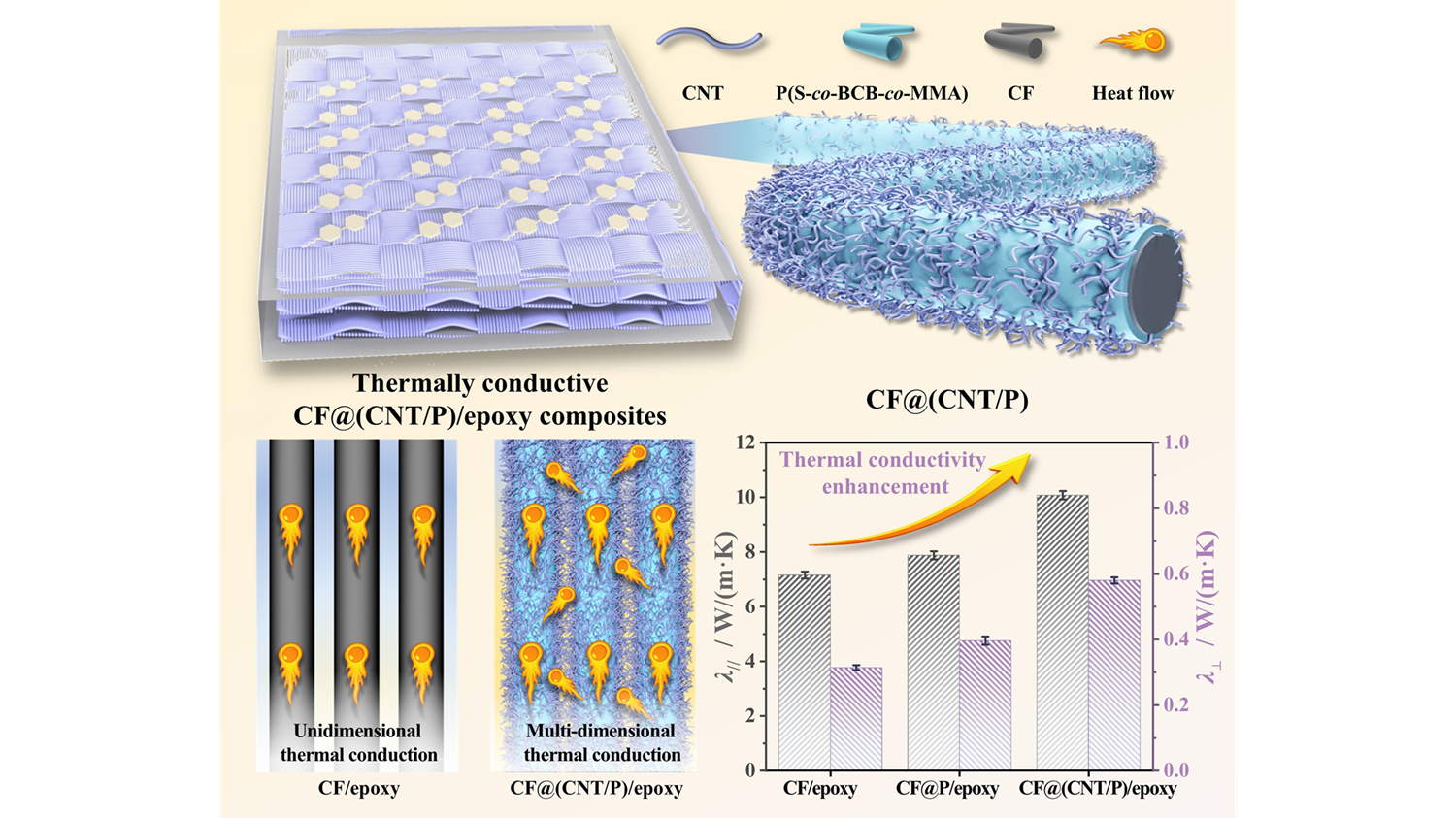
Carbon fibers (CF)/epoxy composites are widely utilized in aerospace and transportation due to their light weight and high specific strength/modulus. However, poor interfacial binding between CF and the epoxy matrix leads to phonon scattering and inefficient load transfer, causing heat accumulation and reduced service life in high-power electronic systems. In this study, CF was coated with a styrene, benzocyclobutene, and methyl methacrylate units containing polymer layer mixed with carbon nanotubes (CNT) through impregnation and drying. The polymer layer was then thermally crosslinked to obtain the polymer and CNT coated CF (CF@(CNT/P)). CF@(CNT/P) was then applied as reinforced fibers and epoxy resin containing a liquid crystal structure as the matrix to prepare CF@(CNT/P)/epoxy composites. The π-π interactions and hydrogen bonds between CF and epoxy resin were enhanced by the benzene ring and ester groups in the polymer, thereby improving the interfacial binding between epoxy resin and CF. CF@(CNT/P)/epoxy composite showed enhanced load-bearing and thermal conduction performance. When the mass fractions of CNT and copolymer in CNT/P/dichloromethane (DCM) solution were 0.03 wt% and 0.1 wt%, respectively, the CF@(CNT/P) had the best interfacial binding to the epoxy resin. The interlaminar shear strength and flexural strength of the CF@(CNT/P)/epoxy composite increased from 23.7 and 252.5 MPa of CF/epoxy composite to 31.4 and 369.1 MPa, respectively. Meanwhile, the in-plane (λ∥) and through-plane (λ⊥) thermal conductivity values were improved from 7.15 and 0.31 W/(m·K) of CF/epoxy composite to 10.08 and 0.58 W/(m·K), respectively. The CF@(CNT/P)/epoxy composite also demonstrated an electromagnetic interference shielding effectiveness of 38.6 dB which has broad application in high-power electronic information systems.
Graphical Abstract
Keywords
Carbon fiber, epoxy resin, thermal conductivity, mechanical properties
1. Introduction
Carbon fiber (CF)/epoxy composites demonstrate many advantages, such as light weight, high specific strength, and high specific modulus. They are often used as substrates and housings for electronic systems in unmanned aerial vehicles and intelligent driving vehicles[1-3]. With the rapid development of aerospace and transportation, the electronic components in these systems are becoming increasingly high-frequency, high-power, and high-density[4,5]. These inevitably lead to rapid heat accumulation in the electronic systems, seriously threatening their operational stability and service life, and impose higher demands on the thermal conductivity of CF/epoxy composites[6,7].
However, the intrinsic thermal conductivity of the epoxy matrix is usually lower than 0.2 W/(m·K)[8-10]. Moreover, the surface of CF is highly inert, making it difficult to interact with the epoxy matrix. In addition, the CF surface is grooved[11,12], leading to voids or defects between the CF and the epoxy matrix, resulting in poor interfacial binding and blocking the thermal conduction paths in the epoxy composite[13,14]. Therefore, the thermal conductivity of CF/epoxy composites is difficult to meet application requirements[15,16]. By introducing mesogenic units into the epoxy monomer to generate an ordered structure during curing[17,18], phonon scattering can be effectively reduced, endowing the epoxy matrix with higher intrinsic thermal conductivity[19-21]. Furthermore, introducing an interfacial compatibilizer on the CF surface will improve the interfacial compatibility and binding between the epoxy matrix and CF, which therefore enhances the thermal conduction and mechanical properties of the composite[22-24]. For instance, Jiang et al.[25] prepared CF, which was coated with polydopamine (PDA). The high density of catechol and amino groups in PDA formed strong π-π stacking and hydrogen bonding interactions with CF and epoxy resin, improving the compatibility between CF and epoxy resin and reducing interfacial defects. The λ⊥ of the modified CF/epoxy composite was increased from 1.51 W/(m·K) of the neat CF/epoxy composite to 1.66 W/(m·K), and its interlaminar shear strength (ILSS) increased from 24.8 to 28.4 MPa. However, the thermal conductivity of CF/epoxy composites usually showed limited improvement by coating the CF surface with only a polymer itself.
Studies have shown that introducing carbon-based nanofillers with high thermal conductivity and polymers with specific structures into the composite interface can further increase thermal conduction pathways and improve heat transfer efficiency[26-28]. Huang et al.[29] used a poly(p-phenylene benzobisoxazole) (PBO) precursor to impregnate CF grafted with graphene oxide (GO), followed by high-temperature oxazole cyclization to obtain CF-GO@PBO. The results showed that the λ⊥ of the CF-GO@PBO/epoxy composite was 85.8% higher than that of the CF/epoxy composite. Yu et al.[30] prepared pitch-based CF (PCF) which was coated with modified graphene nanoplatelets (mGNP) and PDA (mGNP@mPCF). The high adhesiveness of PDA improved the interfacial binding within the composite while mGNP constructed thermal conduction pathways between fibers and increased fiber surface roughness to enhance mechanical interlocking with the epoxy matrix. The results showed that the λ⊥ of mGNP@mPCF/epoxy composite increased from 0.46 W/(m·K) for the PCF/epoxy composite to 0.74 W/(m·K), and its flexural strength increased from 265.4 to 315.8 MPa. Therefore, carbon-based nanofillers can effectively improve thermal conductivity and also serve as nano-reinforcement points during load bearing through mechanical interlocking, endowing the composite with excellent mechanical properties[31,32]. However, the surface of carbon-based nanofillers is highly inert[33,34], and the polymer main chains of PBO and PDA are composed of rigid benzene rings[35,36], which limits the spreading of the polymer and carbon-based nanofillers on the CF surface, leading to easy agglomeration and defect formation. Therefore, their modification effect needs further improvement.
In this study, styrene (S), benzocyclobutene (BCB), and methyl methacrylate (MMA) were employed to synthesize a random copolymer of P(S-co-BCB-co-MMA) through reversible addition-fragmentation chain transfer (RAFT) polymerization. P(S-co-BCB-co-MMA) and carbon nanotubes (CNT) were then applied to coat CF via the strategy of impregnation and drying. After thermal crosslinking of BCB units, CF uniformly coated with CNT and P(S-co-BCB-co-MMA) was obtained, denoted as CF@(CNT/P). The CF@(CNT/P)/epoxy composite was then prepared via an “impregnation-layering-hot pressing” method, where the epoxy contained conventional epoxy (E-51) and liquid crystalline epoxy (liquid crystalline epoxy (LCE), as shown in Figure 1). The structural and surface morphology of CF@(CNT/P) were characterized using X-ray photoelectron spectroscopy (XPS), scanning electron microscopy (SEM), and atomic force microscopy (AFM). The effects of the structural composition and morphology of CF@(CNT/P) on the mechanical properties, thermal conductivity, and thermal resistance of the CF@(CNT/P)/epoxy composite were analyzed and investigated.
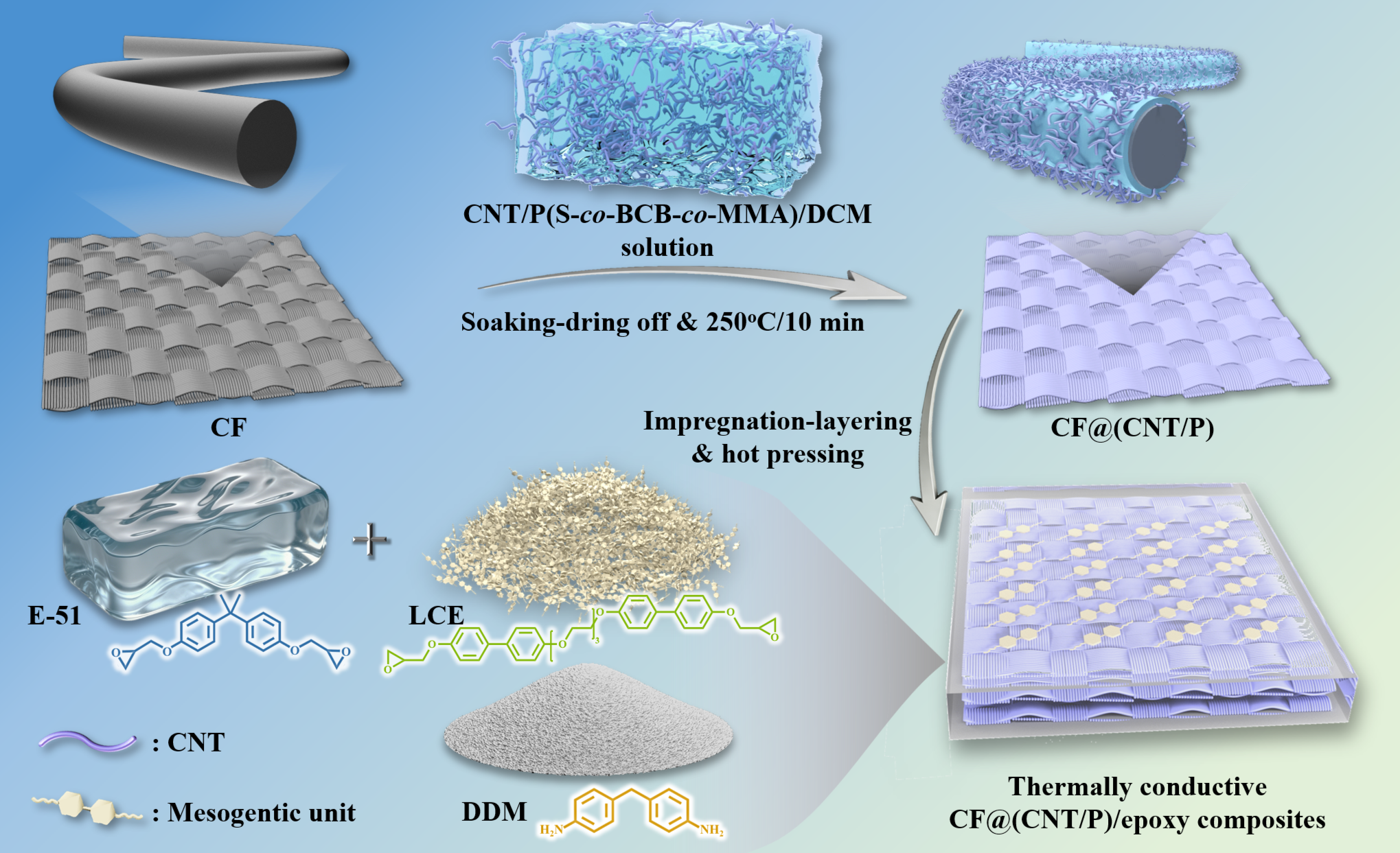
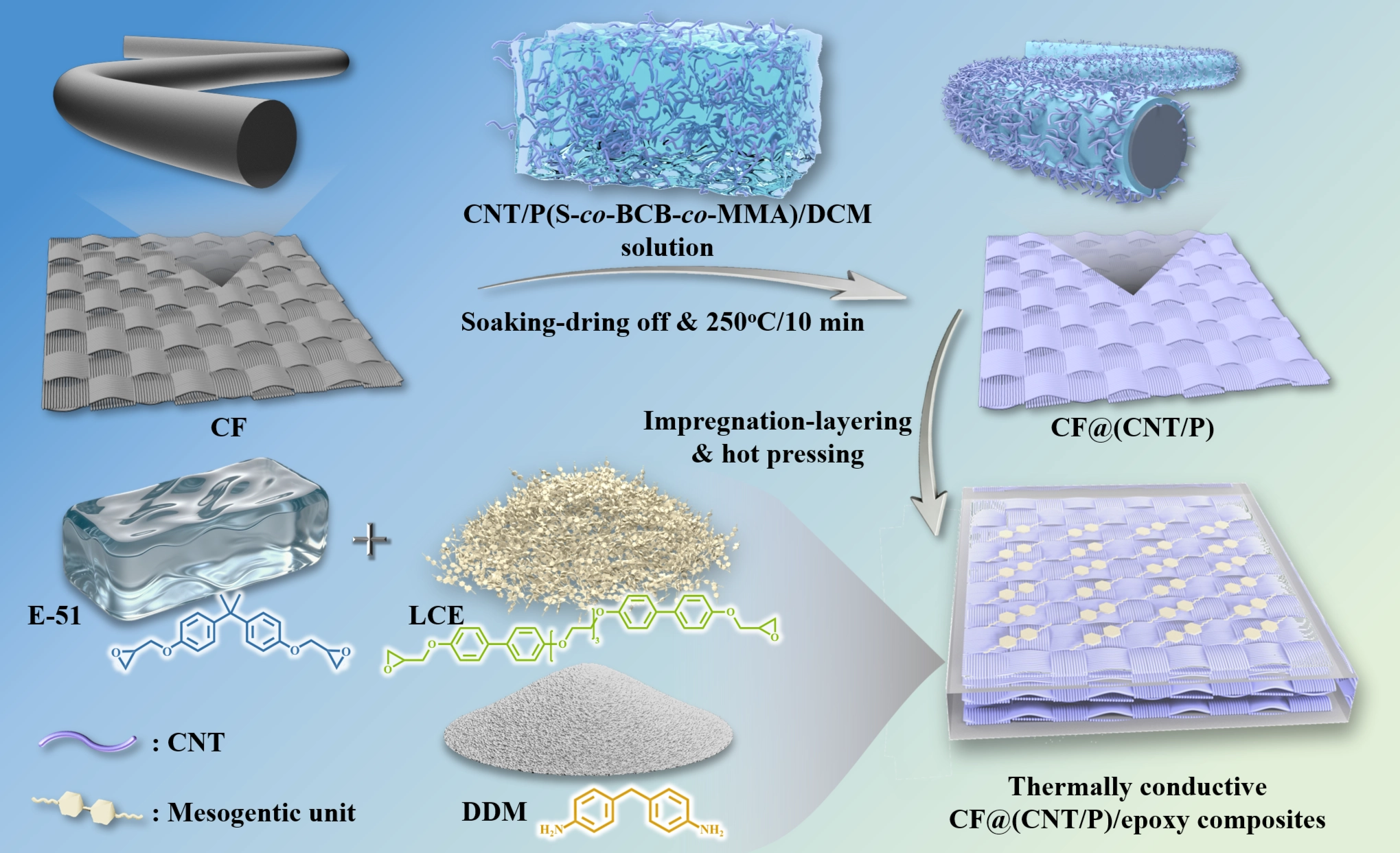
Figure 1. Schematic diagram of the preparation of thermally conductive CF@(CNT/P)/epoxy composite. CNT: carbon nanotube; BCB: benzocyclobutene; MMA: methyl methacrylate; CF: carbon fiber; DDM: 4,4’-diaminodiphenylmethane; DCM: dichloromethane; LCE: liquid crystalline epoxy.
2. Methods
2.1 Main raw materials
CF fabric, T-300, was purchased from Toray Industries, Inc. (Japan). P(S-co-BCB-co-MMA) was synthesized according to our previous study (Scheme S1 and Figure S1)[37]. LCE was synthesized according to our previous work[38]. Dichloromethane (DCM, 98%), acetone (98%), anhydrous ethanol (98%), CNT (95%, inner diameter = 5~12 nm, outer diameter = 30~50 nm, length = 1~10 μm), 4,4’-diaminodiphenylmethane (DDM), and bisphenol A epoxy resin (E-51) were all purchased from Shanghai Macklin Biochemical Technology Co., Ltd. (China).
2.2 Modification of CF with P(S-co-BCB-co-MMA)
The CF fabric was immersed in acetone for 24 hours, rinsed with ethanol, dried in an oven at 80 °C for 12 hours, and then cooled to room temperature. To verify the optimal amount of the random copolymer, appropriate amounts of P(S-co-BCB-co-MMA) were dissolved in DCM to prepare P(S-co-BCB-co-MMA)/DCM solutions with mass fractions of 0.1 wt%, 0.2 wt%, and 0.3 wt%, respectively. The pretreated CF was immersed into the above solutions. After DCM evaporation at 60 °C, CF covered with P(S-co-BCB-co-MMA) was obtained. It was then heated at 250 °C for 10 minutes under a N2 atmosphere to crosslink the BCB units. After cooling to room temperature, the P(S-co-BCB-co-MMA)-modified CF was obtained (denoted as CF@P-1, CF@P-2, and CF@P-3, respectively).
2.3 Preparation of CNT/copolymer hybrid coating modified CF
Appropriate amounts of CNT, P(S-co-BCB-co-MMA), and DCM were mixed under ultrasonic conditions for 10 minutes to prepare a series of CNT/P(S-co-BCB-co-MMA)/DCM mixtures (the mass fractions of CNT in the mixtures were 0.01 wt%, 0.02 wt%, 0.03 wt%, and 0.04 wt%, respectively). The acetone-pretreated CF fabric was immersed in the above mixtures, and then the same treatment procedure as that used for preparing CF@P was applied to obtain CF@(CNT/P), denoted as CF@(CNT/P)-1, CF@(CNT/P)-2, CF@(CNT/P)-3, and CF@(CNT/P)-4, respectively.
2.4 Preparation of CF@(CNT/P)/epoxy composites
Bisphenol A epoxy resin (E-51) was first added to a polytetrafluoroethylene beaker and stirred at 150 °C for preheating. After becoming clear and transparent, LCE was added, dissolved, and stirred evenly to obtain an E-51/LCE (mol:mol = 9:1) mixture. An appropriate amount of curing agent, DDM, was added to the above mixture (the molar ratio of active hydrogen from amino groups to epoxy groups was 1:1). The mixture was prepolymerized at 150 °C to a gel state, then cooled to room temperature, and acetone was added in proportion (vol:vol = 1:1) to prepare an impregnating resin. An appropriate amount of CF@(CNT/P) was immersed in the above impregnating resin to obtain CF@(CNT/P)/epoxy prepreg (resin content was fixed at 40 wt%). After the prepreg was layered (6 layers), it was cured at 150 °C (within the liquid crystal state of LCE) under 10 MPa pressure for 6 hours, then cooled and demolded to obtain the CF@(CNT/P)/epoxy composite. The CF/epoxy and CF@P/epoxy composites were prepared using the same method as controls.
2.5 Characterizations
The characterizations are shown in Supplementary materials.
3. Results and Discussion
3.1 The structure of CF@(CNT/P)
Fourier transform-infrared spectroscopy (FT-IR) was used to characterize and analyze the surface functional groups of CF, CF@P, and CF@(CNT/P) (Figure 2a). The FT-IR spectrum of CF only showed very few characteristic absorption peaks with low intensity. It was mainly attributed to the strong surface chemical inertness of CF, which was composed of a low-polar and highly crystalline flake graphite structure[39]. After modification by P(S-co-BCB-co-MMA), CF@P showed characteristic absorption peaks at 1,727 cm-1 and 1,450-1,600 cm-1, corresponding to the O-C=O group and the benzene ring in the side chain of P(S-co-BCB-co-MMA), respectively, indicating that P(S-co-BCB-co-MMA) was successfully coated on the surface of CF[37]. Compared with CF@P, CF@(CNT/P) also showed a characteristic absorption peak at 3,400 cm-1 attributed to the hydroxyl groups on the CNT surface[40]. In addition, the characteristic absorption peak for O-C=O shifted from 1,727 to 1,722 cm-1, and the characteristic absorption peak for the benzene ring skeleton vibration shifted from 1,452 to 1,450 cm-1, indicating that CNT formed hydrogen bonding and π-π stacking interactions with the BCB units and the benzene rings of P(S-co-BCB-co-MMA), respectively[41,42].
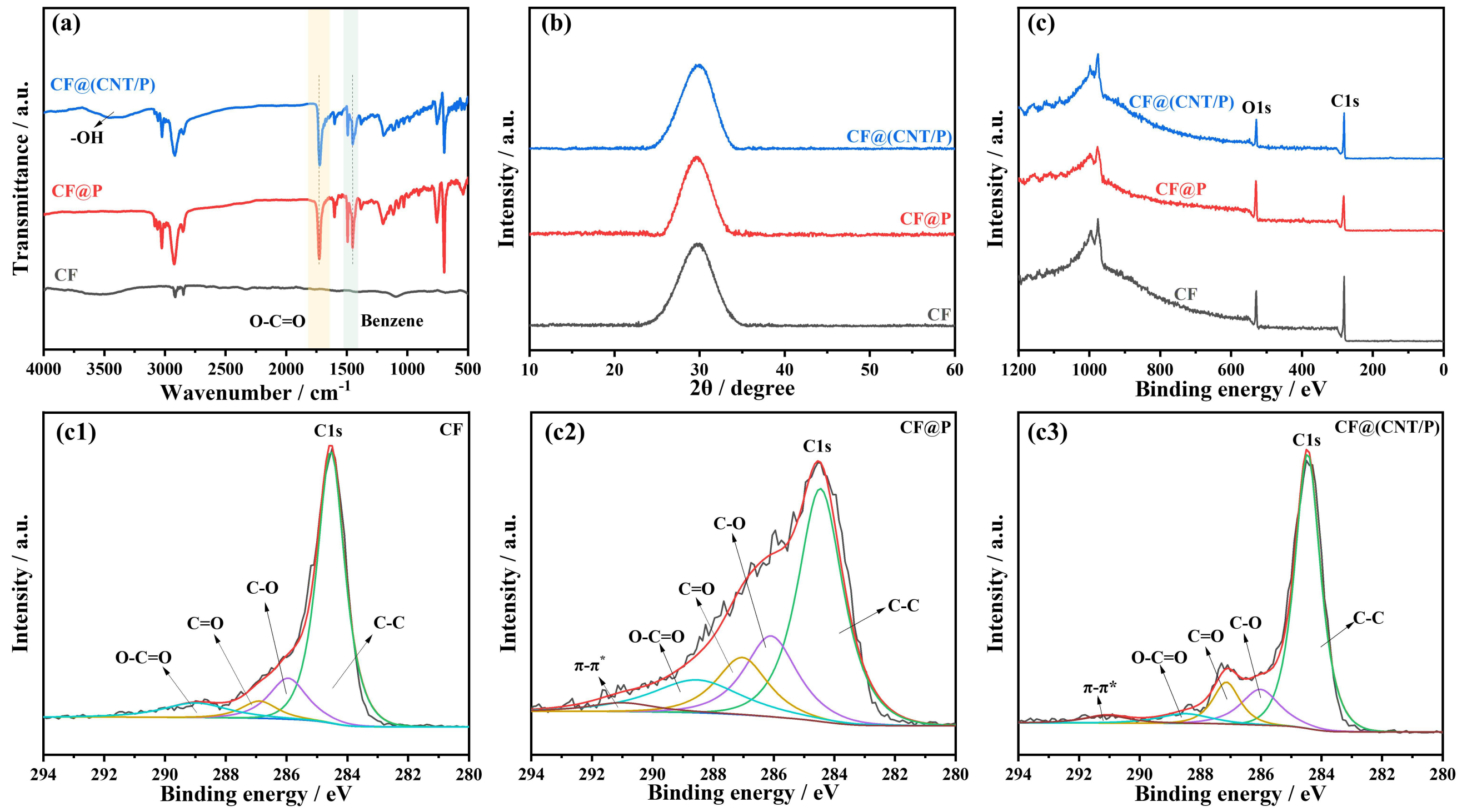
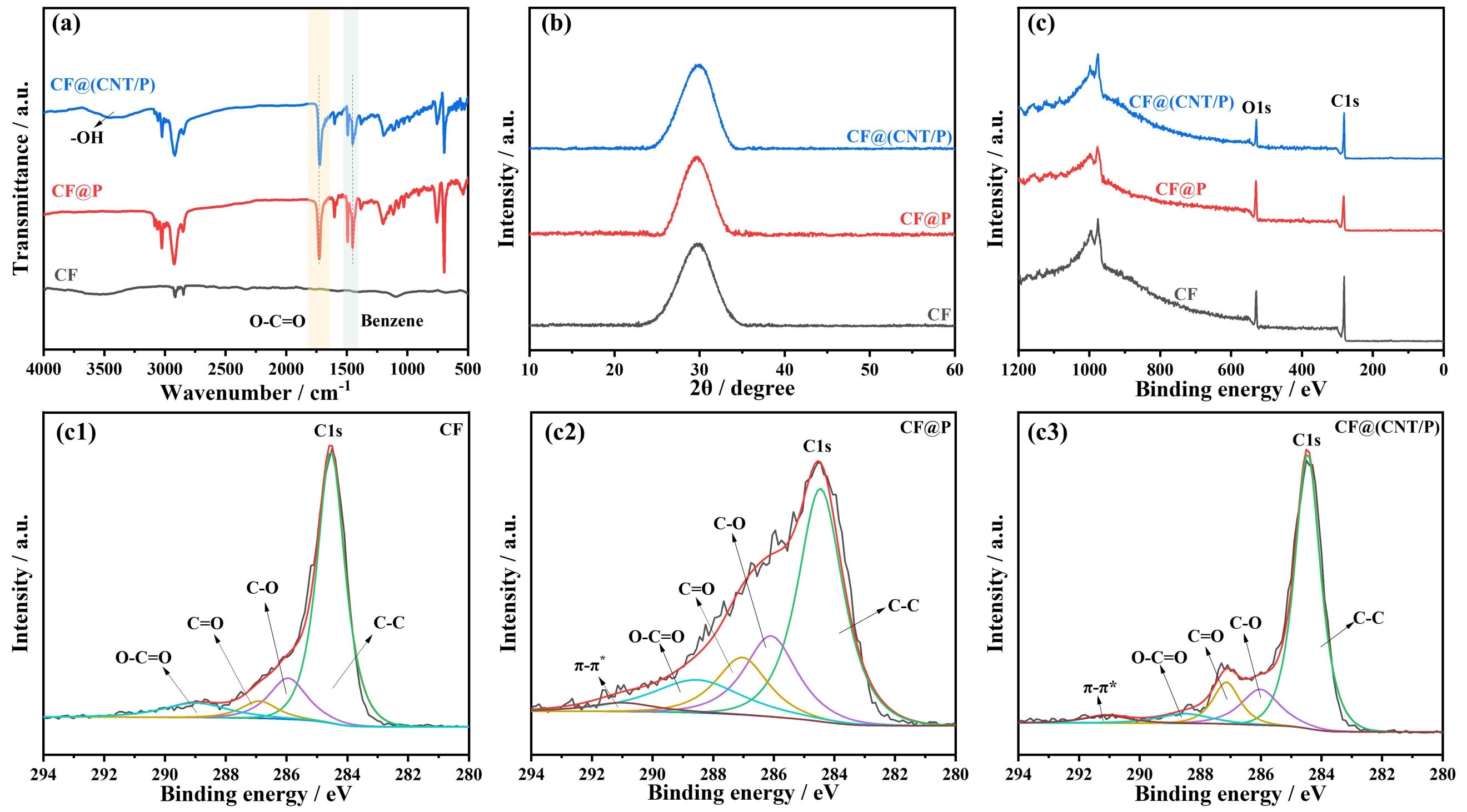
Figure 2. FT-IR spectra (a); XRD curves (b); XPS spectra (c) of CF, CF@P; and CF@(CNT/P), and the high-resolution XPS C1s spectra (c1-c3). FT-IR: Fourier transform-infrared spectroscopy; XRD: X-ray diffraction; XPS: X-ray photoelectron spectroscopy; CF: carbon fiber; CF@(CNT/P): carbon fibers coated with carbon nanotubes/polymer layer.
X-ray diffraction (XRD) was then applied to characterize the crystal structures of CF, CF@P, and CF@(CNT/P) (Figure 2b). CF showed a characteristic peak at 29.7o corresponding to the crystal plane of the crystalline flake graphite structure of CF. After modification with CNT and P(S-co-BCB-co-MMA), this characteristic peak showed no obvious change for CF@P and CF@(CNT/P), indicating that the surface modification had no significant effect on the crystal structure of CF[43-45]. Figure 2c shows the XPS spectra of CF before and after modification with CNT and P(S-co-BCB-co-MMA), and the corresponding element contents are listed in Table S1. CF displayed a low O content. Its C1s peak mainly consisted of C-C bonds (284.5 eV) and small amounts of C-O bonds (285.9 eV), C=O bonds (286.9 eV), and O-C=O bonds (288.8 eV) (Figure 2c1), indicating poor surface activity. For CF@P, the relative content of O on the surface increased, while the relative content of C decreased. The peak areas of oxygen-containing functional groups in its high-resolution C1s spectrum increased significantly, and a characteristic peak (π-π*) attributed to π-π stacking appeared at 291.0 eV (Figure 2c2)[46,47]. These changes were attributed to the high oxygen content of the O-C=O side groups in P(S-co-BCB-co-MMA) and the π-π interactions between the benzene rings in the side groups and CF. For CF@(CNT/P), the introduction of CNT, which had a high C content, caused a slight decrease in the O content on the fiber surface[48], but the oxygen-containing functional group content (O/C ratio = 0.25) was still higher than that of CF (O/C ratio = 0.18). In addition, the π-π* peak remained, and its shape was essentially unchanged (Figure 2c3), further confirming the presence of π-π interactions between P(S-co-BCB-co-MMA) and both CF and CNT.
SEM was applied to characterize the surface morphology of CF, CF@P, and CF@(CNT/P) (Figure 3a,b,c). The surface of pristine CF displayed a grooved structure with a diameter of about 6.65 μm (Figure 3a). The diameter and coating thickness of CF@P increased from 6.71 μm and 0.03 μm of CF@P-1 (Figure 3b) to 7.12 μm and 0.23 μm of CF@P-3 (Figure S2) with increasing mass fraction of P(S-co-BCB-co-MMA), respectively. Besides, the surface of CF@P-3 showed clumpy aggregates (Figure S2b). In addition, when the solution concentration of P(S-co-BCB-co-MMA) was 0.1 wt%, the CF@P-1/epoxy composite exhibited the highest ILSS of 27.3 MPa and flexural strength of 327.1 MPa (Figure S3), indicating that the interfacial binding between CF@P and the epoxy resin was optimal at this treatment concentration[49]. Therefore, this mass fraction (0.1 wt%) of P(S-co-BCB-co-MMA) solution was selected for subsequent preparation of CF@P. As shown in Figure 3c and Figure S4, when the CNT mass fraction in the CNT/P(S-co-BCB-co-MMA)/DCM mixture was low, the CF@(CNT/P)-1 and CF@(CNT/P)-2 (Figure S4) surfaces had few CNT, and the CNT was difficult to orient. As the CNT mass fraction in the mixture increased, the amount of CNT on the CF surface increased, and the degree of orientation improved (Figure 3c). When the CNT mass fraction in the mixture reached 0.04 wt%, CNT agglomeration occurred on the surface of CF@(CNT/P)-4 (Figure S4c).
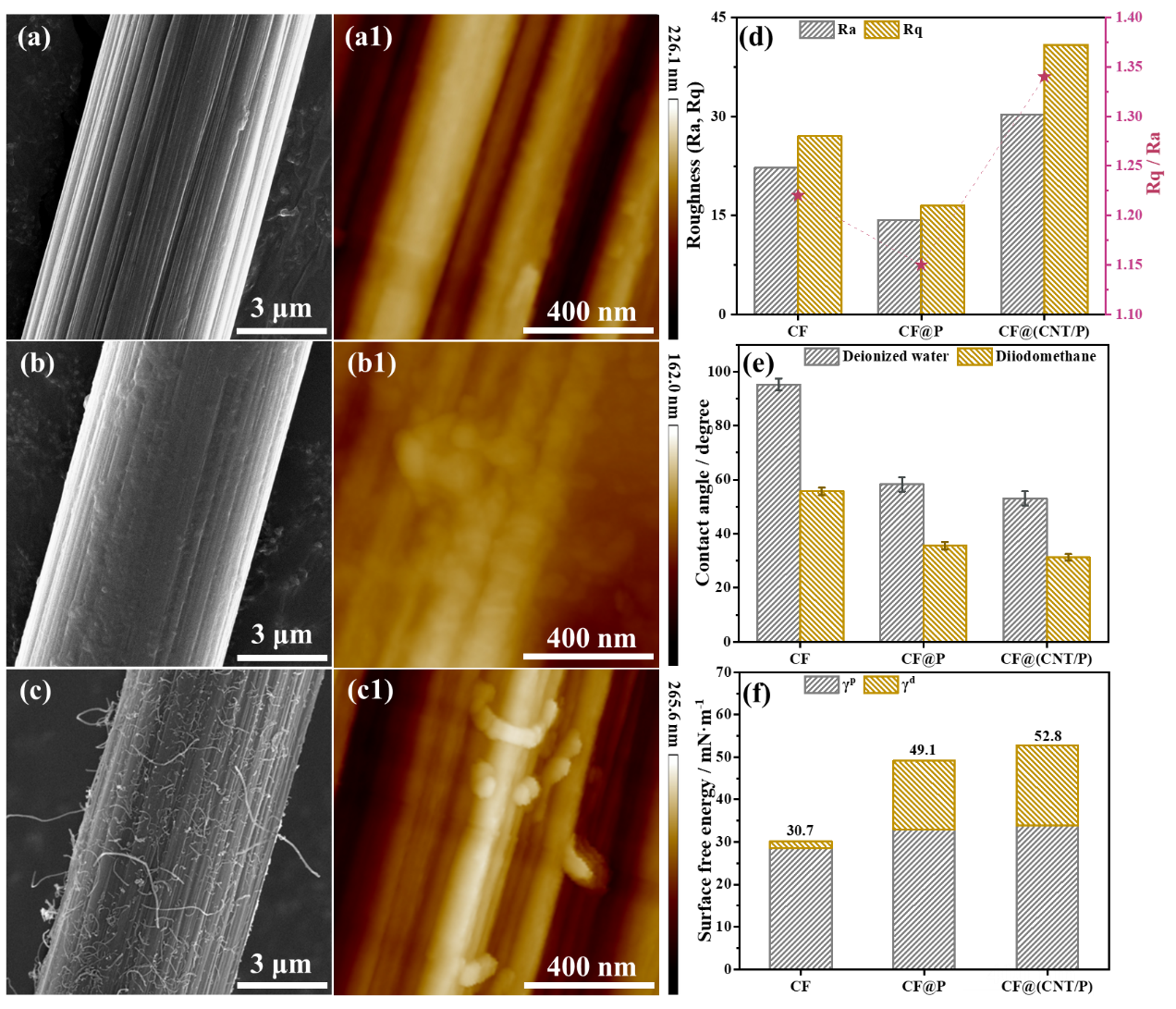
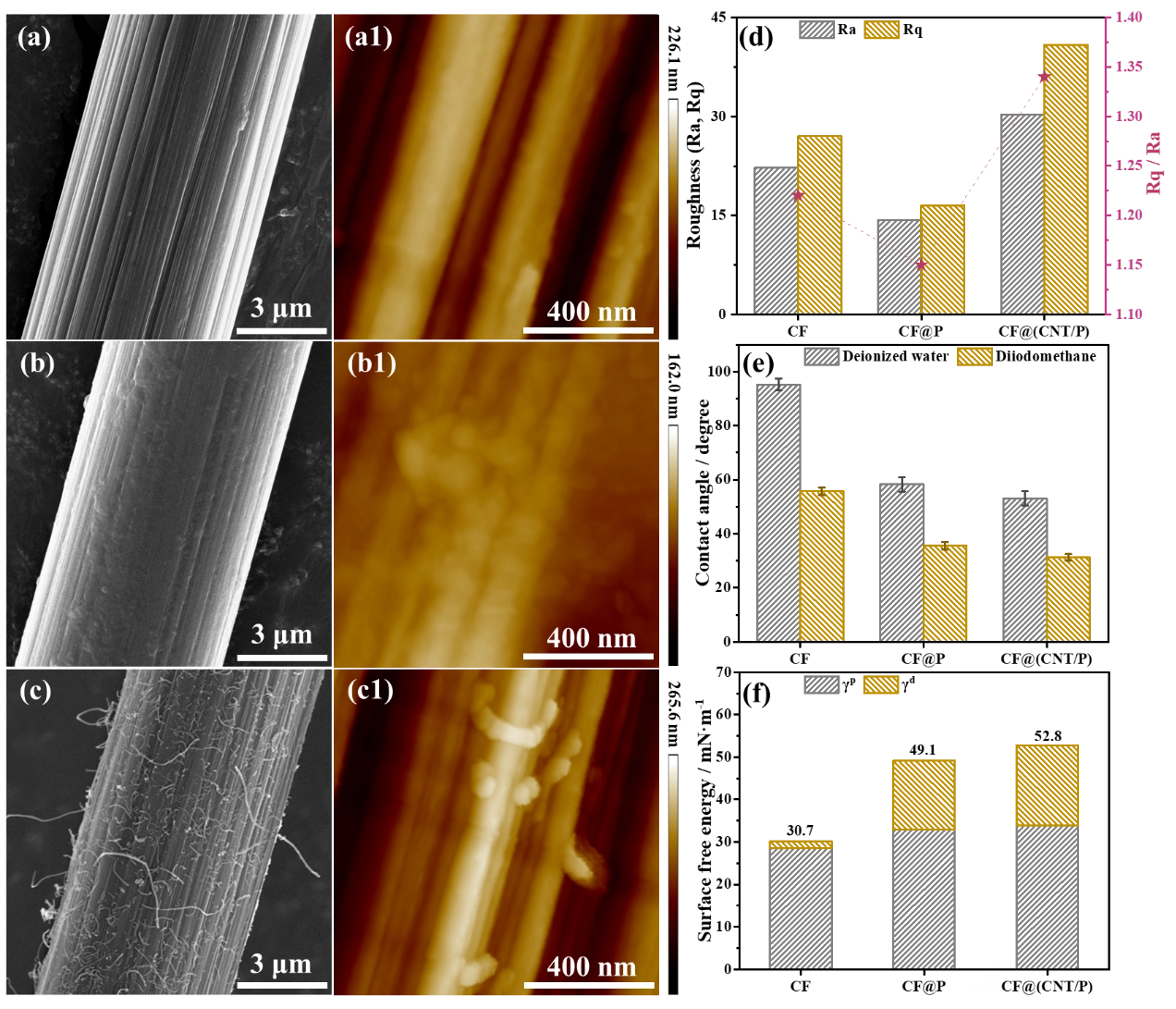
Figure 3. SEM (a-c) and AFM (a1-c1) images of CF, CF@P, and CF@(CNT/P); Roughness parameters (d); Contact angles between fibers and water and diiodomethane (e); Calculated surface energy (f). SEM: scanning electron microscopy; AFM: atomic force microscopy; CF: carbon fiber; CF@P: poly(styrene-co-benzocyclobutene-co-methyl methacrylate)-coated carbon fibers; CF@(CNT/P): carbon fibers coated with carbon nanotubes/polymer layer.
This is because, when the polymer solution concentration was low, the molecular chains of P(S-co-BCB-co-MMA) could easily disperse in DCM and fully spread on the CF surface. Increasing the polymer concentration tended to cause entanglement and agglomeration of the molecular chains, forming clumpy aggregations. In addition, due to the low boiling point of DCM, during its rapid volatilization, the tension generated by the shrinking liquid-gas interface exerted a force toward the gas on the CNT with a relatively large diameter, light weight, and high rigidity, making them prone to orientation. While the P(S-co-BCB-co-MMA), which had high flexibility, strong freedom of movement, and contained benzene rings and ester groups, had a stronger interaction with CF and was more likely to adhere to the surface of CF[50]. When the CNT mass fraction was low, the relatively high content of P(S-co-BCB-co-MMA) interacting with CF restricted the orientation of CNT, resulting in fewer oriented CNT. As the CNT mass fraction increased, the orientation effect became stronger, overcoming the restriction of the interactions between P(S-co-BCB-co-MMA) and CF, leading to more oriented CNT[51]. However, when the CNT mass fraction further increased, the viscosity of the mixture increased as well, making it difficult to spread uniformly on the CF surface, thus causing agglomeration. Moreover, when the CNT mass fraction in the CNT/P(S-co-BCB-co-MMA)/DCM mixture was 0.03 wt%, the CF@(CNT/P)-3/epoxy composite exhibited the highest ILSS of 31.4 MPa and flexural strength of 369.1 MPa (Figure S3), indicating that at this mass fraction, the interfacial binding between CF@(CNT/P) and the epoxy resin was optimal. Therefore, this CNT mass fraction in the mixture was selected for subsequent preparation of CF@(CNT/P).
As shown in the AFM images (Figure 3a1,b1,c1) and roughness parameters (Figure 3d) of CF, CF@P, and CF@(CNT/P), the surface of pristine CF exhibited relatively high roughness. Its arithmetic mean deviation of the profile (Ra) reached 22.2, and the ratio of the root mean square roughness (Rq) to Ra was relatively large[52,53], being 1.22. The surface roughness of CF@P was 14.3, and the Rq/Ra value decreased to 1.15. The Ra value of CF@(CNT/P) significantly increased to 30.3, with an Rq/Ra value of 1.34. This is because some CNT were distributed on the CF surface at certain orientation angles, which increased the height difference on the CF@(CNT/P) surface. According to the contact angles of the three fibers with water and diiodomethane and the calculated surface energy results (Figure 3e,f), the contact angles of CF@P and CF@(CNT/P) with both liquids were significantly lower than those of CF, and the polar component of the surface energy (γd) increased. This is attributed to the polar groups introduced by P(S-co-BCB-co-MMA) and the large specific surface area formed by the high surface roughness of CF@(CNT/P), which improved contact with water and diiodomethane, facilitated infiltration of the fibers by epoxy resin, and enhanced the binding between the fibers and the resin[54,55].
3.2 Mechanical properties of CF@(CNT/P)/epoxy composite
The binding characteristics between the three types of fibers and the epoxy matrix were investigated through the ILSS fracture surfaces of the fibers with epoxy resin (Figure 4a,b,c) and the ILSS test results (Figure 4d). It can be seen that the CF@(CNT/P)/epoxy composite exhibited the highest ILSS of 31.4 MPa, which was 32.4% higher than that of the CF/epoxy composite (23.7 MPa), and higher than that of the CF@P/epoxy composite (27.3 MPa). This is because the ILSS mainly depends on the binding ability between CF and the epoxy matrix. Due to the grooved structure (Figure 3a), strong inertness, and low surface energy (Figure 3f) of CF, it was difficult to be infiltrated by epoxy resin, resulting in micro-voids between CF and the epoxy matrix (Figure 4a). As a result, stress cannot be effectively transferred between CF and the epoxy matrix. During loading, such voids became stress concentration points, which caused the CF to detach from the epoxy matrix and resulted in interlayer sliding failure. Besides, the surface of the CF contained almost no residual epoxy resin[56]. However, CF@P had a higher surface energy, which facilitated the infiltrating of CF by epoxy resin and reduced interfacial defects and voids. After ILSS testing, the amount of epoxy resin adhered to the CF surface increased (Figure 4b), indicating that the benzene rings and ester groups in P(S-co-BCB-co-MMA) could enhance π-π interactions and hydrogen bonding at the interface between CF and the epoxy matrix. This is beneficial for stress transfer between CF and the epoxy matrix, resulting in a higher ILSS. For the fracture surface of the CF@(CNT/P)/epoxy composite, the CF was covered by epoxy resin, indicating good binding between CF and the epoxy matrix, with failure mainly occurring through fracture of the epoxy resin (Figure 4c). This indicated that CF@(CNT/P) further enhanced stress transfer at the interface through mechanical interlocking with epoxy resin, endowing it with the highest ILSS[57,58].
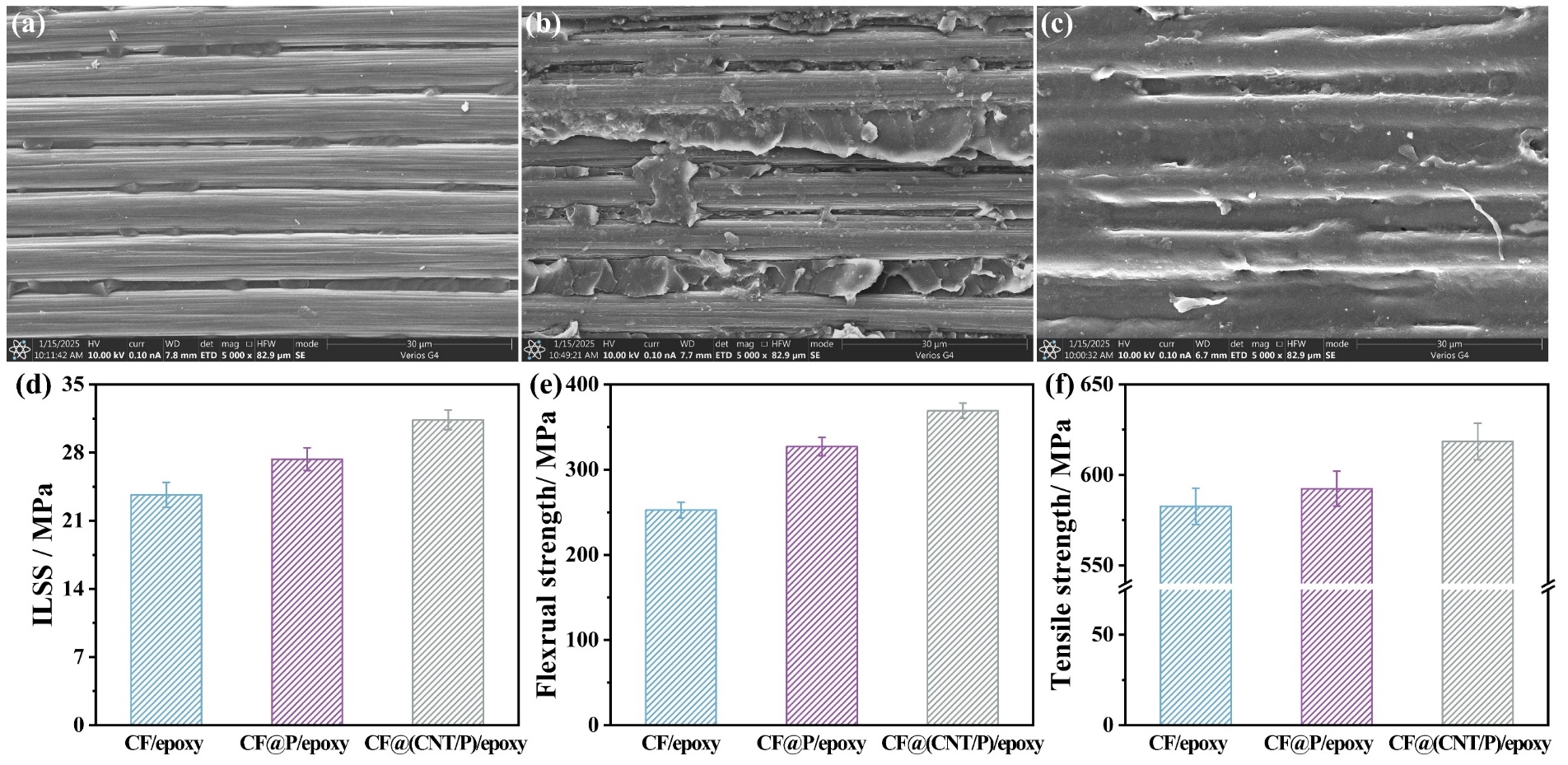
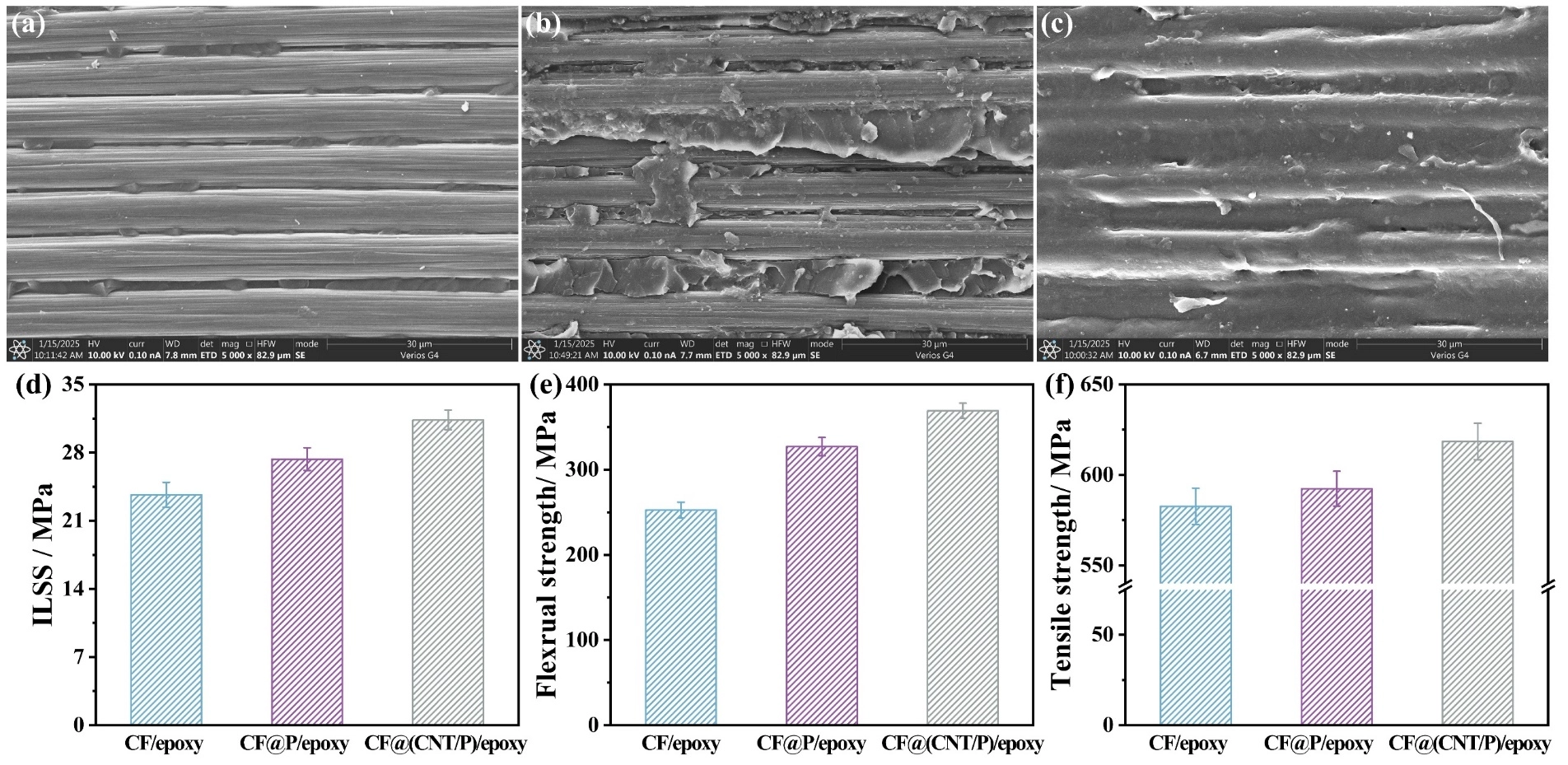
Figure 4. SEM images of ILSS fracture surfaces of CF/epoxy composite, CF@P/epoxy composite, and CF@(CNT/P)/epoxy composite (a-c); test results of ILSS (d); flexural strength (e); and tensile strength (f). SEM: scanning electron microscopy; ILSS: interlaminar shear strength; CF: carbon fiber; CF@P: poly(styrene-co-benzocyclobutene-co-methyl methacrylate)-coated carbon fibers; CF@(CNT/P): carbon fibers coated with carbon nanotubes/polymer layer.
In addition, the flexural strength and tensile strength of the CF@(CNT/P)/epoxy composite reached 369.1 and 617.3 MPa, respectively (Figure 4e,f), which were higher than those of the CF/epoxy composite (252.5 and 582.6 MPa, respectively) and the CF@P/epoxy composite (327.1 and 592.4 MPa, respectively). This further demonstrated that the interfacial binding between CF and the epoxy matrix was effectively improved, and that the surface modification of CF did not reduce the tensile properties of the composite. Meanwhile, the improved interfacial binding between CF and the epoxy resin helped reduce interlaminar slippage during tensile loading, endowing the composite with high tensile strength.
3.3 Thermal conduction and thermal performance of CF@(CNT/P)/epoxy composites
Figure 5a shows the λ∥ and λ⊥ results of CF/epoxy, CF@P/epoxy, and CF@(CNT/P)/epoxy composites. It can be seen that the CF@(CNT/P)/epoxy composite exhibited the highest λ∥ and λ⊥ of 10.08 and 0.58 W/(m·K), respectively, which were 41.0% and 87.1% higher than those of the CF/epoxy composite (λ∥ = 7.15 W/(m·K), λ⊥ = 0.31 W/(m·K)), and also higher than those of the CF@P/epoxy composite (λ∥ = 7.88 W/(m·K), λ⊥ = 0.39 W/(m·K)). This is mainly attributed to the effective construction of more through-plane thermal conduction pathways within the composite after CF modification with P(S-co-BCB-co-MMA) and CNT (Figure 5b and Figure S5), resulting in an improvement in through-plane thermal conductivity.
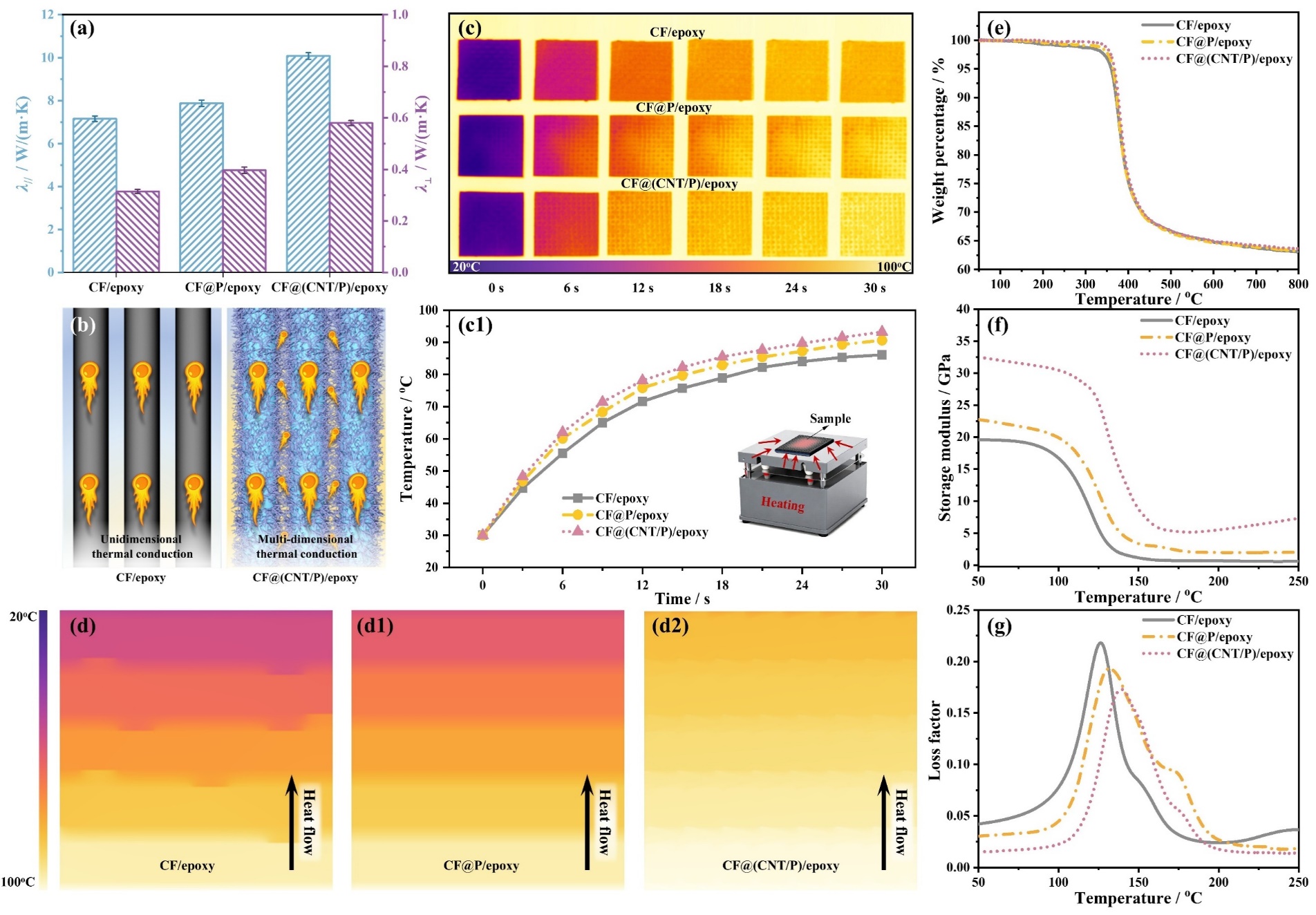
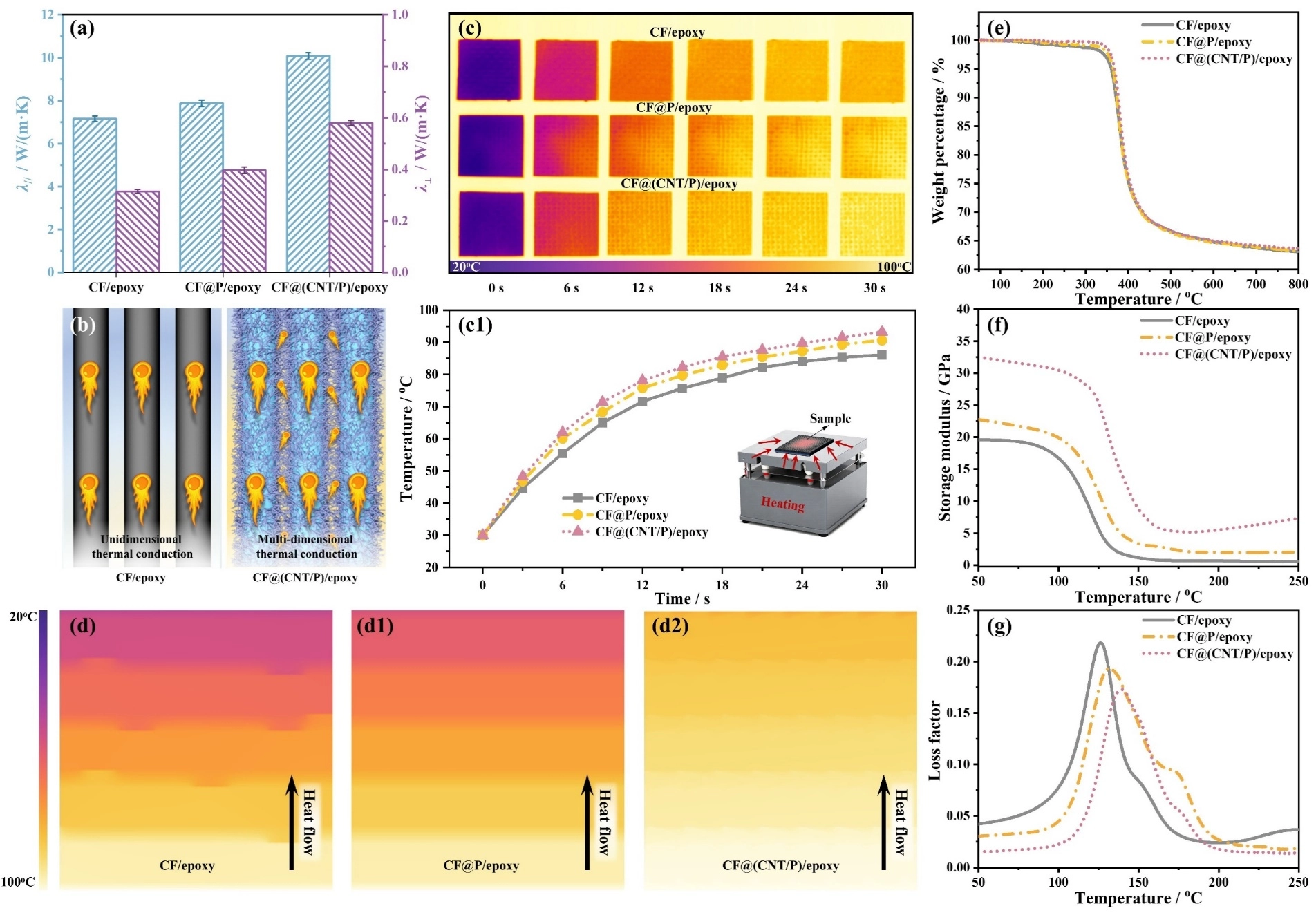
Figure 5. The λ∥ and λ⊥ test results of CF/epoxy, CF@P/epoxy, and CF@(CNT/P)/epoxy composites (a); The schematic diagram of the thermal conduction path (b); The infrared thermal images and curves during the 100 °C heat source heating process (c-c1); The finite element simulation results of microstructure thermal conduction (d-d2); TGA (e), and DMA storage modulus (f) and loss factor curves (g). CF: carbon fiber; CF@P: poly(styrene-co-benzocyclobutene-co-methyl methacrylate)-coated carbon fibers; CF@(CNT/P): carbon fibers coated with carbon nanotubes/polymer layer.
It can be seen that the λ∥ of the composites was higher than the λ⊥. This is because when heat flowed in the in-plane direction, the CF acted as continuous thermal conduction pathways, resulting in less phonon scattering. In contrast, when heat transferred in the through-plane direction, it had to pass through an "epoxy-CF-epoxy" path, encountering numerous interfaces, which led to significant phonon scattering. In addition, the biphenyl units of LCE formed a regular structure in epoxy[26], which constructed thermal conduction pathways between CF and reduced phonon scattering during heat transfer[59,60]. Therefore, the λ∥ and λ⊥ of the CF/epoxy composite with LCE were higher than those of the CF/epoxy composite without LCE (Table S2 and Table S3). However, pristine CF had strong surface chemical inertness, making it difficult for epoxy resin to infiltrate CF, leading to voids at the interface and weak interfacial binding (Figure 4a). After modification with P(S-co-BCB-co-MMA), epoxy resin effectively infiltrated CF@P with higher surface energy, reducing interfacial voids and achieving better binding (Figure 4b), which helped reduce phonon scattering at the interface of the CF@P/epoxy composite during heat transfer, endowing it with higher thermal conductivity. In the CF@(CNT/P)/epoxy composite, the interfacial binding between CF@(CNT/P) and epoxy resin was the best (Figure 4c), which was more favorable for heat flow transfer at the interface. Moreover, the surface of CF@(CNT/P) contained CNT with high thermal conductivity (Figure 3c), which helped construct thermal conduction pathways between CF, forming a more complete three-dimensional thermal conduction network within the composite and endowing it with the best thermal conductivity[61].
According to the infrared thermal images and curves of the composites on the surface of the 100 °C constant-temperature flatbed thermal platform (Figure 5c,c1), the surface temperatures of the CF/epoxy and CF@P/epoxy composites were lower than that of the CF@(CNT/P)/epoxy composite under the same heating time. After 30 s of heating, the surface temperatures were 86.1, 90.6, and 93.2 °C, respectively. Moreover, the surface temperature distribution of the CF@(CNT/P)/epoxy composite was uniform, which was consistent with the thermal conductivity test results, indicating its best thermal conductivity.
The thermal conduction mechanisms of the thermally conductive composites were analyzed using the ILSS fracture (SEM images, Figure 3 and Figure 4a,b,c) and finite element simulation (Figure 5d,d1,d2 and Table S4). By applying a heat source of 100 °C at the bottom of the microscopic model (Figure S6), the temperature of each part under steady-state conditions was simulated. It can be seen that in the CF/epoxy composite, the temperature between the fiber layers decreased significantly, with the upper surface temperature reaching only 43.8 °C, indicating that the interfacial voids between CF and the epoxy matrix disrupted efficient heat flow transfer at the interface. After modification with P(S-co-BCB-co-MMA), the infiltration of the epoxy matrix was improved, defects and voids were reduced, and heat conduction at the interface was enhanced, raising the upper surface temperature to 51.0 °C. For the CF@(CNT/P)/epoxy composite, the upper surface temperature reached 83.1 °C, which was significantly higher than those of the above two composites. This is attributed to the fact that there is a lower temperature difference at the interface between the fibers and the resin in the simulation of CF@(CNT/P)/epoxy composite (Figure S7), indicating that the introduction of CNT with excellent thermal conductivity can effectively construct thermal conduction pathways between CF and reduce the thermal resistance, endowing the composite with superior thermal conductivity[62-64]. Further comparison between the CF@(CNT/P)/epoxy composite and other modification methods for CF reinforced composites showed that the method presented herein can effectively improve the thermal conductivity and mechanical properties of the composite (Figure S8 and Table S5).
As shown in Figure 5e and Table S6, the main thermal weight loss temperature range of the three composites was 350~700 °C, which was mainly attributed to the decomposition of epoxy resin at high temperatures (Figure S9). Among them, the CF@(CNT/P)/epoxy composite exhibited the highest thermal resistance index (THRI)[19], reaching 200.3 °C. This indicated that the modification of CF with P(S-co-BCB-co-MMA) and CNT was beneficial for restricting the thermal decomposition of epoxy resin molecules through interfacial interactions, endowing the composite with higher thermal resistance. In addition, as displayed by the DMA storage modulus and loss factor curves of the composites (Figure 5f,g), the CF@(CNT/P)/epoxy composite showed the highest storage modulus of 32.4 GPa at 50 °C, which was 65.3% higher than that of the CF/epoxy composite (19.6 GPa), and also higher than that of the CF@P/epoxy composite (22.7 GPa). This was attributed to the improved interfacial binding between CF@(CNT/P) and the epoxy and the mechanical interlocking effect. Furthermore, the CF@(CNT/P)/epoxy composite exhibited the highest glass transition temperature of 139.1 °C, which was higher than those of CF/epoxy (127.8 °C) and CF@P/epoxy (131.1 °C) composites. This further demonstrated that the interfacial binding between CF and the epoxy matrix in the CF@(CNT/P)/epoxy composite was more excellent, and the interphase restricted the movement of epoxy resin segments at high temperatures, endowing the CF@(CNT/P)/epoxy composite with better performance for high-temperature applications[65,66]. This is beneficial for avoiding deformation during high-temperature heat transfer processes, ensuring the effective performance of its thermal conductivity[67,68].
3.4 Electromagnetic shielding performance of thermally conductive CF@(CNT/P)/epoxy composite
As shown in Figure 6a,a1, the CF@(CNT/P)/epoxy composite exhibited the best electromagnetic interference shielding effectiveness (EMI SET, 38.6 dB), which was significantly higher than those of the CF/epoxy (23.6 dB) and CF@P/epoxy (23.7 dB) composites, and mainly relied on reflection of electromagnetic waves (Figure S10a). This is because the CF@(CNT/P)/epoxy composite constructed conductive pathways between CF by introducing CNT with high electrical conductivity, resulting in better electrical conductivity (Figure S10b). As a result, when electromagnetic waves were incident on the surface of the CF@(CNT/P)/epoxy composite, impedance mismatch occurred, reflecting a large amount of electromagnetic wave energy[69-71]. Furthermore, finite element simulation of the electric potential change of the composite under an electromagnetic field (Figure 6b,b1 and Table S7, with electromagnetic waves incident from the top of the composite model) showed that the electric field intensity of the CF@(CNT/P)/epoxy composite decreased more rapidly along the direction of electromagnetic wave propagation. The average electric field intensity at the bottom was 0.14 V, which was significantly lower than that of the CF/epoxy composite (0.47 V), indicating that the introduction of CNT could effectively reduce the penetration of electromagnetic waves into the composite interior[72].
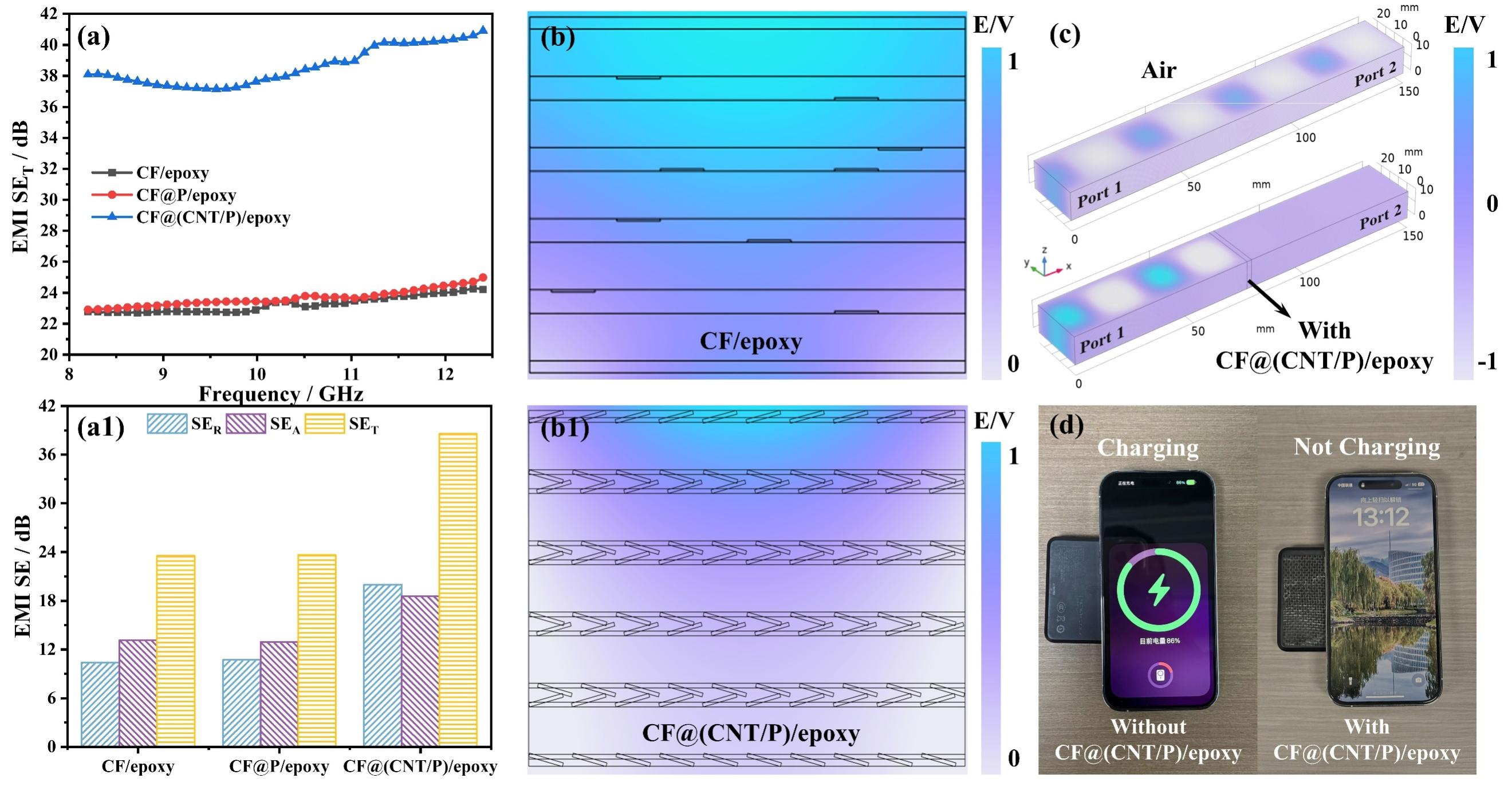
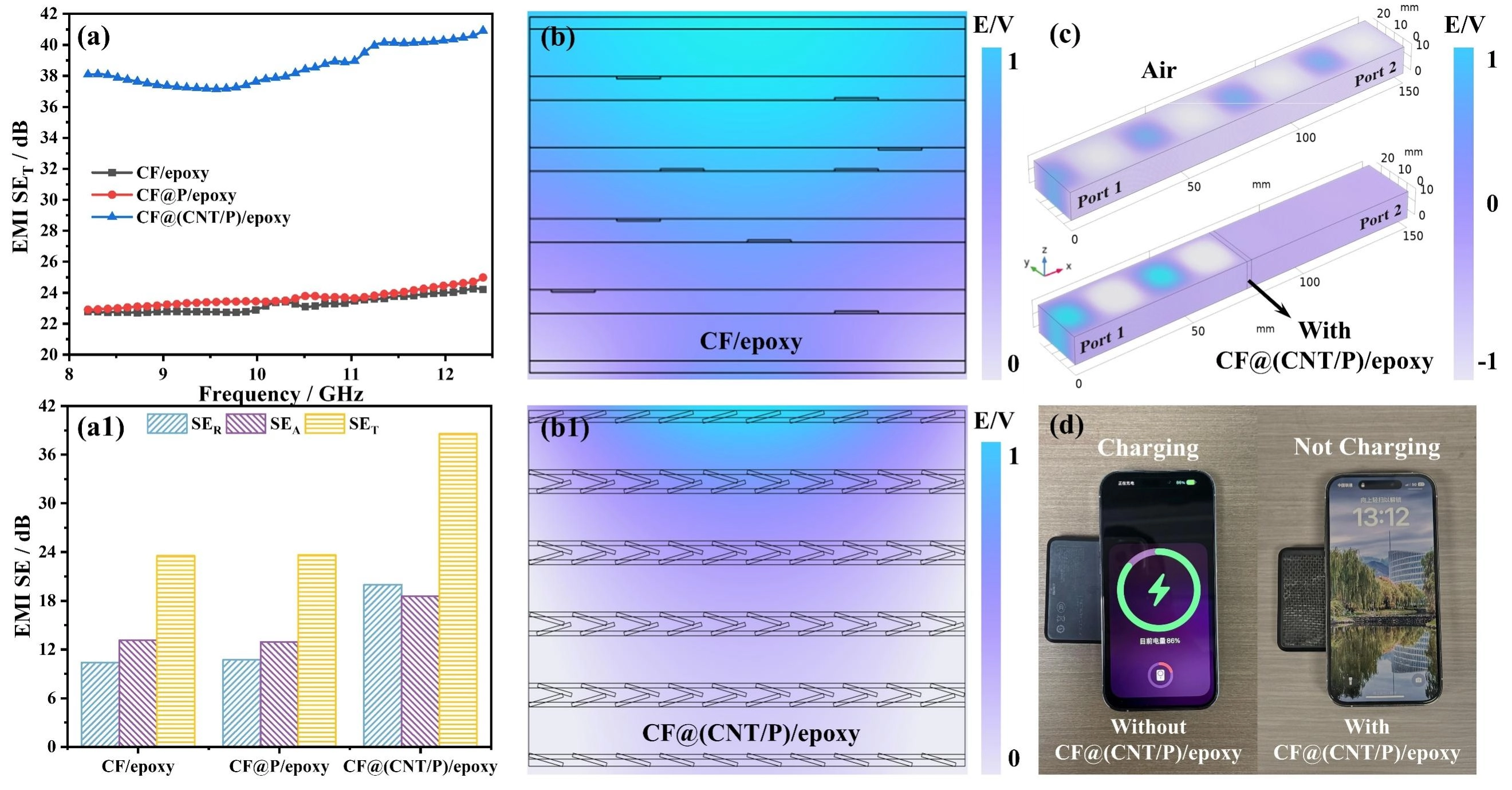
Figure 6. Electromagnetic shielding effectiveness of CF/epoxy, CF@P/epoxy, and CF@(CNT/P)/epoxy composites (a-a1); Electric field intensity under the microscopic structure electromagnetic field (b-b1); Finite element simulation of macroscopic structure electromagnetic shielding performance (c); Photos of electromagnetic shielding in wireless charging scenarios (d). CF: carbon fiber; CF@P: poly(styrene-co-benzocyclobutene-co-methyl methacrylate)-coated carbon fibers; CF@(CNT/P): carbon fibers coated with carbon nanotubes/polymer layer.
A rectangular waveguide was used to simulate the electromagnetic shielding performance of the CF@(CNT/P)/epoxy composite (Figure 6c and Table S8). Electromagnetic waves were emitted from Port 1 and propagated toward Port 2 along the X-axis, with the electric and magnetic field components oscillating orthogonally along the Y-axis and Z-axis, respectively. When the CF@(CNT/P)/epoxy composite was not introduced into the rectangular waveguide model, the electric field intensity of the electromagnetic waves between the two ports remained constant, appearing as alternating blue-purple and white colors, with the absolute maximum electric field intensity of the electromagnetic waves being 0.71 V. After introducing the CF@(CNT/P)/epoxy composite into the rectangular waveguide model, the electric field intensity of the electromagnetic waves between Port 1 and the composite increased significantly, reaching an absolute maximum electric field intensity of 0.97 V. However, the intensity of the electromagnetic waves after passing through the composite decreased markedly (appearing as a relatively uniform purple color), further demonstrating that the CF@(CNT/P)/epoxy composite had excellent electromagnetic wave reflection capability.
In addition, the electromagnetic shielding performance of the CF@(CNT/P)/epoxy composite was verified using a wireless charging device (Figure 6d). When a mobile phone was placed on the wireless charger, it started charging immediately. However, when the CF@(CNT/P)/epoxy composite was placed between the wireless charger and the mobile phone, the mobile phone could not be charged, indicating that the CF@(CNT/P)/epoxy composite had good electromagnetic shielding performance.
4. Conclusion
FT-IR, XPS, SEM, and AFM results indicated that CNT and P(S-co-BCB-co-MMA) were simultaneously functionalized onto the surface of CF to obtain CF@(CNT/P). CNT were uniformly distributed on the CF surface, and P(S-co-BCB-co-MMA) bound to CF through hydrogen bonding and π-π interactions, effectively increasing the surface energy of CF and improving its wettability with the epoxy matrix as well as its interfacial binding. The CF@(CNT/P)/epoxy composite exhibited an ILSS of 31.4 MPa and a flexural strength of 369.1 MPa, with λ∥ and λ⊥ values of 10.08 W/(m·K) and 0.58 W/(m·K), respectively. All these values were higher than those of the CF/epoxy composite (ILSS: 23.7 MPa, flexural strength: 252.5 MPa, λ∥: 7.15 W/(m·K), λ⊥: 0.31 W/(m·K)). In addition, the CF@(CNT/P)/epoxy composite also demonstrated excellent electromagnetic shielding properties by exhibiting the best EMI SET of 38.6 dB, which was significantly higher than those of the CF/epoxy (23.6 dB) and CF@P/epoxy (23.7 dB) composites. This work provides a promising strategy to make a load-bearing, thermally conductive, and electromagnetic shielding material to be utilized in high-power electronic information systems.
Supplementary materials
The supplementary material for this article is available at: Supplementary materials.
Acknowledgments
The authors are grateful for the Analytical & Testing Center of Northwestern Polytechnical University for SEM, AFM, and DMA tests performed in this work.
Authors contribution
Lin Y: Writing-original draft, investigation.
Zhang W: Resources, data curation.
Guo H: Investigation, data curation.
Liu J: Investigation.
Zhang J: Writing-review & editing, methodology, supervision, funding acquisition.
Guo Y: Resources, data curation.
Gu J: Writing-review & editing, resources, methodology, funding acquisition.
Conflicts of interest
Junwei Gu is an Editorial Board Member of Thermo-X. The other authors declare no conflicts of interest.
Consent to participate
Not applicable.
Consent for publication
Not applicable.
Availability of data and materials
Data supporting the findings of this study are available from the corresponding author upon reasonable request.
Funding
The work was supported by the National Natural Science Foundation of China (52473083, 52473084), Natural Science Basic Research Program of Shaanxi (2024JC-TBZC-04), Innovation Capability Support Program of Shaanxi (2024RS-CXTD-57), Shaanxi Province Key Research and Development Plan Project (2025CY-YBXM-023), Natural Science Basic Research Plan in Shaanxi Province of China (2024JC-YBMS-279), Undergraduate Innovation & Business Program in Northwestern Polytechnical University (This program does not have a grant number).
Copyright
© The Author(s) 2026.
References
-
1. Luo J, Xue Y, Yang X, Yang C, Jiang M, Zhang L, et al. Integrating thermal, EMI shielding, and mechanical properties in carbon fiber/epoxy resin composites via interface-layup synergistic design. Adv Funct Mater. 2026;36(8):e13660.[DOI]
-
2. Feng P, Ma L, Zhou X, Li M, Zhang Q, Zhang M, et al. Constructing a gradient modulus interface layer on the surface of carbon fibers to enhance the mechanical properties of carbon fiber/epoxy composites at different temperatures. Compos Part B Eng. 2024;271:111190.[DOI]
-
3. Ren Q, Sheng J, Li J, Liu B, Xing C, Wu Y, et al. Upcycling carbon fibre wastes in solid-flames. Nat Commun. 2026;17:1443.[DOI]
-
4. He M, Gu J. Tunable low-frequency microwave absorption and thermal management through In-situ confined growth of alloys within aramid nanofibers. ENGINEERING Transformative Materials. 2026.[DOI]
-
6. Jiang X, Wang C, Li G, Yu Y, Yang X. Enhanced interfacial property and thermal conductivity of pitch-based carbon fiber/epoxy composites via three-layer assembly of PDI/GN/PDI interphase. Compos Part B Eng. 2024;273:111238.[DOI]
-
7. Hao M, Qian X, Zhang Y, Yang J, Li C, Gong H, et al. Thermal conductivity enhancement of carbon fiber/epoxy composites via constructing three-dimensionally aligned hybrid thermal conductive structures on fiber surfaces. Compos Sci Technol. 2023;231:109800.[DOI]
-
9. Mehdipour M, Doğan S, Al-Nadhari A, Sorayani Bafqi MS, Beylergil B, Yildiz M, et al. Influence of functionalized h-BN particle interphase and interface regulation with structural design on the directional thermal conductivity and mechanical performance of carbon fiber/epoxy composites. Compos Part A Appl Sci Manuf. 2025;190:108708.[DOI]
-
10. Pang XY, Zhang ZP, Rong MZ. Thermal conductivity of boron nitride/liquid crystal epoxy composites via synergistic exfoliation-adsorption effects. Acta Polym Sin. 2025;56(12):2452-2468.[DOI]
-
11. Feng Q, Lei K, Wang W, Li J, Zhang J, Guo S. Ring-axial aligned carbon fibers enabling 3D heat conduction in vibration-damping silicone composites. Chem Eng J. 2026;537:176232.[DOI]
-
12. Wang Y, Wang Z, Pang G, Wang Q, Deng Y, Liu C, et al. Phase-differentiated interfacial engineering enabled by a cationic dual-component waterborne sizing for CF/PA6 composites. Compos Part A Appl Sci Manuf. 2026;207:109816.[DOI]
-
13. Luo J, Xue Y, Yang C, Lu W, Yin M, Liu Y, et al. Synchronically enhanced thermal conductivity, electromagnetic interference shielding and mechanical properties of carbon fiber/epoxy resin composites by in-situ assembly of needle-like MnO2 on CF felt. Chem Eng J. 2025;521:166646.[DOI]
-
14. Han P, Zhang S, Hu S, Yu Y, Han S, Wang H, et al. Polydopamine and polyethyleneimine comodified carbon fibers/epoxy composites with gradual and alternate rigid-flexible structures: Design, characterizations, interfacial, and mechanical properties. Polym Compos. 2023;44(8):4495-4508.[DOI]
-
15. Jiang T, Wang Y, Xu K, Xiang L, Tang B, Shi S, et al. Highly thermally conductive and negative permittivity epoxy composites by constructing the carbon fiber/carbon networks. Compos Commun. 2023;39:101560.[DOI]
-
16. Gao S, Guo H, Guo Y, Qiu H, Gong W, Gu J. Superior through-plane thermal conductivity in carbon fibers/spherical graphene/epoxy laminated composites for low-altitude aircrafts. InfoMat. 2026;8(6):e70139.[DOI]
-
18. Tao Y, Diao W, Yuan G, Liu Z, Yang B, Wu Y, et al. Temperature-regulated ordered structure for synergistically enhanced thermal, mechanical, and thermal conductive in UV-cured liquid crystalline polymers. Prog Org Coat. 2026;216:110168.[DOI]
-
20. Lu X, Wu Z, Zhao Y, Thabet H K, El-Bahy Z M, Algadi H, et al. Advances in intrinsically high thermal conductive liquid crystal epoxy resins. Polym Rev. 2026;66(2):674-720.[DOI]
-
21. Li JW, Zhang ZP, Rong MZ, Zhang MQ. Preparation of boron nitride/liquid crystal epoxy composites with high thermal conductivity based on patterning method. Acta Polym Sin. 2025;56(2):306-321.[DOI]
-
22. Yang P, Kong W, Li B, Liang S, Qu Y, Shi P, et al. Enhanced thermal conductive and interfacial performance of M40X carbon fiber/epoxy composites with multi-dimensional liquid crystalline interphase: A combined method of experimental analysis and molecular simulation. Compos Part B Eng. 2025;307:112866.[DOI]
-
23. Zhao Q, Lu Z, Wu Y, Zhao W. Designing strong interfacial adhesion between carbon fiber and epoxy resin via dopamine towards excellent protection ability under high hydrostatic pressure and severe erosion corrosion condition. Compos Sci Technol. 2022;217:109090.[DOI]
-
24. Huang S, Luo W, Jiang H, Shi Z, Xu R, Xie D. Progress and prospects of thermally conductive/flame-retardant integrated polymer composites. Nano Res. 2026;19(3):94908429.[DOI]
-
25. Yao X, Yang G, Chen J, Zhao Q, Jiang J. Enhancing mechanical, EMI shielding, and thermal properties of pitch-based carbon fiber composites via MXene/polydopamine modification. Polym Compos. 2025;46(16):14883-14898.[DOI]
-
26. Wang H, Guo Q, Wang S, Gao L, Shi X. Enhanced delamination resistance and through-thickness thermal conductivity of carbon fiber epoxy resin composites by in situ generation of interconnected thick oriented matrix-carbon nanotube layer. Compos Part B Eng. 2025;297:112297.[DOI]
-
27. Li J, Jiang N, Cheng C, Quan G, Feng H, Li W, et al. Preparation of magnetic solvent-free carbon nanotube/Fe3O4 nanofluid sizing agent to enhance thermal conductivity and interfacial properties of carbon fiber composites. Compos Sci Technol. 2023;236:109980.[DOI]
-
28. Li M, Qiu P, Wen H, Ruan K, Gu J. Thermochromic hydrogels for thermal management smart windows. Sci Bull. 2026;71(4):900-920.[DOI]
-
29. Hao M, Hu Z, Huang Y, Qian X, Wen Z, Wang X, et al. Enhanced both in-plane and through-thickness thermal conductivity of carbon fiber/epoxy composites by fabricating high thermal conductive coaxial PAN/PBO carbon fibers. Compos Part B Eng. 2022;229:109468.[DOI]
-
31. Mandal S, Halder A, Bohra BS, Samanta K, CS A, Kumar S, et al. Beyond durability: The transformative journey of carbon fiber reinforced epoxy composites through advanced interfacial engineering, self-healing, and vitrimer-enabled recycling. Adv Compos Hybrid Mater. 2025;9(1):2.[DOI]
-
32. Lu XH, Liu J, Shu C, Zhang SC, Zhao HY, Zhang Y, et al. Densifying conduction networks of vertically aligned carbon fiber arrays with secondary graphene networks for highly thermally conductive polymer composites. Adv Funct Mater. 2025;35(11):2417324.[DOI]
-
33. Cheng C, Zhang M, Wang S, Li Y, Feng H, Bu D, et al. Improving interfacial properties and thermal conductivity of carbon fiber/epoxy composites via the solvent-free Go@Fe3O4 nanofluid modified water-based sizing agent. Compos Sci Technol. 2021;209:108788.[DOI]
-
35. Tang L, Hu Q, Pan X, Lei Y, Li L, Wang Y, et al. Surface modification of PBO fibers with random copolymer containing benzoxazole for improving surface activity, and enhancing interfacial bonding strength with cyanate ester resins. Adv Compos Hybrid Mater. 2024;8(1):41.[DOI]
-
36. Tu Z, Hu X, Lee SY, Zhang M, Zheng Q, Zhang F, et al. Structure-interface engineering-driven high-performance bidirectional thermally conductive Graphene/PBO composite films for lithium-ion battery thermal management. Compos Sci Technol. 2026;277:111550.[DOI]
-
37. Tang L, Zhang J, Gu J. Random copolymer membrane coated PBO fibers with significantly improved interfacial adhesion for PBO fibers/cyanate ester composites. Chin J Aeronaut. 2021;34(2):659-668.[DOI]
-
39. Wang Z, Zhu M, Yang D, Zhang S, Song Q, Shen Q, et al. Bioinspired inosculation of heterogeneous carbon network structures to prompt heat conduction. J Mater Sci Technol. 2026;275:161-169.[DOI]
-
40. Wu Q, Li Y, Zhang Y, Wang H, Liu Q, Jin D, et al. Generating a stronger and tougher interphase of epoxy composite by constructing an interwoven heterogeneous network-structured coating on carbon fiber. Compos Part B Eng. 2026;318:113646.[DOI]
-
41. Xing Z, Zou S, Ma C, Qiao Q, Cai X, Yue K, et al. π-π stacked nigrosine@carbon nanotube nanocomposite as an all-in-one additive for high energy flexible batteries. ACS Nano. 2024;18(27):17950-17957.[DOI]
-
43. Cheng Z, Wang S, Zhou J, Yan J, Liu Y, Tao J, et al. 3D printed flexible composites based on carbon fiber-led interfacial modification strategy for enhanced microwave absorption. Chem Eng J. 2024;502:157810.[DOI]
-
44. Li X, Liu S, Meng X, Zhang S, Yu M, Wu L, et al. Modified antistatic carbonaceous fiber with excellent hydrophobicity, environmental stability and radar absorption performance. Carbon. 2024;229:119501.[DOI]
-
45. Shi S, Jiang T, Cao S, Gui X, Wang Y, Li Y, et al. Thermal conductivity and heat transfer mechanism of epoxy composites constructing by carbon fiber felt with three-dimensional layered structure. Polym Compos. 2025;46(8):7633-7645.[DOI]
-
46. Liu H, Du W, Wang H, Zhang C, Zang J, Wang L, et al. Vegetable oil-based non-isocyanate polyurethane sizing agent: Constructing a “rigid-flexible” green interface for carbon fiber/epoxy composites. Sustain Mater Technolog. 2026;47:e01866.[DOI]
-
47. Sun T, Cao W, Zhao K, Wang X, Wang Z, Gao G, et al. Bio-inspired robust and highly thermal conductive BNNS/PBO nanofiber composite films with excellent thermal stability, wear resistance, and adjustable photothermal properties. Chem Eng J. 2023;474:145916.[DOI]
-
49. Yu M, Li J, Zhang M, Song X, Zhou C, Liu L, et al. Interface enhancement of unidirectional carbon fiber/epoxy resin composites using bio-based hyperbranched waterborne polyurethane with biomimetic rhizome structure. Polym Compos. 2026;47(1):862-875.[DOI]
-
50. Zhu Y, Ju Z, Zhang X, Lutz DM, Housel LM, Zhou Y, et al. Evaporation-induced vertical alignment enabling directional ion transport in a 2D-nanosheet-based battery electrode. Adv Mater. 2020;32(10):1907941.[DOI]
-
52. Li L, Wang C, Gao H, Wang H, Lai T, Li Z, et al. GO-PPDA modified and aligned PBO fibers for high-performance insulating core-rod composites. Compos Part B Eng. 2026;313:113379.[DOI]
-
53. He J, Li X, Chen R, Kou W, Zhou P, Zhong G, et al. High interfacial performance ultra-low k PBO wave-transparent composite derived from in situ entangled chain and ion-crosslinking. Polym Compos. 2025;46(S3):S462-S475.[DOI]
-
54. Xie Y, Wang Y, Deng Y, Wang Z, Zhou W, Liu C, et al. Aromatic π-π interaction–driven sizing strategy for enhanced interfacial adhesion in carbon fiber/PPESK thermoplastic composites. Compos Part A Appl Sci Manuf. 2026;203:109551.[DOI]
-
55. Yan S, Zhang Y, Yuan R, Zhao H, Lang X, Zhou J, et al. Carboxyl-switch mediated interface enhancement toward green manufacturing of CF/PEEK composites. Compos Part A Appl Sci Manuf. 2026;206:109784.[DOI]
-
56. Leng C, Hu M, Li Q, Ma X, Zhang B, Jia D, et al. Dual-engineered interfacial strategies for carbon fiber/epoxy composites: Synergy of chemical C–N bonds and nanoscale mechanical interlocks. Polymer. 2025;339:129118.[DOI]
-
57. Luo J, Xue Y, Yang C, Yin M, Lu W, Zhang L, et al. Ordered alignment of short carbon fibers enabling high-performance carbon fiber/epoxy resin composites with synergistic thermal conductive and mechanical enhancement. Polym Compos. 2025;46(16):15301-15312.[DOI]
-
58. Ren C, Gui X, Wang Y, Xiang L, Tang B, Shi S, et al. Preparation of Ag@CFC/EP composites with excellent thermal management performance via electroless silver plating on polydopamine-modified carbon fiber/carbon felt. Compos Commun. 2025;58:102552.[DOI]
-
59. Ou ZR, Mo WJ, Pang XY, Zhang ZP, Rong MZ. Molecular tailoring of imine-based liquid crystal epoxy resins for minimized interfacial thermal resistance in recyclable boron nitride composites. Compos Sci Technol. 2026;278:111586.[DOI]
-
63. Zhang F, Sun Y, Guo L, Zhang Y, Liu D, Feng W, et al. Microstructural welding engineering of carbon nanotube/polydimethylsiloxane nanocomposites with improved interfacial thermal transport. Adv Funct Mater. 2024;34(10):2311906.[DOI]
-
64. Shi S, Li XF, Jiang T, Cao S, Gui X, Wang Y, et al. Ultra-high in-plane thermal conductivity of epoxy composites reinforced by three-dimensional carbon fiber/graphene hybrid felt. J Polym Sci. 2025;63(5):1059-1069.[DOI]
-
65. Suo X, Zhang Y, Dong S, Wei C, Meng F, Lin Z. Interlaminar fracture toughness, thermal conductivity and electromagnetic wave absorption of CF/EP composites with SiCnw-loaded polypropylene nonwoven fabrics interleaves. Polym Compos. 2025;46(S3):S910-S922.[DOI]
-
66. Chen W, Zhang K, Wang S, Chen C, Zhao X, Zhou H, et al. Construction of “rigid-and-flexible” interphase by waterborne carboxylated polyimide sizing agent for interfacial enhancement of carbon fiber/poly ether ether ketone (CF/PEEK) composites. Compos Part B Eng. 2025;298:112388.[DOI]
-
67. Jiang T, Wang Y, Xiang L, Tang B, Shi S, Jiang C, et al. Synthesis of Ni-diamond hybrid reinforced carbon fiber/epoxy thermally conductive composites with “Rod-on-particle microstructure” via composite electrodeposition. Compos Sci Technol. 2025;271:111351.[DOI]
-
68. Zhao X, Yu H, Qin M, Feng W. Polysiloxane ionic gel-based soft elastic thermally conductive interfacial materials. Acta Polym. Sin. 2025;56(12):2334-2346.[DOI]
-
70. Wang Y, Liang C, Lin C, Li J, Liang Y, Liu X, et al. Flexible, ultrastrong, and recyclable polymer/CNT/carbon fiber fabric composites for high-performance electromagnetic interference shielding. Chem Eng J. 2026;535:175759.[DOI]
-
71. Wang Y, Ren C, Cao S, Jiang T, Chen J, Xiang L, et al. Fabrication of highly thermal conductivity silver-coated carbon fiber/carbon/epoxy composites via CVD carbon deposition and electrochemical silver deposition method. Compos Commun. 2026;61:102710.[DOI]
-
72. Si M, Yao B, Ding Q, Liu Z, Wei P, Zhou F, et al. Switchable electromagnetic absorption and shielding in liquid metal-ZnO ceramics via ultralow-electric-field. Adv Funct Mater. 2026;36(35):e74171.[DOI]
Copyright
© The Author(s) 2026. This is an Open Access article licensed under a Creative Commons Attribution 4.0 International License (https://creativecommons.org/licenses/by/4.0/), which permits unrestricted use, sharing, adaptation, distribution and reproduction in any medium or format, for any purpose, even commercially, as long as you give appropriate credit to the original author(s) and the source, provide a link to the Creative Commons license, and indicate if changes were made.
Publisher’s Note
Science Exploration remains a neutral stance on jurisdictional claims in published
maps
and institutional affiliations. The views expressed in this article are solely those
of
the author(s) and do not reflect the opinions of the Editors or the publisher.
Share And Cite


Science Exploration Style
Lin Y, Zhang W, Guo H, Liu J, Zhang J, Guo Y, et al. Simultaneously improving thermal conductivities and mechanical strength of carbon fibers/epoxy composites via CNT/copolymer hybrid interphase. Thermo-X. 2026;2:202618. https://doi.org/10.70401/tx.2026.0023
Tips
Copy completed.
Submit a Manuscript
Author Instructions
Cite this Article
Article Metrics
0
View
0
Download
Cited
Article Updates

 Get citation
Science Exploration Style

Lin Y, Zhang W, Guo H, Liu J, Zhang J, Guo Y, et al. Simultaneously improving thermal conductivities and mechanical strength of carbon fibers/epoxy composites via CNT/copolymer hybrid interphase. Thermo-X. 2026;2:202618. https://doi.org/10.70401/tx.2026.0023
copy
Share Link
copy
Subscribe