Reconfigurable solid-state thermal routing using thermoelectric effects

Ran Ju
1,2,3,#

,
Yanxiang Wang
1,2,#
,
Zifu Xu
4
,
Kaile Sun
1,2
,
Shuihua Yang
3
,
Dong Wang
1,2
,
Minghong Qi
1,2
,
Pei-Chao Cao
5
,
Hongsheng Chen
1,2,*
,
Cheng-Wei Qiu
3,6,7,*
,
Ying Li
1,2,*
*Correspondence to:
Hongsheng Chen, Interdisciplinary Center for Quantum Information, State Key Laboratory of Extreme Photonics and Instrumentation, ZJU-Hangzhou Global Scientific and Technological Innovation Center, Zhejiang University, Hangzhou 310027, Zhejiang, China.
E-mail: hansomchen@zju.edu.cn
Cheng-Wei Qiu, Department of Electrical and Computer Engineering, National University of Singapore, Singapore 117583, Singapore. E-mail: chengwei.qiu@nus.edu.sg
Ying Li, Interdisciplinary Center for Quantum Information, State Key Laboratory of Extreme Photonics and Instrumentation, ZJU-Hangzhou Global Scientific and Technological Innovation Center, Zhejiang University, Hangzhou 310027, Zhejiang, China. E-mail: eleying@zju.edu.cn
Cheng-Wei Qiu, Department of Electrical and Computer Engineering, National University of Singapore, Singapore 117583, Singapore. E-mail: chengwei.qiu@nus.edu.sg
Ying Li, Interdisciplinary Center for Quantum Information, State Key Laboratory of Extreme Photonics and Instrumentation, ZJU-Hangzhou Global Scientific and Technological Innovation Center, Zhejiang University, Hangzhou 310027, Zhejiang, China. E-mail: eleying@zju.edu.cn
Thermo-X. 2026;2:202622. 10.70401/tx.2026.0025
Received: May 19, 2026Accepted: July 06, 2026Published: July 07, 2026
Abstract
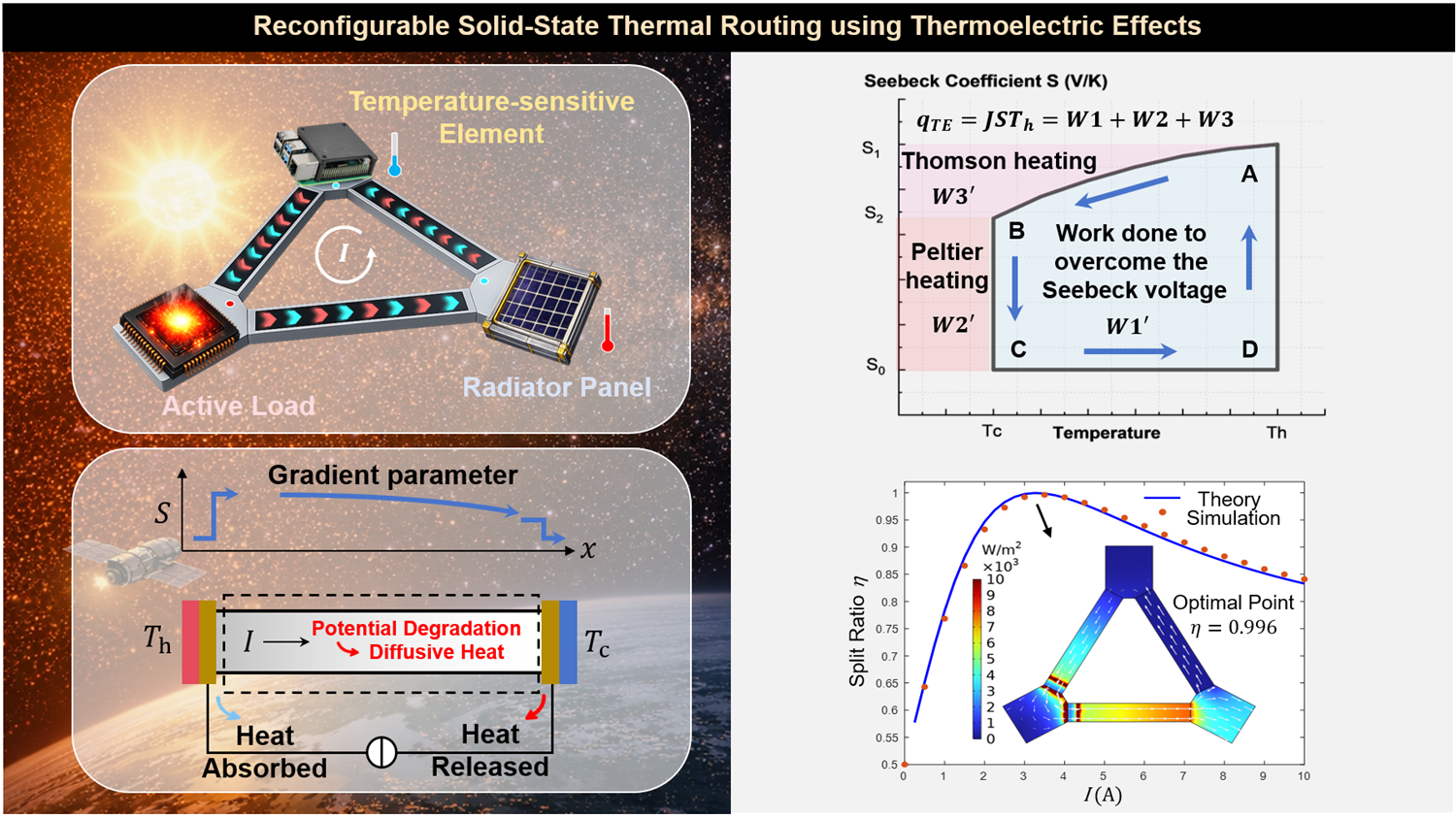
Thermal routing refers to the ability to direct heat energy from a source to a selected drain, offering great potential for asymmetric thermal path regulation. However, existing approaches to asymmetric heat transport largely rely on phononic band engineering and mechanically moving components, typically limited to heat fluxes at the microwatt level or complicated experimental configurations with long-term reliability concerns. Herein, inspired by the analogy between thermal advection and thermoelectric effects in dragging heat energy, we propose a solid-state thermal metadevice featuring large heat energy flux and near-unity thermal split ratio. By examining the evolutionary path of the Seebeck coefficients, the unique asymmetry-enhancement mechanism arising from the commonly-overlooked Thomson effect is revealed, enabling an improved thermal splitting effect of the device. Free of mechanically moving components, this work provides a new paradigm for the design of solid-state thermal routers with great power and electrical reconfigurability. It makes a promising candidate for compact thermal management and thermal logic processing where asymmetric time-varying heat energy reallocation matters.
Graphical Abstract
Keywords
Thermal metamaterials, nonreciprocal heat transfer, solid-state thermal routing, thermoelectric effects
1. Introduction
Thermal routing refers to the ability to direct heat energy from a source to a selected drain[1,2]. By exploiting asymmetric transport mechanisms, it offers significant potential for advanced thermal management scenarios where time-varying heat reallocation is required, such as reconfigurable mode switching between daytime cooling and nighttime overcooling protection in satellites
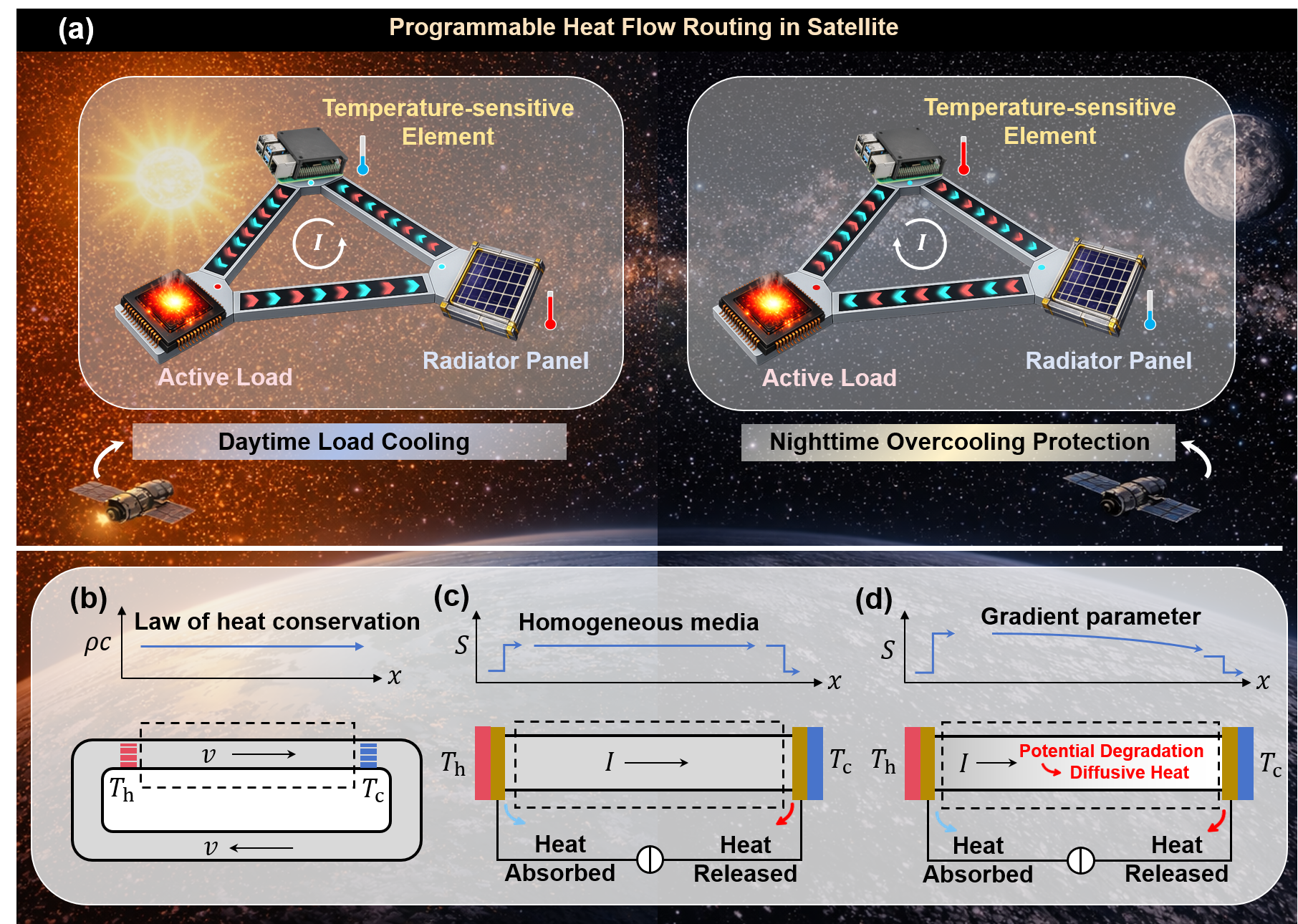
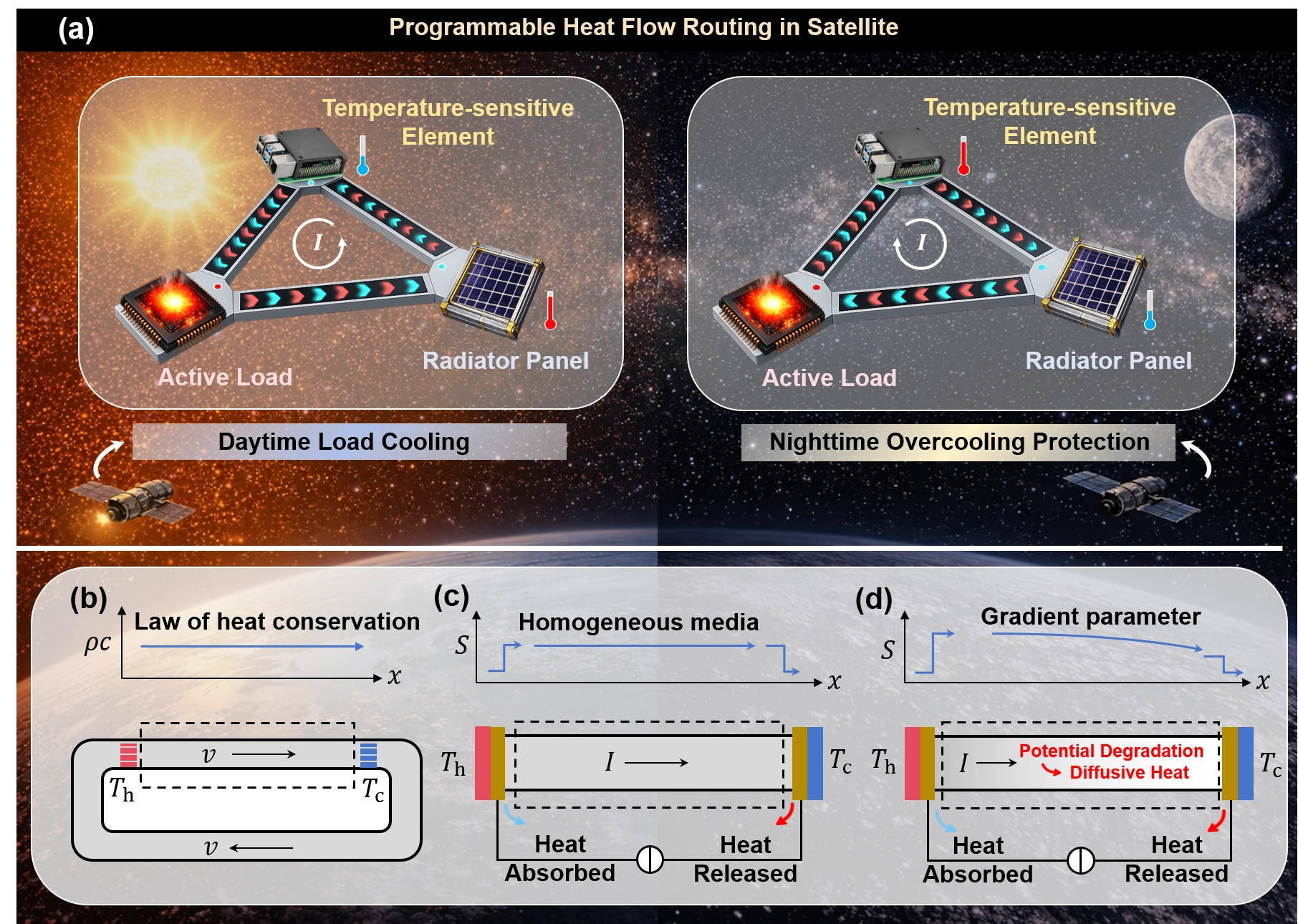
Figure 1. Schematic diagram of a solid-state thermal router. (a) Promising application scenario of the programmable thermal routing in satellite. The heat current coming from the source can be directed to the chosen drain by varying the external electric current I; (b) A reciprocal heat flow loop based on internal liquid circulation; (c) A
In recent decades, thermal diode has been under the spotlight of thermal scientists, and the controllable rectification mechanism behind it serves to be a bedrock of thermal routing[18,19]. One counterintuitive yet influential argument in this field asserts that advection alone cannot make a thermal diode[20-22], because the time-reversal asymmetry introduced by advection is cancelled by the closed heat-flow loop, as constrained by the mass conservation of macroscopic motion (Figure 1b). However, such argument further provokes a thought: does mass conservation of working media fundamentally prohibit all kinds of the external bias mechanisms from realizing a thermal diode due to heat-flow compensation in the loop? The answer could certainly be “no”, if the binding relationship between mass conservation and heat-energy conservation of the working media could be relaxed. Motivated by this insight, we employ external electric field bias as an analog advection and use solid-state thermoelectric material rather than moving liquid as the working media. By doing so, the initially tightly bounded conservation relationship between external momentum bias and heat flux is loosened due to the existence of entropy-change strategies, enabling thermal rectification and laying a foundation for solid-state thermal routing metadevice[23-26].
Thermoelectric (TE) effects enable reversible heat–electricity conversion and underpin applications such as cooling[27,28], energy harvesting[29,30], and thermal camouflage[31,32]. While the Thomson effect has received less attention than the Seebeck and Peltier effects due to its weaker magnitude, growing evidence indicates that it is promising to influence heat transport behaviors[33-35]. In terms of symmetry breaking of heat transfer, the Thomson and Peltier effects are just two sides of the same road whose synergy enables more efficient solid-state thermal routing (Figure 1c,d), yet their combined role remains insufficiently understood.
In this work, we systematically elucidate how the Thomson and Peltier effects break thermal symmetry in distinct but cooperative ways using a thermal diode model. Guided by this analysis, we experimentally realize a thermal metadevice that achieves solid-state thermal routing effect[36]. Driven by drift-biased carrier–phonon coupling, the compact device delivers a directed heat flux over
2. Methods
To elucidate the fundamental physics underlying the routing effect, we begin by analyzing a single-slab model. As illustrated in
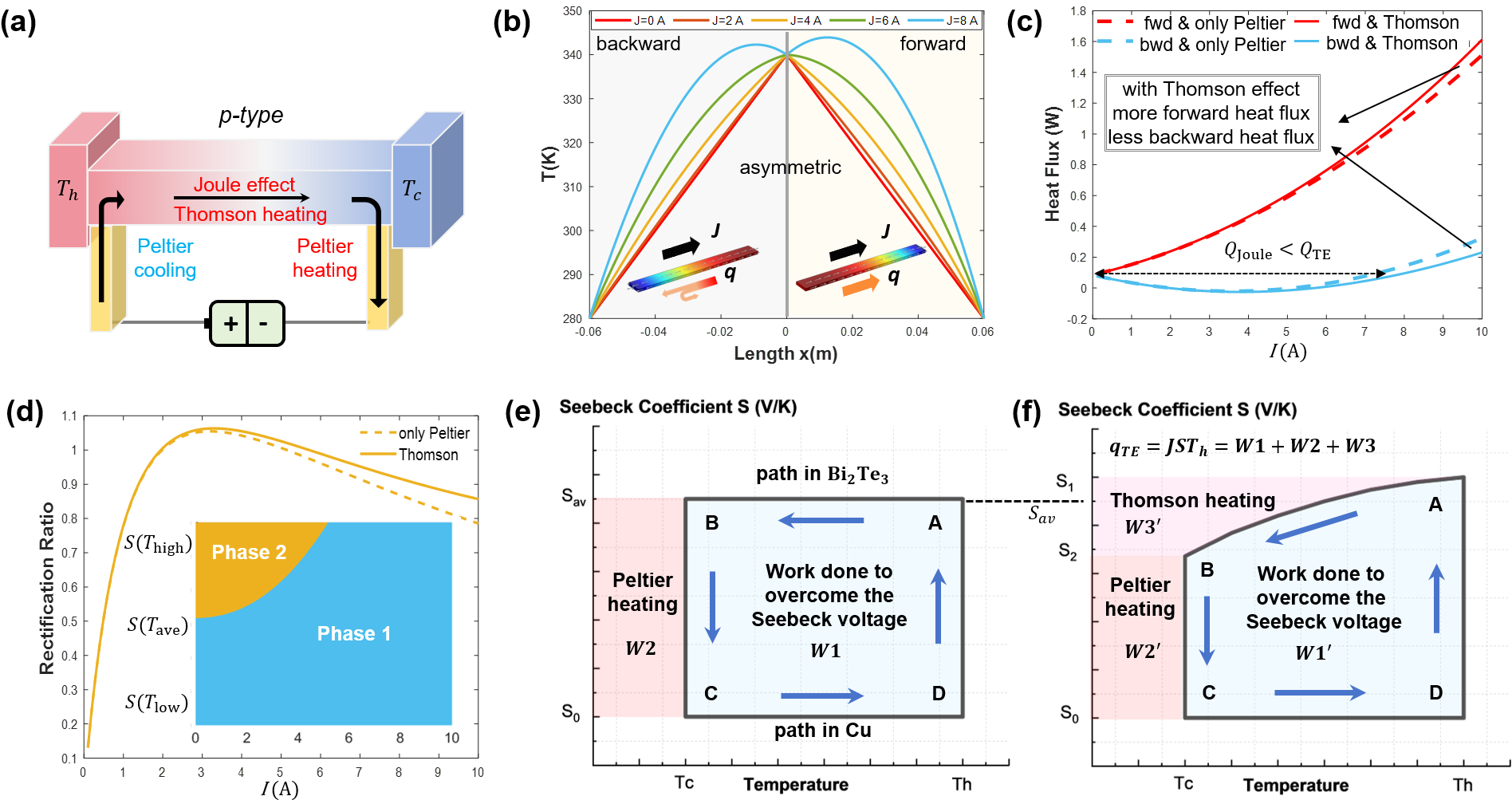
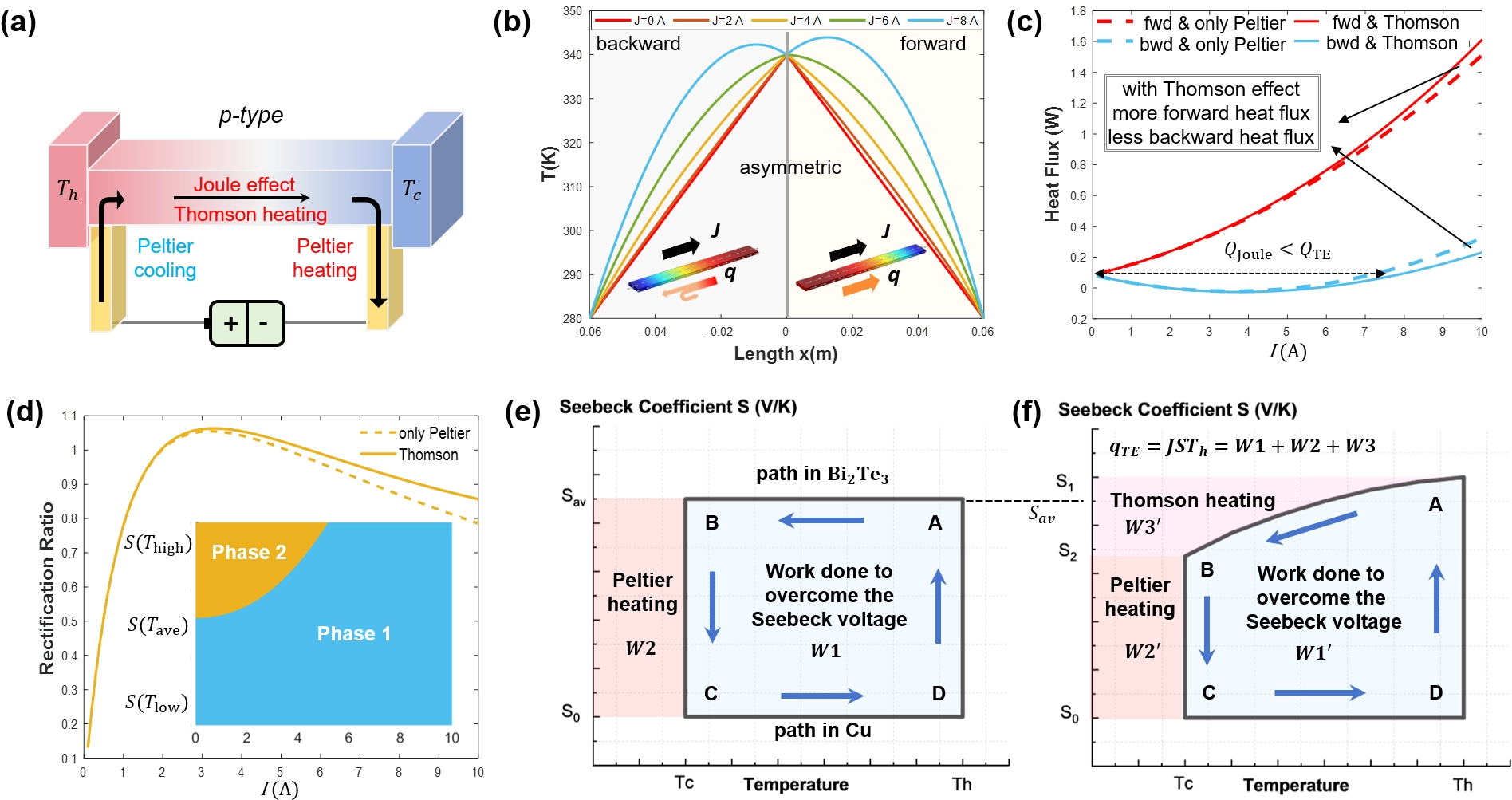
Figure 2. Demonstration of the thermal rectification effects. (a) The forward case of the single slab thermal rectifier; (b) The asymmetric temperature distribution on the single Bi2Te3 slab attributed to Thomson effect; (c) A comparison made between the forward and backward heat flux as a function of electric current I; (d) The rectification ratio of this device. Phases 1 and 2 of the inner Figure represent the parameter domains where the device performance improves or decreases after considering the Thomson effect; (e, f) The S-T diagram of the forward working process in the thermal rectification device with a constant (e) and a temperature-dependent (f) Seebeck coefficient. S-T: Seebeck coefficient–temperature.
where κ, J, σ, and τ are thermal conductivity, electric current density, electric conductivity, and Thomson coefficient[39], respectively. After some algebra, the analytical expression of temperature can be obtained (Section S1).
Here we focus on thermal rectification, quantified by the difference between the forward heat flux qf and backward heat flux qb when the source and drain are interchanged. As shown in Figure 2b, in the absence of external bias, heat transport is driven solely by the temperature gradient, producing symmetric temperature profiles in both directions. Once an external electric field bias is applied, however, the profiles become asymmetric due to the odd parity of the Thomson effect with respect to electric current direction: reversing the relative orientation of current and temperature gradient induces either heat absorption or generation within the material. This mechanism accounts for the asymmetry highlighted by the blue curves in Figure 2b. Although the Thomson coefficient is typically small, its influence on heat flux modulation is physically meaningful: as shown in Figure 2c, compared with the case using a temperature-averaged Seebeck coefficient, the forward heat flux increases while the backward flux decreases when the Thomson effect is considered, thus inducing a greater rectification.
To be quantified, the rectification ratio is defined as , where qf and qb are the forward and backward heat fluxes, respectively. Its dependence on electric current is shown in Figure 2d. As current increases, γ first rises, peaks near I = 3 A, and then declines. This behavior reflects the competition between thermoelectric effects (linear scaling) and Joule heating (quadratic scaling). Notably, as long as the constant Seebeck coefficient in the benchmark Peltier-only model is not overestimated, the inclusion of the Thomson effect can enhance the rectification ratio γ over the full current range, as indicated by the Phase 1 region in the inset of Figure 2d. To reveal the underlying physics responsible for the rectification and enhancement effect, we present an intuitive yet
At the microscopic level, a temperature difference ∆T induces an electrochemical potential difference ∆μe, giving the Seebeck coefficient from the viewpoint of thermopower generation, which couples temperature and electrochemical potential. From the constitutive relation , the heat flux q consists of two parts: a purely diffusive term and an electrochemical term, the latter reflecting heat transport by charge carriers. In this sense, the Seebeck coefficient can be viewed as a “specific heat of electricity”[40,41]. Based on this framework, we first analyze the model in Figure 2a using a temperature-averaged Seebeck coefficient
According to the cycling process described above, the area enclosed by the path in the graph is exactly the Seebeck voltage generated, which is given by , in response to a temperature difference. Therefore, when multiplied by the electric current, the shaded red region corresponds precisely to the heat released at the cold end during the interfacial process B→C. Similarly, the combined area of the blue and red regions proportionally represents the heat absorbed at the hot end during the process D→A, while the blue area alone corresponds to the net electrical work required to overcome the Seebeck voltage established within the system during one evolution. Since the focus here is on a thermal rectifier, our primary interest lies in the heat transported to the cold end, represented by the red area, which reflects the thermoelectric contribution to thermal transport.
Figure 2e,f represent the forward operation mode of the thermal rectifier; for comparison, the backward operation mode is given in Section S2[42]. The key distinction between the two cases lies in the direction of the evolution path (clockwise or counter-clockwise), determined by the polarity of the electric current applied to the device. A comparison between them provides an intuitive geometric interpretation: when the temperature dependence of the Seebeck coefficient is taken into account, both heat flux transferred toward the drain end and heat flux pumped from the drain end can be enhanced, leading to the enhanced rectification performance.
3. Results and Discussion
Based on the method above, here we analyze the performance of the solid-state thermal router, where both a theoretical and experimental validation are presented. In general, a thermal router consists of one heat source and multiple drains, enabling directed heat transport from the source to a selected drain. Here, we design a three-port thermal router coupled with three central channels. The ports are fabricated from pure copper. Channels 1 and 3 are made of Bi2Te3, while Channel 2 combines copper and Bi2Te3. As shown in Figure 3a, the structure is symmetric about the central axis of the heat source. To realize directional heat transport via thermoelectric effects, positive and negative electrodes are attached to the hot ends of Channels 1 and 3, respectively. These two channels are thermally connected but electrically insulated from the source port, achieved using specialized adhesives. This configuration allows current to circulate clockwise or counter-clockwise through the central triangular splitter, thereby routing heat from the source to a chosen drain.
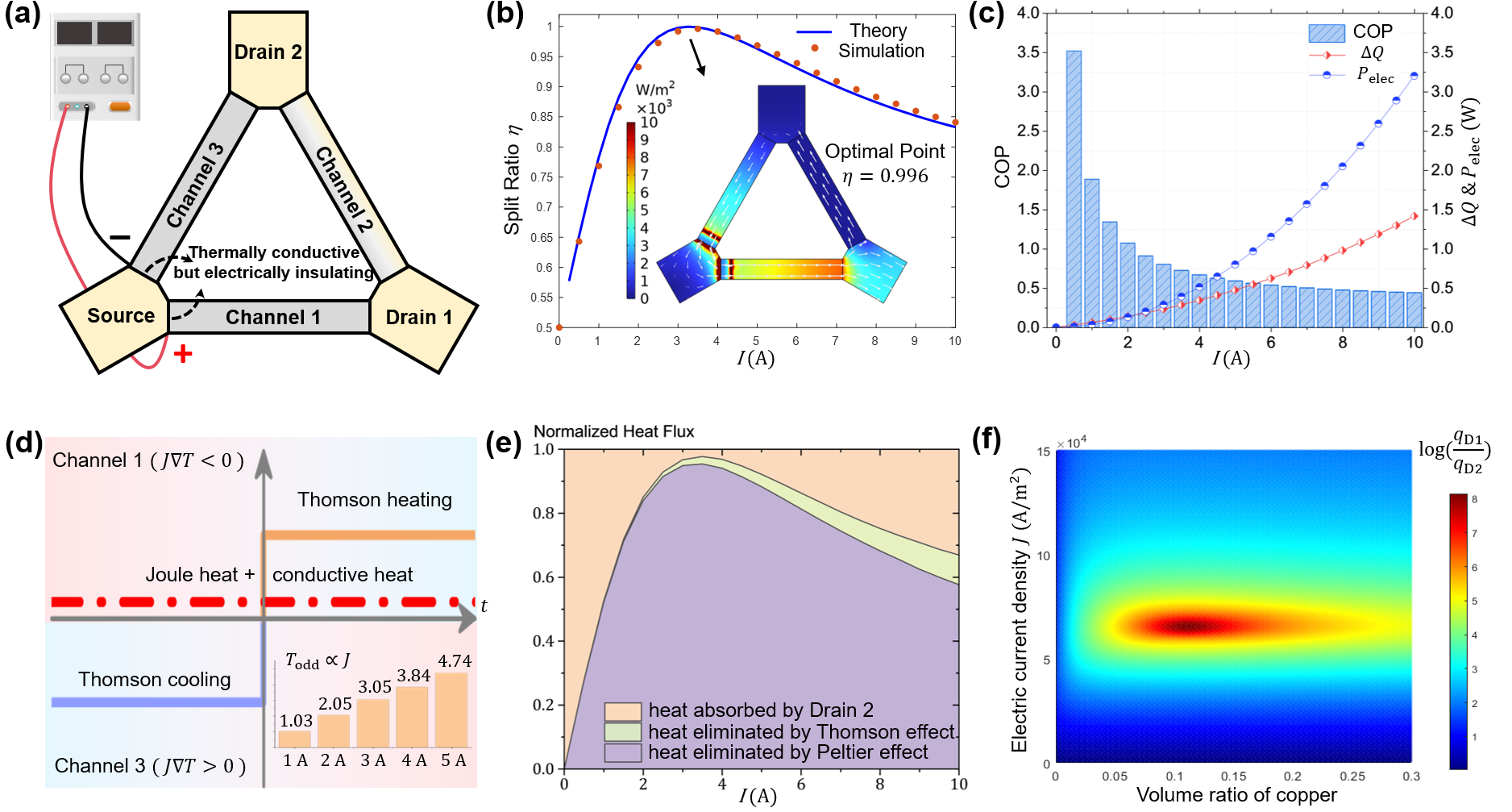
Figure 3. Performance evaluation of thermal router. (a) Schematic of the device; (b) The split ratio η as a function of the electric current I. The inner figure is the energy flux density on the whole device simulated by COMSOL; (c) Coefficient of performance analysis; (d) The method used to extract the temperature contribution from Thomson effect under the DC excitation. Temperature data are extracted from pairs of symmetric points at the central part of TE channel 1 and channel 3. Then, the current-odd thermoelectric temperature signal can be extracted as
Assuming the source and drains exchange heat with their respective reservoirs at a rate of h1, and neglecting air convection (i.e., considering a vacuum environment), the mathematical expression of the temperature field distribution can be solved by applying both temperature and heat flux continuity conditions for the coupled equations (Section S3). In the absence of external field bias, the resulting temperature distribution is symmetric with respect to the central axis of the source, characteristic of pure thermal diffusion. By contrast, when a circulating electric current is introduced, a directional heat conveyor belt emerges due to thermoelectric effects. Without loss of generality, consider a counter-clockwise current. As the current flows from channel 1 (Bi2Te3) to drain 1 (copper), the electrochemical potential of carriers drops sharply at the junction, releasing heat at a rate of J(S1 - S2)*T, where S1 and S2 are the Seebeck coefficients of Bi2Te3 and copper, respectively, and T is the junction temperature. The heat released is efficiently absorbed by drain 1 due to copper’s high thermal conductivity. Conversely, at the junction between drain 2 and channel 3, carriers move from copper to Bi2Te3, where they must absorb heat to traverse from a low to high Seebeck coefficient region. This suppresses the natural heat diffusion toward drain 2. Consequently, heat flow is preferentially routed to drain 1, while drain 2 is effectively isolated.
To quantify routing performance, the split ratio is defined as η = qD1/(qD1 + qD2), where and denote the heat fluxes into drains 1 and 2, respectively. An ideal router yields η = 1 or 0, meaning all heat is directed to a single drain. Detailed derivations are provided in Section S4. As shown in Figure 3b, varying the external current from 0 to 10 A produces a non-monotonic dependence of η, peaking at ~3 A. The inset of Figure 3b illustrates the simulated energy flux distribution at this optimal point: the arrows reveal that nearly all heat is directed to drain 1, with drain 2 almost perfectly isolated. At this condition, the split ratio reaches 0.996, demonstrating excellent routing performance. Besides, since split ratio alone is insufficient to quantify the working performance of an active device like this, an analysis of the coefficient of performance (COP) of electric energy is shown in Figure 3c. It is found that near the optimal working point of thermal routing, a COP of 0.8 can be achieved, which verifies the worth of the energy investment. More details on this can be found in Section S5.
To further reveal the Thomson effect, its contribution to the bulk temperature variation has been isolated from other forms of heating, based on the fact that, among mechanisms directly manifested as bulk temperature changes, only the Thomson effect exhibits an odd-parity response to the direction of electric current
In addition, it is worth noting that, to prevent the heat released at drain 1 from being further dragged counter-clockwise to drain 2, channel 2 is designed as a composite of both Bi2Te3 and copper[44]. Figure 3f presents the split ratio as a function of both electric current and copper volume fraction, where a trade-off between minimizing parasitic Peltier effects and limiting unwanted thermal conduction has been made (Section S7).
In the previous section, a vacuum environment was assumed to evaluate the ideal thermal split ratio of the device. This assumption is reasonable for aerospace application scenarios where the ambient air is sufficiently rarefied to be neglected, such as in satellite thermal management. To further assess the performance of the thermal router under terrestrial conditions, we conducted experiments at room temperature (~300 K) under atmospheric pressure. In the experiment, a heat reservoir maintained at about
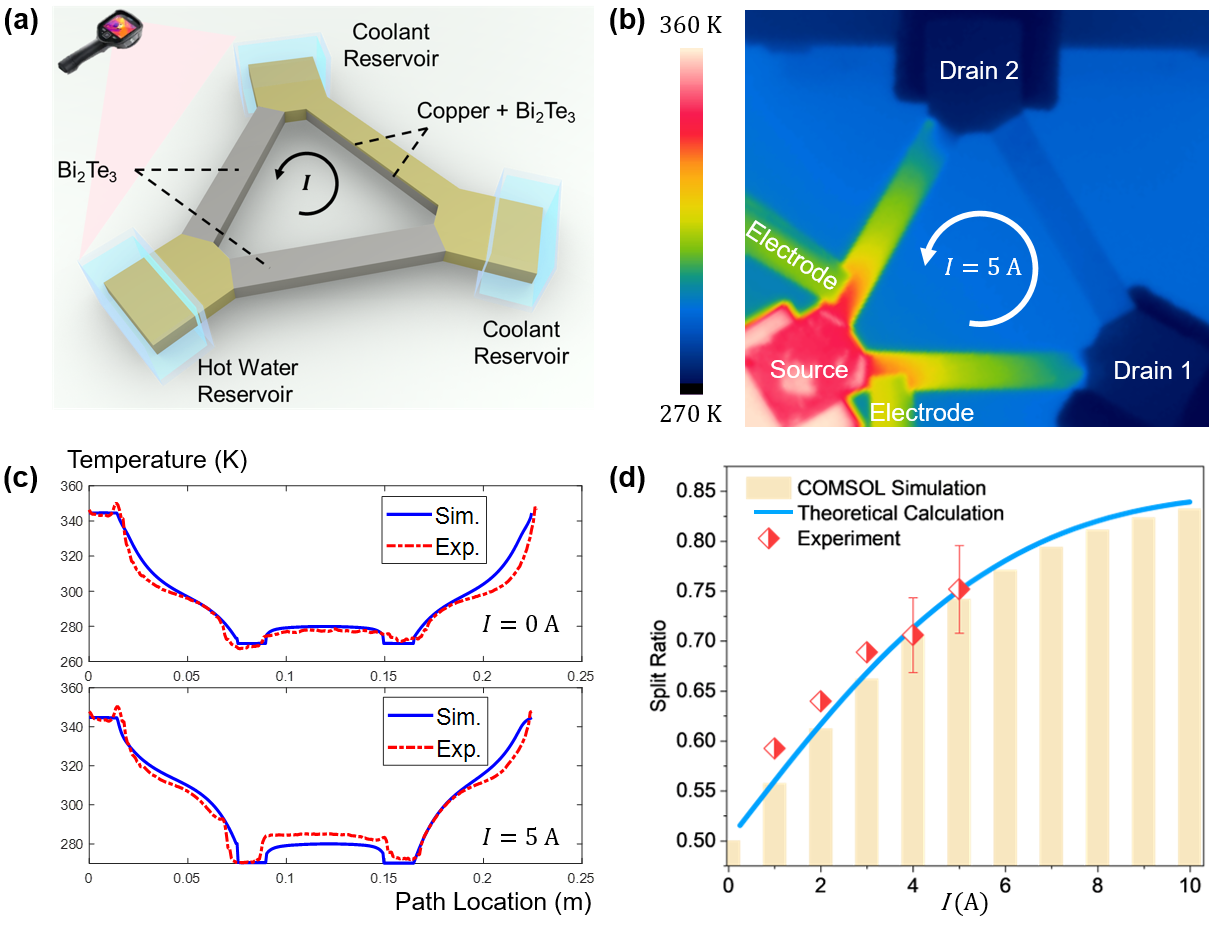
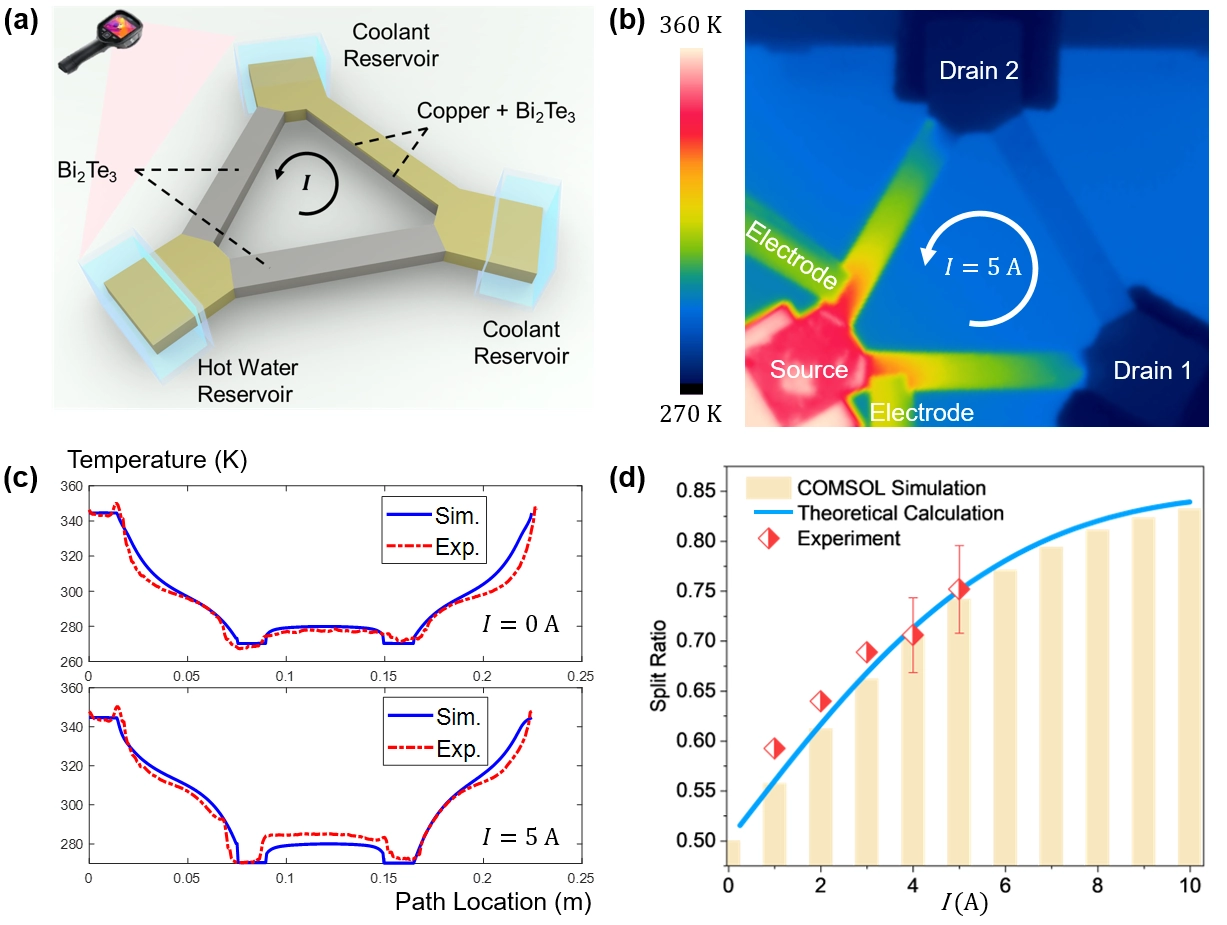
Figure 4. Experimental demonstration of thermal splitting effects. (a) Experimental setups; (b) The thermo diagram of experimental test at I = 5 A; (c) The extracted
The temperature distribution across the device was recorded using an external infrared thermal camera (Figure 4b). To highlight the effect of thermoelectric contributions, we extracted one-dimensional temperature profiles along the three transport channels under two conditions: zero current (upper panel, Figure 4c) and high current (lower panel, Figure 4c). Unlike the idealized case, the experimental profiles at zero current are neither linear nor monotonically convex, reflecting the limited thermal conductivity of
To minimize accidental influences, three independent groups of experiments were performed on the device. The raw temperature data recorded by the thermal camera are provided in Section S8, together with the theoretical procedure for quantifying the thermal split ratio from experimental temperature fields. As presented in Figure 4d, when the applied current is relatively small (1-3 A), the measurement results remain highly stable, with nearly negligible variance. However, as the current increases to 4-5 A, significant deviations appear. This discrepancy mainly arises from overwhelming Joule heating at high current and nonlinear heat exchange with the environment at high temperature that combine together to increase the measurement uncertainty. In addition, when compared with the idealized theoretical predictions in Figure 3 from an overall perspective, the experimentally measured split ratio is notably lower. This is understandable because under room-temperature conditions, natural convection of ambient air indiscriminately heats or cools the device, introducing background thermal noise that obscures the thermoelectric contribution to thermal splitting and degrades experimental performance. A more detailed evaluation is provided in Section S9, where it is found that compared with thermal interface resistance, natural convection contributes to most of the performance degradation.
However, despite these environmental effects, the thermal router still achieves a split ratio of approximately 0.75 at 5 A. When these external influences are taken into account, the theoretical, simulated, and experimental results show good agreement, thereby confirming the robustness of the thermal routing functionality. To be noted, while it is confusing that the splitting effect can still emerge even when the temperature distribution appears nearly symmetric with respect to the source port, this counterintuitive behavior originates from the fact that, in thermoelectric transport, the total heat flux is not solely determined by the Fourier conduction term. Therefore, the temperature field alone cannot fully represent the heat-flux distribution, where the relationship between asymmetric temperature distribution and asymmetric heat flux transport can be decoupled to some extent. Finally, while a current of 5 A may seem impractically large for practical applications, the optimal operating current of the device is inherently
4. Conclusion
To summarize, we have demonstrated a solid-state thermal router with both high power and strong routing contrast. The odd-parity changes of electrochemical potential in thermoelectric materials enable the system to break time-reversal symmetry in a mechanically stationary way while effectively directing heat from the source to a selected drain. Through analyzing the either synergistic or competitive roles of hybrid thermal effects, an intuitive yet in-depth physical insight have been provided for the robust operation and optimization of the metadevice[45-49]. With the solid-state property and a directed heat flux several orders higher than previous solutions, it holds promise for the integrated path-selective heat treatment of advanced electronics, especially for applications where mechanical reliability and operation-mode programmability are required. However, the present work is a
Supplementary materials
The supplementary material for this article is available at: Supplementary materials.
Acknowledgments
The authors would like to acknowledge the support from the Research Platform for Energy and Environmental Nanotech, National University of Singapore (Suzhou) Research Institute.
Authors contribution
Ju R: Conceptualization, methodology, investigation, writing-original draft, writing-review & editing.
Wang Y: Experiment, validation.
Xu Z: Investigation.
Sun K: Data curation.
Yang S, Wang D, Qi M, Cao PC: Writing-review & editing.
Chen H, Qiu CW, Li Y: Conceptualization, writing-review & editing, resources, supervision, funding acquisition.
Conflicts of interest
The authors declare no conflicts of interest.
Ethical approval
Not applicable.
Consent to participate
Not applicable.
Consent for publication
Not applicable.
Availability of data and materials
The data supporting the findings can be found in supplementary information published with this paper, and obtained from the corresponding authors.
Funding
This study was supported by the National Natural Science Foundation of China (NNSFC) (Grant Nos. T2550093 and 12475040); the Zhejiang Provincial Natural Science Foundation of China (Grant Nos. LZ24A050002 and LR26A050001); the Ministry of Education, Republic of Singapore (Grant No. A-8002978-00-00); the National Research Foundation Singapore (NRF) under NRFs Medium Sized Centre: Singapore Hybrid-Integrated Next-Generation μ-Electronics (SHINE) Centre funding programme; the Science and Technology Project of Jiangsu Province (Grant No. BZ2022056).
Copyright
© The Author(s) 2026.
References
-
1. Timossi GF, Fornieri A, Paolucci F, Puglia C, Giazotto F. Phase-tunable Josephson thermal router. Nano Lett. 2018;18(3):1764-1769.[DOI]
-
2. Chen S, Fu C, Hu G. Phonon-polariton-mediated configurable radiative thermal router. ACS Photonics. 2025;12(1):271-281.[DOI]
-
3. Wang L, Li B. Thermal memory: A storage of phononic information. Phys Rev Lett. 2008;101(26):267203.[DOI]
-
4. Li Y, Xu L, Qiu CW. Thermal metamaterials: Controlling the flow of heat. 1st ed. Singapore: World Scientific;2025:[DOI]
-
5. Li B, Wang L, Casati G. Thermal diode: Rectification of heat flux. Phys Rev Lett. 2004;93(18):184301.[DOI]
-
6. Zhang Y, Lv Q, Wang H, Zhao S, Xiong Q, Lv R, et al. Simultaneous electrical and thermal rectification in a monolayer lateral heterojunction. Science. 2022;378(6616):169-175.[DOI]
-
7. Li B, Ji Q, Zhang Q, Wang C, Kadic M. Thermal nonreciprocity tuned by wrinkle patterns in graphene. New J Phys. 2024;26(11):113020.[DOI]
-
9. Yang F, Zhang Z, Xu L, Liu Z, Jin P, Zhuang P, et al. Controlling mass and energy diffusion with metamaterials. Rev Mod Phys. 2024;96:015002.[DOI]
-
10. Fan C, Wu CL, Wang Y, Wang B, Wang J. Thermal metamaterials: From static to dynamic heat manipulation. Phys Rep. 2024;1077:1-111.[DOI]
-
14. Ju R, Cao PC, Wang D, Qi M, Xu L, Yang S, et al. Nonreciprocal heat circulation metadevices. Adv Mater. 2024;36(3):2309835.[DOI]
-
15. Qiu Y, Yang F, Huang J, Xu L. Giant and robust thermal nonreciprocity in a fluid-solid multiphase circulator. Phys Fluids. 2024;36(10):103632.[DOI]
-
16. Xu G, Zhou X, Chen W, Hu G, Yan Z, Li Z, et al. Hydrodynamic moiré superlattice. Science. 2024;386(6728):1377-1383.[DOI]
-
18. Hu R, Chen Z, Kim SK. Can thermal nonreciprocity help radiative cooling? Research. 2024;7:0563.[DOI]
-
19. Liu M, Jin S, Zhou C, Wang B, Zhao C, Qiu CW, et al. An inconvenient truth of thermal nonreciprocity’s impact on radiative cooling efficiency. Joule. 2025;9(4):101887.[DOI]
-
21. Li Y, Li J, Qi M, Qiu CW, Chen H. Diffusive nonreciprocity and thermal diode. Phys Rev B. 2021;103(1):014307.[DOI]
-
23. Goupil C. Continuum theory and modeling of thermoelectric elements. 1st ed. Hoboken: John Wiley & Sons; 2015.
-
24. Li Y, Li J. Advection and thermal diode. Chin Phys Lett. 2021;38(3):030501.[DOI]
-
25. Wang Z, Liu Q, Xiang L, Wang Z, Kong W, Yao Y, et al. Macroscale anomalous heat conduction in active thermal metamaterials. Newton. 2025;1(9):100255.[DOI]
-
26. Li J. Diffusive circulation via spatiotemporal modulation. Int J Heat Mass Transf. 2026;260:128474.[DOI]
-
27. Zhang Q, Deng K, Wilkens L, Reith H, Nielsch K. Micro-thermoelectric devices. Nat Electron. 2022;5(6):333-347.[DOI]
-
28. Mao J, Chen G, Ren Z. Thermoelectric cooling materials. Nat Mater. 2021;20(4):454-461.[DOI]
-
29. Xu Z, Li Y, Gao G, Xie F, Ju R, Yu S, et al. Scalable selective absorber with quasiperiodic nanostructure for low-grade solar energy harvesting. APL Photonics. 2023;8(2):020801.[DOI]
-
31. Guo J, Xu G, Tian D, Qu Z, Qiu CW. A real-time self-adaptive thermal metasurface. Adv Mater. 2022;34(24):2201093.[DOI]
-
32. Jin P, Liu J, Yang F, Marchesoni F, Jiang JH, Huang J, et al. In situ simulation of thermal reality. Research. 2023;6:0222.[DOI]
-
33. Snyder GJ, Toberer ES, Khanna R, Seifert W. Improved thermoelectric cooling based on the Thomson effect. Phys Rev B. 2012;86(4):045202.[DOI]
-
34. Modak R, Murata M, Hou D, Miura A, Iguchi R, Xu B, et al. Phase-transition-induced giant Thomson effect for thermoelectric cooling. Appl Phys Rev. 2022;9:011414.[DOI]
-
35. Takahagi A, Hirai T, Alasli A, Park SJ, Nagano H, Uchida KI. Observation of the transverse Thomson effect. Nat Phys. 2025;21(8):1283-1289.[DOI]
-
36. Hu Y, Li Y, Liu Y, Li B, Christensen J. Giant elastic-wave asymmetry in a linear passive circulator. Nat Commun. 2025;16(1):3991.[DOI]
-
38. Nie X, Xue J, Zhao L, Deng S, Xiong H. New insight of thermodynamic cycle in thermoelectric power generation analyses: Literature review and perspectives. Energy. 2024;292:130553.[DOI]
-
39. Huang MJ, Yen RH, Wang AB. The influence of the Thomson effect on the performance of a thermoelectric cooler. Int J Heat Mass Transf. 2005;48(2):413-418.[DOI]
-
41. Chen H, Huang QKL, HYPERLINK "javascript:;" Wang Y, HYPERLINK "javascript:;" Shou Y, HYPERLINK "javascript:;" Cao PC, Yu W, et al. Learning to reverse thermal diffusion. Natl Sci Rev. 2026.[DOI]
-
42. Zebarjadi M. Electronic cooling using thermoelectric devices. Appl Phys Lett. 2015;106(20):203506.[DOI]
-
43. Wang Y, Wang D, Xing X, Cao PC, Huang QKL, Yan HR, et al. Amplifying time-harmonic thermal signal in spinning lock-in thermography. Commun Phys. 2025;8(1):283.[DOI]
-
45. Ye Q, Sanders S, Alabastri A. Resonant energy transfer and storage in coupled flow-driven heat oscillators. PRX Energy. 2023;2(2):023007.[DOI]
-
46. Zhou Y, Ding T, Xu G, Yang S, Qiu CW, He J, et al. Sustainable heat harvesting via thermal nonlinearity. Nat Rev Phys. 2024;6(12):769-783.[DOI]
-
47. Cao PC, Ju R, Wang D, Qi M, Liu YK, Peng YG, et al. Observation of parity-time symmetry in diffusive systems. Sci Adv. 2024;10(16):eadn1746.[DOI]
-
48. Wang D, Cao PC, Wang Y, Qi M, Ju R, Chen H, et al. Scattering symmetry of diffusive systems. Phys Rev B. 2026;113(10):L100301.[DOI]
Copyright
© The Author(s) 2026. This is an Open Access article licensed under a Creative Commons Attribution 4.0 International License (https://creativecommons.org/licenses/by/4.0/), which permits unrestricted use, sharing, adaptation, distribution and reproduction in any medium or format, for any purpose, even commercially, as long as you give appropriate credit to the original author(s) and the source, provide a link to the Creative Commons license, and indicate if changes were made.
Publisher’s Note
Science Exploration remains a neutral stance on jurisdictional claims in published
maps
and institutional affiliations. The views expressed in this article are solely those
of
the author(s) and do not reflect the opinions of the Editors or the publisher.
Share And Cite


Science Exploration Style
Ju R, Wang Y, Xu Z, Sun K, Yang S, Wang D, et al. Reconfigurable solid-state thermal routing using thermoelectric effects. Thermo-X. 2026;2:202622. https://doi.org/10.70401/tx.2026.0025
Tips
Copy completed.
Submit a Manuscript
Author Instructions
Cite this Article
Article Metrics
0
View
0
Download
Cited
Article Updates

 Get citation
Science Exploration Style

Ju R, Wang Y, Xu Z, Sun K, Yang S, Wang D, et al. Reconfigurable solid-state thermal routing using thermoelectric effects. Thermo-X. 2026;2:202622. https://doi.org/10.70401/tx.2026.0025
copy
Share Link
copy
Subscribe