Nonmonotonic phonon thermal transport during layer-by-layer magnetic switching in four-layer CrSBr

Rongkun Chen
1,2

,
Yan Luo
3
,
Junhan Li
1
,
Weina Ren
2,*
,
Shiqian Hu
1,*
*Correspondence to:
Weina Ren, Faculty of Science, Kunming University of Science and Technology, Kunming 650500, Yunnan, China.
E-mail: wnren@kust.edu.cn
Shiqian Hu, School of Physics and Astronomy, Yunnan Key Laboratory for Quantum Information, Yunnan University, Kunming 650091, Yunnan, China. E-mail: shiqian@ynu.edu.cn
Shiqian Hu, School of Physics and Astronomy, Yunnan Key Laboratory for Quantum Information, Yunnan University, Kunming 650091, Yunnan, China. E-mail: shiqian@ynu.edu.cn
Thermo-X. 2026;2:202627. 10.70401/tx.2026.0030
Received: June 04, 2026Accepted: August 20, 2026Published: August 20, 2026
Abstract
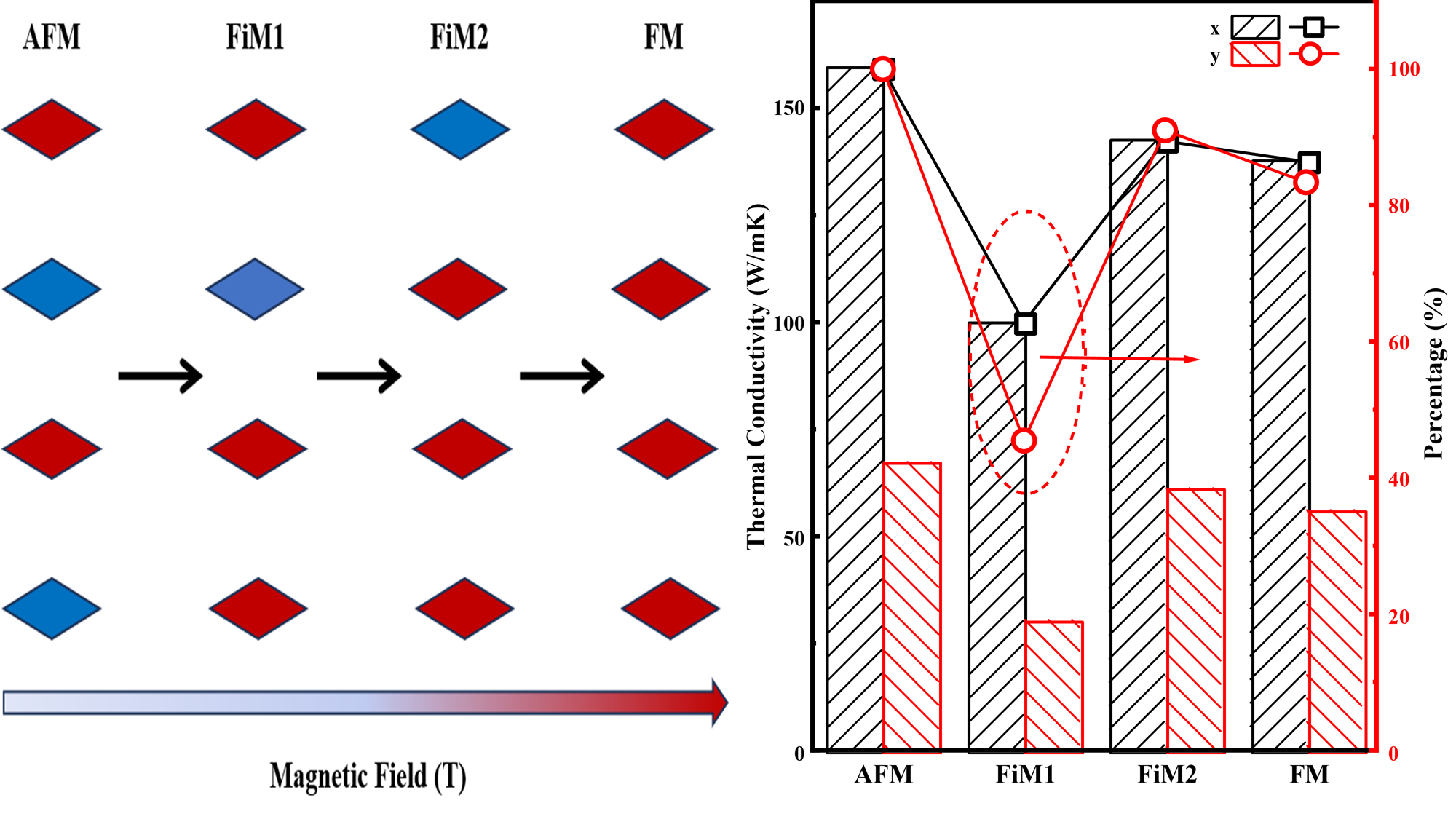
Understanding the interplay between magnetic ordering and phonon thermal transport is crucial for the thermal management of two-dimensional magnetic devices. Here, using first-principles calculations combined with the phonon Boltzmann transport equation, we systematically investigate the lattice thermal transport properties of four-layer CrSBr during its layer-by-layer magnetic switching process. As the magnetic configuration evolves from the antiferromagnetic (AFM) state to the ferromagnetic (FM) state through successive spin reversals, the lattice thermal conductivity exhibits a pronounced nonmonotonic variation. In particular, the intermediate first ferrimagnetic (FiM1) state shows a dramatic reduction in thermal conductivity of approximately 37.2% along x and 54.5% along y compared with the AFM state, whereas the second ferrimagnetic (FiM2) and FM states retain thermal conductivities close to the AFM configuration. Detailed analysis reveals that magnetic switching only weakly affects harmonic phonon properties, including phonon dispersions and group velocities. In contrast, the FiM1 state exhibits strongly enhanced anharmonic phonon scattering and reduced phonon participation ratios in the low-frequency region dominated by heat-carrying phonons. Further layer-resolved vibrational analysis identifies a mixed vibrational character in the FiM1 state, combining AFM-like layer-selective and FM-like layer-equivalent features, which is correlated with enhanced low-frequency anharmonic phonon scattering. Our results reveal a unique mechanism for magnetically tunable thermal transport in van der Waals magnets and provide microscopic insights into magnetic-order-dependent phonon thermal transport in layered magnetic materials.
Graphical Abstract
Keywords
CrSBr, two-dimensional magnetic materials, phonon thermal transport, layer-by-layer magnetic switching, spin-phonon coupling
1. Introduction
Magnetic materials play a central role in modern technologies, including sensing, refrigeration, spintronics, and information storage[1-7]. In particular, the rapid development of microelectronics and artificial intelligence has created increasing demands for ultrahigh integration density, fast information processing, and energy-efficient memory technologies. Conventional three-dimensional magnetic systems face significant challenges in meeting these demands because device miniaturization and high integration densities inevitably lead to increased power consumption and heat generation. In contrast, two-dimensional (2D) magnetic materials, which retain long-range magnetic order despite reduced dimensionality, have emerged as promising candidates for next-generation nanoscale magnetic and spintronic devices.
The performance and reliability of magnetic devices are highly sensitive to temperature because magnetic ordering can be suppressed once the operating temperature exceeds the magnetic transition temperature. In highly integrated devices, Joule heating generated during operation may locally disrupt magnetic order and degrade device performance[8-11]. For example, spin-transfer torque magnetic random-access memory (STT-MRAM), considered a promising next-generation nonvolatile memory technology due to its fast read/write speed and compatibility with complementary metal-oxide-semiconductor (CMOS) processes, suffers from thermal stability issues as device dimensions continue to shrink[9]. The high-power density generated during write operations can transiently destroy magnetic ordering, leading to write failures, read errors, or data loss. Therefore, effective thermal management is essential for ensuring the stable operation of nanoscale magnetic devices.
In semiconductors and insulating magnetic materials, phonons are the dominant heat carriers. Consequently, understanding and controlling phonon thermal transport is crucial for thermal management and device optimization in magnetic systems. Such tunability of thermal transport is also of potential relevance to thermoelectric materials, where reducing lattice thermal conductivity is widely pursued to improve energy-conversion performance. Conventional approaches for tailoring lattice thermal conductivity include alloying, defect engineering, nanostructuring, strain engineering, and interface-induced phonon scattering[12-14]. Magnetic-order control provides a complementary and reversible route, wherein thermal transport can be dynamically tuned through the influence of magnetic order on phonon transport. Previous theoretical studies have predicted that magnetic ordering and magnetic phase transitions can strongly influence lattice thermal conductivity in various 2D magnetic materials, including CrI3, VSe2, MnPS3, CrOCl, and CrSBr[15-23]. Complementing these predictions, experimental evidence for magnetically modulated phonon transport has been reported in MnPSe3[24]. This behavior reflects the sensitivity of lattice dynamics and phonon scattering to magnetic ordering, which can modify interatomic interactions and phonon transport properties. However, previous studies have primarily focused on bulk magnetic transitions or systems with fixed magnetic configurations. In contrast, the influence of tunable interlayer magnetic configurations on phonon thermal transport in van der Waals magnetic systems remains largely unexplored.
Among layered magnetic materials, CrSBr is particularly attractive for investigating the coupling between interlayer magnetic configurations and phonon transport because of its unique layer-dependent magnetic switching behavior[25-27]. CrSBr is a layered A-type antiferromagnet characterized by ferromagnetic ordering within each layer and antiferromagnetic coupling between adjacent layers mediated by weak van der Waals interactions[28,29]. Its bulk Néel temperature is approximately 132 K, while monolayer CrSBr exhibits a Curie temperature of about 146 K[29,30]. In addition, CrSBr possesses excellent environmental stability and highly tunable magnetic properties under external stimuli such as electric fields[31], strain[30], pressure[32], and carrier doping[30,33], making it a promising platform for 2D spintronic applications. Notably, under an external magnetic field, CrSBr exhibits a layer-by-layer magnetic switching process in which the magnetic moments of individual layers sequentially reverse as the magnetic field strength increases, eventually driving the system from an interlayer antiferromagnetic (AFM) state to a ferromagnetic (FM) state[25-27]. This unique feature provides an ideal opportunity to investigate how layer-dependent magnetic configurations influence phonon thermal transport.
In this work, based on the phonon Boltzmann transport equation, we systematically investigate the lattice thermal transport properties of four-layer CrSBr during the magnetic switching process. As the magnetic configuration evolves from the AFM state to the FM state through successive layer flipping, the lattice thermal conductivity exhibits a pronounced nonmonotonic variation, with a maximum reduction of approximately 37.2% along x and 54.5% along y relative to the AFM state. Detailed analysis reveals that magnetic ordering only weakly affects harmonic interatomic interactions and phonon dispersions, mainly through the gradual restoration of degeneracies in flat phonon branches that are split in the AFM state. In contrast, anharmonic phonon scattering, particularly for low-frequency phonons, is strongly modulated by the magnetic configuration and dominates the evolution of lattice thermal conductivity during magnetic switching. Our findings provide important microscopic insights into magnetic-order-dependent phonon thermal transport and offer theoretical guidance for thermal management and device design in 2D magnetic materials for information storage applications.
2. Methods
All first-principles calculations were performed within the framework of density functional theory (DFT) using the Vienna Ab initio Simulation Package (VASP)[34]. The projector augmented-wave (PAW) method was employed to describe the electron-ion interaction, while the exchange-correlation functional was treated within the generalized gradient approximation (GGA) using the Perdew-Burke-Ernzerhof (PBE) functional[35,36]. To account for the on-site Coulomb interaction of Cr 3d electrons, the GGA+U method in the Dudarev formalism was adopted with U = 4.0 eV and J = 0.8 eV, following previous first-principles studies of CrSBr[37,38]. We did not perform an independent U-sensitivity analysis of the calculated thermal conductivity; accordingly, the results should be understood within this established GGA+U parametrization[39].
Structural relaxations were carried out until the total energy and atomic forces converged to within 10-8 eV and 10-2 eV/Å, respectively. A plane-wave kinetic-energy cutoff of 500 eV was used throughout all calculations. Brillouin-zone integrations were performed using a 14 × 11 × 1 Monkhorst-Pack k-point mesh. A vacuum layer of 15 Å was introduced along the out-of-plane direction to reduce interactions between periodically repeated slabs. To assess the adequacy of this separation at the ground-state level, we calculated the total energy of the AFM configuration using vacuum spacings ranging from 5 to 30 Å. As shown in Supplementary Material Figure S1, the total energy is well converged once the vacuum thickness exceeds 15 Å. We note, however, that the calculations are performed within a three-dimensionally periodic supercell without Coulomb-kernel truncation. Thus, although the ground-state interaction between repeated slabs is converged within the tested range, residual finite-vacuum effects associated with displacement-induced long-range electrostatic fields cannot be rigorously excluded.
The lattice-dynamical calculations in this work are based on static second- and third-order interatomic force constants obtained within collinear DFT without spin-orbit coupling. Accordingly, the present approach does not include noncollinear spin textures, spin-orbit coupling (SOC)-induced anisotropic interactions, Dzyaloshinskii-Moriya interactions, velocity-dependent Berry-curvature terms in the phonon equations of motion, or explicit phonon-magnon coupling and spin-relaxation processes. The results should therefore be interpreted as the dependence of phonon-mediated thermal transport on static magnetic configurations through their effects on harmonic and anharmonic interatomic force constants, rather than as a complete dynamical treatment of spin-phonon coupling.
The second-order and third-order interatomic force constants (IFC2 and IFC3) were calculated using the finite-displacement method. Specifically, IFC2 was obtained using the Phonopy package[40], while IFC3 was generated using the thirdorder_vasp.py script[41]. An 8 × 6 × 1 supercell containing 1,152 atoms was employed for both harmonic and anharmonic force-constant calculations. Its in-plane dimensions exceed the real-space interaction range retained for the third-order IFCs. For IFC3, interactions up to the 15th nearest neighbors were included to capture the relevant anharmonic phonon-scattering processes. The lattice thermal conductivity was calculated by solving the linearized phonon Boltzmann transport equation (PBTE) as implemented in the ShengBTE package[41], explicitly including three-phonon scattering processes. A 7 × 5 × 1 q-point mesh was employed for the thermal transport calculations. The convergence with respect to the third-order IFC cutoff and the PBTE q-point mesh is provided in the Supplementary Material (Figure S2). Owing to the considerable computational cost, a fully explicit convergence test with respect to the IFC3 supercell size was not performed. This parameter-free framework provides a microscopic description of intrinsic lattice thermal transport.
3. Results and Discussion
CrSBr crystallizes in an orthorhombic structure with space group Pmmn, where the in-plane lattice adopts a rectangular geometry rather than the more common hexagonal arrangement. Each monolayer consists of a Cr atomic plane sandwiched between S and Br atomic planes, while adjacent layers are stacked through weak van der Waals interactions, as illustrated in Figure 1a. After full structural relaxation, the optimized lattice constants of four-layer CrSBr are obtained as a = 3.59 Å and b = 4.82 Å, in good agreement with previous theoretical and experimental reports[21,42].
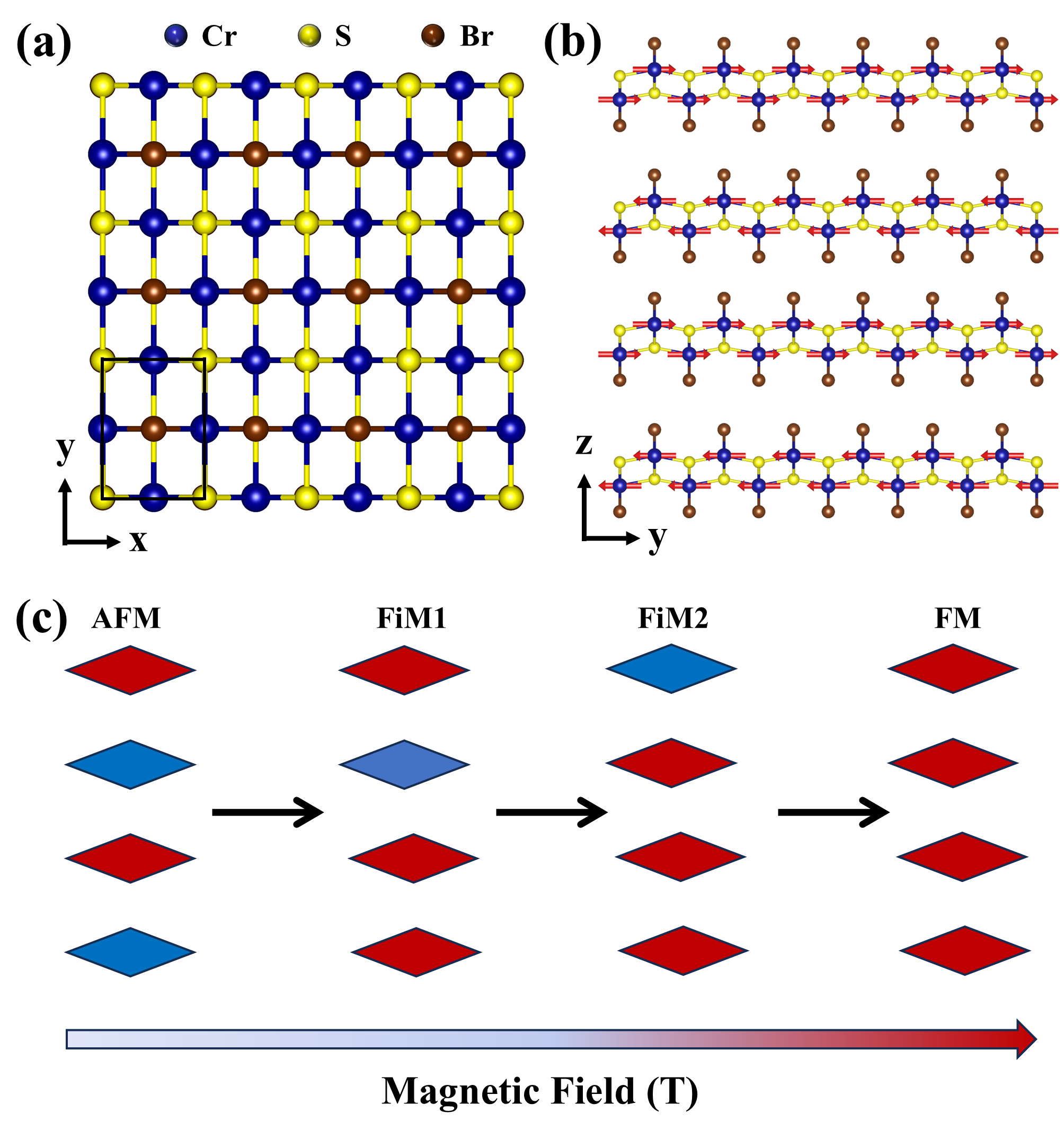
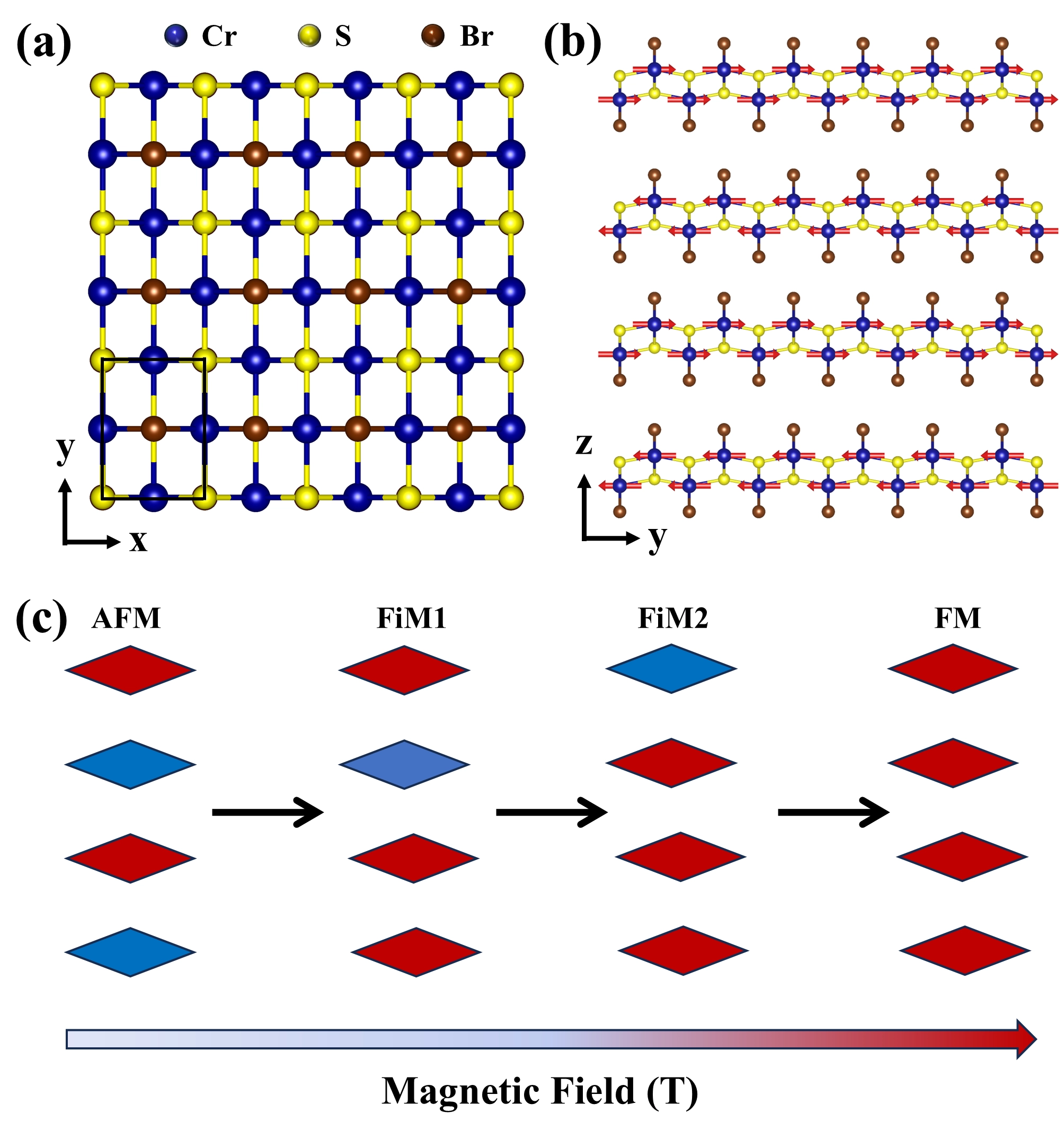
Figure 1. Crystal structure and magnetic configurations of four-layer CrSBr. (a) Top view and (b) side view of the crystal structure of four-layer CrSBr. Blue, yellow, and brown spheres represent Cr, S, and Br atoms, respectively. Spins are ferromagnetically aligned within each layer, while adjacent layers are antiferromagnetically coupled; (c) Schematic illustration of the layer-by-layer magnetic switching process under an external magnetic field. Red and blue diamonds denote layers with opposite spin orientations. From left to right: the AFM state with alternating interlayer spin alignment, two intermediate states, and the fully polarized FM state. AFM: antiferromagnetic; FiM1: first ferrimagnetic; FiM2: second ferrimagnetic; FM: ferromagnetic.
Monolayer CrSBr exhibits intralayer FM ordering, whereas multilayer and bulk CrSBr adopt an A-type AFM configuration characterized by ferromagnetic alignment within each layer and antiferromagnetic coupling between adjacent layers. The four-layer AFM structure considered in this work is shown in Figure 1b, where the magnetic moments alternate between neighboring layers.
Because of the relatively weak interlayer magnetic coupling in CrSBr, its magnetic configuration can be effectively manipulated by an external magnetic field. Experiments have reported multistep, layer-by-layer magnetic switching in tetralayer CrSBr under an in-plane magnetic field at low temperature[25]. In four-layer CrSBr, the system gradually evolves from the AFM state to a fully polarized FM state once the magnetic field exceeds approximately 0.4 T. As illustrated in Figure 1c, the red and blue rectangles represent opposite spin orientations. With increasing magnetic field, the spins in the outermost layers reverse sequentially, eventually driving the system into the FM state.
To verify the reliability of the magnetic configurations considered here, we estimate the equivalent magnetic field required for the AFM-to-FM transition in four-layer CrSBr within the Zeeman framework. The magnetic-field-induced energy difference can be expressed as
where g is the Landé g-factor, μB is the Bohr magneton, and the summation runs over the spins reversed during the transition. The relative energies of the AFM, first ferrimagnetic (FiM1), second ferrimagnetic (FiM2), and FM configurations, together with the corresponding equivalent magnetic fields, are summarized in Table S1. Taking the AFM state as the energy reference, the FiM1, FiM2, and FM states lie 0.49, 1.13, and 2.54 meV higher in energy, respectively. Using these energy differences, we estimate the equivalent magnetic fields associated with the FiM1, FiM2, and FM states relative to the AFM state to be approximately 0.18, 0.27, and 0.45 T, respectively. The estimated equivalent magnetic fields agree well with the experimentally observed layer-by-layer magnetic switching behavior in four-layer CrSBr, supporting the reliability of the magnetic configurations considered in this work[25].
Magnetic phase transitions are often accompanied by pronounced variations in lattice thermal conductivity owing to effects of magnetic order on phonon transport. Previous studies on CrOCl and monolayer CrSBr have shown that changes in magnetic ordering can significantly modify phonon anharmonicity and thermal transport properties. Figure 2 summarizes the evolution of lattice thermal conductivity during the layer-by-layer magnetic switching process in four-layer CrSBr.
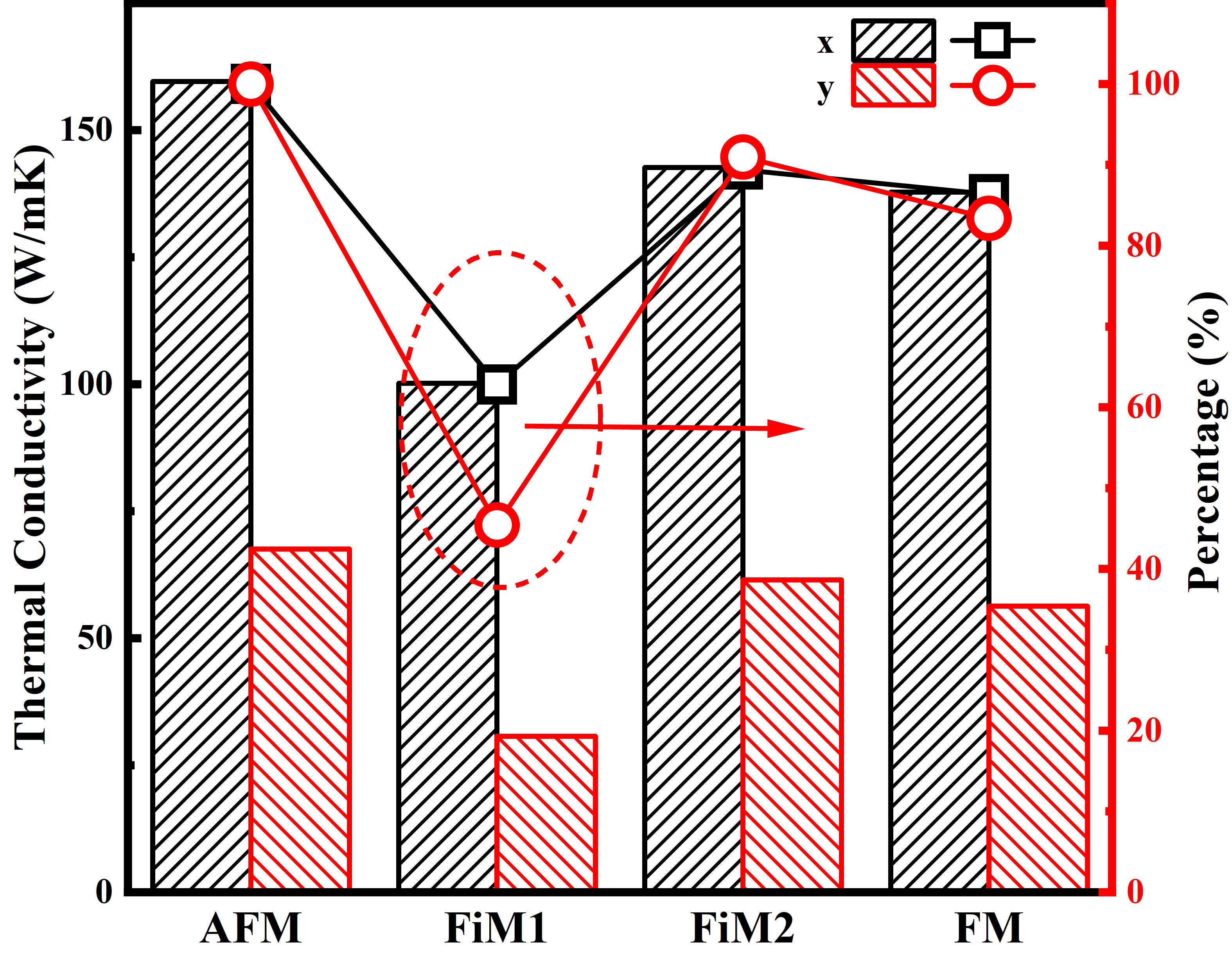
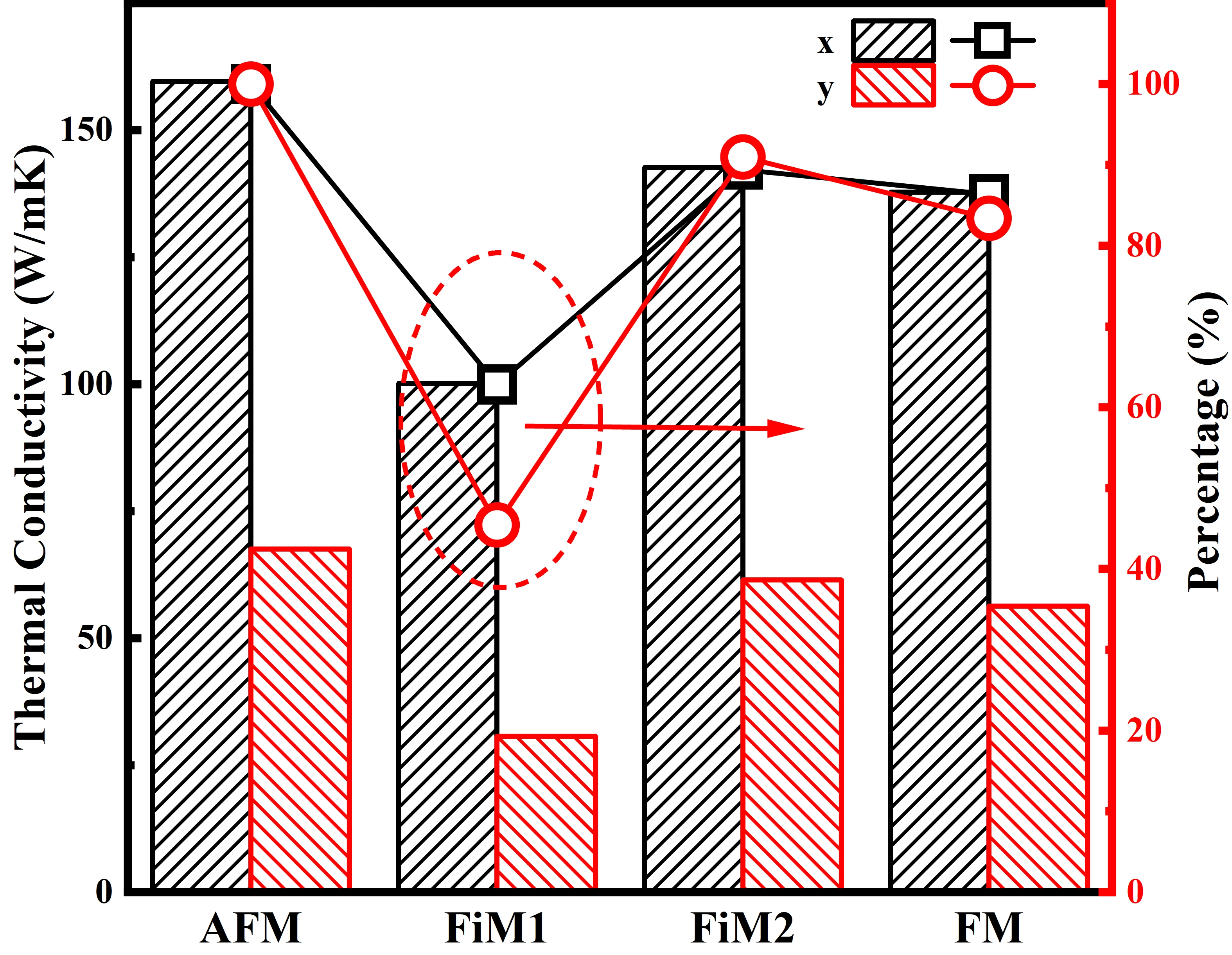
Figure 2. Lattice thermal conductivity under different magnetic configurations. AFM: antiferromagnetic; FiM1: first ferrimagnetic; FiM2: second ferrimagnetic; FM: ferromagnetic.
Lattice thermal conductivity along the x direction (black hatched bars) and y direction (red hatched bars), together with the corresponding thermal conductivity percentages relative to the AFM state (black solid line and red dashed line), for the four magnetic configurations (AFM, FiM1, FiM2, and FM) at 38 K. The FiM1 state exhibits a pronounced suppression of lattice thermal conductivity, by approximately 37.2% along x and 54.5% along y, compared with the AFM state, whereas the FiM2 and FM states retain thermal conductivities close to those of the AFM configuration.
In the AFM state, the lattice thermal conductivities along the x and y directions are 159.53 and 67.55 W/mK, respectively, at 38 K, indicating pronounced in-plane anisotropy with κx/κy = 2.36. As the magnetic configuration evolves through successive spin reversals, the thermal conductivity exhibits a pronounced nonmonotonic behavior. In the FiM1 configuration, the thermal conductivity decreases dramatically to 100.19 W/mK along the x direction and 30.71 W/mK along the y direction, corresponding to a reduction of approximately 37.2% along x and 54.5% along y relative to the AFM state, indicating a stronger suppression along the y direction. By contrast, the thermal conductivities of the FiM2 state and the fully polarized FM state remain much closer to those of the AFM configuration, with only moderate reductions. Interestingly, the strong in-plane anisotropy is largely preserved throughout the magnetic switching process. Only the FiM1 state exhibits a noticeable enhancement of anisotropy, with κx/κy increasing to 3.26, whereas the ratios in the FiM2 and FM states remain close to the AFM value.
To understand the microscopic origin of the nonmonotonic thermal transport behavior, we first analyze the harmonic phonon properties under different magnetic configurations. As shown in Figure 3a, the overall phonon dispersions remain very similar throughout the magnetic switching process, indicating that magnetic ordering has only a minor influence on harmonic interatomic interactions. A notable magnetic-order-dependent evolution appears near 57 cm-1, where several phonon branches that are split in the AFM state progressively converge in frequency as the interlayer magnetic configuration evolves toward the FM state (Figure S3). Although the crystallographic space group remains Pmmn for all magnetic configurations, the magnetic ordering changes the magnetic space group: the AFM, FiM1/FiM2, and FM states belong to Pm′mn (BNS No. 59.407), Pm′m2′ (BNS No. 25.59), and Pm′mn (BNS No. 59.410), respectively (Table S2). The corresponding Γ-point magnetic little groups possess only one-dimensional single-valued phonon irreducible representations, and the relevant antiunitary operations do not enforce Kramers-like degeneracy for spinless phonons. Therefore, the observed frequency convergence near 57 cm-1 should not be interpreted as a symmetry-enforced restoration of an exact twofold degeneracy. Instead, it reflects the magnetic-order-dependent evolution of the harmonic force-constant matrix and lattice dynamics during interlayer spin switching.
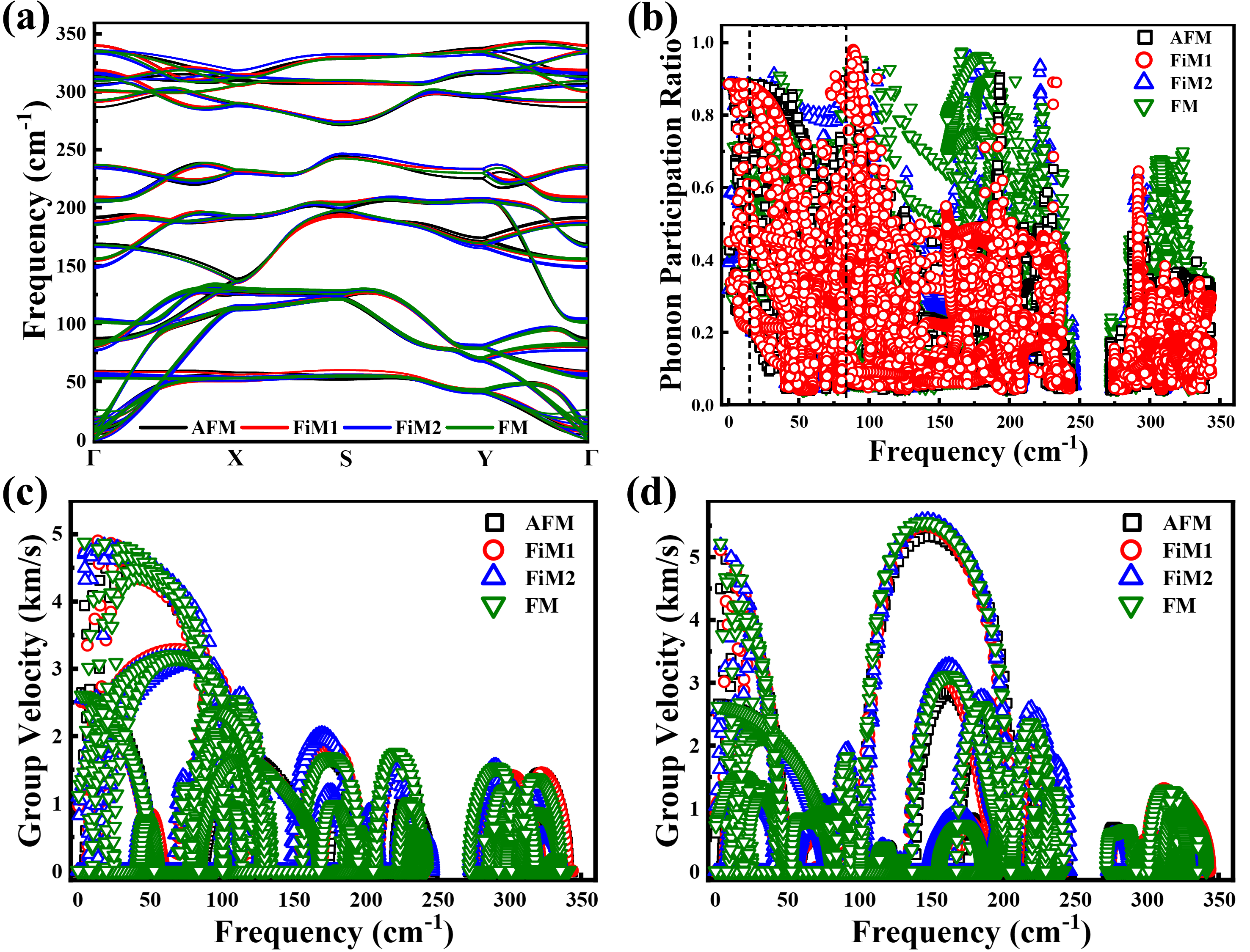
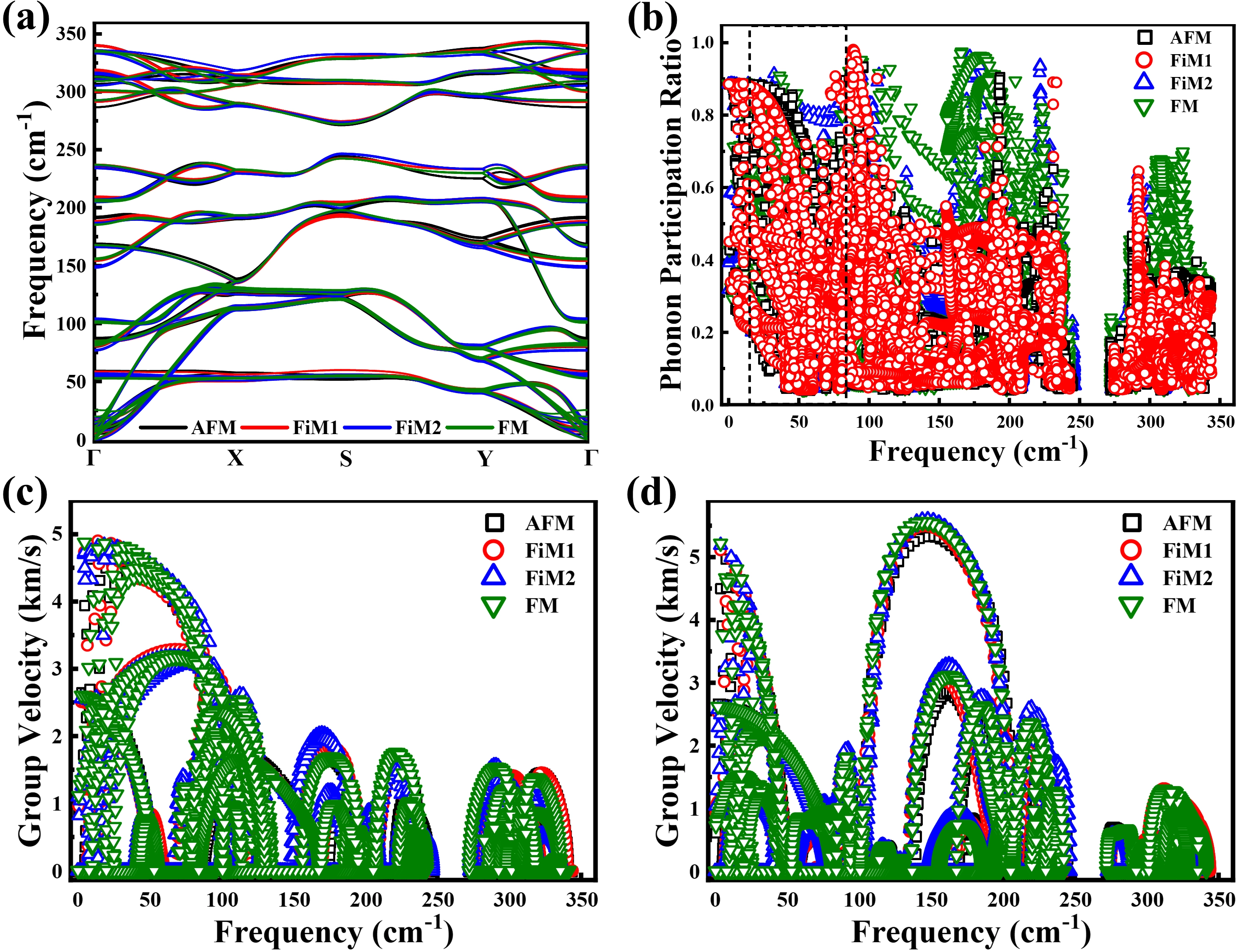
Figure 3. Phonon dispersion, participation ratio, and group velocities of four-layer CrSBr under different magnetic configurations. (a) Phonon dispersions along high-symmetry paths for different magnetic configurations (AFM: black, FiM1: red, FiM2: blue, and FM: green). The overall phonon dispersions remain similar across all magnetic states, although a magnetic-order-dependent splitting (or frequency separation) of closely spaced phonon branches appears near 57 cm-1 in the AFM state (Figure S2); (b) PR as a function of frequency. Most phonon modes exhibit PR values below 0.4, indicating relatively localized vibrational characteristics. Compared with other magnetic states, the FiM1 configuration (red circles) shows noticeably reduced PR values in the 20-80 cm-1 frequency range (Figure S4); (c,d) Phonon group velocities along the x and y directions, respectively. Only minor variations are observed among different magnetic configurations, indicating that harmonic phonon properties are weakly affected by magnetic switching. AFM: antiferromagnetic; FiM1: first ferrimagnetic; FiM2: second ferrimagnetic; FM: ferromagnetic; PR: phonon participation ratio.
The phonon group velocities along the x and y directions, shown in Figure 3c,d, also exhibit only minor variations among different magnetic configurations. The absence of pronounced changes in both phonon dispersions and group velocities indicates that harmonic phonon properties are weakly affected during the layer-by-layer magnetic switching process. Therefore, the strong reduction of lattice thermal conductivity in the FiM1 state is unlikely to originate from harmonic effects.
To further examine phonon localization, we calculate the phonon participation ratio (PR)[43,44], defined as
where ei is the eigenvector of the i-th atom and N is the total number of atoms in the supercell. As shown in Figure 3b, most phonon modes possess PR values below 0.4 for all magnetic states, indicating relatively localized vibrational characteristics consistent with the intrinsically low lattice thermal conductivity of CrSBr. Notably, in the FiM1 state, the PR values in the 20-82 cm-1 range are noticeably reduced compared with those of the AFM state, implying enhanced phonon localization in the frequency range dominated by heat-carrying phonons.
To further clarify the origin of the suppressed thermal conductivity in the FiM1 state, we calculate the frequency-resolved cumulative lattice thermal conductivity as shown in Figure 4a. For all magnetic configurations, phonon modes below approximately 80 cm-1 contribute nearly the entire lattice thermal conductivity, indicating that heat transport in four-layer CrSBr is dominated by low-frequency phonons. However, compared with the AFM, FiM2, and FM states, the FiM1 configuration exhibits a markedly reduced cumulative contribution within the 20-80 cm-1 range. Notably, this frequency window coincides with the region where the participation ratio is significantly suppressed in Figure 3b, indicating enhanced localization of the dominant heat-carrying phonons in the FiM1 state. These results suggest that the anomalous reduction of lattice thermal conductivity in FiM1 originates primarily from the strong suppression of low-frequency phonon transport.
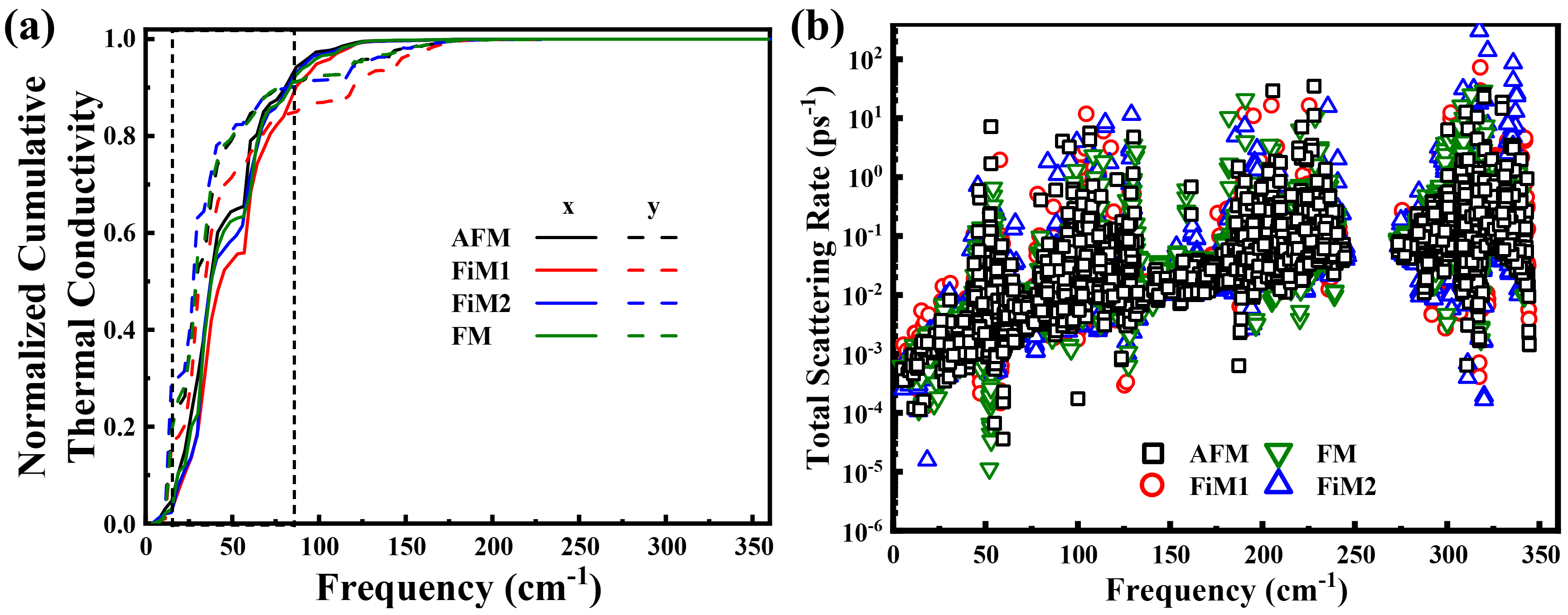
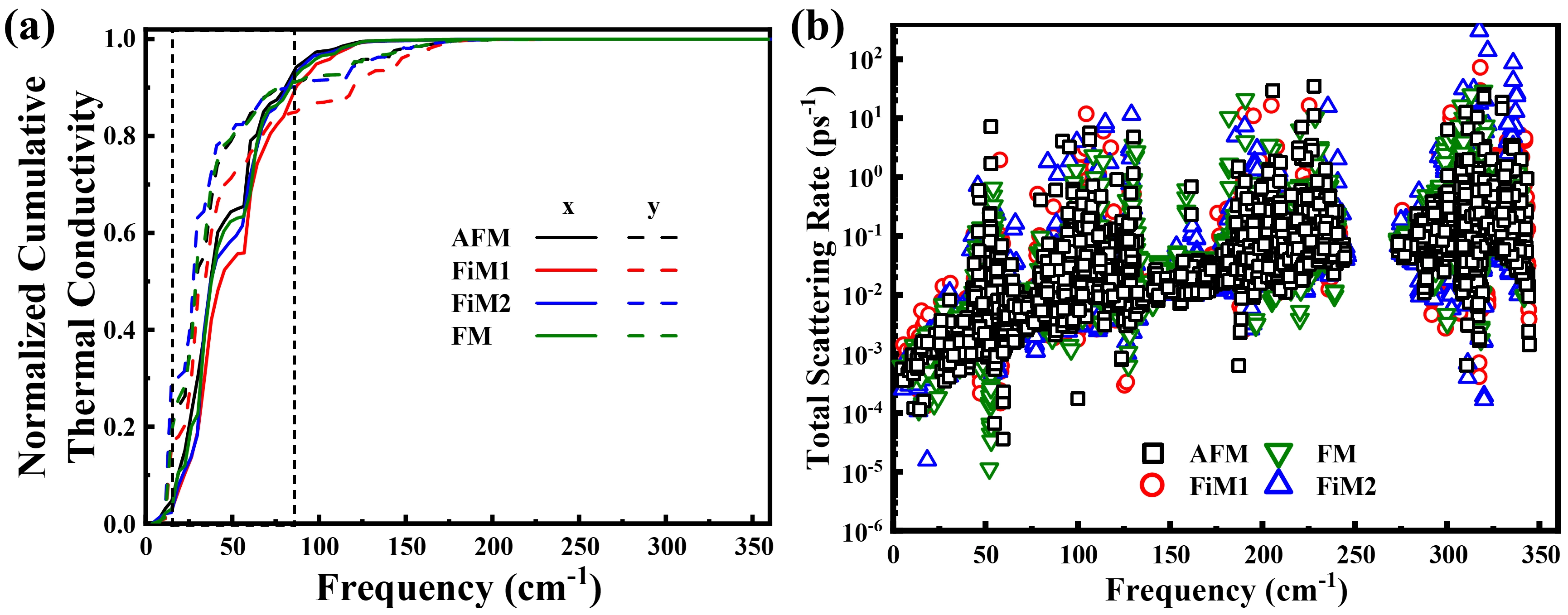
Figure 4. Frequency-dependent cumulative thermal conductivity and three-phonon scattering rates. (a) Normalized cumulative lattice thermal conductivity as a function of phonon frequency along the x (solid lines) and y (dashed lines) directions. Nearly the entire lattice thermal conductivity originates from phonon modes below approximately 80 cm-1. Compared with the AFM, FiM2, and FM states, the FiM1 state (red) exhibits a noticeably slower accumulation in the 20-80 cm-1 range, indicating a strong suppression of low-frequency heat-carrying phonons; (b) Total three-phonon scattering rates as a function of phonon frequency for different magnetic configurations. The FiM1 state (red circles) exhibits significantly enhanced scattering rates below 80 cm-1 compared with the AFM (black squares), FiM2 (blue triangles), and FM (green triangles) states, which display similar scattering behavior (see Figure S6 for a detailed comparison between AFM and FiM1). AFM: antiferromagnetic; FiM1: first ferrimagnetic; FiM2: second ferrimagnetic; FM: ferromagnetic.
To further characterize the length scales of the heat-carrying phonons, we calculated the cumulative lattice thermal conductivity as a function of phonon mean free path (MFP)[45], as shown in Figure S5. The cumulative thermal conductivity of all magnetic configurations is dominated by phonons with MFPs below approximately 4,601 nm. Compared with the AFM state, the FiM1 configuration shows a clear shift of the cumulative thermal-conductivity curve toward shorter MFPs, and the characteristic MFP required to accumulate the total thermal conductivity decreases from approximately 4,601 nm in the AFM state to 2,620 nm in FiM1. This MFP reduction is consistent with the suppressed contribution of low-frequency phonons and indicates enhanced phonon scattering in the FiM1 state.
The corresponding three-phonon scattering rates are presented in Figure 4b. The AFM, FiM2, and FM states exhibit similar scattering strengths, consistent with their comparable lattice thermal conductivities. In contrast, the FiM1 state shows a pronounced enhancement of phonon scattering below 80 cm-1. Combined with the reduced participation ratio and stronger localization of low-frequency phonons, this enhanced anharmonic scattering substantially suppresses thermal transport in the FiM1 state. These results demonstrate that the nonmonotonic evolution of lattice thermal conductivity during magnetic switching is governed primarily by anharmonic phonon scattering rather than by changes in harmonic phonon properties.
To distinguish whether the enhanced scattering in FiM1 originates from an increased number of allowed processes or from stronger anharmonic matrix elements, we further analyze the three-phonon scattering phase space and Grüneisen parameters. As shown in Figure S7a, the scattering phase space in the low-frequency region is broadly similar among the four magnetic configurations, indicating that magnetic switching does not substantially alter the kinematic availability of three-phonon processes. In contrast, FiM1 exhibits markedly enhanced Grüneisen parameters below approximately 80 cm-1 (Figure S7b), consistent with strengthened anharmonic interactions for the heat-carrying modes. The channel-resolved scattering analysis further confirms that the enhanced total scattering rate in FiM1 originates from stronger three-phonon scattering matrix elements in the low-frequency range rather than from a large increase in phase space, as shown in Figure S8. These results quantitatively support the assignment of the FiM1 thermal-conductivity suppression to enhanced anharmonic phonon scattering.
To further elucidate the layer dependence of low-frequency vibrations and their connection to the enhanced anharmonicity in the FiM1 state, we analyze the Cr-resolved vibrational spectral weights of the outer and inner layers. In the AFM configuration, the spectral weight between 40 and 80 cm-1 is strongly layer selective. The inner layers dominate the feature near 57 cm-1, whereas the outer layers contribute only weakly, as shown in Figure 5a,e. This feature, which has also been observed in Raman experiments and attributed to magnetic Brillouin-zone folding[46], is mainly associated with Cr vibrations in the inner layers. In FiM1, both the outer and inner layers contribute appreciably between 40 and 80 cm-1, indicating reduced layer selectivity and a mixed vibrational character, as shown in Figure 5b,f. In FiM2, the spectral weights of the outer and inner layers become more similar, as shown in Figure 5c,g. This tendency is most evident in the FM configuration, where the vibrational spectral weights are nearly equivalent across all four layers, as shown in Figure 5d,h. Therefore, FiM1 represents an intermediate vibrational regime between the layer-selective AFM and layer-equivalent FM limits, and this mixed vibrational character is accompanied by enhanced anharmonic phonon scattering.
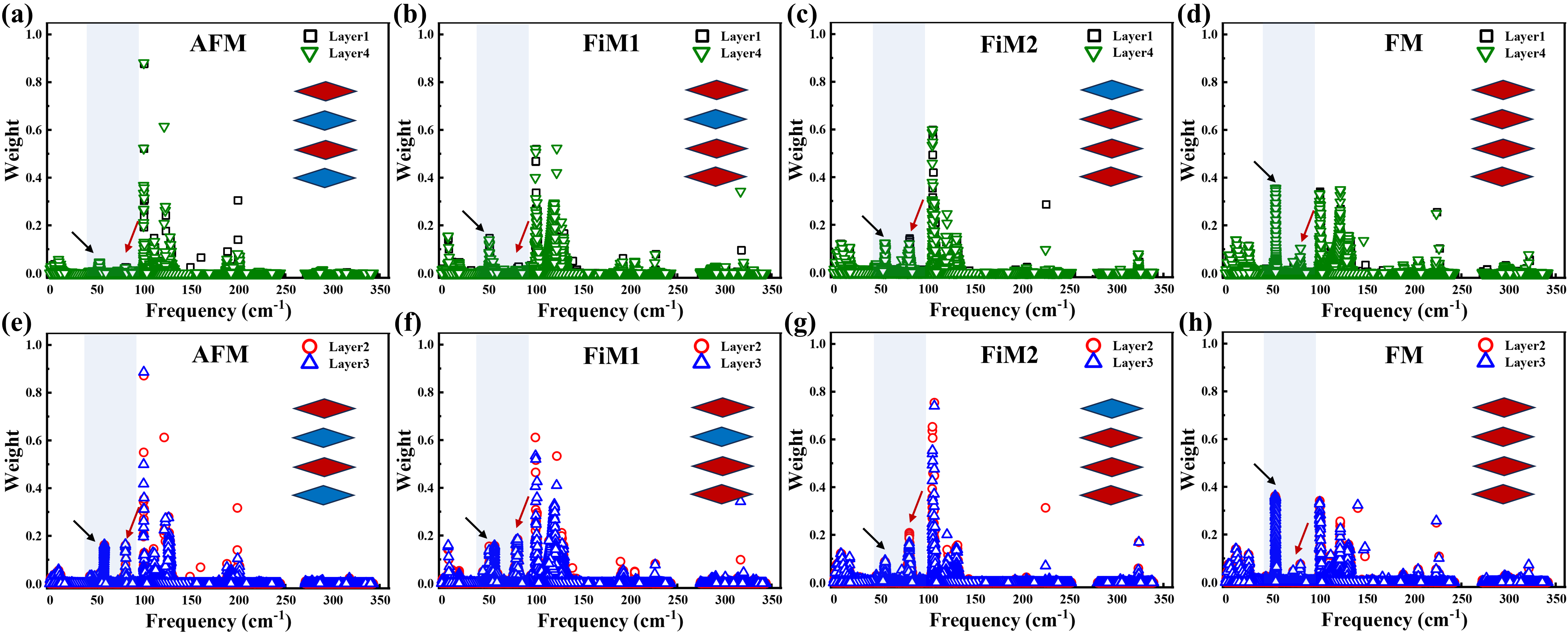
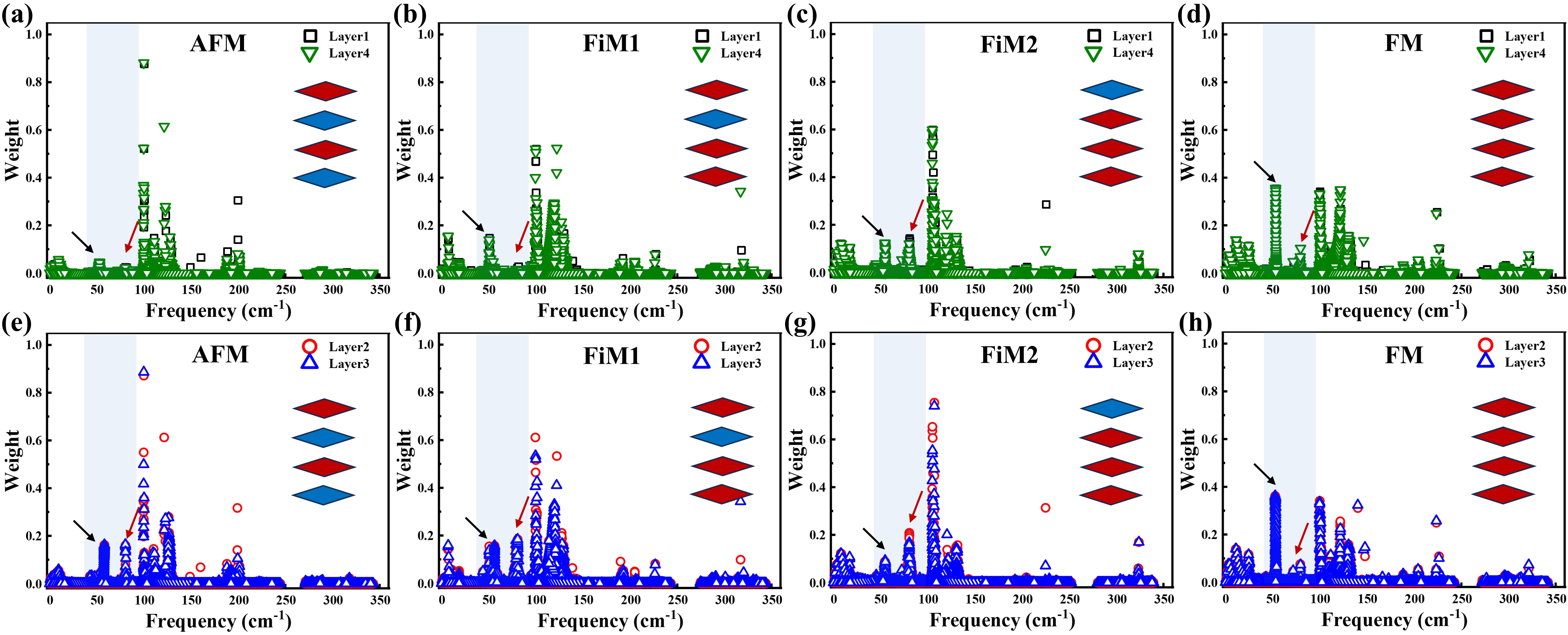
Figure 5. Layer-resolved vibrational spectral weight of Cr atoms under different magnetic configurations. Layer-resolved vibrational spectral weight of Cr atoms as a function of frequency for the (a,e) AFM; (b,f) FiM1; (c,g) FiM2; (d,h) FM states. Panels (a-d) correspond to the outer layers (Layer 1 and Layer 4), while panels (e-h) correspond to the inner layers (Layer 2 and Layer 3). The AFM state exhibits pronounced layer-selective vibrational characteristics in the low-frequency region, whereas the FiM1 state shows enhanced interlayer vibrational mixing and reduced layer selectivity. AFM: antiferromagnetic; FiM1: first ferrimagnetic; FiM2: second ferrimagnetic; FM: ferromagnetic.
As the magnetic order evolves toward the FM state, the characteristic 57 cm-1 feature gradually weakens and eventually disappears completely in the FM configuration, consistent with experimental Raman measurements under strong magnetic fields[46]. During this process, the vibrational characteristics gradually evolve from layer-selective to layer-equivalent behavior.
Compared with the AFM state, the FiM1 configuration exhibits a distinctly mixed vibrational character in the 49-80 cm-1 frequency range. In addition to the inner-layer-dominated modes characteristic of the AFM state, vibrational features associated with the outer layers also become strongly involved, indicating enhanced interlayer vibrational mixing and reduced layer selectivity. By contrast, the FiM2 and FM states exhibit much more layer-equivalent vibrational distributions across all four layers. Therefore, the FiM1 state can be regarded as an intermediate vibrational regime containing both AFM-like and FM-like characteristics. Although this mixed vibrational character has only a minor influence on harmonic phonon properties, it substantially enhances anharmonic phonon scattering and phonon localization, ultimately leading to the pronounced suppression of lattice thermal conductivity in the FiM1 state.
4. Conclusion
In this work, we systematically investigated the phonon thermal transport properties of four-layer CrSBr during the layer-by-layer magnetic switching process using first-principles calculations combined with the phonon Boltzmann transport equation. Our results reveal a pronounced nonmonotonic evolution of lattice thermal conductivity as the system transitions from the antiferromagnetic state to the ferromagnetic state, with the intermediate FiM1 configuration exhibiting a dramatic thermal conductivity reduction of approximately 37.2% along x and 54.5% along y.
Detailed analysis of phonon dispersions, group velocities, participation ratios, cumulative thermal conductivity, three-phonon scattering rates, and layer-resolved vibrational characteristics demonstrates that this strong suppression originates primarily from enhanced anharmonic phonon scattering rather than from modifications of harmonic phonon properties. In particular, the FiM1 state exhibits a mixed vibrational character containing both AFM-like layer-selective vibrations and FM-like layer-equivalent vibrations, which enhances phonon localization and scattering in the low-frequency region responsible for dominant heat transport.
These findings provide microscopic insight into magnetic-order-dependent phonon thermal transport in two-dimensional magnetic materials and demonstrate that layer-dependent magnetic configurations can serve as an effective route for dynamically tuning phonon thermal transport in van der Waals magnets. Although the present effect is relevant to the low-temperature magnetic-switching regime of CrSBr rather than immediate room-temperature thermal-switch applications, it establishes a microscopic design principle for magnetically addressable heat-flow control in layered van der Waals magnets. Our work thus highlights CrSBr and related materials as promising platforms for exploring low-temperature thermal management and spintronic functionalities.
Supplementary materials
The supplementary material for this article is available at: Supplementary materials.
Acknowledgments
The authors used Kimi solely for language polishing. All scientific content, including study design, computational calculations, data analysis, interpretation, figures, tables, and conclusions, was produced and verified by the authors. The authors are responsible for the accuracy and scientific content of the article.
Authors contribution
Chen R: Conceptualization, methodology, investigation, writing-original draft, writing-review & editing.
Luo Y, Li J: Investigation, writing-original draft, writing-review & editing.
Ren W, Hu S: Conceptualization, writing-review & editing, resources, supervision, funding acquisition.
Conflicts of interest
The authors declare no competing interests.
Ethical approval
Not applicable.
Consent to participate
Not applicable.
Consent for publication
Not applicable.
Availability of data and materials
The data that support the findings of this study are available from the corresponding author upon reasonable request.
Funding
This research was funded in part by the National Natural Science Foundation of China (Grant No. 12565007), by the Yunnan Fundamental Research Project (Grant Nos. 202601AS070037, 202401AT070311 and 202301AW070006) and by the Yunnan Provincial Academician Workstation (Grant No. 202505AF350083).
Copyright
© The Author(s) 2026.
References
-
1. Kim SK, Beach GSD, Lee KJ, Ono T, Rasing T, Yang H. Ferrimagnetic spintronics. Nat Mater. 2022;21(1):24-34.[DOI]
-
3. Tannous C, Comstock RL. Magnetic information-storage materials. In: Kasap S, Capper P, editors. Springer handbook of electronic and photonic materials. Cham: Springer; 2017. p. 1.[DOI]
-
4. Spaldin NA. Magnetic materials: Fundamentals and applications. 2nd ed. Cambridge: Cambridge University Press;2010:[DOI]
-
5. Coey JMD. Magnetism and magnetic materials. 1st ed. Cambridge: Cambridge University Press;2010:[DOI]
-
6. Comstock RL. Review Modern magnetic materials in data storage. J Mater Sci: Mater Electron. 2002;13(9):509-523.[DOI]
-
7. Xiang J, Zhang C, Gao Y, Schmidt W, Schmalzl K, Wang CW, et al. Giant magnetocaloric effect in spin supersolid candidate Na2BaCo(PO4)2. Nature. 2024;625(7994):270-275.[DOI]
-
8. Hadámek T, Fiorentini S, Bendra M, Ender J, de Orio RL, Goes W, et al. Temperature increase in STT-MRAM at writing: A fully three-dimensional finite element approach. Solid-State Electronics. 2022;193:108269.[DOI]
-
9. Wang Y, Cai H, Naviner LAB, Zhang Y, Klein JO, Zhao WS. Compact thermal modeling of spin transfer torque magnetic tunnel junction. Microelectron Reliab. 2015;55(9-10):1649-1653.[DOI]
-
10. Hadámek T, Jørstad NP, de Orio RL, Goes W, Selberherr S, Sverdlov V. A comprehensive study of temperature and its effects in SOT-MRAM devices. Micromachines. 2023;14(8):1581.[DOI]
-
11. Zhang L, Cheng Y, Kang W, Zhang Y, Torres L, Zhao W, et al. Reliability and performance evaluation for STT-MRAM under temperature variation. In: 2016 17th International Conference on Thermal, Mechanical and Multi-Physics Simulation and Experiments in Microelectronics and Microsystems (EuroSimE); 2016 Apr 18-20; Montpellier, France. Piscataway: IEEE; 2016. p. 1-4.[DOI]
-
12. Ming H, Luo ZZ, Zou Z, Kanatzidis MG. Strategies and prospects for high-performance Te-free thermoelectric materials. Chem Rev. 2025;125(7):3932-3975.[DOI]
-
13. Park S, Roh JW, Park J, Cho H, Kang SM, Park O, et al. Enhanced thermoelectric performance of TiS2 via large thermal conductivity reduction by solid solution alloying with TiSe2. J Korean Ceram Soc. 2024;61(2):335-341.[DOI]
-
14. Li C, Zhou Z, Lou Y, Fu L. Lattice softening in thermoelectric materials. Microstructures. 2025;5(4):2025075.[DOI]
-
15. Chen Q, Wang NY, Shen KW, Sun J. The effect of magnetic order on the thermal transport properties of the intrinsic two-dimensional magnet 2H-VSe2. Phys Chem Chem Phys. 2023;25(14):9817-9823.[DOI]
-
16. Qin G, Wang H, Zhang L, Qin Z, Hu M. Giant effect of spin-lattice coupling on the thermal transport in two-dimensional ferromagnetic CrI3. J Mater Chem C. 2020;8(10):3520-3526.[DOI]
-
18. Zhang D, Wang K, Chen S, Zhang L, Ni Y, Zhang G. Regulating the thermal conductivity of monolayer MnPS3 by a magnetic phase transition. Nanoscale. 2023;15(3):1180-1185.[DOI]
-
19. Chen R, Luo Y, Xiong L, Ren W, Hu S. Revealing the role of magnetic disorder in phonon transport of monolayer CrOCl. Phys Rev B. 2025;111(22):L220301.[DOI]
-
20. Liu Y, Zhi Y, Liu Q, Liu Y, Jiang X, Zhao J. Lattice thermal conductivity in CrSBr: The effects of interlayer interaction, magnetic ordering and external strain. J Phys: Condens Matter. 2025;37(12):125701.[DOI]
-
21. Li H, Yang Y, Xia Z, Wang Y, Wei J, He J, et al. Stacking effects on magnetic, vibrational, and optical properties of CrSBr bilayers. Phys Rev B. 2025;111(12):125411.[DOI]
-
22. Loletti M, Molina-Sánchez A, Reparaz JS, Cartoixà X, Rurali R. Thermal conductivity and tunable thermal anisotropy of magnetic CrSBr monolayer. Adv Phys Res. 2026;5(6):e70123.[DOI]
-
23. Han L, Li Z, Tang Z, Wang X, Li J, He C, et al. Notable impact of magnetic order and flat phonon mode on the thermal transport properties of 2D magnetic semiconductor CrSBr. J Appl Phys. 2025;138(19):195101.[DOI]
-
24. Chen W, Zhao N, Huang Y, Zeng X, Zhang K, Zhou J, et al. Magnon-phonon coupling modulation via dimensional reduction in thin antiferromagnet MnPSe3 nanoribbons. Appl Phys Lett. 2024;124(11):112406.[DOI]
-
25. Wang Z, Xiang Y, Chen R, Sun Z, Hong C, Chen X, et al. Ferromagnet-like binary switching of a stoner-wohlfarth antiferromagnet. Nature. 2026;650(8101):340-345.[DOI]
-
26. Liu Z, Sun Y, Zhu C, Hong C, Gao Y, Sun Z, et al. Spin texture and tunneling magnetoresistance in atomically thin CrSBr. Phys Rev B. 2025;111(14):L140417.[DOI]
-
27. Tschudin MA, Broadway DA, Siegwolf P, Schrader C, Telford EJ, Gross B, et al. Imaging nanomagnetism and magnetic phase transitions in atomically thin CrSBr. Nat Commun. 2024;15(1):6005.[DOI]
-
28. Jo J, Suárez-Rodríguez M, Mañas-Valero S, Coronado E, Souza I, de Juan F, et al. Anomalous nonlinear magnetoconductivity in van der Waals magnet CrSBr. Adv Mater. 2025;37(16):2419283.[DOI]
-
29. Telford EJ, Dismukes AH, Lee K, Cheng M, Wieteska A, Bartholomew AK, et al. Layered antiferromagnetism induces large negative magnetoresistance in the van der Waals semiconductor CrSBr. Adv Mater. 2020;32(37):2003240.[DOI]
-
30. Rudenko AN, Rösner M, Katsnelson MI. Dielectric tunability of magnetic properties in orthorhombic ferromagnetic monolayer CrSBr. npj Comput Mater. 2023;9(1):83.[DOI]
-
31. Zhao G, Zhao Y, Zhang Y, Yang K, Guo Z, Liu J, et al. Doping-induced magnetic phase transition enables all-electrical spin control in CrSBr. Nat Commun. 2025;17:853.[DOI]
-
32. Pawbake A, Pelini T, Mohelsky I, Jana D, Breslavetz I, Cho CW, et al. Magneto-optical sensing of the pressure driven magnetic ground states in bulk CrSBr. Nano Lett. 2023;23(20):9587-9593.[DOI]
-
33. Tabataba-Vakili F, Nguyen HPG, Rupp A, Mosina K, Papavasileiou A, Watanabe K, et al. Doping-control of excitons and magnetism in few-layer CrSBr. Nat Commun. 2024;15:4735.[DOI]
-
34. Hafner J. Ab-initio simulations of materials using VASP: Density-functional theory and beyond. J Comput Chem. 2008;29(13):2044-2078.[DOI]
-
35. Blöchl PE. Projector augmented-wave method. Phys Rev B. 1994;50(24):17953-17979.[DOI]
-
36. Perdew JP, Burke K, Ernzerhof M. Generalized gradient approximation made simple. Phys Rev Lett. 1996;77(18):3865-3868.[DOI]
-
37. Chen Y, Samanta K, Shahed NA, Zhang H, Fang C, Ernst A, et al. Twist-assisted all-antiferromagnetic tunnel junction in the atomic limit. Nature. 2024;632(8027):1045-1051.[DOI]
-
38. Chen Y, Samanta K, Healey AJ, Fang C, Zhang H, Shahed NA, et al. Twisted atomic magnetic tunnel junctions with multiple nonvolatile states. Nat Commun. 2026;17(1):2439.[DOI]
-
39. Dudarev SL, Botton GA, Savrasov SY, Humphreys CJ, Sutton AP. Electron-energy-loss spectra and the structural stability of nickel oxide: An LSDA+U study. Phys Rev B. 1998;57(3):1505-1509.[DOI]
-
40. Togo A. First-principles phonon calculations with phonopy and phono3py. J Phys Soc Jpn. 2023;92(1):012001.[DOI]
-
41. Li W, Carrete J, Katcho NA, Mingo N. ShengBTE: A solver of the Boltzmann transport equation for phonons. Comput Phys Commun. 2014;185(6):1747-1758.[DOI]
-
42. Bo X, Li F, Xu X, Wan X, Pu Y. Calculated magnetic exchange interactions in the van der Waals layered magnet CrSBr. New J Phys. 2023;25(1):013026.[DOI]
-
43. Bell RJ, Dean P. Atomic vibrations in vitreous silica. Discuss Faraday Soc. 1970;50:55-61.[DOI]
-
44. Schober HR, Oligschleger C. Low-frequency vibrations in a model glass. Phys Rev B. 1996;53(17):11469-11480.[DOI]
-
45. Tang S, Xiao Y, Wu M, Zhang P, Ai P, Wan D, et al. Interface-driven phonon scattering and carrier dynamics in asymmetric GeS/GeSe van der Waals heterostructure. Appl Phys Lett. 2025;127(17):171604.[DOI]
-
46. Pawbake A, Pelini T, Wilson NP, Mosina K, Sofer Z, Heid R, et al. Raman scattering signatures of strong spin-phonon coupling in the bulk magnetic van der Waals material CrSBr. Phys Rev B. 2023;107(7):075421.[DOI]
Copyright
© The Author(s) 2026. This is an Open Access article licensed under a Creative Commons Attribution 4.0 International License (https://creativecommons.org/licenses/by/4.0/), which permits unrestricted use, sharing, adaptation, distribution and reproduction in any medium or format, for any purpose, even commercially, as long as you give appropriate credit to the original author(s) and the source, provide a link to the Creative Commons license, and indicate if changes were made.
Publisher’s Note
Science Exploration remains a neutral stance on jurisdictional claims in published
maps
and institutional affiliations. The views expressed in this article are solely those
of
the author(s) and do not reflect the opinions of the Editors or the publisher.
Share And Cite


Science Exploration Style
Chen R, Luo Y, Li J, Ren W, Hu S. Nonmonotonic phonon thermal transport during layer-by-layer magnetic switching in four-layer CrSBr. Thermo-X. 2026;2:202627. https://doi.org/10.70401/tx.2026.0030
Tips
Copy completed.
Submit a Manuscript
Author Instructions
Cite this Article
Article Metrics
0
View
0
Download
Cited
Article Updates

 Get citation
Science Exploration Style

Chen R, Luo Y, Li J, Ren W, Hu S. Nonmonotonic phonon thermal transport during layer-by-layer magnetic switching in four-layer CrSBr. Thermo-X. 2026;2:202627. https://doi.org/10.70401/tx.2026.0030
copy
Share Link
copy