Revealing the origin of strongly temperature-dependent lattice thermal conductivity in Cu2SnSe3
Hongwei Ming
1,2,3,4

,
Zongxuan Lin
1,4
,
Shike Xu
1,2,3
,
Yunpeng Zheng
1,2,3
,
Zhong-Zhen Luo
1,2,3,5,*
,
Zhigang Zou
1,3,6
*Correspondence to:
Zhong-Zhen Luo, Fujian Science & Technology Innovation Laboratory for Optoelectronic Information of China, Fuzhou 350108, Fujian, China; State Key Laboratory of Green and Efficient Development of Phosphorus Resources, Fuzhou University, Fuzhou 350108, Fujian, China; Key Laboratory of Advanced Materials Technologies, International (HongKong Macao and Taiwan) Joint Laboratory on Advanced Materials Technologies, College of Materials Science and Engineering, Fuzhou University, Fuzhou 350108, Fujian, China; State Key Laboratory of Photocatalysis on Energy and Environment, Fuzhou University, Fuzhou 350116, Fujian, China.
E-mail: zzluo@fzu.edu.cn
Thermo-X. 2027;3:202630. 10.70401/tx.2026.0033
Received: July 01, 2026Accepted: August 31, 2026Published: August 31, 2026
Abstract
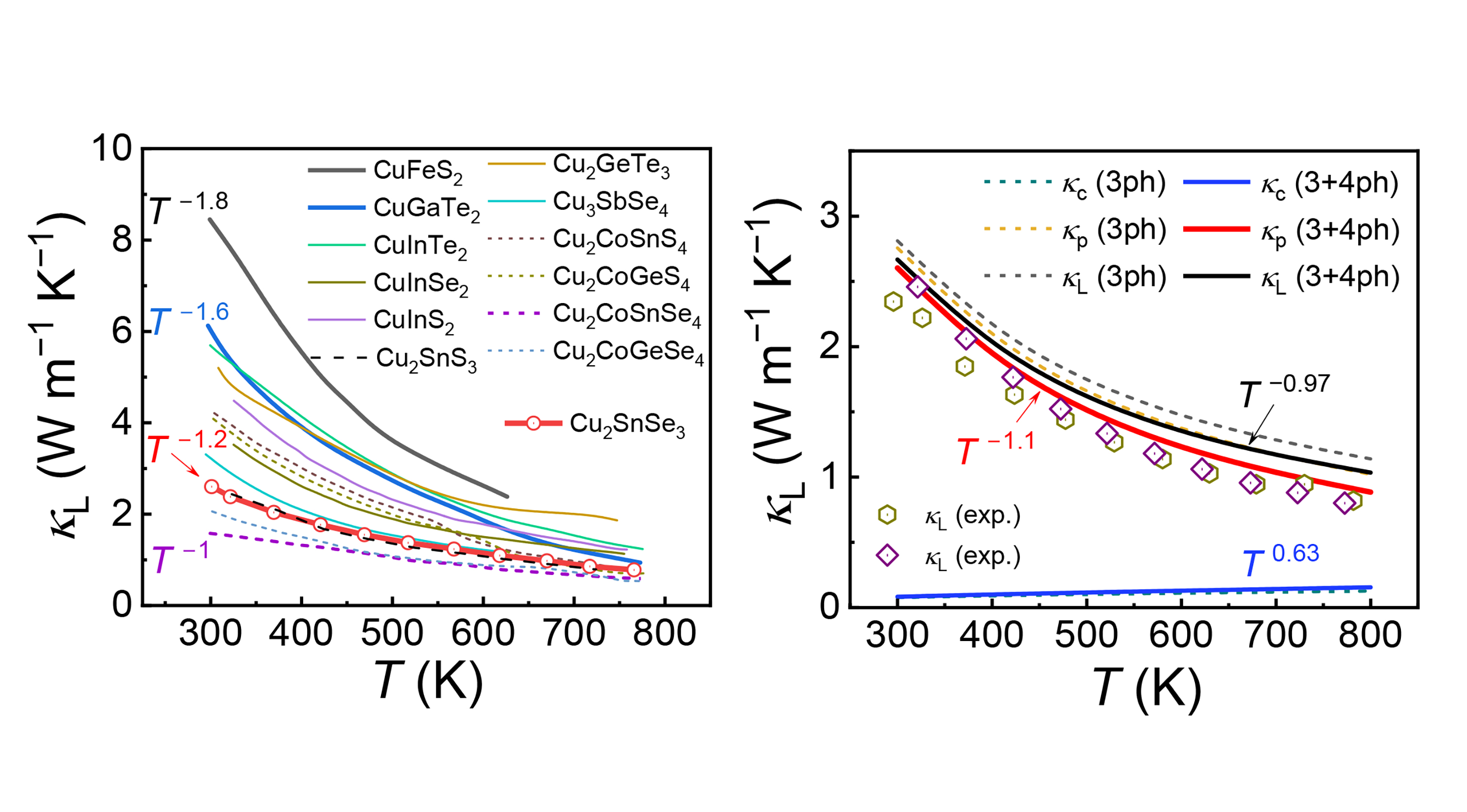
Cu2SnSe3 exhibits exceptionally low lattice thermal conductivity (κL) and a nonclassical temperature dependence among ternary copper-based diamondoid compounds, yet the microscopic origins of these phonon behaviors remain poorly understood. In this work, we theoretically investigate the intrinsic phonon transport in Cu2SnSe3 by employing a two-channel thermal transport model that separates particle-like (κp) and coherent contributions (κc), while fully incorporating both three-phonon (3ph) and four-phonon (4ph) scattering processes. Our calculations show that κc is negligible at 300 K but becomes progressively more significant at elevated temperatures, while κp remains the dominant contributor to κL over the entire temperature range. 4ph scattering is identified as the primary factor driving the deviation from the classical T-1 dependence, yielding a temperature scaling of T-1.1 that closely matches the experimental T-1.2 behavior. This strong 4ph scattering originates from flat optical phonon modes in the 1.2-2.2 THz range, which provide an exceptionally large scattering phase space. The low κL (e.g., ~ 0.8 W m-1 K-1 at 773 K) of Cu2SnSe3 relative to other ternary copper-based diamondoid compounds is attributed to the asymmetric potential energy of Cu atoms, which induces large atomic displacement parameters and pronounced anharmonicity in the Cu-related low-frequency optical branches. Furthermore, qualitative analyses of cation disorder and anion substitution show that disorder leads to significant phonon broadening, while replacing Se with S hardens the acoustic branches and markedly shifts the optical modes upward. Our findings not only clarify the origins of the nonclassical temperature dependence and low κL in Cu2SnSe3, but also provide a general guideline for designing diamondoid thermoelectrics with intrinsically suppressed κL.
Graphical Abstract
Keywords
Cu2SnSe3, diamondoid compounds, lattice thermal conductivity, anharmonicity
1. Introduction
Thermoelectric materials enable direct conversion between heat and electricity, making them promising candidates for waste heat recovery and solid-state refrigeration[1,2]. Their conversion efficiency is described by the dimensionless figure of merit[3], ZT = S2σT/(κe + κL), where S, σ, T, κe, and κL denote the thermopower, electrical conductivity, absolute temperature, charge-carrier thermal conductivity, and the lattice thermal conductivity, respectively. Notably, S, σ, and κe are strongly interdependent and coupled to the carrier concentration, whereas κL is a relatively independent parameter that can be minimized to maximize ZT[4].
Diamondoid compounds have attracted increasing interest in photovoltaics and thermoelectrics due to their eco-friendly constituents and chemically tunable compositions[5-7]. Through cation-site cross-substitution, a broad family of diamondoid compounds with diverse space groups and stoichiometries can be derived from the sphalerite structure[8-11], which exhibit rich and intriguing phonon behaviors[12-14] and yield high ZT values (Figure 1a). Among these, Cu2SnSe3 has garnered increased interest for thermoelectric applications, owing to its earth-abundant constituents and the absence of toxic Pb or scarce Te. Theoretical efforts have been made to understand its electrical transport properties. For instance, Xi et al.[31,32] theoretically revealed that Cu-Se bonds dominate hole transport in Cu2SnSe3, forming a three-dimensional electrical conduction network, while Sn atoms primarily provide electrons and stabilize the framework. Ming et al.[33] further showed that Cu vacancies are the dominant intrinsic point defect, featuring shallow transition energy levels that account for the intrinsic p-type conduction behavior. Concurrently, extensive experimental efforts have focused on enhancing the thermoelectric performance of Cu2SnSe3[34,35]. For example, Shi et al.[36] found that In doping at the Sn site effectively improves the carrier concentration without disrupting the hole conduction network, attaining a high ZT of 1.14 at 850K. Ming et al.[37] found that (In, S)-codoping effectively engineers the band structure, promotes multi-band transport, and gives a high ZT of 1.51 at 858 K. By employing an entropy and enthalpy regulation strategy, Zhang et al.[18] achieved a record-high ZT of 1.76 in Cu1.73Ag0.27(In0.06Sn0.94)Se2S at 873 K, which is an extremely high value among diamondoid compounds, as shown in Figure 1a.
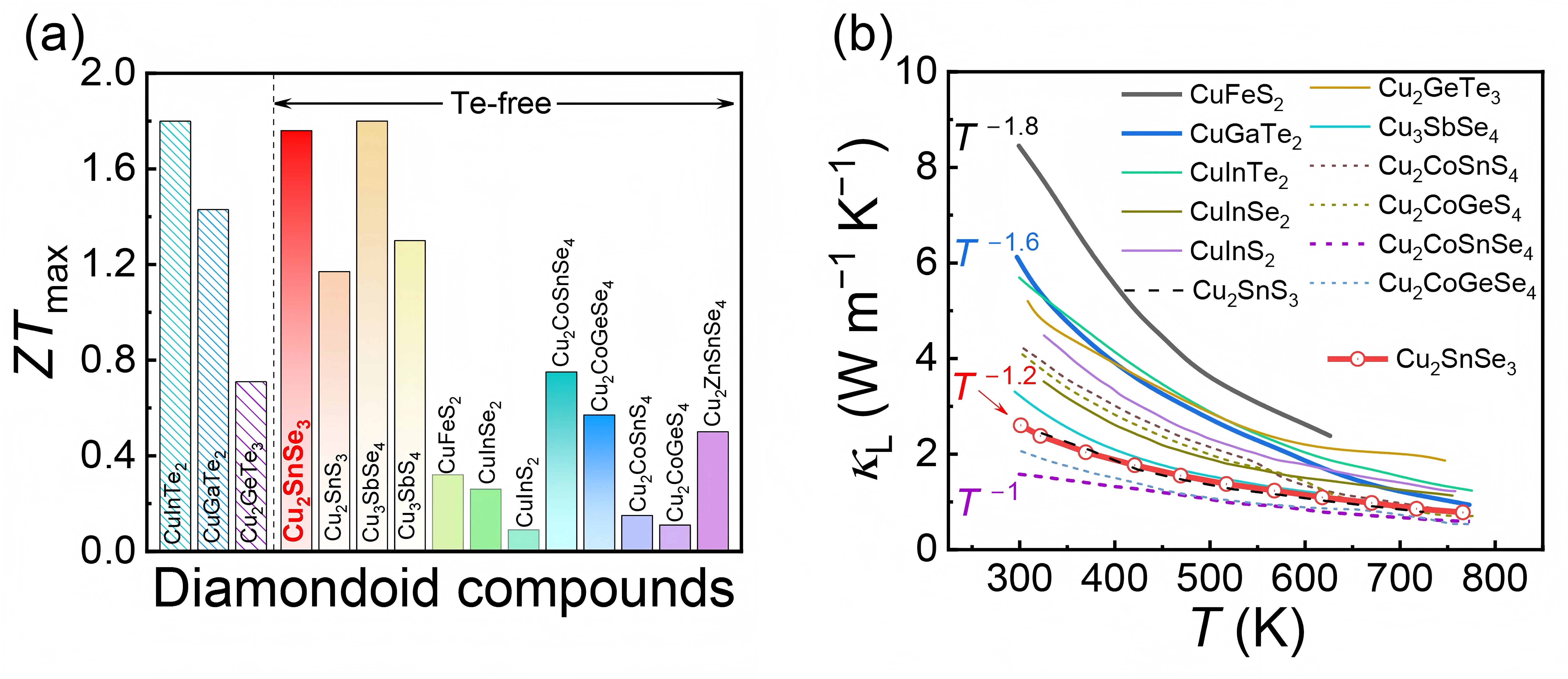
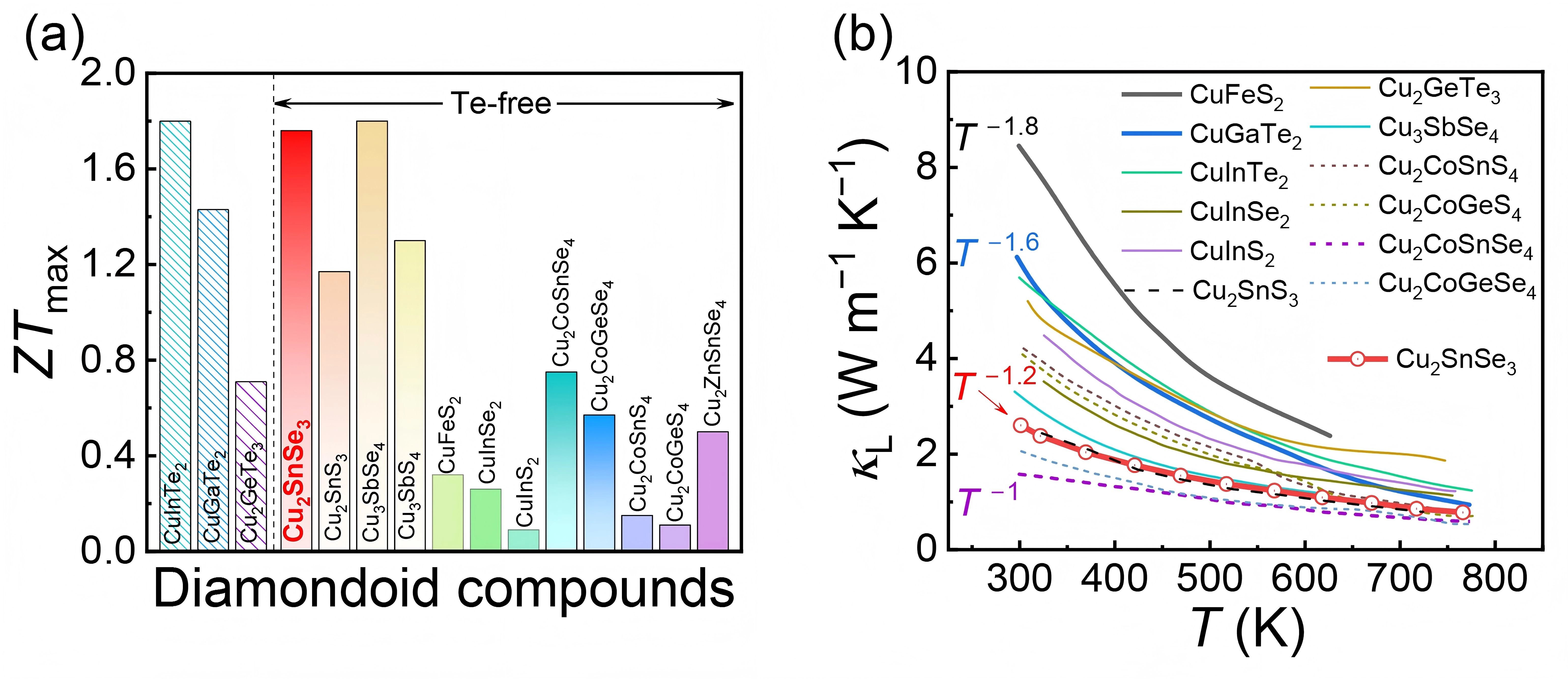
Figure 1. (a) Comparison of maximum ZT (ZTmax) values reported for copper-based diamondoid compounds, including CuInTe2[15], CuGaTe2[16], Cu2GeTe3[17], Cu2SnSe3[18], Cu2SnS3[19], Cu3SbSe4[20], Cu3SbS4[21], CuFeS2[22], CuInSe2[23], CuInS2[23], Cu2CoSnSe4[24], Cu2CoGeSe4[25], Cu2CoSnS4[24], Cu2CoGeS4[25] and Cu2ZnSnSe4[26]; (b) Temperature-dependent lattice thermal conductivity (κL) of copper-based diamondoid compounds, including Cu2SnSe3[27], Cu2SnS3[28], CuFeS2[22], CuGaTe2[29], CuInTe2[15], CuInSe2[23], CuInS2[23], Cu2GeTe3[17], Cu3SbSe4[30], Cu2CoSnS4[24], Cu2CoGeS4[25], Cu2CoSnSe4[24], and Cu2CoGeSe4[25].
Despite these notable advances, the intrinsic phonon transport properties of Cu2SnSe3 have remained largely unexplored. Using the Debye-Callaway model, Qin et al. demonstrated that introducing grain boundaries[38], high-density stacking faults[39], or nanoinclusions[40] can effectively scatter the heat-carrying phonons in Cu2SnSe3. However, such analyses provide only semi-quantitative insights into the effect of additional defects on phonon scattering. Figure 1b compares the κL of copper-based diamondoid compounds. Cu2SnSe3 exhibits an exceptionally low κL[27] compared with other ternary copper-based diamondoid compounds, including CuFeS2[22], CuGaTe2[29], CuInTe2[15], CuInSe2[23], CuInS2[23], Cu2GeTe3[17], and Cu3SbSe4[30]. At 300 K, Cu2SnSe3 shows a κL of 2.6 W m-1 K-1[27], substantially lower than the values of 8.4 and 6.12 W m-1 K-1 reported for CuFeS2 and CuGaTe2[22,29], respectively. More intriguingly, the κL of these ternary diamondoids deviates from the classical T-1 temperature dependence. For example, κL of CuFeS2 follows a strongly temperature-dependent T-1.8 relationship, while that of Cu2SnSe3 scales as T-1.2. Therefore, elucidating the origin of both the strong temperature dependence and the exceptionally low κL in Cu2SnSe3 is of fundamental importance.
The temperature dependence of κL in several typical diamondoid compounds has been previously investigated. For instance, Liu et al.[41] reproduced the strong temperature dependence of κL for diamondoid CuInSe2 (~ T-1.8) and CuInTe2 (~ T-2) by considering temperature-dependent force constants within the framework of three-phonon scattering alone. They attributed this behavior to the dominant role of Cu atomic motion in generating large anharmonicity at elevated temperatures, which makes anharmonic renormalization indispensable for accurately predicting lattice dynamics and thermal conductivity[41]. Similarly, Yu et al.[42] examined the nonclassical temperature dependence of CuInTe2 using first-principles calculations combined with experimental Raman spectroscopy. Their results show that incorporating both three-phonon (3ph) and four-phonon (4ph) scattering with temperature-independent force constants successfully reproduces the experimentally observed strong temperature dependence. Moreover, their calculated scattering rates indicate that 4ph scattering reaches the same order of magnitude as 3ph at 300 K and even exceeds it at higher temperatures. More importantly, their work is further supported by temperature‑dependent Raman analyses, which demonstrate that the temperature-induced Raman shift and linewidth broadening can be well reproduced only when both 3ph and 4ph scattering processes are taken into account.
In this work, we theoretically investigate the κL of Cu2SnSe3 using a two-channel thermal transport model. Specifically, the phonon contribution to thermal transport is decomposed into a particle-like contribution (κp) and the coherence contribution (κc)[43,44], such that κL = κp + κc. A complete theoretical description should incorporate both aspects. Moreover, previous studies have shown that κc can even dominate heat transport in certain materials, such as Cu12Sb4S13[45] and diamondoid AgInSnSe4[46]. Furthermore, given that high-order phonon scattering strongly influences the temperature dependence of κL, both 3ph and 4ph scattering are incorporated into our calculations. Our results reveal that κp dominates κL and decreases with increasing T, whereas κc exhibits the opposite trend. When both 3ph and 4ph scattering are considered, κp displays a strong temperature dependence of T-1.1, closely matching the experimental ~ T-1.2 behavior. This confirms that 4ph scattering is the primary origin of the anomalous temperature dependence. The strong 4ph scattering is attributed to the flat optical phonon modes in the frequency range of 1.2-2.2 THz, which provide a large 4ph scattering phase space. The markedly low κL of Cu2SnSe3 relative to other ternary copper-based diamondoids arises predominantly from the asymmetric potential energy profiles of Cu atoms, leading to large atomic displacement parameters and strong anharmonicity of the Cu-related low-frequency optical phonon modes. Furthermore, qualitative analyses of cation disorder and anion substitution show that disorder leads to significant phonon broadening, while replacing Se with S hardens the acoustic branches and shifts the optical modes markedly upward. This study elucidates the intrinsic phonon transport properties of Cu2SnSe3 and establishes a foundation for the rational design of diamondoid compounds with intrinsically low κL.
2. Experimental Section
Detailed experimental procedures, computational details, convergence tests, and additional characterization results are provided in the Supplementary materials.
3. Results and Discussion
Figure 2a shows the monoclinic crystal structure of Cu2SnSe3, which contains two types of metal-centered tetrahedra, [CuSe4]7- and [SnSe4]4-, connected by corner-sharing Se atoms. Figure 2b presents the negative integrated crystal orbital Hamiltonian populations (-ICOHP) for Cu-Se and Sn-Se bonds in monoclinic Cu2SnSe3, with the insert showing the [CuSe4]7- and [SnSe4]4- tetrahedra. The Cu-Se bond lengths within a [CuSe4]7- tetrahedron range from 2.431 to 2.468 Å, while those of Sn-Se within a [SnSe4]4- tetrahedron vary from 2.596 to 2.693 Å. These varying bond lengths give rise to differences in bonding strength and are typically associated with anisotropic potential energy. Furthermore, the smaller -ICOHP value for Cu-Se compared to Sn-Se bonds indicates that the Cu-Se bond is considerably weaker, which is expected to contribute to the low κL of Cu2SnSe3. This weak bonding originates from the strong antibonding interactions between the Cu 3d and Se 4p states, as confirmed by Figure S4.
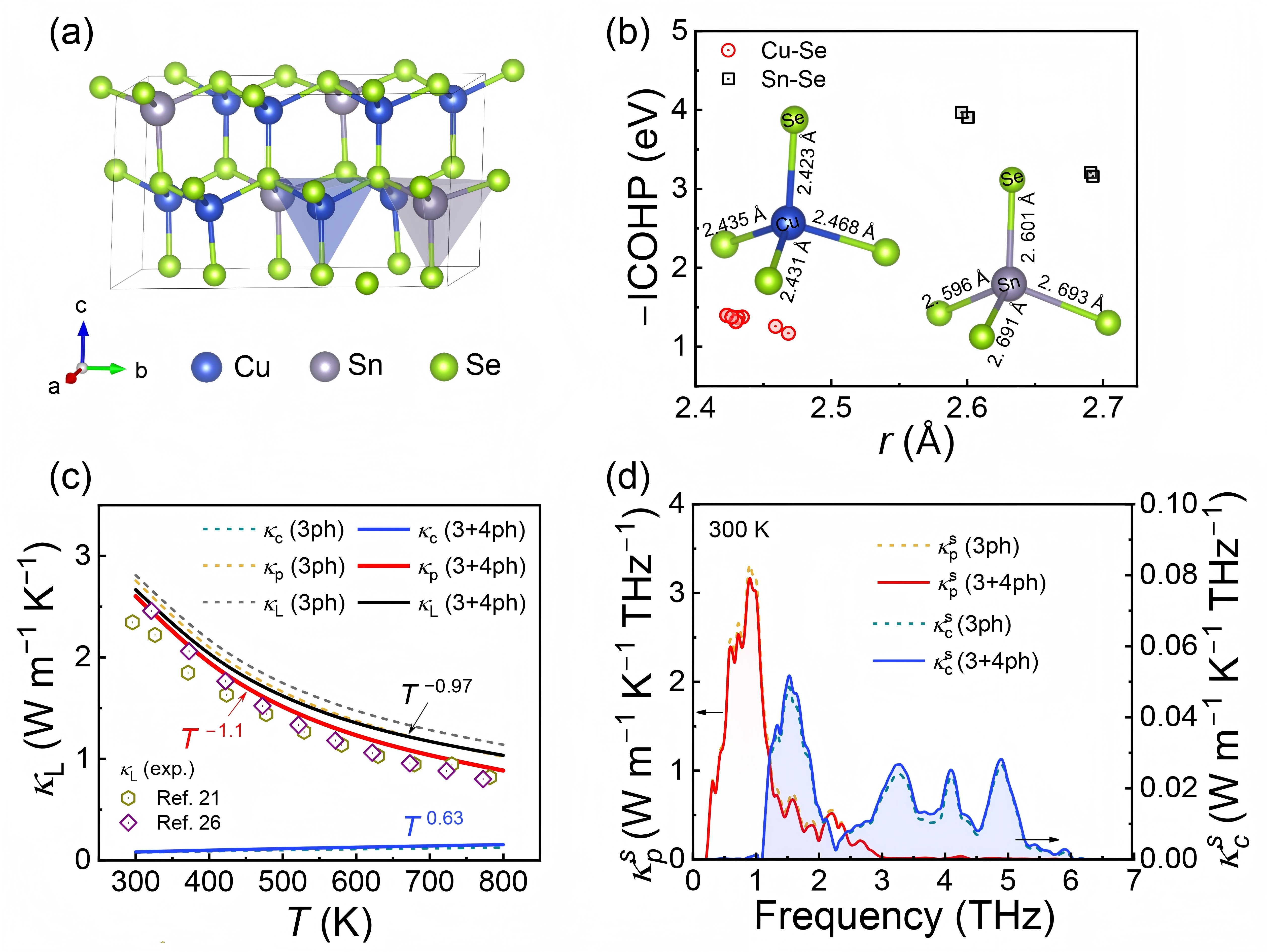
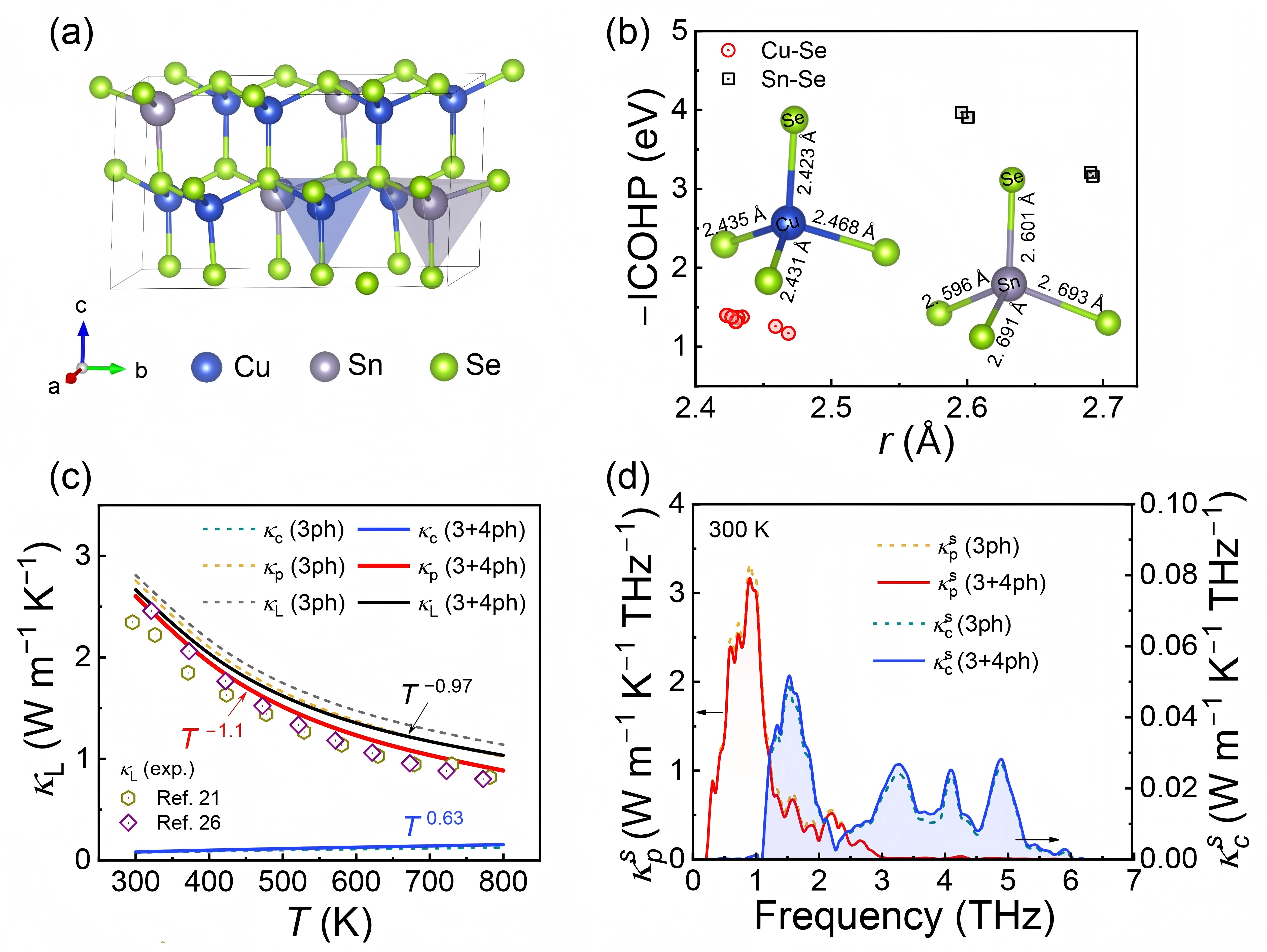
Figure 2. (a) Crystal structure of monoclinic Cu2SnSe3; (b) -ICOHP of Cu-Se and Sn-Se bonds in monoclinic Cu2SnSe3. The insert shows the [CuSe4]7- and [SnSe4]4- tetrahedra; (c) Temperature-dependent κp (3ph), κc (3ph), and κL (3ph) by considering the three-phonon process (3ph), and κp (3 + 4ph), κc (3 + 4ph), and κL (3 + 4ph) by considering three- and four-phonon process (3 + 4ph) for Cu2SnSe3. Here, κp and κc denote particle-like propagation and wave-like coherent contribution to the lattice thermal transport. The dots denote the experimental κL[27,37]; (d) The spectral
To elucidate the origins of both the strong temperature dependence and the exceptionally low κL in Cu2SnSe3 (Figure 1b), we theoretically investigate its lattice thermal transport using a two-channel thermal transport model. Within the Wigner formalism[43,44], κL is decomposed into two contributions: κL = κp + κc, where κp corresponds to the particle-like propagation of phonon wavepackets discussed by Peierls’s semiclassical picture, and κc is the wave-like coherent component arising from tunneling and loss of coherence between different phonon branches. We further incorporate both 3ph and 4ph scattering processes into our calculations. As shown in Figure 2c, κp is the dominant contributor to κL and decreases as T increases, while κc follows the opposite trend and can be neglected at 300 K. When both 3ph and 4ph scattering are included, κp(3 + 4ph) displays a strong temperature dependence of T-1.1, closely matching the experimentally observed ~ T-1.2 behavior. This confirms that 4ph scattering is the primary origin of the anomalous temperature dependence.
Figure 2d displays the spectral
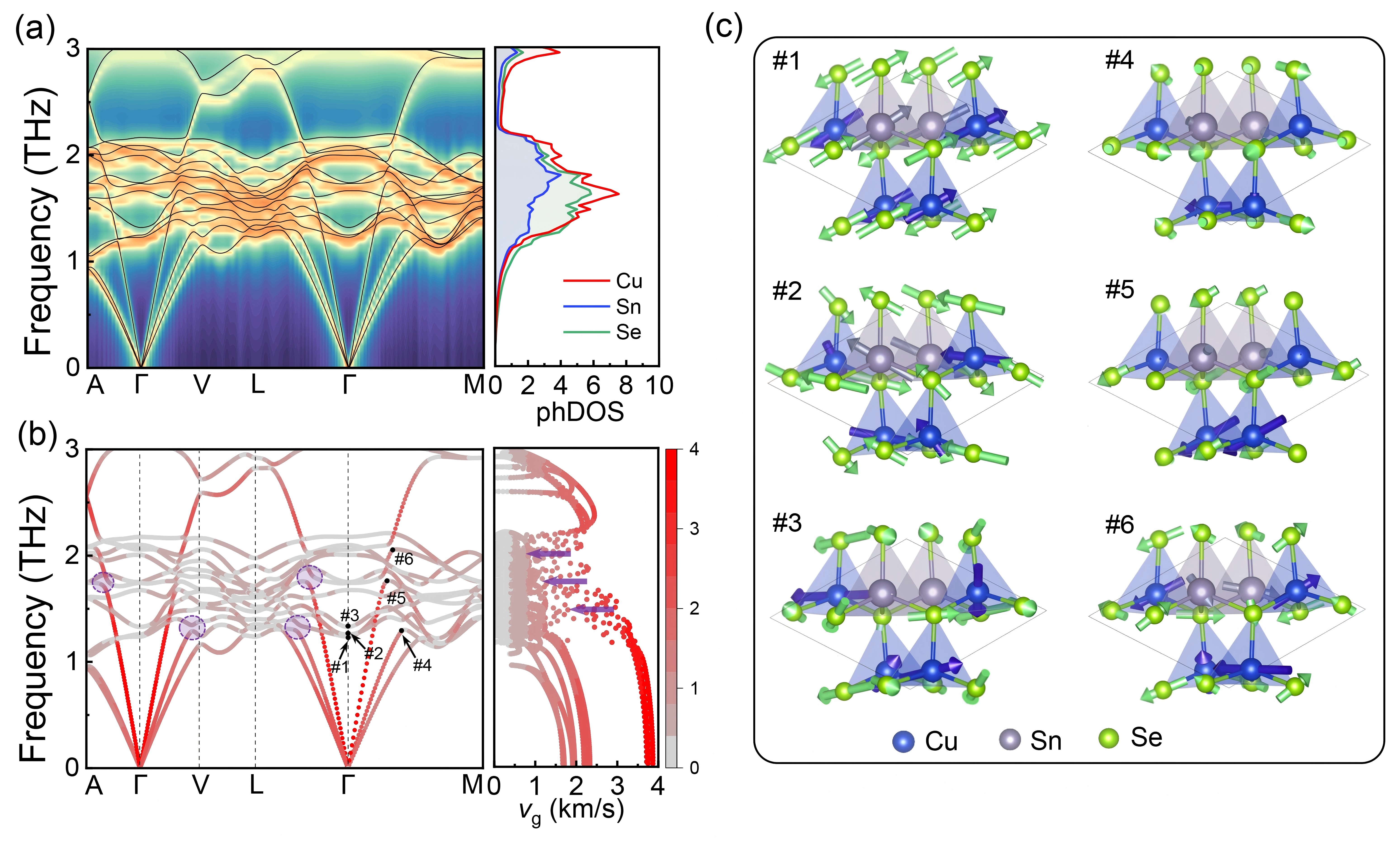
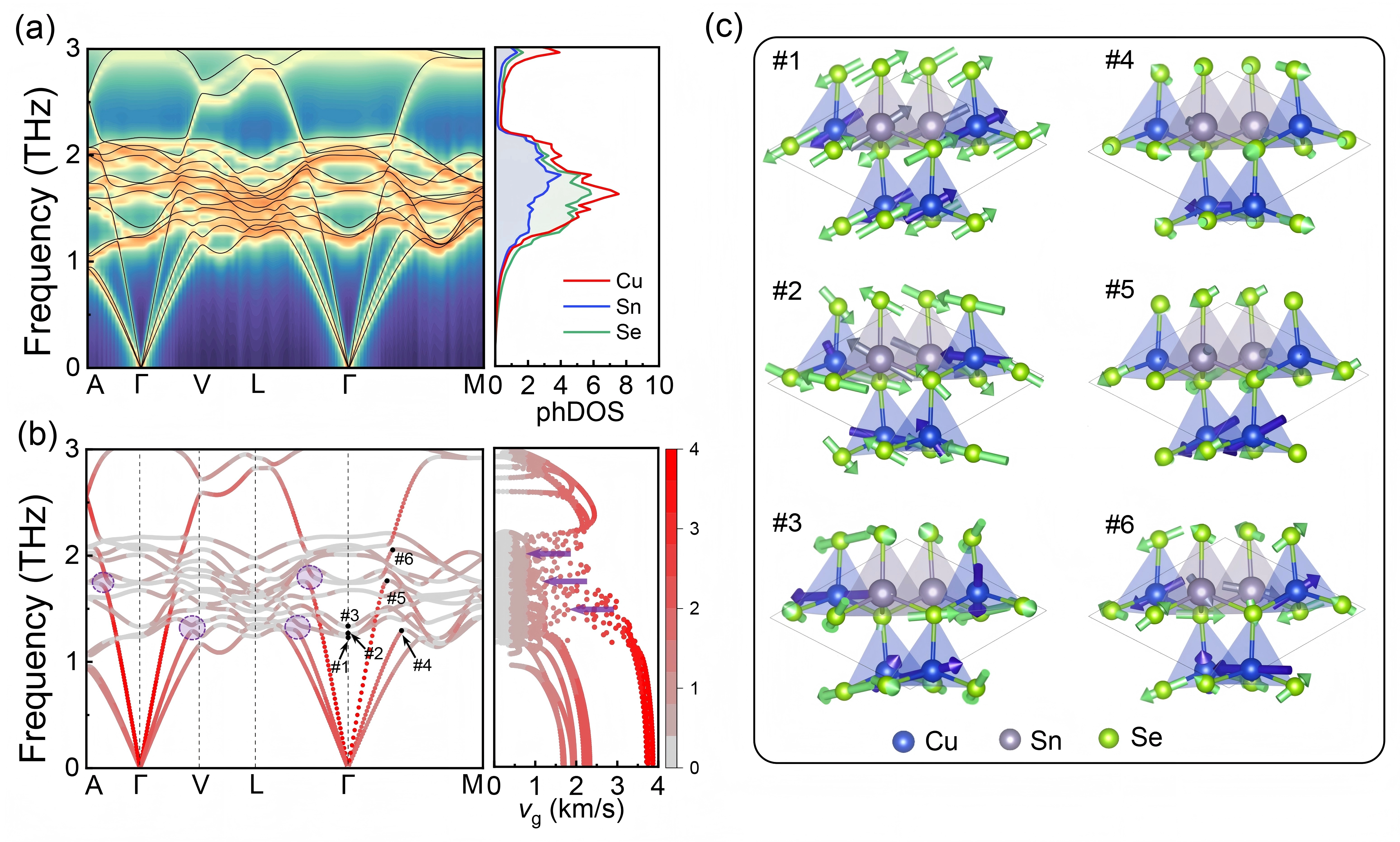
Figure 3. (a) Phonon dispersion and density of states of Cu2SnSe3 at 300 K, including phonon frequency shifts and broadening. The black solid line denotes the harmonic phonon dispersion; (b) Harmonic phonon dispersion at 300 K with projected group velocities (vg) (left panel), and the corresponding vg variation with phonon frequencies (right panel). The color bar, ranging from white (0) to red (4), denotes the phonon group velocity in km/s; (c) Eigenvector visualizations of representative phonon modes in Cu2SnSe3.
Representative eigenvector visualizations for the low-lying optical modes (# 1-3) and the avoided-crossing modes (# 4-6) are provided in Figure 3c. Modes # 1 and # 2 feature antiphase vibrations between [CuSe4]7- and [SnSe4]4- tetrahedra. Mode # 3 specifically involves twisting motions of Cu and Se atoms within [CuSe4]7- tetrahedra. Furthermore, modes # 4-6 clearly reveal the participation of Cu atoms, which perturb the highly dispersive acoustic branches.
Figure 4a,b,c present the 3ph and 4ph scattering rates (SRs) of Cu2SnSe3 at 300, 500, and 800 K. In the 1.2-2.2 THz range, corresponding to the flat optical phonon region, both 3ph and 4ph scattering rates are substantially high, with 3ph SRs being roughly one order of magnitude larger than their 4ph counterparts at 300 K. As temperature increases from 300 to 800 K, however, the 4ph scattering rates rise sharply and eventually become comparable in magnitude to the 3ph rates at 800 K (Figure 4c). Such pronounced scattering rates can be attributed to the combination of a large scattering phase-space volume and a strong Grüneisen parameter (γ).
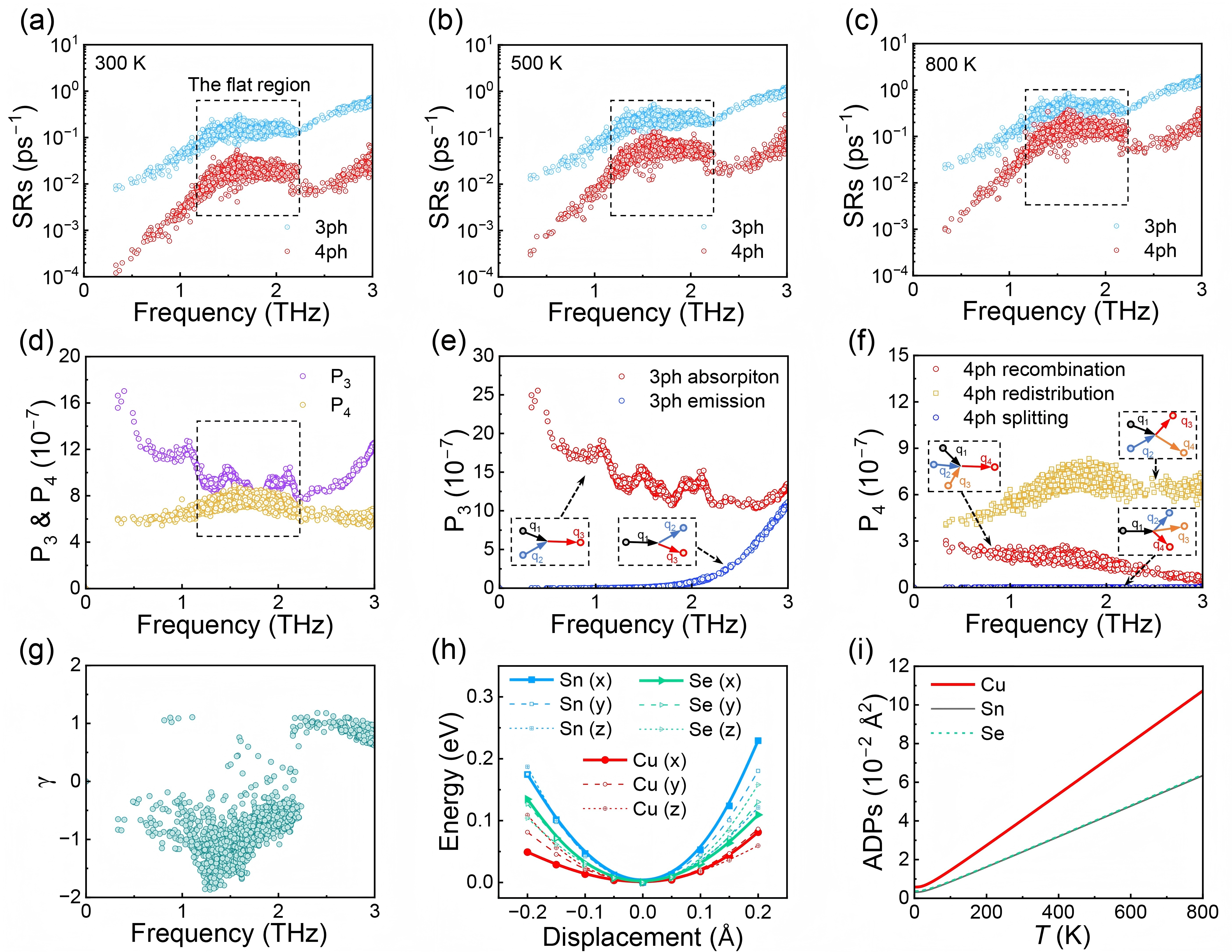
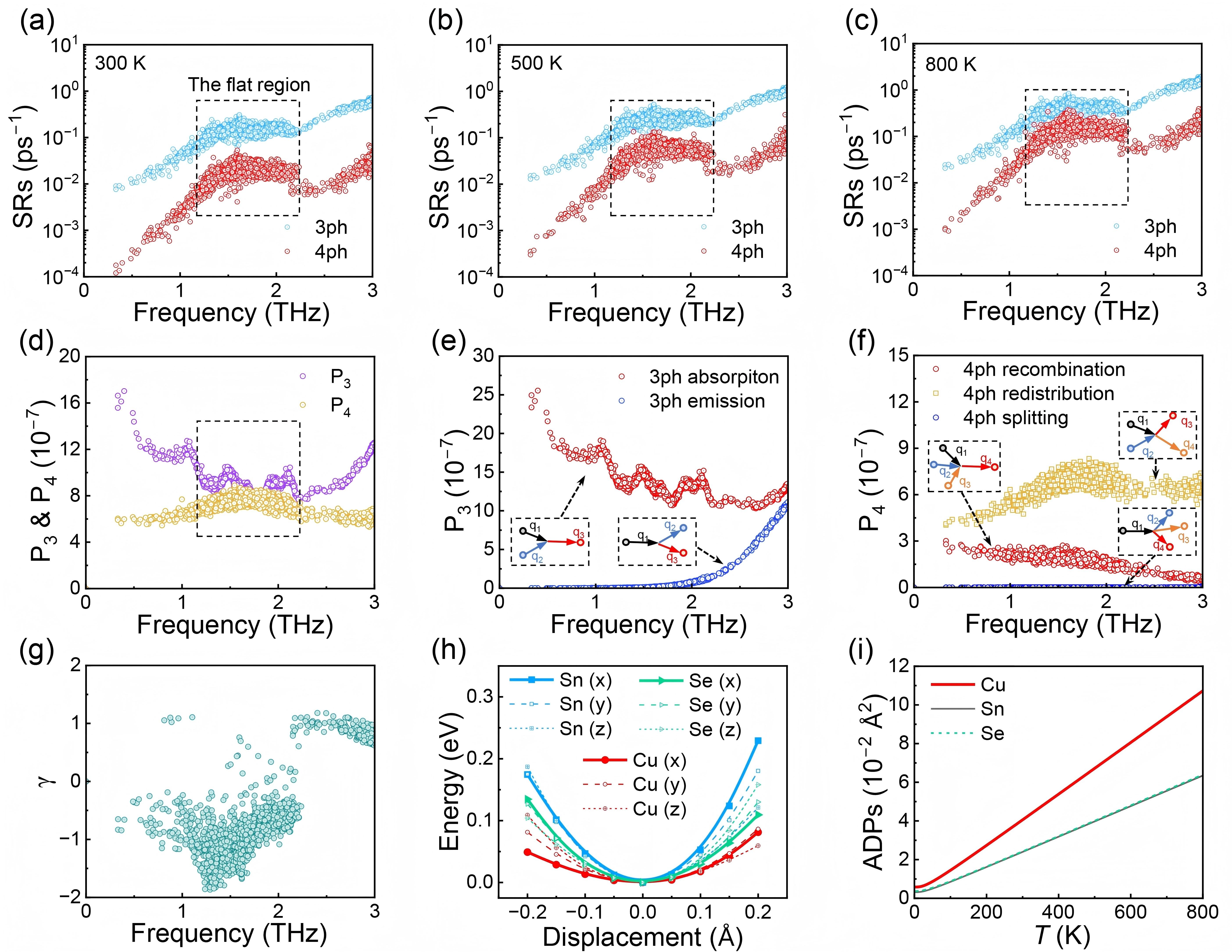
Figure 4. (a-c) Three- (3ph) and four-phonon (4ph) SRs for Cu2SnSe3 at (a) 300 K, (b) 500 K, and (c) 800 K; (d) Dimensionless phonon scattering phase space volumes (P3, P4) at 300 K; (e) Phase space volume for three-phonon scattering (P3); (f) Scattering phase space volume for four-phonon scattering (P4); (g) Grüneisen parameter (γ) as a function of phonon frequency; (h) Potential energies of Cu, Sn, and Se along x, y, and z directions in Cu2SnSe3; (i) Atomic displacement parameters for Cu, Sn, and Se in Cu2SnSe3. 3ph: three-phonon; SRs: scattering rates.
The scattering phase-space volume, which quantifies the number of scattering processes available to each phonon while obeying momentum and energy conservation, depends solely on the phonon dispersion, unlike the scattering rates. We calculated their 3ph and 4ph scattering phase-space volumes (P3 and P4), as shown in Figure 4d. In the flat frequency region, P3 and P4 exhibit comparable magnitudes. For 3ph scattering, the large P3 predominantly arises from the absorption process (Figure 4e), i.e., the coalescence of two phonons into a single phonon. For 4ph scattering, the large P4 in the same frequency range is attributed to the redistribution process (Figure 4f), where two incoming phonons annihilate and generate two outgoing phonons, thereby redistributing energy across different phonon branches. This redistribution process not only enlarges the total 4ph scattering phase space but also introduces additional scattering channels that are particularly effective at high temperatures, thereby contributing to the deviation from the classical T-1 behavior observed in the κL.
Figure 4g shows γ as a function of phonon frequency, with high γ values in the flat region enhancing scattering rates. These large γ values stem from weak Cu-Se bonding, as supported by the phDOS (Figure 3a) and eigenvector visualizations (Figure 3c). Figure 4h presents the potential energy profiles of Cu, Sn, and Se along the x, y, and z directions. The Cu profile is considerably flatter than that of Sn, consistent with the COHP analysis (see ICOHP values in Figure 2b), confirming weaker Cu-Se bonds. Quantitative fitting of these profiles using a third-degree polynomial (y = a1x + a2x2 + a3x3) yields parameters listed in Table S1, revealing a much shallower potential well for Cu (Figure S7) and significantly smaller a2 coefficients (1.6-2.1 for Cu vs. ~ 3.8-5 for Sn and ~ 3-3.3 for Se), indicative of lower bond stiffness. Moreover, the Cu potential is strongly anharmonic, especially along x and z, in contrast to the nearly harmonic potentials of Sn and Se; this anharmonicity arises from the variation in bond lengths and strengths among the four Cu-Se bonds within each tetrahedron (Figure 2b). The asymmetric potential around Cu also leads to large atomic displacement parameters (ADPs) and pronounced anharmonicity in the Cu-related low-frequency optical branches, as confirmed by Figure 4i, where Cu atoms exhibit substantially larger ADPs than Sn and Se.
Beyond the particle-like propagation contribution κp, we also analyzed the coherent (wave-like) contribution κc. Phonons can be classified according to their lifetimes (τ) relative to the Wigner (τWigner) and Ioffe-Regel (τIoffe-Regel) limits: modes with τ > τWigner predominantly contribute to particle-like transport κp, whereas those satisfying τIoffe-Regel < τ < τWigner give rise to wave-like coherent transport κc. With increasing temperature from 300 to 800 K, an increasing number of phonons enter the coherent transport regime (Figure 5a), accounting for the observed enhancement in κc (Figure 2c). The inclusion of 4ph scattering further promotes this trend by enlarging the phonon population that contributes to κc (Figure 5b).
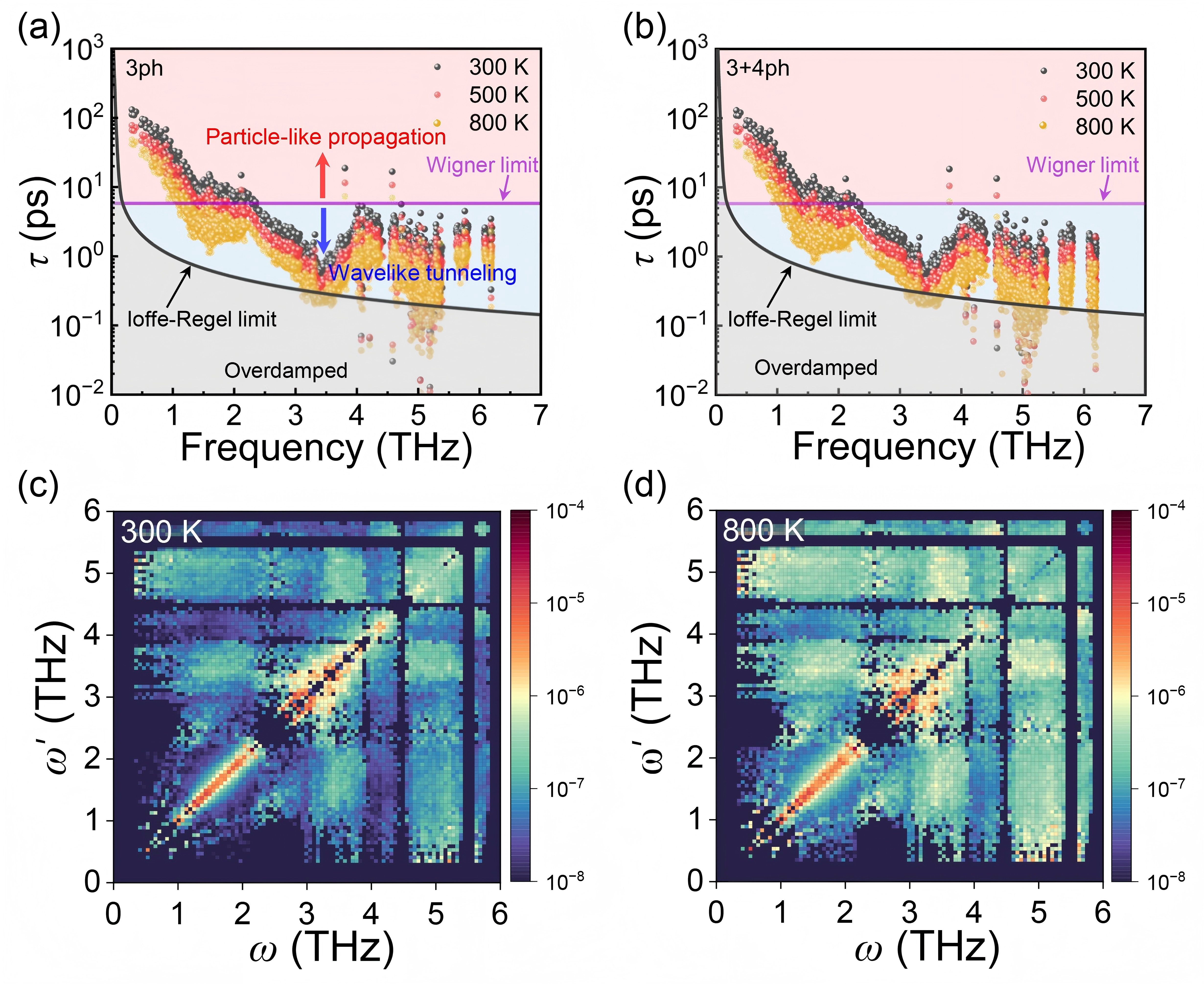
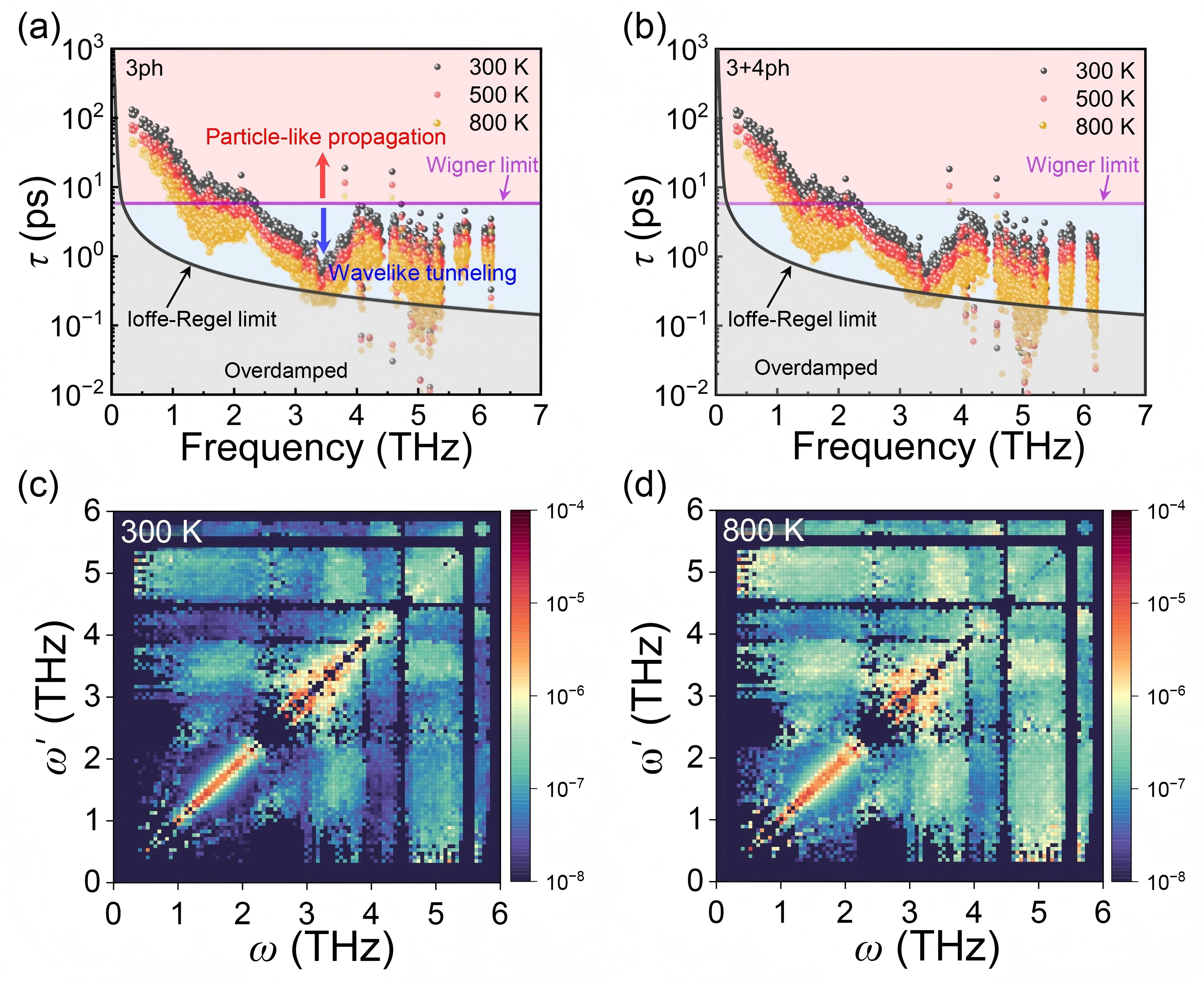
Figure 5. Phonon lifetimes (τ) in Cu2SnSe3 considering (a) only three-phonon (3ph) interactions and (b) both three- and four-phonon (3 + 4ph) interactions, at 300 K, 500 K, and 800 K. The horizontal lines indicate the Wigner limit, τWigner = N/ωmax, where N is the number of phonon branches, and ωmax is the maximum phonon frequency. The solid diagonal lines mark the Ioffe-Regel limit (τIoffe-Regel = 1/ω). Contour plots of the coherent thermal conductivity contribution (κc (3 + 4ph)) as a function of phonon-frequency pairs (ω, ωs) for Cu2SnSe3 at (c) 300K and (d) 800K. 3ph: three-phonon.
To gain deeper insight into the frequency-selective nature of coherent transport, we examined the contribution of phonon branch pairs (ω, ω') to κc. At both 300 and 800 K, κc is dominated by quasi-degenerate phonon pairs with similar frequencies (ω ~ ω'), underscoring the critical role of small interband frequency spacing in facilitating coherence (Figure 5c). As the temperature rises, off-diagonal contributions (from pairs with different frequencies) gradually increase. This broadening of the contributing frequency space is a direct consequence of enhanced phonon broadening, which becomes more pronounced at higher temperatures and more effectively bridges the frequency gaps between distinct phonon modes in Cu2SnSe3 (Figure 5d).
Raman spectroscopy provides direct verification of this phonon broadening. We measured the Raman spectra of Cu2SnSe3 across the temperature range from 93 K to 773 K (Figure S3). The selected spectra at representative temperatures are shown in Figure S3. With increasing temperature, the peaks around 180 cm-1 exhibit pronounced frequency softening (marked by the red arrow) and broadening, ultimately becoming indiscernible above 603 K. A detailed discussion of the Raman spectra is provided in Section 4 of the Supplementary materials.
Cu2SnSe3 exhibits polymorphism, with cation-ordered monoclinic and cation-disordered cubic phases, and is also closely related to its sister compound Cu2SnSe3. This motivates a qualitative analysis of how cation disorder and anion substitution affect its phonon dispersions. To specifically evaluate the impact of cation disorder on phonon dispersions and thermal transport, we computed the phonon spectra of both the ordered monoclinic and disordered cubic polymorphs. The primitive cell of the monoclinic phase (Cu4Sn2Se6) contains 12 atoms (Figure S8), giving rise to 36 phonon branches, whereas that of the cubic phase (Cu0.667Sn0.333Se) comprises only 2 atoms (Figure S8) and thus 6 branches. Figure 6a shows that the monoclinic phase has complex dispersion, with low-lying optical modes (1.3-2.3 THz, yellow shaded) that scatter heat-carrying acoustic phonons, as discussed earlier. Furthermore, although the longitudinal acoustic (LA) branch folds back to lower frequencies owing to acoustic-optical coupling, an optical mode retains the highly dispersive character of the LA branch, extending it up to ~ 3.1 THz (black dashed line).
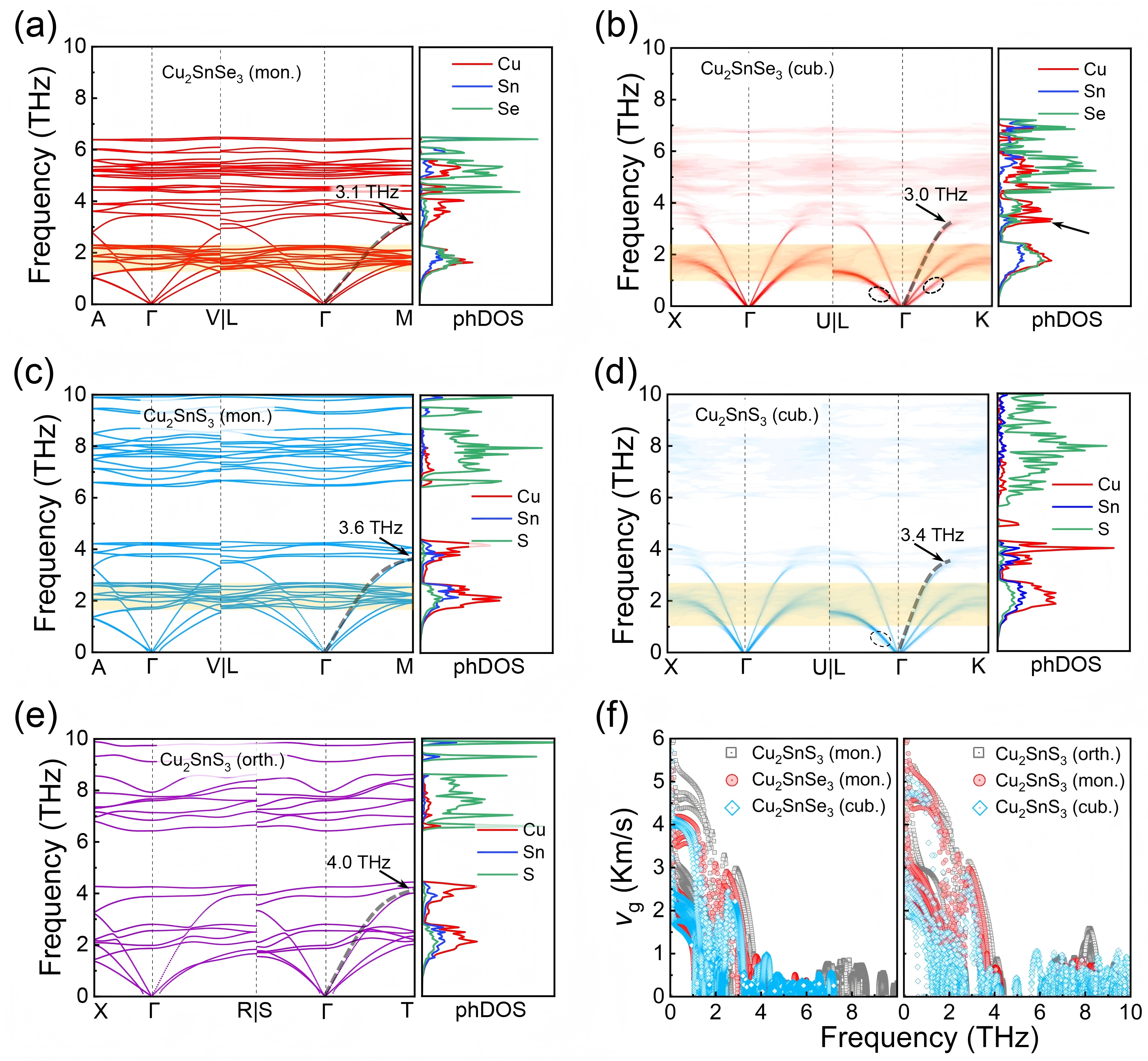
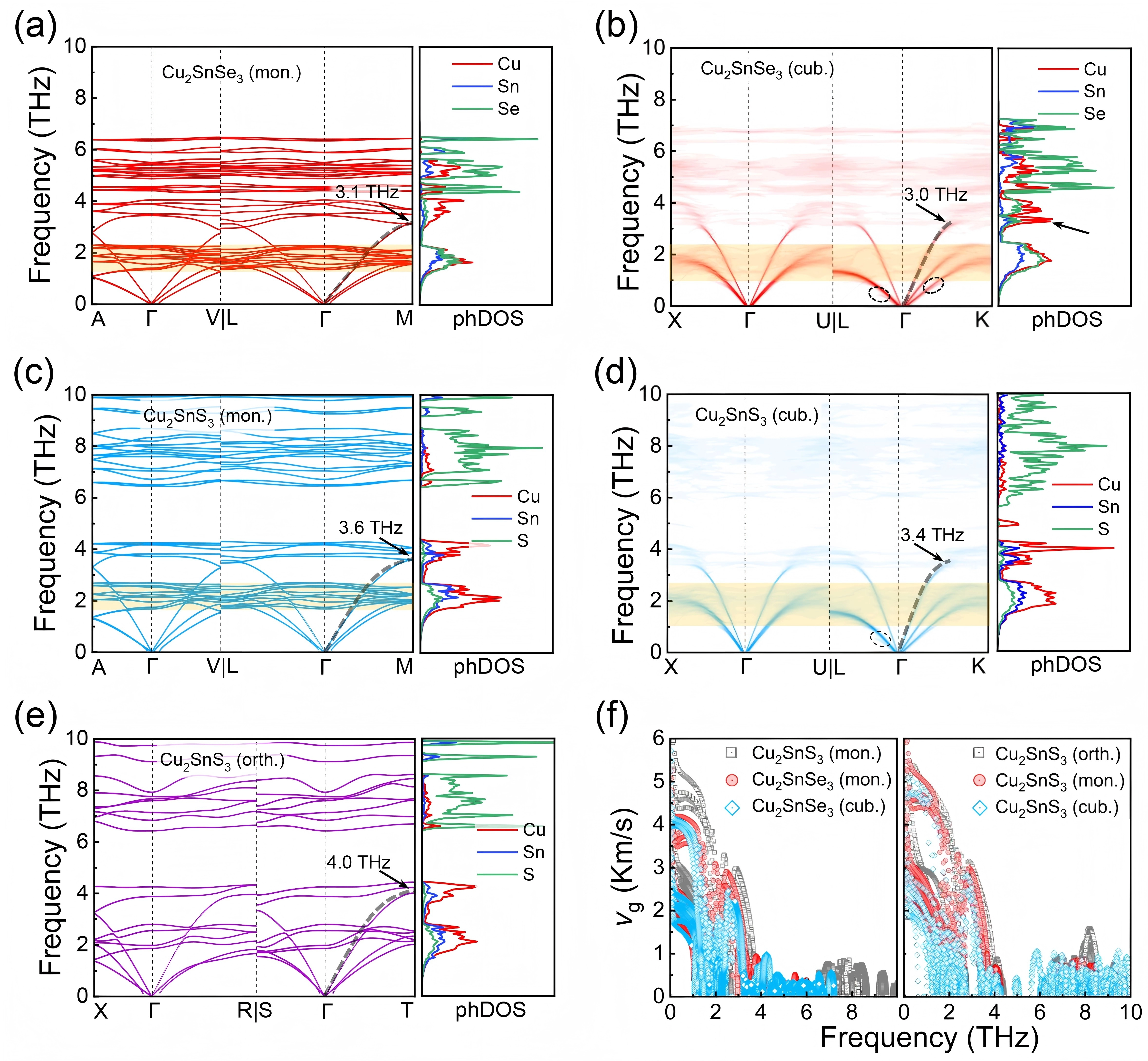
Figure 6. Phonon dispersions and density of states of (a) Monoclinic Cu2SnSe3; (b) Cubic Cu2SnSe3; (c) Monoclinic Cu2SnS3; (d) Cubic Cu2SnS3; (e) Orthorhombic Cu2SnS3 at 0 K; (f) Comparison of phonon group velocities.
In stark contrast, the cubic phase (Figure 6b) shows only three discernible acoustic branches in the low-frequency region; its LA branch reaches ~ 3.0 THz, slightly lower than that of the monoclinic phase, implying a reduced vg (as confirmed by Figure 6f). More importantly, significant broadening is observed in both the high-frequency acoustic and optical modes in the cubic phase, which arises directly from cation disorder. Although no low-frequency optical modes below 3 THz exist to scatter acoustic phonons, the pronounced broadening in the 1-2.3 THz region (yellow shaded area) indicates strong inter-acoustic scattering, and even the transverse acoustic (TA) modes exhibit notable broadening (dashed circle). Collectively, these features suggest that the cubic phase should possess a lower κL than the monoclinic phase, due to both reduced vg and enhanced phonon scattering rates.
To systematically investigate the anion effect, we extended our phonon calculations to Cu2SnS3, which exhibits even richer polymorphism, including cation-ordered orthorhombic and monoclinic, as well as cation-disordered cubic and orthorhombic structures (Figure S8). The general trend observed for Cu2SnSe3 is preserved in the sulfide. The cation-ordered monoclinic Cu2SnS3 displays complex dispersions with low-lying optical modes in the 1.7-4.2 THz range (Figure 6c), while the disordered cubic phase shows only three acoustic branches (Figure 6d); the orthorhombic dispersion (Figure 6e) resembles that of the monoclinic counterpart but has only 18 branches.
Comparing the two compounds (Figure 6), three key differences emerge: (i) the maximum phonon frequency, (ii) the phonon band gap, and (iii) the cut-off frequency of the dispersive branches. For the monoclinic phase, the highest frequency increases from 6.4 THz in Cu2SnSe3 (Figure 6a) to 10 THz in Cu2SnS3 (Figure 6c), and the same trend holds for the cubic phases (Figure 6b,d). Since these high-frequency modes are dominated by anion vibrations, this shift is attributed to the lighter mass of S. Consequently, the upward shift of the optical modes in Cu2SnS3 opens a much wider phonon gap of 2.3 THz (between 4.3 and 6.5 THz, Figure 6c), compared with the narrow gap (4.1-4.3 THz) in Cu2SnSe3, implying weaker scattering across the gap in the sulfide. Moreover, the cut-off frequency of the dispersive branches, which reflects the upper limit of the LA-like modes, is ~ 3 THz for Cu2SnSe3 in both polymorphs, but rises to 3.4-4 THz for Cu2SnS3. This increase originates from the shorter and stronger Sn-S and Cu-S bonds relative to their Se counterparts, as verified by the harmonic interatomic force constants (Figure S9), and is also consistent with higher vg (Figure 6f). Therefore, for the same crystal structure, Cu2SnSe3 is expected to exhibit lower κL than Cu2SnS3, owing to its lower phonon frequencies, narrower gap, and reduced cut-off frequency.
4. Conclusion
In summary, we have theoretically unraveled the microscopic origin of the anomalously low and strongly temperature-dependent κL in Cu2SnSe3 by employing a two-channel thermal transport model that incorporates both three- and four-phonon scattering processes. Our calculations show that κc is negligible at 300 K but becomes progressively more significant at elevated temperatures, while κp remains the dominant contributor to κL over the entire temperature range. Furthermore, four-phonon scattering, rather than three-phonon scattering, is the primary factor responsible for the deviation from the classical T-1 dependence, yielding a temperature scaling of T-1.1 that closely matches the experimental T-1.2 behavior. This strong four-phonon scattering originates from the flat optical phonon modes in the 1.2-2.2 THz range, which provide an exceptionally large scattering phase space volume. The low κL of Cu2SnSe3 relative to other ternary copper-based diamondoid compounds is attributed to the asymmetric potential energy around Cu atoms, which induces large atomic displacement parameters and pronounced anharmonicity in the Cu-related low-frequency optical branches. Furthermore, qualitative analyses of cation disorder and anion substitution show that disorder leads to significant phonon broadening, while replacing Se with S hardens the acoustic branches and shifts the optical modes markedly upward. Our findings clarify the origins of the nonclassical temperature dependence and low κL in Cu2SnSe3, and provide a general way to design diamondoid thermoelectrics with intrinsically low κL.
Supplementary materials
The supplementary material for this article is available at: Supplementary materials.
Authors contribution
Ming H: Investigation, methodology, conceptualization, writing-review & editing.
Lin Z, Xu S: Investigation, formal analysis.
Zheng Y: Conceptualization, supervision.
Luo ZZ: Project administration, conceptualization, supervision, writing-review & editing.
Zou Z: Project administration, supervision.
Conflicts of interest
The authors declare no conflicts of interest.
Ethical approval
Not applicable.
Consent to participate
Not applicable.
Consent for publication
Not applicable.
Availability of data and materials
The data and materials could be obtained from the corresponding author upon request.
Funding
This study is supported in part by the National Natural Science Foundation of China (Grant Nos. 12504032, 52472191, and 52102218), the National Key Research and Development Program of China (Grant No. 2020YFA0710303), and the Fujian Science & Technology Innovation Laboratory for Optoelectronic Information of China (Grant Nos. 2021ZZ127 and 2023RC103). The authors acknowledge the Natural Science Foundation of Fujian Province of China (Grant Nos. 2026J009076, 2024J08290, 2025J010017, and 2025J08029). Yunpeng Zheng is funded by Fuzhou University Testing Fund of precious apparatus (Grant No. 2025T003) and funding (Grant No. XRC-25036-0180-511573). This project is also supported by the State Key Laboratory of New Ceramic Materials Tsinghua University (Grant No. KF202525).
Copyright
© The Author(s) 2026.
References
-
1. Yang D, Xing Y, Wang J, Hu K, Xiao Y, Tang K, et al. Multifactor roadmap for designing low-power-consumed micro thermoelectric thermostats in a closed-loop integrated 5G optical module. Interdiscip Mater. 2024;3(2):326-337.[DOI]
-
2. Xu W, Ding J, Liao L, Gao D, Lai Z, Mei J, et al. Ag-doping-mediated interlayer coordination engineering: Enabling thermoelectric ZT = 1 in TMDs-derived narrow-gap semiconductor CuCrTi2Se6. J Am Chem Soc. 2026;148(22):22653-22662.[DOI]
-
3. Xu W, Guo W, Liao L, Xie C, Cui J, Mei Q, et al. Chemical bond engineering in charge-balanced layered TiSe2 derivatives: 3D charge transport and lattice anharmonicity for exceptional thermoelectric performance. J Am Chem Soc. 2025;147(38):34804-34812.[DOI]
-
4. Huang Y, Lyu T, Zeng M, Wang M, Yu Y, Zhang C, et al. Manipulation of metavalent bonding to stabilize metastable phase: A strategy for enhancing zT in GeSe. Interdiscip Mater. 2024;3(4):607-620.[DOI]
-
5. Zhou Y, Wu H, Wang D, Fu L, Zhang Y, He J, et al. Investigations on electrical and thermal transport properties of Cu2SnSe3 with unusual coexisting nanophases. Mater Today Phys. 2018;7:77-88.[DOI]
-
7. Xie H, Zhao LD, Kanatzidis MG. Lattice dynamics and thermoelectric properties of diamondoid materials. Interdiscip Mater. 2024;3(1):5-28.[DOI]
-
11. Xu T, Bai W, Qin M, Huang L, Liu Y, Wang S, et al. Dual-antisite defects and domain structures synergistically boosting a record-high ZT > 2.0 in chalcopyrite Cu0.7Ag0.3Ga1-xInxTe2(x = 0-0.5). J Am Chem Soc. 2026;148(11):12343-12353.[DOI]
-
12. Candolfi C, Le Gars L, Guélou G, Ventrapati PK, Prestipino C, Guizouarn T, et al. Influence of cationic ordering on the lattice dynamics of monoclinic Cu5Sn2S7 and cubic Cu5Sn2S6.65Cl0.35 sulfides. J Phys Chem C. 2024;128(33):14075-14084.[DOI]
-
13. Lohani K, Nautiyal H, Ataollahi N, Fanciulli C, Sergueev I, Etter M, et al. Experimental and ab initio study of Cu2SnS3(CTS) polymorphs for thermoelectric applications. J Phys Chem C. 2021;125(1):178-188.
-
14. Zhu Y, Wei B, Liu J, Koocher NZ, Li Y, Hu L, et al. Physical insights on the low lattice thermal conductivity of AgInSe2. Mater Today Phys. 2021;19:100428.[DOI]
-
15. Zhang T, Ning S, Zhang T, Qi N, Su X, Tang X, et al. Stepwise vacancy manipulation for optimized carrier concentration and blocked phonon transport realizing record high figure of merit zT in CuInTe2. Adv Funct Mater. 2025;35(30):2419984.[DOI]
-
16. Xie H, Liu Y, Zhang Y, Hao S, Li Z, Cheng M, et al. High thermoelectric performance in chalcopyrite Cu1-xAgxGaTe2-ZnTe: Nontrivial band structure and dynamic doping effect. J Am Chem Soc. 2022;144(20):9113-9125.[DOI]
-
18. Zhang W, Wu F, Hua Y, Nie H, Xu P, Zhao W, et al. Entropy and enthalpy co-tuning strategy in Cu2-yAgy(In0.06Sn0.94)Se2S system toward excellent thermoelectric performance. Adv Funct Mater. 2025;35(15):2420268.[DOI]
-
19. Wan J, Li L, Lin C, Wu Y, Cheng Z, Luo Z, et al. Harnessing halogen-induced anharmonic effect to achieve low lattice thermal conductivity in high-symmetry Cu2SnS3 for high-performance thermoelectric applications. Adv Funct Mater. 2025;35(34):2501535.[DOI]
-
20. Huang Y, Shen X, Wang G, Zhang B, Zheng S, Yang CC, et al. High thermoelectric performance and compatibility in Cu3SbSe4-CuAlS2 composites. Energy Environ Sci. 2023;16(4):1763-1772.[DOI]
-
21. Zhang D, Wang X, Wu H, Huang Y, Zheng S, Zhang B, et al. High thermoelectric performance in earth-abundant Cu3SbS4 by promoting doping efficiency via rational vacancy design. Adv Funct Mater. 2023;33(15):2214163.[DOI]
-
22. Xie H, Su X, Zhang X, Hao S, Bailey TP, Stoumpos CC, et al. Origin of intrinsically low thermal conductivity in talnakhite Cu17.6Fe17.6S32 thermoelectric material: Correlations between lattice dynamics and thermal transport. J Am Chem Soc. 2019;141(27):10905-10914.[DOI]
-
23. Sadia Y, Lifshitz I, Sebaoun D, Gelbstein Y. Transport properties of cd- and Ni-doped CuIn(S, Se, Te)2-based semiconductors. ACS Appl Electron Mater. 2024;6(5):2870-2878.[DOI]
-
25. Parashchuk T. Modulated electronic and thermal transport properties in Cu-based diamond-like chalcogenides by point defect engineering. J Phys Chem C. 2025;129(6):3272-3284.[DOI]
-
26. Malagutti MA, Isotta E, Nautiyal H, Anselmi-Tamburini U, Chiappini A, Bette S, et al. Role of microstructure in the lattice thermal conductivity and thermoelectric performance of Cu2+yZn1-ySnSxSe4-x alloys. J Mater Chem A. 2026;14(40):26757-26769.[DOI]
-
27. Hu L, Luo Y, Fang YW, Qin F, Cao X, Xie H, et al. High thermoelectric performance through crystal symmetry enhancement in triply doped diamondoid compound Cu2SnSe3. Adv Energy Mater. 2021;11(42):2100661.[DOI]
-
28. Zhao H, Xu X, Li C, Tian R, Zhang R, Huang R, et al. Cobalt-doping in Cu2SnS3: Enhanced thermoelectric performance by synergy of phase transition and band structure modification. J Mater Chem A. 2017;5(44):23267-23275.[DOI]
-
29. Zhang J, Huang L, Zhu C, Zhou C, Jabar B, Li J, et al. Design of domain structure and realization of ultralow thermal conductivity for record-high thermoelectric performance in chalcopyrite. Adv Mater. 2019;31(52):1905210.[DOI]
-
30. Huang Y, Zhang B, Li J, Zhou Z, Zheng S, Li N, et al. Unconventional doping effect leads to ultrahigh average thermoelectric power factor in Cu3SbSe4-based composites. Adv Mater. 2022;34(14):2109952.[DOI]
-
31. Xi L, Zhang YB, Shi XY, Yang J, Shi X, Chen LD, et al. Chemical bonding, conductive network, and thermoelectric performance of the ternary semiconductors Cu2SnX3 (X = Se, S) from first principles. Phys Rev B. 2012;86(15):155201.[DOI]
-
32. Zhai YT, Chen S, Yang JH, Xiang HJ, Gong XG, Walsh A, et al. Structural diversity and electronic properties of Cu2SnX3(X = S, Se): A first-principles investigation. Phys Rev B. 2011;84(7):075213.[DOI]
-
34. Li Y, Liu G, Cao T, Liu L, Li J, Chen K, et al. Enhanced thermoelectric properties of Cu2SnSe3 by (Ag, In)-co-doping. Adv Funct Mater. 2016;26(33):6025-6032.[DOI]
-
36. Shi X, Xi L, Fan J, Zhang W, Chen L. Cu-Se bond network and thermoelectric compounds with complex diamondlike structure. Chem Mater. 2010;22(22):6029-6031.[DOI]
-
39. Ming H, Zhu C, Chen T, Yang S, Chen Y, Zhang J, et al. Creating high-dense stacking faults and endo-grown nanoneedles to enhance phonon scattering and improve thermoelectric performance of Cu2SnSe3. Nano Energy. 2022;100:107510.[DOI]
-
41. Li Y, Liu J, Hong J. Anharmonicity-induced strong temperature-dependent thermal conductivity in CuInX2 (X = Se, Te). Phys Rev B. 2022;106(9):094317.[DOI]
-
42. Yu H, Chen LC, Pang HJ, Qiu PF, Peng Q, Chen XJ. Temperature-dependent phonon anharmonicity and thermal transport in CuInTe2. Phys Rev B. 2022;105(24):245204.[DOI]
-
43. Simoncelli M, Marzari N, Mauri F. Wigner formulation of thermal transport in solids. Phys Rev X. 2022;12(4):041011.[DOI]
-
44. Simoncelli M, Marzari N, Mauri F. Unified theory of thermal transport in crystals and glasses. Nat Phys. 2019;15(8):809-813.[DOI]
Copyright
© The Author(s) 2027. This is an Open Access article licensed under a Creative Commons Attribution 4.0 International License (https://creativecommons.org/licenses/by/4.0/), which permits unrestricted use, sharing, adaptation, distribution and reproduction in any medium or format, for any purpose, even commercially, as long as you give appropriate credit to the original author(s) and the source, provide a link to the Creative Commons license, and indicate if changes were made.
Publisher’s Note
Science Exploration remains a neutral stance on jurisdictional claims in published
maps
and institutional affiliations. The views expressed in this article are solely those
of
the author(s) and do not reflect the opinions of the Editors or the publisher.
Share And Cite


Science Exploration Style
Ming H, Lin Z, Xu S, Zheng Y, Luo ZZ, Zou Z. Revealing the origin of strongly temperature-dependent lattice thermal conductivity in Cu2SnSe3. Thermo-X. 2027;3:202630. https://doi.org/10.70401/tx.2026.0033
Tips
Copy completed.
Submit a Manuscript
Author Instructions
Cite this Article
Article Metrics
0
View
0
Download
Cited
Article Updates

 Get citation
Science Exploration Style

Ming H, Lin Z, Xu S, Zheng Y, Luo ZZ, Zou Z. Revealing the origin of strongly temperature-dependent lattice thermal conductivity in Cu2SnSe3. Thermo-X. 2027;3:202630. https://doi.org/10.70401/tx.2026.0033
copy
Share Link
copy