Thermomechanical programming boosts phase change enthalpy

Jindi Zhao
Yuhao Feng
Yu Jiang
Xiao Chen
*

*Correspondence to:
Xiao Chen, School of Physics and Astronomy, Beijing Normal University, Beijing 100875, China.
E-mail: xiaochen@bnu.edu.cn
Thermo-X. 2026;2:202635. 10.70401/tx.2026.0034
Received: August 06, 2026Accepted: September 04, 2026Published: September 09, 2026
Graphical Abstract
Thermal energy storage and intelligent thermal management are critical to the energy efficiency, operational, safety and service life of cutting-edge technologies spanning electric vehicles, wearable electronics, and large-scale energy storage systems[1,2]. Phase change materials (PCMs), which store and release substantial latent heat through reversible phase transitions, represent a highly promising thermal energy storage technology[3]. Among them, solid-solid phase change materials (SSPCMs) overcome the liquid leakage and structural failure issues inherent to conventional solid-liquid PCMs[4]. Polyurethane (PU)-based SSPCMs offer tunable phase transition temperatures, superior mechanical flexibility, and versatile molecular designability, positioning them as a competitive platform for advanced SSPCM development. Phase transition enthalpy, as the core performance metric of PCMs, directly governs the thermal energy storage capacity per unit mass. However, the covalently cross-linked network of PU-based SSPCMs strictly restricts the mobility of phase change soft segments, impeding the formation of highly ordered crystalline structures[5]. This constraint results in intrinsically low enthalpy, severely limiting their thermal management capabilities. To address this limitation, researchers have developed strategies including chemical grafting, nanoconfinement, and filler doping to improve the enthalpy of SSPCMs[5-7]. Although these approaches yield moderate improvements, they rely on the introduction of exogenous components or alterations to the chemical composition, which increases processing complexity and production costs, compromises recyclability, and hinders scalability and practical application. Specifically, filler doping suffers from aggregation and interfacial thermal resistance issues, chemical grafting produces irreversible cross-links that undermine reprocessability, and nanoconfinement involves complicated template fabrication procedures. Therefore, exploring an intrinsic, simple, and universal strategy to break the structural constraints of cross-linked SSPCMs and elevate their enthalpy without introducing of additional components has become a critical scientific challenge in this field.
Urethane bonds, the core functional groups of PU networks, exhibit unique thermoresponsive behavior. At high temperatures (> 130 °C), they undergo dynamic exchange, endowing thermosetting PU with reprocessability[8]. Unlike low-activation dynamic bonds (e.g., disulfide bonds) that tend to undergo stress relaxation at service temperatures, the dynamic exchange of urethane bonds features a high activation threshold[9,10]. This creates a thermal safety window above the phase transition temperature of PU, ensuring the stability of the programmed topological structure during thermal cycling. Mechanical stretching induces chain orientation and crystallization in polymer systems. PU features an intrinsic microphase-separated structure with prominent advantages. Rigid hard segments form stable mechanical skeletons capable of sustaining high-stress elongation, while flexible soft segments serve as crystallizable reservoirs that undergo pronounced orientation along the stretching direction[5]. This structural configuration facilitates stress-induced crystallization. Based on these inherent characteristics, Zou and colleagues[11] integrated the dynamic exchange of urethane bonds with stress-induced crystallization in Joule, proposing a thermomechanical programming strategy to realize robust enthalpy enhancement in PU-based SSPCMs.
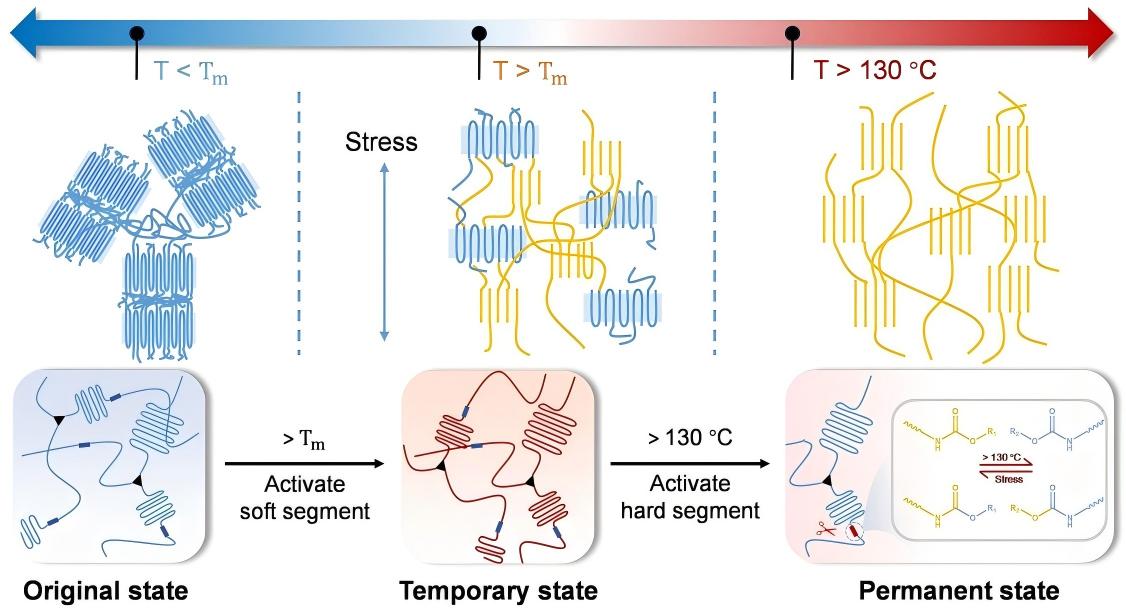
The fundamental mechanism of this thermomechanical programming strategy relies on the synergistic effect of high-temperature dynamic bond exchange and mechanical stretching. The programmable polyurethane (PPU) is synthesized via polycondensation of polyethylene glycol (PEG), glycerol (GLY), and hexamethylene diisocyanate (HDI). The PEG soft segments provide phase change functionality, while the urethane bonds derived from HDI impart dynamic exchange capability and mechanical robustness (Figure 1a). Stretching at 150 °C activates the dynamic exchange of urethane bonds, enabling topological rearrangement of the polymer network, dissipation of stored elastic energy, resetting of the network reference state, and establishment of a thermodynamically stable oriented configuration. Tensile stress drives high orientation of soft segments along the stretching direction. This oriented topology reduces the entropic penalty and nucleation Gibbs free energy barrier for crystallization upon cooling, thereby promoting the formation of highly ordered, densely packed crystalline domains. In contrast, stretching below 130 °C relies solely on entropic elasticity for temporary chain orientation, and the oriented structure relaxes and recovers upon reheating, leading to reversible enthalpy variation (Figure 1b). Notably, thermomechanical programming achieves the irreversible fixation of the oriented crystalline structure and robust enthalpy enhancement (Figure 1c). Experimental results demonstrate that PPU-3 stretched at 150 °C to a 150% strain exhibits an enthalpy increase from 85.98 J·g-1 to 96.81 J·g-1, representing a 12.60% enhancement[11]. The programmed PPU maintains stable phase change enthalpy over 100 thermal cycles[11]. Structural characterization confirms the formation of well-defined crystalline domains with significantly improved crystallinity, and a fixed chain orientation factor of 0.53. The enthalpy enhancement presents a nonlinear dependence on strain: crystallinity increases rapidly in the 0%-50% strain range, achieving peak enthalpy gain; beyond 50% strain, crystallinity plateaus, and further enthalpy enhancement proceeds slowly, attributed to saturation of stress-induced crystallization and the limited latent heat contribution of subsequent structural refinements such as lamellar thickening. Moreover, the crosslinking density of PPU exerts a non-monotonic effect on enthalpy enhancement: an intermediate crosslinking density balances dynamic exchange reactivity and structural adaptability to yield the maximum enthalpy gain, whereas excessively low crosslinking density fails to stabilize crystalline domains and excessively high crosslinking density restricts chain mobility. Although thermomechanical programming achieves stable 12.60% irreversible enthalpy enhancement, it still remains challenging whether such peak enthalpy gains can be reliably reproduced in scaled manufacturing under variable industrial thermomechanical conditions remains challenging. With material scaling toward batch production, uniform control over stretching rate, holding time, and stress distribution becomes demanding, posing a fundamental tradeoff between high enthalpy and scalable process feasibility.
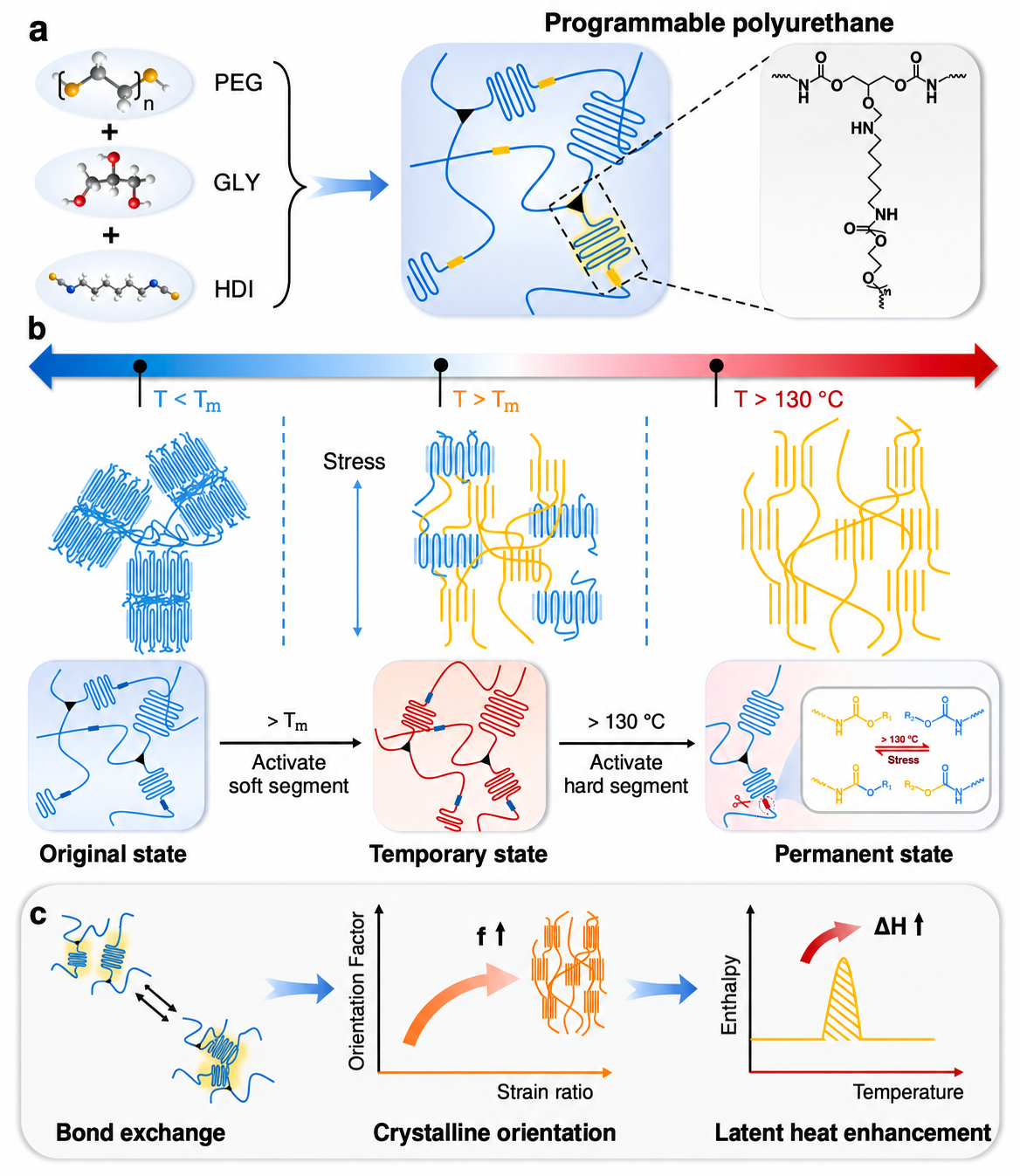
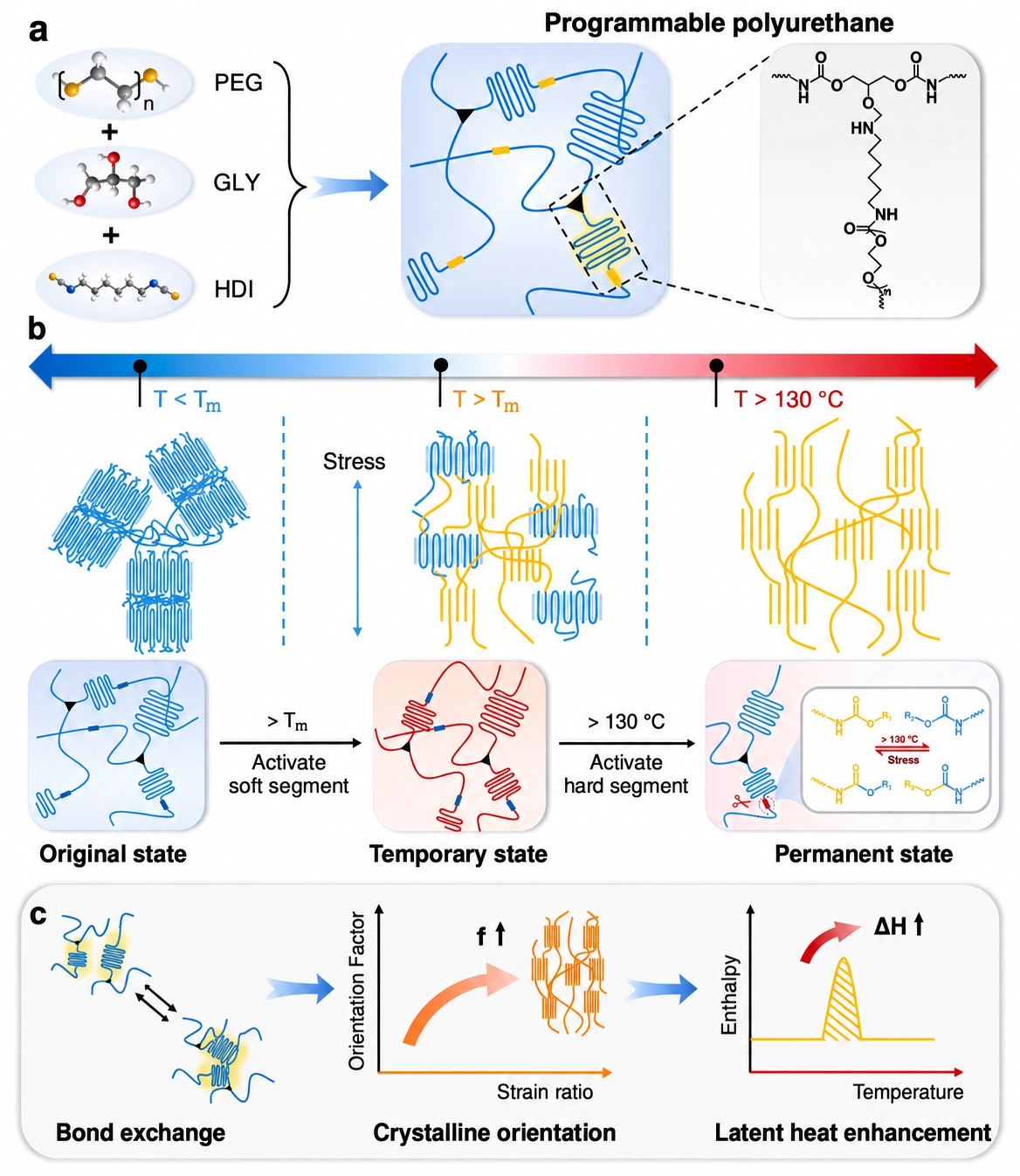
Figure 1. Schematic illustration of mechanism for enthalpy enhancement in PPU. (a) Schematic illustration of the synthesis of PPU; (b)Temperature-dependent structural evolution of PPU; (c) Schematic summary of the thermomechanical programming process. Reproduced with permission from reference[11]. Copyright © 2026 Elsevier. PPU: programmable polyurethane; PEG: polyethylene glycol; GLY: glycerol; HDI: hexamethylene diisocyanate.
The thermomechanical programming strategy boasts excellent universality. This research verified this approach across PU systems synthesized with different diisocyanates (cycloaliphatic isophorone diisocyanate and aromatic tolylene diisocyanate) and crosslinkers (triethanolamine), all of which achieved significant enthalpy enhancement after high-temperature stretching. Topological rearrangement and stress-induced crystallization driven by urethane bond dynamic exchange are intrinsic characteristics of PU dynamic networks, independent of the specific chemical structures of hard segments and crosslinkers. Such universality endows the strategy with broad application prospects in the design of various PU-based SSPCMs and offers guiding principles for enthalpy enhancement in dynamic covalent polymer networks more generally. PPU also features excellent recyclability and reprocessability, rooted in the dynamic exchange characteristics of urethane bonds. PPU dissolves completely in dimethylformamide at 150 °C through solvent-assisted thermal dissociation of urethane bonds and re-crosslinks into homogeneous films upon heating. Recycled PPU retains an almost identical chemical structure and phase change enthalpy to the pristine form. Fragmented PPU can be fabricated into integrated membranes through direct hot-pressing at 150 °C. Reprocessed PPU maintains favorable mechanical ductility and phase change enthalpy, overcoming the poor recyclability of traditional cross-linked SSPCMs and offering significant benefits for material sustainability and reduced environmental impact.
Battery thermal management tests further confirm the practical utility of programmed PPU. High-rate discharge tests on pouch cells show that the PPU thermal management layer efficiently absorbs battery-generated heat through solid-solid phase transition. Under extreme 17C discharge conditions, the peak temperature of the battery is reduced by 16.10 °C compared to the unprotected group, with the battery temperature maintained stably below the critical safety threshold of 60 °C[11]. In battery 2C charge-discharge cycle tests, cells wrapped with programmed PPU exhibit surface temperatures 2 °C lower than those wrapped with pristine PPU throughout cycling. Infrared thermal images clearly reveal a temperature gradient between PPU-wrapped and exposed areas of the battery surface, directly demonstrating the excellent thermal buffering effect of programmed PPU. These results confirm that enthalpy-enhanced PPU effectively mitigates rapid heat accumulation in lithium-ion batteries under extreme charge-discharge conditions, underscoring its application potential for passive thermal management in high-power energy devices as well as other scenarios demanding superior phase change enthalpy and reprocessability, such as wearable electronics. Although programmed PPU delivers remarkable thermal buffering effects, its long-term stability under alternating extreme temperatures remains unvalidated, and future studies should systematically characterize its thermal regulation reliability across thousands of deep charge-discharge cycles.
In summary, this research develops a thermomechanical programming strategy based on urethane bond dynamic exchange, realizing the robust enthalpy enhancement in PU-based SSPCMs without chemical modification. Importantly, this research breaks the traditional paradigm of enhancing SSPCM enthalpy through external component incorporation, establishes a scalable energy-state programming method for dynamic polymer networks, and offers new perspectives for the design of high-enthalpy, reconfigurable, and sustainable thermal energy storage materials. Future efforts may focus on process optimization of thermomechanical programming, including systematic refinement of stretching rate and holding time to maximize enthalpy gains. Beyond structural modulation, functional integration presents new design opportunities, enabling this strategy to be combined with antibacterial, antistatic, or other functional modifications to construct multifunctional SSPCMs for diverse application scenarios. Additionally, it is essential to explore how programming affects the subsequent mechanical response. Furthermore, long-term service behavior warrants deeper investigation, as the thermal management performance of PPU under extreme temperatures and prolonged cycling conditions requires further validation to support practical systems. Finally, extending beyond PU systems, the broader translation of this dynamic covalent bond-based thermomechanical programming approach to other polymer-type SSPCMs holds promise for driving universal innovation in thermal energy storage materials.
Acknowledgements
Deepseek V3.1 was used solely for language editing and polishing of the manuscript. The authors reviewed, revised, and approved the final manuscript and take full responsibility for its content.
Authors contribution
Zhao J: Methodology, writing-original draft.
Feng Y: Data curation, visualization.
Jiang Y: Methodology.
Chen X: Supervision, writing-review & editing, funding acquisition.
Conflicts of interest
The authors declare no competing interests.
Ethical approval
Not applicable.
Consent to participate
Not applicable.
Consent for publication
Not applicable.
Availability of data and materials
Not applicable.
Funding
This work was financially supported by the Beijing Natural Science Foundation (Grant No. 2264105).
Copyright
© The Author(s) 2026.
References
-
1. Li ZR, Hu N, Wang ZB, Fu GT, Lai YY, Wu YF, et al. Pulse heating and slip enhance charging of phase-change thermal batteries. Nature. 2026;649(8096):360-365.[DOI]
-
3. Saher S, Johnston S, Esther-Kelvin R, Pringle JM, MacFarlane DR, Matuszek K. Trimodal thermal energy storage material for renewable energy applications. Nature. 2024;636(8043):622-626.[DOI]
-
4. Wang M, Zhang YJ. Thermal and mechanical robust solid-solid phase change materials enabled by reactive crosslinkable poly(ethylene glycol)s via facile thiol-ene photo-click chemistry. Adv Funct Mater. 2025;35(14):2420042.[DOI]
-
5. Aftab W, Mahmood A, Guo W, Yousaf M, Tabassum H, Huang X, et al. Polyurethane-based flexible and conductive phase change composites for energy conversion and storage. Energy Storage Mater. 2019;20:401-409.[DOI]
-
6. Huang R, Zhao F, Li Y, Jiang Z, He F, Zhang K, et al. GO-enhanced polyurethane phase change materials with triple dynamic bonds: Oxime-urethane, coordination and hydrogen bonds. Chem Eng J. 2025;522:168010.[DOI]
-
8. Liang H, Zhang S, Liu Y, Yang Y, Zhang Y, Wu Y, et al. Merging the interfaces of different shape-shifting polymers using hybrid exchange reactions. Adv Mater. 2023;35(1):2202462.[DOI]
-
9. Huyan C, Pan C, Chen Q, Wang T, Yang F, Ge J, et al. Recyclable polyurethane thermosets with high rigidness and toughness via side chain induced dual phase separation strategy. Adv Mater. 2026;38(1):e11620.[DOI]
-
11. Han H, Xiong F, Jin Y, Qin M, Jia K, Chu HK, et al. Robust enthalpy enhancement of polyurethane-based phase change materials via thermomechanical programming. Joule. 2026;10(7):102399.[DOI]
Copyright
© The Author(s) 2026. This is an Open Access article licensed under a Creative Commons Attribution 4.0 International License (https://creativecommons.org/licenses/by/4.0/), which permits unrestricted use, sharing, adaptation, distribution and reproduction in any medium or format, for any purpose, even commercially, as long as you give appropriate credit to the original author(s) and the source, provide a link to the Creative Commons license, and indicate if changes were made.
Publisher’s Note
Science Exploration remains a neutral stance on jurisdictional claims in published
maps
and institutional affiliations. The views expressed in this article are solely those
of
the author(s) and do not reflect the opinions of the Editors or the publisher.
Share And Cite


Science Exploration Style
Zhao J, Feng Y, Jiang Y, Chen X. Thermomechanical programming boosts phase change enthalpy. Thermo-X. 2026;2:202635. https://doi.org/10.70401/tx.2026.0034
Tips
Copy completed.
Submit a Manuscript
Author Instructions
Cite this Article
Article Metrics
0
View
0
Download
Cited
Article Updates

 Get citation
Science Exploration Style

Zhao J, Feng Y, Jiang Y, Chen X. Thermomechanical programming boosts phase change enthalpy. Thermo-X. 2026;2:202635. https://doi.org/10.70401/tx.2026.0034
copy
Share Link
copy