Phonon-mediated thermal transport at cryogenic temperatures: physical insights and device applications
Xinyu Zhang
1

,
Ru Jia
1
,
Cheng Shao
2,*
,
Hua Bao
1,*
*Correspondence to:
Cheng Shao, Shandong Institute of Advanced Technology, Jinan 250103, Shandong, China.
E-mail: cheng.shao@iat.cn
Hua Bao, Global Institute of Future Technology, Shanghai Jiao Tong University, Shanghai 200240, China. E-mail: hua.bao@sjtu.edu.cn
Hua Bao, Global Institute of Future Technology, Shanghai Jiao Tong University, Shanghai 200240, China. E-mail: hua.bao@sjtu.edu.cn
Thermo-X. 2026;2:202617. 10.70401/tx.2026.0035
Received: April 30, 2026Accepted: September 16, 2026Published: September 17, 2026
Abstract
At cryogenic temperatures, thermal transport is predominantly governed by long-wavelength acoustic phonons with exceptionally long intrinsic mean free paths, leading to significant departures from the diffusive transport behavior characteristic of room temperature. Understanding these transport mechanisms is essential for emerging technologies, including quantum computing, cryogenic electronics, and aerospace systems. This review summarizes the fundamental physics governing phonon-mediated thermal transport in the cryogenic regime. We first introduce the classical Casimir-Knudsen framework for geometry-limited transport and then discuss how this picture is modified by reduced dimensionality, competing scattering mechanisms, collective phonon transport, and wave effects. Particular emphasis is placed on the physical origins of thermal-conductivity behaviors that deviate from the conventional T3 scaling. We further examine the implications of cryogenic phonon transport for self-heating and thermal management in electronic and quantum devices. Finally, we identify key unresolved questions, particularly regarding predictive modeling and thermal management in cryogenic quantum devices. By providing a unified overview of recent advances, this review aims to stimulate further progress in the fundamental understanding and engineering of thermal transport at cryogenic temperatures.
Graphical Abstract
Keywords
Cryogenic temperature, thermal transport, phonon transport properties
1. Introduction
Recent years have witnessed rapid advances in quantum computing[1-3], spacecraft technologies[4-6], and cryogenic refrigeration systems[7-9], many of which operate at temperatures ranging from tens of kelvin to the millikelvin regime. Under such conditions, even nanowatt-level heat dissipation can produce significant local temperature rises because of the extremely limited cooling power[10]. Continued device miniaturization and increasing integration density further exacerbate self-heating and inter-device thermal crosstalk, making thermal management essential for maintaining device reliability and ultimately sustaining overall system performance[11].
Heat transport at cryogenic temperatures differs fundamentally from its room-temperature counterpart. As temperature decreases, anharmonic phonon-phonon scattering is strongly suppressed, thermal conduction becomes increasingly dominated by long-wavelength acoustic phonons, and intrinsic phonon mean free paths may exceed the characteristic dimensions of the system. Consequently, heat transport becomes highly sensitive to elastic anisotropy, disorder, and sample geometry[12-14]. Under these conditions, a variety of non-Fourier transport phenomena[15] can emerge, challenging the conventional diffusive description based on Fourier's law.
Experimental[16-20] and theoretical models[21-26] have substantially advanced the understanding of thermal transport at cryogenic temperatures. More recently, first-principles lattice dynamics, Boltzmann transport equation (BTE) methods, and advances in high-performance computing have enabled increasingly predictive simulations of phonon transport[27-29]. Previous reviews have broadly examined nanoscale and non-Fourier phonon transport or focused on individual transport mechanisms[15,30]. However, cryogenic thermal transport has often been considered only as a subset of these broader topics rather than as a distinct organizing theme. This has hindered a systematic understanding of the unique transport mechanisms that emerge at cryogenic temperatures and their implications for thermal management in cryogenic electronic and quantum devices.
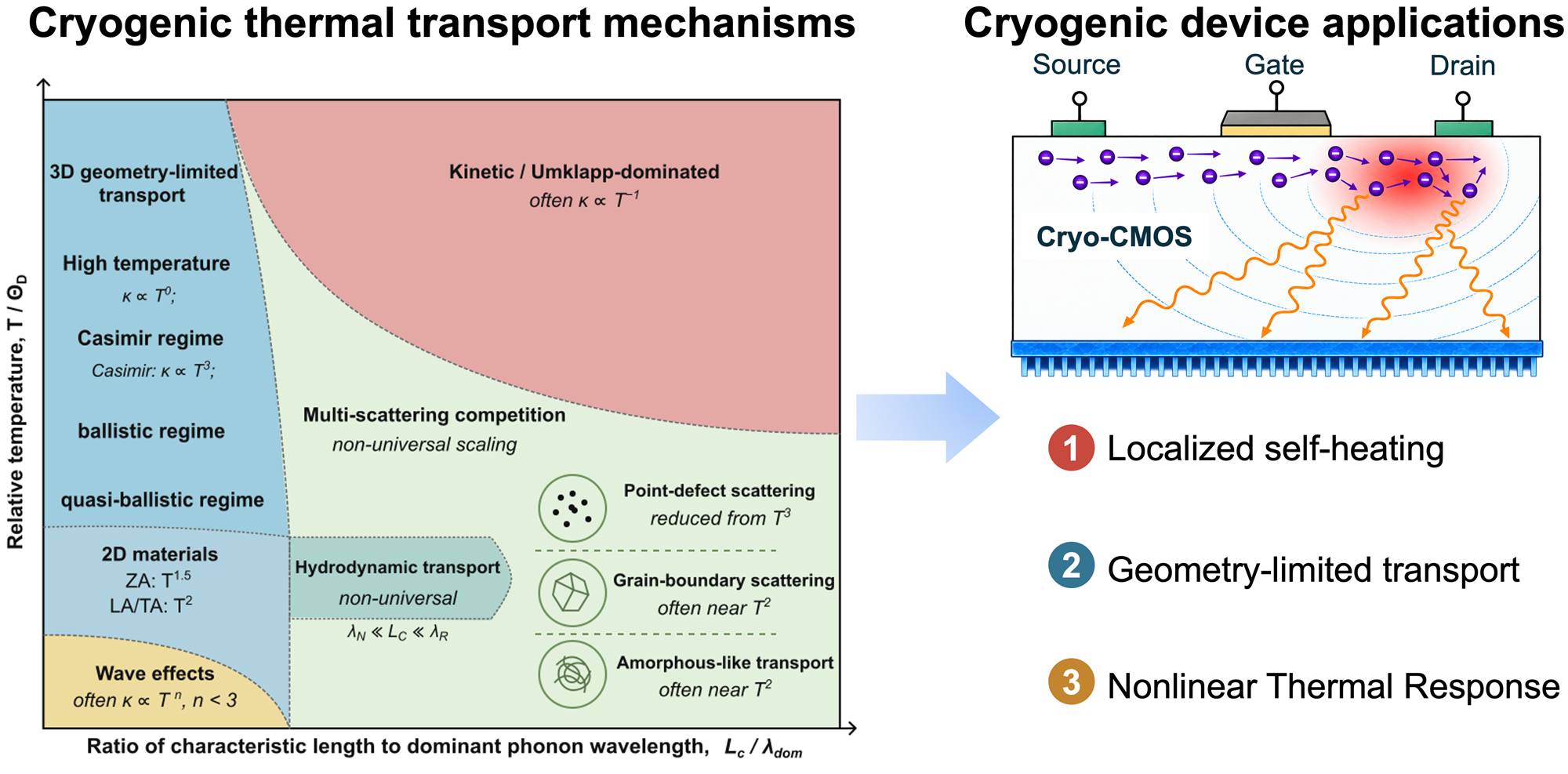
Motivated by this need, we offer a unified perspective on cryogenic phonon transport, organizing transport mechanisms across temperature and length scales, clarifying deviations from (T3) scaling, and connecting the underlying physics to thermal management in cryogenic devices. Figure 1 schematically maps the dominant transport regimes using temperature and characteristic length scales normalized by the Debye temperature and phonon mean free path, respectively. Guided by this framework, the following sections examine the major transport mechanisms, with their key characteristics summarized in Table 1. Finally, we examine the mechanisms emerging in electronic and quantum devices, with particular emphasis on mitigating cryogenic self-heating. This present review focuses on phonon-mediated thermal transport in dielectric, insulating, and lightly doped semiconducting materials. Although electrons, magnons, and other quasiparticles[31-33] may contribute significantly to heat transport in metals, magnetic materials, and correlated quantum materials, these coupled transport phenomena are beyond the scope of this review.
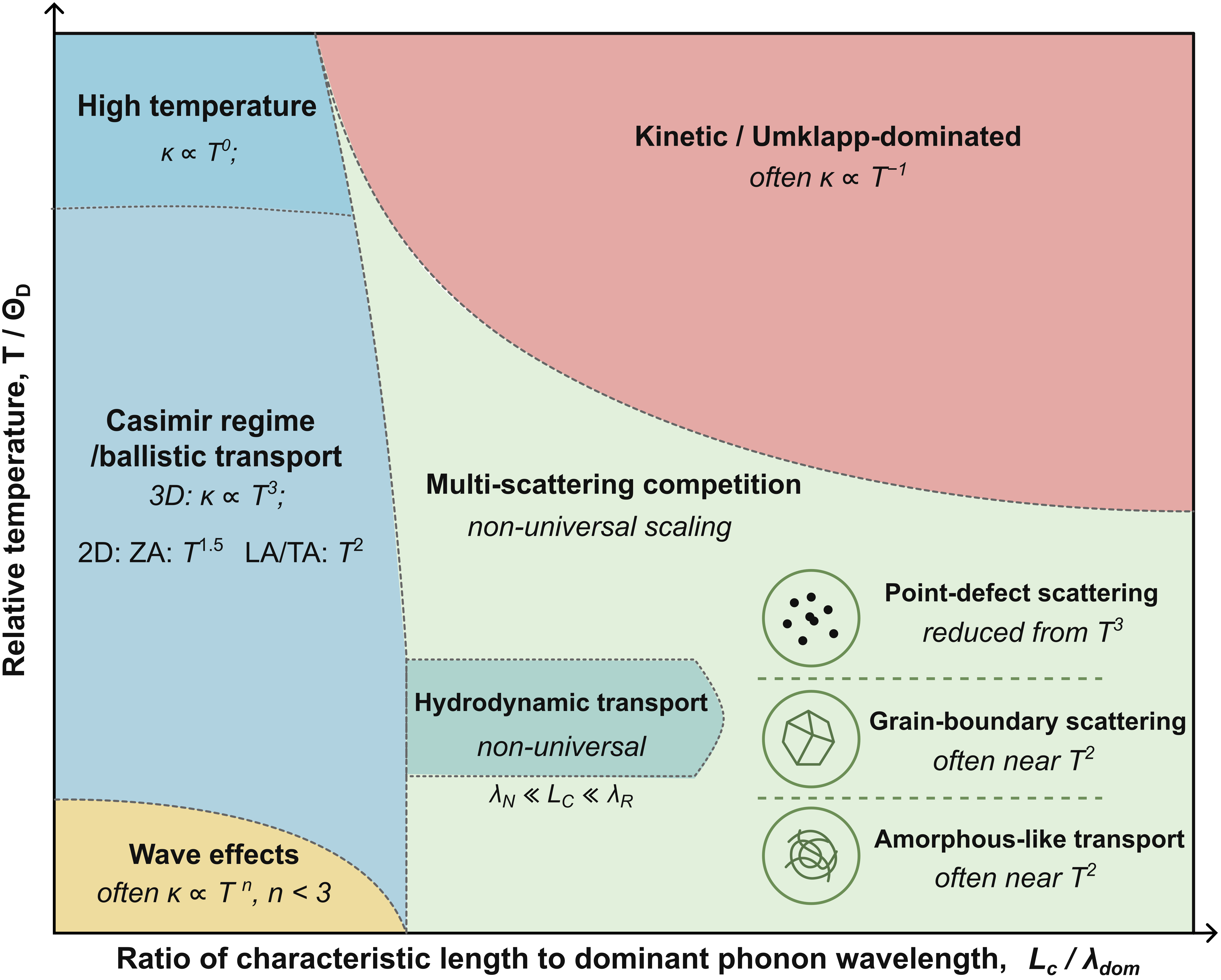
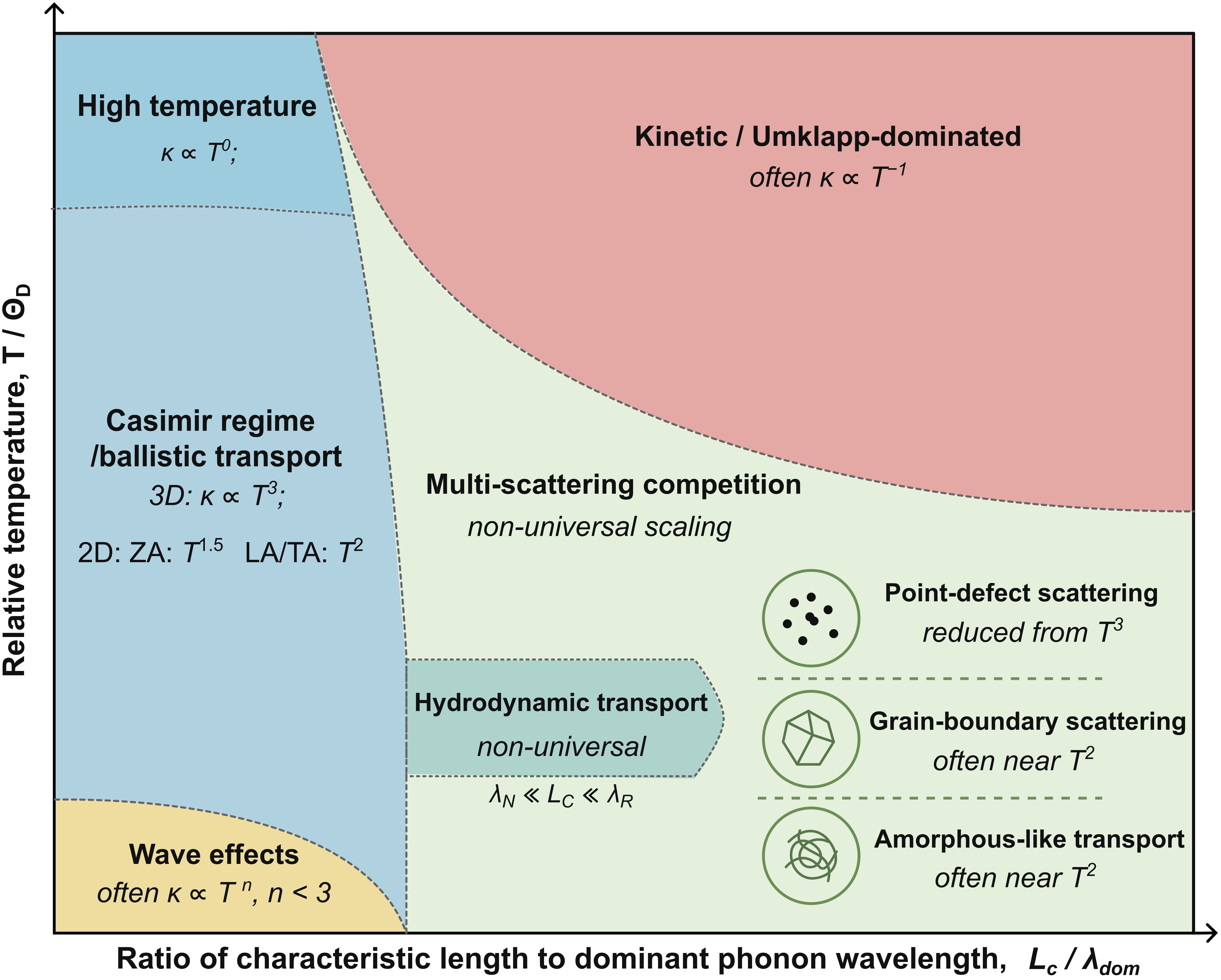
Figure 1. Phonon transport mechanisms at cryogenic temperature and corresponding temperature scaling. 2D: two-dimensional; 3D: three-dimensional.
Table 1. Summary of cryogenic phonon-transport regimes and modeling applicability.
| Dominated mechanisms | Representative scaling | Key criterion/applicability | |
| 3D Casimir regime/ballistic | κ ~T3 | Geometry-limited 3D transport; dominant MFP much larger than sample size; λdom « roughness scale | |
| Kinetic/Umklapp-dominated | κ decreases with T; often κ ~T-1 at high T | Relatively high T/θD; resistive Umklapp scattering dominates | |
| 2D geometry-limited transport | Graphene/2D: ZA often ~T1.5; LA/TA often ~ T2 | Confined dimension comparable to phonon wavelength or thermal length scale | |
| Multi-scattering competition | Point-defect/isotope scattering | Reduced from ideal T3; material- and concentration-dependent | Elastic mass-disorder scattering becomes important as anharmonic scattering weakens; τd-1 ∝ ω4 |
| Grain-boundary scattering | Often close to T2, but not universal | Grain size comparable to MFP; phonon transmission is frequency dependent | |
| Amorphous-like transport | Often close to T2 | Strong disorder, tunneling states, rattling modes, or glass-like low-energy excitations | |
| Hydrodynamic transport | Not universal; can increase faster than T3 in Poiseuille window for 3D materials | Scattering hierarchy ΛN « L « ΛR | |
| Wave/coherent effects | Often weaker than T3 or non-monotonic | λdom comparable to roughness, disorder length, or superlattice/phononic-crystal period | |
As summarized in Table 1, cryogenic phonon transport has no universal temperature scaling. The classical (T3) Casimir law applies to 3D geometry-limited crystals, while deviations reflect dimensionality, boundary effects, competing scattering, hydrodynamics, or ballistic transport. 3D: three-dimensional; MFP: mean free path.
2. Physical Picture of Cryogenic Phonon Transport
At cryogenic temperatures, the thermal population of high-frequency lattice vibrations is strongly suppressed, and heat transport is governed predominantly by low-frequency acoustic phonons[34]. Consequently, the quantum statistics of lattice vibrations become essential, and thermal conduction is naturally described in terms of phonon quasiparticles.
Within the semiclassical framework of quasiparticle transport, steady-state heat transport under a temperature gradient ∇T is commonly described by the phonon BTE, first formulated by Peierls in 1929[35]. At low temperatures, heat conduction in three-dimensional crystals is dominated by long-wavelength acoustic phonons with approximately linear dispersion (ω = vsq). Within the relaxation-time approximation (RTA), the phonon BTE then reduces to the standard Debye-RTA expression for thermal conductivity[36,37]:
where kB is the Boltzmann constant, vs is the speed of sound, θ is the Debye temperature, T is the temperature, τc is the phonon relaxation time. Physically, τc represents the characteristic time over which scattering relaxes the nonequilibrium phonon distribution toward equilibrium. Inside the integration, the product τc ∙ vs can also be defined as the mean free path of phonons lc = τc ∙ vs. If the phonon mean free path is also temperature and frequency independent, as in the diffuse boundary-scattering limit, the integral converges to the constant, yielding the overall thermal conductivity
Peierls’s pioneering analysis showed that, in the absence of extrinsic momentum-relaxing mechanisms, the thermal conductivity of an ideal crystal would diverge at sufficiently low temperatures[35]. This fundamental insight highlights the increasing importance of extrinsic scattering mechanisms, and the combined influence is commonly considered using Matthiessen’s rule[38]:
where the four terms represent anharmonic phonon-phonon interactions, point-defect scattering, boundary scattering, and grain-boundary scattering, respectively. When diffusive boundary scattering dominates, τc becomes effectively independent of temperature and frequency, leading to the well-known κ ∝ T3 scaling of the Casimir regime. Boundary scattering is commonly described by[28]:
where p is the boundary specularity and L0 is the characteristic geometric length scale. Point-defect scattering (1/τd), arising from isotopes, impurities, and vacancies, becomes increasingly important at cryogenic temperatures because its scattering strength is temperature-independent and the corresponding scattering rate follows the characteristic ω4 dependence[39]. In polycrystalline materials, grain-boundary scattering (1/τgrain) provides an additional source of resistance, with the effective boundary-limited mean free path depending on grain size and boundary characteristics. Klemens[40] showed that the boundary-limited mean free path is also temperature-independent and exhibits an explicit frequency dependence of the form Λbdy ∝ Dave ωn, where Dave is the average grain size and the exponent n ranges from 0 to -2 depending on the assumed boundary scattering model and degree of specularity.
Building on these scattering models, several phenomenological theories have been developed to describe cryogenic thermal transport and have achieved excellent agreement with various experiments[23,26]. While the RTA provides valuable physical insight, it neglects the collective nature of momentum-conserving Normal (N) phonon scattering. Unlike resistive scattering processes, N-processes conserve crystal momentum and therefore do not directly generate thermal resistance. Instead, sufficiently frequent N scattering redistributes phonon momentum and drives the phonon system toward a displaced equilibrium characterized by a finite drift velocity. As Umklapp scattering becomes strongly suppressed at cryogenic temperatures, collective phonon transport can substantially enhance thermal conductivity beyond the prediction of the RTA.
To account for this effect, Callaway introduced an effective correction to the RTA by incorporating Normal scattering through a displaced phonon distribution[22] refined subsequently by Allen[25]. Although the Callaway model remains approximate, it established the conceptual foundation for understanding collective phonon transport and has been widely used to interpret hydrodynamic heat conduction and benchmark numerical solutions of the phonon BTE[41,42].
Together, the Debye model, Matthiessen's rule, and Callaway theory constitute the classical framework for understanding cryogenic phonon transport. These models successfully explain many experimental observations, including the characteristic T3 behavior of boundary-limited transport. Nevertheless, they cannot fully capture phenomena that become increasingly important at cryogenic temperatures, including reduced-dimensional transport and coherent wave interference[43-46]. These limitations have motivated the development of modern theoretical approaches based on first principles and numerical solutions of the full phonon BTE. The following sections review these advances and discuss how they extend the classical picture of cryogenic phonon transport.
3. Geometry Effects on Cryogenic Phonon Transport
At cryogenic temperatures, heat transport is frequently governed by geometry-limited phonon transport, in which boundary scattering dominates over intrinsic phonon-phonon interactions. Unlike room-temperature nanoscale transport[15,47], where all phonon modes can be excited, cryogenic transport is often dominated by long-wavelength acoustic phonons whose population changes drastically with temperature[48]. Consequently, the characteristic sample dimensions, surface morphology, and crystal orientation become the primary factors affecting phonon transport.
3.1 Boundary-limited transport: The Casimir limit
As discussed in Section 2, three-dimensional dielectric crystals at sufficiently low temperatures are well described by Eq. (1), which predicts the characteristic temperature dependence κ = AT3[49]. According to Eq. (1), the prefactor A scales as
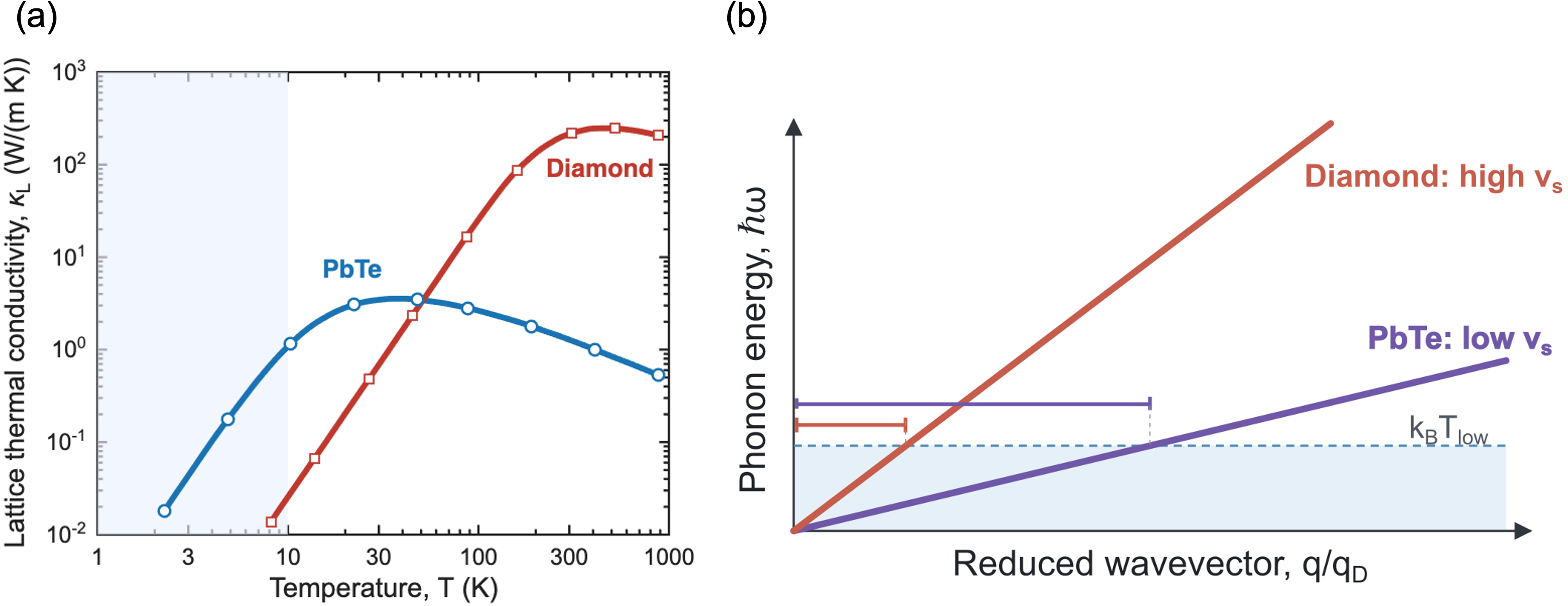
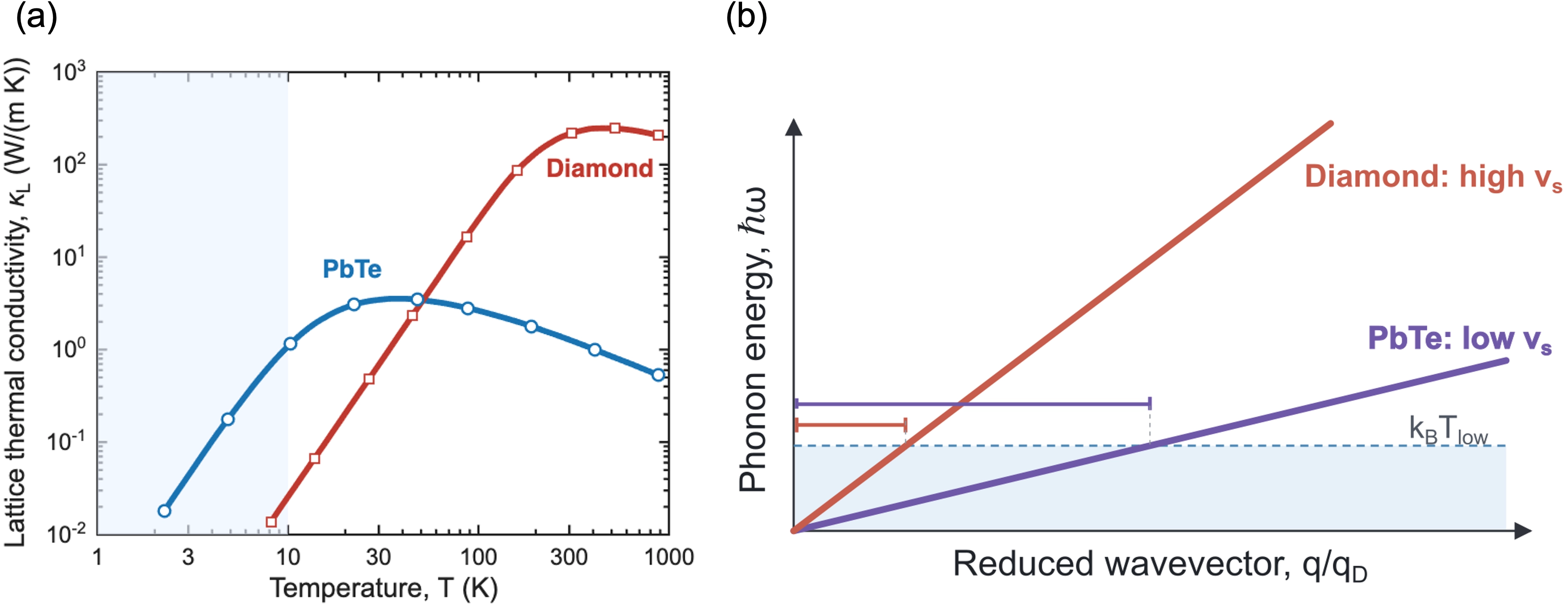
Figure 2. (a) A reversal in κL as the temperature decreases for PbTe and diamond[48]. Reproduced with permission from reference[48]. Copyright © 2012 Annual Reviews; (b) This phenomenon can be explained by phonon freezeout, where the reduced group velocity of PbTe results in a higher number of occupied states at a given temperature.
3.2 Geometry-induced thermal conductivity anisotropy: Phonon focusing
A second hallmark of geometry-limited transport is the enhanced directional dependence of thermal conductivity. As momentum-destroying phonon scattering becomes progressively suppressed, the effective phonon mean free path is determined primarily by boundary scattering, making thermal transport increasingly sensitive to the propagation direction of phonons.
Silicon provides a representative example. Figure 3a shows that the thermal conductivity measured along different crystallographic directions diverges significantly as temperature decreases into the Casimir regime. Figures 3b,c,d show the angular dependence of thermal conductivity and branch-resolved contributions in silicon at 20, 100, and 300 K for a nanowire with a diameter of 115 nm. The labels 1, 2, 3, and 4 in the polar plots denote the total thermal conductivity, the contribution from the fast transverse acoustic mode, the slow transverse acoustic mode, and the longitudinal acoustic mode, respectively. At cryogenic temperatures, the slow transverse acoustic branch contributes nearly half of the total thermal conductivity and dominates the observed anisotropy due to its lower group velocity and higher phonon population. As temperature increases, higher-frequency longitudinal and fast transverse modes contribute more significantly, and isotropic scattering dominates, gradually reducing the overall anisotropy. Consequently, even materials that exhibit only weak thermal anisotropy at room temperature can develop strong directional dependence at cryogenic temperatures.
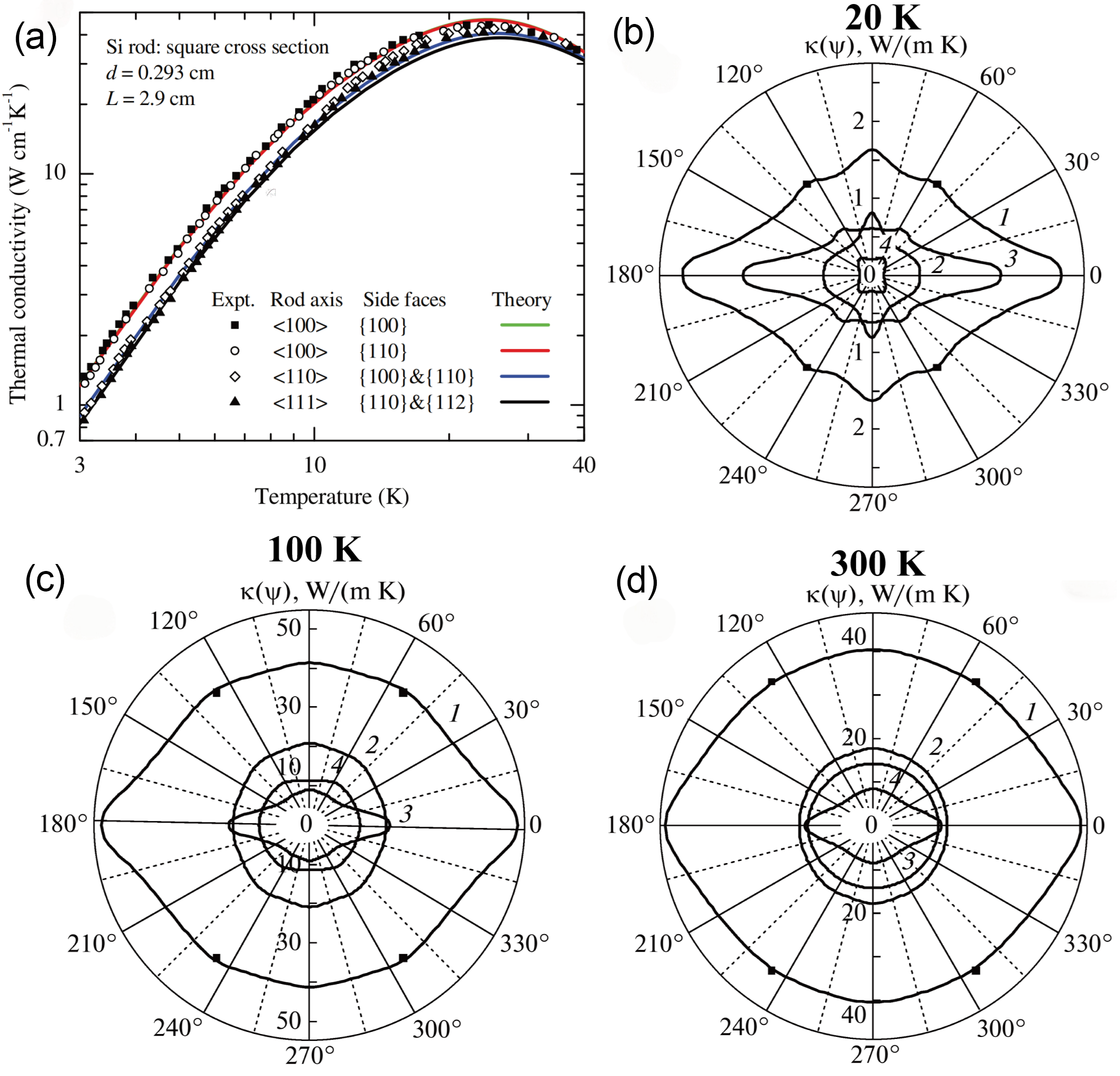
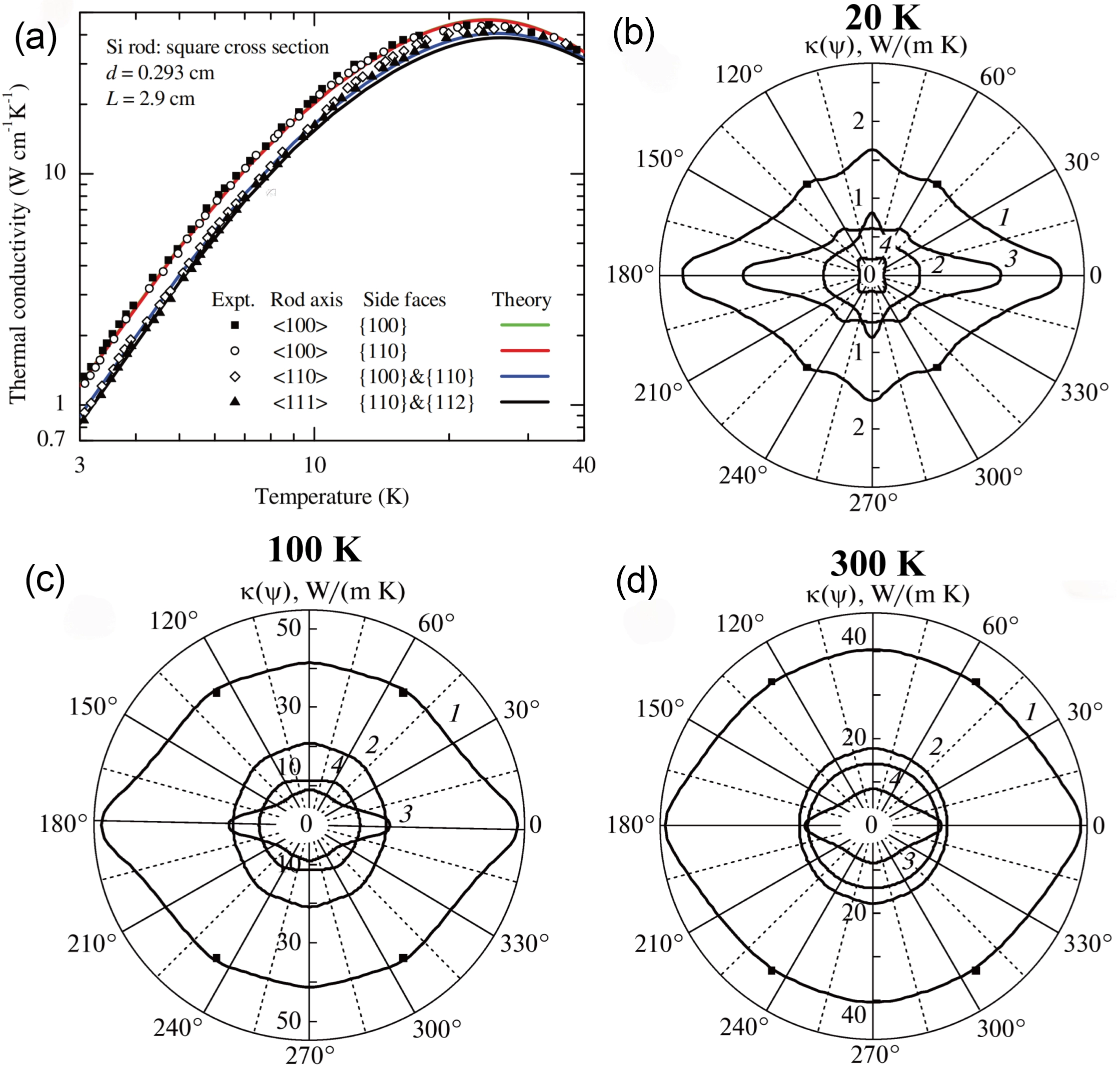
Figure 3. (a) Thermal conductivity of silicon rods at cryogenic temperatures with macroscopic sample sizes. The figure is reproduced with permission from reference[52]. Copyright © 2014 John Wiley & Sons; Thermal conductivity of Si at different angles and contributions from different phonon branches for Si with 115 nm diameter and axis rotated in the diagonal plane at (b) 20 K (c) 100 K, and (d) 300 K. Figures (b,c,d) are adapted with permission from reference[53]. Copyright © 2014 Springer Nature.
The physical origin of phonon focusing was established by Every and Maznev[54], who showed that anisotropic elastic constants cause phonon group velocities to deviate from the corresponding wavevector directions. Within continuum elasticity theory, the strength of this effect is commonly characterized by the elastic anisotropy factor
where A = 1 corresponds to elastic isotropy and larger values indicate a stronger focusing effect. Combined elastic-continuum and Callaway-type transport models have successfully reproduced experimental anisotropy in materials such as potassium[14] and silicon across various geometries and length scales[52,53,55,56].
Although phonon focusing is most prominent at cryogenic temperatures, its influence can extend to higher temperatures in strongly anisotropic systems. Examples include single-crystal β-Ga2O3, which exhibits pronounced thermal conductivity anisotropy above 80 K due to direction-dependent phonon velocities[57], and SiGe nanowires where alloying scattering enhances the contribution of weakly scattered low-frequency phonons even near room temperature[58]. Recent mode-resolved first-principles studies further confirm the decisive role of transport direction in determining thermal conductivity anisotropy in bulk crystals and nanowires[56,59], although systematic mode-level investigations of phonon focusing remain limited.
3.3 Surface morphology and boundary specularity
The classical Casimir model discussed above assumes that phonons are scattered diffusely at sample boundaries, an approximation that is valid when the dominant phonon wavelength is much smaller than the characteristic surface roughness. At sufficiently low temperatures, however, this assumption gradually breaks down. The dominant thermal phonon wavelength,
increases inversely with temperature[60] and can eventually exceed the characteristic surface roughness. For example, in silicon, the dominant wavelength of transverse acoustic phonons reaches hundreds of nanometers at 1 K, given the group velocity of Si[61]. Under these conditions, phonon reflection becomes increasingly specular rather than fully diffuse, marking a gradual departure from the ideal Casimir regime.
Unlike diffusive scattering, specular reflection preserves the phonon momentum parallel to the surface and therefore does not completely randomize phonon trajectories. As a consequence, the effective boundary-limited mean free path increases, reducing the thermal resistance introduced by sample boundaries. The resulting thermal conductivity exhibits a weaker temperature dependence than the classical T3 scaling expected for fully diffusive boundary scattering.
Experimental observations provide compelling evidence for this transition. Figure 4 shows measurements on single-crystalline Nd2CuO4[62], where smooth boundaries lead to progressive deviation from the diffusive-boundary T3 scaling. The weaker temperature dependence reflects the increasing contribution of long-wavelength phonons undergoing partially specular boundary reflections. Similar behavior has been observed in silicon nanowires[63] and layered materials such as single-crystal WS2[64].
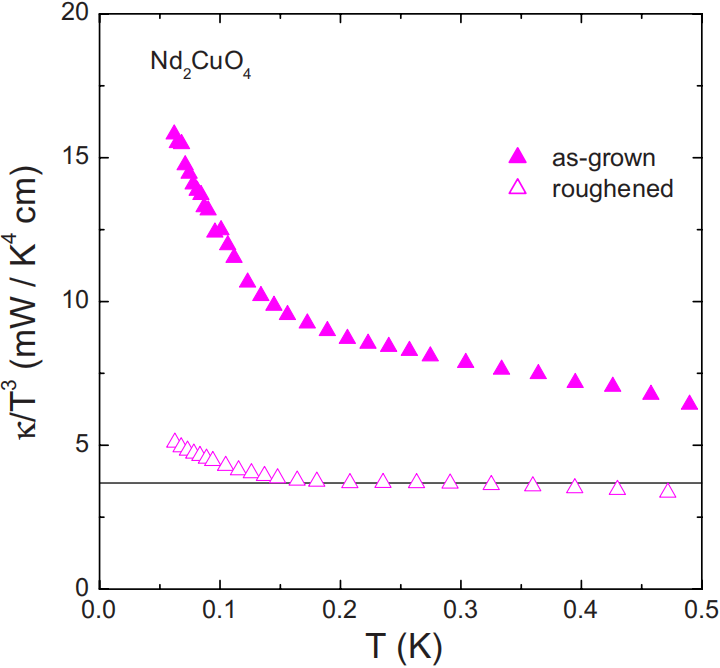
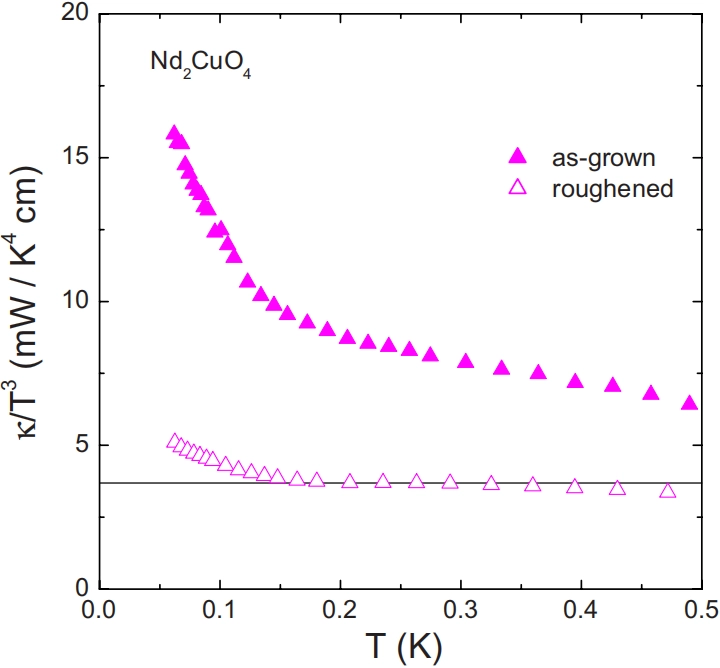
Figure 4. In-plane thermal conductivity of an as-grown single crystal of Nd2CuO4 before (“as-grown,” full triangles) and after (“roughened,” empty triangles) its smooth, mirror-like surfaces were roughened by sanding. As indicated by the horizontal line, roughening allows one to recover the diffusive regime at cryogenic temperature, characterized by a constant κ/T3, at least down to 150 mK. The figure is reproduced with permission from reference[62]. Copyright © 2008 American Physical Society.
3.4 Size effects and anomalous boundary-limited transport in 2D materials
Reduced dimensionality introduces an even more fundamental modification to cryogenic phonon transport. Graphene provides the most representative example. As shown in Figure 5a, the low-temperature thermal conductance of suspended graphene follows an approximate T1.5 dependence in the ballistic limit, significantly weaker than the T2.5 dependence in graphite[65], and the classical T3 of the 3D Casimir limit. This systematic reduction of the temperature exponent with decreasing layer thickness reflects the crossover from three-dimensional to two-dimensional phonon transport.
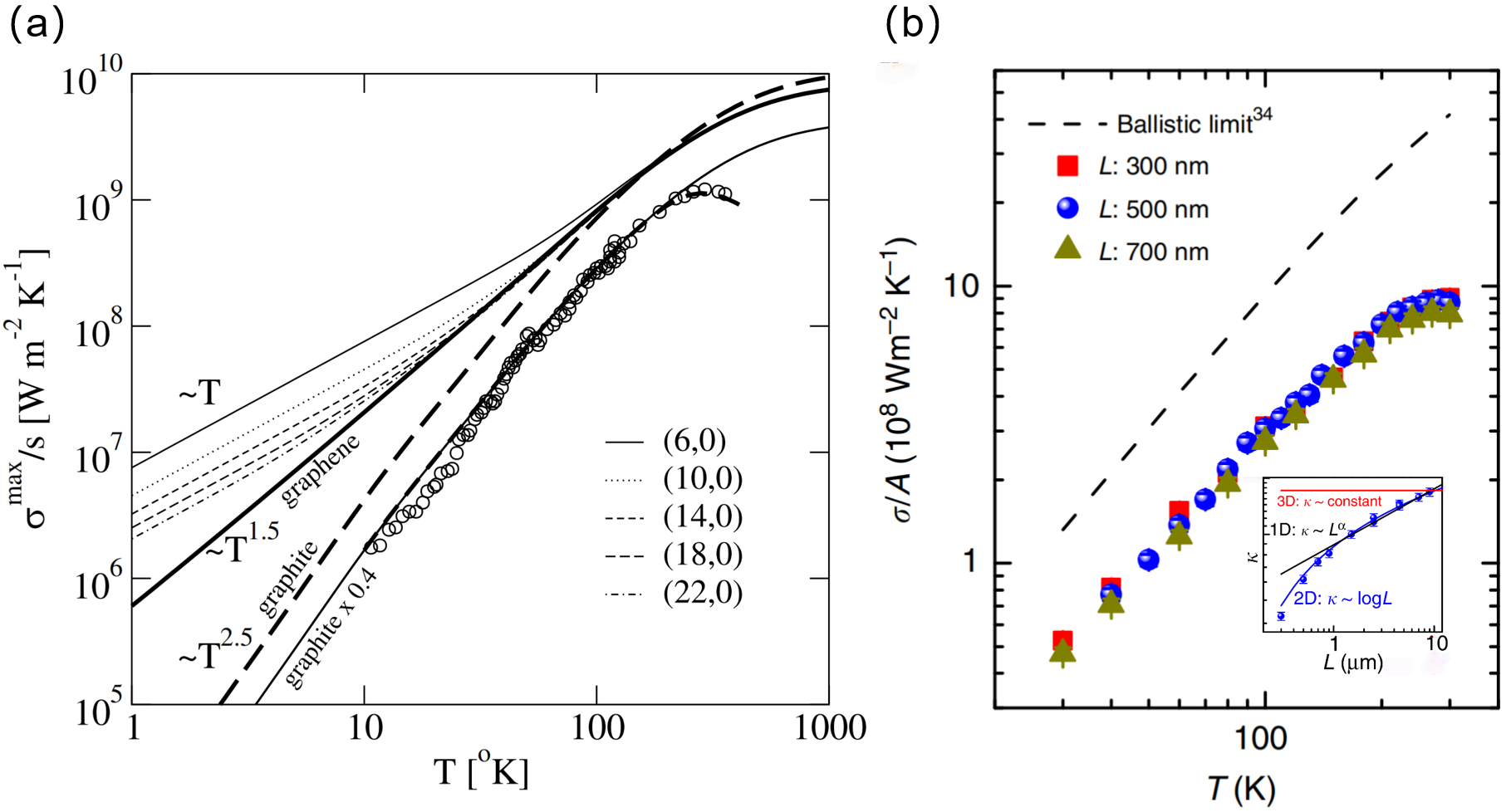
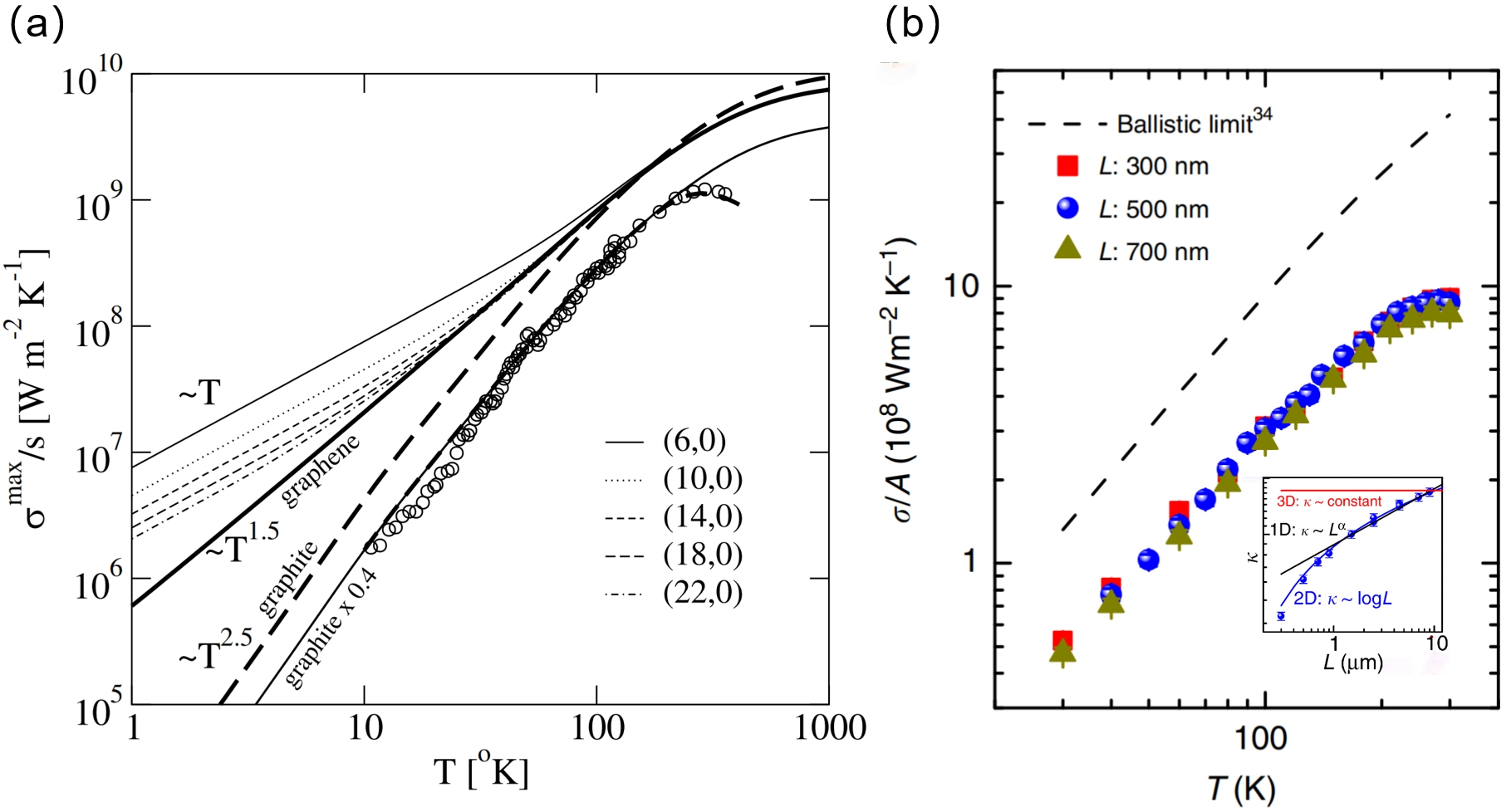
Figure 5. (a) Thermal conductance of graphene and graphite at cryogenic temperature and their temperature scaling. Figure is reproduced with permission from reference[65]. Copyright © 2005 American Physical Society; (b) Experimental thermal conductance per unit cross-sectional area, σ/A as a function of temperature in samples with lengths from 300 nm to 700 nm. The ballistic limit is indicated by the black dashed curve. The figure is reproduced from reference[66]. CC BY 4.0; the inset is reproduced from reference[20]. CC BY 4.0.
The physical origin of this behavior lies in the modified phonon spectrum of two-dimensional crystals. In addition to the in-plane longitudinal and transverse acoustic branches, graphene possesses a flexural acoustic (ZA) branch with a quadratic dispersion near the Brillouin-zone center[67]. This quadratic dispersion produces a much larger low-frequency phonon density of states than the linear acoustic branches in bulk crystals, and a different temperature dependence of specific heat and group velocity[48].
Additional experiments further show that both ballistic transport and boundary scattering play an essential role in graphene-based structures[68]. In short supported graphene samples, the thermal conductance can approach a substantial fraction of the ballistic limit, whereas in narrow graphene nanoribbons the thermal conductivity is strongly suppressed and becomes controlled by boundary scattering, as shown in Figure 5b. Although the temperature scaling remains the same, the resulting conductance reaches around 40% of the purely ballistic thermal conductance[20,66].
However, theoretical analyses by Wang and Mingo demonstrated that the classical Casimir picture itself breaks down in an ideal two-dimensional ribbon[69]. Unlike three-dimensional systems, fully diffuse edge scattering alone does not produce a finite boundary-limited phonon mean free path. Instead, long-wavelength phonons can continue to propagate over arbitrarily long distances unless additional scattering mechanisms are present. The logarithmic increase of thermal conductivity with sample length, illustrated in the inset of Figure 5b, is therefore a manifestation of the anomalous nature of two-dimensional phonon transport rather than simply a stronger finite-size effect.
In realistic graphene samples, thermal transport is determined by the combined action of ballistic propagation and different scattering mechanisms. Calculations by Nika et al. incorporating these mechanisms predict effective low-temperature scaling close to T2 for high-quality graphene with highly specular boundaries[70,71], in good agreement with experimental observations of quasi-ballistic heat transport in micron-scale samples[20,66]. Therefore, dimensionality does not merely modify the exponent of thermal conductivity; it changes the fundamental relationship between boundary scattering and phonon mean free path.
4. Phonon Scattering Competition and Transport Crossover
An ideal Casimir regime can only be observed under highly controlled experimental conditions because multiple extrinsic and intrinsic scattering mechanisms compete at cryogenic temperatures, as illustrated in Figure 6. Even in millimeter-scale samples where boundary scattering is expected to dominate, noticeable deviations from the T3 law are frequently observed[74].
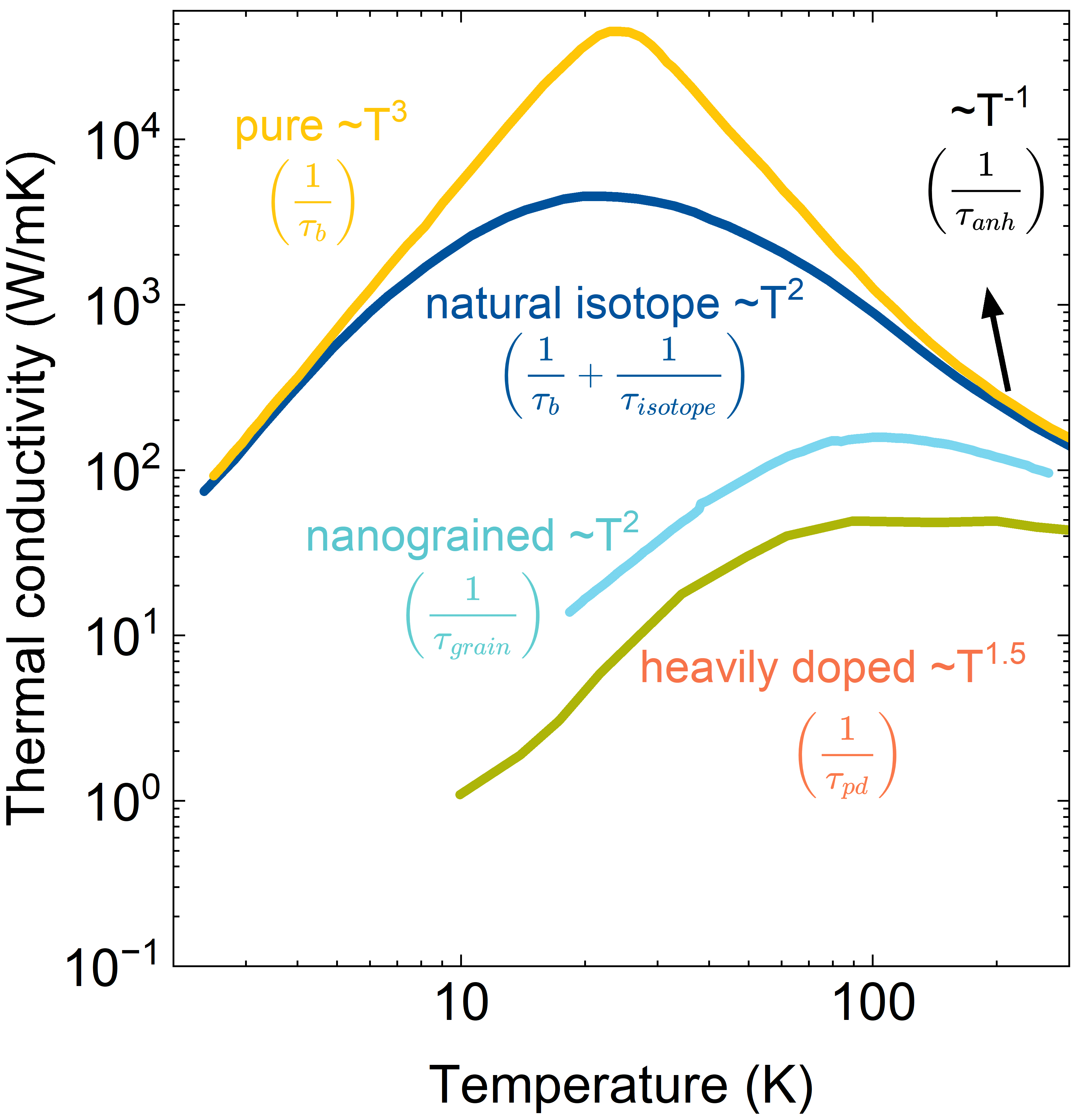
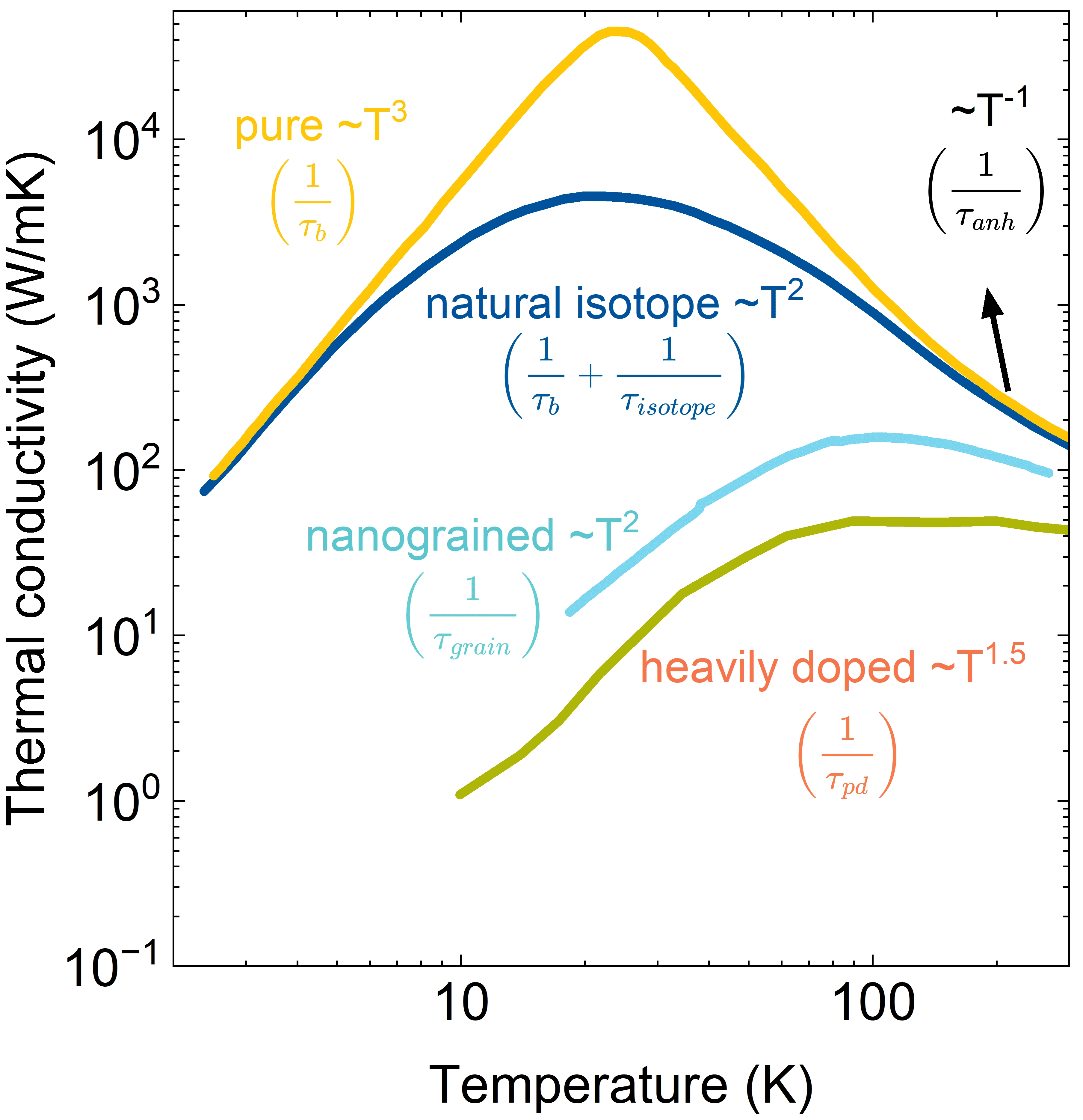
Figure 6. Experimental data of thermal conductivity as a function of temperature of pure and naturally isotopic Si[18], doped Si[72], nanograined Si[73]. Reproduced from reference[18]. CC BY 4.0. Reproduced with permission from reference[72]. Copyright © 2017 John Wiley & Sons. Reproduced with permission from reference[73]. Copyright © 2011 American Chemical Society. The experimental data are reproduced with permission from reference[47]. Copyright © 2022 Elsevier Ltd.
In high-purity dielectric crystals, the dominant competition occurs among boundary scattering, isotope scattering, and anharmonic phonon scattering. As shown in Figure 6, isotopically enriched silicon closely follows the classical T3 behavior, indicating boundary-limited transport, whereas natural silicon exhibits a noticeably weaker temperature dependence above approximately 5 K because the dominant heat-carrying phonons shift toward higher frequencies, where isotope scattering becomes increasingly effective due to its ω4 dependence, as discussed in Section 2. The influence of isotope scattering reaches a maximum near the thermal-conductivity peak before gradually giving way to anharmonic phonon scattering at higher temperatures. Similar isotope-induced reductions in thermal conductivity have been reported for other group-IV and III-V semiconductors[62,75].
Recent advances in first-principles Boltzmann transport calculations have enabled parameter-free, mode-resolved analyses of the competition among these scattering mechanisms[76,77]. As shown by the first-principles results in Figure 7, these calculations confirm that diffusive boundary scattering is nearly frequency-independent for long-wavelength acoustic phonons, whereas isotope scattering follows the characteristic ~ ω4 dependence. Meanwhile, the magnitude and frequency dependence of phonon-phonon scattering vary with temperature. At cryogenic temperatures, low-frequency phonon-phonon scattering can exhibit weaker frequency dependences associated with Normal processes[24]. As the temperature increases, the contribution from Umklapp scattering grows, resulting in a stronger frequency dependence and greater magnitude of scattering.
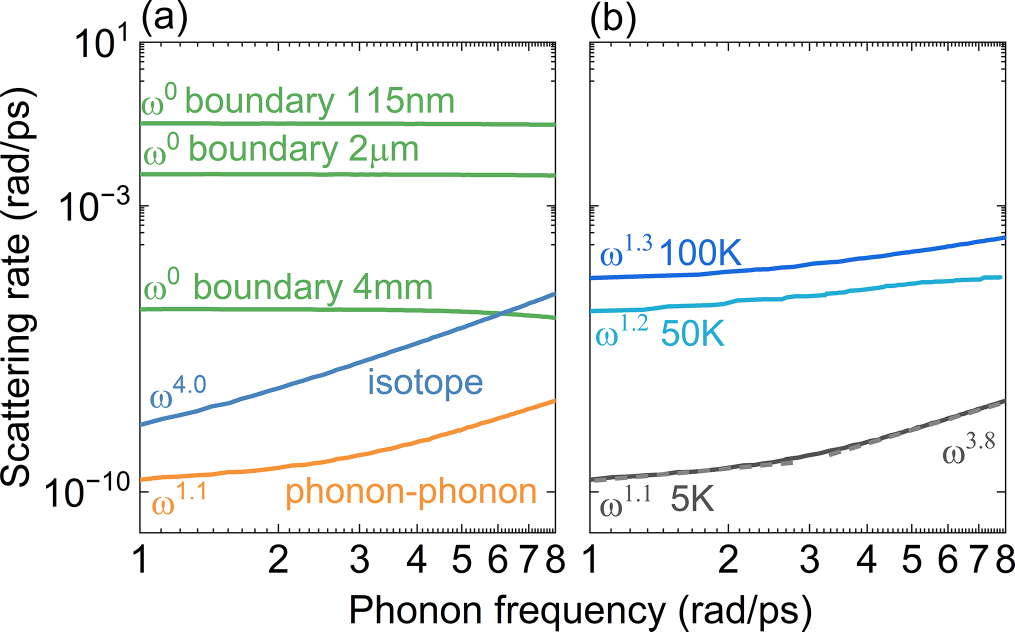
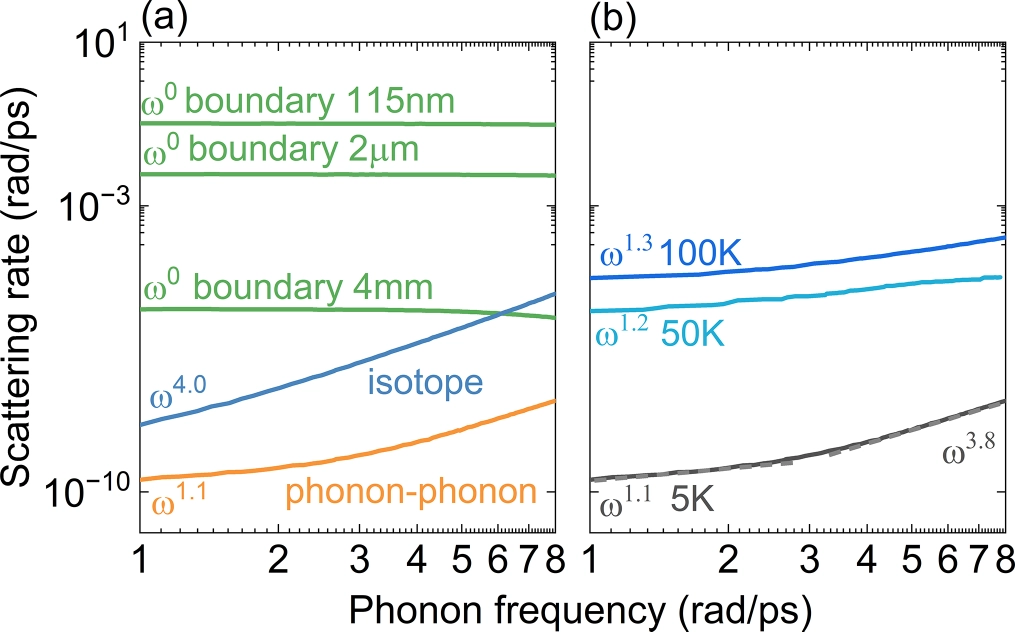
Figure 7. Scattering rates of Si at 5 K from first-principles calculations. The figure is reproduced with permission from reference[13]. Copyright © 2024 American Physical Society.
4.1 Isotope and point-defect scattering
Point defects, including isotopes, substitutional impurities, and vacancies, are important extrinsic scattering sources at cryogenic temperatures, where suppressed phonon-phonon interactions enhance their impact, as observed in[18,78,79] and in single-crystalline AlN[80].
Impurity scattering plays a similarly important role in doped semiconductors. As shown in Figure 8a, silicon with different doping concentrations exhibits distinct low-temperature thermal conductivity scaling. Likewise, Paskov et al.[82] successfully reproduced the cryogenic thermal conductivity of Si-doped GaN down to 20 K using a modified Callaway model, while Guthy et al.[83] reported an approximate T1.8 dependence in GaN, substantially weaker than the classical T3 law. Similar behavior has also been observed in insulating oxides and perovskites, where intrinsic disorder and vacancies introduce additional phonon scattering[84,85]. Notably, point-defect scattering alone cannot fully limit thermal transport in an ideal crystal because its Rayleigh-type scattering rate scales as ω4, making it increasingly ineffective at scattering long-wavelength acoustic phonons[13]. Consequently, in the ultra-low-temperature regime, boundary scattering gradually becomes the dominant resistance mechanism, restoring the conventional T3, as shown in Figure 6.
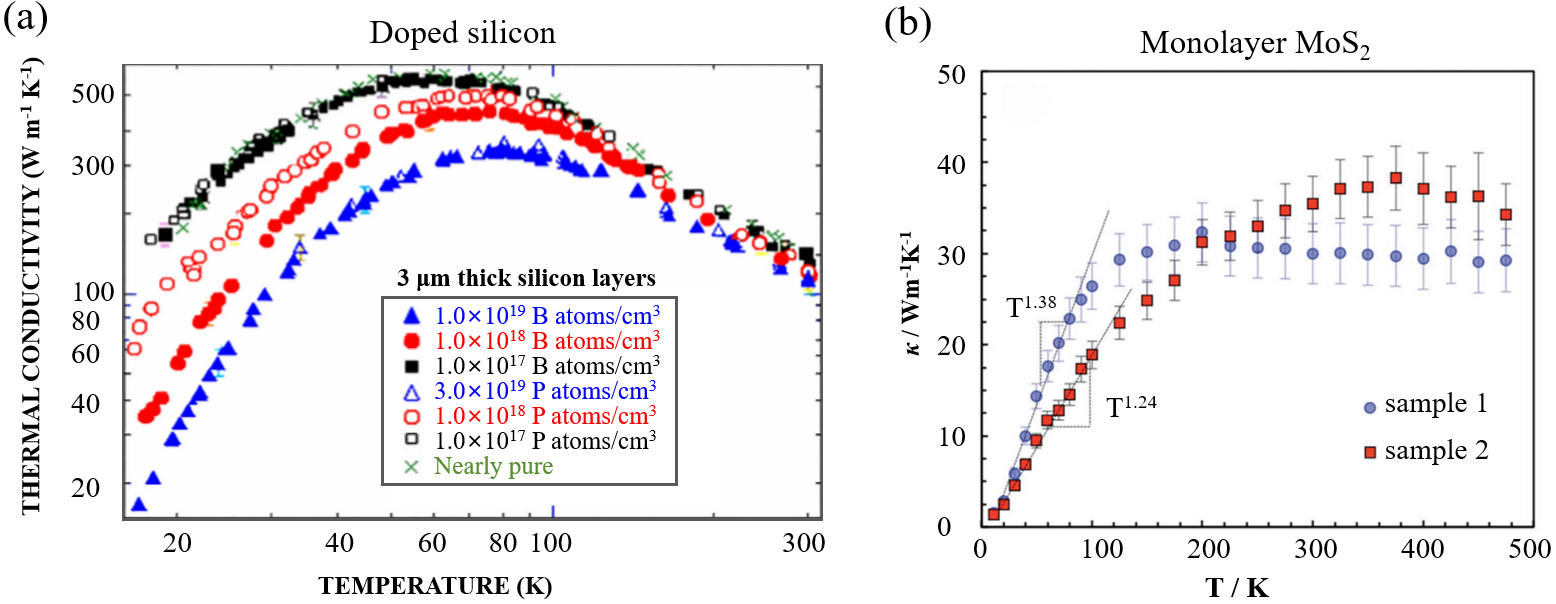
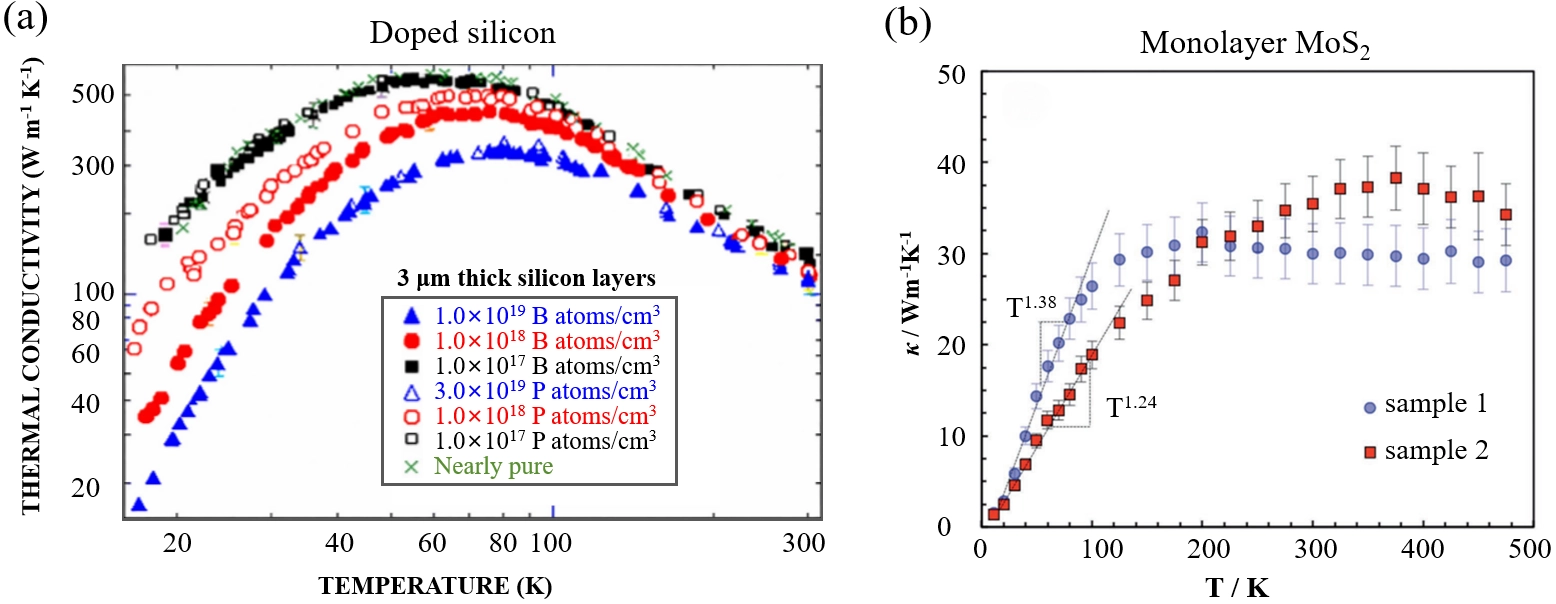
Figure 8. (a) Thermal conductivity of Si layers with different doping concentrations. The figure is reproduced with permission from reference[81]. Copyright © 2002 American Institute of Physics; (b) Thermal conductivity of monolayer MoS2 with different sizes and defect concentrations, showing different temperature scaling from the purely geometry-limited temperature scaling of T1.5. The figure is reproduced with permission from reference[72]; Copyright © 2017 John Wiley & Sons.
In low-dimensional systems, the influence of defect scattering becomes further intertwined with reduced dimensionality. As discussed in the previous section, ideal two-dimensional crystals exhibit a ballistic thermal conductivity approximately following κ ~ T1.5. As shown in Figure 8b, Yarali et al.[72] measured suspended monolayer MoS2 and reported an effective scaling of κ ~ T1.24-1.38 at cryogenic temperatures, demonstrating the combined influence of reduced dimensionality and defect scattering.
4.2 Grain-boundary scattering
In nanocrystalline and polycrystalline materials, grain boundaries can become an important source of extrinsic phonon scattering at cryogenic temperatures. Unlike the diffuse boundary scattering considered in the classical Casimir model, grain-boundary scattering is generally frequency-dependent because long-wavelength acoustic phonons can be partially transmitted across grain interfaces[86].
Klemens[40] proposed that grain-boundary-limited mean free paths can be expressed as Λbdy ∝ Dave ωn, where Dave is the average grain size and the exponent n ranges from 0 to -2, depending on the grain-boundary transmission characteristics. This frequency dependence leads to a weaker temperature dependence of thermal conductivity at cryogenic temperatures.
Experimental observations support this picture. As shown in Figure 9a, measurements on nanocrystalline silicon[73] and diamond[88,89] reveal approximately ω-1 dependent phonon transmission and a corresponding reduction of the low-temperature thermal-conductivity scaling from the classical T3 toward approximately T2. These results demonstrate that grain boundaries preferentially scatter higher-frequency phonons while allowing long-wavelength acoustic phonons to transmit more efficiently.
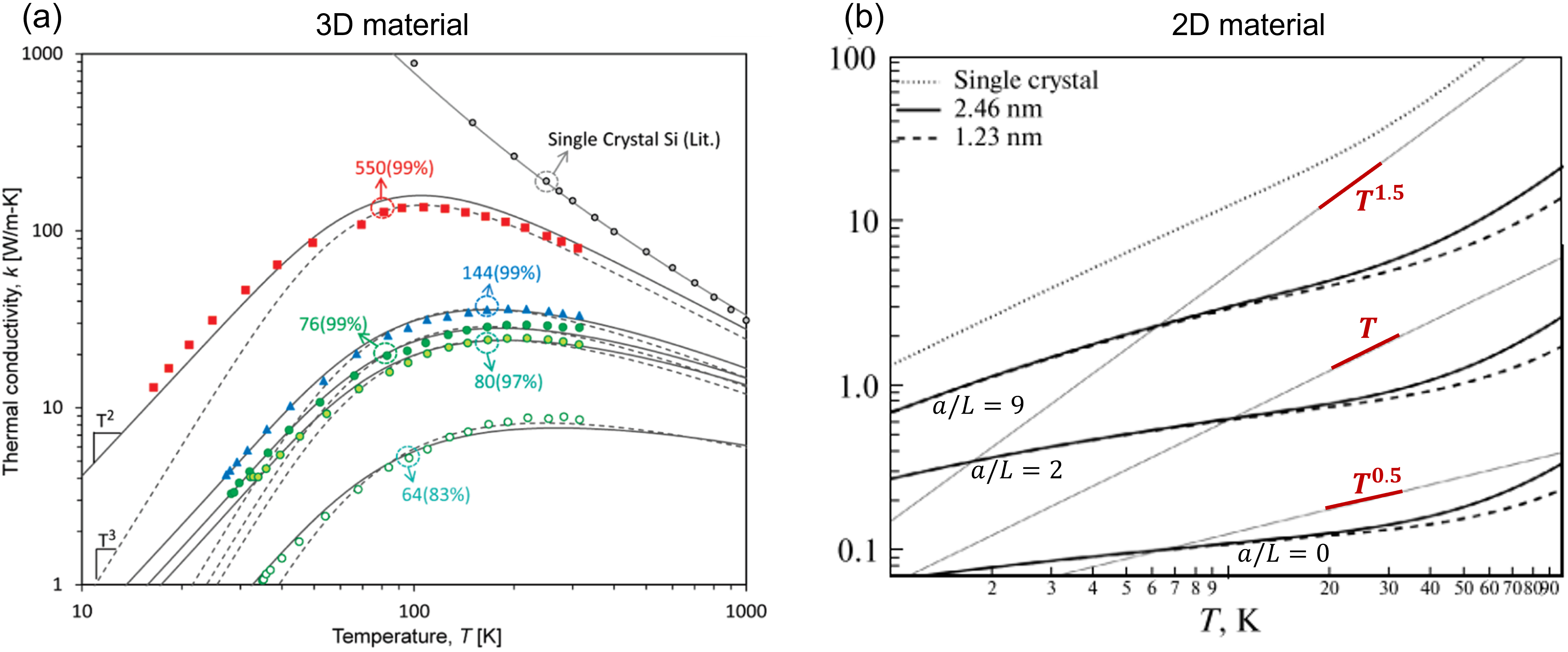
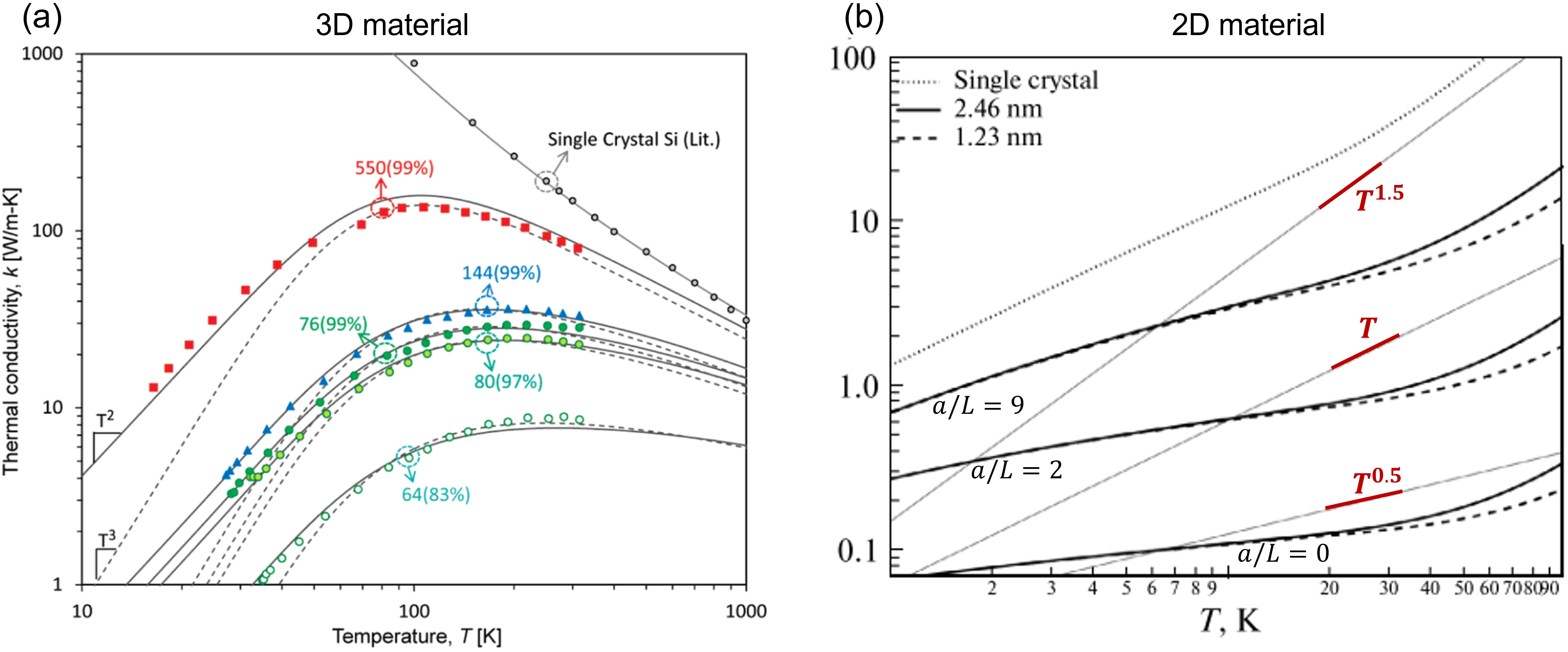
Figure 9. (a) Thermal conductivity of polycrystalline Si with different grain sizes; the marks are the experimental values and the solid lines are non-gray models and dashed lines are gray models. The figure is reproduced with permission from reference[73]. Copyright © 2011 American Chemical Society; (b) Thermal conductivity in graphene with different grain sizes and grain-boundary concentration: L is the grain size, a is the average distance between grain boundaries; solid curves represent samples with grain size of L = 2.46 nm, while dashed curves represent samples with grain size of L = 1.23 nm. The figure is reproduced with permission from reference[87]. Copyright © 2015 Springer Nature.
The influence of grain boundaries becomes even more complex in two-dimensional materials[87]. As shown in Figure 9b, for pure graphene, the thermal conductivity shows T1.5 above 30 K, and T1 below 30 K, due to the quantum wire behavior[87,90]. With different grain sizes and concentrations, the temperature scaling further varies from T0.3 to T1. Analytical models also show that open and closed grain boundaries produce distinct mean free path scaling, ℓ ∝ ω-1 and ℓ ∝ ω-3[91]. These strong grain-size dependences highlight the limitations of treating grain boundaries as purely diffusive interfaces in low-dimensional materials.
Besides phonon transmission, grain boundaries are often accompanied by strain fields and dislocations, which introduce additional scattering channels for long-wavelength phonons. Kim et al.[92] demonstrated that dislocation-induced strain can dominate phonon scattering in polycrystalline thermoelectric materials at cryogenic temperatures.
4.3 Glass-like cryogenic thermal transport in strongly anharmonic crystals
In most crystalline solids, anharmonic phonon-phonon scattering is strongly suppressed at cryogenic temperatures, making boundary and defect scattering the dominant sources of thermal resistance[13,93]. An important exception is provided by materials with exceptionally strong lattice anharmonicity. As a result, the thermal conductivity can deviate markedly from the crystalline T3 behavior and instead approach the T2 scaling characteristic of amorphous solids[16], as illustrated in Figure 10.
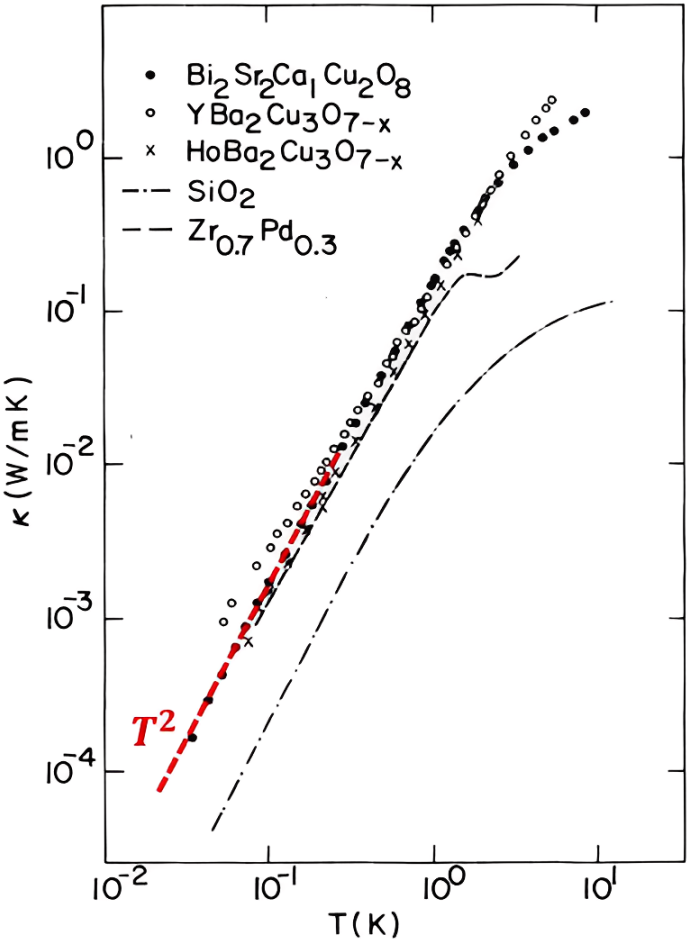
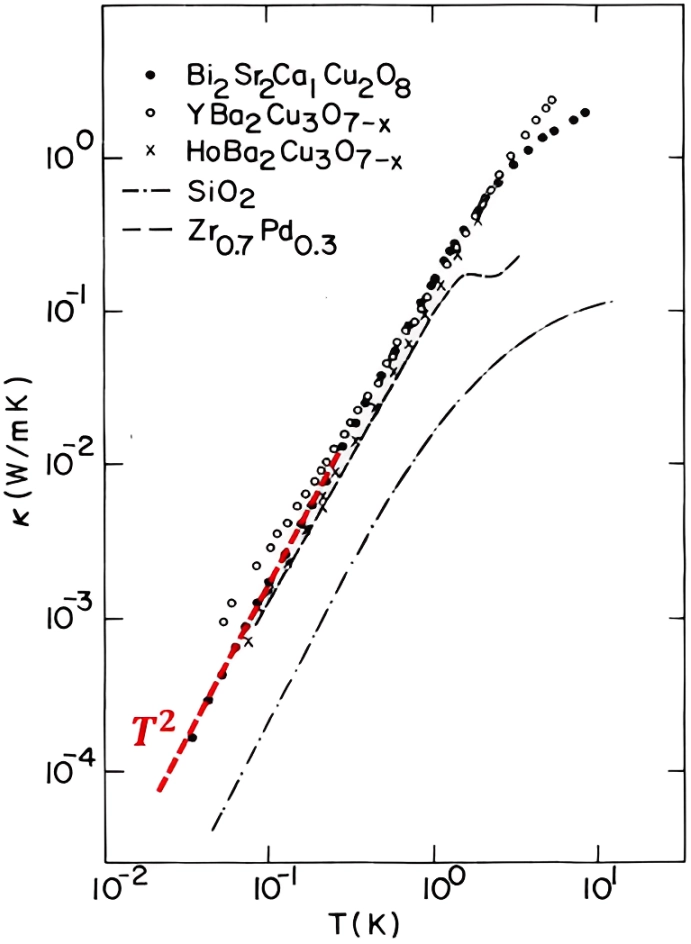
Figure 10. Cryogenic thermal conductivity of strongly anharmonic single crystals, showing an approximate T2 dependence. The figure is reproduced with permission from reference[94]. Copyright © 1989 American Physical Society.
Representative examples include α-ZrW2O8, which exhibits approximately T1.8 below 10 K with thermal conductivity approaching the minimum thermal conductivity limit[95]. This behavior has been attributed to strong coupling of acoustic phonons by highly anharmonic low-frequency modes associated with negative thermal expansion. Similarly, single-crystalline Ba8Ga16Ge30 displays a κ ∝ T2 dependence below 1 K because of intrinsic low-energy excitations within the clathrate framework[96], while comparable glass-like behavior has also been reported in Bi2Sr2CaCu2O8[94].
4.4 Interplay between boundary and internal scattering
Throughout the preceding discussion, competing phonon scattering mechanisms have been combined using Matthiessen’s rule. While this approximation is widely used because of its simplicity, boundary scattering depends on the intrinsic mean free path and cannot, in general, be represented by an independent relaxation process[69].
A more rigorous treatment requires solving the spatially dependent phonon BTE. Simplified scaling functions derived from such analyses have been proposed[29,59]
which explicitly account for the spatial evolution of the phonon distribution near sample boundaries. These analyses show that Matthiessen’s rule provides an excellent approximation for most three-dimensional structures but becomes increasingly inaccurate as transport becomes ballistic or the dimensionality is reduced[69]. In particular, solutions of the phonon BTE show that boundary scattering alone cannot produce finite thermal conductivity in ideal two-dimensional ribbons, implying the absence of a strict Casimir-Knudsen regime in 2D materials[97], as discussed in Section 3.
Figure 11a compares the phonon mean free paths calculated using Matthiessen’s rule with full solutions of the space-dependent BTE for wires with different cross-sectional geometries[69]. Excellent agreement is obtained for most three-dimensional wires, while somewhat larger deviations appear for triangular and hexagonal-shaped cross sections because of their sharper edges. In contrast, ideal two-dimensional ribbons exhibit a qualitative breakdown of Matthiessen’s rule, as shown in Figure 11b. These findings highlight a fundamental limitation of treating boundary scattering as an effective volumetric scattering process. In low-dimensional and ballistic-dominated systems, size effects must be treated explicitly within spatially resolved transport models[27].
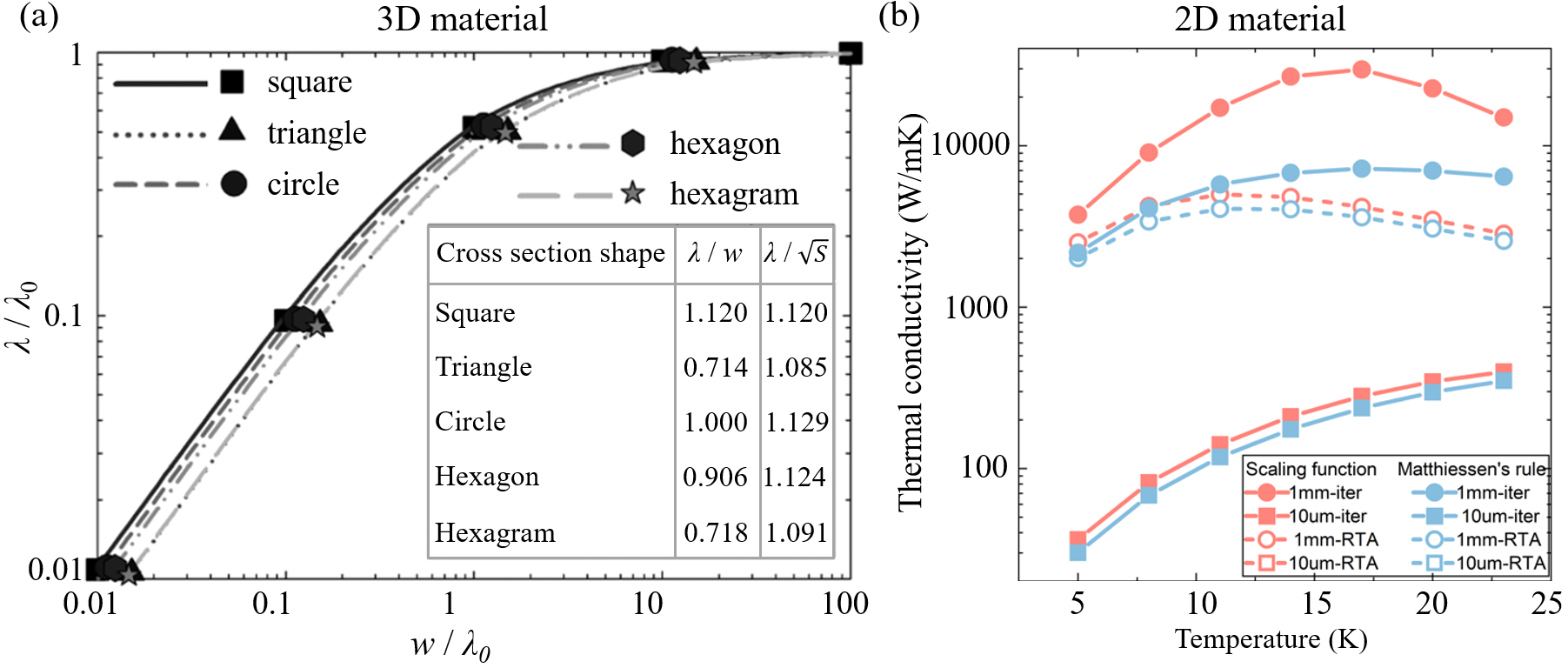
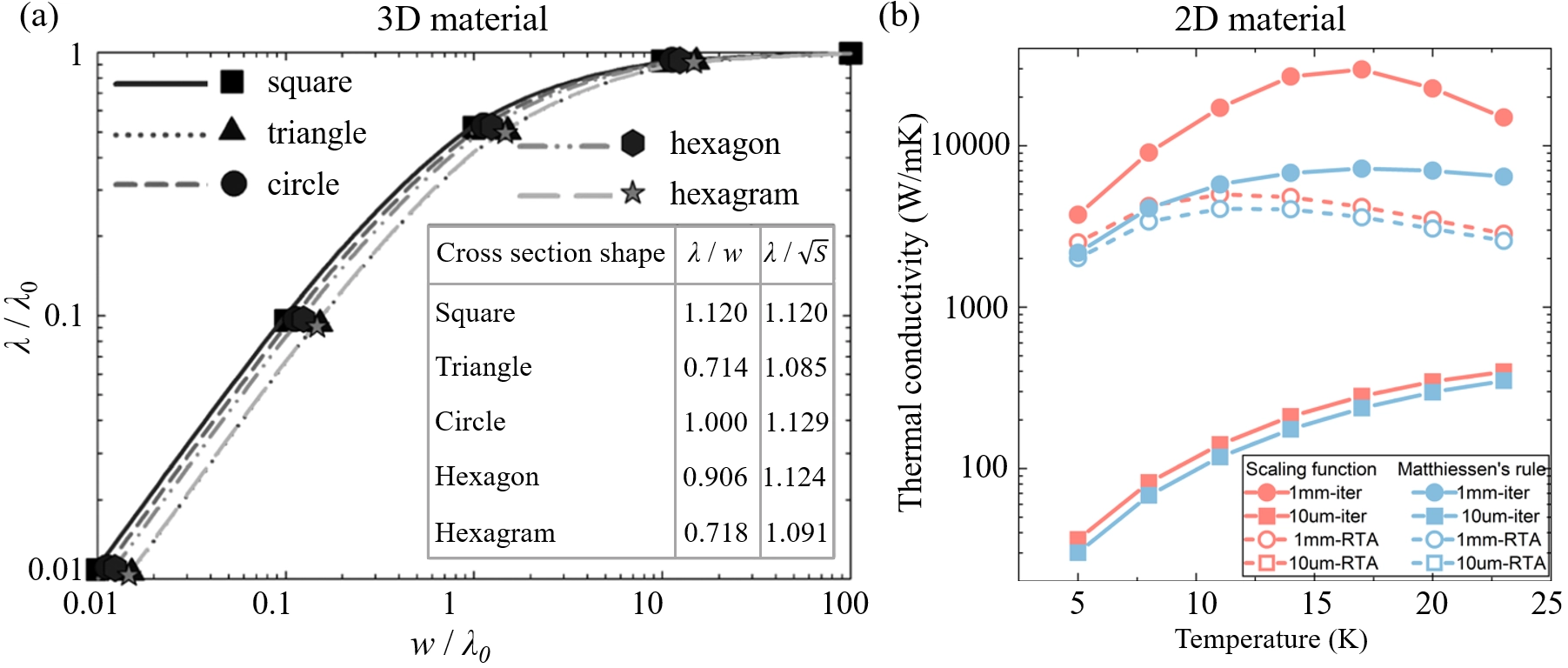
Figure 11. (a) Mean free path comparisons from BTE scaling function and boundary scattering via Matthiessen’s rule of (a) 3D material (infinite lengths with different cross-sections) and (b) 2D material (square-shaped ribbons). Matthiessen’s rule agrees quantitatively with the BTE scaling function. Figure (a) is reproduced with permission from reference[69]. Copyright © 2011 American Institute of Physics. And Figure (b) is reproduced with permission from reference[98]. Copyright © 2026 American Physical Society. BTE: Boltzmann transport equation; 2D: two-dimensional; 3D: three-dimensional.
4.5 Collective and hydrodynamic phonon transport
As the temperature decreases, phonon transport can evolve beyond the conventional kinetic regime, where heat is carried by independent phonon quasiparticles and limited by resistive scattering. When momentum-conserving N-processes become more frequent than momentum-relaxing resistive processes, phonons develop a collective drift velocity, which is the Ziman regime of collective transport[99], as illustrated in Figure 12b. Under a temperature gradient, heat flows collectively with a nonuniform profile analogous to viscous fluid flow[100], as shown in Figure 12a. Upon further cooling, however, internal scattering becomes too weak to sustain local equilibration, and transport ultimately crosses over into the ballistic regimes. Consequently, hydrodynamic transport exists only within an intermediate temperature window between the diffusive and ballistic transport.
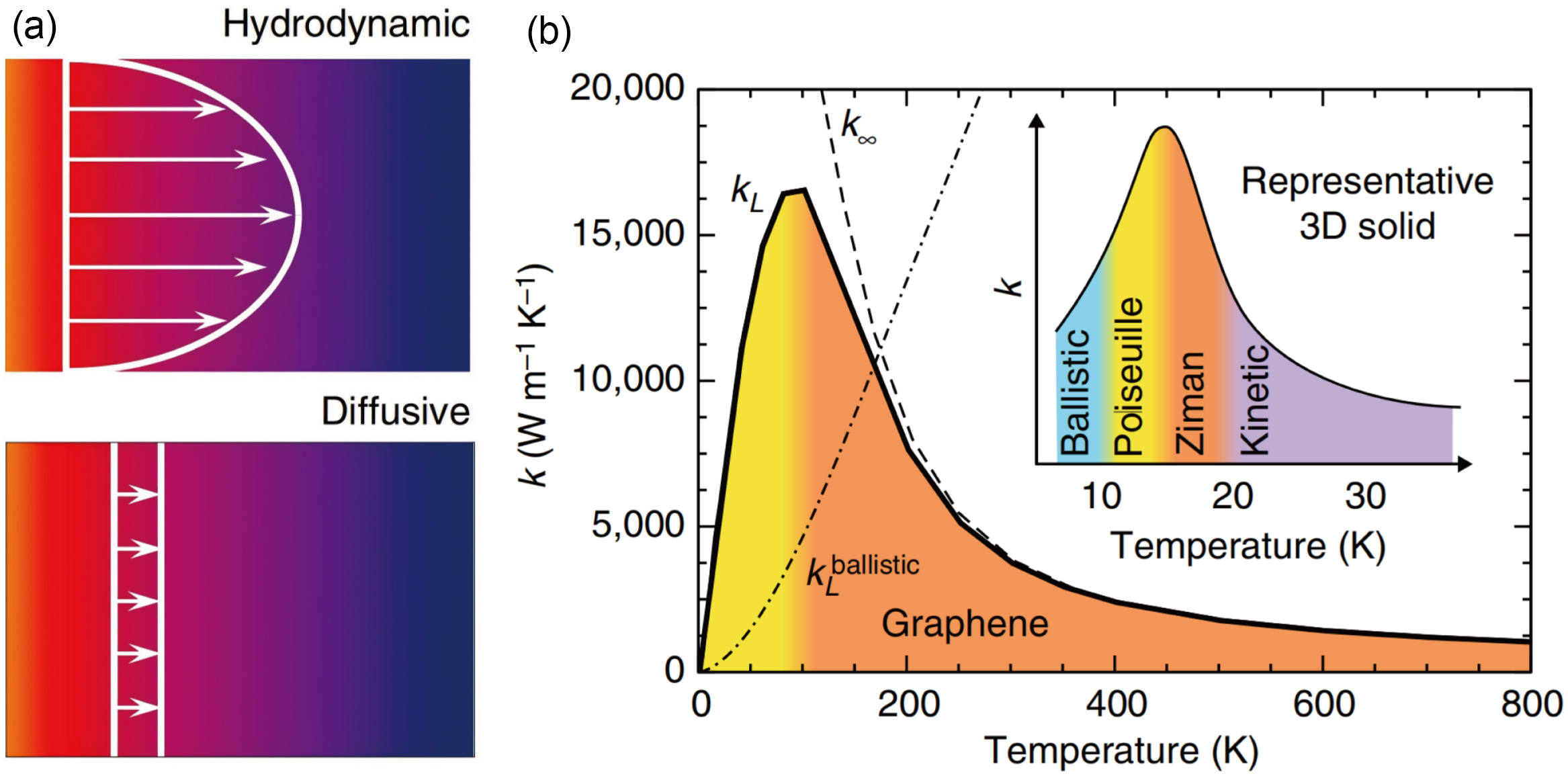
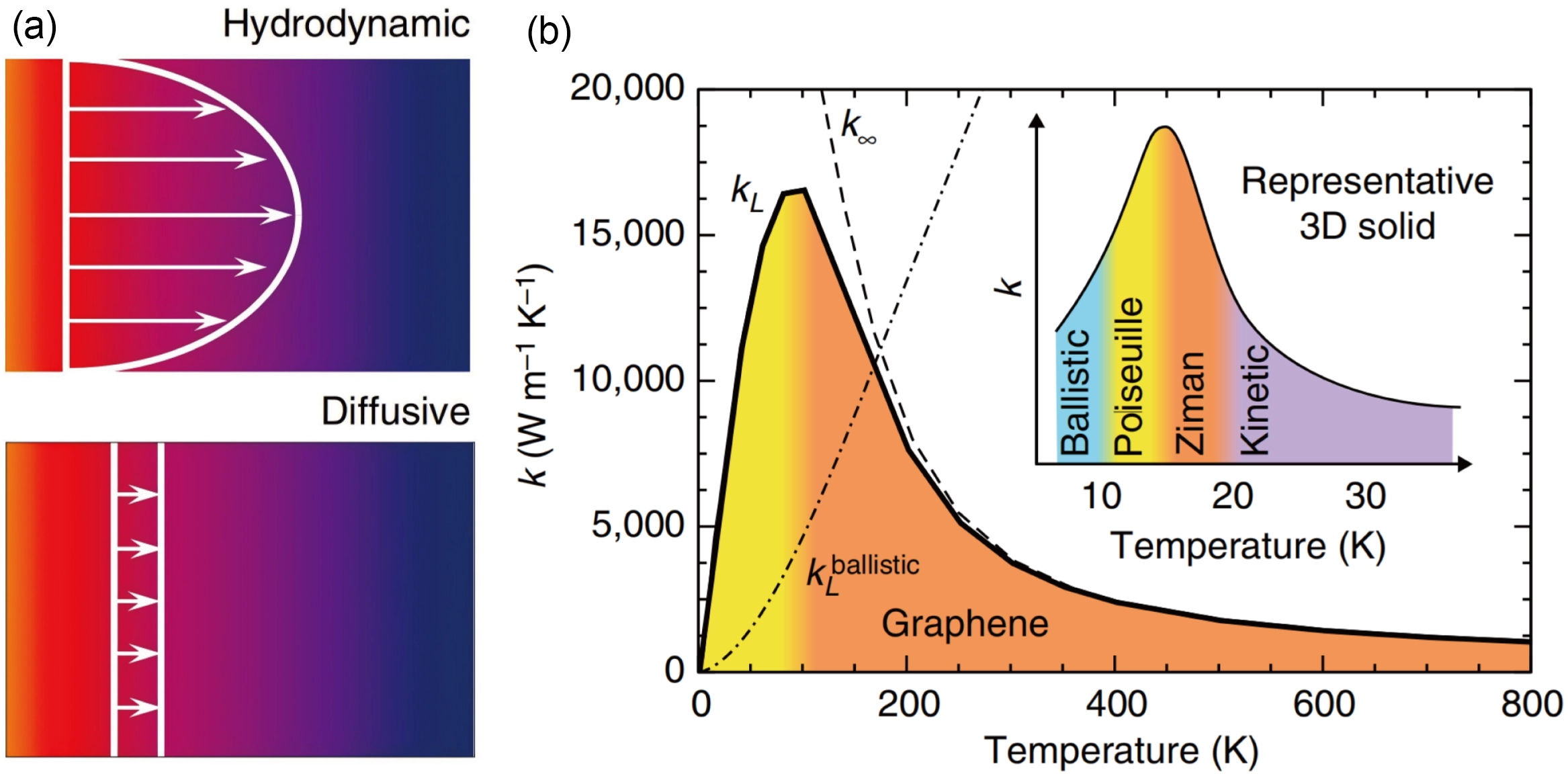
Figure 12. (a) Illustration of the steady-state heat-flux profiles in the hydrodynamic and ballistic regimes under a temperature gradient. The figure is reproduced from reference[100]. CC BY 4.0; (b) Thermal conductivity of a graphene ribbon of width L = 100 μm (κL), its ballistic limit
The theoretical foundation of phonon hydrodynamics was established by Guyer and Krumhansl[101], who showed that hydrodynamic transport requires the approximate hierarchy
where ΛN and ΛR are mean free paths associated with Normal and resistive scattering, respectively, and L is the characteristic sample dimension. Under these conditions, collective phonon motion can produce Poiseuille heat flow in steady-state transport and second sound in transient transport[102].
Hydrodynamic phonon transport has been observed or proposed in only a limited number of exceptionally clean materials. Early evidence came from solid helium, where thermal conductivity exhibits an unusually steep temperature dependence approaching T8 as shown in Figure 13a, consistent with strong collective phonon transport[103]. More recently, SrTiO3 has attracted considerable attention because its thermal conductivity increases faster than T3 within a narrow temperature range below the conductivity peak[104], as shown in Figure 13b. The approximately exponential decrease of thermal conductivity with increasing temperature is also characteristic of the Ziman regime.
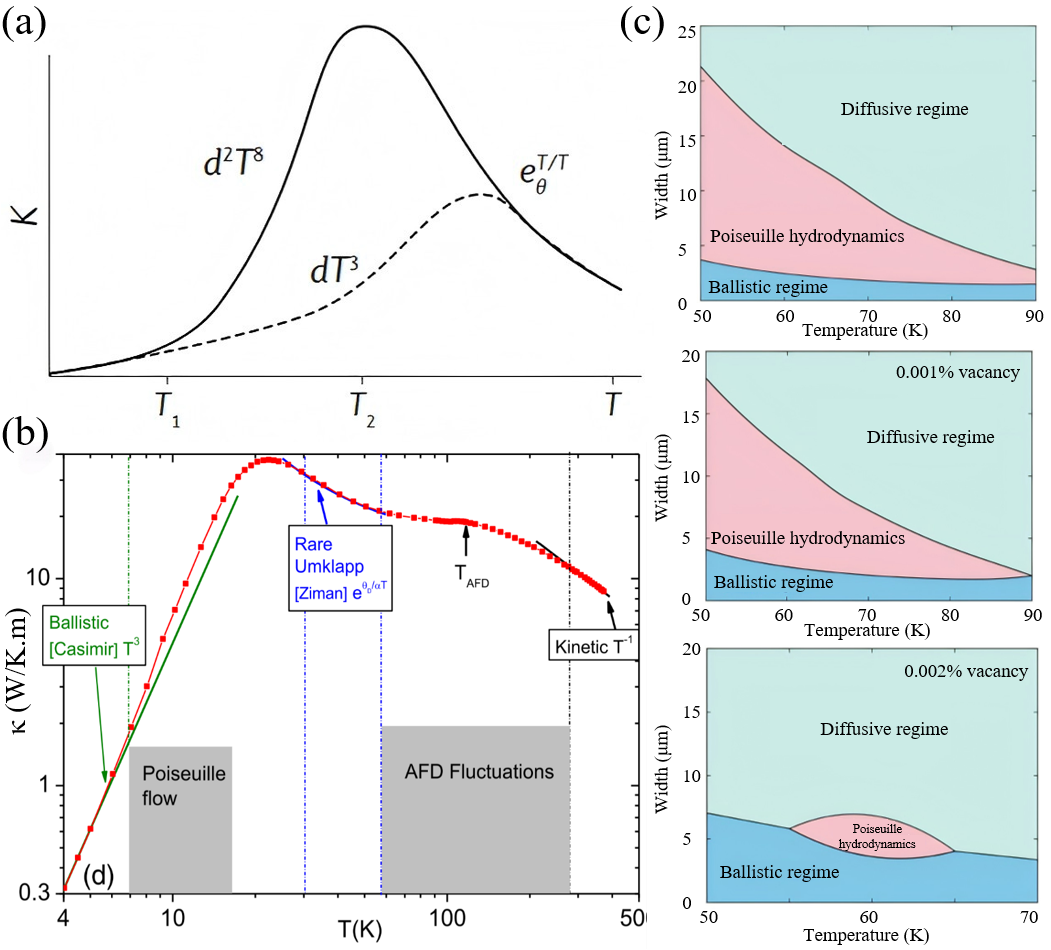
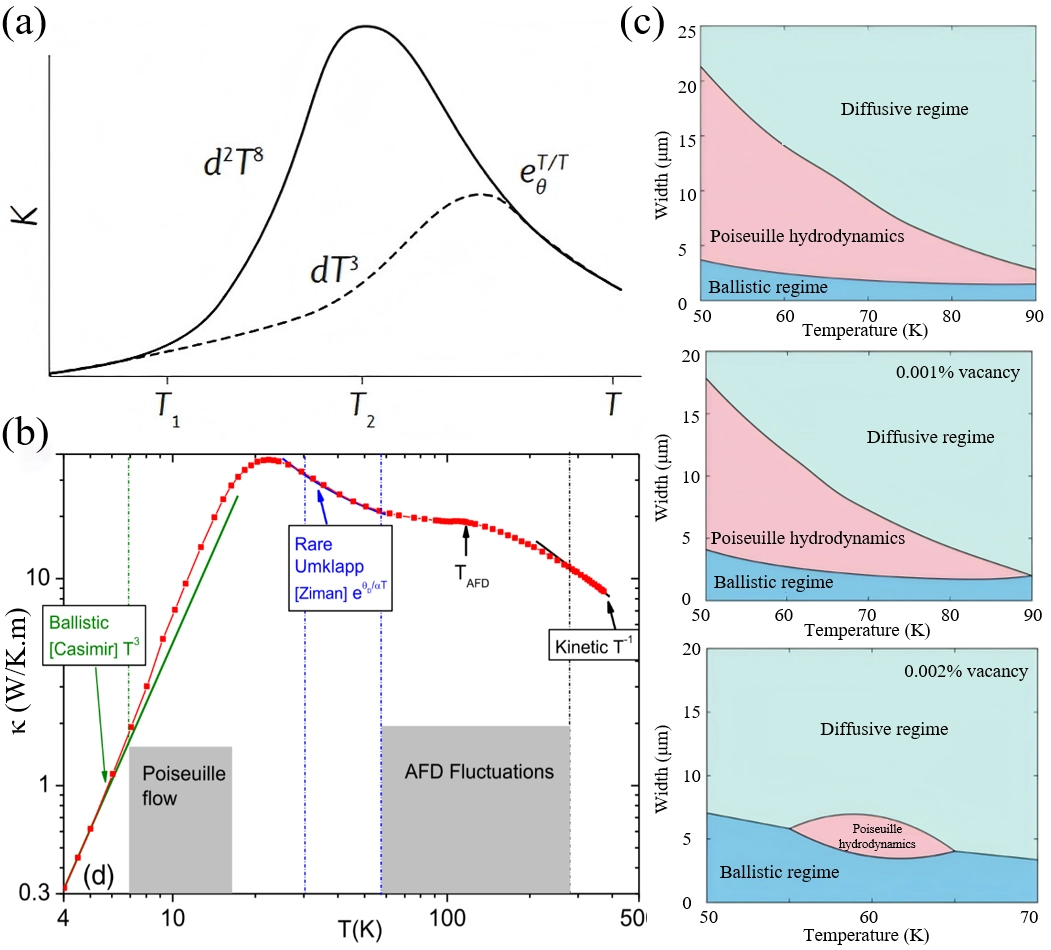
Figure 13. (a) Thermal conductivity of solid helium in the Poiseuille flow regime and temperature dependence predicted by the Casimir limit (dashed line). The figure is reproduced from reference[103]. CC BY 4.0; (b) Thermal conductivity of a SrTiO3 crystal (closed red squares) and exponential variation in the Ziman region; the figure is reproduced with permission from reference[104]. Copyright © 2018 American Physical Society; (c) Transport regimes in graphite ribbons between 50-90 K for different vacancy concentrations, illustrating the variation of hydrodynamic transport regions. The figure is reproduced with permission from reference[102]. Copyright © 2017 American Chemical Society.
Reduced dimensionality substantially enlarges the hydrodynamic transport window. First-principles calculations predict that in graphene, graphite, and related layered materials, collective phonon transport can persist up to tens or even hundreds of kelvin[99,100,105-107]. Graphite is a representative example, where hydrodynamic transport and the Knudsen minimum have been predicted and experimentally investigated over a much broader temperature range[102], as shown in Figure 13c. Nevertheless, hydrodynamic transport remains highly sensitive to defects and other momentum-relaxing mechanisms, which substantially reduce the accessible hydrodynamic regime.
Accurate descriptions of collective phonon transport requires solving the full linearized phonon BTE. Although the Callaway model also considered such mechanisms[12], recent first-principles studies demonstrate that its accuracy deteriorates in the cryogenic regime and that it does not consistently outperform the relaxation-time approximation[108,109]. These limitations have motivated rigorous iterative and relaxon-based solutions of the BTE, which provide a more complete description of collective phonon dynamics[110].
5. Beyond the Particle Picture: Wave and Coherence Effects
The transport mechanisms discussed in the preceding sections are based on the semiclassical Boltzmann transport equation, which treats phonons as incoherent quasiparticles undergoing stochastic scattering. This description is appropriate when phonon phase information is effectively destroyed by scattering processes. At cryogenic temperatures, however, the dominant phonon wavelength increases substantially, and phonon phase coherence can persist[11]. In silicon, for example, phonon coherence lengths can approach submicron scales at a few kelvin, remaining significant even in nanostructures with etched boundaries[45]. When the phase-coherence length becomes comparable to characteristic structural dimensions, the particle picture gradually breaks down, and phonons must be described as coherent elastic waves[111].
5.1 Phonon confinement and mode quantization
Spatial confinement modifies the phonon spectrum by quantizing vibrational modes, producing discrete subbands and altered group velocities, as illustrated in Figure 14a[114]. These changes influence both the heat capacity and thermal conductivity of thin films[115,116], phononic crystals[117,118], and superlattices[119,120].
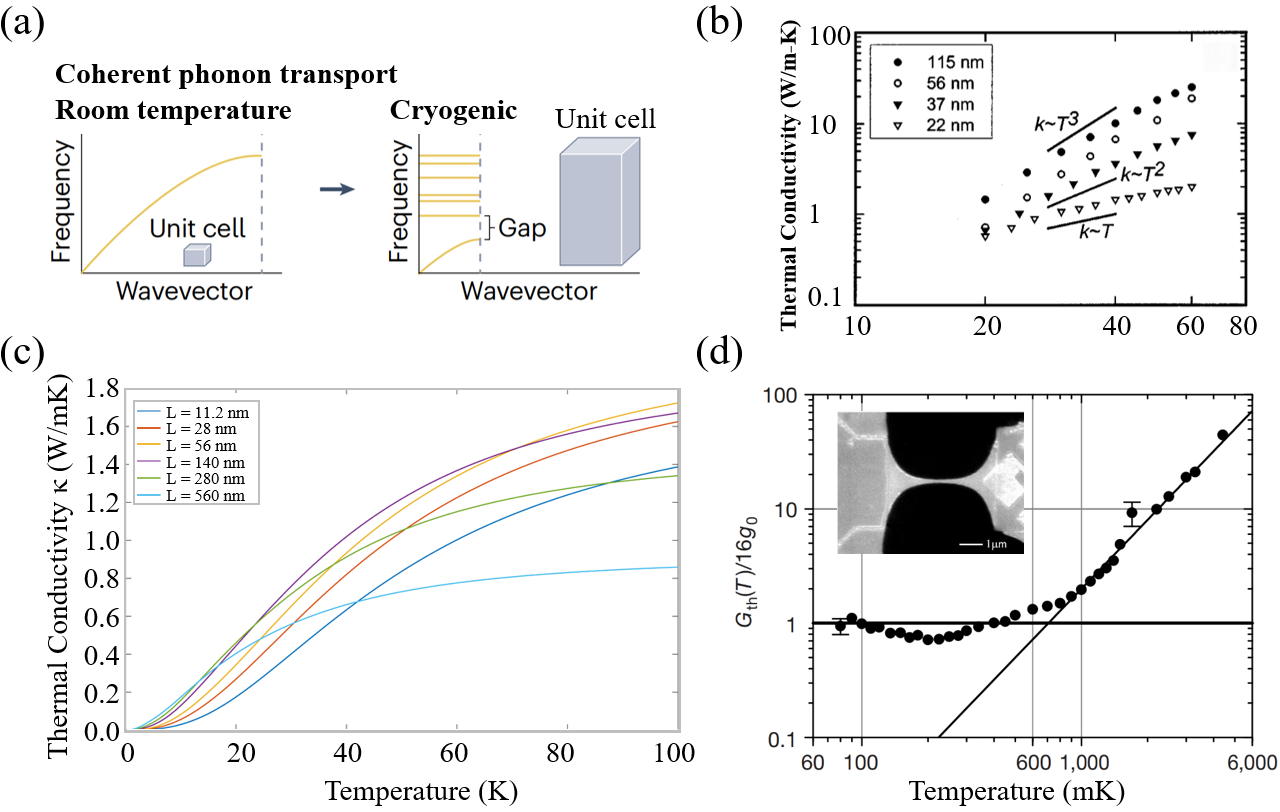
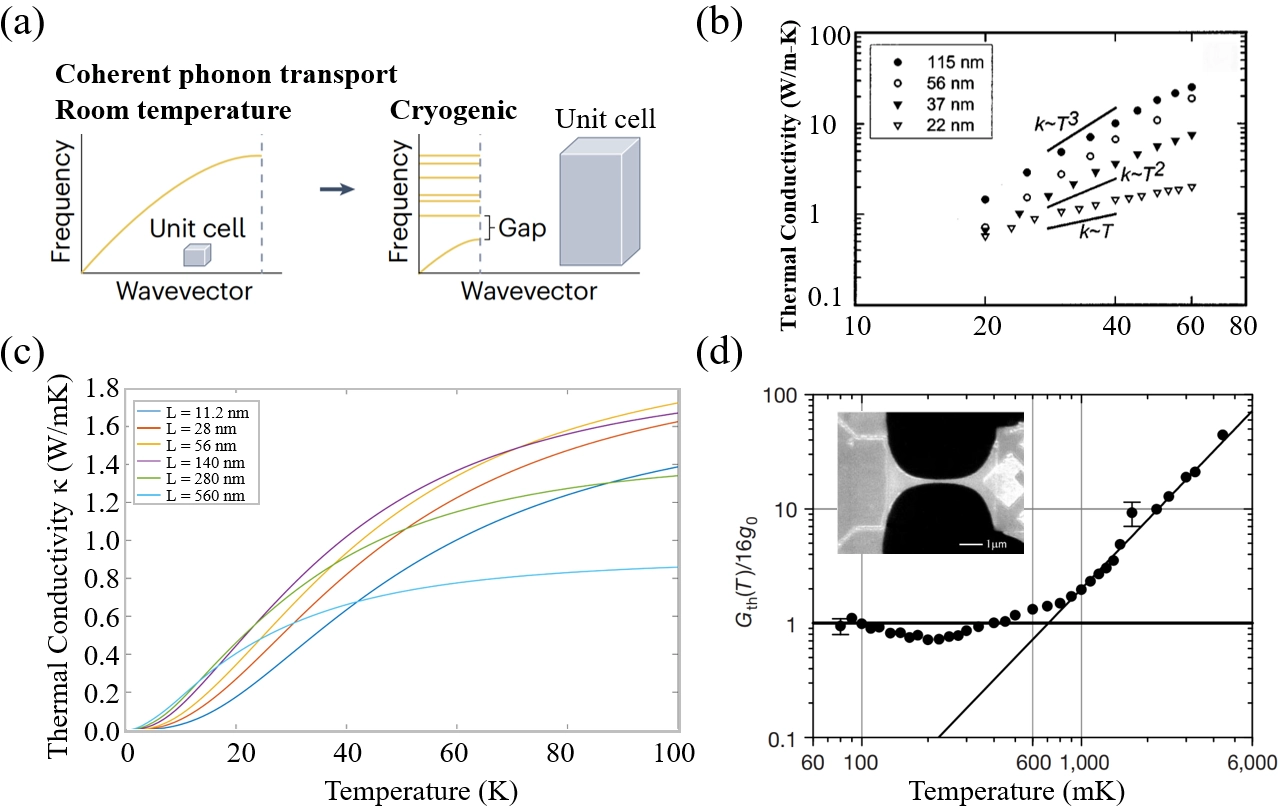
Figure 14. (a) Phonon dispersions in a finite unit cell channel at room and cryogenic temperatures, illustrating coherent phonon modes. The figure is reproduced with permission from reference[11]. Copyright © 2024 Springer Nature Limited; (b) Cryogenic-temperature thermal conductivity measurements of silicon nanowires. The figure is reproduced with permission from reference[19]. Copyright © 2003 American Institute of Physics; (c) Thermal conductivity as a function of temperature for GaAs/AlAs superlattices with 23.8% ErAs interfacial coverage at different sample lengths. The figure is reproduced with permission from reference[112]. Copyright © 2016 American Chemical Society; (d) Experimental observation of the universal quantized thermal conductance Gth at ultra-low temperature, which is normalized by the theoretical derivation of the universal quantized thermal conductance g0. The figure is reproduced with permission from reference[113]. Copyright © 2000 Springer Nature Limited.
Low-dimensional materials provide particularly clear manifestations of confinement. In silicon nanowires (Figure 14b), reducing the diameter from 115 to 22 nm produces a gradual crossover from bulk-like three-dimensional transport to behaviors similar to two- and one-dimensional samples, accompanied by corresponding changes in the temperature dependence of thermal conductivity[19]. Similar dimensional effects have been observed in boron nitride and B-C-N nanotubes at cryogenic temperatures[121].
In ballistic one-dimensional channels at sufficiently low temperatures, thermal conductance becomes quantized. The conductance of each propagating mode approaches the universal quantum[113]
where kB is the Boltzmann constant, h is Planck’s constant. As illustrated in Figure 14d, as the temperature decreases to around 600 mK, the thermal conductance of the nanowire converges to the universal quantized thermal conductance[113], as shown in Eq. (8).
5.2 Anderson localization and coherent transport of phonons
When phonon wavelengths become comparable to characteristic disorder length scales, coherent multiple scattering can induce localization.
Early observations of heat transport in silicon nanomembranes suggested the contributions from wave effects[122], while subsequent experiments and simulations demonstrated substantial reductions in thermal conductivity caused by interference in disordered nanostructures[123,124]. A representative example is provided by GaAs/AlAs superlattices containing ErAs nanoparticles[112], shown in Figure 14c. At temperatures near 1 K, thermal conductivity initially increases with sample length, reflecting ballistic transport. At higher temperatures, however, disorder localizes higher-frequency phonons, producing the unusual behavior that thicker samples exhibit lower thermal conductivity. This anomalous length dependence provides strong evidence for phonon Anderson localization[46]. More recently, phononic crystals have demonstrated that coherent wave transport can be engineered through periodic nanostructuring and controlled disorder[125,126]. By tailoring phonon dispersion and interference, these structures enable thermal-conductivity suppression and heat-flow manipulation beyond the limits of conventional particle-based transport models.
6. Self-Heating and Phonon Transport in Cryogenic Devices
The cryogenic phonon transport mechanisms discussed above have direct implications for thermal management in modern electronic and quantum devices. At cryogenic temperatures, self-heating, the local temperature increase caused primarily by dissipated electrical power, becomes a major performance limitation because both the cooling power of cryogenic systems and the heat capacity of solids are extremely small[127]. Recent studies of cryogenic Fully Depleted Silicon-On-Insulator (FDSOI) technologies further demonstrate that self-heating remains significant down to deep cryogenic temperatures, exhibiting large temperature rises, strongly temperature-dependent thermal resistance, and rapid thermal dynamics[10,128].
A representative example is the InP high-electron-mobility transistor (HEMT) used in cryogenic low-noise amplifiers, where channel temperatures tens of kelvin above the cryostat temperature have been reported despite operation near 0.1 K, as shown in Figure 15[129]. Such local heating degrades carrier transport[130,131], increases microwave noise, and reduces gain stability[132], and perturbs nearby quantum circuits through elevated phonon temperatures and thermal noise[133].
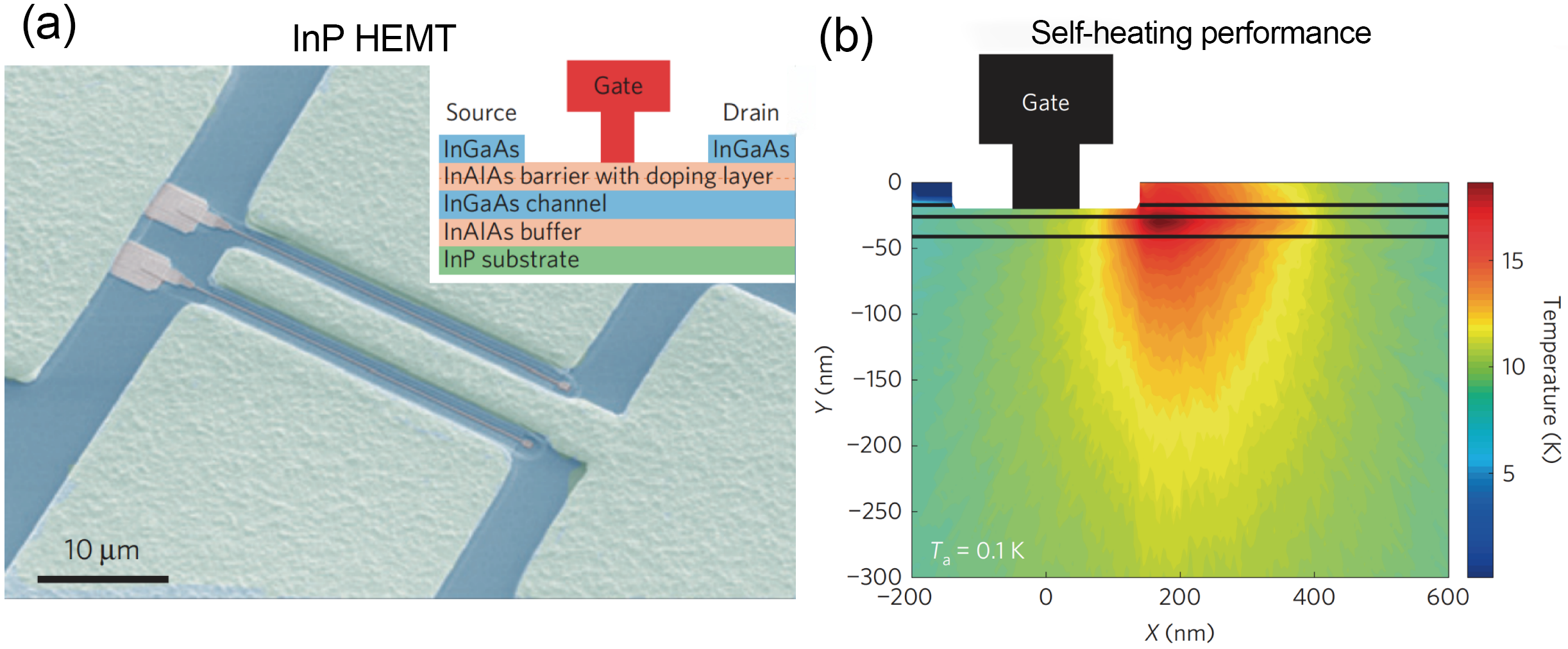
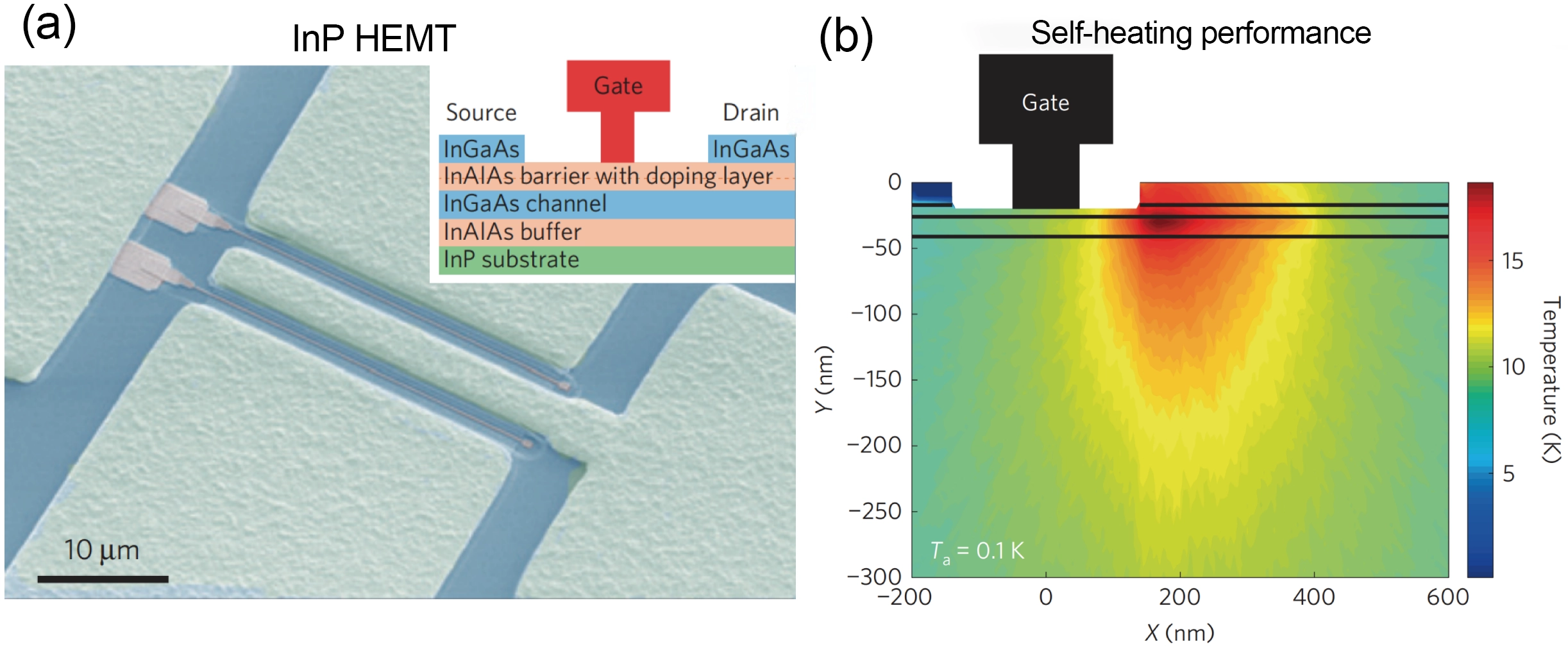
Figure 15. (a) Scanning electron micrograph image of an InP HEMT. Inset: schematic view of the HEMT cross-section; (b) Simulations were performed with 29 mW mm-1 input power at an operating temperature of 0.1 K. Figures (a) and (b) are reproduced with permission from reference[129]. Copyright © 2015 Springer Nature Limited. HEMT: high-electron-mobility transistor.
6.1 Geometry-limited phonon transport and phonon radiation limit
In nanoscale devices, the local heat flux is governed not only by thermal conductivity but also by the available phonon modes, their group velocities, and transmission across interfaces[130,134-136]. Consequently, heat removal can approach the phonon radiation limit, the maximum ballistic phonon energy flux emitted from a heated region.
Experimental and theoretical studies consistently show that thermal resistance increases with decreasing local temperature as shown in Figure 16a, while ballistic phonons dominate thermal resistance in these cryogenic devices. Schleeh et al.[129] demonstrated that heat transport in cryogenic HEMTs approaches the phonon radiation limit at 4 K, while subsequent studies successfully reproduced the measured thermal resistance using ballistic phonon transport models[137,139], as shown in Figure 16b,c.
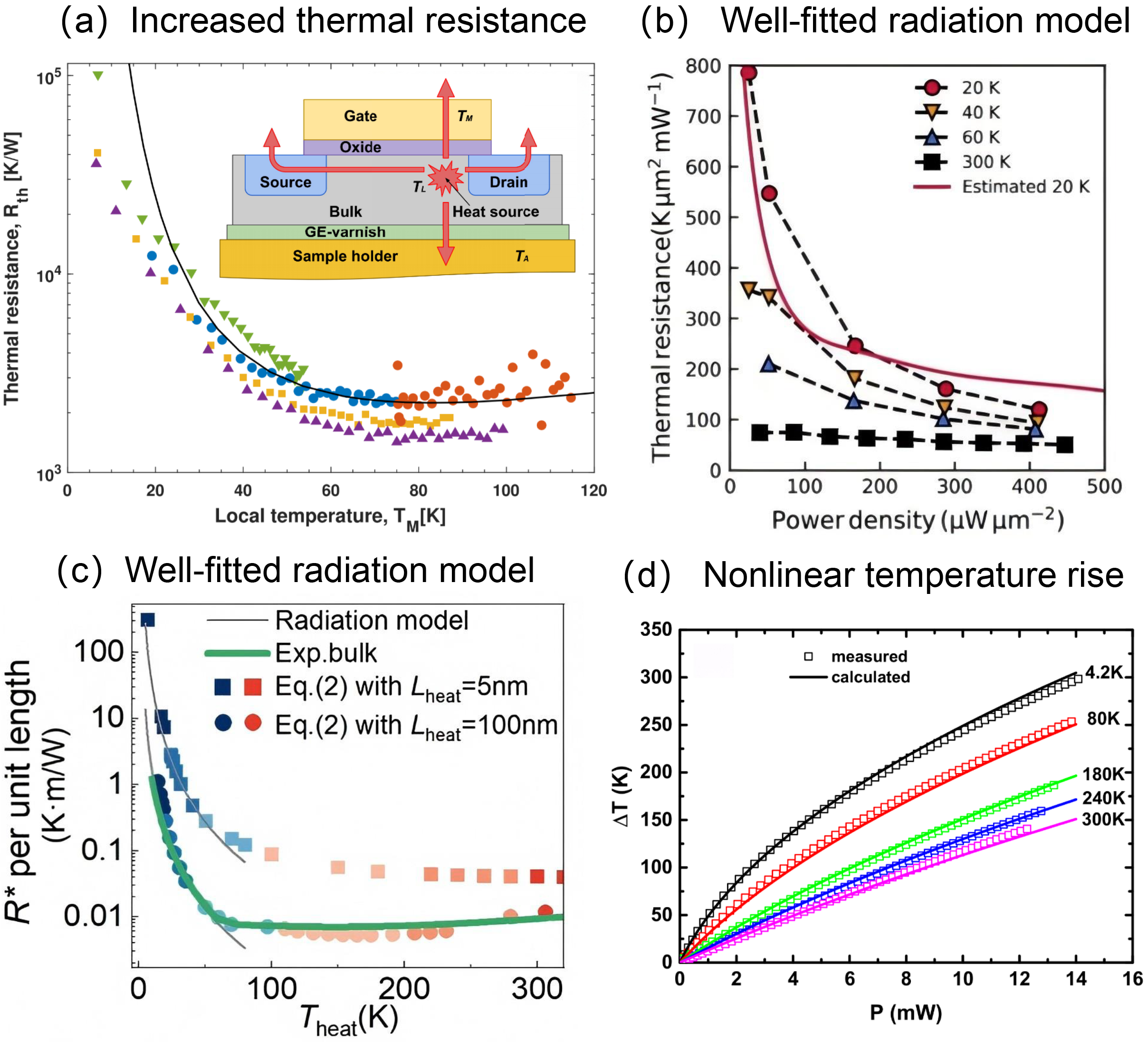
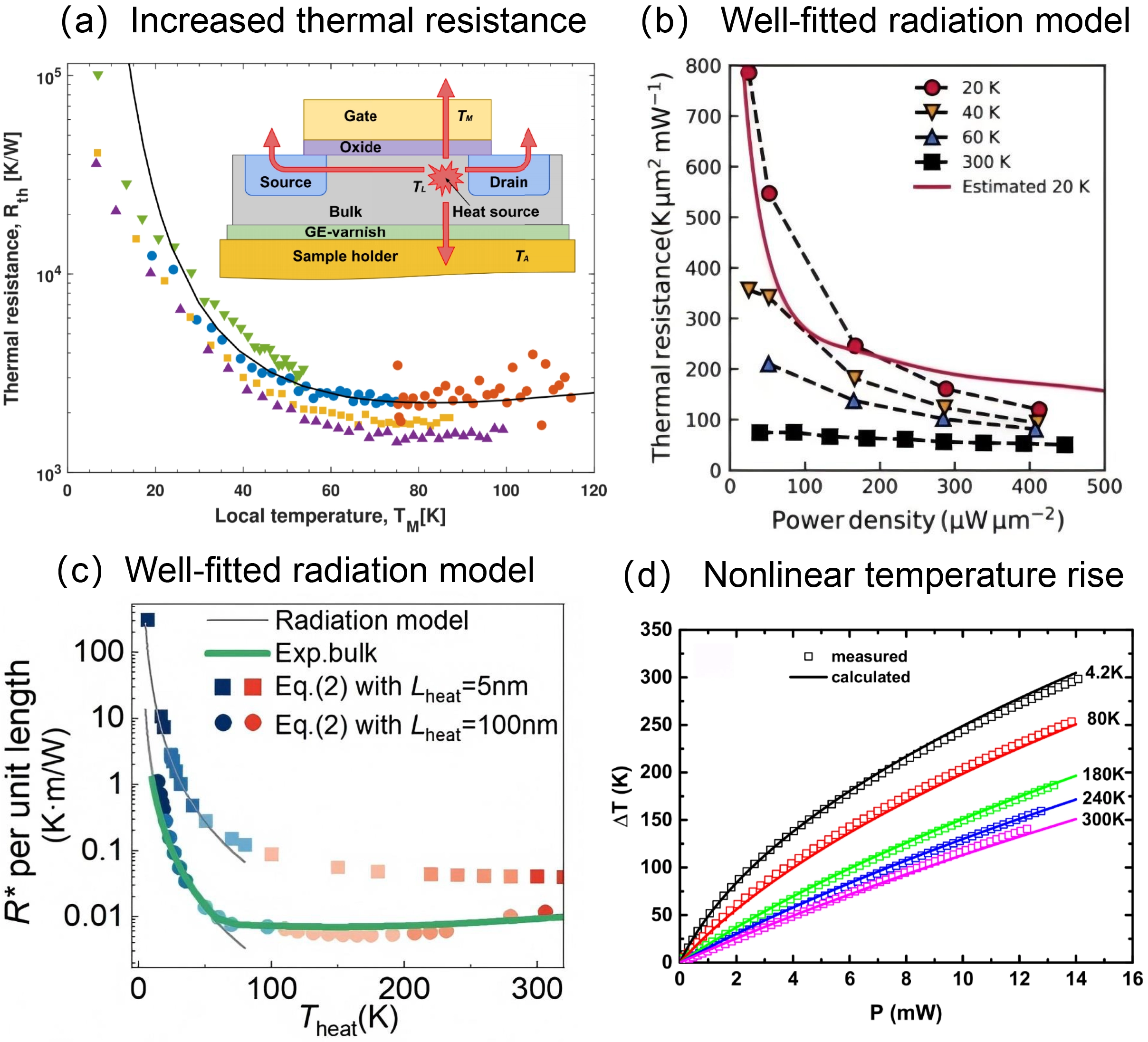
Figure 16. (a) Increased thermal resistance as temperature decreases. Figure is reproduced with permission from reference[134]. Copyright © 2022 IEEE; (b-c) Well-fitted radiation model in experiments[137] and simulations[138]. Reproduced with permission from reference[137]. Copyright © 2021 Author(s). Figures are reproduced from reference[138]. CC BY 4.0; (d) Nonlinearity of temperature rise at cryogenic temperatures. The figure is reproduced with permission from reference[135]. Copyright © 2019 IEEE.
At the same time, boundary scattering becomes increasingly important. In silicon-on-insulator technologies, thin-film thermal conductivity can be reduced by more than an order of magnitude relative to bulk silicon because of enhanced phonon-boundary scattering[138]. Device geometry, interface quality, and multilayer heat-flow paths therefore become key factors controlling thermal resistance. Recent simulations and measurements of cryogenic Complementary Metal-Oxide-Semiconductor (CMOS) and FDSOI devices further show that shrinking device dimensions substantially increases thermal resistance and exacerbates self-heating[10,128].
6.2 Nonlinear thermal response and power-temperature relationship in cryogenic devices
Another characteristic feature of cryogenic devices is the nonlinear relationship between dissipated power and temperature rise[135], as shown in Figure 16d. Unlike the nearly linear behavior observed near room temperature[140], the thermal resistance at cryogenic temperatures depends strongly on the local temperature. As a hotspot forms, additional phonon modes become thermally populated, increasing the local heat-carrying capacity and causing the effective thermal resistance to decrease. Recent phonon BTE simulations reproduce this nonlinear behavior by combining the effects of ballistic transport, boundary scattering, and strongly temperature-dependent phonon properties[130,135].
These studies demonstrate that self-heating in cryogenic devices requires accurate simulations considering detailed phonon properties and scattering mechanisms. Despite rapid advances in cryogenic electronics for quantum computing, sensing, and space applications, quantitative simulations remain limited. Establishing such connections represents an important direction for future research and will be essential for the thermal design of next-generation cryogenic technologies.
7. Summary and Outlook
Phonon-mediated thermal transport at cryogenic temperatures differs markedly from the diffusive heat conduction commonly encountered near room temperature. As anharmonic phonon-phonon scattering is progressively suppressed, heat transport becomes increasingly dominated by long-wavelength acoustic phonons with exceptionally long mean free paths, rendering thermal conductivity highly sensitive to geometry, boundaries, defects, and crystal anisotropy. Consequently, cryogenic heat transport exhibits a rich range of behaviors beyond the classical (T3) Casimir limit, including dimensional crossover, competing scattering mechanisms, collective phonon transport, and coherent wave effects. These phenomena not only deepen our understanding of heat conduction in solids but also provide the physical basis for thermal management in cryogenic electronics, quantum technologies, and other low-temperature systems.
Despite these advances, cryogenic thermal transport remains comparatively underexplored, with many fundamental questions and methodological challenges still unsolved. Several directions are particularly important for future research:
• Interfaces and disorder in the long-wavelength limit: At cryogenic temperatures, dominant phonon wavelengths can become comparable to surface roughness, interfacial thickness, and microstructural length scales. Under these conditions, specular reflection, coherent transmission, defect scattering, and interfacial mode conversion may play important roles, requiring more microscopic descriptions beyond conventional boundary-scattering models.
• Thermal transport in complex crystals: Cryogenic transport in perovskites, clathrates, and other strongly anharmonic crystals remains poorly understood, particularly when soft modes[141], rattling modes[142], or wave-like phonons[143] interact with the long-wavelength acoustic phonons that dominate heat transport at low temperatures. Understanding these interactions may reveal new transport regimes that cannot be captured by conventional phonon-gas descriptions.
• Multiscale device simulation across extreme length scales: Cryogenic phonon mean free paths can span from nanometers to millimeters or beyond, while phonon populations and thermophysical properties vary strongly with temperature. Direct first-principles simulations at device-relevant scales therefore remain computationally challenging. Efficient multiscale frameworks are needed to bridge atomistic calculations, Boltzmann transport, and realistic device geometries while retaining essential nonequilibrium and size-dependent effects.
• Electron-phonon nonequilibrium at cryogenic temperatures: As electron-phonon scattering is strongly suppressed upon cooling, electrons and phonons can remain out of equilibrium over extended time and length scales. Conventional approaches that treat electron and phonon transport separately, particularly within the RTA, may therefore become inadequate. Mode-resolved descriptions of electron-phonon energy exchange and hot-carrier relaxation will be important for understanding nanoscale thermalization and cryogenic hotspots.
• Cryogenic experimental characterization: Extremely small heat capacities, weak thermal signals, parasitic heat leaks, and large boundary resistances make quantitative thermal measurements particularly challenging at cryogenic temperatures. Beyond measuring effective thermal conductivity, future experiments should aim to resolve phonon propagation, mean free paths, and nonequilibrium phonon populations, enabling direct identification of the underlying transport regime.
Together, these challenges highlight the need for a more comprehensive physical framework for cryogenic heat transport, supported by closer integration of theory, simulation, and experiment. Addressing these challenges will be essential not only for advancing the fundamental understanding of low-temperature thermal transport, but also for developing predictive thermal-management strategies for next-generation cryogenic electronics, quantum devices, and other technologies operating in extreme thermal environments.
Authors contribution
Zhang X: Conceptualization, investigation, visualization, writing-original draft, writing-review & editing.
Jia R: Writing-original draft, writing-review & editing.
Shao C: Conceptualization, supervision, resources, funding acquisition, writing-review & editing.
Bao H: Conceptualization, supervision, resources, funding acquisition, writing-review & editing.
Conflicts of interest
Hua Bao is an Editorial Board Member of Thermo-X. The other authors declare no conflicts of interest.
Ethical approval
Not applicable.
Consent to participate
Not applicable.
Consent for publication
Not applicable.
Availability of data and materials
Not applicable.
Funding
This work is supported by National Natural Science Foundation of China (Grant No. 52476080). C. S. acknowledges support from the National Natural Science Foundation of China (Grant No. 52306102).
Copyright
© The Author(s) 2026.
References
-
1. Zhao P, Li HY, Lim YD, Seit WW, Guidoni L, Tan CS. The integration of grounding plane into TSV integrated ion trap for efficient thermal management in large scale quantum computing device. In: 2022 IEEE 72nd Electronic Components and Technology Conference (ECTC); 2022 May 31-June 3; San Diego. Piscataway: IEEE; 2022. p. 137-142.[DOI]
-
2. Pauka SJ, Das K, Kalra R, Moini A, Yang Y, Trainer M, et al. A cryogenic CMOS chip for generating control signals for multiple qubits. Nat Electron. 2021;4(1):64-70.[DOI]
-
3. Arute F, Arya K, Babbush R, Bacon D, Bardin JC, Barends R, et al. Quantum supremacy using a programmable superconducting processor. Nature. 2019;574(7769):505-510.[DOI]
-
5. Sabri F, Marchetta J, Smith KM. Thermal conductivity studies of a polyurea cross-linked silica aerogel-RTV 655 compound for cryogenic propellant tank applications in space. Acta Astronaut. 2013;91:173-179.[DOI]
-
6. Sekimoto Y, Ade P, Arnold K, Aumont J, Austermann J, Baccigalupi C, et al. Concept design of the LiteBIRD satellite for CMB B-mode polarization. In: Space Telescopes and Instrumentation 2018: Optical, Infrared, and Millimeter Wave; 2018 Aug 9; Austin. Bellingham: SPIE; 2018.[DOI]
-
7. Zu H, Dai W, de Waele ATAM. Development of dilution refrigerators: A review. Cryogenics. 2022;121:103390.[DOI]
-
8. Krinner S, Storz S, Kurpiers P, Magnard P, Heinsoo J, Keller R, et al. Engineering cryogenic setups for 100-qubit scale superconducting circuit systems. EPJ Quantum Technol. 2019;6(1):2.[DOI]
-
9. Park J, Kim B, Jeong S. A review on a 4 K cryogenic refrigeration system for quantum computing. Prog Supercond Cryog. 2022;24(2):1-6.[DOI]
-
10. Cassé M, Bergamaschi FE, Berlingard Q. Self-heating effects in FDSOI transistors at cryogenic temperature: A spatial and temporal experimental study (invited). In: 2025 IEEE International Reliability Physics Symposium (IRPS); 2025 March 30-April 3; Monterey. Piscataway: IEEE; 2025. p. 1-7.[DOI]
-
11. Shiomi J, Uchida K. Scientific challenges of cryo-electronics thermal management. Nat Rev Electr Eng. 2024;1(12):762-763.[DOI]
-
12. Callaway J. Low-temperature lattice thermal conductivity. Phys Rev. 1961;122(3):787-790.[DOI]
-
13. Zhang X, Shao C, Bao H. Cryogenic thermal transport properties from accelerated first-principles calculations: Role of boundary and isotope scattering. Phys Rev B. 2024;110(22):224301.[DOI]
-
14. Kuleyev II, Kuleyev IG. Phonon focusing and anisotropy of the lattice thermal conductivity of potassium crystals at low temperatures. Phys Metals Metallogr. 2018;119(12):1141-1147.[DOI]
-
15. Chen G. Non-Fourier phonon heat conduction at the microscale and nanoscale. Nat Rev Phys. 2021;3(8):555-569.[DOI]
-
16. Ventura G, Perfetti M. Thermal properties of solids at room and cryogenic temperatures. Dordrecht: Springer; 2014. Available from: https://link.springer.com/book/10.1007/978-94-017-8969-1
-
17. Cahill DG. Thermal conductivity measurement from 30 to 750 K: The 3ω method. Rev Sci Instrum. 1990;61(2):802-808.[DOI]
-
18. Inyushkin AV, Taldenkov AN, Ager JW III, Haller EE, Riemann H, Abrosimov NV, et al. Ultrahigh thermal conductivity of isotopically enriched silicon. J Appl Phys. 2018;123(9):095112.[DOI]
-
19. Li D, Wu Y, Kim P, Shi L, Yang P, Majumdar A. Thermal conductivity of individual silicon nanowires. Appl Phys Lett. 2003;83(14):2934-2936.[DOI]
-
20. Bae MH, Li Z, Aksamija Z, Martin PN, Xiong F, Ong ZY, et al. Ballistic to diffusive crossover of heat flow in graphene ribbons. Nat Commun. 2013;4:1734.[DOI]
-
21. Klemens PG. Thermal conductivity of solids at low temperatures. In: Flügge S. Low Temperature Physics I / Kältephysik I. Berlin: Springer; 1956. p. 198-281.[DOI]
-
22. Callaway J. Model for lattice thermal conductivity at low temperatures. Phys Rev. 1959;113(4):1046-1051.[DOI]
-
23. Holland MG. Phonon scattering in semiconductors from thermal conductivity studies. Phys Rev. 1964;134(2A):A471-A480.[DOI]
-
24. Herring C. Role of low-energy phonons in thermal conduction. Phys Rev. 1954;95(4):954-965.[DOI]
-
25. Allen PB. Improved Callaway model for lattice thermal conductivity. Phys Rev B. 2013;88(14):144302.[DOI]
-
26. Asen-Palmer M, Bartkowski K, Gmelin E, Cardona M, Zhernov AP, Inyushkin AV, et al. Thermal conductivity of germanium crystals with different isotopic compositions. Phys Rev B. 1997;56(15):9431-9447.[DOI]
-
27. Bao H, Chen J, Gu X, Cao B. A review of simulation methods in micro/nanoscale heat conduction. ES Energy Environ. 2018;1:16-55.[DOI]
-
28. Feng T, Ruan X. Prediction of spectral phonon mean free path and thermal conductivity with applications to thermoelectrics and thermal management: A review. J Nanomater. 2014;2014:206370.[DOI]
-
29. Li W, Carrete J, Katcho NA, Mingo N. ShengBTE: A solver of the Boltzmann transport equation for phonons. Comput Phys Commun. 2014;185(6):1747-1758.[DOI]
-
30. Cahill DG, Braun PV, Chen G, Clarke DR, Fan S, Goodson KE, et al. Nanoscale thermal transport. II. Appl Phys Rev. 2014;1(1):011305.[DOI]
-
31. Zhang X, Li S, Wang A, Bao H. Pressure-dependent thermal conductivity in Al, W, and Pt: Role of electrons and phonons. Phys Rev B. 2022;106(9):094313.[DOI]
-
32. Mousatov CH, Hartnoll SA. Phonons, electrons and thermal transport in Planckian high Tc materials. npj Quantum Mater. 2021;6:81.[DOI]
-
33. Li S, Guo S, Hoke T, Chen X. Thermal transport in magnetic materials: A review. Mater Today Electron. 2025;12:100156.[DOI]
-
34. Carruthers P. Theory of thermal conductivity of solids at low temperatures. Rev Mod Phys. 1961;33(1):92-138.[DOI]
-
35. Peierls R. Zur kinetischen theorie der Wärmeleitung in kristallen. Ann Phys. 1929;395(8):1055-1101.[DOI]
-
36. Kittel C. Introduction to Solid State Physics. Hoboken, NJ: John Wiley & Sons; 2005. Available from: http://metal.elte.hu/~groma/Anyagtudomany/kittel.pdf
-
37. Kahiu JN, Lee HS. Debye-Callaway model simulator: An interactive slider-based program for fitting theoretical and experimental lattice thermal conductivity. npj Comput Mater. 2026;12:118.[DOI]
-
38. Ziman JM. Electrons and phonons: The theory of transport phenomena in solids. Oxford: Oxford University Press; 2001. Available from: https://doi.org/10.1093/acprof:oso/9780198507796.001.0001
-
39. Tamura SI. Isotope scattering of dispersive phonons in Ge. Phys Rev B. 1983;27(2):858-866.[DOI]
-
40. Klemens PG. Thermal conductivity and lattice vibrational modes. In: Seitz F, Turnbull D, editors. Solid State Physics. Amsterdam: Elsevier; 1958. p. 1-98.[DOI]
-
41. Guo Y, Wang M. Heat transport in two-dimensional materials by directly solving the phonon Boltzmann equation under Callaway’s dual relaxation model. Phys Rev B. 2017;96(13):134312.[DOI]
-
42. Guo Y, Wang M. Phonon hydrodynamics for nanoscale heat transport at ordinary temperatures. Phys Rev B. 2018;97(3):035421.[DOI]
-
44. Mingo N, Yang L, Li D, Majumdar A. Predicting the thermal conductivity of Si and Ge nanowires. Nano Lett. 2003;3(12):1713-1716.[DOI]
-
45. Maire J, Anufriev R, Yanagisawa R, Ramiere A, Volz S, Nomura M. Heat conduction tuning by wave nature of phonons. Sci Adv. 2017;3(8):e1700027.[DOI]
-
46. Luckyanova MN, Mendoza J, Lu H, Song B, Huang S, Zhou J, et al. Phonon localization in heat conduction. Sci Adv. 2018;4(12):eaat9460.[DOI]
-
47. Davier B, Dollfus P, Le ND, Volz S, Shiomi J, Saint-Martin J. Revisiting thermal conductivity and interface conductance at the nanoscale. Int J Heat Mass Transf. 2022;183:122056.[DOI]
-
48. Toberer ES, Baranowski LL, Dames C. Advances in thermal conductivity. Annu Rev Mater Res. 2012;42:179-209.[DOI]
-
49. Casimir HBG. Note on the conduction of heat in crystals. Physica. 1938;5(6):495-500.[DOI]
-
50. Slack GA. Nonmetallic crystals with high thermal conductivity. J Phys Chem Solids. 1973;34(2):321-335.[DOI]
-
51. Morelli DT, Slack GA. High lattice thermal conductivity solids. In: Shindé SL, Goela JS, editors. High thermal conductivity materials. New York: Springer; 2006. p. 37-68.[DOI]
-
52. Kuleyev II, Kuleyev IG, Bakharev SM, Inyushkin AV. Effect of phonon focusing on the temperature dependence of thermal conductivity of silicon. Phys Status Solidi B. 2014;251(5):991-1000.[DOI]
-
53. Kuleyev IG, Kuleyev II, Bakharev SM. Phonon focusing and temperature dependences of the thermal conductivity of silicon nanowires. J Exp Theor Phys. 2014;118(2):253-265.[DOI]
-
54. Every AG, Maznev AA. Boundary-limited thermal conduction of crystalline rods oriented near phonon-focusing caustics. Phys Lett A. 2014;378(45):3372-3381.[DOI]
-
55. Kuleyev II, Kuleyev IG, Bakharev SM, Inyushkin AV. Effect of dispersion on the phonon focusing and anisotropy of thermal conductivity of silicon single crystals in the boundary scattering regime. Phys Solid State. 2013;55(7):1545-1556.[DOI]
-
56. Aksamija Z, Knezevic I. Anisotropy and boundary scattering in the lattice thermal conductivity of silicon nanomembranes. Phys Rev B. 2010;82(4):045319.[DOI]
-
57. Guo Z, Verma A, Wu X, Sun F, Hickman A, Masui T, et al. Anisotropic thermal conductivity in single crystal β-gallium oxide. Appl Phys Lett. 2015;106(11):111909.[DOI]
-
58. Li W, Mingo N. Alloy enhanced anisotropy in the thermal conductivity of SixGe1-x nanowires. J Appl Phys. 2013;114(5):054307.[DOI]
-
59. Wu L, Mingo N, Lindsay L, Broido DA, Stewart DA, Katcho NA. Thermal conductivity of diamond nanowires from first principles. Phys Rev B. 2012;85(19):195436.[DOI]
-
60. Heron JS, Souche GM, Ong FR, Gandit P, Fournier T, Bourgeois O. Temperature modulation measurements of the thermal properties of nanosystems at low temperatures. J Low Temp Phys. 2009;154(5):150-160.[DOI]
-
61. Slack GA. Thermal conductivity of pure and impure silicon, silicon carbide, and diamond. J Appl Phys. 1964;35(12):3460-3466.[DOI]
-
62. Li SY, Bonnemaison JB, Payeur A, Fournier P, Wang CH, Chen XH, et al. Low-temperature phonon thermal conductivity of single-crystalline Nd2CuO4: Effects of sample size and surface roughness. Phys Rev B. 2008;77(13):134501.[DOI]
-
63. Sadhu J, Sinha S. Room-temperature phonon boundary scattering below the Casimir limit. Phys Rev B. 2011;84(11):115450.[DOI]
-
64. Pisoni A, Jacimovic J, Gaál R, Náfrádi B, Berger H, Révay Z, et al. Anisotropic transport properties of tungsten disulfide. Scr Mater. 2016;114:48-50.[DOI]
-
65. Mingo N, Broido DA. Carbon nanotube ballistic thermal conductance and its limits. Phys Rev Lett. 2005;95(9):096105.[DOI]
-
66. Xu X, Pereira LFC, Wang Y, Wu J, Zhang K, Zhao X, et al. Length-dependent thermal conductivity in suspended single-layer graphene. Nat Commun. 2014;5:3689.[DOI]
-
67. Lindsay L, Broido DA, Mingo N. Flexural phonons and thermal transport in graphene. Phys Rev B. 2010;82(11):115427.[DOI]
-
68. Savin AV, Kivshar YS, Hu B. Suppression of thermal conductivity in graphene nanoribbons with rough edges. Phys Rev B. 2010;82(19):195422.[DOI]
-
69. Wang Z, Mingo N. Absence of Casimir regime in two-dimensional nanoribbon phonon conduction. Appl Phys Lett. 2011;99(10):101903.[DOI]
-
70. Nika DL, Pokatilov EP, Askerov AS, Balandin AA. Phonon thermal conduction in graphene: Role of Umklapp and edge roughness scattering. Phys Rev B. 2009;79(15):155413.[DOI]
-
72. Yarali M, Wu X, Gupta T, Ghoshal D, Xie L, Zhu Z, et al. Effects of defects on the temperature-dependent thermal conductivity of suspended monolayer molybdenum disulfide grown by chemical vapor deposition. Adv Funct Mater. 2017;27(46):1704357.[DOI]
-
74. Klemens PG. Theory of lattice thermal conductivity: Role of low-frequency phonons. Int J Thermophys. 1981;2(1):55-62.[DOI]
-
75. Morelli DT, Heremans JP, Slack GA. Estimation of the isotope effect on the lattice thermal conductivity of group IV and group III-V semiconductors. Phys Rev B. 2002;66(19):195304.[DOI]
-
76. Gu X, Yang R. First-principles prediction of phononic thermal conductivity of silicene: A comparison with graphene. J Appl Phys. 2015;117(2):025102.[DOI]
-
77. Lindsay L. First principles Peierls-Boltzmann phonon thermal transport: A topical review. Nanoscale Microscale Thermophys Eng. 2016;20(2):67-84.[DOI]
-
78. Kremer RK, Graf K, Cardona M, Devyatykh GG, Gusev AV, Gibin AM, et al. Thermal conductivity of isotopically enriched 28Si: Revisited. Solid State Commun. 2004;131(8):499-503.[DOI]
-
79. Inyushkin AV, Taldenkov AN, Gibin AM, Gusev AV, Pohl HJ. On the isotope effect in thermal conductivity of silicon. Phys Stat Sol C. 2004;1(11):2995-2998.[DOI]
-
80. Inyushkin AV, Taldenkov AN, Chernodubov DA, Mokhov EN, Nagalyuk SS, Ralchenko VG, et al. On the thermal conductivity of single crystal AlN. J Appl Phys. 2020;127(20):205109.[DOI]
-
81. Asheghi M, Kurabayashi K, Kasnavi R, Goodson KE. Thermal conduction in doped single-crystal silicon films. J Appl Phys. 2002;91(8):5079-5088.[DOI]
-
82. Paskov PP, Slomski M, Leach JH, Muth JF, Paskova T. Effect of Si doping on the thermal conductivity of bulk GaN at elevated temperatures-theory and experiment. AIP Adv. 2017;7(9):095302.[DOI]
-
83. Guthy C, Nam CY, Fischer JE. Unusually low thermal conductivity of gallium nitride nanowires. J Appl Phys. 2008;103(6):064319.[DOI]
-
84. Jeżowski A, Danilchenko BA, Boćkowski M, Grzegory I, Krukowski S, Suski T, et al. Thermal conductivity of GaN crystals in 4.2-300 K range. Solid State Commun. 2003;128(2-3):69-73.[DOI]
-
85. Langenberg E, Ferreiro-Vila E, Leborán V, Fumega AO, Pardo V, Rivadulla F. Analysis of the temperature dependence of the thermal conductivity of insulating single crystal oxides. APL Mater. 2016;4(10):104815.[DOI]
-
86. Helgee EE, Isacsson A. Scattering of flexural acoustic phonons at grain boundaries in graphene. Phys Rev B. 2014;90(4):045416.[DOI]
-
87. Kolesnikov DV, Osipov VA. The influence of grain boundaries on the low-temperature thermal conductivity of graphene nanoribbons. Phys Part Nuclei Lett. 2015;12(1):122-124.[DOI]
-
88. Ralchenko VG, Inyushkin AV, Shu G, Dai B, Karateev IA, Bolshakov AP, et al. Thermal conductivity of diamond mosaic crystals grown by chemical vapor deposition: Thermal resistance of junctions. Phys Rev Appl. 2021;16:014049.[DOI]
-
89. Morelli DT, Uher C, Robinson CJ. Transmission of phonons through grain boundaries in diamond films. Appl Phys Lett. 1993;62(10):1085-1087.[DOI]
-
90. Rego LGC, Kirczenow G. Quantized thermal conductance of dielectric quantum wires. Phys Rev Lett. 1998;81(1):232-235.[DOI]
-
91. Krasavin SE, Osipov VA. Impact of grain boundary characteristics on thermal transport in polycrystalline graphene: Analytical results. J Appl Phys. 2019;125(8):084301.[DOI]
-
92. Kim HS, Kang SD, Yinglu T, Hanus R, Snyder GJ. Dislocation strain as the mechanism of phonon scattering at grain boundaries. Mater Horiz. 2016;3(3):234-240.[DOI]
-
93. Agrawal BK, Verma GS. Lattice thermal conductivity at low temperatures. Phys Rev. 1962;126(1):24-29.[DOI]
-
94. Zhu DM, Anderson AC, Bukowski ED, Ginsberg DM. Low-temperature thermal conductivity of single-crystal Bi2Sr2CaCu2O8. Phys Rev B. 1989;40(1):841-843.[DOI]
-
95. Kennedy CA, White MA. Unusual thermal conductivity of the negative thermal expansion material, ZrW2O8. Solid State Commun. 2005;134(4):271-276.[DOI]
-
96. Bentien A, Christensen M, Bryan JD, Sanchez A, Paschen S, Steglich F, et al. Thermal conductivity of thermoelectric clathrates. Phys Rev B. 2004;69(4):045107.[DOI]
-
97. Majee AK, Aksamija Z. Length divergence of the lattice thermal conductivity in suspended graphene nanoribbons. Phys Rev B. 2016;93(23):235423.[DOI]
-
98. Zhang X, Shao C, Bao H. Phonon-mediated thermal transport in two-dimensional MoSe2 at cryogenic temperatures from accelerated ab initio calculations. Phys Rev B. 2026;113(21):214309.[DOI]
-
99. Cepellotti A, Fugallo G, Paulatto L, Lazzeri M, Mauri F, Marzari N. Phonon hydrodynamics in two-dimensional materials. Nat Commun. 2015;6:6400.[DOI]
-
100. Lee S, Broido D, Esfarjani K, Chen G. Hydrodynamic phonon transport in suspended graphene. Nat Commun. 2015;6:6290.[DOI]
-
101. Guyer RA, Krumhansl JA. Thermal conductivity, second sound, and phonon hydrodynamic phenomena in nonmetallic crystals. Phys Rev. 1966;148(2):778-788.[DOI]
-
102. Ding Z, Zhou J, Song B, Chiloyan V, Li M, Liu TH, et al. Phonon hydrodynamic heat conduction and Knudsen minimum in graphite. Nano Lett. 2018;18(1):638-649.[DOI]
-
103. Mezhov-Deglin LP. Measurement of the thermal conductivity of crystalline He4. Zh. Eksp. Teor. Fiz. 49, 66 (1965). Available from: https://www.jetp.ras.ru/cgi-bin/e/index/e/22/1/p47?a=list
-
104. Martelli V, Jiménez JL, Continentino M, Baggio-Saitovitch E, Behnia K. Thermal transport and phonon hydrodynamics in strontium titanate. Phys Rev Lett. 2018;120(12):125901.[DOI]
-
106. Aksamija Z, Knezevic I. Lattice thermal conductivity of graphene nanoribbons: Anisotropy and edge roughness scattering. Appl Phys Lett. 2011;98(14):141919.[DOI]
-
107. Yu C, Ouyang Y, Chen J. A perspective on the hydrodynamic phonon transport in two-dimensional materials. J Appl Phys. 2021;130:010902.[DOI]
-
108. Ma J, Li W, Luo X. Examining the Callaway model for lattice thermal conductivity. Phys Rev B. 2014;90(3):035203.[DOI]
-
109. Malviya N, Ravichandran NK. Callaway approximation to the Boltzmann equation fails to predict phonon hydrodynamics. J Phys: Condens Matter. 2025;37(26):265701.[DOI]
-
110. Cepellotti A, Marzari N. Thermal transport in crystals as a kinetic theory of relaxons. Phys Rev X. 2016;6(4):041013.[DOI]
-
111. Chakraborty D, Karamitaheri H, de Sousa Oliveira L, Neophytou N. Effect of wave versus particle phonon nature in thermal transport through nanostructures. Comput Mater Sci. 2020;180:109712.[DOI]
-
112. Mendoza J, Chen G. Anderson localization of thermal phonons leads to a thermal conductivity maximum. Nano Lett. 2016;16(12):7616-7620.[DOI]
-
113. Schwab K, Henriksen EA, Worlock JM, Roukes ML. Measurement of the quantum of thermal conductance. Nature. 2000;404(6781):974-977.[DOI]
-
114. Hyldgaard P, Mahan GD. Phonon superlattice transport. Phys Rev B. 1997;56(17):10754-10757.[DOI]
-
115. Chen G. Phonon wave heat conduction in thin films and superlattices. J Heat Transf. 1999;121(4):945-953.[DOI]
-
116. Tian ZT, White BE Jr, Sun Y. Phonon wave-packet interference and phonon tunneling based energy transport across nanostructured thin films. Appl Phys Lett. 2010;96(26):263113.[DOI]
-
117. Hu S, Zhang Z, Jiang P, Ren W, Yu C, Shiomi J, et al. Disorder limits the coherent phonon transport in two-dimensional phononic crystal structures. Nanoscale. 2019;11(24):11839-11846.[DOI]
-
118. Jiang P, Ouyang Y, Ren W, Yu C, He J, Chen J. Total-transmission and total-reflection of individual phonons in phononic crystal nanostructures. APL Mater. 2021;9(4):040703.[DOI]
-
119. Mu X, Zhang T, Go DB, Luo T. Coherent and incoherent phonon thermal transport in isotopically modified graphene superlattices. Carbon. 2015;83:208-216.[DOI]
-
120. Saha B, Koh YR, Feser JP, Sadasivam S, Fisher TS, Shakouri A, et al. Phonon wave effects in the thermal transport of epitaxial TiN/(Al,Sc)N metal/semiconductor superlattices. J Appl Phys. 2017;121:015109.[DOI]
-
121. Chang CW, Han WQ, Zettl A. Thermal conductivity of B-C-N and BN nanotubes. J Vac Sci Technol B. 2005;23(5):1883-1886.[DOI]
-
122. Song D, Chen G. Thermal conductivity of periodic microporous silicon films. Appl Phys Lett. 2004;84(5):687-689.[DOI]
-
123. Marconnet AM, Asheghi M, Goodson KE. From the Casimir limit to phononic crystals: 20 years of phonon transport studies using silicon-on-insulator technology. J Heat Transf. 2013;135(6):061601.[DOI]
-
124. Zen N, Puurtinen TA, Isotalo TJ, Chaudhuri S, Maasilta IJ. Engineering thermal conductance using a two-dimensional phononic crystal. Nat Commun. 2014;5:3435.[DOI]
-
125. Anufriev R, Ramiere A, Maire J, Nomura M. Heat guiding and focusing using ballistic phonon transport in phononic nanostructures. Nat Commun. 2017;8:15505.[DOI]
-
126. Sledzinska M, Graczykowski B, Maire J, Chavez-Angel E, Sotomayor-Torres CM, Alzina F. 2D phononic crystals: Progress and prospects in hypersound and thermal transport engineering. Adv Funct Mater. 2020;30(8):1904434.[DOI]
-
127. Sheng Y, Wang S, Hu Y, Xu J, Ji Z, Bao H. Integrating first-principles-based non-Fourier thermal analysis into nanoscale device simulation. IEEE Trans Electron Devices. 2024;71(3):1769-1775.[DOI]
-
128. Ghibaudo G, Cassé M, Balestra F. Numerical simulation and analytical modelling of self-heating in FDSOI MOSFETs down to very deep cryogenic temperatures. World J Phys. 2023;1(2):87-109.[DOI]
-
129. Schleeh J, Mateos J, Íñiguez-de-la-Torre I, Wadefalk N, Nilsson PA, Grahn J, et al. Phonon black-body radiation limit for heat dissipation in electronics. Nature Mater. 2015;14(2):187-192.[DOI]
-
130. Prasad C. A review of self-heating effects in advanced CMOS technologies. IEEE Trans Electron Devices. 2019;66(11):4546-4555.[DOI]
-
131. Pavlidis G, Foley B, Graham S. 9-Gate resistance thermometry: An electrical thermal characterization technique. In: Tadjer MJ, Anderson TJ, editors. Thermal management of gallium nitride electronics. Amsterdam: Elsevier; 2022. p. 201-221.[DOI]
-
132. Ardizzi AJ, Choi AY, Gabritchidze B, Kooi J, Cleary KA, Readhead AC, et al. Self-heating of cryogenic high electron-mobility transistor amplifiers and the limits of microwave noise performance. J Appl Phys. 2022;132(8):084501.[DOI]
-
133. Bartee SK, Gilbert W, Zuo K, Das K, Tanttu T, Yang CH, et al. Spin-qubit control with a milli-kelvin CMOS chip. Nature. 2025;643(8071):382-387.[DOI]
-
134. Artanov AA, Gutierrez-D EA, Cabrera-Galicia AR, Kruth A, Degenhardt C, Durini D, et al. Self-heating effect in a 65 nm MOSFET at cryogenic temperatures. IEEE Trans Electron Devices. 2022;69(3):900-904.[DOI]
-
135. Triantopoulos K, Cassé M, Barraud S, Haendler S, Vincent E, Vinet M, et al. Self-heating effect in FDSOI transistors down to cryogenic operation at 4.2 K. IEEE Trans Electron Devices. 2019;66(8):3498-3505.[DOI]
-
136. Hart PAT, Babaie M, Vladimirescu A, Sebastiano F. Characterization and modeling of self-heating in nanometer bulk-CMOS at cryogenic temperatures. IEEE J Electron Devices Soc. 2021;9:891-901.[DOI]
-
137. Choi AY, Esho I, Gabritchidze B, Kooi J, Minnich AJ. Characterization of self-heating in cryogenic high electron mobility transistors using Schottky thermometry. J Appl Phys. 2021;130(15):155107.[DOI]
-
138. Jia R, Zhang X, Sheng Y, Xu J, Xia Y, Bao H. Thermal transport near hotspots in cryogenic devices via the phonon Boltzmann transport equation. J Appl Phys. 2026;139:015705.[DOI]
-
139. Jia R, Sheng Y, Xu J, Xie H, Bao H. The effective thermal conductivity of micro/nanofilm under different heating conditions using nongray Boltzmann transport equation. Int J Therm Sci. 2025;208:109446.[DOI]
-
140. Pop E. Energy dissipation and transport in nanoscale devices. Nano Res. 2010;3(3):147-169.[DOI]
-
141. Cheng R, Zeng Z, Wang C, Ouyang N, Chen Y. Impact of strain-insensitive low-frequency phonon modes on lattice thermal transport in A2XB6-type perovskites. Phys Rev B. 2024;109(5):054305.[DOI]
-
143. Zheng J, Lin C, Lin C, Hautier G, Guo R, Huang B. Unravelling ultralow thermal conductivity in perovskite Cs2AgBiBr6: Dominant wave-like phonon tunnelling and strong anharmonicity. npj Comput Mater. 2024;10:30.[DOI]
Copyright
© The Author(s) 2026. This is an Open Access article licensed under a Creative Commons Attribution 4.0 International License (https://creativecommons.org/licenses/by/4.0/), which permits unrestricted use, sharing, adaptation, distribution and reproduction in any medium or format, for any purpose, even commercially, as long as you give appropriate credit to the original author(s) and the source, provide a link to the Creative Commons license, and indicate if changes were made.
Publisher’s Note
Science Exploration remains a neutral stance on jurisdictional claims in published
maps
and institutional affiliations. The views expressed in this article are solely those
of
the author(s) and do not reflect the opinions of the Editors or the publisher.
Share And Cite


Science Exploration Style
Zhang X, Jia R, Shao C, Bao H. Phonon-mediated thermal transport at cryogenic temperatures: physical insights and device applications. Thermo-X. 2026;2:202617. https://doi.org/10.70401/tx.2026.0035
Tips
Copy completed.
Submit a Manuscript
Author Instructions
Cite this Article
Article Metrics
0
View
0
Download
Cited
Article Updates

- Abstract
- Keywords
- 1. Introduction
- 2. Physical Picture of Cryogenic Phonon Transport
- 3. Geometry Effects on Cryogenic Phonon Transport
- 4. Phonon Scattering Competition and Transport Crossover
- 5. Beyond the Particle Picture: Wave and Coherence Effects
- 6. Self-Heating and Phonon Transport in Cryogenic Devices
- 7. Summary and Outlook
- Authors contribution
- Conflicts of interest
- Ethical approval
- Consent to participate
- Consent for publication
- Availability of data and materials
- Funding
- References
- Copyright
 Get citation
Science Exploration Style

Zhang X, Jia R, Shao C, Bao H. Phonon-mediated thermal transport at cryogenic temperatures: physical insights and device applications. Thermo-X. 2026;2:202617. https://doi.org/10.70401/tx.2026.0035
copy
Share Link
copy