Strain amplification from within: Harnessing programmable intrinsic resonance in dielectric elastomers driven by space charge mechanism

Chenkai Zhang
1,#
,
Chengcheng Zhang
1,#
,
Binjie Jin
2,*

,
Tao Xie
1,*
*Correspondence to:
Binjie Jin, Institute of Emergent Elastomers, School of Materials Science and Engineering, South China University of Technology, Guangzhou 510640, Guangdong, China.
E-mail: binjiejin@scut.edu.cn
Tao Xie, State Key Laboratory of Chemical Engineering and Low-carbon Technology, College of Chemical and Biological Engineering, Zhejiang University, Hangzhou 310058, Zhejiang, China. E-mail: taoxie@zju.edu.cn
Tao Xie, State Key Laboratory of Chemical Engineering and Low-carbon Technology, College of Chemical and Biological Engineering, Zhejiang University, Hangzhou 310058, Zhejiang, China. E-mail: taoxie@zju.edu.cn
Smart Mater Devices. 2026;2:202618. 10.70401/smd.2026.0037
Received: April 04, 2026Accepted: July 03, 2026Published: July 06, 2026
This article belongs to the Special lssue Bioinspired Artificial Muscles and Intelligent Soft Machines
Abstract
The flight of insects exemplifies nature’s use of resonance to achieve large-amplitude, high-frequency motion with exceptional energy efficiency. Emulating this resonant amplification effect (RAE) in artificial systems remains a key challenge in soft robotics. Conventional dielectric elastomers (DEs) can be tuned electrically but rely on in-plane deformation. This generates insufficient inertial forces for resonance and thus requires rigid external frames, which consequently add fabrication complexity and reduces energy density. Here, we present a material-level approach to achieve intrinsic resonance amplification using space charge-driven dielectric elastomers (SC-DEs), which generate asymmetric electric fields and self-induced bending without external support. The optimized materials exhibited efficient actuation at low driving fields (~1 V μm-1), with bending angles amplified from 20° to 150° through resonance without increasing field strength. This work establishes a framework for realizing resonance-amplified electromechanical actuation intrinsically within soft materials, offering new design routes toward lightweight, energy-efficient, and high-performance soft robotic systems.
Keywords
Resonant effect, amplitude amplification, dielectric elastomer, space charge
1. Introduction
The flight of insects represents a pinnacle of biomechanical efficiency, achieving large-amplitude, high-frequency wing strokes with remarkably low energy consumption[1-4]. This capability stems not only from specialized muscle physiology but also from the strategic exploitation of mechanical resonance, wherein the flight apparatus operates near its natural frequency to amplify motion without a proportional increase in power input[5-7]. Reproducing this resonant amplification effect (RAE) has therefore become a central goal in soft robotics, with the promise of imparting artificial actuators with insect-like agility, adaptability, and energy efficiency[8-10].
Dielectric elastomers (DEs) are particularly attractive for resonant actuation because their operating frequency can be directly tuned by an applied electric field (e-field)[11,12]. However, their intrinsic in-plane deformation limits the generation of strong resonance, which requires substantial inertial forces to sustain energy exchange between kinetic and potential forms. The distributed, planar strain in conventional DEs produces insufficient kinetic energy to overcome material damping[13,14]. Consequently, most DE-based resonant systems rely on rigid external frames to convert in-plane motion into out-of-plane deformation (e.g., bending[15]), thereby increasing fabrication complexity and reducing energy density[16-19]. This limitation raises a fundamental question: can resonant amplification be realized intrinsically within a soft material, without structural support?
To address this challenge, we introduce a distinct class of space-charge dielectric elastomers (SC-DEs). In these materials, electrons are injected from the cathode through the Schottky effect and accumulate near the anode, generating an asymmetric electric field that produces uneven stress distribution and drives out-of-plane bending[20-23]. This inherent asymmetry renders SC-DEs ideally suited for self-resonant actuation. While prior work has focused on reducing the operating voltage and expanding actuation modes[22,24,25], the influence of material composition and geometry on resonant performance remains poorly understood[20].
Motivated by this, we synthesized a series of SC-DEs via light-initiated copolymerization of acrylate precursors, which enables precise tuning of mechanical and dielectric properties through compositional control. This design achieved space charge-driven actuation at remarkably low electric fields (~1 V μm-1). More importantly, we systematically investigated the dependence of self-resonant behavior on boundary conditions and sample geometry. Owing to the resonant amplification effect, the bending angle was enhanced from 25° to 150° without increasing the applied field. Collectively, this work establishes a material-based strategy for realizing RAE actuation intrinsically within soft systems, offering a new paradigm for lightweight, energy-efficient, and high-performance soft robotic actuators.
2. Experimental Section
2.1 Materials
2-[2-(2-Methoxyethoxy) ethoxy] ethyl acrylate (MEEA) was purchased from TCI. 2-(Dimethylamino) ethyl acrylate (DMEA), bis(4-hydroxyphenyl) disulfide (TDP), carbon nanotubes (single-walled), and sodium dodecyl sulfate were purchased from Aladdin. 2-Isocyanatoethyl acrylate, ditin butyl dilaurate (DBTDL), and Phenyl bis(2,4,6-trimethylbenzoyl)-phosphine oxide (Irgacure 819) were purchased from Macklin. Toluene and dichloromethane were purchased from Sinopharm Chemical Reagent Co., Ltd. Polyurethane diacrylate (PUD, Ebecryl 8413) was purchased from Allnex. All the chemicals were used as received.
2.2 Synthesis of diacrylate esterified TDP (TDPDA)
TDP (12.51 g), 2-isoctanatoethyl acrylate (14.67 g), DBTDL (0.25 g), and toluene (150 g) were added to a 250 mL flask. The mixture was kept under magnetic stirring at 70 °C for 8 h. The reaction mixture was subjected to solvent evaporation at 70 °C using a rotary evaporator and vacuum drying to yield the final product, the molecular structure of which was determined by 1H-NMR (Bruker AVANCE III 500, solvent: DMSO-d).
2.3 Synthesis of the space charge polymer
MEEA, DMEA, TDPDA, PUD, and Irgacure 819 (0.2 wt%, photo-initiator) were added into the bottle and stirred at room temperature. The mixture was heated to 80 °C for 10 min to dissolve the solids and eliminate bubbles. Then, the mixture was placed between two glass slides separated by a spacer and exposed to 405 nm visible light for 240 s. The polymer was obtained after the removal of the glass slides.
2.4 Preparation of actuators and electrical actuation
Single-walled carbon nanotube electrodes were prepared according to previous literature[26]. For electrical actuation, the e-field was provided by a high-voltage supply (TREK INC MODEL 610-K) and an arbitrary waveform generator (AFG 1022).
2.5 Thermal, thermomechanical, and mechanical characterization
Differential scanning calorimetry (DSC) measurements were performed using a DSC 250 machine at a ramping rate of 10 °C/min under a nitrogen atmosphere. Iso-strain stress relaxation tests were conducted using a dynamic mechanical analyzer (DMA, TA Q800) under stress-relaxation mode. All the samples were subjected to a fixed strain (10%). Cyclic uniaxial tensile experiments were tested at a rate of 200 %/min using a TA Q800. The modulus, elongation at break, and tensile strength were measured by an electronic universal testing machine (SUNS UTM 2102) at a rate of 100 %/min. The rheological experiments were tested using a rheometer (HAAKE MARS 60) with the frequency swept from 0.1 to 1,000 Hz at a strain of 5%, and the temperature was maintained at 25 °C. The temperature evolution during cyclic actuation was monitored by an IR camera (Hikmicro, E54). The electrode thickness was evaluated by scanning electron microscopy (Hitachi SU-8010, Oxford Aztec).
2.6 Dielectric characterization
A circular specimen (diameter: 20 mm, thickness: 0.3 mm) was used for the test. The relative dielectric constant, conductivity, and dielectric loss factor at 25 °C were measured using a broadband dielectric spectrometer (Novocontrol Concept 40) from 0.01 to 107 Hz.
2.7 Space charge characterization
A circular specimen (diameter: 20 mm) was used for the test. The space charge distribution inside the polymer film was recorded via a PEA system (Fivelab Peanuts). When a positive voltage is applied, the Al electrode serves as the anode, while the semiconductor electrode serves as the cathode, with the space charge polymer sandwiched between them.
2.8 Permanent shape reconfiguration
Two hard cardboards (thickness: 0.1 mm) were placed on both sides of the sample. This tri-layered sandwich film was deformed into an intended geometry, which was held by a fixture. It was then annealed at 130 °C for 40 mins. Upon cooling to room temperature, the permanent shape configuration was obtained by removing the cardboard.
2.9 Measurement of bending angles
Photographic images were captured using a mobile phone. The bending angles were measured on the computer through the protractor software (Screen Protractor 4.0). This work defines leftward bending as negative values (-) and rightward bending as positive values (+) when driven by alternating current (AC).
3. Results and Discussion
3.1 Preparation and mechanical properties of the SC-DEs
The SC-DE films were synthesized via light-initiated copolymerization of acrylate precursors (Figure 1A). Two monomers, MEEA and DMEA, were selected for distinct functionalities. MEEA introduces flexible polyethylene glycol (–CH2CH2O–) segments that enhance elasticity, while DMEA increases the dielectric constant via its polar tertiary amine group. Unless otherwise noted, the MEEA:DMEA mass ratio was fixed at 97:3. A disulfide-containing diacrylate (TDPDA, whose synthesis and characterization are presented in Figure S1) served as a dynamic covalent crosslinker, enabling reversible bond exchange and permanent shape reconfiguration. Within the formulation, PUD was also added to improve stretchability, and is also known as EBECRYL 8413 as a commercial polyurethane diacrylate oligomer. Since its exact molecular structure and molecular-weight distribution are proprietary and not fully disclosed, the PUD structure shown in Figure 1A is presented as a representative urethane diacrylate architecture. In this structure, Rx denotes the urethane-containing oligomeric spacer between the two terminal acrylate groups. As shown in Figure 1B,C, the formulation containing 0.8 wt% TDPDA and 0.7 wt% PUD (denoted 0.8T+0.7P) achieved balanced mechanical properties, with a modulus of 138 kPa and an elongation at break of 161%, which outperforms samples crosslinked solely by TDPDA (0.8T) or PUD (0.7P). All the samples exhibited low glass transition temperatures (around -60 °C, Figure S2), suggesting high segmental mobility and stable performance across a broad temperature range.
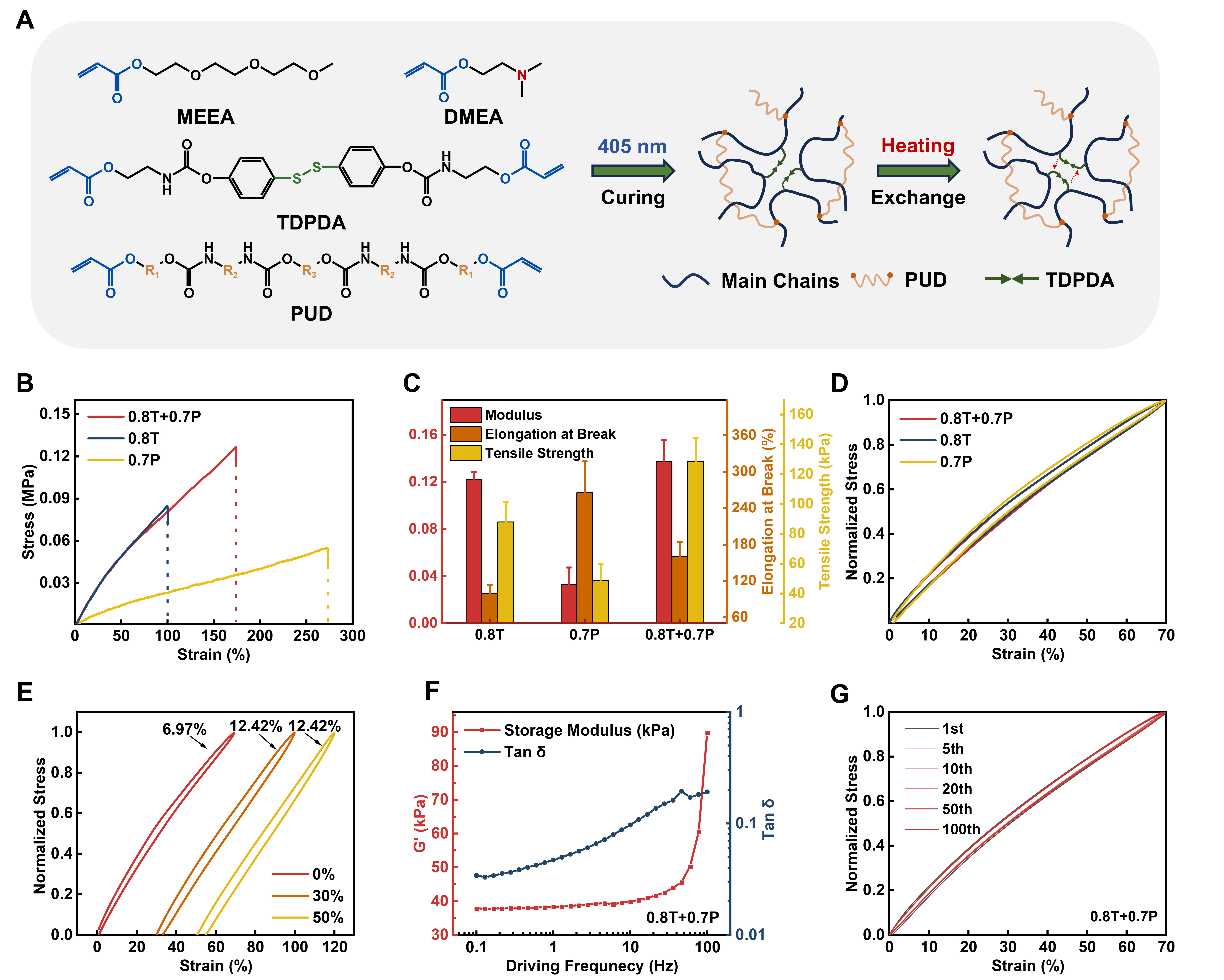
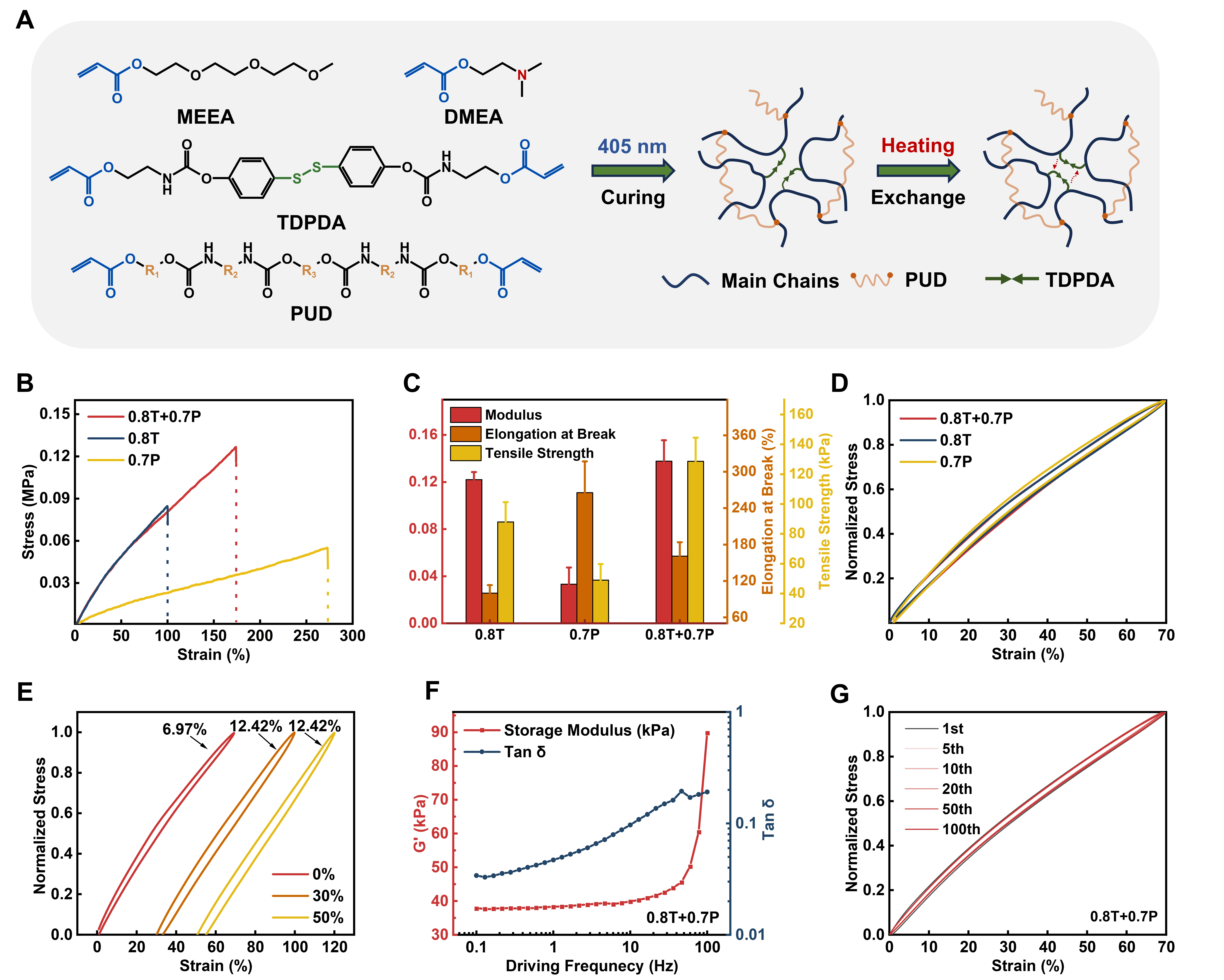
Figure 1. Preparation and mechanical properties of the SC-DEs with varied compositions. (A) Synthesis route. PUD is a commercial urethane acrylate oligomer, where R1 represents the alkyl linker adjacent to the acrylate group, R2 represents the diisocyanate-derived residue, and R3 represents the polyol-derived soft segment; (B) Tensile curves; (C) Modulus, elongation at breaking, and tensile strength; (D) Cyclic curves from 0% to 70% strain; (E) Cyclic Curves with strain of 0-70%, 30%-100% and 50%-120% for 0.8T+0.7P; (F) Storage modulus (G’) and tan δ (mechanical) of 0.8T+0.7P with frequency; (G) Repeated stretching test (100 times) for 0.8T+0.7P. SC-DEs: space-charge dielectric elastomers; PUD: polyurethane diacrylate; MEEA: 2-[2-(2-Methoxyethoxy) ethoxy] ethyl acrylate; DMEA: 2-(Dimethylamino) ethyl acrylate; TDPDA: diacrylate esterified bis(4-hydroxyphenyl) disulfide.
Dynamic mechanical response is crucial for resonant actuation. Figure 1D presents stress-strain cycles of 0.8T+0.7P, 0.8T, and 0.7P, revealing distinct elastic hysteresis behaviors. For quantitative evaluation, mechanical hysteresis was defined as the ratio of the dissipated energy during one loading–unloading cycle to the input mechanical energy during loading. It was calculated from cyclic stretching tests using the following equation: Hysteresis (%) = [(Wloading − Wunloading)/Wloading] × 100%, where Wloading and Wunloading are the areas under the loading and unloading stress-strain curves, respectively. Accordingly, their hysteresis ratios were 6.97%, 6.99%, and 8.72%, respectively. Although the hysteresis ratio slightly increased with increasing crosslinking density, all samples maintained low hysteresis, indicating limited energy dissipation during cyclic deformation. This behavior can be attributed to abundant polyethylene glycol (PEG, –CH2CH2O–) segments that enhance network flexibility. Stress-strain measurements under different pre-strains (0%, 30%, 50%) for 0.8T+0.7P (Figure 1E) show only a modest increase in hysteresis from 6.97% to 12.42%, confirming good elasticity across large deformation ranges. Rheological analysis further showed a low mechanical loss factor of 0.047 at 1 Hz (Figure 1F), significantly below that of most typical dielectric elastomers, such as VHB-4910 (0.69 @ 1 Hz)[12] and PHDE (0.1 @ 1 Hz)[11].
We believe this exceptional elasticity is critical for self-resonance since it allows achieving a highly efficient exchange between the potential and kinetic energy forms with negligible loss. Cyclic loading tests confirmed that 0.8T+0.7P retained full elastic recovery after 100 cycles, whereas 0.8T fractured and 0.7P deformed irreversibly (Figure 1G and Figure S3). These results demonstrate the synergistic reinforcement of the dual-crosslinker network, imparting both elasticity and fatigue resistance. Therefore, 0.8T+0.7P (0.3 mm thick) was chosen for further study, and its dielectric properties are shown in Figure S4.
3.2 Mechanisms and dielectric actuation performance of SC-DEs
We next examined the space charge-driven dielectric actuation mechanism. Figure 2A illustrates the injection, transport, and accumulation of space charges in the SC-DE film via the Schottky effect. Pulsed electro-acoustic (PEA) measurements reveal that holes are injected from the anode and electrons from the cathode (Figure 2B). Unlike charge-packet transport observed in conventional polymers (e.g., LDPE)[27,28], the injected carriers in SC-DEs migrate toward opposite electrodes, with holes accumulating near the cathode and electrons being extracted at the anode (Figure 2C). This results in a stronger electric field near the cathode and an asymmetric field distribution across the film (Figure 2D). The asymmetric field induces differential surface strain, generating out-of-plane bending deformation, whose direction depends on the applied e-field direction (Figure 2E). To quantify this bending deformation, the bending angle (θ) of a clamped film was used (Figure 2F). The electrode patterns of all prepared actuators are summarized in Table S1 in detail. As shown in Figure 2G, θ increases monotonically with the applied electric field, reaching 40° at only 2 V μm-1 and reverses direction upon field reversal, which outperforms our previous SC-DE designs[22,24].
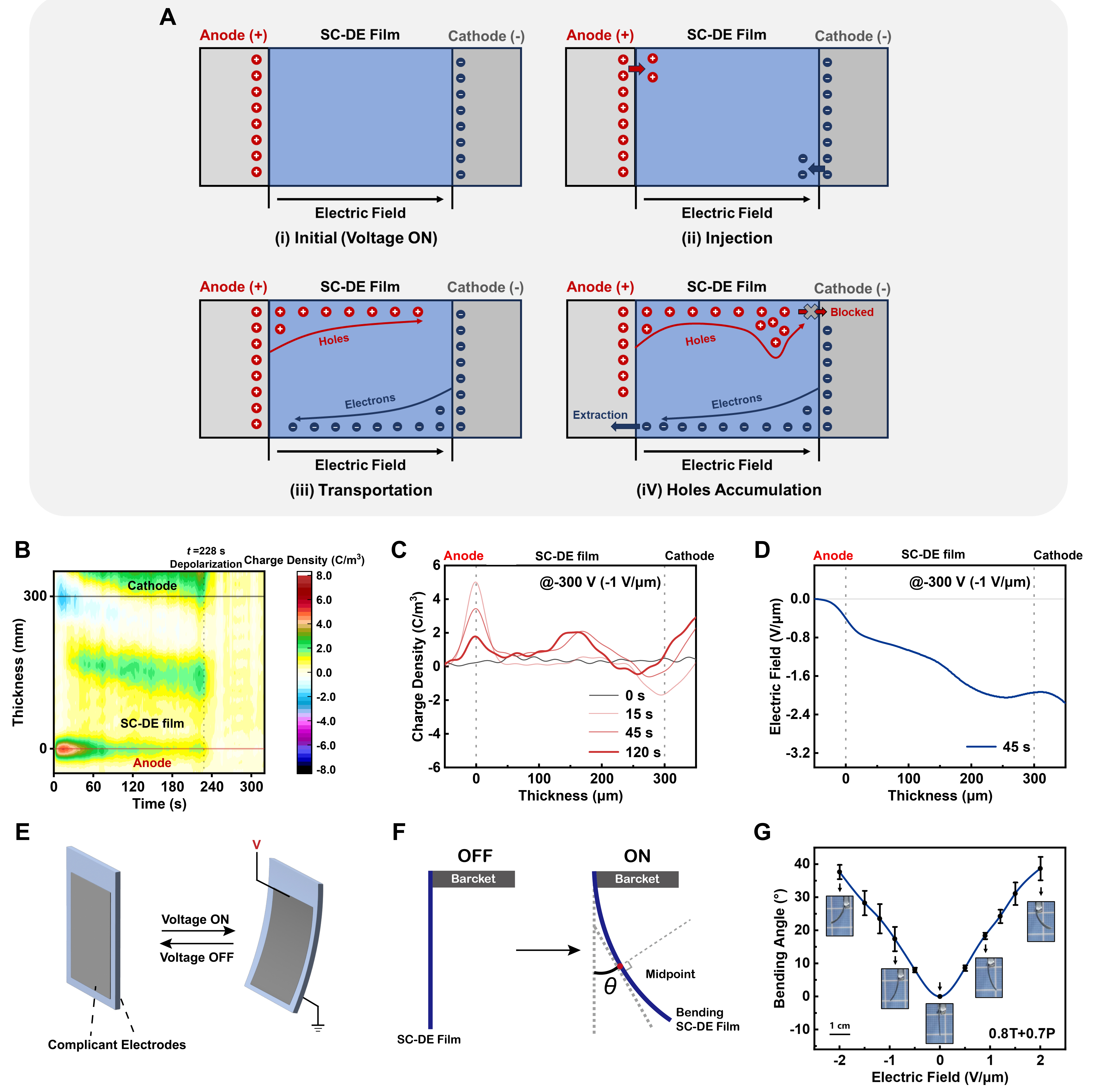
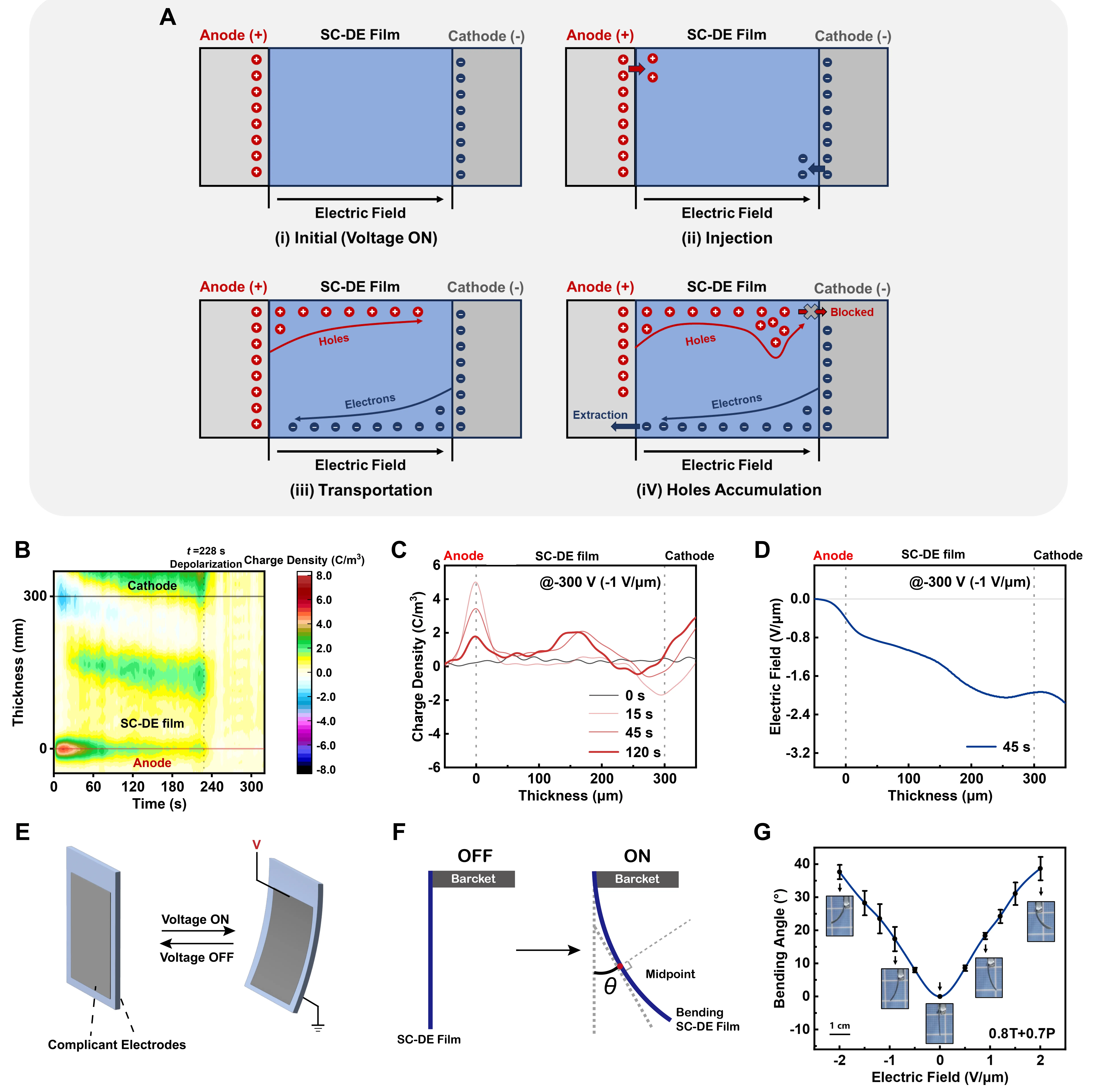
Figure 2. Space charge-driven dielectric actuation of SC-DEs. (A) The mechanisms of charge injection, transfer, and accumulation; (B) Contour plot of the spatiotemporal variation in charge density distribution. The red and blue domains correspond to the negative and positive charges, respectively; (C) Space charge distribution of sample 0.8T+0.7P under 300 V applied voltage; (D) Electric field distribution of sample 0.8T+0.7P under 300 V voltage; (E) Schematic diagram of out-of-plane actuation; (F) Schematic diagram of bending angle θ from a side view; (G) The relationship between bending angle θ and e-field with photographic images of sample 0.8T+0.7P. SC-DEs: space-charge dielectric elastomers.
3.3 Resonant amplification effect in alternating current response
To evaluate whether resonant effects can amplify actuation, we measured the bending angle (θ) of suspended rectangular SC-DE samples under a square-wave AC voltage across varied frequencies. Upon e-field application, the sample bends forward. When the e-field is removed, inertial relaxation drives bending in the opposite direction, producing a cyclic response (Figure 3A). Thus, θ denotes the sum of forward and backward bending. For the 0.8T+0.7P sample, θ increases sharply near ~10.5 Hz (Figure 3B,C), where it exceeds 150° and is over five times higher than its direct current (DC) response at the same field (1 V μm-1). In our system, the SC-DE actuator can be approximated as a soft viscoelastic beam/plate. Resonance occurs when the driving frequency approaches the natural bending frequency of the actuator[29]. For an ideal slender beam, the resonance frequency (fr) can be calculated as follows:
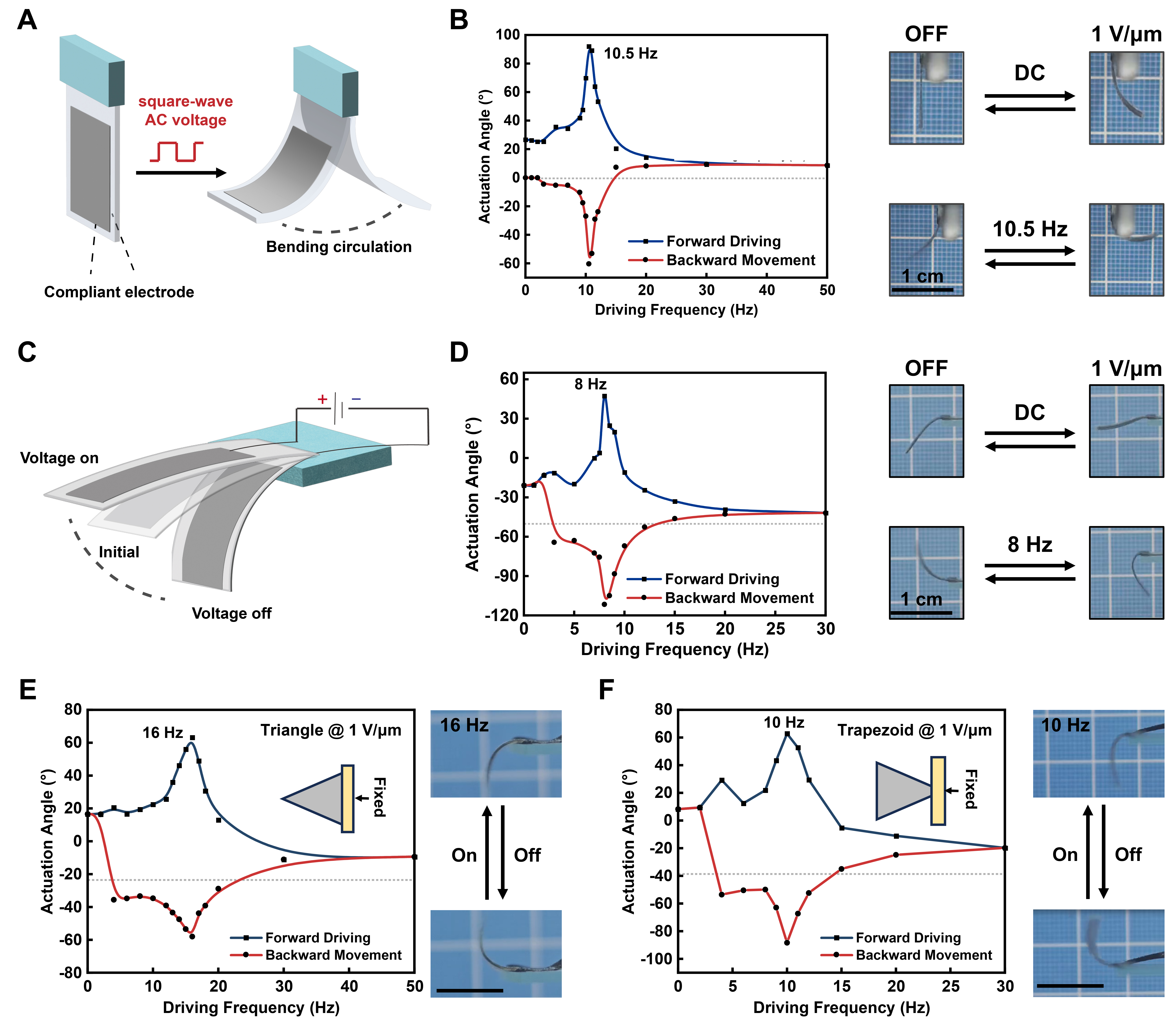
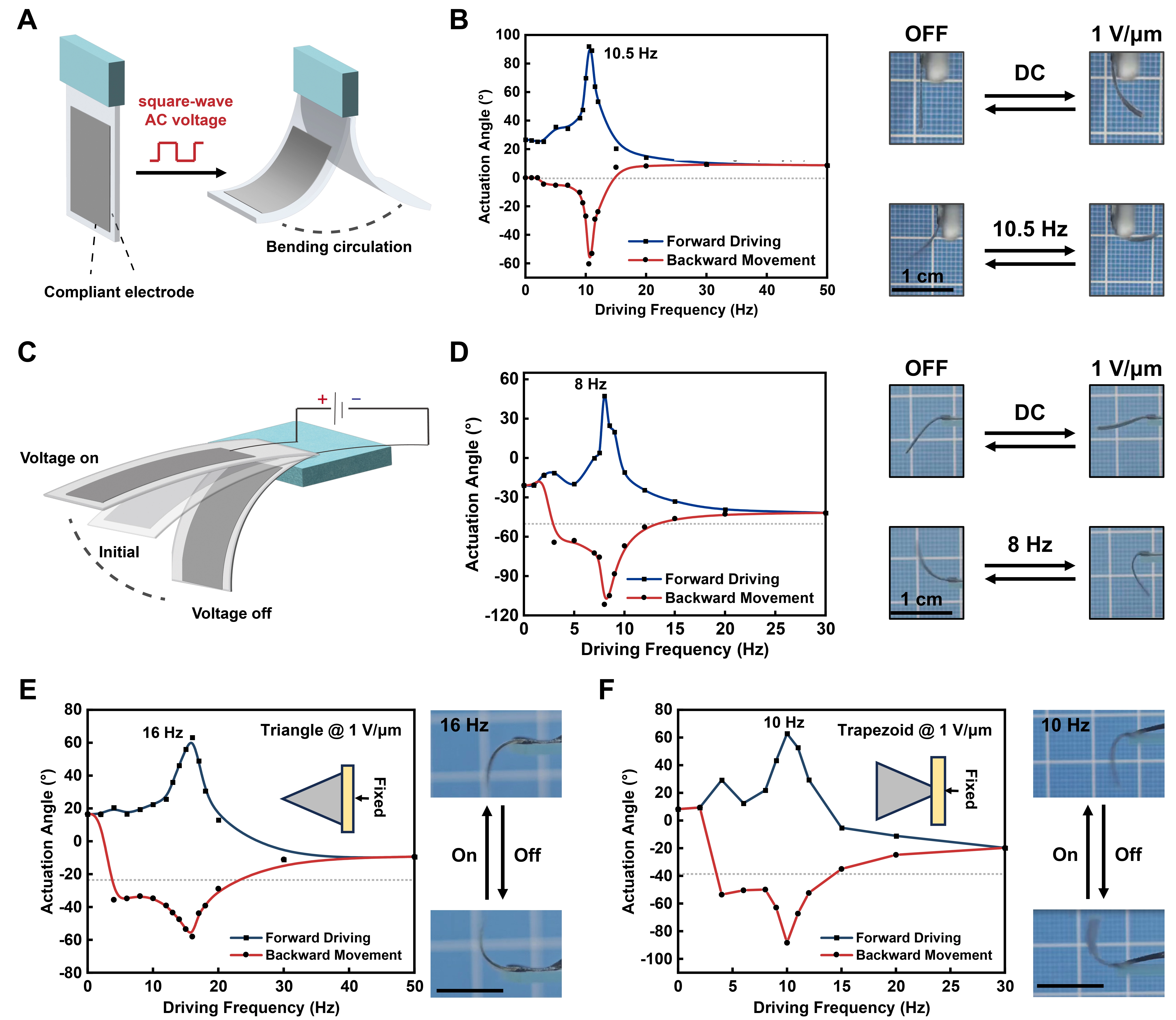
Figure 3. Resonant amplification effect of SC-DEs. (A) Scheme of the suspended sample subjected to a square-wave AC voltage across varied frequencies; (B) Actuation angle at different driving frequencies and the resonant actuation of the suspended sample; (C) Scheme of the cantilever sample subjected to a square-wave AC voltage across varied frequencies; (D) Actuation angle at different frequencies and the resonant actuation of the cantilever sample; (E) Triangle and (F) trapezoid sample’s actuation angles at different driving frequencies. Scale bars: 1 cm. SC-DEs: space-charge dielectric elastomers; AC: alternating current.
Using the measured dynamic modulus and the geometric parameters of the CNT-coated suspended sample, the calculated first bending-mode frequency is approximately 11.6 Hz, as detailed in Figure S5[30]. This value is close to the experimentally observed resonance frequency of 10.5 Hz, supporting that the resonance-amplified actuation of the SC-DE is governed by the structural bending resonance of the electrode-coated soft beam. The slight deviation between the calculated and measured frequencies may be attributed to uncertainties in the effective CNT electrode properties, nonideal boundary conditions, clamp compliance, viscoelastic damping, large-amplitude deformation, and the nonuniform space-charge-induced bending moment. Thus, the model provides a semi-quantitative validation of the resonance mechanism rather than an exact prediction.
This resonance model also indicates that changes in boundary conditions and geometry can shift the resonance frequency by modifying the effective stiffness-to-mass ratio and mode shape. As shown in Figure 3C,D, the cantilever sample exhibits resonance near 8 Hz, which can be attributed to its distinct boundary constraint and active free length compared with the suspended configuration. In addition, the triangular sample shows a resonant bending angle of approximately 120° at 16 Hz, whereas the trapezoidal sample achieves a larger angle of approximately 145° at 10 Hz (Figure 3E,F). These geometry-dependent responses arise from differences in width distribution, bending moment of inertia, and modal mass. Overall, these results demonstrate that SC-DEs can achieve large, frameless, self-resonant actuation under ultralow AC electric fields of approximately 1 V μm-1.
It should be noted that the time scale used for PEA characterization in Figure 2B,C,D is longer than the actuation cycle associated with the resonant driving frequencies. The PEA results in Figure 2B,C,D are intended to verify the formation of an asymmetric space-charge distribution and the corresponding asymmetric internal electric field, rather than to resolve charge redistribution during each actuation cycle. Therefore, the time scale for complete depolarization does not necessarily correspond directly to the time scale of mechanical recovery. As shown in Figure S6, complete depolarization requires approximately 20 s after voltage removal, whereas the actuator mechanically recovers within less than 1 s (Movie S1). This difference suggests that full disappearance of the injected charges is not required to substantially reduce the bending moment. Instead, partial charge redistribution or a reduction in field asymmetry may be sufficient to trigger mechanical recovery. Moreover, measurable changes in charge density are already observed after 1 s of depolarization (Figure S6), indicating that the internal electric-field distribution can evolve on a time scale relevant to dynamic actuation. Due to the temporal resolution limit of our current PEA setup, sub-second space-charge/electric-field evolution cannot be directly captured at this stage. Further studies using higher-temporal-resolution characterization techniques will be pursued to clarify the transient charge dynamics during high-frequency actuation.
To further clarify the distinction between the present SC-DE and existing DE/SC-DE systems[22,24,31-41], a systematic comparison was provided in Table S2. Compared with recent SC-DE systems, the present material operates at a lower electric field and achieves a larger bending amplitude through resonance amplification. Compared with traditional DE bending systems, the present actuator avoids passive frames, pre-stretching, and other complicated mechanical architectures, while maintaining a much lower operating field. Notably, previously reported resonance-amplified DE systems can reach large angular deformation, but they generally operate at nominal electric fields around ~100 V μm-1 and require external supporting structures. The present SC-DE achieves comparable large-angle resonant bending at ~1 V μm-1 through an intrinsic material-level mechanism, in which space-charge-induced asymmetric bending provides the driving moment and the low-loss elastomer network enables efficient energy exchange near resonance.
Heat accumulation during cyclic actuation was subsequently examined to evaluate energy conversion efficiency. The suspended sample was continuously actuated at 7 Hz for 1,000 s, while its surface temperature was monitored using an infrared camera; the resulting temperature profile is presented in Figure S7. Upon application of the electric field, the temperature rapidly increased from 24.0 to 43.1 °C within the first 10 s, presumably due to frictional dissipation associated with the interaction between injected charges and the polymer chains. The temperature then gradually decreased to 27.5 °C within 300 s and remained nearly constant for the subsequent 700 s. This stable temperature, only slightly above the initial value, indicates negligible further heat accumulation during prolonged cyclic actuation. These results support our conclusion that resonance-based amplification of actuation provides an energy-efficient strategy.
3.4 Programming of resonant amplification and an artificial dragonfly actuator
The shape-dependent resonance behavior underscores the feasibility of tailoring resonant actuation behaviors by systematically programming the sample’s geometry. However, fabricating polymer structures with intricate geometries remains challenging using conventional methods (e.g., molding). To overcome this limitation, dynamic disulfide bonds were incorporated into the polymer network, enabling thermally activated bond exchange reactions that facilitate network rearrangement. Consequently, the material’s permanent shape can be reconfigured in a controllable and repeatable manner[42,43]. The tertiary amine group in DMEA acts as an intrinsic activator, triggering thiolate anion-mediated bond exchange without the need for external catalysts. This mechanism was verified through a stress relaxation experiment conducted at 130 °C for the 0.8T+0.7P sample, where nearly 70% of the applied stress was relaxed within 40 mins (Figure 4A). Such reconfigurability allows planar films to be transformed into diverse three-dimensional geometries, such as different quadrangular pyramidal structures (Figure 4B).
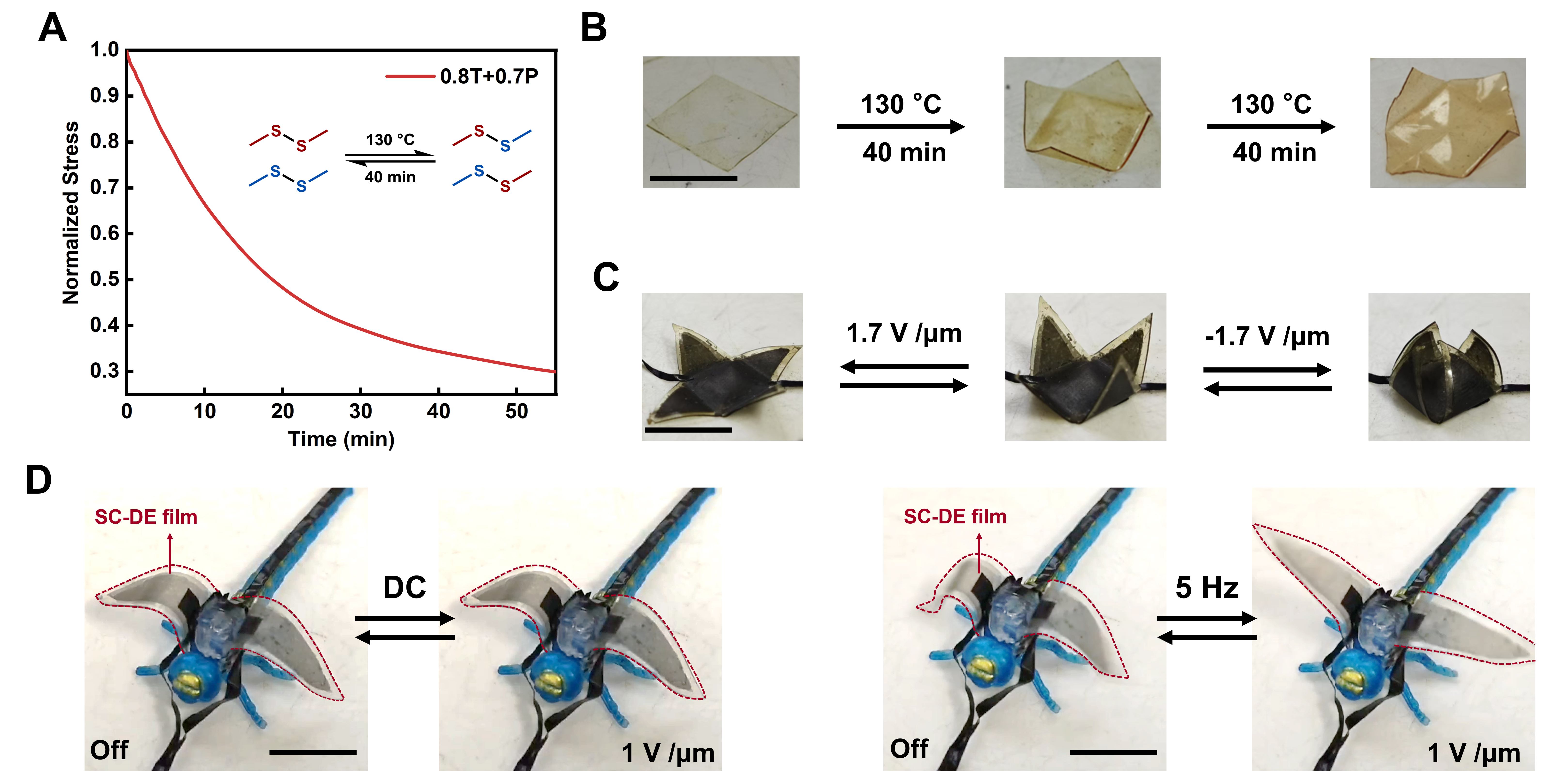
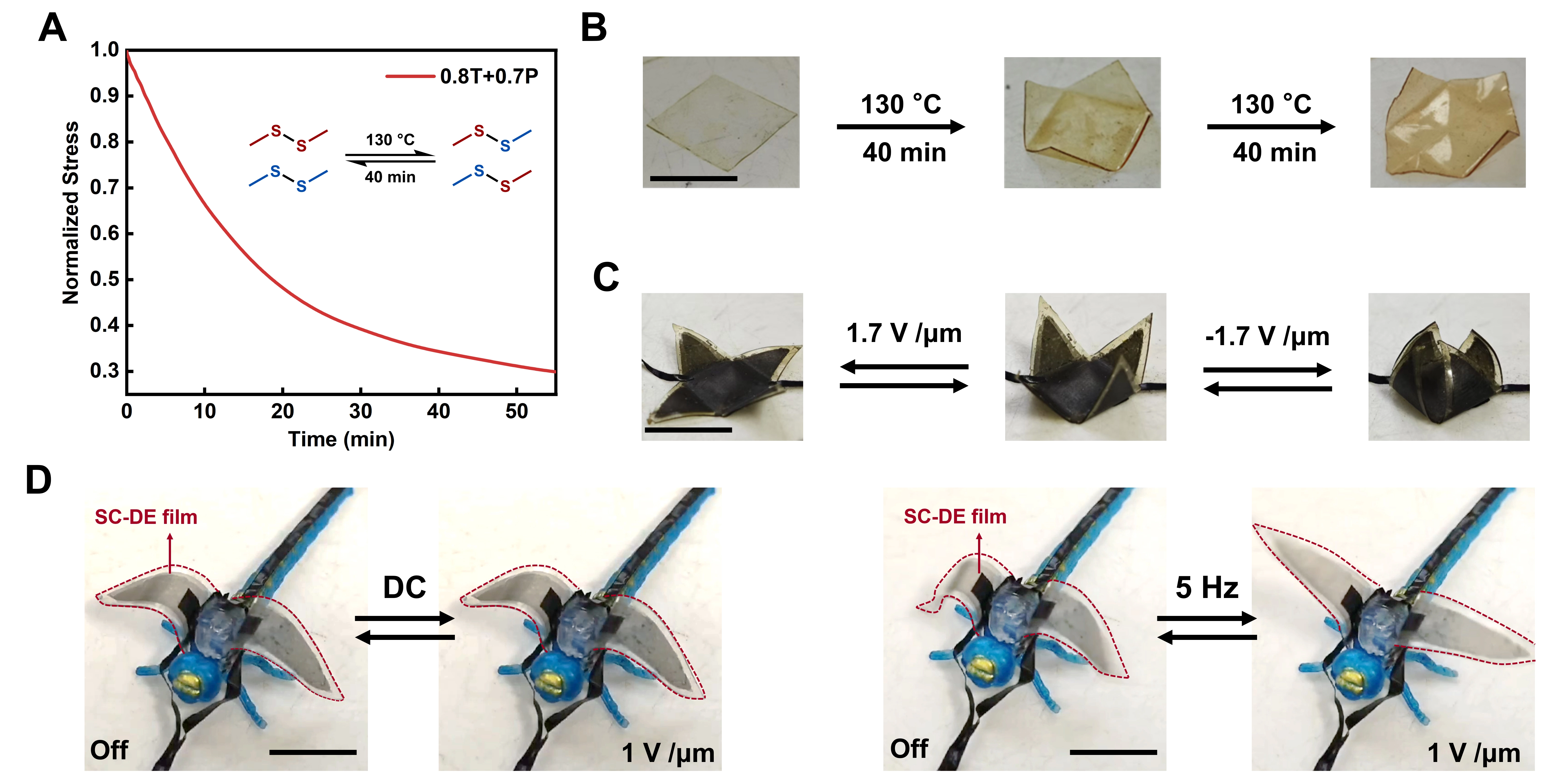
Figure 4. Resonant amplification programming via shape regulation. (A) Stress relaxation of 0.8T+0.7P based on the bond exchange of disulfide; (B) Repeatable permanent shape reconfiguration based on the network dynamicablity; (C) Bidirectional actuation of a quadrangular pyramidal actuator with reversed e-field direction; (D) Comparison of an artificial dragonfly driven by DC and AC (5 Hz). Scale bars: 1 cm. AC: alternating current; DC: direct current.
This programmable shape reconfiguration significantly broadens the range of achievable actuation modes in our SC-DEs. For instance, a quadrangular pyramidal actuator derived from a flat sheet exhibits bidirectional actuation under reversed electric field polarity (Figure 4C). Remarkably, even at relatively low electric fields (±1.7 V μm-1), the actuator transitions from a flattened to a closed configuration, demonstrating potential for soft robotic gripping applications that extend beyond the simple bending observed in previous rectangular samples.
Furthermore, in terms of self-resonant actuation, a simplified flapping-wing configuration was developed and fabricated into an artificial dragonfly (Figure 4D). This dragonfly demonstrates rapid oscillatory motion at 5 Hz with a much larger deformation than that of DC voltage under a significantly low field (1 V μm-1), operating at room temperature without pre-straining or auxiliary structural support (Movie S2). We emphasize that Figure 4D is intended solely as a proof-of-principle demonstration. Realizing a practical flying device will require integrated optimization of materials, structural mechanics, and aerodynamics, which we identify as an important direction for future work. Even so, compared with representative SC-DE and bending-type DE systems[22,24,31-41], the present actuator provides a distinct performance combination: ultralow operating electric field (~1 V μm-1), large bending amplitude, intrinsic resonance amplification, and frameless operation. By coupling space-charge-induced asymmetric bending with a low-loss elastomer network, the bending angle can be amplified to approximately 150° without increasing the electric field. The geometry-dependent resonance behavior and permanent shape reconfigurability further demonstrate the potential of this material platform for programmable soft robotic actuation with increased mechanical freedom and functional adaptability.
4. Conclusion
In this work, we present a new class of self-resonant dielectric elastomers that intrinsically realize resonant-amplified electromechanical (RAE) actuation without external frames or pre-strain. Driven by asymmetric space-charge accumulation, these materials exhibit large, frameless out-of-plane deformation under ultralow electric fields (~1 V μm-1). Through compositional tuning, the resonance frequency and amplitude were precisely modulated, achieving bending angles exceeding 150°, over fivefold higher than the quasistatic response at the same field. In addition, dynamic disulfide crosslinks endow them with permanent reconfigurability, enabling shape programming into diverse geometries that dictate distinct resonant behaviors. The overall result is that our SC-DEs achieve efficient, insect-inspired resonance without rigid support. This intrinsic self-resonance mechanism establishes a versatile platform for lightweight, energy-efficient, and programmable soft actuators, offering new opportunities for autonomous soft robotics and biomimetic devices.
Supplementary materials
The supplementary material for this article is available at: Supplementary materials.
Acknowledgements
We thank Mrs. Hui Li for assistance in using the broadband dielectric spectrometer at the State Key Laboratory of Chemical Engineering (Zhejiang University). We also thank Mr. Ben He for assisting in performing the 1H-NMR spectrum.
Authors contribution
Zhang CK: Writing-original draft, data curation, formal analysis, methodology.
Zhang CC: Methodology, investigation.
Jin BJ: Conceptualization writing-review & editing.
Xie T: Funding acquisition, resources, supervision.
Conflicts of interest
The authors declare no conflicts of interest.
Ethical approval
Not applicable.
Consent to participate
Not applicable.
Consent for publication
Not applicable.
Availability of data and materials
Data and materials supporting the findings of this study are available from the supplementary materials and the corresponding authors upon reasonable request.
Funding
This work was supported by the National Natural Science Foundation of China (Grant No. U23A2098 and 52473111) and TCL Science and Technology Innovation Fund (Grant No. 20242061).
Copyright
© The Author(s) 2026.
References
-
1. Weis-Fogh T. Energetics of hovering flight in hummingbirds and in drosophila. J Exp Biol. 1972;56(1):79-104.[DOI]
-
2. Liu H. Integrated modeling of insect flight: From morphology, kinematics to aerodynamics. J Comput Phys. 2009;228(2):439-459.[DOI]
-
4. Sunada S, Wang H, Zeng L, Kawachi K. Analysis of maneuvering flight of an insect. J Bionic Eng. 2004;1(2):88-101.[DOI]
-
6. Masoud H, Alexeev A. Resonance of flexible flapping wings at low Reynolds number. Phys Rev E Stat Nonlin Soft Matter Phys. 2010;81(5 Pt 2):056304.[DOI]
-
7. Pons A, Beatus T. Distinct forms of resonant optimality within insect indirect flight motors. J R Soc Interface. 2022;19(190):20220080.[DOI]
-
8. Zhang C, Rossi C. A review of compliant transmission mechanisms for bio-inspired flapping-wing micro air vehicles. Bioinspir Biomim. 2017;12(2):025005.[DOI]
-
9. Helbling EF, Wood RJ. A review of propulsion, power, and control architectures for insect-scale flapping-wing vehicles. Appl Mech Rev. 2018;70(1):010801.[DOI]
-
10. Zhang J, Deng X. Resonance principle for the design of flapping wing micro air vehicles. IEEE Trans Robot. 2017;33(1):183-197.[DOI]
-
11. Shi Y, Askounis E, Plamthottam R, Libby T, Peng Z, Youssef K, et al. A processable, high-performance dielectric elastomer and multilayering process. Science. 2022;377(6602):228-232.[DOI]
-
13. Suo Z. Theory of dielectric elastomers. Acta Mech Solida Sin. 2010;23(6):549-578.[DOI]
-
14. Zhang J, Zhao J, Chen H, Li D. Dynamic analyses of viscoelastic dielectric elastomers incorporating viscous damping effect. Smart Mater Struct. 2017;26(1):015010.[DOI]
-
15. Li T, Li G, Liang Y, Cheng T, Dai J, Yang X, et al. Fast-moving soft electronic fish. Sci Adv. 2017;3(4):e1602045.[DOI]
-
17. Ren Z, Kim S, Ji X, Zhu W, Niroui F, Kong J, et al. A high-lift micro-aerial-robot powered by low-voltage and long-endurance dielectric elastomer actuators. Adv Mater. 2022;34(7):2106757.[DOI]
-
20. Watanabe M, Wakimoto N, Shirai H, Hirai T. Bending electrostriction and space-charge distribution in polyurethane films. J Appl Phys. 2003;94(4):2494-2497.[DOI]
-
21. Watanabe M, Hirai T. Bending-electrostrictive response of polyurethane films subjected to a reversed electric field. J Appl Polym Sci. 2004;92(6):3644-3650.[DOI]
-
23. Hirai T, Sadatoh H, Ueda T, Kasazaki T, Kurita Y, Hirai M, et al. Polyurethane-elastomer-actuator. Angew Makromol Chem. 1996;240(1):221-229.[DOI]
-
25. Kakizaki S, Shintake J, Iwatake Y, Baba K, Takeuchi H, Yamamoto A. Large, fast, and bidirectional bending of slide-ring polymer materials. Adv Intell Syst. 2020;2(4):1900155.[DOI]
-
27. Fu M, Dissado L, Chen G, Fothergill J. Space charge formation and its modified electric field under applied voltage reversal and temperature gradient in XLPE cable. IEEE Trans Dielect Electr Insul. 2008;15(3):851-860.[DOI]
-
28. Lv Z, Ma Y, Zhang C, Peng J, Wu K, Dissado LA. The simultaneous evolution of space charge and conduction current in LDPE. IEEE Trans Dielect Electr Insul. 2021;28(2):616-624.[DOI]
-
29. Kornbluh RD, Pelrine R, Pei Q, Oh S, Joseph J. Ultrahigh strain response of field-actuated elastomeric polymers. In: Bar-Cohen Y, editor. Smart Structures and Materials 2000: Electroactive Polymer Actuators and Devices (EAPAD); 2000 Mar 6-9; Newport Beach, USA. Bellingham: SPIE. 2000. p. 51-64.[DOI]
-
30. Kastanis D, Tasis D, Papagelis K, Parthenios J, Tsakiroglou C, Galiotis C. Oxidized multi-walled carbon nanotube film fabrication and characterization. Adv Compos Lett. 2007;16(6):096369350701600606.[DOI]
-
31. Xiong SF, Zhang CC, Jin BJ, Guo BC. Liquid crystalline dielectric elastomer with thermo-and light-guided multimodal electrical actuations. Chin J Polym Sci. 2026;44:1457-1464.[DOI]
-
33. Li A, Cuvin P, Lee S, Gu J, Tugui C, Duduta M, et al. Data-driven long-term energy efficiency prediction of dielectric elastomer artificial muscles. Adv Funct Mater. 2024;34(42):2406710.[DOI]
-
34. Dong H, Chen Z, Zhuo J, Tang R, Peng J, Wang L, et al. Biomimetic gradient structured dielectric elastomer actuators for long-term large out-of-plane actuation. ACS Mater Lett. 2025;7(5):2002-2009.[DOI]
-
35. Zhang Y, Song Z, Yu W, Wang C, Dong C, Wu J, et al. Dielectric elastomer with covalently charged interpenetrated polyacrylate network for large actuation strain under low driving electric field. Chem Eng J. 2025;520:165877.[DOI]
-
37. Wang H, Tan MWM, Poh WC, Gao D, Wu W, Lee PS, et al. A highly stretchable, self-healable, transparent and solid-state poly(ionic liquid) filler for high-performance dielectric elastomer actuators. J Mater Chem A. 2023;11(26):14159-14168.[DOI]
-
38. Han Y, Zhang Y, Huang P, Shi B, Xie E, Xue C, et al. A dielectric elastomer containing bicomponent core-shell nanoparticles with enhanced electromechanical properties for flexible crawling robots. ACS Appl Polym Mater. 2024;6(11):6667-6678.[DOI]
-
39. Borayek R, Zhang P, Willy HJ, Zedan M, Zhu J, Ding J. Programmable, UV-printable dielectric elastomers actuate at low voltage without prestretch and supporting frames. ACS Appl Electron Mater. 2020;2(12):4042-4053.[DOI]
-
40. Lau GK, Heng KR, Ahmed AS, Shrestha M. Dielectric elastomer fingers for versatile grasping and nimble pinching. Appl Phys Lett. 2017;110(18):182906.[DOI]
-
41. Zhao J, Niu J, McCoul D, Leng J, Pei Q. A rotary joint for a flapping wing actuated by dielectric elastomers: Design and experiment. Meccanica. 2015;50(11):2815-2824.[DOI]
-
44. Yamawake K, Hayashi M. The role of tertiary amines as internal catalysts for disulfide exchange in covalent adaptable networks. Polym Chem. 2023;14(6):680-686.[DOI]
Copyright
© The Author(s) 2026. This is an Open Access article licensed under a Creative Commons Attribution 4.0 International License (https://creativecommons.org/licenses/by/4.0/), which permits unrestricted use, sharing, adaptation, distribution and reproduction in any medium or format, for any purpose, even commercially, as long as you give appropriate credit to the original author(s) and the source, provide a link to the Creative Commons license, and indicate if changes were made.
Publisher’s Note
Science Exploration remains a neutral stance on jurisdictional claims in published
maps
and institutional affiliations. The views expressed in this article are solely those
of
the author(s) and do not reflect the opinions of the Editors or the publisher.
Share And Cite


Science Exploration Style
Zhang C, Zhang C, Jin B, Xie T. Strain amplification from within: Harnessing programmable intrinsic resonance in dielectric elastomers driven by space charge mechanism. Smart Mater Devices. 2026;2:202618. https://doi.org/10.70401/smd.2026.0037
Tips
Copy completed.
Submit a Manuscript
Author Instructions
Cite this Article
Article Metrics
0
View
0
Download
Cited
Article Updates

- Abstract
- Keywords
- 1. Introduction
- 2. Experimental Section
- 3. Results and Discussion
- 4. Conclusion
- Supplementary materials
- Acknowledgements
- Authors contribution
- Conflicts of interest
- Ethical approval
- Consent to participate
- Consent for publication
- Availability of data and materials
- Funding
- References
- Copyright
 Get citation
Science Exploration Style

Zhang C, Zhang C, Jin B, Xie T. Strain amplification from within: Harnessing programmable intrinsic resonance in dielectric elastomers driven by space charge mechanism. Smart Mater Devices. 2026;2:202618. https://doi.org/10.70401/smd.2026.0037
copy
Share Link
copy
Subscribe