Advancing the anodic chloride-resistant catalyst design and reaction mechanism studies in seawater electrolysis through synchrotron radiation-based in-situ spectroscopies

Yijie Wu

Wenji Shao
Hao Zhang
*
,
Xuhui Sun
*
*Correspondence to:
Hao Zhang, Institute of Functional Nano & Soft Materials (FUNSOM), Jiangsu Key Laboratory for Carbon-Based Functional Materials & Devices, Jiangsu Key Laboratory of Advanced Negative Carbon Technologies, Soochow University, Suzhou 215123, Jiangsu, China.
E-mail: haozhang@suda.edu.cn
Xuhui Sun, Institute of Functional Nano & Soft Materials (FUNSOM), Jiangsu Key Laboratory for Carbon-Based Functional Materials & Devices, Jiangsu Key Laboratory of Advanced Negative Carbon Technologies, Soochow University, Suzhou 215123, Jiangsu, China. E-mail: xhsun@suda.edu.cn
Xuhui Sun, Institute of Functional Nano & Soft Materials (FUNSOM), Jiangsu Key Laboratory for Carbon-Based Functional Materials & Devices, Jiangsu Key Laboratory of Advanced Negative Carbon Technologies, Soochow University, Suzhou 215123, Jiangsu, China. E-mail: xhsun@suda.edu.cn
Smart Mater Devices. 2026;2:202631. 10.70401/smd.2026.0041
Received: June 22, 2026Accepted: August 03, 2026Published: August 03, 2026
This article belongs to the Special lssue Smart Electrocatalysts and Interfaces for Efficient Energy Conversion
Abstract
Seawater electrolysis is a promising route for sustainable hydrogen production, yet its practical deployment is severely restricted by the chloride-rich electrolyte environment, which imposes more stringent demands on anodic oxygen evolution reaction (OER) catalysts than conventional purified water electrolysis. Chloride ions not only trigger competing chlorine-related reactions but also accelerate catalyst corrosion, surface reconstruction, active-site degradation, and interfacial reaction complexity, making the rational design of active and durable chloride-resistant catalysts a central challenge in this field. In this context, synchrotron radiation (SR)-based spectroscopies have emerged as indispensable tools for bridging catalyst design and mechanistic understanding under operating conditions. In particular, X-ray absorption spectroscopy (XAS) enables direct probing of the oxidation state, electronic structure, and local coordination environment of catalytic centers, providing atomic-scale insights into chloride-induced structural evolution, active-site reconstruction, and stability regulation. SR-based infrared spectroscopy (SR-IR) offers molecular-level information on adsorbed intermediates, surface functional groups, and interfacial water structure, thereby revealing how chloride perturbs reaction pathways and interfacial chemistry during seawater electrolysis with large-scale applications in the future. This review first summarizes the fundamental challenges of seawater electrolysis, with emphasis on the critical role of chloride in governing catalyst selectivity and durability; it then introduces the basic principles and unique advantages of XAS and IR, highlighting their irreplaceable value in studying working electrocatalytic systems; subsequently, recent progress in applying these techniques to chloride-resistant catalyst design and reaction mechanism studies is discussed; finally, future opportunities are outlined, which are expected to substantially deepen the understanding of chloride-related processes and guide the rational development of efficient, robust, and low-cost catalysts for seawater electrolysis.
Keywords
Seawater electrolysis, chloride ion, X-ray absorption spectroscopy, infrared spectroscopy, in-situ techniques
1. Introduction
Hydrogen produced by water electrolysis is widely regarded as a key component of future sustainable energy systems[1,2]. However, the large-scale deployment of conventional electrolysis is constrained by already-scarce freshwater[3-5]. As seawater accounts for approximately 97% of the Earth’s total water resources, its direct utilization as an electrolysis feedstock offers an attractive route toward scalable and resource-accessible hydrogen production[6-8]. Nevertheless, compared with purified water electrolysis, seawater electrolysis operates in a much more complicated chemical environment and therefore faces substantially greater challenges[9-12]. On the cathodic side, Figure 1[13] shows that the local accumulation of OH- can induce the precipitation of multivalent cations such as Ca2+ and Mg2+, leading to surface blockage and performance deterioration. More critically, the high concentration of chloride ions at the anode can introduce severe selectivity and stability issues. Specifically, chloride can trigger competing chlorine evolution reactions (CER), lowering oxygen evolution reaction (OER) selectivity. Although operation in alkaline media can partially expand the thermodynamic window for OER, it cannot completely eliminate chloride-induced corrosion and instead imposes stringent requirements on catalyst design, particularly with respect to activity, selectivity, and long-term durability[14-16].
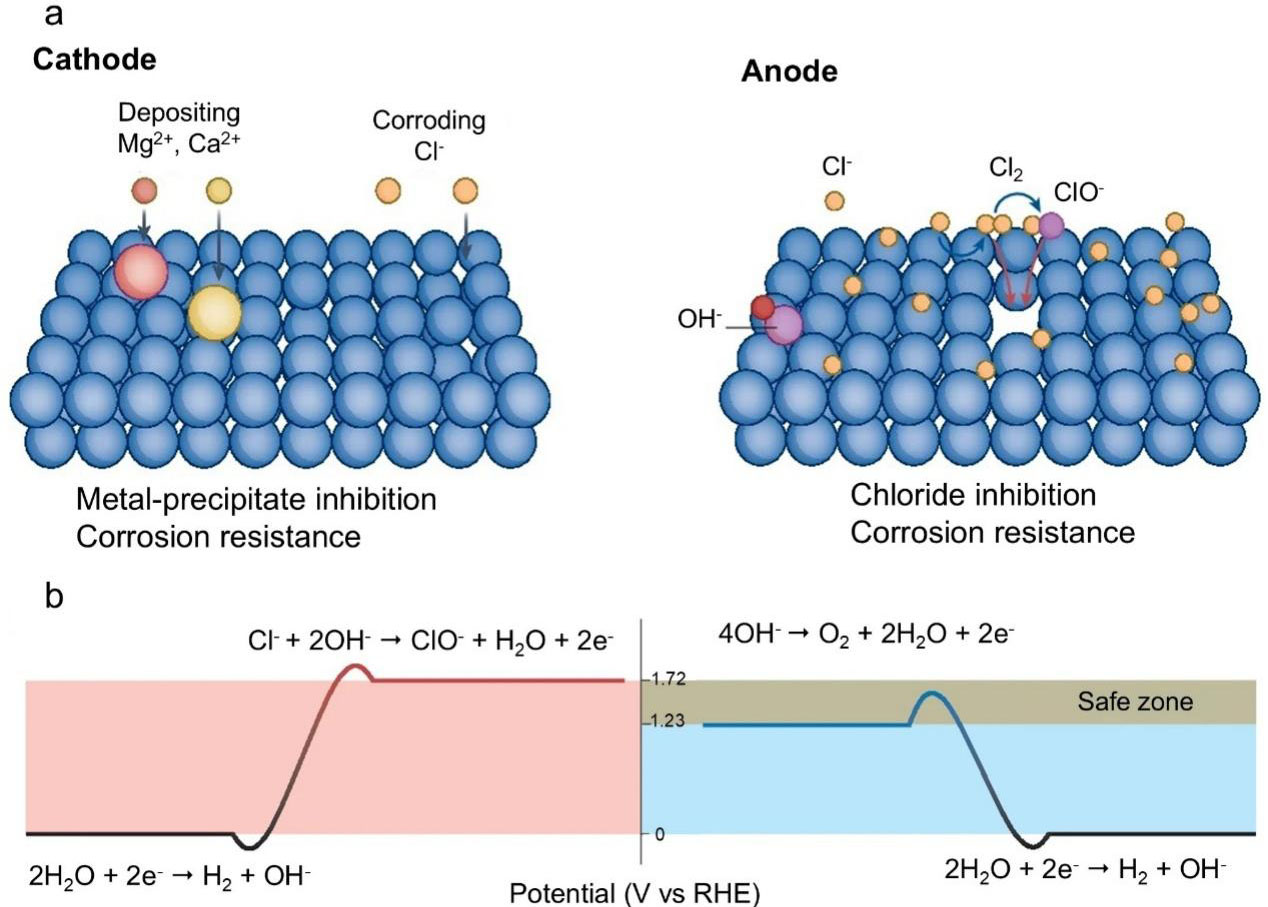
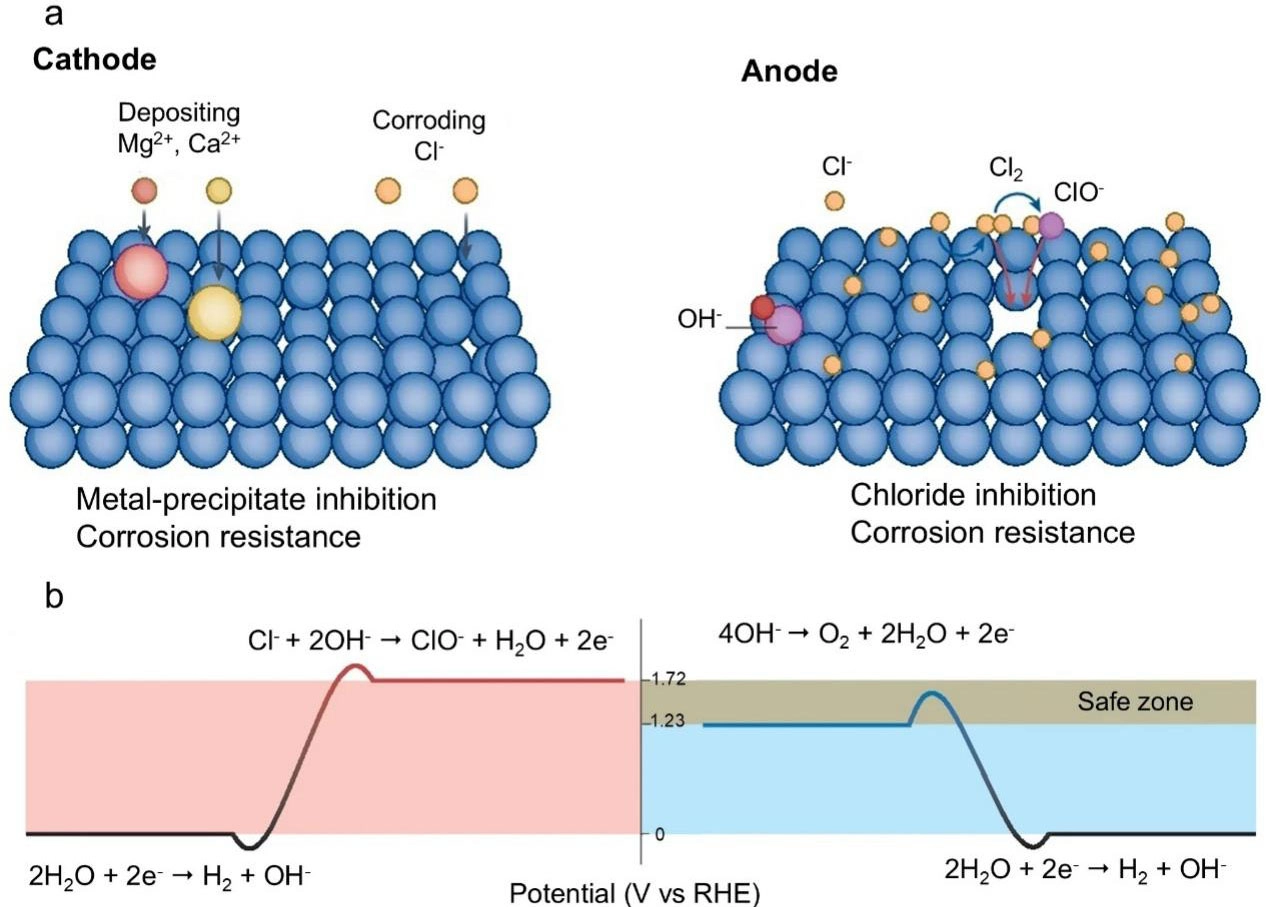
Figure 1. (a) Schematic diagram of the challenges of the anode and cathode in seawater electrolysis; (b) The thermodynamic potentials and kinetics barriers for CER and OER in an alkaline environment. Reproduced with permission from reference[13]. Copyright © 2025 Springer Nature. CER: chlorine evolution reactions; OER: oxygen evolution reaction; V: volts; RHE: reversible hydrogen electrode.
Accordingly, the development of chloride-resistant anodic catalysts has become one of the central issues in seawater electrolysis. To mitigate chloride-induced deactivation, a variety of strategies have been proposed, including the construction of protective coatings[17,18], alloying[19-21] and heterostructure engineering to improve intrinsic corrosion resistance[22-25], and regulation of local alkaline microenvironments to suppress chloride attack and chlorine-related side reactions[26,27]. These approaches have led to substantial improvements in catalyst stability and OER selectivity. However, the fundamental origins of their effectiveness remain far from fully understood. For example, it is still unclear whether chloride-induced deactivation primarily arises from changes in oxidation state, disruption of the local coordination environment, surface reconstruction, or a combination of these factors. Likewise, the mechanisms by which protective layers and interfacial microenvironments regulate chloride adsorption and reaction pathways at the reaction interfaces remain insufficiently resolved. A clear mechanistic understanding of these issues is essential for establishing rational design principles for chloride-resistant OER catalysts.
Addressing these questions requires in-situ characterization of catalysts and interfacial processes under operating conditions. In this regard, synchrotron radiation (SR)-based spectroscopies have emerged as indispensable tools for probing the structure-activity-stability relationships of OER catalysts in seawater electrolysis. Owing to their high brilliance, tunable energy, and compatibility with in-situ measurements, SR-based techniques enable direct observation of dynamic structural and chemical changes[28,29]. Among them, X-ray absorption spectroscopy (XAS), including X-ray absorption near-edge structure (XANES) and extended X-ray absorption fine structure (EXAFS), is particularly powerful for elucidating the electronic structure and local coordination environment of active sites[30]. Complementary to XAS, SR-based infrared spectroscopy (SR-IR) offers molecular-level insight into adsorbed intermediates, surface functional groups, and interfacial water structures[31,32], making it especially important for understanding how chloride ions perturb interfacial interactions and alter reaction pathways during OER.
In the field of purified water electrolysis, numerous review articles have already summarized the application of SR-based spectroscopies, such as XAS[33,34], X-ray diffraction[35], and IR[36], in elucidating structure-activity relationships, probing reaction intermediates, and tracking dynamic structural changes under operating conditions. These papers provide valuable references for researchers interested in fundamental insights into purified water systems. However, a systematic review of how these techniques advance the understanding of chloride effects and guide the design of chloride-resistant catalysts is still lacking. Therefore, this review focuses on the critical role of SR-based X-ray and infrared spectroscopies in linking catalyst design with mechanistic understanding in chloride-containing seawater electrolysis systems. In contrast to the cathode, chloride ions exert a significant influence on the anode consequently, this review is primarily devoted to anodic catalysts. Firstly, this review introduces the principles and distinctive advantages of XAS and fourier transform infrared spectroscopy (FTIR), highlighting their unique capability to capture the structural evolution of electrocatalysts and interfacial intermediates. Subsequently, we discuss recent advances in the use of these techniques to identify active structures, elucidate chloride-induced degradation and reconstruction pathways, and validate different chloride-resistance strategies. Finally, we outline future opportunities in high-resolution spectroscopic techniques, multimodal correlative analysis, and machine-learning-assisted spectral interpretation, which are expected to deepen mechanistic insight and accelerate the rational development of efficient, durable, and low-cost catalysts for seawater electrolysis.
2. Fundamentals of SR-Based Techniques
SR refers to broadband electromagnetic radiation generated when the relativistic electrons undergo transverse acceleration. As illustrated in Figure 2a, high-energy electrons circulating in a storage ring continuously emit tangential radiation as their trajectories are bent by magnetic devices, including bending magnets, wigglers, and undulators. This emission spans a wide spectrum from infrared to hard X-rays. By integrating the source with beamline optics and monochromators, photons of selected energies with high spectral purity can be delivered for sophisticated structural and chemical characterization[37].
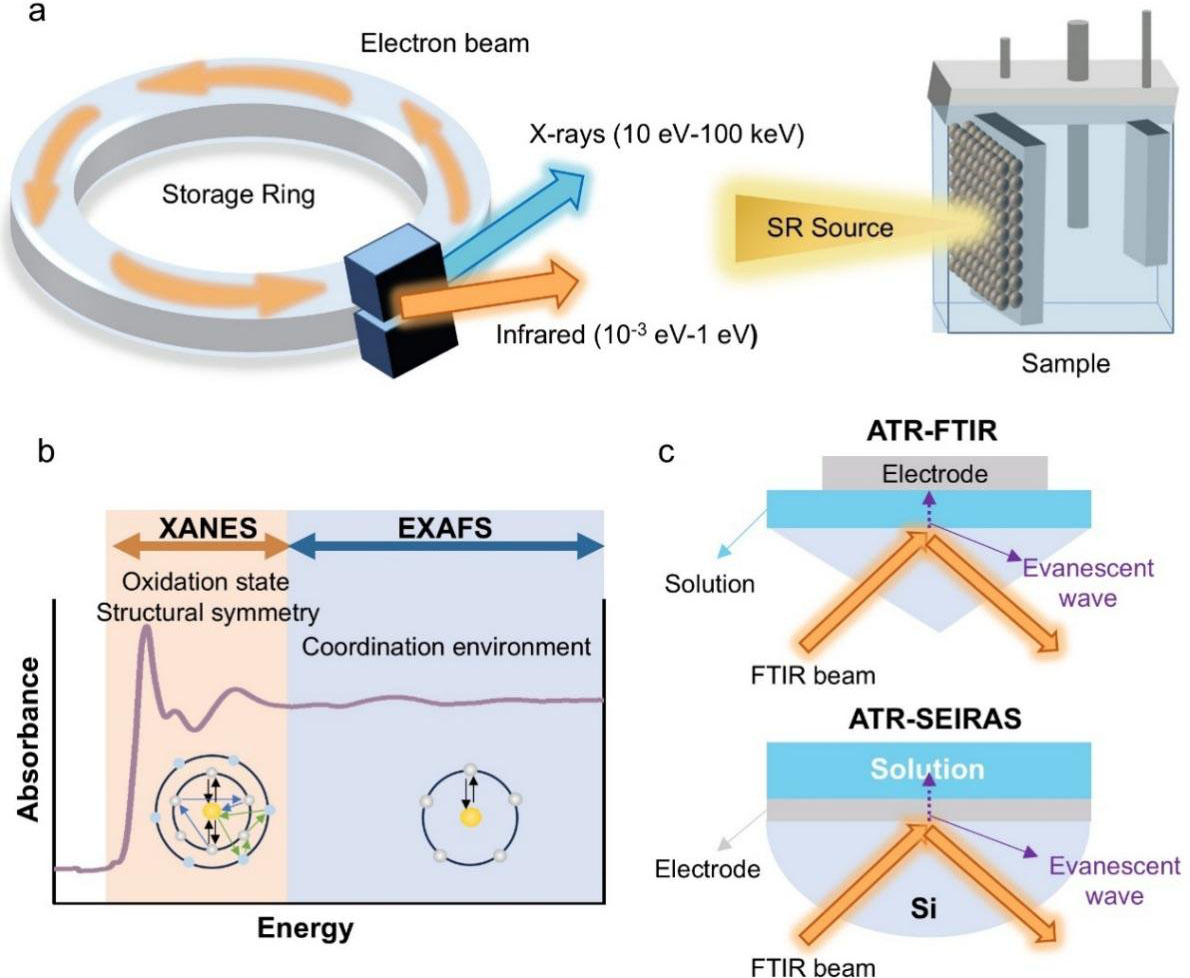
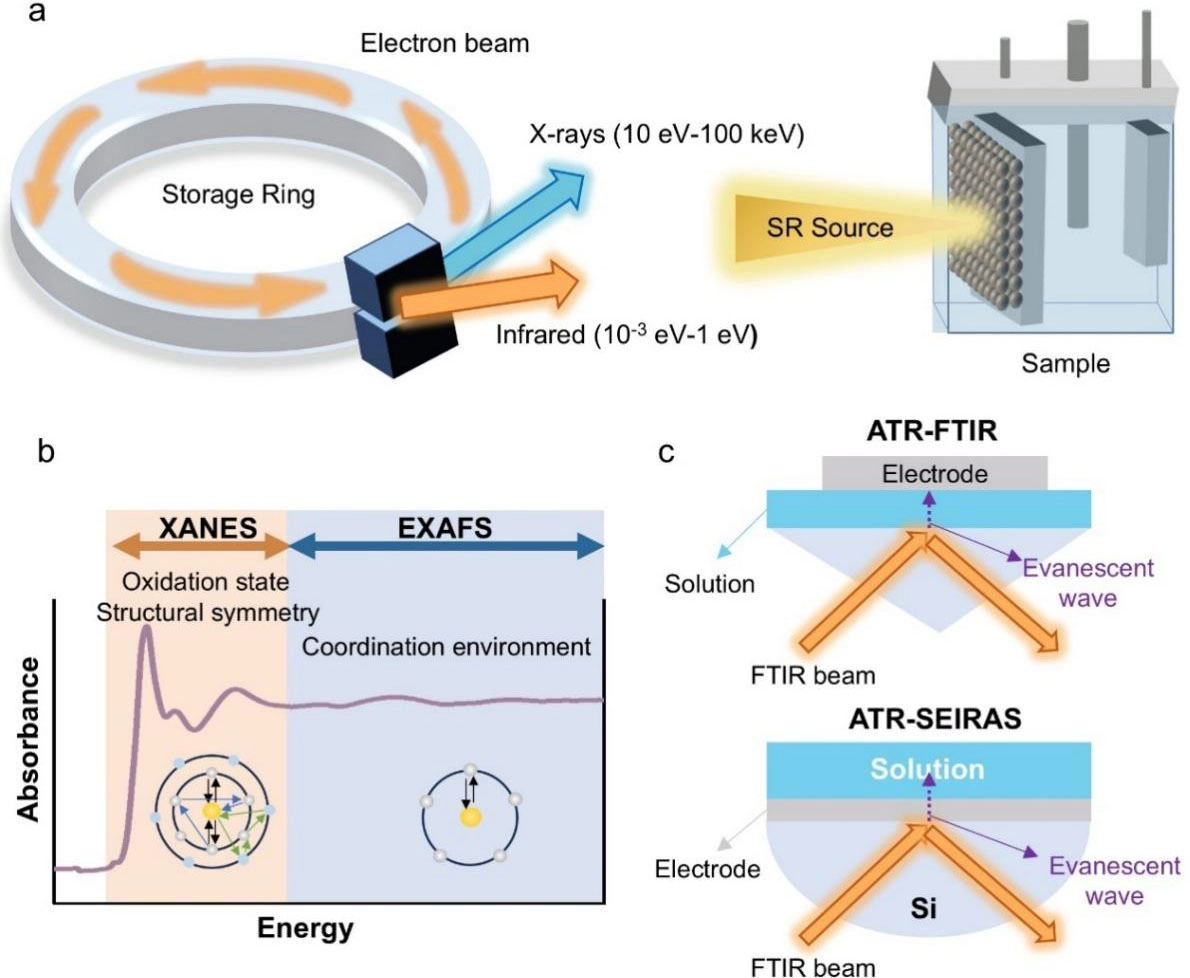
Figure 2. (a) Schematic diagram of synchrotron radiation generated by the deflection of electrons in a magnetic field; (b) Schematic diagram of XAS; (c) Schematic diagram of ATR-FTIR and ATR-SEIRAS. XAS: X-ray absorption spectroscopy; ATR-FTIR: attenuated total reflection Fourier‑transform infrared spectroscopy; ATR-SEIRAS: attenuated total reflection surface‑enhanced infrared absorption spectroscopy; XANES: X-ray absorption near-edge structure; EXAFS: extended X-ray absorption fine structure; FTIR: fourier transform infrared spectroscopy. SR: synchrotron radiation.
Compared to laboratory-based sources, SR combines ultrahigh brilliance with exceptional spectral tunability and resolution, while maintaining full compatibility with in-situ reaction cells. These features are critical for deciphering electrocatalytic mechanisms, particularly those involving dynamic active sites and buried solid-liquid interfaces[38]. For seawater electrolysis, SR enables direct observation of how chloride ions perturb active sites, modulate coordination environments, and alter reaction pathways[39-42]. Consequently, SR serves as a multiscale probe capable of linking atomic-level structural evolution to molecular-level interfacial chemistry. Herein, we highlight two complementary techniques, SR-XAS and SR-IR, to evaluate their respective capabilities and limitations in elucidating chloride effects on seawater electrolysis.
2.1 XAS
XAS is an element-specific technique that probes the local electronic and atomic structure of matter through the interaction of X-rays with core-level electrons. When the incident X-ray energy matches or exceeds the binding energy of an inner-shell electron of a given element, the electron can be excited into unoccupied bound states or emitted into the continuum. This process leads to a sharp rise in the absorption coefficient at a characteristic absorption edge, such as the K, L, or M edge, thereby providing intrinsic elemental selectivity. Beyond the edge, the absorption spectrum contains fine structure arising from the interaction between the emitted photoelectron wave and the surrounding atomic environment. The outgoing photoelectron can be scattered by neighboring atoms and interfere with itself, causing energy-dependent oscillations in the absorption coefficient. Because this interference is governed by the identity, distance, and number of neighboring atoms, XAS is exceptionally sensitive to the local coordination environment of the absorbing atom, even in structurally disordered or amorphous systems where diffraction-based techniques are less informative[43]. As schematically shown in Figure 2b, XAS is generally divided into two regimes: XANES and EXAFS. These two regions provide complementary information on the electronic and geometric structure of catalytic centers.
2.1.1 XANES
XANES typically covers an energy range spanning from approximately 50 eV below to 50 eV above the absorption edge and is commonly divided into the pre-edge, main-edge, and near-edge regions. In this energy range, the photoelectron has relatively low kinetic energy and a long wavelength, so multiple scattering processes become prominent. As a result, XANES is highly sensitive to the oxidation state, local symmetry, coordination geometry, and unoccupied electronic states of the absorbing atom[44,45]. The pre-edge region often reflects transitions to localized unoccupied states and can therefore provide insight into site symmetry and orbital hybridization. The edge position and white-line intensity are widely used to evaluate the oxidation state of the absorbing atom. During the electrocatalytic process, XANES is particularly powerful for identifying potential-dependent electronic structures of active sites and monitoring the formation of high-valence intermediates[46]. Thus, XANES is not merely a tool for tracking valence changes; more importantly, it connects those changes to the electronic characteristics governing adsorption energetics and catalytic selectivity.
2.1.2 EXAFS
EXAFS refers to the oscillatory region extending from roughly 50 to 1000 eV above the absorption edge. In this region, the photoelectron has higher kinetic energy and can be treated approximately as an outgoing spherical wave. Interference between this wave and the waves backscattered by neighboring atoms generates periodic oscillations in the absorption spectrum. Analysis of these oscillations allows the extraction of structural parameters such as coordination number, interatomic distance, disorder, and the identity of neighboring scatterers[47-49]. Fourier transform (FT) of the EXAFS signal converts the data from k-space into R-space, yielding a radial distribution-like profile that is useful for visualizing shell-by-shell coordination. However, conventional FT-EXAFS provides only global distance-domain information and may struggle to discriminate contributions from different neighboring atoms with similar scattering amplitudes or overlapping distances. Wavelet transform (WT) analysis addresses this limitation by simultaneously resolving the signal in both k- and R-space, thereby improving the separation of overlapping coordination contributions. In the context of seawater electrolysis, EXAFS is particularly important because chloride-induced degradation often manifests first as short-range coordination changes rather than long-range crystallographic transformations. Accordingly, EXAFS can reveal whether chloride causes direct metal-Cl coordination, weakens metal-oxygen bonds, triggers dissolution of specific metal sites, or drives reconstruction into new motifs.
2.1.3 Unique advantages of in-situ XAS
A key advantage of XAS is its compatibility with in-situ measurements. Conventional ex-situ characterization often captures only post-reaction structures, which may differ substantially from the actual active state because of air exposure, potential release, or structural relaxation after reaction. This limitation is especially problematic for seawater electrolysis, where chloride-induced adsorption, ligand exchange, and reconstruction can be highly dynamic and strongly potential dependent.
In-situ XAS overcomes this problem by enabling real-time monitoring of catalysts under electrochemical working conditions. Through the use of specially designed electrochemical cells, XAS measurements can be performed while controlling the applied potential and simultaneously recording electrochemical response. Such measurements make it possible to directly correlate catalyst performance with the evolution of oxidation states and coordination structure[50]. For seawater electrolysis, in-situ XAS allows one to identify the genuine working-state structure, determine when structural changes occur relative to electrochemical events, and establish causal links between chloride exposure, active-site transformation, and catalytic failure or stabilization.
2.2 FTIR
FTIR is a technique for identifying molecular species through their characteristic vibrational fingerprints. In the context of electrochemical interfaces, in-situ FTIR can monitor the adsorption and transformation of surface species. However, its application in aqueous electrolytes is severely hindered by the intense infrared absorption of bulk water, which masks the weak signals from adsorbed intermediates and limits the detection sensitivity. The attenuated total reflection (ATR) configuration effectively overcomes this limitation. In ATR-FTIR, the IR beam is directed into a high-refractive-index crystal at an angle exceeding the critical angle, generating an evanescent wave that penetrates only a few micrometres into the adjacent solution (Figure 2c). This short optical path length dramatically reduces the interference from bulk water while maintaining high surface sensitivity. To further enhance surface sensitivity down to the sub-monolayer level, the attenuated total reflection surface-enhanced infrared absorption spectroscopy (ATR-SEIRAS) has been developed. In this configuration, a nanostructured metal film is deposited on the crystal and serves as the working electrode. When the IR evanescent wave interacts with this nanostructured film, it excites localized surface plasmon resonance, generating a significantly amplified local electric field near the electrode surface. This electromagnetic enhancement, together with a chemical enhancement arising from charge transfer between adsorbates and the metal, increases the infrared absorption of surface species by one to two orders of magnitude. As a result, ATR-SEIRAS enables the identification of interfacial adsorbates and reaction intermediates with minimal interference from the bulk electrolyte. In seawater electrolysis, in-situ FTIR has been employed to monitor the dynamic adsorption of *OH intermediates, to probe the restructuring of hydration shells upon Cl- introduction, and to distinguish physical Cl- adsorption from chemical substitution at the catalyst surface[51].
Compared with conventional thermal IR sources, SR-IR uses synchrotron facility-generated infrared light as the excitation source and exhibits much higher brightness and better collimation, enabling the beam to be focused into microscale spots without severe loss of signal-to-noise ratio. This feature is particularly beneficial for electrocatalytic interfaces, where the probed region is often spatially confined and the signal of interfacial species is extremely low. In addition, SR-IR provides broad spectral coverage from the near-IR to the far-IR region, thereby allowing simultaneous detection of adsorbates and hydration structures. From a mechanistic perspective, SR-IR can provide molecular-level information that is complementary to XAS. Whereas XAS mainly tracks the local electronic and coordination structure of metal centers, SR-IR can directly reveal the evolution of adsorbed intermediates, surface hydroxyls, hydrogen-bonding networks, and interfacial water organization. In electrocatalysis, these interfacial species often determine proton-coupled electron transfer kinetics, adsorption selectivity, and reaction-pathway competition. For seawater electrolysis, this capability is particularly important because chloride not only perturbs the catalyst but also reshapes the local interfacial environment by competing with OH-, reorganizing hydration shells, and modifying hydrogen-bond networks near the surface[52].
3. Understanding the Negative Effects of Chloride Ions
The presence of chloride is the main feature that distinguishes seawater electrolysis from purified water electrolysis. Conventional electrochemical measurements can reveal activity loss or stability degradation in chloride-containing electrolytes, but they cannot explain how chloride interacts with catalysts or why deactivation occurs. In contrast, in-situ characterization techniques can not merely characterize the active states of electrocatalysts, but also identify the mechanistic origin of chloride-induced performance deterioration, thereby establishing the basis for rational anti-chloride design. Existing studies can be broadly grouped into three aspects: chloride-induced perturbation of electronic structure, changes in local coordination, and modulation of interfacial intermediates and surface species.
3.1 Cl- Alters the electronic structure of active sites
One of the earliest manifestations of chloride interaction is the redistribution of electron density around catalytic centers, which can shift the oxidation state and modify the adsorption energetics of OER intermediates. XANES is especially valuable in this context because the absorption-edge position and near-edge features sensitively reflect changes in oxidation state and electronic structure[53]. Thus, XANES can reveal whether chloride perturbs the electronic environment of the active site during operation.
For example, Sun et al. employed in-situ XANES to investigate a high-spin HS-Fe0.17Co0.83Se2 array catalyst[54], in which Fe modulates the Co centers to generate high-spin Co sites. As the applied potential increased, the Co absorption edge shifted to higher energy, indicating progressive oxidation of Co. Importantly, the edge shift was more pronounced in alkaline seawater than in alkaline pure water, demonstrating that the presence of chloride further perturbs the electronic structure of Co. This result provides direct evidence that chloride adsorption is electronically coupled to the catalytic center rather than acting solely as an external corrosive species. A similar mechanistic insight was obtained in the work of Liu et al.[55], who compared the potential-dependent XANES evolution of NiFe-layered double hydroxide (LDH) in alkaline seawater and alkaline pure water. The Ni and Fe K-edge shifts shown in Figure 3a,b,c,d, together with the summary in Figure 3e, reveal that the two metals respond differently to chloride-containing electrolytes during the OER process. At low potentials, both metals display similar edge shifts in the two electrolytes, indicating comparable early-stage oxidation behavior. However, as the potential increases into the precatalytic and OER regions, the Ni K-edge exhibits a more pronounced positive shift in seawater, whereas the Fe K-edge eventually shifts to lower energy. These observations suggest a chloride-triggered redistribution of charge between Ni and Fe sites: chloride adsorption preferentially perturbs Ni, increasing its oxidation state, while electron transfer to Fe leads to partial reduction of Fe under OER conditions. This work suggests that chloride can alter the internal electronic coupling between neighboring active centers, thereby reshaping the catalytic pathway.
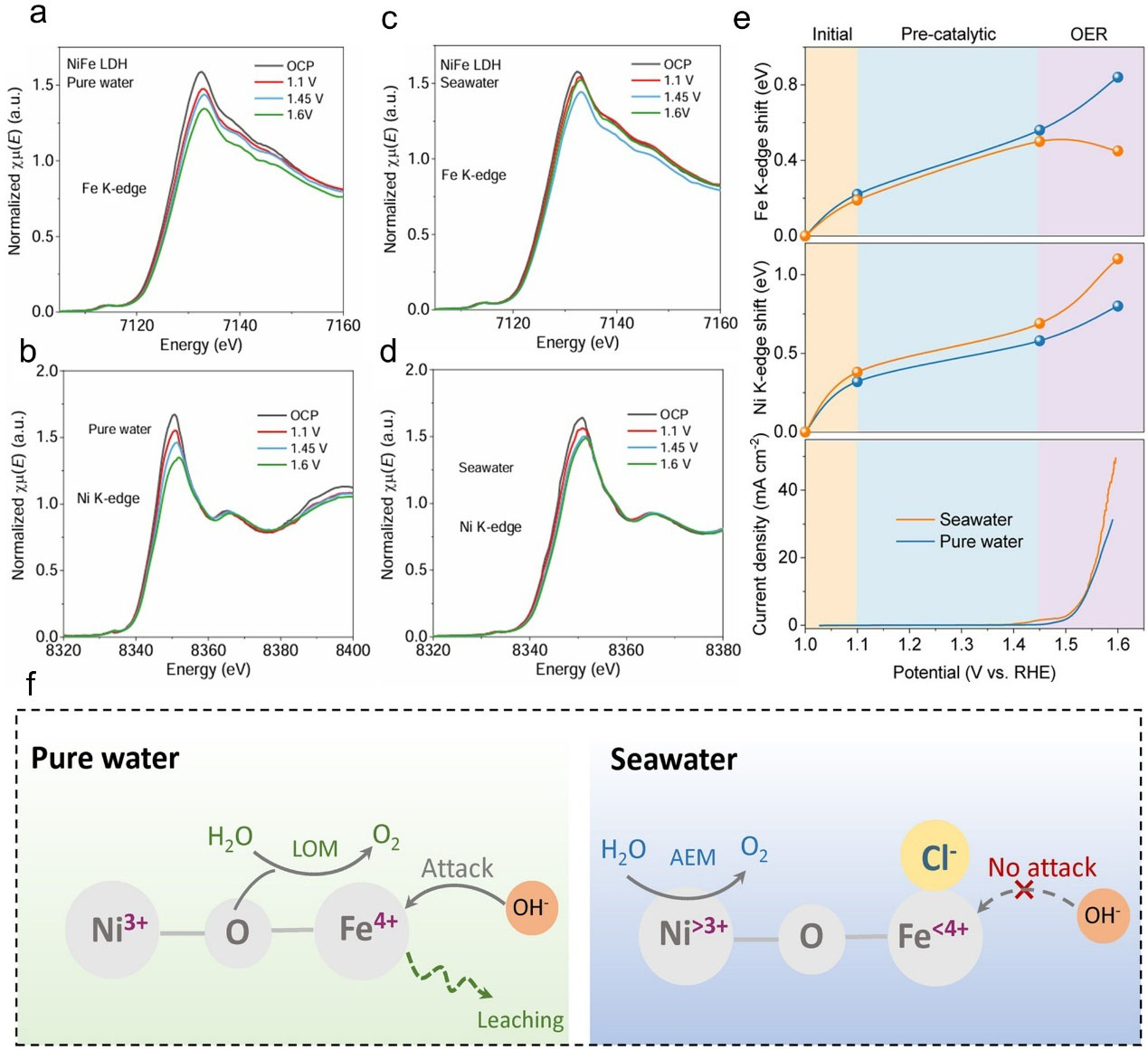
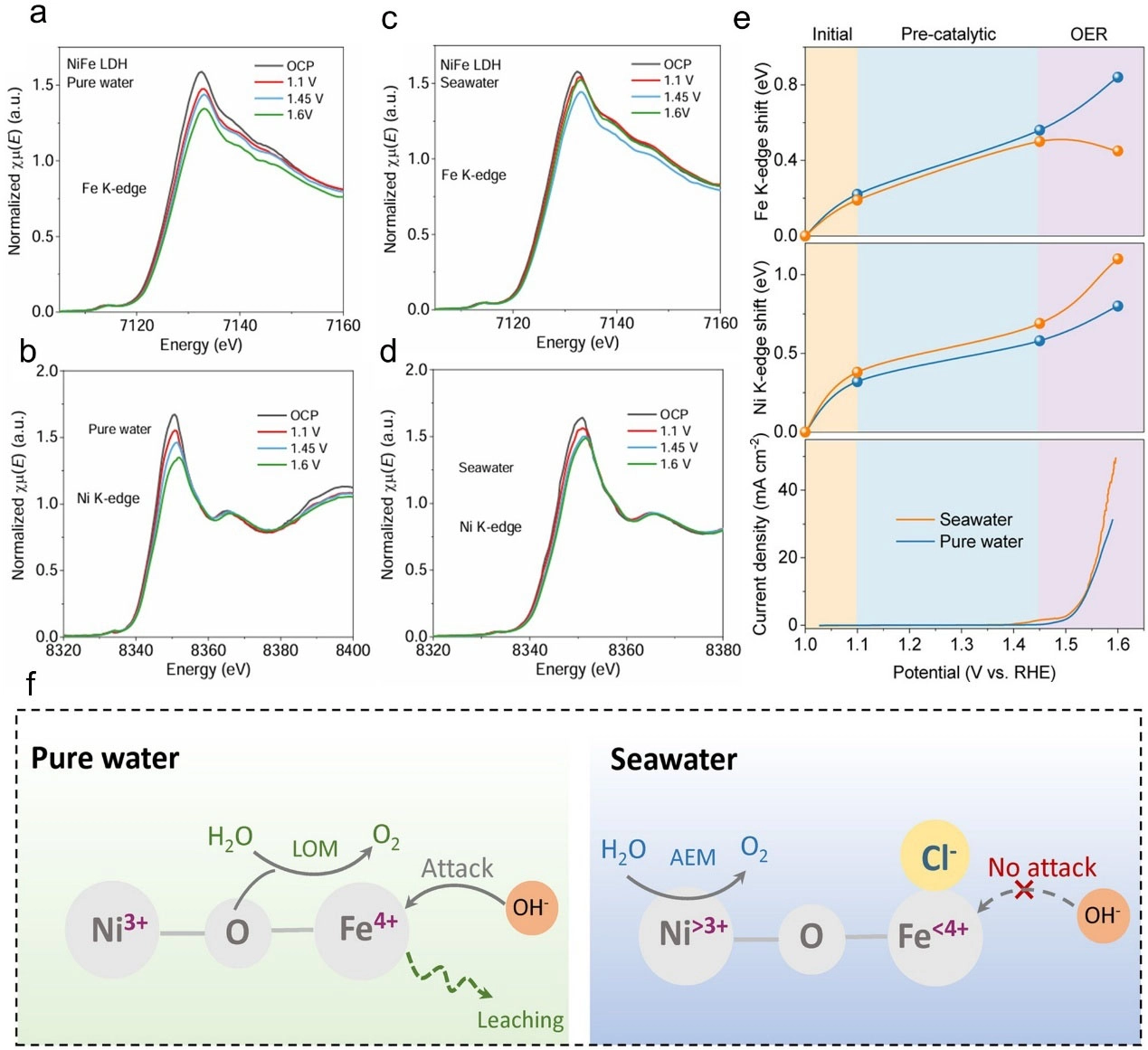
Figure 3. (a) Fe K-edge in-situ XANES spectra of NiFe-LDH in pure water; (b) Ni K-edge in-situ XANES spectra of NiFe-LDH in pure water; (c) Fe K-edge in-situ XANES spectra of NiFe-LDH in seawater; (d) Ni K-edge in-situ XANES spectra of NiFe-LDH in seawater; (e) K-edge displacements of Ni and Fe sites during different OER processes; (f) Schematic diagram for OER mechanism in pure water and seawater. Reproduced from reference[55]. CC BY 4.0. XANES: X-ray absorption near-edge structure. OCP: open circuit potential; OER: oxygen evolution reaction; AEM: adsorbate evolution mechanism; LDH: layered double hydroxide; V: volts; RHE: reversible hydrogen electrode; LOM: lattice oxygen mechanism.
3.2 Cl- modifies the local coordination environment
Beyond electronic perturbation, chloride also induces atomic-scale disturbance on the local coordination environment of catalytic centers. EXAFS is particularly suited to this problem because it can resolve coordination number, bond distance, and neighboring atomic species around the absorber. In the context of seawater electrolysis, EXAFS therefore provides a more structural view of chloride effects, distinguishing whether performance degradation originates from direct metal-Cl coordination, weakening of metal-oxygen frameworks, or reaction-induced reconstruction.
Sun et al. further used in-situ EXAFS to probe the local coordination evolution of HS-Fe0.17Co0.83Se2[54]. As shown in Figure 4a,b, a Co-Cl contribution gradually emerges and broadens with increasing overpotential in alkaline seawater, whereas no corresponding feature is observed in pure water. This comparison clearly demonstrates that chloride changes not only the electronic state but also the first-shell coordination chemistry of the active center. EXAFS can also be utilized to clarify the competition between chloride and hydroxide adsorption, which is central to anodic selectivity in seawater electrolysis. For example, Duan et al. investigated the Ir/CoFe-LDH catalyst by in-situ EXAFS in NaOH and NaOH+NaCl[56]. At 1.57 V, only Ir-O coordination was detected in NaOH, indicating preferential OH- adsorption. In contrast, Ir-Cl coordination remained observable in NaOH-NaCl because of the high chloride concentration. This result reveals that hydroxide does not completely exclude chloride even under alkaline conditions, and that the local adsorption equilibrium at single-atom Ir sites is strongly electrolyte dependent. More importantly, the persistence of dynamic Ir-Cl coordination throughout electrolysis provides a structural explanation for the catalyst’s high OER activity and stability in chloride-containing media.
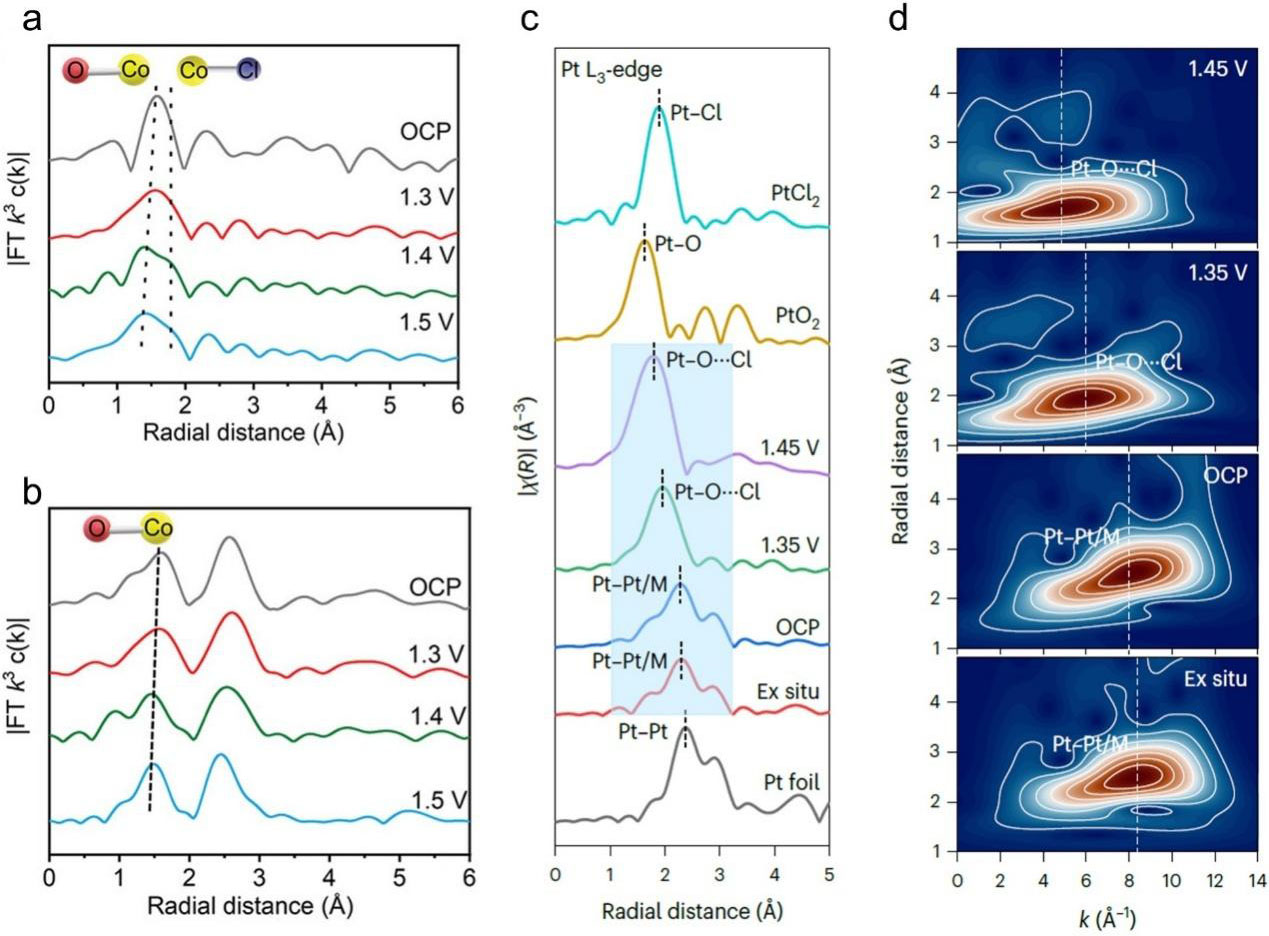
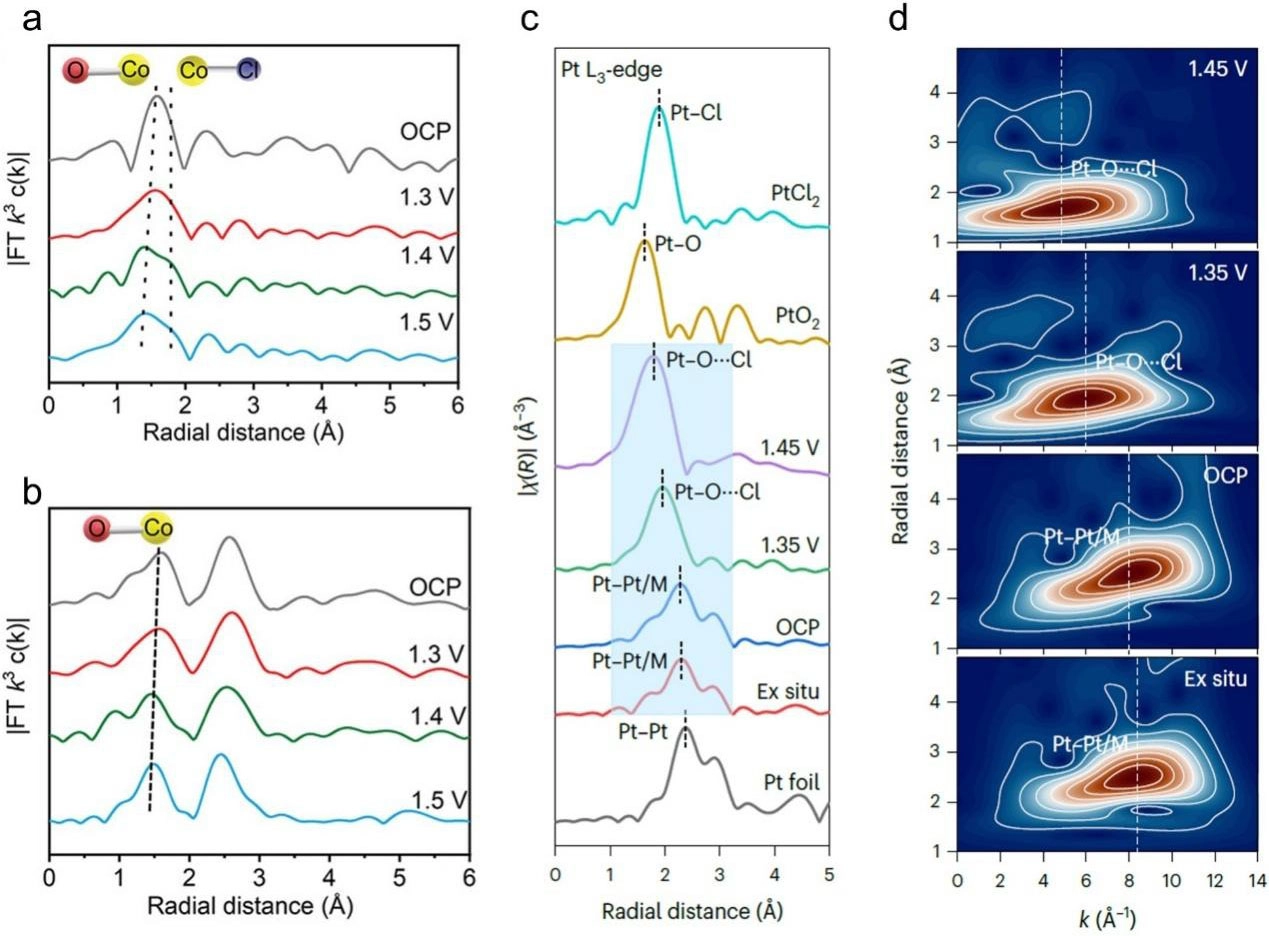
Figure 4. (a) Co K-edge in-situ Fourier-transformed EXAFS spectra of HS-Fe0.17Co0.83Se2 in alkaline seawater; (b) Co K-edge in-situ Fourier-transformed EXAFS spectra of HS-Fe0.17Co0.83Se2 in 1 M KOH. Reproduced with permission from reference[54]. Copyright © 2025 Wiley-VCH GmbH; (c) Pt L3-edge in-situ Fourier-transformed EXAFS spectra on the PtNiCoFeMo UF-HEANWs electrode; (d) The corresponding in-situ wavelet transform signals. Reproduced with permission from reference[57]. Copyright © 2026 Springer Nature. EXAFS: extended X-ray absorption fine structure; FT: Fourier transform; OCP: open circuit potential; UF-HEANWs: ultrafine high-entropy alloy nanowires.
Another important application of EXAFS is the identification of reaction-induced structural reorganization. Yang et al. conducted a comparative analysis of the mechanism of the chlorine evolution reaction (CER) in seawater electrolysis[57]. As shown in Figure 4c, the Pt sites gradually transform from the initial Pt-Pt/M coordination environment to a Pt-O configuration, and a Pt-O···Cl interaction appears at 1.35 V. Meanwhile, the Pt-O bond length decreases with increasing potential. WT-EXAFS analysis in Figure 4d further strengthens this assignment by clearly resolving the increasing contribution of the Pt-O···Cl feature. These data show that chloride corrosion is not necessarily a simple one-step chlorination event; rather, it may proceed through oxygen-coordinated reconstructed sites that subsequently interact with chloride.
3.3 Cl- regulates reaction intermediates and interfacial species
While XAS reveals how chloride modifies the electronic and atomic structure of catalysts, it cannot directly capture how chloride perturbs the molecular interface. Yet, the interfacial information is equally important because chloride can influence OER by competing with OH- adsorption, reorganizing interfacial water, and changing the population of oxygenated intermediates. Infrared spectroscopy is therefore essential for constructing a more complete mechanistic picture of chloride effects.
In water electrolysis, FTIR has been utilized to resolve the key OER intermediates[58]. For instance, Li et al. used SR-IR to monitor three representative OER intermediates[59], as shown in Figure 5a,b. Their results indicate that the *O signal appears as the potential reaches the OER region; with further increasing potential, the intensities of *OH and *O increase, whereas that of *OOH decreases. These results can directly link molecular adsorption behavior to the reaction pathway. It is worth noting that the application of SR-IR is still relatively underexplored, because it is constrained by various factors. First, the number of synchrotron beamlines equipped with the specialized optical components required for in-situ electrochemical infrared measurements is substantially smaller than that available for XAS, which inherently limits accessibility. Furthermore, due to the intrinsically strong infrared absorption of water molecules, the surface specific signals from the catalyst, such as reaction intermediates, are readily obscured by the background absorption of the bulk seawater electrolyte in such complex aqueous media, thereby increasing the difficulty of background subtraction and spectral deconvolution.
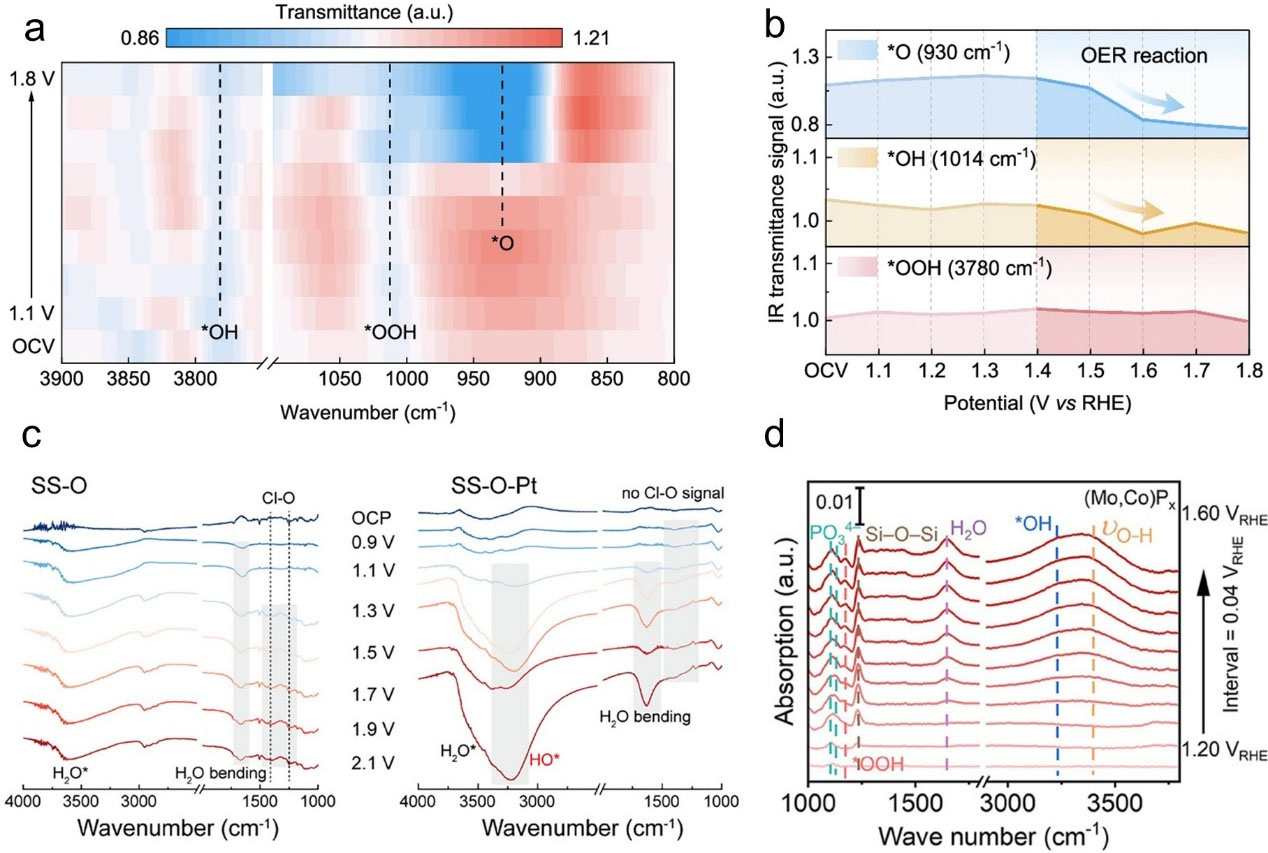
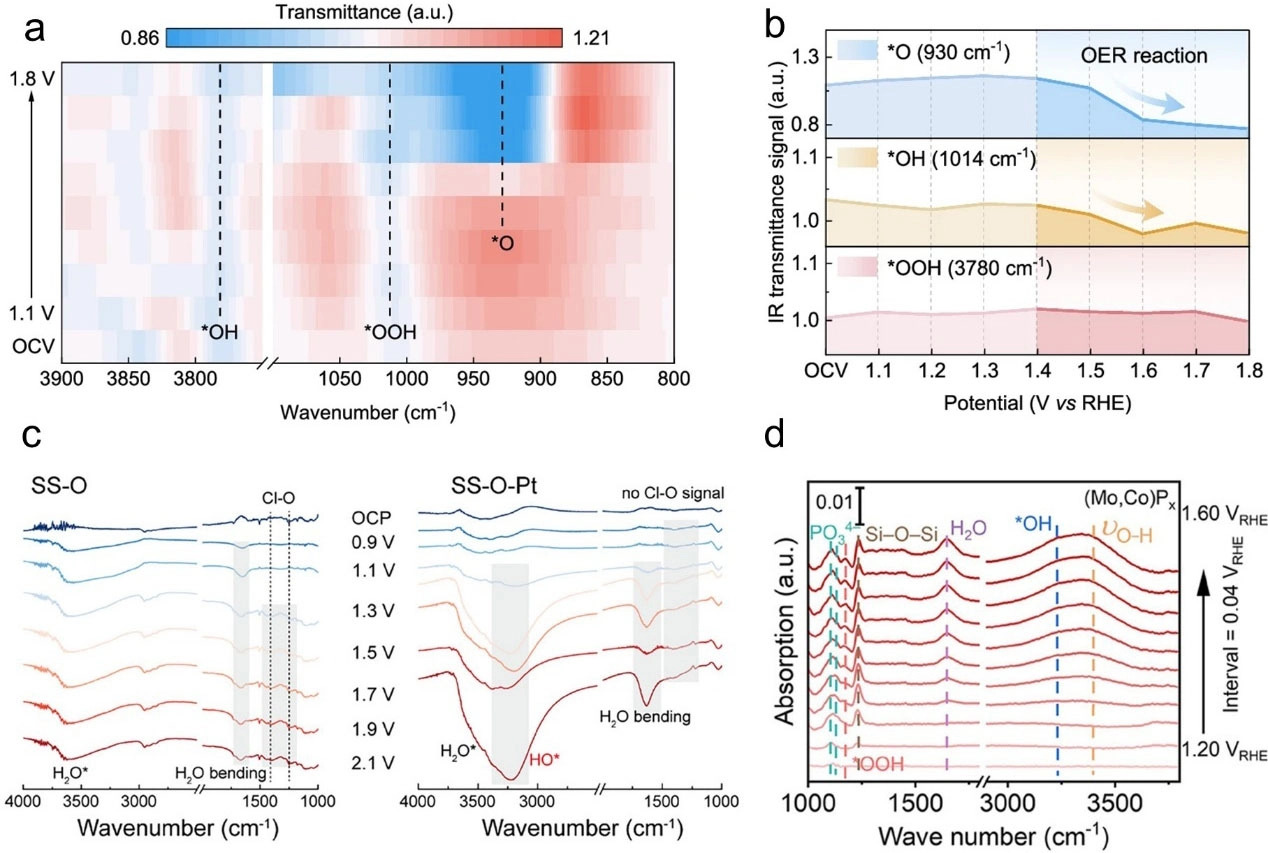
Figure 5. (a) In-situ SR-IR spectra for CoCrOx during the OER process; (b) Infrared transmittance signals versus potentials of *O, *OH, and *OOH. Reproduced from reference[59]. CC BY 4.0; (c) In-situ IR spectra for SS-O and SS-O-Pt in 0.6 M NaCl. Reproduced with permission from reference[60]. Copyright © 2026 Wiley-VCH GmbH; (d) In-situ ATR-SEIRAS spectra for (Mo, Co)Px. Reproduced with permission from reference[62]. Copyright © 2025 Wiley-VCH GmbH. SR-IR: synchrotron radiation-based infrared spectroscopy; IR: infrared; ATR-SEIRAS: attenuated total reflection surface‑enhanced infrared absorption spectroscopy; OER: oxygen evolution reaction.
At present, the commonly used method in the field of seawater electrolysis is still in-situ FTIR. For example, Li et al. investigated chloride-related interfacial behavior on the catalyst surface[60]. As shown in Figure 5c, the SS-O-Pt catalyst exhibits a broad band at around 3,200 cm-1, whose intensity increases with potential; this band is assigned to H2O and HO* species. More importantly, no Cl-O signal is detected on SS-O-Pt during operation, indicating that the catalyst enriches OH- at the interface and promotes water dissociation while suppressing chloride accumulation. Similarly, Hou et al. used in-situ ATR-SEIRAS to investigate the OER mechanism in alkaline seawater; no distinct chloride adsorption signal is observed, whereas the interfacial *OOH signal increases with potential[61]. This result suggests that the catalyst follows an adsorbate evolution mechanism (AEM) under alkaline seawater conditions and that chloride does not dominate the reactive surface at the measured potentials. Thus, IR here serves to identify which intermediates remain kinetically relevant despite the presence of chloride. Che et al. further applied in-situ ATR-SEIRAS to probe the dynamic interfacial evolution of CoPx and (Mo, Co)Px[62]. As the potential increases, phosphate-related interfacial signals gradually emerge, indicating that phosphate species accumulate at the interface and can electrostatically inhibit chloride adsorption. In addition, the stronger interfacial water signal observed for (Mo, Co)Px indicates enhanced water adsorption on this catalyst as shown in Figure 5d. Taken together, these results show that in-situ IR can reveal how interfacial anions and water jointly regulate chloride access to the surface.
4. Validating the Efficiency of Cl- Resistance Strategies
By revealing the electronic, structural, and interfacial origins of chloride-induced degradation, these techniques provide the mechanistic foundation for anti-chloride catalyst design. On this basis, several major strategies have emerged, including the construction of anionic protective layers, the design of intrinsically stable structures, and the regulation of local alkaline microenvironments. However, electrochemical performance alone can only show that a strategy works; it cannot explain why it works. In this section, we discuss how XAS and FTIR-based methods substantiate the effectiveness of three representative classes of anti-chloride approaches.
4.1 Electrostatic repulsion strategy
Constructing an anionic layer on the catalyst surface is a widely adopted strategy for inhibiting the approach of chloride ions to the electrode surface through electrostatic repulsion[63,64]. Therefore, the anionic species must remain stably present at the interface under OER conditions and create a local chemical environment that disfavors chloride adsorption. In-situ spectroscopic techniques are particularly important to determine whether the interfacial anions are truly stable and whether they effectively regulate the local adsorption environment.
For example, Sun et al. introduced different anionic layers into NiFe-LDH, a representative alkaline seawater OER catalyst, and examined how these layers influence OER activity and corrosion resistance[65]. XANES analysis in Figure 6a,b shows that increasing anionic charge causes the edge peak of the K-edge of Ni to shift towards lower energy levels, which selectively decreases the valence state of Ni while leaving Fe nearly unchanged, indicating that Ni serves as the primary electron donor to the introduced anions. This result identifies the electronic origin of anion anchoring and suggests that the protective layer is not a physically adsorbed spectator, but is electronically coupled to specific surface sites. The interfacial consequence of this coupling was further clarified by in-situ infrared measurements. As shown in Figure 6c, the νO-H intensity of interfacial water decreases with increasing potential for NiFe-LDH-[PO43-], indicating strengthened interaction with interfacial water and therefore facilitated proton transfer. By contrast, NiFe-LDH-[Cl-] exhibits a redshift of the νO-H band, reflecting a strengthened hydrogen-bond network that is unfavorable for proton transport. Importantly, no such redshift is observed for NiFe-LDH-[PO43-], implying that the interfacial composition remains relatively stable under applied bias. Combined with the mechanism illustrated in Figure 6d, these findings show that phosphate not only repels chloride electrostatically but also maintains a locally OH--rich interface favorable for OER. Thus, the mechanistic value of XANES and infrared analysis here lies in demonstrating both the anchoring stability of the anionic layer and its functional impact on interfacial chemistry. A related example was reported by Ren et al.[66], who designed a catalyst consisting of Os nanoparticles anchored on CoP to achieve dual chloride repulsion through self-released phosphate ions and in-situ formed Os-Cl interactions. In-situ FTIR (Figure 6e) shows that the introduction of Os leads to a stronger phosphate-related signal with a stronger infrared signal of phosphate ions at low current density. As the voltage increases, Os-CoP exhibits a stronger infrared peak of HPO42- at 1,000-1,150 cm-1, indicating that Os promotes the formation of a phosphate-enriched interface capable of repelling chloride. In-situ Raman spectroscopy (Figure 6f) further reveals the emergence of an Os-Cl bond as the potential increases from open circuit potential (OCP) to 1.525 V, suggesting that chloride preferentially binds to Os sites. XAS of the reacted Os-CoP catalyst (Figure 6g) confirms the presence of Os-Cl coordination, while density functional theory (DFT) calculations show that Os preferentially adsorbs Cl- and Co preferentially adsorbs OH-. The XANES and IR data demonstrate that the electronic structure disruption caused by Cl- and the interface Cl- mechanism were suppressed, and the effectiveness of the electrostatic repulsion effect was proved. More broadly, they highlight how synchrotron-based characterization can distinguish whether an anion-mediated protection strategy operates through passive repulsion, active chloride capture, or both.
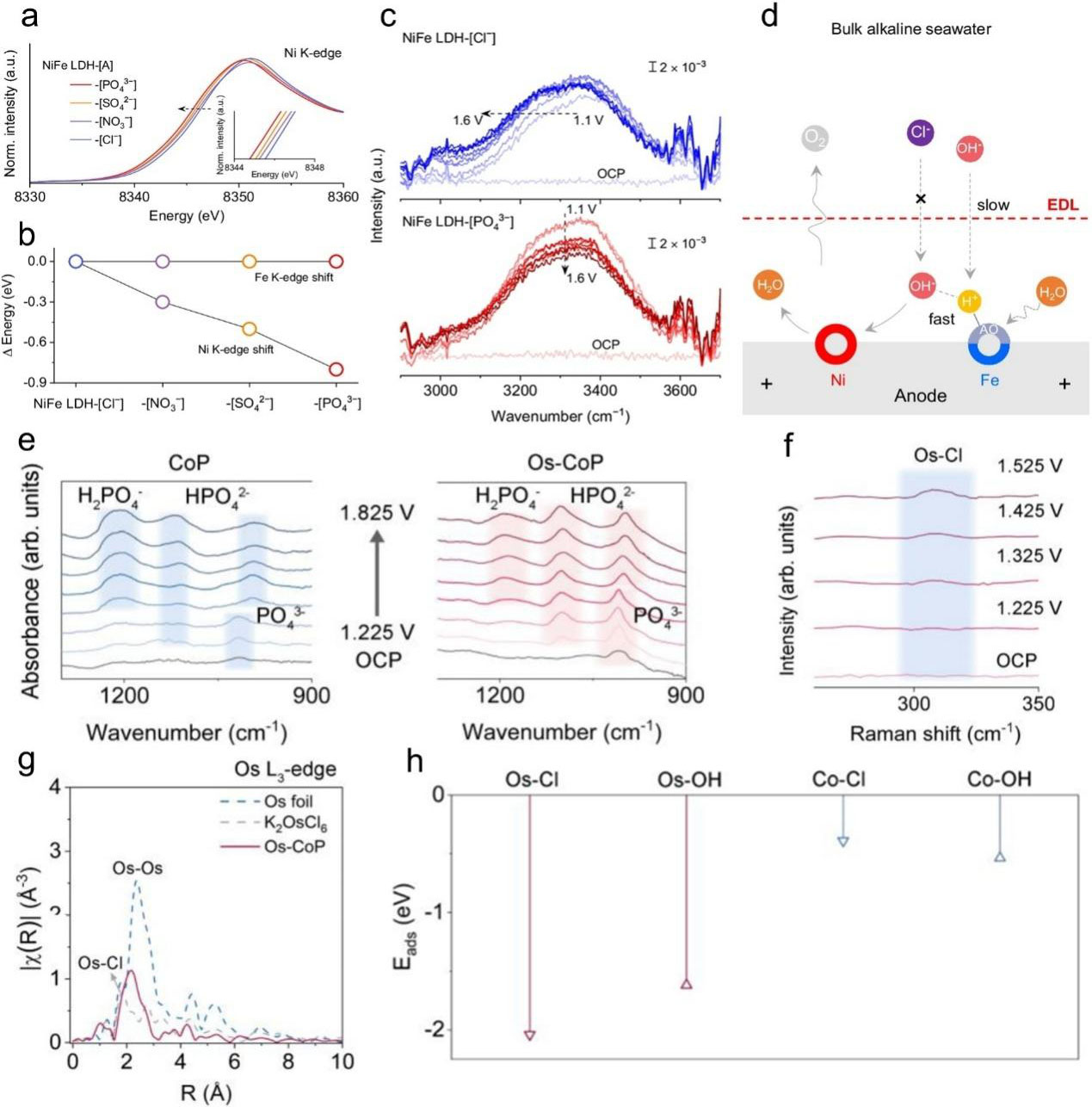
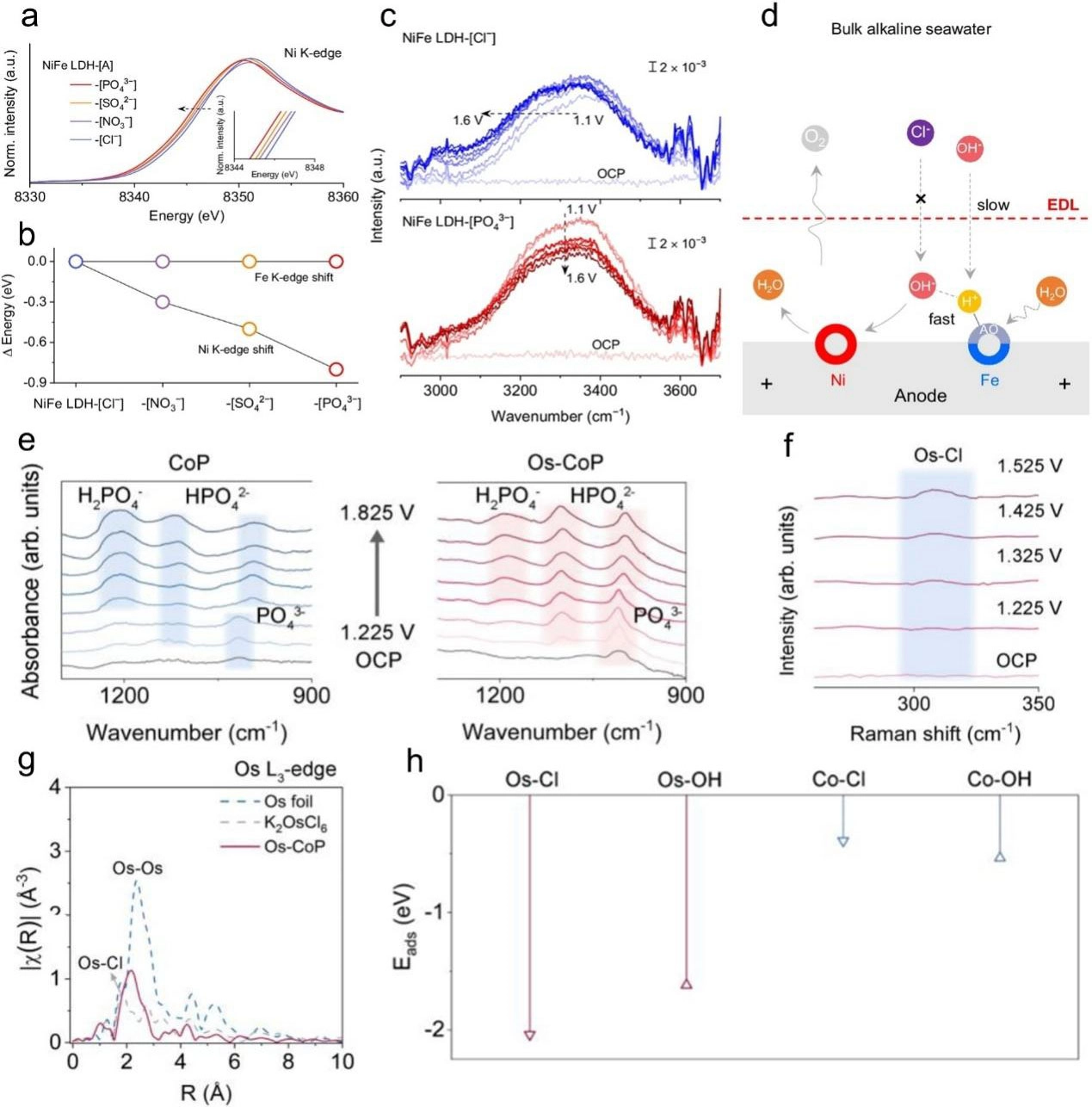
Figure 6. (a) Ni K-edge XANES spectra of NiFe LDH-[A] in seawater; (b) Energy shift of Ni and Fe K-edges; (c) In-situ IR spectra of interfacial water for NiFe LDH-[A]; (d) Schematic diagram of NiFe LDH-[A] anti-chlorine property. Reproduced with permission from reference[65]. Copyright © 2024 Springer Nature; (e) In-situ IR spectra of CoP and Os-CoP in alkaline seawater; (f) In-situ Raman spectra of Os-Cl at different potentials; (g) Os L3-edge Fourier-transformed EXAFS spectra of Os-CoP after the stability test; (h) Adsorption energy of Cl- and OH- on Os and Co active sites. Reproduced with permission from reference[66]. Copyright © 2026 Springer Nature. XANES: X-ray absorption near-edge structure; IR: infrared; EXAFS: extended X-ray absorption fine structure; LDH: layered double hydroxide; OCP: open circuit potential.
4.2 Design of stable structures for enhancing intrinsic corrosion resistance
Beyond electrostatic repulsion at the interface, an equally important question is whether the catalyst itself can be made intrinsically resistant to chloride attack. Chloride ions can directly coordinate to metal sites, weaken metal-oxygen bonds, and even trigger the dissolution of active species, all of which are rooted in the local coordination environment of the catalytic centers. The design of intrinsically stable structures aims to suppress chloride-induced degradation by modifying the catalyst itself[67,68]. Alloying, elemental substitution, and heterostructure construction can tune the electronic structure, strengthen local bonding, and increase the energetic penalty for chloride adsorption or metal dissolution. Because these effects are fundamentally encoded in local coordination and electronic structure, XAS is particularly well suited to validate this class of strategies.
In this context, He et al. introduced the polyoxometalate PW12-polyoxometalate (POM) into CoFe-LDH to regulate the active-site environment[69]. As shown in Figure 7a, the Co K-edge of the modified catalyst shifts more significantly with increasing potential than that of pristine CoFe-LDH, indicating more facile oxidation of Co sites. This high-valent Co has a lower OER overpotential and Tafel slope, indicating that it exhibits higher activity and a lower reaction energy barrier. In contrast, the Fe sites show no obvious shift, suggesting that PW12 preferentially anchors to Fe and stabilizes these sites under anodic conditions. This site-selective stabilization is further supported by in-situ EXAFS in Figure 7b,c: pristine CoFe-LDH exhibits Fe-O bond elongation and reduced coordination number as the applied voltage increases, consistent with chloride-induced structural collapse and Fe leaching, whereas PW12-CoFe-LDH maintains a nearly unchanged Fe-O environment with increasing potential. The mechanism illustrated in Figure 7d therefore gains direct structural support: PW12 protects Fe sites from chloride attack while simultaneously tuning the electron density of adjacent Co centers to enhance OH- adsorption. The EXAFS evidence presented above directly validates that intrinsically stable structures are capable of effectively resisting chloride-induced metal dissolution, bond elongation, and formation of M-Cl bonds, thereby effectively suppressing the negative effects of Cl-.
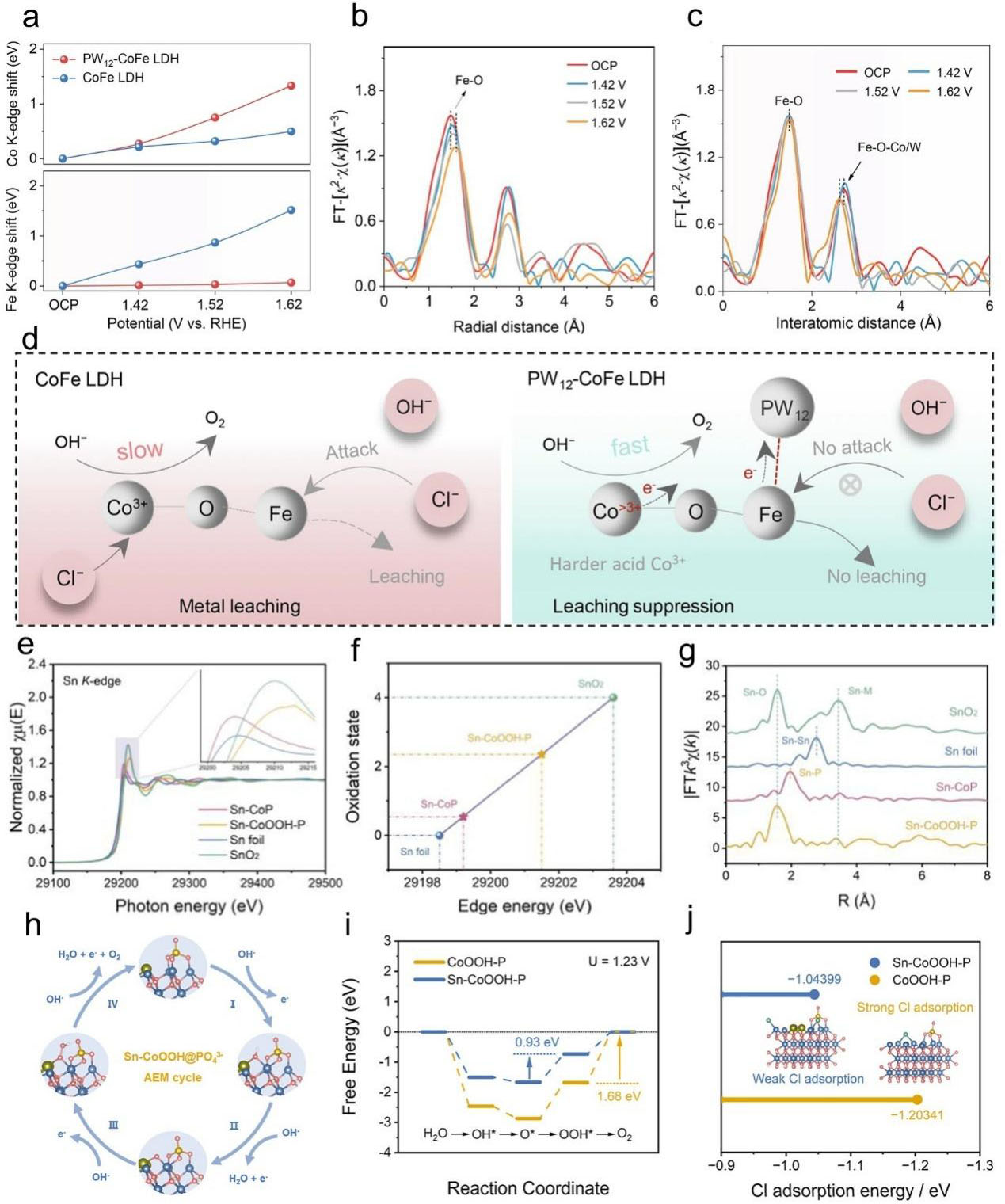
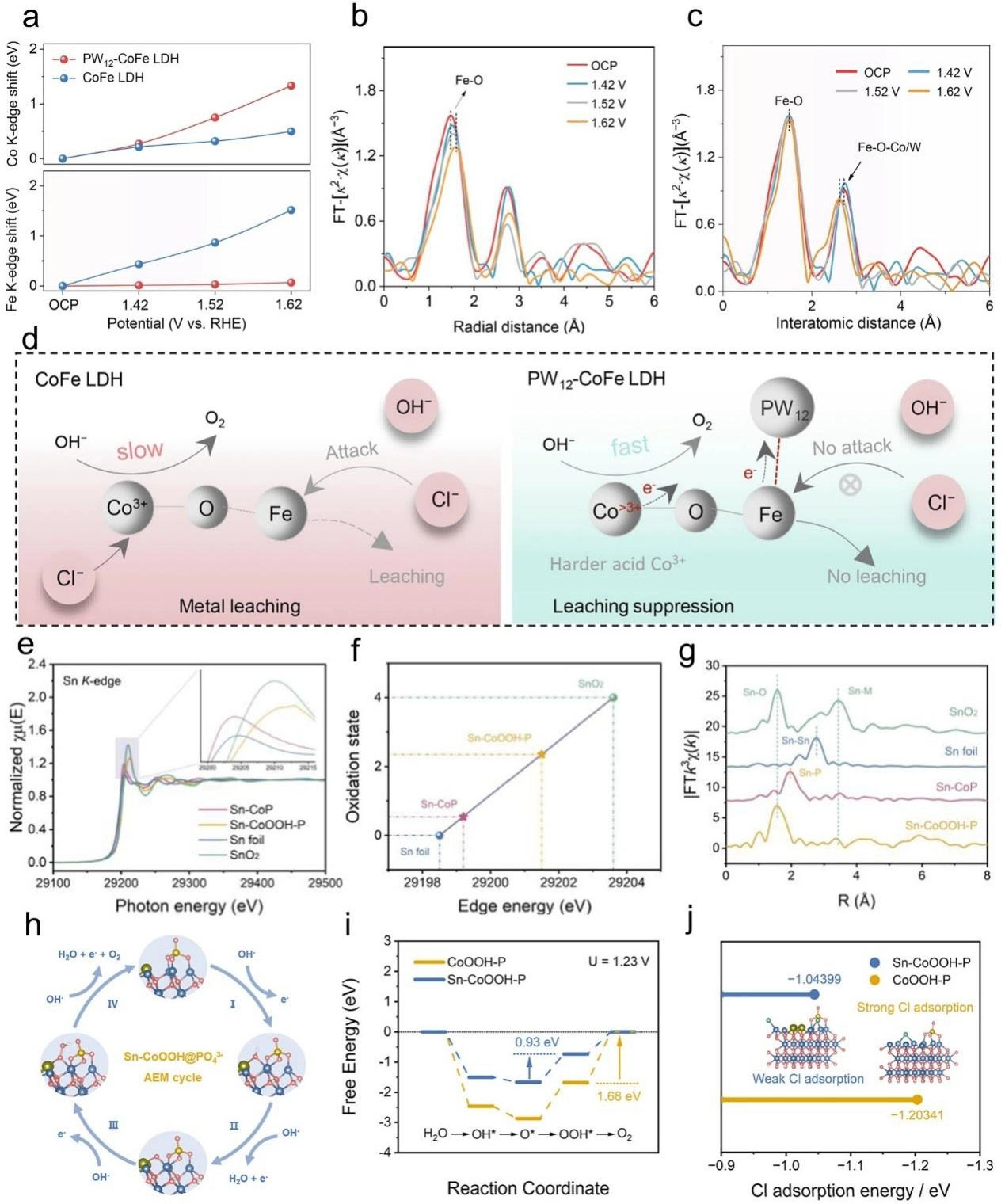
Figure 7. (a) Co K-edge and Fe K-edge shift of PW12-CoFe LDH and CoFe LDH in alkaline seawater; (b) Fe K-edge in-situ Fourier-transformed EXAFS of CoFe LDH in alkaline seawater; (c) Fe K-edge in-situ Fourier-transformed EXAFS of PW12-CoFe LDH in alkaline seawater; (d) Schematic illustration of the PW12-CoFe LDH for seawater electrolysis mechanism. Reproduced from reference[69]. CC BY 4.0; (e) Sn K-edge XANES of Sn-CoP, Sn-CoOOH-P, Sn foil, and SnO2; (f) Relationship between Sn K-edge absorption energy and oxidation state; (g) Sn K-edge Fourier-transformed EXAFS of Sn-CoP, Sn-CoOOH-P, Sn foil, and SnO2; (h) OER mechanism for Sn-CoOOH-P; (i) Free energy diagrams for the OER on the Co site of CoOOH-P and Sn-CoOOH-P; (j) Cl adsorption energy for CoOOH-P and Sn-CoOOH-P. Reproduced with permission from reference[70]. Copyright © 2024 American Chemical Society. EXAFS: extended X-ray absorption fine structure; XANES: X-ray absorption near-edge structure; OER: oxygen evolution reaction; OCP: open circuit potential; LDH: layered double hydroxide.
A different approach was reported by Wang et al.[70], who constructed an asymmetric adsorption motif by introducing a d10 metal into the original Co-OH-Co framework, thereby weakening overly strong OH adsorption mediated by d-p-p interactions. Their Sn-CoOOH-P catalyst provides an illustrative example of how XAS can validate both geometric substitution and electronic-function relationships. XANES analysis (Figure 7e) and oxidation-state estimation using the E0 function (Figure 7f) indicate that Sn is significantly oxidized in Sn-CoOOH-P relative to the precursor Sn-CoP. FT-EXAFS performed at the K-edge of Sn further shows the absence of Sn-O or Sn-Sn features in Sn-CoP, ruling out segregated SnOx or metallic Sn and instead supporting substitutional Sn incorporation into a Sn-P-Co environment (Figure 7g). This structural assignment is crucial because it confirms the formation of the intended asymmetric coordination motif rather than a simple composite phase. As the theoretical modeling further suggests, as shown in Figure 7h,i, the symmetric Co-OH-Co configuration in pristine CoOOH-P binds OH too strongly, making the OOH* to O2 step rate-limiting. By contrast, the asymmetric Co-OH-Sn motif weakens OH adsorption, lowers the barrier for OOH* to O2 conversion, and shifts the rate-determining step to the more favorable O* to OOH* process. At the same time, Figure 7j shows that Sn-CoOOH-P imposes a higher energy barrier for chloride adsorption owing to orbital-energy mismatch, thereby enhancing chloride tolerance.
4.3 Alkaline microenvironment: An interfacial regulation strategy
Chloride ions can directly compete with OH- for adsorption sites, disrupt the interfacial hydrogen-bond network, and trigger corrosion of active metal centers. Therefore, a rational anti-chloride strategy should not only modify the catalyst itself but also actively regulate the local chemical environment at the electrode-electrolyte interface. A third major route to chloride resistance is the construction of a local alkaline microenvironment near the catalyst surface. By enriching OH- or introducing strongly Lewis acidic interfacial components, such systems can suppress chloride adsorption and favor the OER process[71]. For instance, Hu et al. developed a NiFe-LDH/Ce(OH)CO3 heterostructure as a representative example of this strategy[72]. XANES and EXAFS results in Figure 8a,b,c,d,e,f show that both Fe and Ni in NiFe-LDH/Ce(OH)CO3 exhibit greater forward edge shifts of XANES and higher valence states than in pristine NiFe-LDH, indicating that the introduction of Ce(OH)CO3 modifies the electronic structure of the NiFe framework, which causes the formation of more active species and lower overpotential during the OER process. EXAFS further reveals that although the overall coordination motifs remain similar, the coordination numbers of Fe-O and Ni-O increase, consistent with enhanced oxidation and stronger Lewis acidity at the active centers. This change in coordination number optimizes the adsorption of the reaction intermediate and the rate-limiting step of the reaction, resulting in faster reaction kinetics and a lower Tafel slope than NiFe-LDH. WT-EXAFS analysis additionally indicates pronounced distortion around both Ni and Fe, suggesting displacement of the metal centers associated with the formation of interfacial Ni-O-Fe-O-Ce linkage. Furthermore, differential charge-density analysis in Figure 8g reveals electron accumulation at interfacial Ce and electron depletion around Ni and Fe, demonstrating interfacial charge redistribution. As rationalized in Figure 8h, strong electronic repulsion between Ni2+ and O2-, together with weak π donation from Fe3+ through Fe-O linkages, promotes electron delocalization toward the electron-deficient d orbitals of Ce. The resulting Ni-O-Fe-O-Ce connectivity enhances the Lewis acidity of Ni and Fe, weakens chloride adsorption, and thereby improves chloride resistance. The spectroscopic characterization of this strategy not only validates the effectiveness of the alkaline microenvironment approach but also reciprocally confirms its significance in revealing the negative effects of Cl-. The observed enhancement of Lewis acidity at the active sites, evidenced by XANES and EXAFS, provides a structural explanation for reduced chloride adsorption, consistent with the interfacial regulation mechanisms discussed earlier.
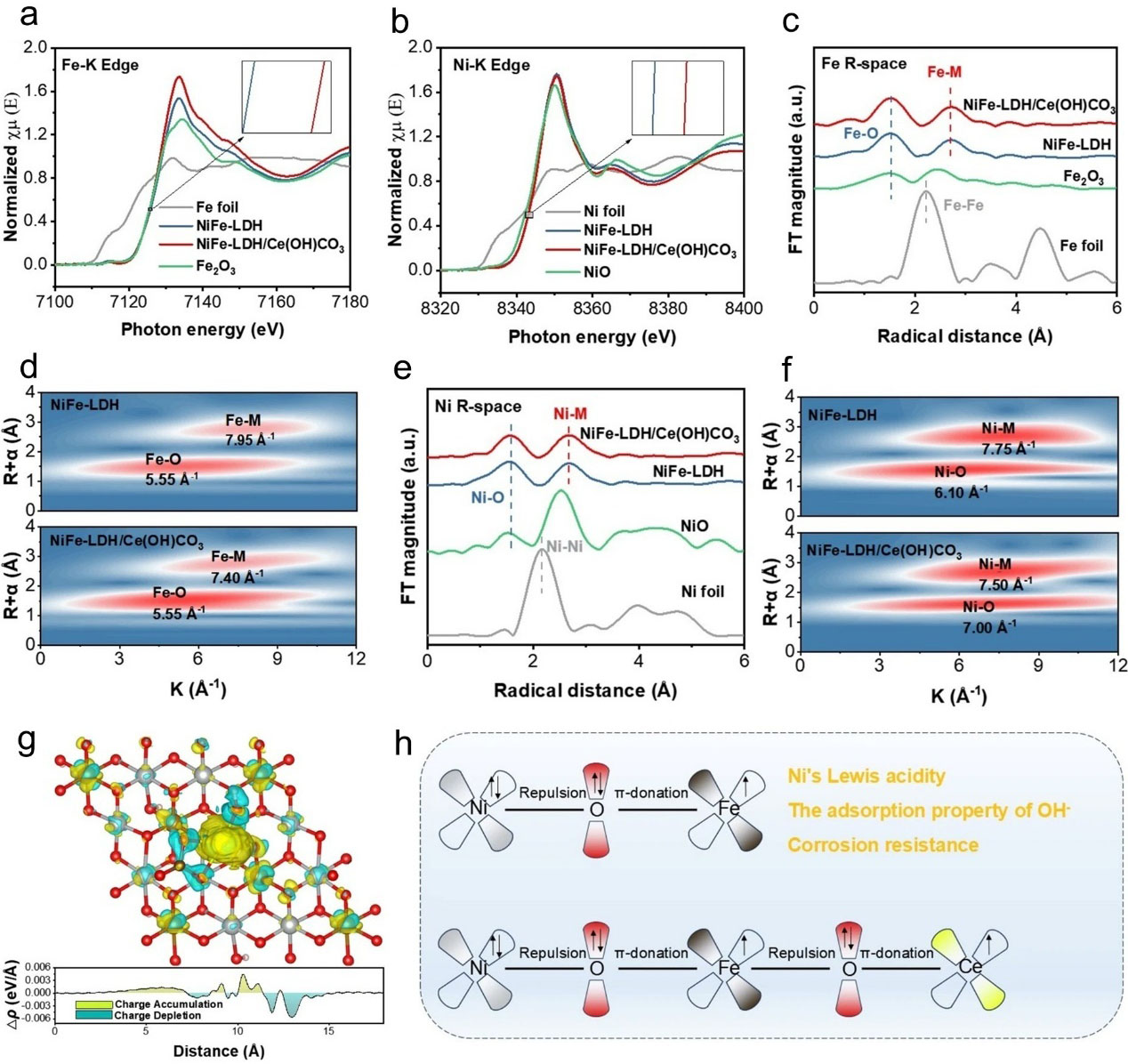
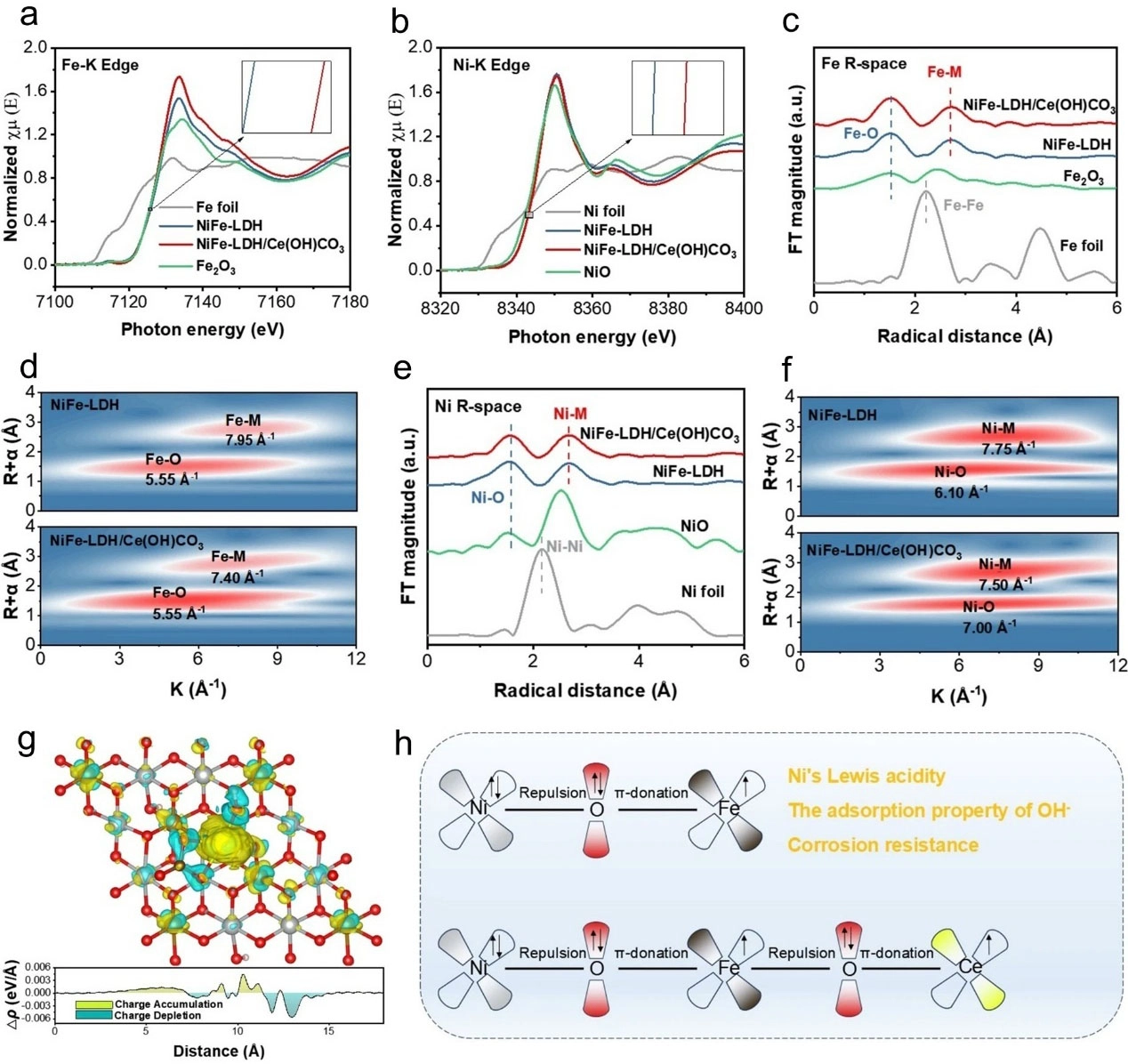
Figure 8. (a) Fe K-edge XANES spectra of Fe foil, NiFe-LDH, NiFe-LDH/Ce(OH)CO3, and Fe2O3; (b) Ni K-edge XANES spectra of Ni foil, NiFe-LDH, NiFe-LDH/Ce(OH)CO3, and NiO; (c) Fe K-edge Fourier-transformed EXAFS spectra of Fe foil, NiFe-LDH, NiFe-LDH/Ce(OH)CO3, and Fe2O3; (d) Wavelet transform of the Fe K-edge EXAFS spectra in NiFe-LDH and NiFe-LDH/Ce(OH)CO3; (e) Ni K-edge Fourier-transformed EXAFS spectra of Ni foil, NiFe-LDH, NiFe-LDH/Ce(OH)CO3, and NiO; (f) Wavelet transform of the Ni K-edge EXAFS spectra in NiFe-LDH and NiFe-LDH/Ce(OH)CO3; (g) Differential charge density for NiFe-LDH/Ce(OH)CO3; (h) Schematics of the electronic interplay among Ni, Fe, and Ce in NiFe-LDH/Ce(OH)CO3. Reproduced from reference[72]. CC BY 4.0. XANES: X-ray absorption near-edge structure; EXAFS: extended X-ray absorption fine structure; LDH: layered double hydroxide.
4.4 Design principles for chloride-resistant anodic catalysts
The representative strategies outlined above offer a set of common design principles for the rational design of chloride-resistant anodic oxygen evolution catalysts.
First, electronic structure modulation represents a common design principle. Whether through the introduction of electron withdrawing anionic species, the incorporation of heteroatoms such as Sn, or the construction of heterostructures with Lewis-acidic components, these approaches all converge on tuning the electron density at the active metal sites. This modulation serves two purposes: optimizing the adsorption energy of OER intermediates to enhance intrinsic activity and increasing the energy barrier for chloride adsorption to improve corrosion resistance.
Second, the construction of a favorable interfacial microenvironment is equally critical for effective chloride resistance. In-situ IR has revealed that a chloride-resistant interface features local enrichment of OH- or other anions, along with a disrupted yet functional hydrogen-bond network that still enables proton transfer. The interface acts as a selective barrier, preventing chloride ions from approaching the active sites. Therefore, this strategy of effectively regulating the local chemical environment has been demonstrated to be superior to merely modifying the bulk catalyst.
Third, stabilizing the local coordination structure against chloride-induced reconstruction is a key determinant of long-term durability. EXAFS has repeatedly demonstrated that chloride attack typically manifests as metal dissolution, bond elongation, or the formation of metal-chlorine bonds. Effective anti-chlorine strategies for this issue include the anchoring of polymetallic salts at specific metal sites and the construction of robust metal oxygen frameworks, both of which can maintain the structural integrity of active sites in chloride-containing electrolyte environments.
Fundamentally, the most promising chloride-resistant catalysts are not simply those that block Cl-; instead, they are those that combine the optimization of electronic structure for high activity, the construction of an interfacial microenvironment favoring OH- over Cl-, and the preservation of a stable local coordination structure against corrosion. In-situ synchrotron radiation techniques can validate the successful fulfillment of each of these principles.
5. Summary and Outlook
SR-based spectroscopies have provided important mechanistic insights into seawater electrolysis, especially in understanding how Cl- affects catalyst structure, interfacial chemistry, and reaction pathways. In particular, in-situ XAS has been widely used to reveal valence-state evolution, local coordination changes, and catalyst reconstruction under working conditions, offering direct evidence for evaluating chloride-resistant catalyst design. IR spectroscopy provides complementary information on interfacial adsorbates, reaction intermediates, and water-structure evolution. However, most current IR studies in this field still rely on conventional in-situ FTIR rather than SR-IR. Due to its high brightness and improved spatial resolution, SR-IR is expected to play a larger role in future studies, especially for probing weak, localized interfacial species in aqueous environments. In summary, synchrotron-based spectroscopies have successfully answered several critical scientific questions in seawater electrolysis. They have unequivocally demonstrated that Cl- modifies the electronic structure and local coordination of active sites, and they have provided direct evidence for the working mechanisms of various anti-chloride strategies.
Despite these advances, many questions remain unresolved. For instance, the exact nature of the transient species formed during Cl- induced surface reconstruction, Cl- adsorption/desorption dynamics evolve at high current densities, and the dynamic behavior of active sites under the combined influence of Cl- and high anodic potentials are still elusive. Many measurements provide ensemble-averaged information and lack sufficient surface sensitivity, spatial resolution, or temporal resolution to capture rapid and heterogeneous interfacial processes. In addition, realistic seawater contains multiple ions and impurities, making it difficult to isolate the specific role of Cl-. The separation of XAS, IR, Raman, microscopy, and electrochemical measurements across different platforms also limits direct correlation between catalyst structure, interfacial species, and catalytic performance.
Future progress should therefore focus on developing more realistic in-situ reaction cells, high-spatiotemporal-resolution characterization techniques, and integrated multi-modal characterization platforms, which have already been applied in other electrocatalytic fields[73-75], but still lack application in the field of seawater electrolysis. To address the challenges outlined above, future developments can be divided into four parts, including the instrumentation and data analysis:
Industrial seawater electrolysis is typically conducted at elevated temperatures with vigorous electrolyte circulation, requiring the development of in-situ cells compatible with both thermal and hydrodynamic conditions to enable spectroscopic characterization under industrially relevant operation. Recent progress in high-temperature in-situ cell design has demonstrated the feasibility of simultaneous electrochemical testing and XAS data acquisition at elevated temperatures[76], providing a basis for further development of more representative operando reaction cells.
SR-IR is expected to play an increasingly important role in future seawater electrolysis studies. The high brightness and spatial resolution of SR-IR, combined with the advancements in in-situ cell design and data processing methods, have already been applied in other electrocatalytic fields[77-79]. For instance, when applied to seawater electrolysis, it is expected to enable more sensitive detection of weak interfacial species, including short-lived reaction intermediates and disturbed hydrogen bond networks, that are currently difficult to resolve with laboratory-based infrared sources. Furthermore, the broad spectral coverage of SR-IR allows simultaneous probing of adsorbate vibrations, water structure, and anion surface interactions, offering a more holistic view of the chloride-perturbed interface. The integration of SR-IR with other synchrotron-based techniques on the same beamline, as discussed below, holds particular promise for establishing direct correlations between interfacial molecular chemistry and catalyst structural evolution. This synergy will be essential for resolving the complex interplay among chloride adsorption, intermediate transformation, and catalyst degradation under realistic operating conditions.
Time-resolved and spatially resolved SR-XAS will be crucial for tracking rapid valence changes, active-site reconstruction, and chloride-induced degradation[80-82]. Combining these techniques under identical working conditions will help distinguish reversible reconstruction from irreversible degradation and clarify the true origin of chloride tolerance.
In parallel, machine learning is expected to become increasingly important for interpreting large and complex operando datasets, and has been applied in other catalytic fields[83,84]. For the future field of seawater electrolysis, data-driven analysis can assist in extracting subtle spectral features, identifying transient species, correlating spectral fingerprints with catalytic performance, and guiding adaptive experiments or closed-loop catalyst optimization, which has been stated in other reviews in the field of electrocatalysis[85-87]. With continued advances in SR-based techniques, interfacial probing, multi-modal integration, and intelligent data analysis, future studies will establish a more complete mechanistic framework for Cl- effects and accelerate the rational design of efficient, stable, and low-cost catalysts for practical seawater electrolysis.
Acknowledgments
Deepseek was used solely for language editing and polishing of the manuscript. The authors take full responsibility for the integrity, accuracy, and originality of the content. The authors gratefully acknowledge the support of the Collaborative Innovation Center of Suzhou Nano Science & Technology, the Priority Academic Program Development of Jiangsu Higher Education Institutions (PAPD), the 111 Project, Jiangsu Key Laboratory of Nano-Optoelectronic Materials, the Suzhou Key Laboratory of Functional Nano & Soft Materials, and the Soochow University-Western University Centre for Synchrotron Radiation Research.
Authors contribution
Sun X: Writing-review & editing, supervision, resources, project administration, funding acquisition.
Zhang H: Conceptualization, writing-review & editing, supervision, project administration, funding acquisition.
Wu Y: Writing-original draft, writing-review & editing.
Shao W: Investigation, data organization.
Conflicts of interest
The authors declare no conflicts of interest.
Ethical approval
Not applicable.
Consent to participate
Not applicable.
Consent for publication
Not applicable.
Availability of data and materials
Not applicable.
Funding
This work was supported by the National Natural Science Foundation of China (Grant Nos. 12105201 and 12275190), the National Key Research and Development Program of China (Grant No. 2022YFB3205500), and the Suzhou Science and Technology Development Planning Project (Grant No. SYC2022141).
Copyright
© The Author(s) 2026.
References
-
2. Liang Q, Huang Y, Guo Y, Zhang X, Hu X, Zeng H, et al. Efficient osmosis-powered production of green hydrogen. Nat Sustain. 2024;7(5):628-639.[DOI]
-
6. Guo J, Zheng Y, Hu Z, Zheng C, Mao J, Du K, et al. Direct seawater electrolysis by adjusting the local reaction environment of a catalyst. Nat Energy. 2023;8(3):264-272.[DOI]
-
11. Liu X, Chi J, Mao H, Wang L. Principles of designing electrocatalyst to boost reactivity for seawater splitting. Adv Energy Mater. 2023;13(31):2301438.[DOI]
-
13. Yu L, Ning M, Wang Y, Yuan C, Ren Z. Direct seawater electrolysis for hydrogen production. Nat Rev Mater. 2025;10(11):857-873.[DOI]
-
15. Zhang K, Zou T, Zhang J, Wang S, Liu X, Yang H, et al. Iron induced electronic structure modulation of cobalt hydrogen phosphite for efficient freshwater/seawater splitting. Chem Eng J. 2025;511:162097.[DOI]
-
17. Li T, Zhao X, Sendeku MG, Zhang X, Xu L, Wang Z, et al. Phosphate-decorated Ni3Fe-LDHs@CoPx nanoarray for near-neutral seawater splitting. Chem Eng J. 2023;460:141413.[DOI]
-
18. Guo L, Chi J, Cui T, Zhu J, Xia Y, Guo H, et al. Phosphorus defect mediated electron redistribution to boost anion exchange membrane-based alkaline seawater electrolysis. Adv Energy Mater. 2024;14(31):2400975.[DOI]
-
19. Logeshwaran N, Vijayapradeep S, Kim AR, Sampath P, Ramakrishnan S, Poudel MB, et al. Study of engineering electronic structure modulated non-noble metal oxides for scaled-up alkaline blend seawater splitting. J Energy Chem. 2023;86:167-179.[DOI]
-
21. Li JH, Chen H, You SH, Yang GX, Liu P, Gao MQ, et al. Highly anti-corrosive NiFe LDHs-NiFe alloy hybrid enables long-term stable alkaline seawater electrolysis. Rare Met. 2024;43(9):4321-4332.[DOI]
-
22. Na J, Chi J, Jia S, Pang W, Wang W, Zhao Y, et al. CuO@NiCoS NAs heterostructure boosting anionic ligand defect sites enabled 2000 h stable seawater electrolysis. Adv Funct Mater. 2026;36(11):e18289.[DOI]
-
23. Wu Y, Gan Y, Wen L, Ye Y, Cai R, Wang B, et al. Superhydrophilic La-doped NiFe LDH Heterostructure facilitating lattice oxygen mechanism for efficient water/seawater electrolysis. Chem Eng J. 2026;535:175271.[DOI]
-
24. Su J, An W, Wang YH, Huang XX, Ma S, Peng Z, et al. Dynamic and self-regulating dual-anion regulation engineering for 5000 h direct seawater electrolysis at industrial current density. Nano Energy. 2026;154:111987.[DOI]
-
31. Liu H, Qi Z, Song L. In situ electrocatalytic infrared spectroscopy for dynamic reactions. J Phys Chem C. 2021;125(44):24289-24300.[DOI]
-
33. Pang K, Long C, Yuan J. Operando X-ray spectroscopies for tracking electrocatalytic dynamic interfaces across multiple scales. Chem. 2026.[DOI]
-
35. He Y, Liu S, Wang M, Cheng Q, Ji H, Qian T, et al. Advanced in situ characterization techniques for direct observation of gas-involved electrochemical reactions. Energy Environ Mater. 2023;6(6):e12552.[DOI]
-
38. Zoric MR, Fabbri E, Herranz J, Schmidt TJ. In situ and operando spectroscopic techniques for electrochemical energy storage and conversion applications. J Phys Chem C. 2024;128(45):19055-19070.[DOI]
-
42. Liu X, Yu Q, Qu X, Wang X, Chi J, Wang L. Manipulating electron redistribution in Ni2P for enhanced alkaline seawater electrolysis. Adv Mater. 2024;36:2307395.[DOI]
-
43. Cutsail III GE, DeBeer S. Challenges and opportunities for applications of advanced X-ray spectroscopy in catalysis research. ACS Catal. 2022;12(10):5864-5886.[DOI]
-
45. Wu H, Zhao Z, Wang M, Zheng W, Zhang Y, Wang Y, et al. Alkaline-earth-metal regulated metal carbides with bioinspired gradient OH spillover for efficient and long-lasting direct seawater electrolysis. J Mater Chem A. 2024;12(18):10755-10763.[DOI]
-
46. Feng D, Wang P, Qin R, Shi W, Gong L, Zhu J, et al. Flower-like amorphous MoO3–x stabilized Ru single atoms for efficient overall water/seawater splitting. Adv Sci. 2023;10(18):2300342.[DOI]
-
47. Zhang Y, Zheng W, Wu H, Zhu R, Wang Y, Wang M, et al. Tungsten oxide-anchored Ru clusters with electron-rich and anti-corrosive microenvironments for efficient and robust seawater splitting. SusMat. 2024;4(1):106-115.[DOI]
-
49. Yu Z, Li Y, Martin-Diaconescu V, Simonelli L, Ruiz Esquius J, Amorim I, et al. Highly efficient and stable saline water electrolysis enabled by self-supported nickel-iron phosphosulfide nanotubes with heterointerfaces and under-coordinated metal active sites. Adv Funct Mater. 2022;32(38):2206138.[DOI]
-
50. Huang J, Zhu J, Hu B, Huang Y, Gao W, Zhao H, et al. Polymorphy-triggered rapid self-reconstruction for efficient alkaline seawater oxidation. Appl Catal B Environ Energy. 2026;381:125897.[DOI]
-
52. Li T, Tang Q, Han Y, Liu Y, Xu C, Li H, et al. Recent advances in seawater electrolysis for hydrogen production: NiFe-based electrocatalysts, corrosion mitigation, and system design. Coord Chem Rev. 2026;567:218338.[DOI]
-
53. Chen H, Gao RT, Chen H, Yang Y, Wu L, Wang L. Ruthenium and silver synergetic regulation NiFe LDH boosting long-duration industrial seawater electrolysis. Adv Funct Mater. 2024;34(25):2315674.[DOI]
-
54. Sun Y, Li Y, Dai L, Sui NLD, Fan W, Zhou Y, et al. An unconventional seawater acceleration effect enables high-spin cobalt sites for industrial-level seawater electrooxidation. Adv Funct Mater. 2025;35(23):2419626.[DOI]
-
57. Yang Y, Yang Y, Yuwono JA, Cheong S, Shi X, Zhao T, et al. High-entropy alloy nanowires for direct electrosynthesis of chlorine from seawater. Nat Synth. 2026;5(6):907-917.[DOI]
-
61. Hou X, Zhang Z, Zhou J, Ni T, Zhang C, Dai S, et al. Dual-pathway chloride suppression enables stable industrial-scale anion exchange membrane seawater electrolysis. Adv Energy Mater. 2026;16(9):e05239.[DOI]
-
62. Che Y, Shang J, Zhang Y, Bo S, Zhang J, Qin X, et al. In situ engineering a dual-anion rejection interface for high-efficiency oxygen evolution in alkaline seawater. Adv Funct Mater. 2025;35(43):2507544.[DOI]
-
64. Yu Y, Zhou W, Yuan J, Zhou X, Meng X, Zhang X, et al. A hydrogen-bond network sieve enables selective OH-/Cl- discrimination for stable seawater splitting at 2.0 A cm-2. Energy Environ Sci. 2025;18(22):9949-9958.[DOI]
-
67. Tang H, Ding J, Feng Z, Shen K, Chen L, Li Y. Ultrastable Ni-Fe-P-based heterostructures for seawater electrolysis. Adv Funct Mater. 2026;36(27):e28467.[DOI]
-
68. Wang W, Ding H, Bian J, Sun S, Chen Z, Fan T, et al. Bioinspired multi-faceted defense architecture of PBA-derived hollow porous nanocages for chloride-resistant electrocatalytic seawater oxidation. Appl Catal B Environ Energy. 2026;386:126385.[DOI]
-
70. Wang S, Zhang J, Jia S, Liu Q, Li J, Wang J, et al. Alleviating OH blockage: Asymmetric adsorption configuration of Co-OH-M (d10) for seawater electrolysis. ACS Catal. 2026;16(4):3851-3863.[DOI]
-
71. Lu J, Guan J, Yuan K, Liu L, Zhang R, Zhu J, et al. Dual anti-corrosion mechanisms enabled by Lewis acid and PO43- modification for alkaline seawater electrolysis with Ni/Cr2O3 anchored on P-RuO2 fibrous aerogel. Adv Funct Mater. 2026;36(44):e75248.[DOI]
-
83. Wang S, Liu C, Hao W, Zhu X, Niu X, Ma D, et al. Machine learning accelerates the design and discovery of single-atom catalysts for electrochemical reactions. J Energy Chem. 2026;115:347-371.[DOI]
-
85. Gui T, Wang Y, Li J, Qiao Z, Wu Z, Sheng Y, et al. Machine-learning-driven design of dynamically adaptive MOF catalysts: Structural evolution mechanisms and industrial translation pathways in seawater electrolysis. Adv Energy Mater. 2026;16(15):e06002.[DOI]
Copyright
© The Author(s) 2026. This is an Open Access article licensed under a Creative Commons Attribution 4.0 International License (https://creativecommons.org/licenses/by/4.0/), which permits unrestricted use, sharing, adaptation, distribution and reproduction in any medium or format, for any purpose, even commercially, as long as you give appropriate credit to the original author(s) and the source, provide a link to the Creative Commons license, and indicate if changes were made.
Publisher’s Note
Science Exploration remains a neutral stance on jurisdictional claims in published
maps
and institutional affiliations. The views expressed in this article are solely those
of
the author(s) and do not reflect the opinions of the Editors or the publisher.
Share And Cite


Science Exploration Style
Wu Y, Shao W, Zhang H, Sun X. Advancing the anodic chloride-resistant catalyst design and reaction mechanism studies in seawater electrolysis through synchrotron radiation-based in-situ spectroscopies. Smart Mater Devices. 2026;2:202631. https://doi.org/10.70401/smd.2026.0041
Tips
Copy completed.
Submit a Manuscript
Author Instructions
Cite this Article
Article Metrics
0
View
0
Download
Cited
Article Updates

- Abstract
- Keywords
- 1. Introduction
- 2. Fundamentals of SR-Based Techniques
- 3. Understanding the Negative Effects of Chloride Ions
- 4. Validating the Efficiency of Cl- Resistance Strategies
- 5. Summary and Outlook
- Acknowledgments
- Authors contribution
- Conflicts of interest
- Ethical approval
- Consent to participate
- Consent for publication
- Availability of data and materials
- Funding
- References
- Copyright
 Get citation
Science Exploration Style

Wu Y, Shao W, Zhang H, Sun X. Advancing the anodic chloride-resistant catalyst design and reaction mechanism studies in seawater electrolysis through synchrotron radiation-based in-situ spectroscopies. Smart Mater Devices. 2026;2:202631. https://doi.org/10.70401/smd.2026.0041
copy
Share Link
copy