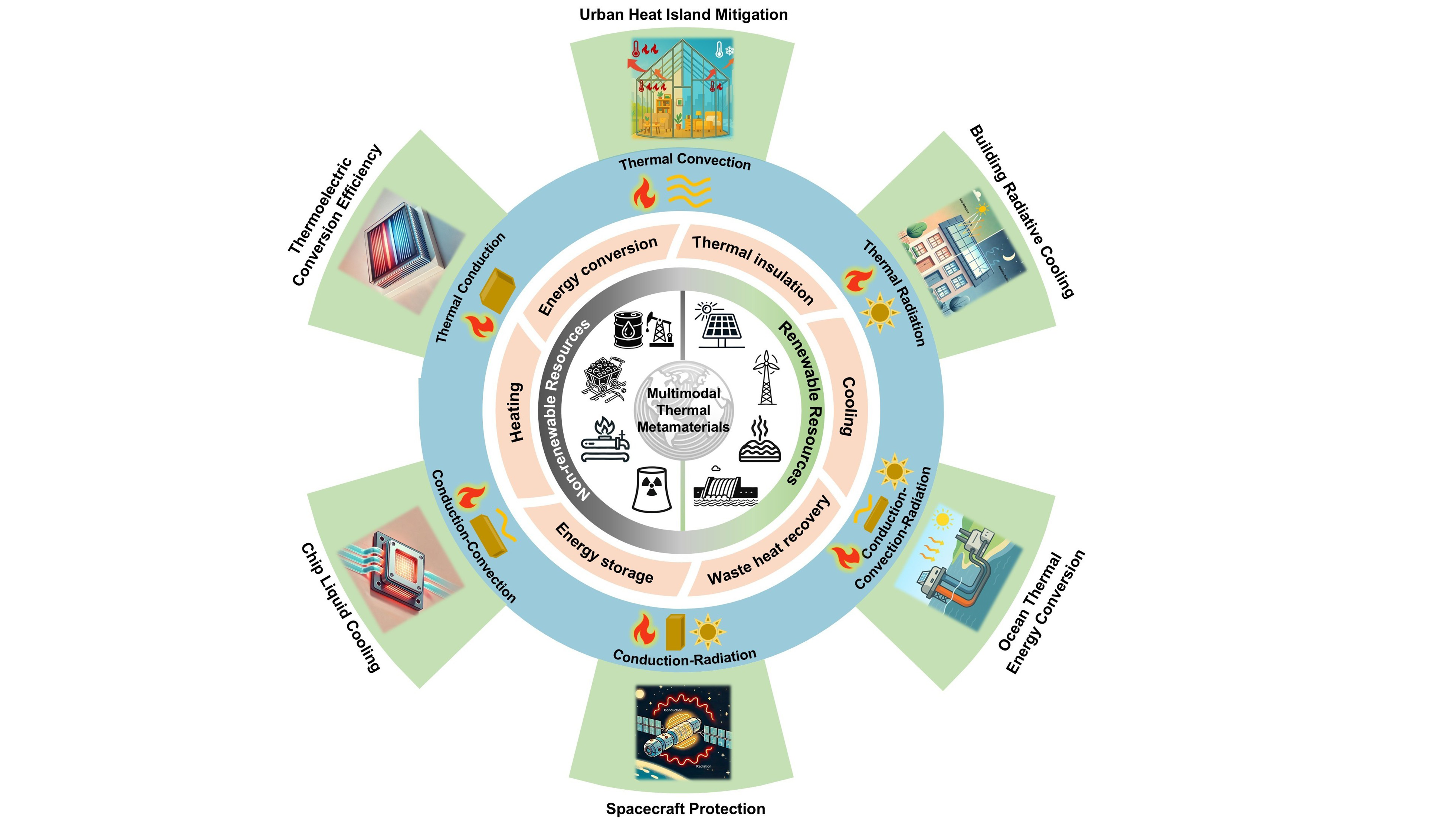
Effective thermal management is crucial for global sustainability, yet it faces a fundamental challenge: traditional materials cannot dynamically regulate the three coupled heat transfer modes, namely conduction, convection, and radiation, in complex, ...
More.
Effective thermal management is crucial for global sustainability, yet it faces a fundamental challenge: traditional materials cannot dynamically regulate the three coupled heat transfer modes, namely conduction, convection, and radiation, in complex, real-world environments. To overcome this, we present a paradigm shift from material selection to the architectural design of synergistic heat transfer. This perspective explores how multimodal thermal metamaterials, through engineered microstructures and topology, enable programmable control over coupled thermal flows. We highlight how this approach yields advanced functionalities, including directional guidance, adaptive cooling, and waste-heat recovery, across scales ranging from microelectronics to buildings and marine systems. This architectural design framework transcends intrinsic material limits, establishing a foundational pathway toward intelligent, high-efficiency, and sustainable thermal technologies essential for energy sustainability.
Less.
Huolei Feng, ... Jiping Huang