Table of Contents
Harnessing molecular motion for asymmetry – nitrogen inversion as a springboard for stereoselective C–H functionalization
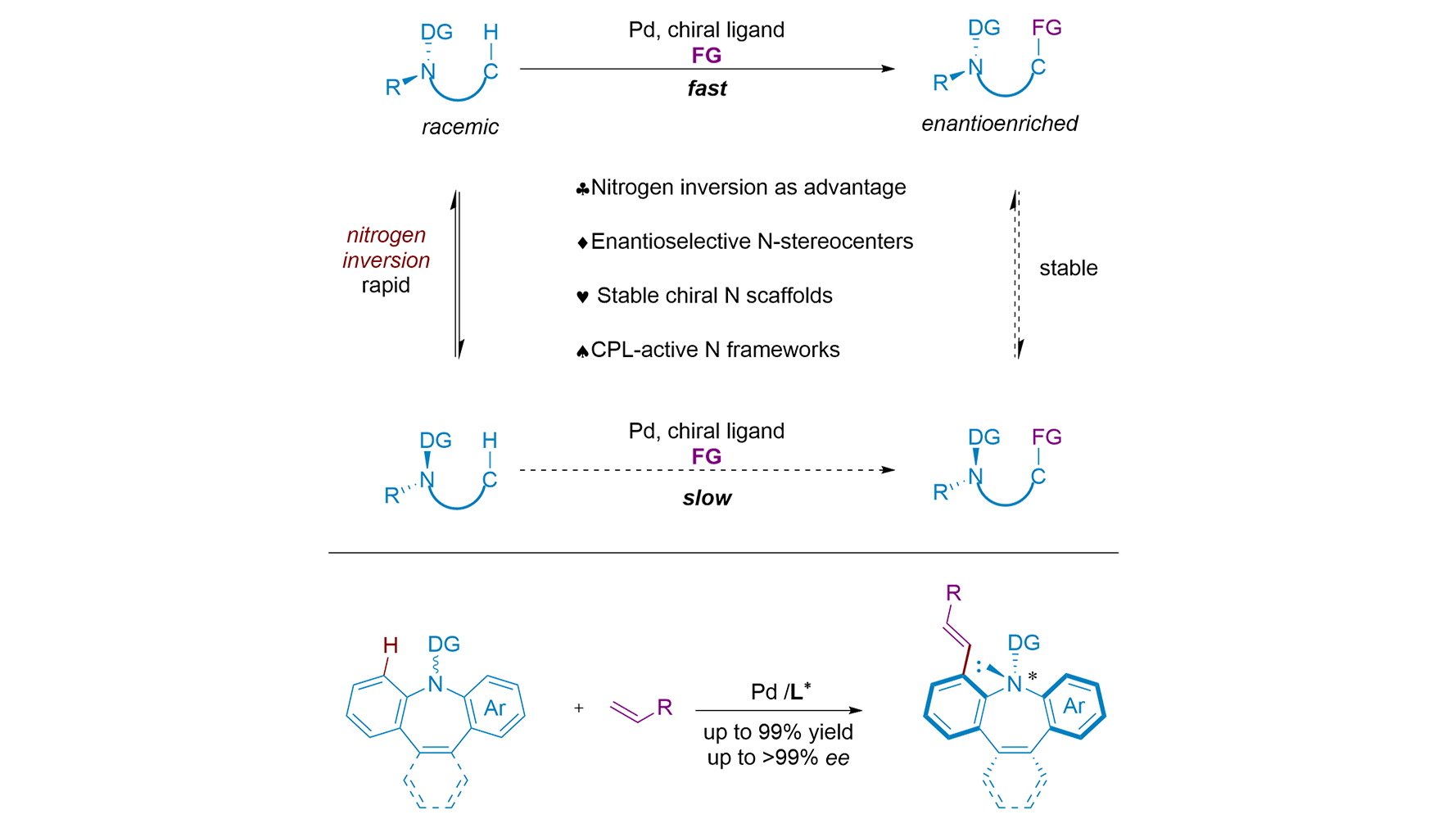
The asymmetric construction of nitrogen stereocenters is notoriously difficult due to rapid nitrogen inversion. Zhang and co-workers now showcase a Pd-catalyzed enantioselective C-H activation strategy that turns this inversion into an advantage, delivering ...
More.The asymmetric construction of nitrogen stereocenters is notoriously difficult due to rapid nitrogen inversion. Zhang and co-workers now showcase a Pd-catalyzed enantioselective C-H activation strategy that turns this inversion into an advantage, delivering stable chiral azepines with high enantioselectivity. Coincidentally, almost at the same time, Shi and co-workers reported a similar C-H alkylation reaction. Beyond methodology, the products serve as promising scaffolds for asymmetric catalysis and chiroptical materials, bridging synthesis and function. This Perspective discusses how their works not only provide a powerful synthetic method but also open a new avenue for constructing heteroatom stereocenters by harnessing, rather than suppressing, molecular dynamics. Here, nitrogen inversion is deliberately exploited as a dynamic feature that enables enantioselective C-H functionalization, rather than being suppressed as a stereochemical liability.
Less.Chun-Yan Guan, Guang-Jian Mei
DOI:https://doi.org/10.70401/cc.2026.0015 - March 11, 2026
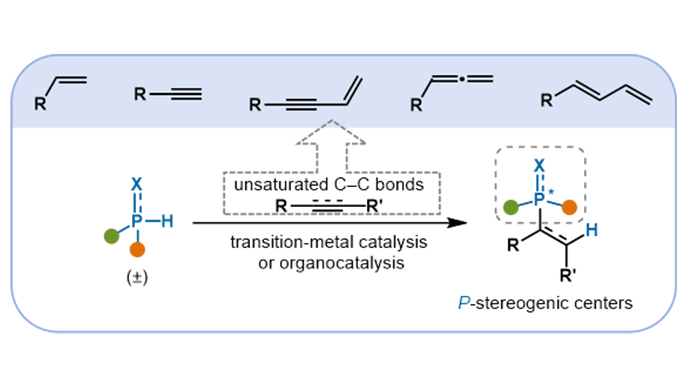
Catalytic construction of P-stereogenic centers through asymmetric hydrophosphination of unsaturated C–C bonds
P-Stereogenic centers are important structural motifs prevalent in natural products, bioactive molecules, and high-performance ligands. Their presence confers significant value across medicinal chemistry, materials science, and asymmetric ...
More.P-Stereogenic centers are important structural motifs prevalent in natural products, bioactive molecules, and high-performance ligands. Their presence confers significant value across medicinal chemistry, materials science, and asymmetric catalysis. In recent years, catalytic asymmetric hydrophosphination has emerged as a powerful and efficient strategy for constructing such P-stereogenic compounds. Distinguished by high atom economy, broad substrate compatibility, and excellent stereocontrol under mild conditions, these transformations align closely with the principles of sustainable and green synthesis. This review summarizes recent advances in the catalytic asymmetric hydrophosphination of unsaturated C–C bonds for the synthesis of P-stereogenic centers. It covers substrates including alkenes bearing electron-withdrawing groups, alkynes, as well as specialized systems such as enynes, allenes, and conjugated dienes. Emphasis is placed on the design of catalytic systems, encompassing transition-metal catalysts (e.g., Pd, Ni, Cu, Co, Mn) and organocatalysts, along with their mechanisms. Current challenges, such as the low reactivity of unactivated or sterically hindered substrates and difficulties in achieving stereochemical differentiation between phosphorus substituents, are also discussed. This review aims to provide a reference for further innovation and methodological development in the synthesis of P-stereogenic molecules.
Less.Bing-Lin Wang, ... Xiao-Hui Yang
DOI:https://doi.org/10.70401/cc.2026.0014 - March 10, 2026
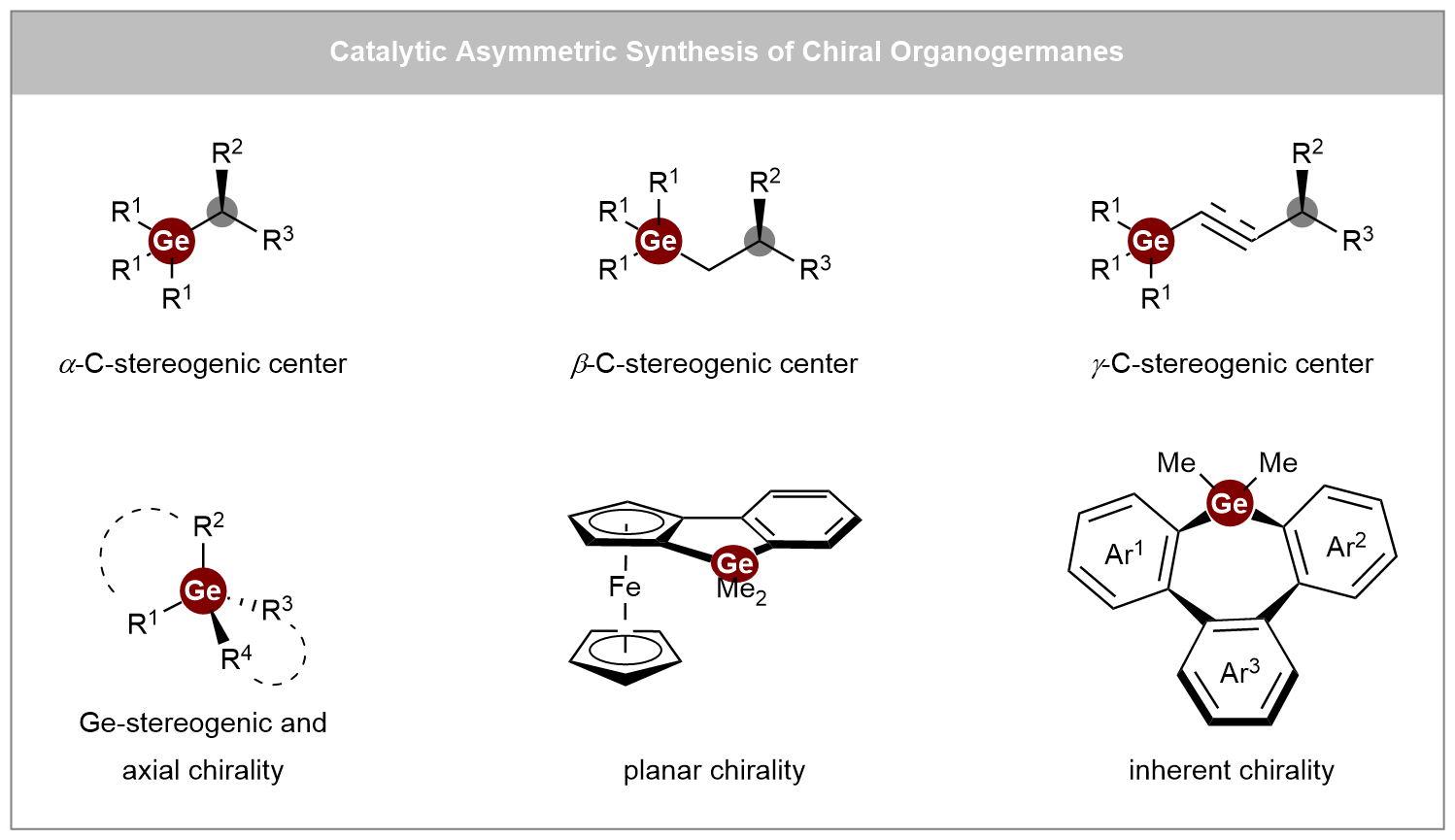
Recent advances in catalytic asymmetric synthesis of chiral organogermanes
Chiral organogermanes hold great potential as bioisosteres in medicinal chemistry and functional materials, yet their development has long been hindered by a scarcity of efficient synthetic strategies. This review offers a comprehensive overview of recent ...
More.Chiral organogermanes hold great potential as bioisosteres in medicinal chemistry and functional materials, yet their development has long been hindered by a scarcity of efficient synthetic strategies. This review offers a comprehensive overview of recent advances in the catalytic asymmetric synthesis of chiral organogermanes, highlighting a shift from traditional resolution methods toward asymmetric catalytic approaches. The content is organized into three main categories: (i) synthesis of C-stereogenic germanes, (ii) synthesis of Ge-stereogenic germanes, and (iii) synthesis of other chiral germanes, including planar, inherent, and axially chiral types. Key synthetic methodologies are systematically examined, such as enantioselective alkene hydrofunctionalization, carbene insertion, coupling reactions, and [2+2+2] cycloaddition, utilizing a variety of catalytic systems ranging from transition metals (Rh, Cu, Ni, Co) and Lewis acids to engineered metalloenzymes. Particular emphasis is placed on the mechanistic insights and ligand design principles that enable stereochemical control in these transformations. We hope this review will inspire chemists working in related areas and contribute to the future advancement of this field.
Less.Shao-Wu Liu, ... Chuan He
DOI:https://doi.org/10.70401/cc.2026.0013 - February 13, 2026