
Table of Contents
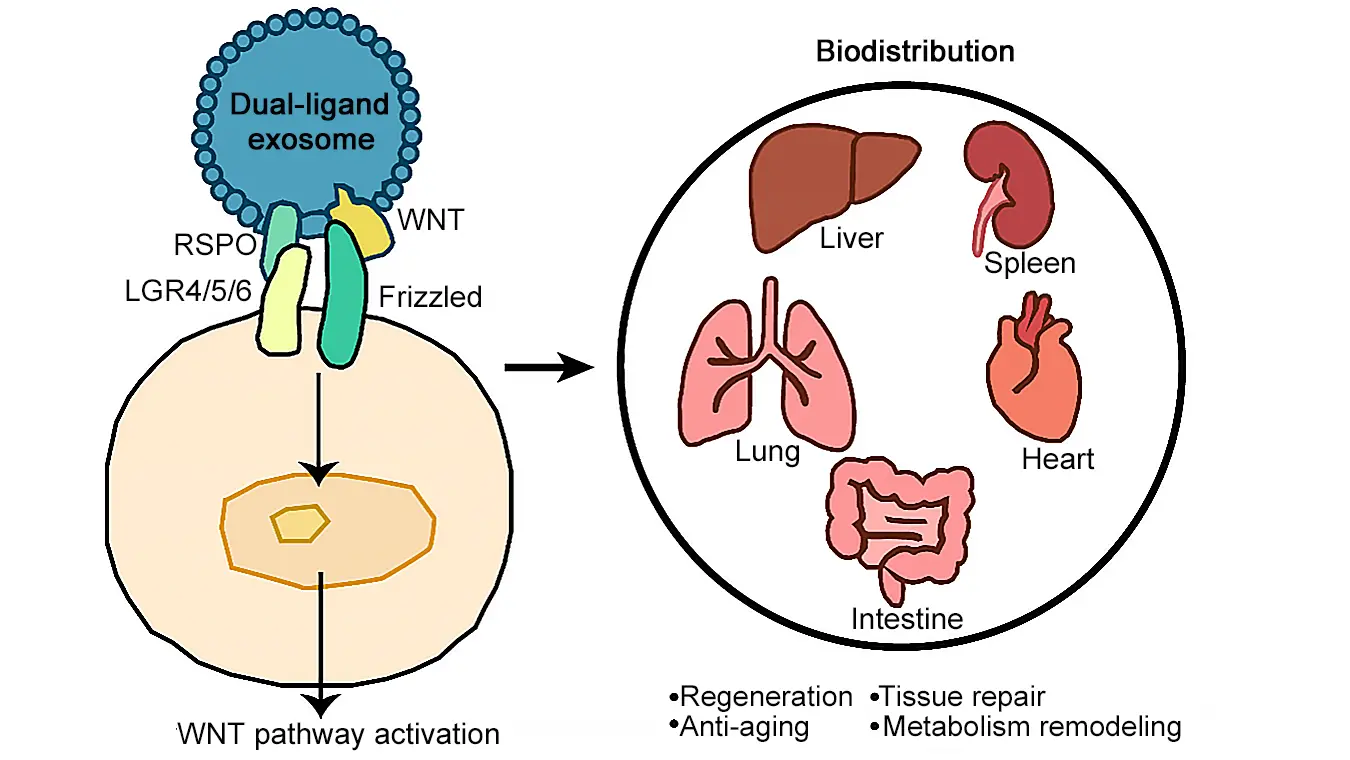
Harnessing engineered WNT exosomes for regenerative medicine: A new era for WNT signaling activation
Wingless/Integrated (WNT) signaling is a central pathway governing tissue morphogenesis, stem cell maintenance, and regeneration. However, its therapeutic translation has been hindered by challenges in delivering stable and active WNT ligands over long ...
More.Wingless/Integrated (WNT) signaling is a central pathway governing tissue morphogenesis, stem cell maintenance, and regeneration. However, its therapeutic translation has been hindered by challenges in delivering stable and active WNT ligands over long distances to target tissues and organs. Recent advances in exosome engineering offer a new solution to this problem by delivering WNT ligands via engineered exosomes, dual-ligand vesicles to achieve robust and sustained activation of WNT signaling both in vitro and in vivo. This perspective highlights how such dual-ligand exosomes overcome the biochemical and delivery barriers of WNT activation, promote liver regeneration under diverse conditions, including acute, chronic, and aging-associated injuries, and establish a conceptual framework for next-generation regenerative therapeutics. These findings mark a pivotal step toward reprogramming tissue homeostasis and rejuvenation through bioengineered signaling vesicles.
Less.Shixiang Wang, ... Lingyan Yang
DOI:https://doi.org/10.70401/bmeh.2025.0010 - December 30, 2025
An intelligent silk fibroin-phenylboronic acid microneedle patch for the protection and delivery of adrenaline hydrochloride
Adrenaline hydrochloride is an indispensable drug in clinical emergencies, effective at alleviating critical conditions such as weak pulse and respiratory distress. However, the catechol moiety in its molecular structure is prone to oxidation, leading ...
More.Adrenaline hydrochloride is an indispensable drug in clinical emergencies, effective at alleviating critical conditions such as weak pulse and respiratory distress. However, the catechol moiety in its molecular structure is prone to oxidation, leading to drug degradation, reduced efficacy, and a short half-life. These inherent limitations significantly restrict its broader clinical application. To address this challenge, this study constructed an intelligent microneedle patch designed to stabilize drugs. We first grafted 3-aminophenylboronic acid onto silk fibroin via 1-Ethyl-3-(3-dimethylaminopropyl)carbodiimide/N-hydroxysuccinimide coupling chemistry. This design enables the formation of reversible boronic ester bonds between phenylboronic acid and the catechol structure of adrenaline, effectively shielding the oxidation-sensitive sites and significantly enhancing the drug’s storage stability. Upon insertion into the skin, the microneedles encounter the physiological environment where glucose competitively binds to the phenylboronic acid, triggering the cleavage of the boronic ester bonds and resulting in the on-demand release of adrenaline. A cumulative drug release rate of approximately 60% was achieved over 24 hours. This study proposes a novel “protection-release” dual-functional design, offering a new strategy for the efficient delivery and stabilized storage of catechol-containing drugs. This approach holds significant promise for applications in emergency medicine and the long-term storage of pharmaceuticals.
Less.Yijia Cao, ... Shenzhou Lu
DOI:https://doi.org/10.70401/bmeh.2025.0009 - December 23, 2025
Immune activation strategy based on copper-based nanomaterials: A novel approach to synergistic antitumor therapy
Immunotherapy has emerged as a transformative approach in cancer therapeutics, yet its clinical translation remains constrained by significant challenges, including tumor immune evasion mechanisms and suboptimal efficacy of monotherapy, collectively ...
More.Immunotherapy has emerged as a transformative approach in cancer therapeutics, yet its clinical translation remains constrained by significant challenges, including tumor immune evasion mechanisms and suboptimal efficacy of monotherapy, collectively impeding the full realization of its therapeutic potential. With their unique physicochemical properties, tunable enzyme-mimetic activities, and ability to induce cuproptosis, copper-based nanomaterials provide a new solution to overcome these limitations and have become a research focus in the field of targeted antitumor immunotherapy. This review systematically summarizes the research progress of copper-based nanomaterials in tumor immunotherapy, with a focus on discussing their core antitumor immunological mechanisms. These materials trigger immunogenic cell death by inducing cuproptosis and activate the body’s innate and adaptive immune responses through the release of damage-associated molecular patterns, such as calreticulin, high-mobility group box 1, adenosine triphosphate, and mitochondrial DNA. Meanwhile, they remodel the immunosuppressive tumor microenvironment by alleviating tumor hypoxia, scavenging immunosuppressive metabolites, and reducing immunosuppressive cells. On this basis, this review further analyzes the combined therapeutic strategies of copper-based nanomaterials with immune checkpoint blockade, photodynamic therapy, photothermal therapy, sonodynamic therapy, chemotherapy, and radiotherapy. It also elaborates on the specific mechanisms by which various combined regimens enhance antitumor efficacy, such as through synergistically amplifying oxidative stress, strengthening cell death effects, or improving therapeutic targeting. Additionally, this review discusses the current challenges faced by copper-based nanomaterials in clinical translation and points out future development directions. This review aims to provide a theoretical basis and practical guidance for the clinical translation of multifunctional copper-based nanoplatforms. It also offers new insights for the development of tumor immunotherapies based on metal and redox biology, helping to overcome immune tolerance and improve the efficacy of antitumor treatment.
Less.Wenhao Dong, ... Degui Wang
DOI:https://doi.org/10.70401/bmeh.2025.0008 - November 28, 2025
Opportunities and challenges of adhesive hemostatic hydrogels in spinal surgery
The effectiveness of hemostasis during spinal surgery directly influences the surgical success rate and patient prognosis. Minimally invasive surgery has multiple advantages, including reductions in intraoperative and postoperative blood loss, minimized ...
More.The effectiveness of hemostasis during spinal surgery directly influences the surgical success rate and patient prognosis. Minimally invasive surgery has multiple advantages, including reductions in intraoperative and postoperative blood loss, minimized damage to surrounding tissues, and alleviation of postoperative pain. However, when the spinal epidural venous plexus is located within deep cavities, achieving sufficient hemostasis often presents challenges due to limited operating space and the limitations of traditional hemostatic materials. In recent years, novel adhesive hemostatic hydrogels have served as local injectable hemostatic agents. These hydrogels function through dual mechanisms: physical blockage of bleeding sites and biological activation, such as promoting coagulation cascades, thereby showing significant advantages in bleeding control at complex anatomical sites. Accordingly, this article systematically reviews the progress of basic research and clinical translation related to hemostatic materials over the past five years to provide a scientific foundation for optimizing perioperative hemostatic strategies.
Less.Qianli Gao, ... Dongdong Xia
DOI:https://doi.org/10.70401/bmeh.2025.0007 - November 28, 2025
Peptide-modified lipid for organ-specific mRNA delivery
Lipid nanoparticle-based messenger RNA (mRNA) delivery system have ushered in a new era of gene therapeutics. However, their clinical advances have been impeded by the inherent liver tropism of lipid nanoparticles (LNPs), which limits extrahepatic applications. ...
More.Lipid nanoparticle-based messenger RNA (mRNA) delivery system have ushered in a new era of gene therapeutics. However, their clinical advances have been impeded by the inherent liver tropism of lipid nanoparticles (LNPs), which limits extrahepatic applications. Herein, we highlight two recent studies written in Nature Materials. Guided by surface interface molecular mechanics, Chang and his colleagues worked on the intelligent design of targeted peptides combined with lipids. Concurrently, Lin and his colleagues explored novel organ-specific peptide-lipid materials and analyzed important LNP traits that co-determined the in vitro/in vivo transfection discrepancy. The resulting peptide-modified lipids exhibit the capacity for targeted delivery to various organs and realize gene editing function. These studies jointly established a modular platform that provides a rational and predictable strategy for designing tissue-specific LNPs, thereby paving the way for next-generation mRNA-based therapeutics.
Less.Mutang Li, Hongjun Li
DOI:https://doi.org/10.70401/bmeh.2025.0006 - November 18, 2025