High-heat-flux chips in high-performance computing, heterogeneous integration, and wide-bandgap electronics are reaching a thermal-management ceiling: transistor-scale hotspots, dense stacks, and low-conductivity interlayers force heat through ...
More.
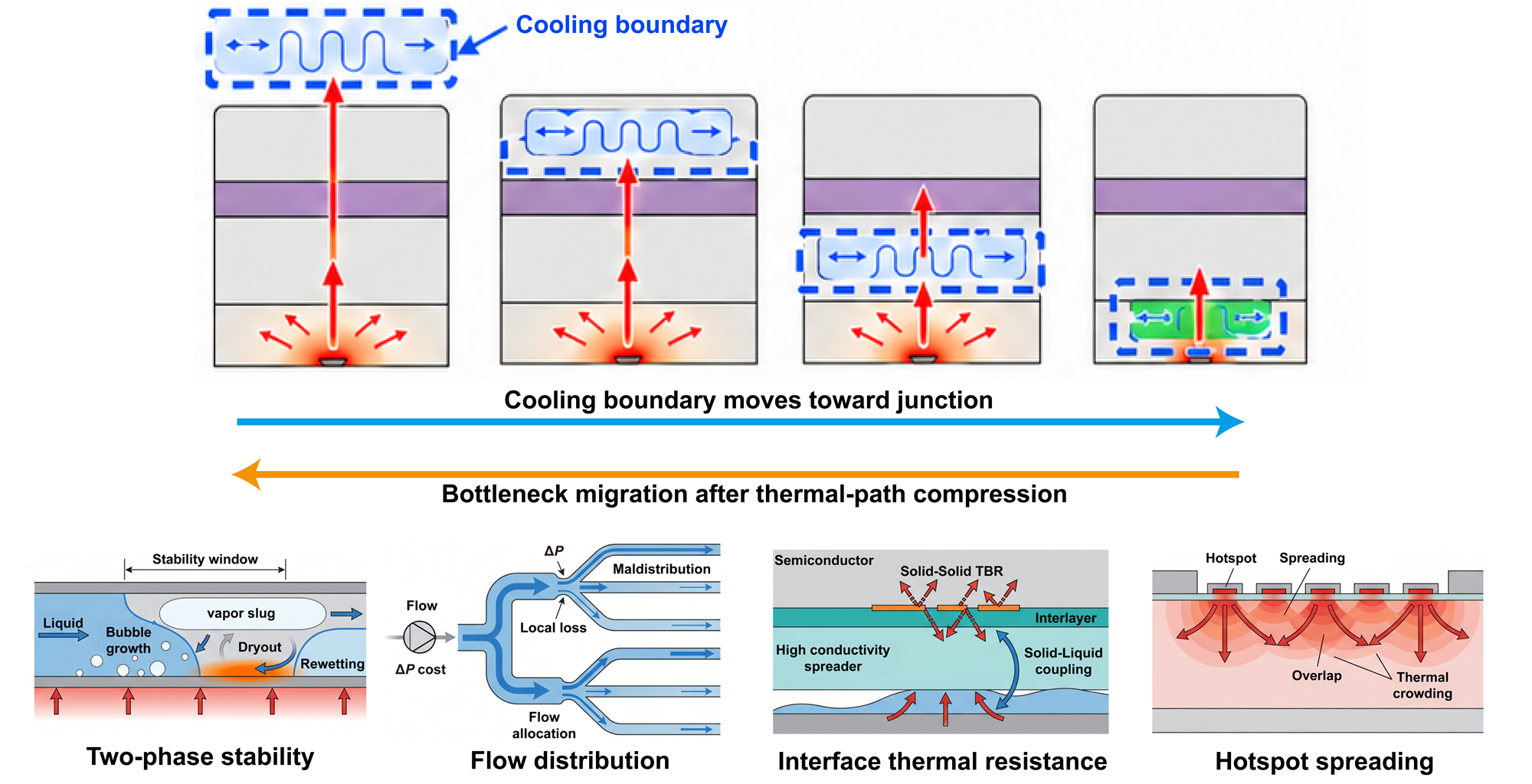
High-heat-flux chips in high-performance computing, heterogeneous integration, and wide-bandgap electronics are reaching a thermal-management ceiling: transistor-scale hotspots, dense stacks, and low-conductivity interlayers force heat through resistive, interface-rich paths before it reaches the coolant. Microfluidic cooling can support 102-103 W/cm2 heat fluxes and higher local loads, yet it is often framed as a competition among microchannels, jets, manifolds, two-phase structures, and high-conductivity spreaders. This review reconstructs the field through thermal-path compression and bottleneck migration, using cooling-boundary location, compressed resistance segment, and residual limit as organizing axes. As cooling advances from package-integrated schemes to embedded/interposer and near-junction architectures, the dominant limit shifts from package-side conduction to hotspot spreading, solid–solid/solid–liquid interfacial resistance, hydraulic allocation, and confined phase instability. Representative architectures are assessed through heat flux, pressure drop, area-normalized thermal resistance, and evidence maturity, emphasizing that record heat flux is not transferable without defined heated area, temperature criterion, coolant state, hydraulic cost, and device boundary. We further distinguish proof-of-concept thermal vehicles from device-relevant, package-compatible, and deployment-oriented platforms by considering manufacturability, sealing and leakage risk, semiconductor-process compatibility, coolant/material compatibility, and scale-up to large-area or multi-chip systems. Interface engineering and diamond-enabled platforms show that high intrinsic conductivity is useful only through reliable, low-resistance, and manufacturable interfaces. This framework recasts microfluidic cooling as near-junction co-design rather than a heat-flux race.
Less.
Junjie Wei, ... Ning Wei