
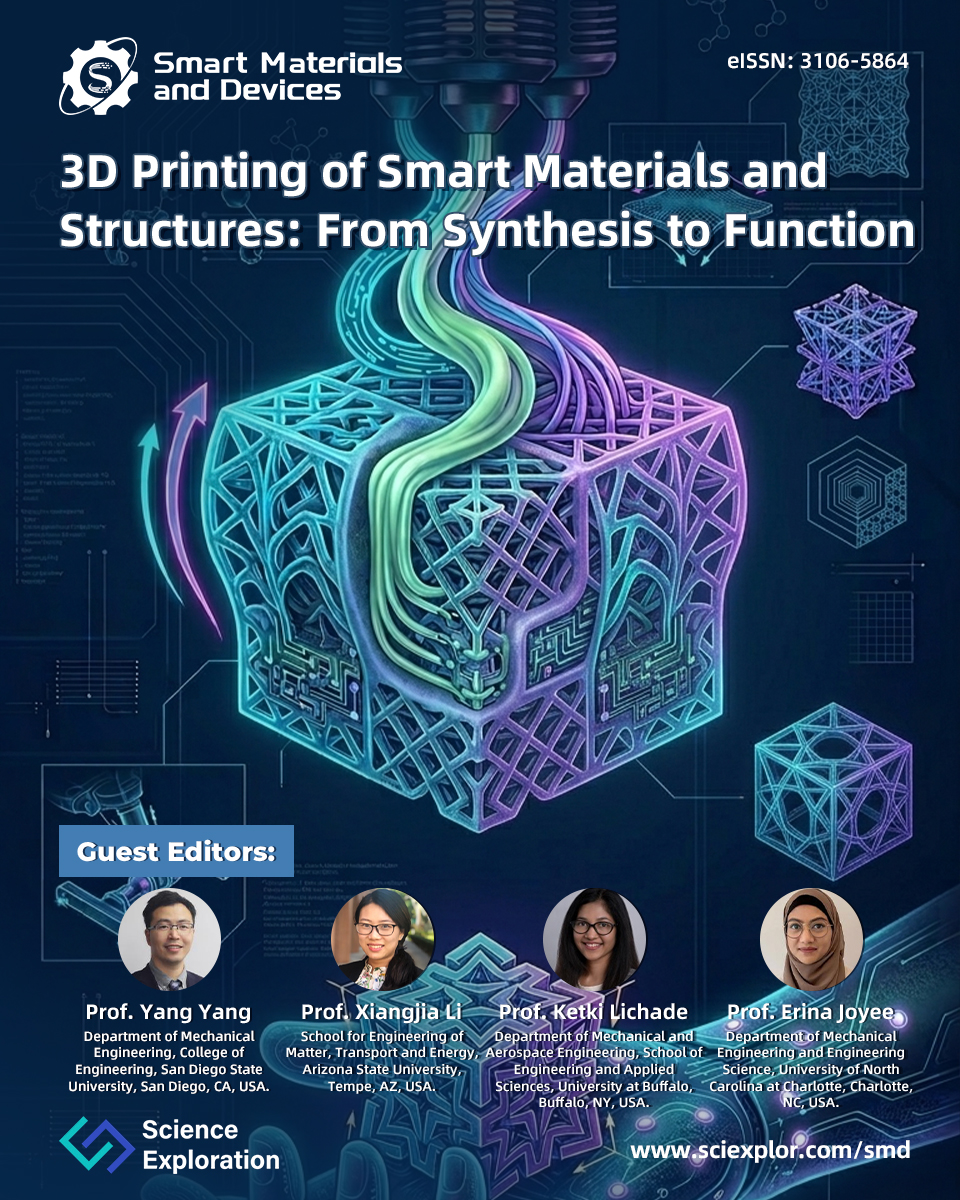
Guest Editor(s)
Department of Mechanical Engineering, College of Engineering, San Diego State University, San Diego, CA, USA.
School for Engineering of Matter, Transport and Energy, Arizona State University, Tempe, AZ, USA.
Department of Mechanical and Aerospace Engineering, School of Engineering and Applied Sciences, University at Buffalo, Buffalo, NY, USA.
Special Issue Information
The convergence of additive manufacturing (AM) with the science of smart materials is revolutionizing the way we conceive and fabricate functional devices. This Special Issue, focused on "3D Printing of Smart Materials and Structures", aims to provide a comprehensive overview of the latest advancements in the synthesis, processing, and application of materials that can sense, react, or adapt to external stimuli. While 4D printing (the evolution of shape over time) remains a key outcome, this Issue broadens the scope to include the fundamental material science that enables such functionalities.
The relevance of this field is underscored by its profound impact across multiple high-tech sectors. In sports, 3D printed smart helmets with piezoelectric or piezoresistive sensitivity allow for health monitoring. In aerospace, 3D-printed structures with embedded sensing capabilities allow for real-time structural health monitoring. In healthcare, the ability to print patient-specific implants made from biocompatible, stimuli-responsive materials (such as shape-memory polymers or piezoelectric ceramics) promises personalized and minimally invasive treatments. Furthermore, the development of printed smart composites and metamaterials is pushing the boundaries of mechanical and acoustic performance, enabling devices with programmable stiffness or negative Poisson's ratios. This focused section will cover a broad spectrum of topics, including but not limited to:
• Manufacturing of multifunctional autonomous devices and 4D printing of active materials. 3D printing of electronics (actuators, antennas, sensors, piezoelectric, thermoelectric, etc.), energy storage, and conversion devices.
• Innovative characterization techniques and mechanism investigations for bioinspired artificial muscles and intelligent soft machines.
• 3D printing of metamaterials and meta-structures.
• Continuous scalable fabrication and industrialization of soft intelligent systems.
• 3D printing of multifunctional materials for diverse applications (e.g., mechanical, surface & interface, optics, electronics, thermal, robotics).
• Design, models, and simulation for 3D printing of smart materials and structures.
Contact Us
Journal Editorial Office Email: smdjournal@sciexplor.com
For Author Instructions, please refer to: www.sciexplor.com/smd/author_instructions
For Online Submission, please login at: http://www.intellimanus.com/#/login?journalPath=smd