
Table of Contents
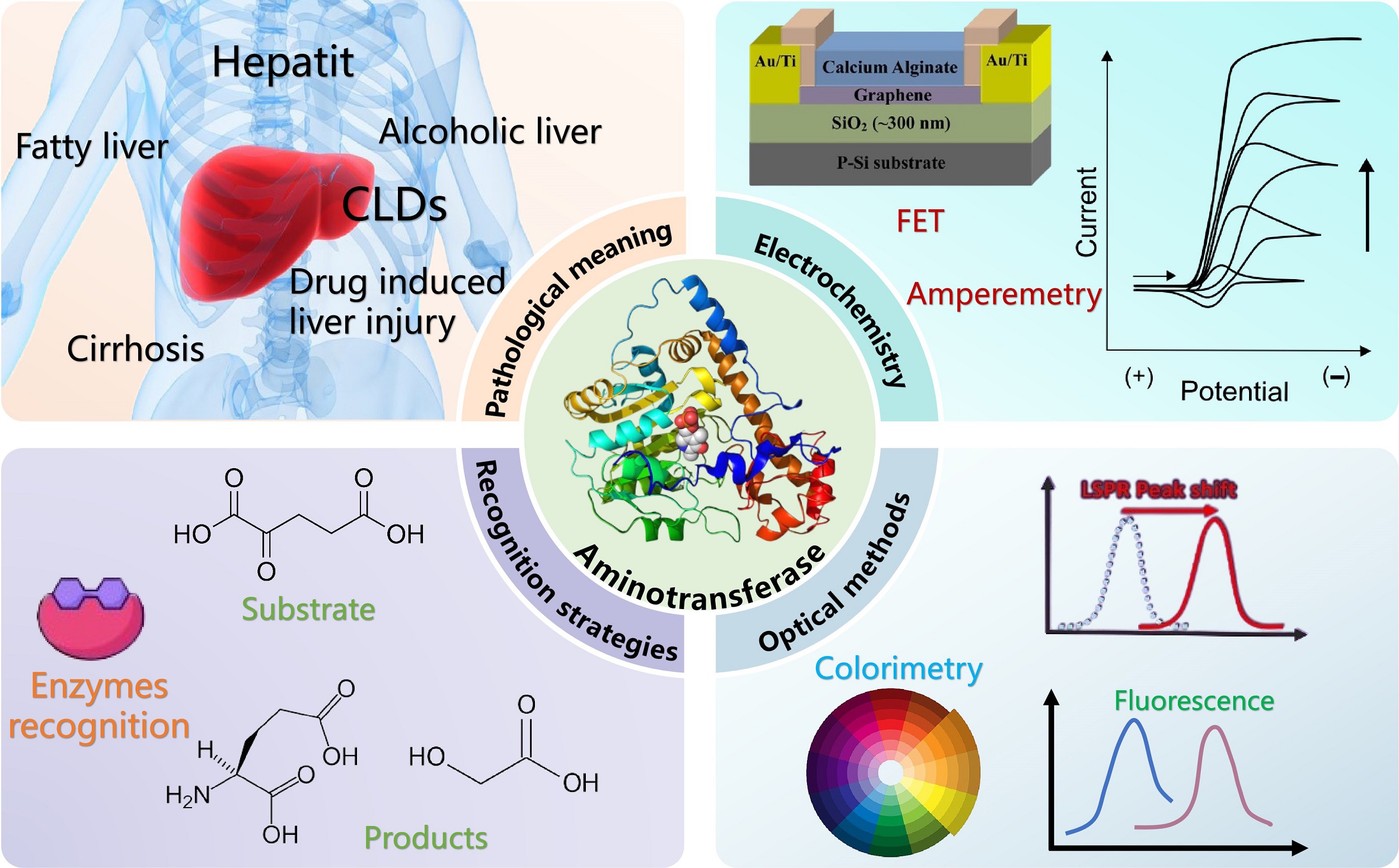
Advances and challenges in biosensors for point-of-care detection of Alanine/Aspartate Aminotransferase: A review
Alanine aminotransferase (ALT) and aspartate aminotransferase (AST) are routinely measured serum biochemical markers used primarily for the assessment of hepatocellular injury and the screening and monitoring of liver diseases. Although ultraviolet-visible ...
More.Alanine aminotransferase (ALT) and aspartate aminotransferase (AST) are routinely measured serum biochemical markers used primarily for the assessment of hepatocellular injury and the screening and monitoring of liver diseases. Although ultraviolet-visible spectrophotometry and automatic biochemical analyzers in traditional central laboratories possess high accuracy, they are limited by equipment cost, sample pretreatment and detection duration, and cannot meet the demands of primary healthcare, resource-limited regions, and point-of-care testing (POCT). In recent years, diverse electrochemical, optical, and microfluidic biosensing strategies have been developed for point-of-care aminotransferase detection; this review summarizes these representative advances. It emphatically discusses electrochemical and optical signal transduction mechanisms, deeply analyzes recognition strategies such as oxidase/dehydrogenase cascade reactions, enzyme-free electrode monitoring, and direct capture by high-affinity aptamers, and explores the integrated application of nanomaterials in signal amplification, while stressing that activity-based (U/L) and affinity-based outputs are not interchangeable. Glutamate oxidase and pyruvate oxidase are the most frequently adopted key enzymes in aminotransferase activity detection, and electrochemical biosensors remain the most extensively investigated technology in this field. Distinct from biosensors for metabolites such as glucose and uric acid, aminotransferase biosensors generally require substrate incubation and strict temperature control, which elevates the complexity of miniaturization and point-of-care device development. Paper-based colorimetric sensors provide useful reagent-loading capacity and reaction space, but their POCT readiness still depends on standardized whole-blood handling, reaction control, and clinical validation. This review provides systematic guidance and design strategies for developing next-generation low-cost, portable, and clinically practical aminotransferase POCT diagnostic devices.
Less.Jie Cheng, ... Jinhong Guo
DOI:https://doi.org/10.70401/smd.2026.0058 - November 02, 2026
Carbon black modified engineered cementitious composite-based triboelectric nanogenerator for mechanical energy harvesting and self-powered cathodic protection
Civil infrastructure is continuously exposed to low-frequency mechanical excitations from vehicles, pedestrians, wind vibration, and water flow during service, making in situ mechanical energy harvesting a promising route for self-powered structural ...
More.Civil infrastructure is continuously exposed to low-frequency mechanical excitations from vehicles, pedestrians, wind vibration, and water flow during service, making in situ mechanical energy harvesting a promising route for self-powered structural health monitoring and cathodic protection. However, conventional cement-based triboelectric nanogenerators (TENGs) are limited by intrinsic brittleness, poor cycling stability, and inefficient charge transfer, which restrict their practical application in civil engineering environments. Herein, a carbon black (CB)-modified engineered cementitious composite (ECC) triboelectric nanogenerator, denoted as CBECC-TENGs, is developed by incorporating conductive CB into a highly ductile cement-based matrix. The optimized CB content synergistically regulates the surface roughness, pore structure, and electrical conductivity of ECC, thereby enhancing interfacial contact electrification, charge transport, and triboelectric output. COMSOL simulations reveal the potential evolution and charge transfer behavior during the contact-separation process. The CBECC-TENGs retain approximately 90% of their initial output after 5,000 cycles, indicating promising preliminary cycling stability. Moreover, the self-powered cathodic protection system shifts the open-circuit potential of carbon steel in chloride solution from -0.28 to -0.33 V (vs. Ag/AgCl) and effectively suppresses rust formation. This work provides a feasible strategy for developing ductile, durable, and energy-harvesting cement-based TENGs for smart civil infrastructure.
Less.Yinghui Wu, ... Guoxu Liu
DOI:https://doi.org/10.70401/smd.2026.0056 - November 01, 2026
Evolution of side-by-side electrospinning and Janus nanofibers
Janus and core-shell structures are among the most fundamental dual-chamber architectures for advanced functional materials. However, compared to electrospun core-shell nanofibers, electrospun Janus nanofibers have been extremely limited over the ...
More.Janus and core-shell structures are among the most fundamental dual-chamber architectures for advanced functional materials. However, compared to electrospun core-shell nanofibers, electrospun Janus nanofibers have been extremely limited over the past three decades. This commentary examines the evolution of side-by-side electrospinning and Janus nanofibers. This limitation stems from the electrostatic repulsion between working fluids, posing a significant challenge to the formation of integrated Janus nanofibers. As increasing efforts have been devoted to this issue, new insights have emerged for resolving it through rational spinneret design and modifications to electrospinning processes. To bridge this gap in Janus-nanofiber-based devices and products, several key directions are proposed: (i) designing novel spinneret structures as templates for Janus nanofibers; (ii) scaled-up production via the newly developed "needle-in-hole" electrospinning technique; (iii) strategies for large-scale manufacturing of potential commercial products; and (iv) novel complex tri-chamber architectures.
Less.Deng-Guang Yu, Ying Wang
DOI:https://doi.org/10.70401/smd.2026.0057 - November 01, 2026

Photovoltaic materials and devices for enhanced building performance: Progress, evaluation, and future directions
With global energy demand continuing to rise and pressure to reduce carbon emissions increasing, photovoltaic (PV) technology is being integrated more widely into buildings. This approach supports low-carbon building operations and enables the local generation ...
More.With global energy demand continuing to rise and pressure to reduce carbon emissions increasing, photovoltaic (PV) technology is being integrated more widely into buildings. This approach supports low-carbon building operations and enables the local generation and use of renewable energy. This paper reviews recent progress in PV materials and devices for improving building performance. Developments in crystalline silicon, conventional thin-film PV, transparent and semi-transparent PV, colored PV, perovskite solar cells, and tandem solar cells are summarized. Particular attention is given to power conversion efficiency (PCE), stability, functionalization, and architectural compatibility. Research on building-integrated PV performance is also reviewed at different scales, including laboratory studies, outdoor tests, real buildings, urban districts, and cities. The effects of module temperature, installation methods, climate, building form, and three-dimensional shading on power generation are examined. The influence of PV systems on building energy use, thermal performance, daylighting, and the visual environment is also discussed. Existing studies show that the performance of building-integrated PV is affected by materials, device design, envelope characteristics, building loads, and urban morphology. Future research should give more attention to the joint optimization of multiple performance indicators. Colored and multifunctional PV facades also require further development. Greater integration of passive thermal management technologies, such as radiative cooling, should be explored alongside PV systems' adaptability to extreme and resource-constrained environments.
Less.Shaohang Shi, ... Borong Lin
DOI:https://doi.org/10.70401/smd.2026.0055 - October 12, 2026
Bridging the scales: Advanced scanning probe microscopy across molecular redox regimes
Redox-active ligands, metal complexes, and larger coordination frameworks are chemically precise, responsive building blocks for smart materials, molecular electronics, energy storage, and neuromorphic device concepts. However, their redox behavior ...
More.Redox-active ligands, metal complexes, and larger coordination frameworks are chemically precise, responsive building blocks for smart materials, molecular electronics, energy storage, and neuromorphic device concepts. However, their redox behavior depends strongly on the experimental regime in which it is probed. Bulk electrochemistry, confined nanodroplet methods, electrochemical scanning probe microscopy, tunneling spectroscopy, and synchrotron-coupled nanospectroscopy often probe the same molecular event through fundamentally different physical observables. In this mini-review, we use polyoxometalates as a guiding molecular class to compare redox behavior across three length-scale regimes: bulk ensembles, confined nanoscale assemblies, and single-molecule or few-molecule junctions. We discuss cyclic voltammetry, scanning electrochemical probe methods, electrochemical scanning tunneling microscopy, scanning tunneling spectroscopy, electron-spin-resonance scanning tunneling microscopy (ESR-STM), scattering-type near-field optical microscopy, and synchrotron nanospectroscopic methods. We argue that advanced scanning probe microscopy provides the missing conceptual and experimental bridge between classical electrochemical redox potentials and nanoscale electronic charge and spin structure, enabling a regime-aware design language for redox-programmable molecular materials.
Less.Noah Al-Shamery, ... Kirill Monakhov
DOI:https://doi.org/10.70401/smd.2026.0054 - October 12, 2026
TCPP-based metal-organic frameworks for cancer theranostics: Structural design, functional mechanisms, and biomedical applications
Metal-organic frameworks (MOFs) have emerged as a versatile class of porous nanomaterials for cancer therapy owing to their programmable compositions, ordered architectures, and multifunctional properties. Among them, meso-tetra(4-carboxyphenyl)porphyrin ...
More.Metal-organic frameworks (MOFs) have emerged as a versatile class of porous nanomaterials for cancer therapy owing to their programmable compositions, ordered architectures, and multifunctional properties. Among them, meso-tetra(4-carboxyphenyl)porphyrin (TCPP)-based MOFs have attracted particular attention because the porphyrinic ligand serves not only as a structural building block but also as an intrinsic photosensitizer and sonosensitizer, while framework metal nodes provide catalytic, imaging, and radiosensitizing functions. The synergistic integration of these components enables TCPP-based MOFs to function as multifunctional theranostic platforms rather than conventional drug carriers. In this Perspective, we organize recent advances around a structure–active center–mechanism–therapeutic outcome framework for interpreting TCPP-based MOFs in cancer theranostics. We first discuss the coordination chemistry of TCPP, representative framework topologies, and the distinct roles of metalloporphyrin centers and framework metal nodes in regulating reactive oxygen species generation, catalytic activity, ferroptosis, and multimodal imaging. We then use this framework to examine their applications in photodynamic, chemodynamic, sonodynamic, radiotherapy/radiosensitization, and radiodynamic strategies, as well as drug-delivery-enabled combination therapy and image-guided theranostics. Finally, we highlight current challenges associated with biosafety, degradation, scalable synthesis, and biological barriers, and outline future opportunities for developing structurally programmable, stimulus-responsive, and clinically translatable TCPP-based MOFs for precision oncology.
Less.Huan Zhang, ... Li Qiu
DOI:https://doi.org/10.70401/smd.2026.0052 - October 08, 2026
Load-responsive control of electrochromic windows for commercial buildings: Global cooling benefits and climate-dependent energy trade-offs
Electrochromic (EC) glazing can regulate solar heat gain, but the control signal affects the balance between cooling and heating energy use. This study compares the Load strategy, which uses predicted sensible load, with the fixed temperature-based T24 strategy, ...
More.Electrochromic (EC) glazing can regulate solar heat gain, but the control signal affects the balance between cooling and heating energy use. This study compares the Load strategy, which uses predicted sensible load, with the fixed temperature-based T24 strategy, which uses a 24 °C upper switching threshold. Both strategies were implemented through the EnergyPlus Energy Management System (EMS) under identical building, heating, ventilation, and air-conditioning (HVAC), thermostat, weather, and EC glazing conditions across 384 worldwide EnergyPlus Weather (EPW) records. EC (Load) reduced cooling electricity across most climates but increased heating gas use, with larger penalties in colder regions. The resulting annual energy-use intensity (EUI) was 146.54 kWh m-2 year-1 for EC (Load) and 145.23 kWh m-2 year-1 for EC (T24), while the carbon-equivalent response varied geographically because of the competing electricity and heating effects. These results indicate that the Load strategy primarily redistributes energy use between cooling and heating rather than providing a universal annual-energy advantage, thereby demonstrating the climate-dependent energy trade-offs associated with this strategy.
Less.Pin-Yu Chen, ... Yi Long
DOI:https://doi.org/10.70401/smd.2026.0053 - October 08, 2026
Morphological control and structural modification of RuO2-based materials for boosting electrochemical oxygen evolution
Proton exchange membrane water electrolysis (PEMWE) is regarded as a practical hydrogen production method due to its advantages such as smaller resistance loss, higher current density, and higher hydrogen purity. However, the efficiency of PEMWE technology ...
More.Proton exchange membrane water electrolysis (PEMWE) is regarded as a practical hydrogen production method due to its advantages such as smaller resistance loss, higher current density, and higher hydrogen purity. However, the efficiency of PEMWE technology is severely hindered by the slow kinetics and the high reaction barrier of the oxygen evolution reaction (OER). Therefore, developing cost-effective, efficient, and stable OER electrocatalysts is urgently needed. The RuO2-based electrocatalysts have been proven to be promising alternatives to Ir-based catalysts due to their excellent electrocatalytic activity and high adaptability in acidic environments. This review comprehensively summarizes and discusses the morphological control strategies, advanced modification strategies, and structural synergy of RuO2 catalysts. Furthermore, the composition and industrial development status of PEMWE are elaborated, along with the current research progress of RuO2 as an anode in electrolysis. Finally, relevant suggestions for RuO2 research and practical applications are presented, the challenges facing practical deployment are analyzed, and future research directions are outlined.
Less.Wen-Jing Feng, ... Ruixiang Wang
DOI:https://doi.org/10.70401/smd.2026.0049 - September 20, 2026